
Best AI SEO Tools 2026: 11 Dashboards Compared

On this page
AI Overviews now trigger on roughly 48% of tracked queries per BrightEdge, and ChatGPT alone accounts for 87.4% of AI referral traffic per Conductor’s 2026 enterprise benchmarks. Your brand is either named inside those answers or it isn’t, and you can’t optimize what you can’t measure.
The “AI SEO tools” category is now three categories pretending to be one: citation tracking (the new rank tracking), content optimization (writing pages AI engines actually quote), and full-suite SEO (traditional tools that bolted on AI features). The tools below cover all three, with pricing and engine coverage as of May 2026.
We tested 11 of them on real commercial-investigation workflows. Here’s what works, what’s marketing fluff, and how to pick.
The 11 AI SEO dashboards at a glance
| Tool | Category | Engine coverage | Starting price |
|---|---|---|---|
| Profound | Citation tracking | 10+ engines incl. DeepSeek, Meta AI, Grok | $99/mo (Starter) |
| AthenaHQ | Citation tracking | ChatGPT, Perplexity, Gemini, AI Overview | $295/mo |
| Peec AI | Citation tracking | ChatGPT, Perplexity, Gemini, AI Overview, Copilot | €89/mo (~$95) |
| Brandlight | Citation tracking (enterprise) | ChatGPT, Gemini, Claude, Perplexity | Custom (contact) |
| Surfer SEO | Content optimization | n/a — classic SERP focused | $89/mo |
| Frase | Content optimization | SEO + GEO scoring | $15/mo (Solo) |
| MarketMuse | Content optimization | Topic-cluster modeling | $99/mo (Optimize) |
| Clearscope | Content optimization | Premium NLP scoring | $170/mo |
| Semrush | Full suite + AI | AI Visibility Toolkit | ~$140/mo |
| Ahrefs (Brand Radar) | Full suite + AI | 6 AI platforms | $129/mo + API tier |
| Search Atlas | Full suite + AI | AI Overview-focused | ~$99/mo |
The infrastructure layer underneath. The 11 dashboards above are the products SEO leads, agencies, and brand managers buy off the shelf. Underneath, several of them pull their raw SERP and LLM data from API providers like cloro, which sits one layer down as the infrastructure that returns parsed responses for ChatGPT, Perplexity, Gemini, Copilot, Google AI Overview, AI Mode, and Google SERP. Dashboards are the right purchase for SEO leads and stakeholders who want a polished interface; the API layer is the right purchase for engineers building custom dashboards, multi-tenant tools, or in-house BI feeds. This guide compares the dashboards. If you’re shopping the underlying API layer instead, start with cloro’s AI SEO API — 500 free credits is enough to evaluate.
Table of contents
- How we tested
- What we focused on (and what’s out of scope)
- Category 1: AI citation & visibility tracking
- Category 2: AI content optimization
- Category 3: Full SEO suites with AI features
- How to choose: a working decision tree
How we tested
We picked 25 commercial-investigation queries spanning B2B SaaS (“best project management software for remote teams”, “best SOC 2 monitoring”) and consumer (“best running shoes for flat feet”, “cheapest meal kit delivery”) — the kinds of prompts a buyer would actually type into ChatGPT or Perplexity rather than into Google.
For each query, we recorded ground-truth answers manually across six surfaces:
- ChatGPT (with web search enabled)
- Perplexity
- Google AI Overviews
- Google AI Mode
- Gemini app
- Microsoft Copilot
We captured which brands were cited, which source URLs the engine used as citations, and how each brand was described. That ground-truth picture became the benchmark.
We then ran the same 25 queries through each of the 12 tools below and scored them on five axes: engine coverage, citation fidelity (parsed URLs vs screenshots vs frequency counts), update frequency, reporting depth (mention rate, share of voice, competitor positioning, sentiment), and pricing fairness at the volume most teams actually need.
Where pricing has changed since we tested, we’ve noted it. Where a tool’s marketing claims didn’t match what we observed, we’ve said so directly.
What we focused on (and what’s out of scope)
The 12 tools above passed two filters: (1) they had a real AI-specific feature (not just an “AI” rebrand of existing functionality), and (2) they were available to non-enterprise teams (no $50k-minimum gated platforms).
A few categories of tool are deliberately out of scope below, with the reason:
- Budget-tier and lightweight LLM trackers — narrower in engine coverage and reporting depth than the platforms above. Covered separately in our LLM visibility tracking tools roundup, which goes deeper on the entry-price tier.
- AI crawler-access tools — focused narrowly on optimizing how AI bots reach and parse your pages rather than tracking citations once they do. Worth evaluating separately if AI crawler access is your specific bottleneck rather than visibility measurement.
- Workflow automation and analytics dashboards — products that aggregate AI SEO data from other tools rather than collecting it themselves. Useful as a reporting layer on top of the tools above, not as a substitute.
llms.txt-only services —llms.txtfiles have no measurable impact on AI citations per Otterly’s analysis of a million citations. Any vendor whose pitch centers onllms.txtis selling a meta-keywords tag.
Category 1: AI citation & visibility tracking
This is the new rank tracking. The job: monitor whether your brand appears as a cited source inside AI-generated answers across the engines that matter, and break that down by query, surface, and competitor.
The category divides on one axis: structured citation data vs screenshots/frequency counts. Tools that return parsed source URLs let you compute citation share, run competitive diff queries, and feed AI visibility data into custom dashboards. Tools that return screenshots or mention-frequency tallies look fine in the demo but break down when you try to operationalize them.
1. Profound — best enterprise AEO platform
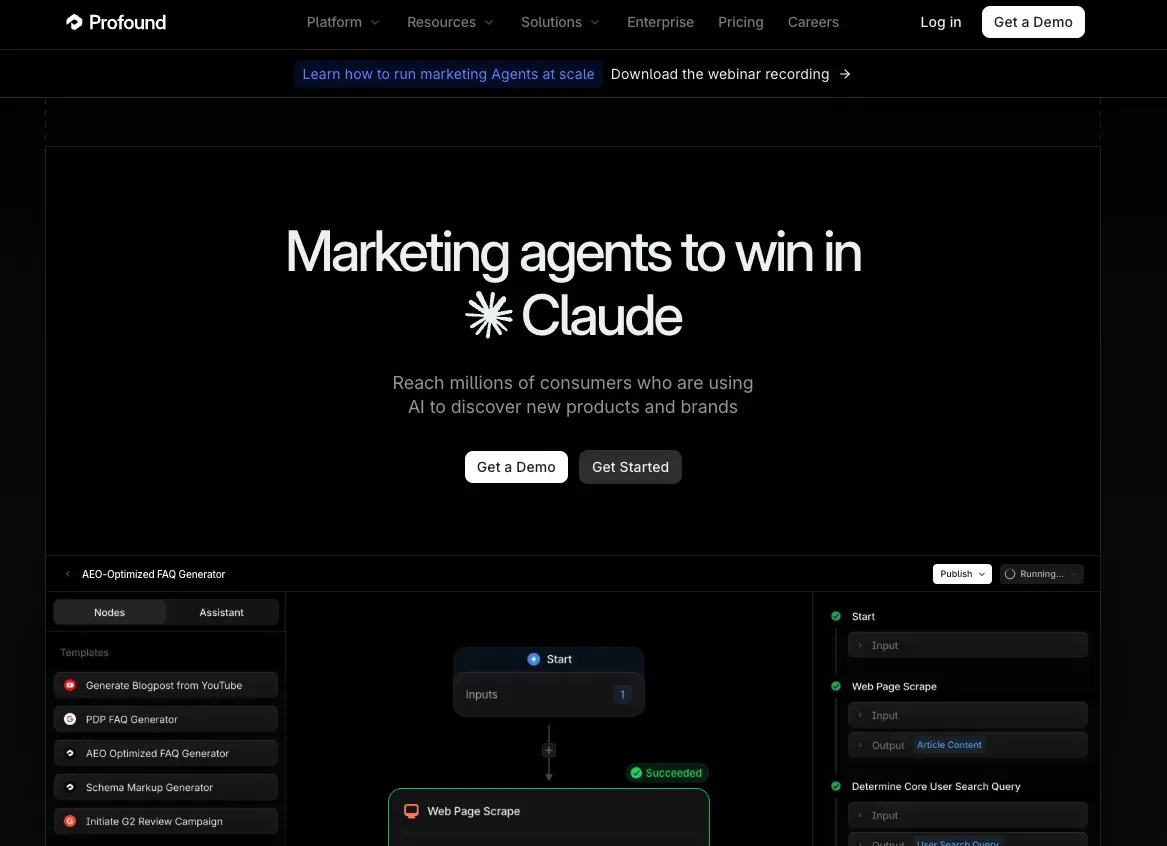
Best for: Enterprise teams with budget for the category leader and a need for dashboard polish, sentiment analysis, and content briefs in one platform.
Profound is the category’s commercial leader and the G2 Winter 2026 AEO Leader, backed by a $96M Series C at a $1B valuation. It captures data from 10+ AI engines — ChatGPT, Claude, Perplexity, Google AI Overviews, Gemini, Copilot, DeepSeek, Grok, Meta AI, and Google AI Mode — and exposes the data through three primary products: an AI Visibility Dashboard, a Conversation Explorer for real-time AI search volume, and Agents that draft content briefs from observed citation patterns.
At platform scale, Profound processes 5M+ citations daily and tracks 1.5B+ historical AI conversations. The depth shows up in the reporting: sentiment analysis, citation context, and competitor positioning are all surfaced natively rather than computed by the user.
Pros
- Widest engine coverage on the market, including engines (DeepSeek, Meta AI) that most competitors skip.
- Polished UI built for SEO leads and execs, not engineers.
- Agent Analytics tracks how AI bots interpret your content, not just whether they cite it.
Cons
- API access lives in the higher tiers; the Starter plan is dashboard-only.
- Pricing sits at the premium end of the AEO category — worth budget-checking against pure citation-tracking needs.
Pricing. Starter at $99/month, Growth at $399/month, Enterprise typically $1,500–$2,000+/month depending on platform coverage and seat count.
2. AthenaHQ — best for revenue attribution
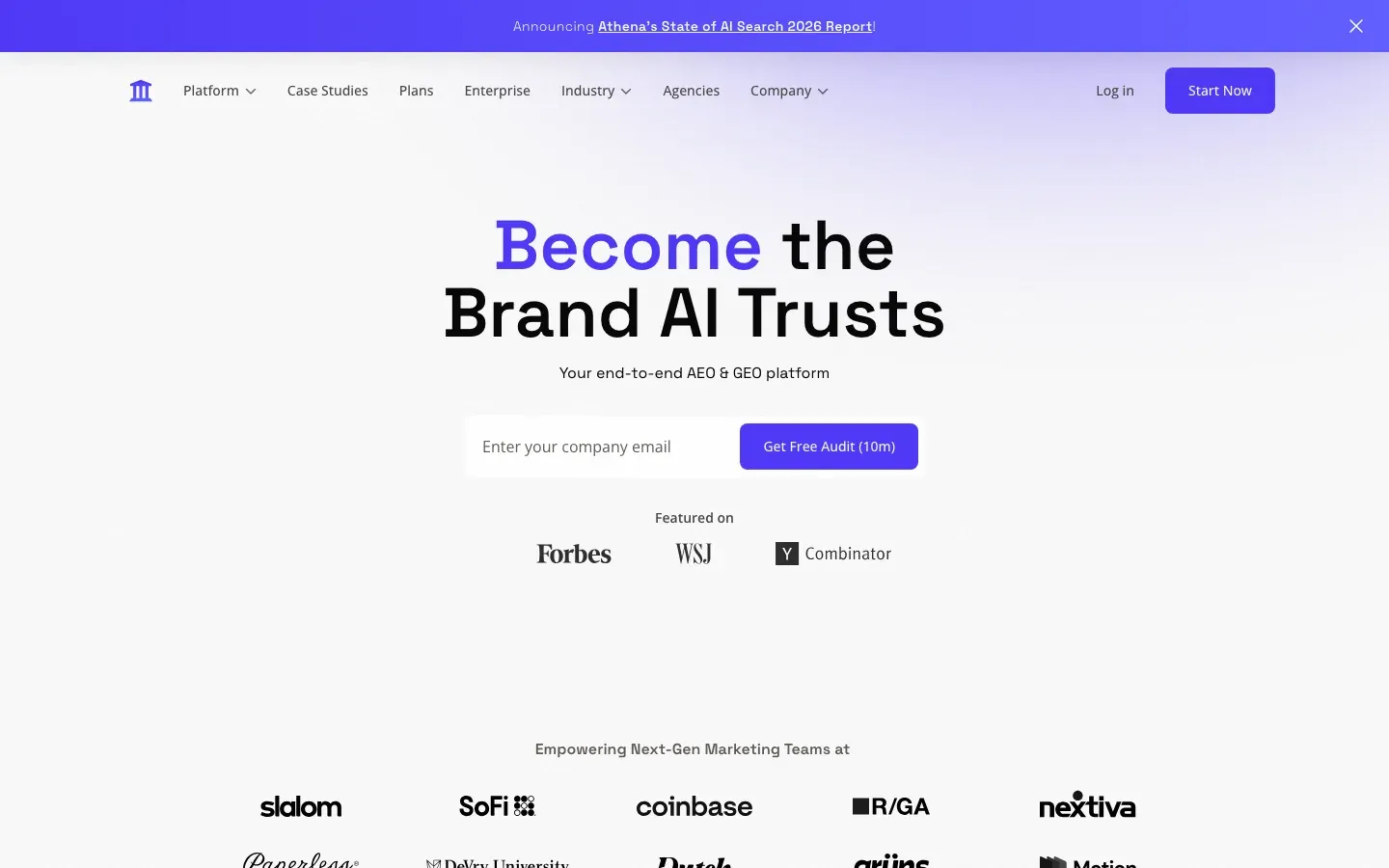
Best for: Mid-market and enterprise teams that need to tie AI visibility to revenue and competitor displacement, not just citation counts.
AthenaHQ emerged from stealth in 2025 with a founding team out of Google Search and DeepMind, Y Combinator backing, and 90+ Fortune 500 customers per its own comparison page. The product is built around the Athena Citation Engine (ACE) and a proprietary Query Volume Estimation Model that maps citation share to estimated downstream revenue impact.
The revenue framing is the differentiator. Most tools tell you whether you’re cited; AthenaHQ tries to tell you what that citation is worth.
Pros
- Revenue-attribution modeling is real and specifically valuable for B2B teams justifying AI SEO budget to finance.
- Strong dashboard ergonomics aimed at SEO leads who present to executive stakeholders.
- Competitor displacement reporting (which competitor took your citation slot, on which query, when).
Cons
- Engine coverage focused on the big four (ChatGPT, Perplexity, Gemini, AI Overview) rather than long-tail engines like DeepSeek or Grok.
- Dashboard-first product; less programmatic flexibility than API-first tools.
Pricing. Starting at $295/month.
3. Peec AI — best simple visibility tracker
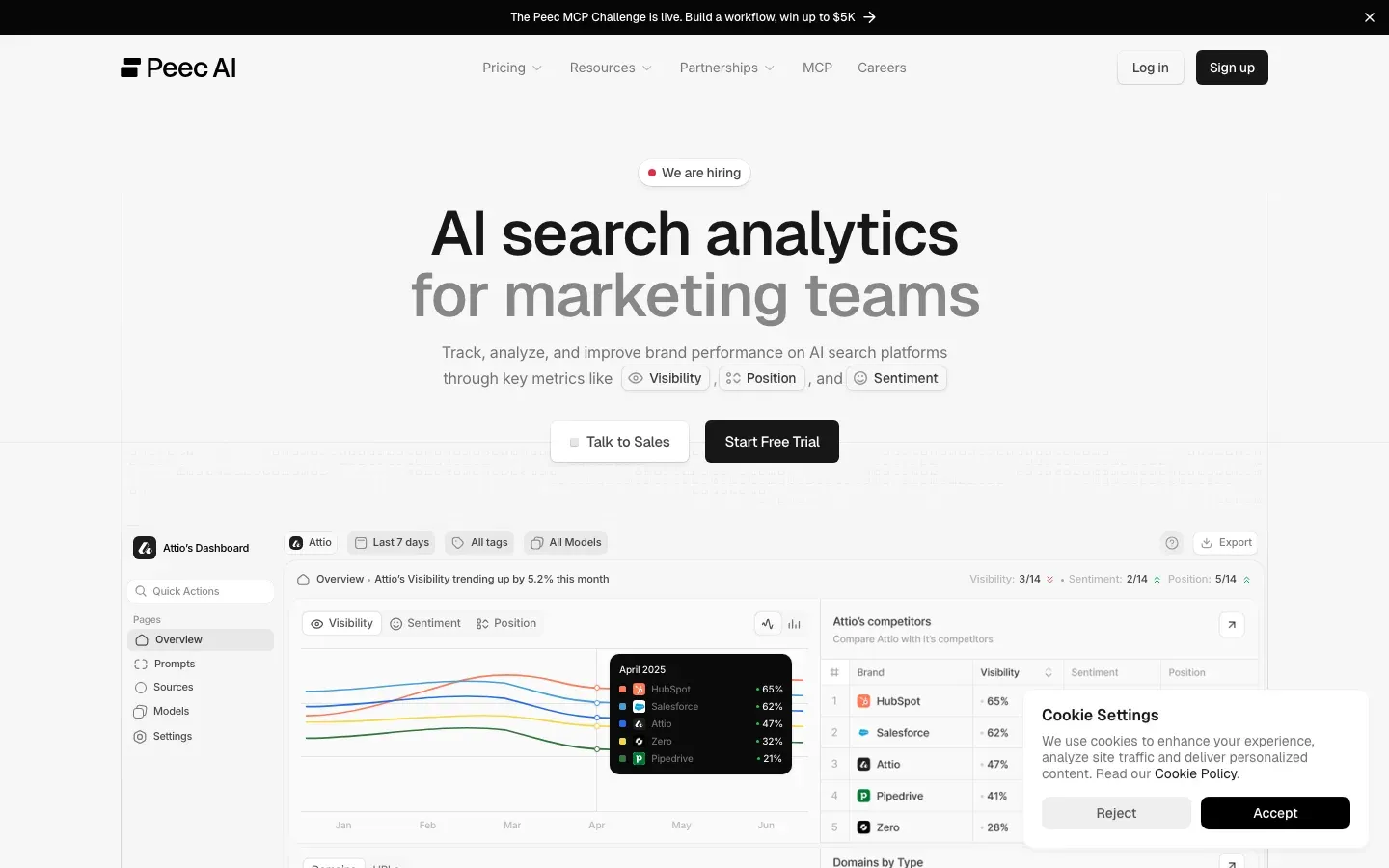
Best for: Small and mid-market teams that want repeatable LLM visibility tracking without the configuration overhead of an enterprise platform.
Peec AI is the category’s “just works” pick. You define a query set, the tool monitors brand appearance over time, surfaces competitor comparisons, and ships shareable reports. No complex setup, no learning curve, no enterprise sales cycle. It covers ChatGPT, Perplexity, Gemini, Google AI Overview, and Copilot.
The trade-off is depth. Reporting is mention-frequency oriented rather than citation-URL oriented, which is fine for monitoring trends but limiting if you want to build custom analyses on top.
Pros
- Lowest setup friction in the visibility-tracking category. Typical time-to-first-data under an hour.
- Clean, focused UI aimed at non-technical users.
- Competitive pricing for the engine coverage, starting at €85/month (~$95).
Cons
- Reports mention frequency rather than parsed citation URLs.
- API access is constrained at the entry tier; teams needing deep BI integration may want the higher plans.
- Built for repeatable visibility tracking rather than custom analytical workflows.
Pricing. €85–€505/month (~$95–$565) depending on prompt volume and platform coverage.
4. Brandlight — best enterprise-only visibility platform
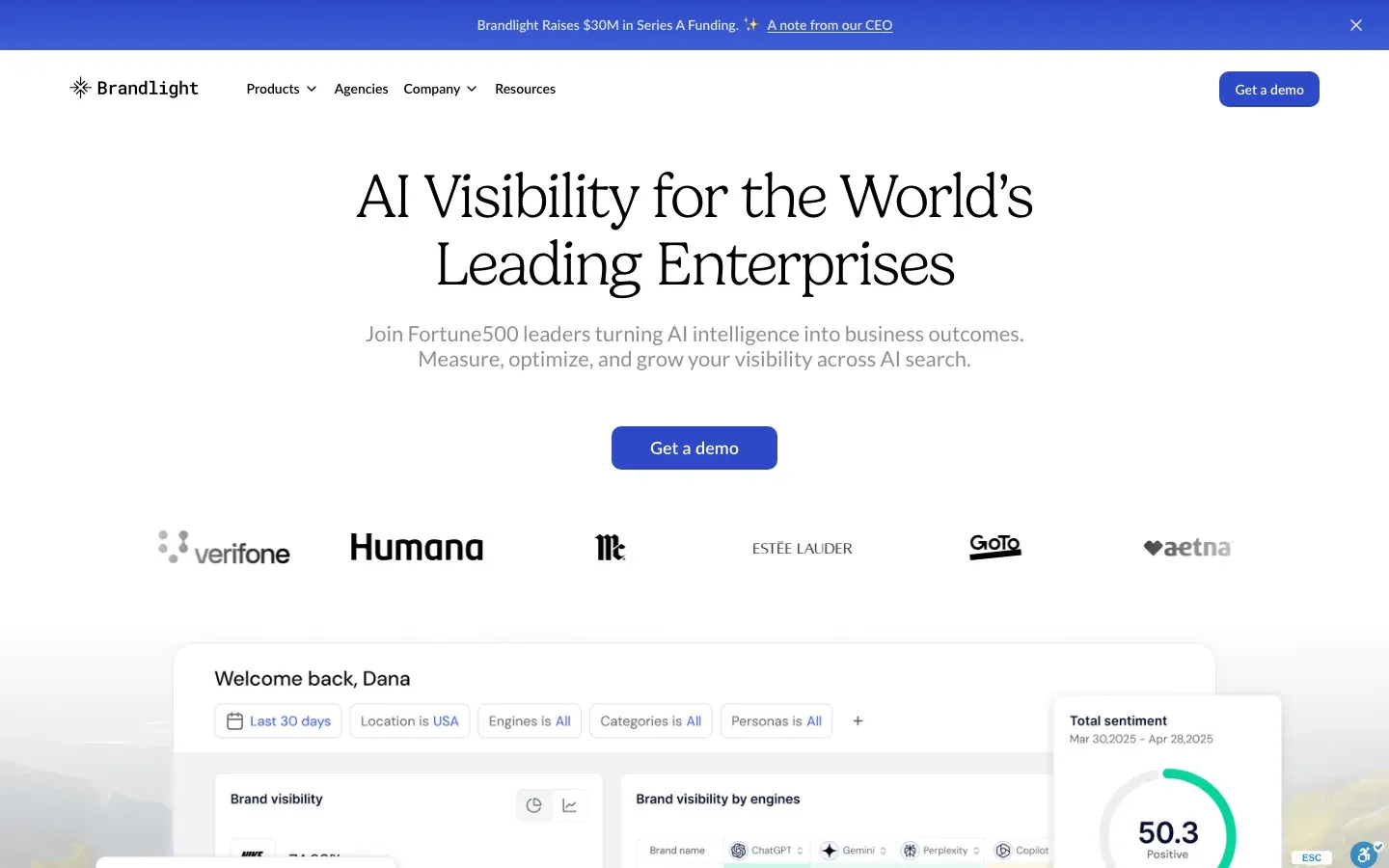
Best for: Enterprise brands prioritizing compliance, white-glove service, and influence-the-answer workflows rather than self-serve tracking.
Brandlight positions explicitly as an “enterprise AI visibility platform” for iconic brands. The product analyzes brand mentions, sentiment, citations, and competitive positioning across ChatGPT, Gemini, Claude, and Perplexity, with the differentiator being influence workflows — programmatic outputs aimed at moving brand description, not just measuring it.
Pricing is custom and unpublished — Brandlight requires a contact form for any quote. That alone narrows the audience to large enterprise.
Pros
- Strong sentiment and brand-description quality analysis, not just citation counts.
- White-glove onboarding and managed-service options.
- Influence layer (content recommendations tied to specific citation gaps) is more actionable than pure tracking.
Cons
- No published pricing. Enterprise-only, not viable for SMB/mid-market.
- Engine coverage narrower than Profound; no DeepSeek, Grok, or Meta AI.
- Dashboard-only — no programmatic data access advertised.
Pricing. Custom (contact required), typically enterprise-tier.
Category 2: AI content optimization
These tools optimize the content itself rather than measuring its citation. The category predates the AI-search shift — Surfer, Clearscope, and MarketMuse have been around since the late 2010s — but each has added AI-specific features and benchmarking. Pick based on whether your bottleneck is content quality (these tools help) or AI citation (Category 1 is the right shelf).
5. Surfer SEO — best mature content optimizer
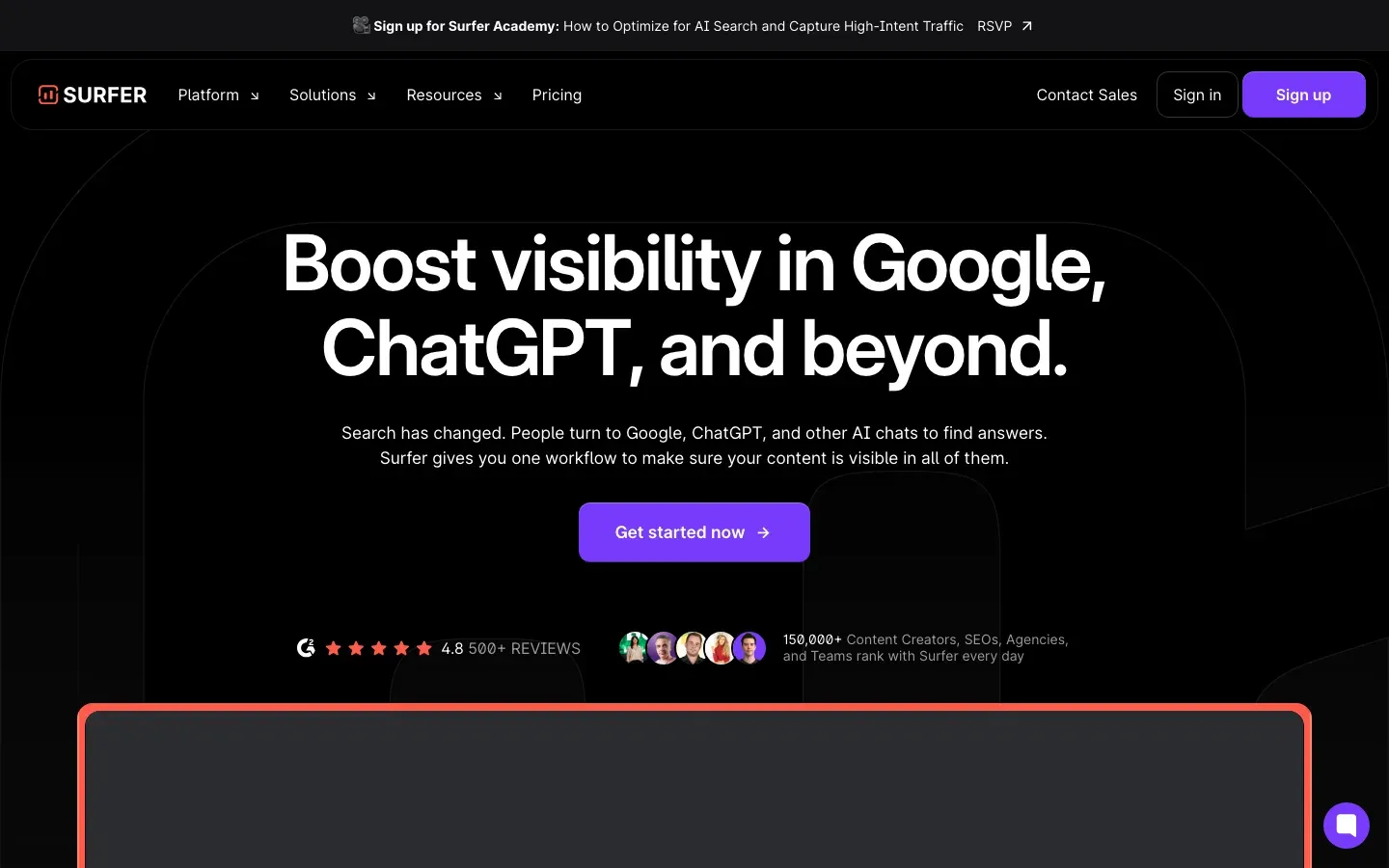
Best for: Content teams whose primary output is long-form articles targeting Google rankings, who want real-time NLP feedback during writing.
Surfer’s core product is an NLP-driven content editor that scores your draft against what top-ranking pages include. The AI Humanizer rewrites content drafted by other AI tools, and the Content Audit module flags pages losing ground on their target terms.
A category note worth being direct about: Surfer optimizes for ranking on Google’s classic SERP. It doesn’t track whether your brand appears in ChatGPT answers or Perplexity citations. The correlation between classic ranking strength and AI citation exists but is weaker than vendors imply.
Pros
- Proven workflow with strong Google Docs integration.
- Mature NLP scoring surfaces term gaps that aren’t obvious from keyword research alone.
- Strong agency tier with multi-client management.
Cons
- Scope is classic SERP and content optimization, not multi-engine AI citation tracking — pair with a Category 1 tool if both surfaces matter.
- The classic SERP is becoming a smaller share of total visibility as AIO presence grows, so the ROI math depends on your traffic mix.
Pricing. $89/month mid-tier; agency tiers higher.
6. Frase — best budget AI content tool
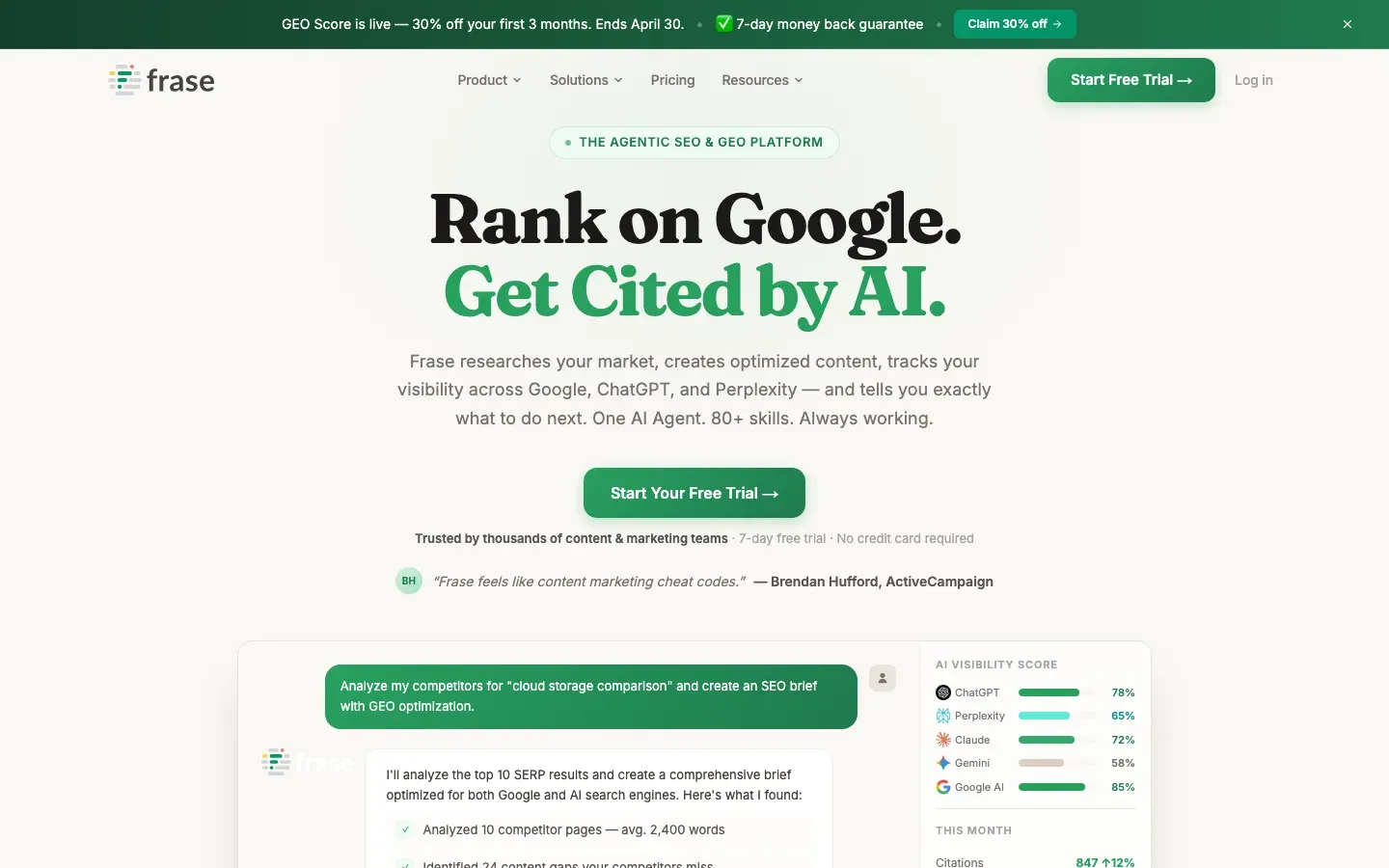
Best for: Solo creators and small teams who want a dual SEO + GEO scoring layer without committing to Surfer-level pricing.
Frase offers what its team calls a “dual SEO + GEO scoring system” — content briefs that score against both classic ranking signals and AI-citation likelihood signals (extractability, FAQ structure, entity strength). Notably, Frase’s own research found FAQ-marked pages were 3.2x more likely to appear in Google AI Overviews, and that finding is baked into the scoring layer.
At $15/month for Solo, it’s the easiest way to start producing content tuned for both SERP and AI surfaces without a real investment.
Pros
- Cheapest credible entry into AI-aware content optimization.
- The dual scoring approach is unique in the budget tier.
- Strong content-brief generation with research integrated into the workflow.
Cons
- Less mature than Surfer or Clearscope on raw NLP scoring depth.
- No AI citation tracking — it scores content for AI extractability, doesn’t measure if the content is actually cited.
- Higher tiers needed for team workflows and unlimited usage.
Pricing. $14.99/month (Solo) to $44.99/month (Team).
7. MarketMuse — best for topic-cluster planning
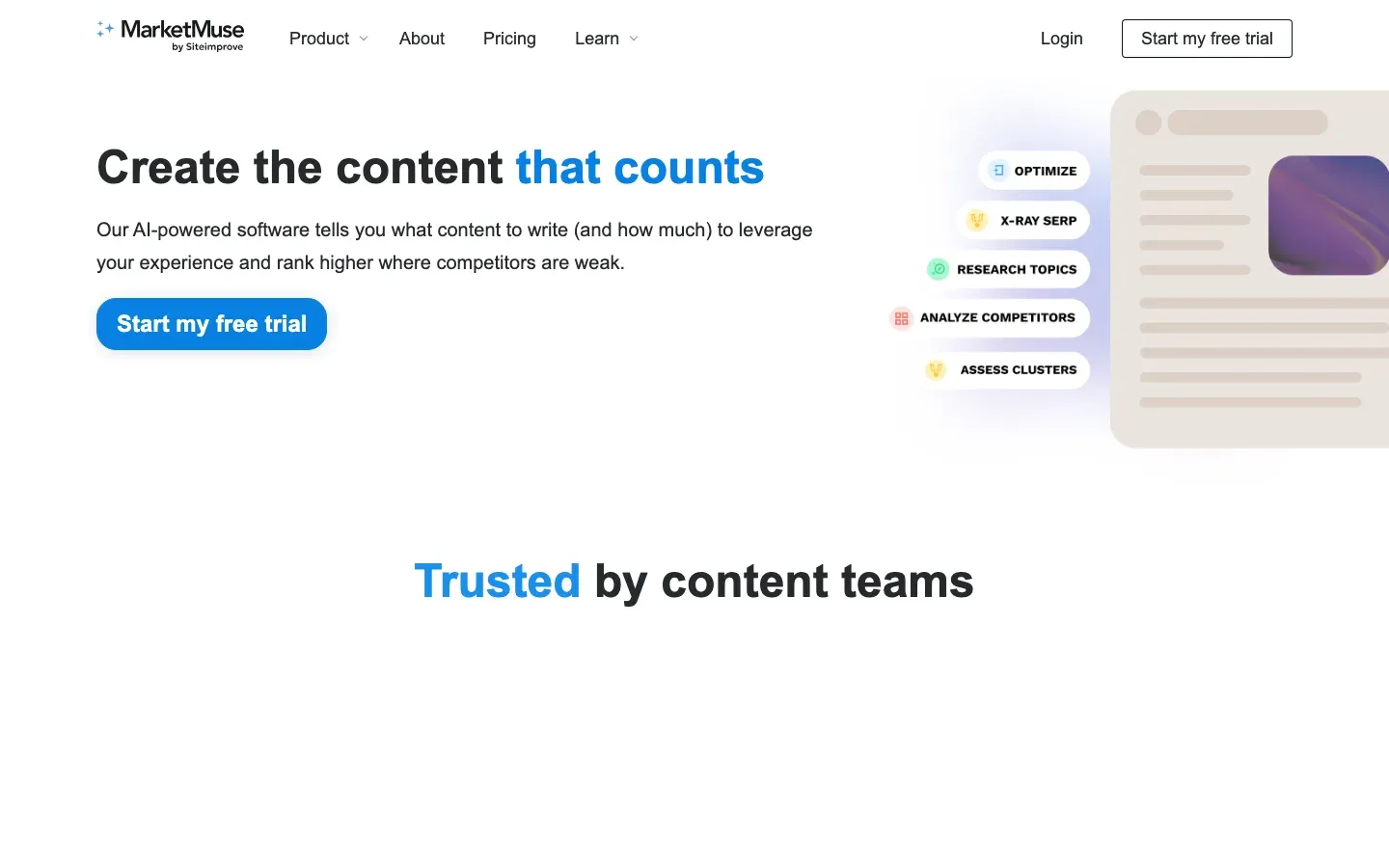
Best for: Teams managing large content libraries who need to plan topical authority across clusters, not just optimize individual pages.
MarketMuse goes deeper on topic modeling and content strategy than any other tool in this category. Its standout feature is the Personalized Difficulty score — an estimate of how hard it will be for your specific domain to rank for a given keyword based on your existing authority. That domain-aware framing is rare and useful.
For AI SEO specifically, the strategy is indirect: topical authority across a cluster correlates with the entity-strength signal that drives AI citation per Ahrefs’ analysis of 75,000 brands.
Pros
- Personalized Difficulty score is genuinely useful for teams allocating limited content budget.
- Best-in-class topic-cluster planning and gap analysis.
- Free tier exists for evaluation.
Cons
- Strategic-planning focus means slower time-to-content than Surfer or Frase.
- No direct AI citation tracking.
- The “Strategy” plan pricing ($499/month) puts the full feature set out of reach for small teams.
Pricing. Free; paid plans $99/month (Optimize), $249/month (Research), $499/month (Strategy).
8. Clearscope — best premium content scorer
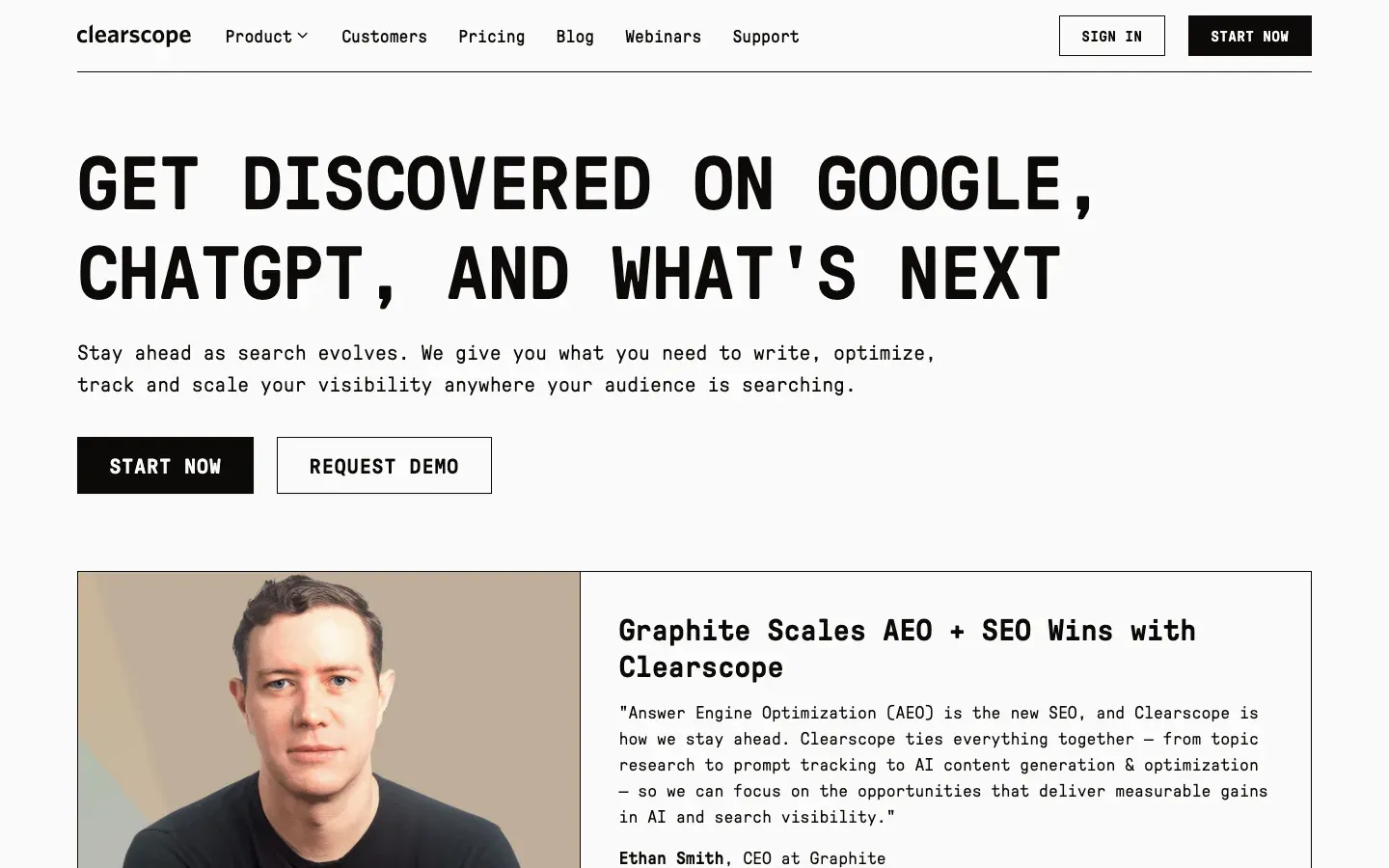
Best for: Enterprise content teams that want premium NLP scoring, unlimited seats, and the editorial discipline a higher price point enforces.
Clearscope sits at the top of the content-optimization price tier. The scoring model is mature, the interface is clean, and the unlimited-seats pricing model removes the per-user math that plagues mid-market alternatives. The trade-off: it’s more expensive than Surfer or Frase for what is — in 2026 — a similar core feature set.
Pros
- Unlimited seats included even at the Essentials tier.
- Best ergonomics for editor-driven workflows where content goes through multiple review rounds.
- Mature integrations (Google Docs, WordPress, Trello).
Cons
- No AI citation tracking layer at all.
- ~2x the price of Surfer for comparable core functionality.
- Less differentiation in 2026 than the price point implies.
Pricing. $170/month (Essentials).
Category 3: Full SEO suites with AI features
The legacy SEO platforms — Semrush, Ahrefs — have added AI features as add-on toolkits rather than rebuilt their products around AI search. The bet is that bundling traditional SEO data with AI visibility reduces tooling overhead for teams already paying them. The drawback is that AI features inside a 60-product suite tend to lag specialist tools on depth.
9. Semrush (with AI Visibility Toolkit) — best bundled all-in-one
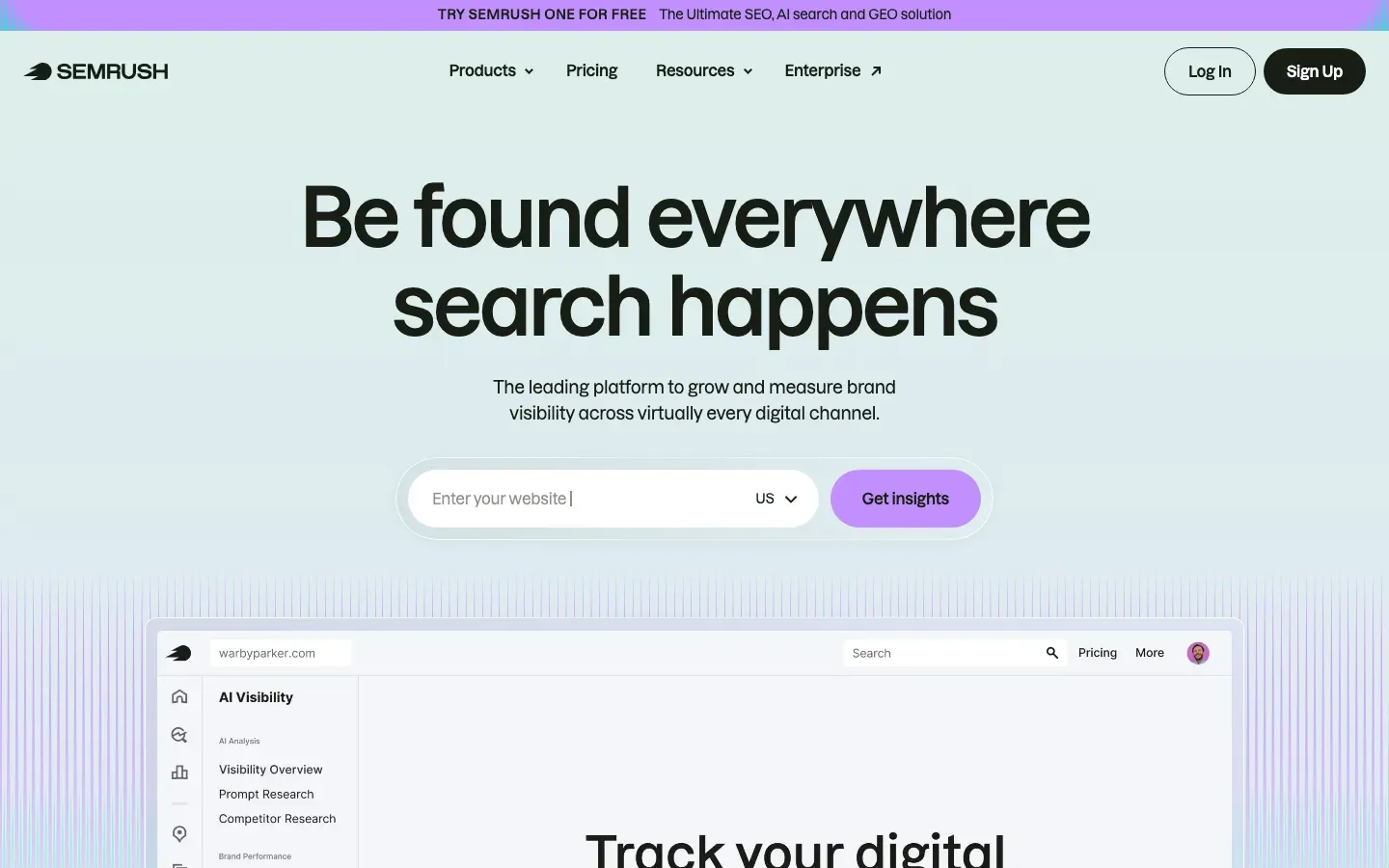
Best for: Teams already on Semrush who want a “good enough” read on AI visibility without adding a second tool.
Semrush’s AI Visibility Toolkit tracks over 100 million prompts across ChatGPT, Google AI Mode, Perplexity, and AI Overviews in six regions. The data is real, the dashboard is integrated with the rest of the Semrush suite, and the bundled bill is appealing for teams already paying for Semrush at the Pro tier or above.
The AI Visibility reporting is sampled and frequency-oriented — useful for trend monitoring inside the broader Semrush workflow. Teams that need parsed citation URLs for custom analytics should pair it with a Category 1 tool.
Pros
- One vendor and one bill for traditional SEO plus AI visibility.
- Best-in-class keyword and backlink data underneath the AI features.
- Strong Enterprise AIO tier for very large accounts.
Cons
- AI Visibility reports trend-level frequency rather than citation-URL granularity.
- AI features require the higher tiers; the entry-level Pro plan doesn’t include the AI Visibility Toolkit.
- Engine coverage focused on the most common surfaces.
Pricing. Starts around $140/month for the SEO base; AI Visibility features typically require Guru ($289/month) or higher.
10. Ahrefs Brand Radar — best authority-driven AI strategy
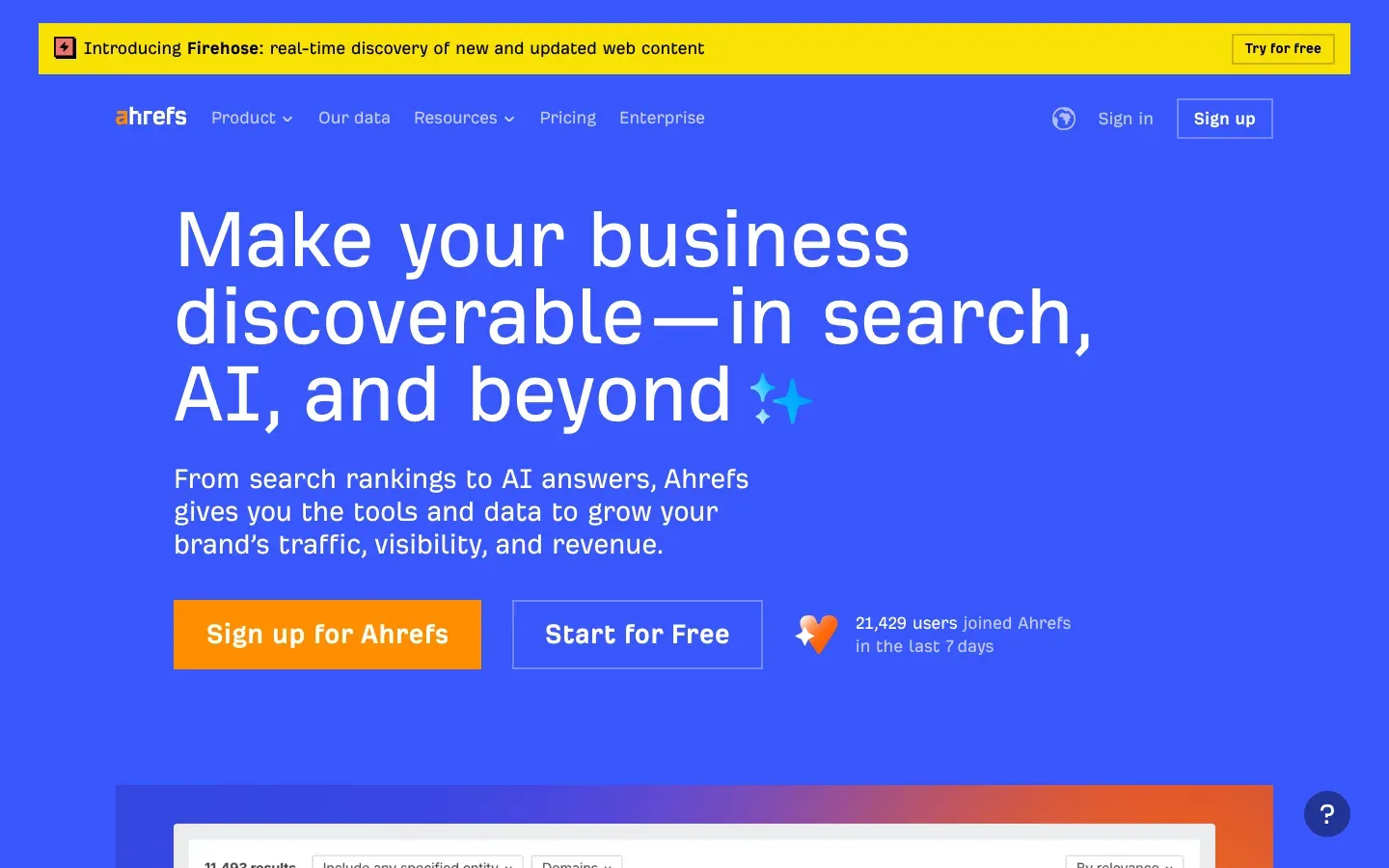
Best for: SEO leads already living in Ahrefs who want to layer in AI citation awareness without changing their core workflow.
Brand Radar monitors brand visibility across 243M+ monthly prompts derived from real “People Also Ask” data, covering six AI platforms: ChatGPT, Perplexity, Gemini, Copilot, Google AI Overviews, and Google AI Mode. The thesis behind the product is defensible: AI engines cite authoritative pages, and authority correlates with the same backlink signals Ahrefs has measured for a decade.
The shipping product is newer than competitors and the coverage depth reflects that, but the integration with Ahrefs’ rest-of-suite is the strongest in the legacy-SEO-plus-AI category.
Pros
- Best-in-class backlink data combined with AI tracking in one workflow.
- 190M+ search-backed prompts is the largest prompt corpus among legacy suites.
- The authority-to-citation thesis is supported by Ahrefs’ own 75,000-brand correlation study — branded web mentions and YouTube mentions show the highest correlation with AI visibility.
Cons
- Brand Radar is newer than purpose-built citation trackers; the breadth of integration is the trade-off for depth on any single AI surface.
- API access for the AI features begins at the Advanced tier ($449/month).
- Best fit for teams already invested in the Ahrefs workflow; standalone evaluations may find Category 1 tools more focused.
Pricing. Lite $129/month; API access from Advanced tier at $449/month.
11. Search Atlas — best for AI-first agencies
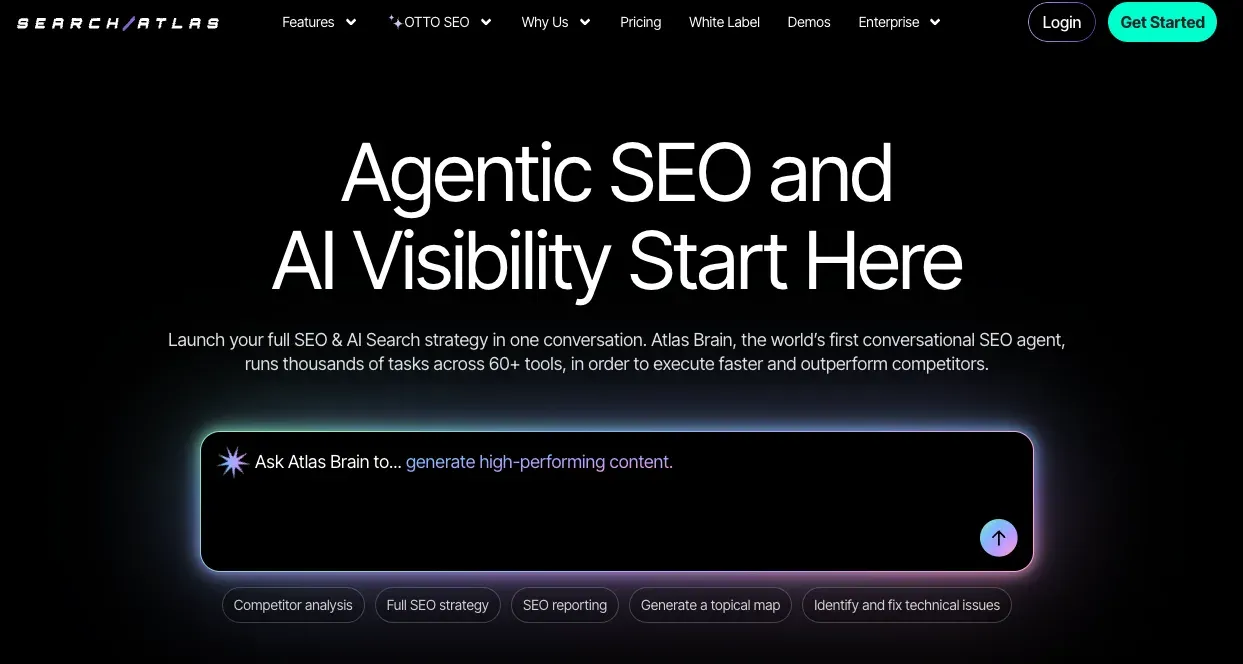
Best for: Agencies that want a consolidated SEO + AI SEO platform with multi-client workflows under one bill.
Search Atlas positions explicitly as “AI SEO software,” and there’s real search demand around that framing (~3,600 monthly searches for “search atlas ai seo software”). It bundles content generation, keyword research, backlink analysis, and AI engine tracking into a single platform aimed at agencies managing multiple client accounts.
The trade-off is breadth over depth. The product spans more surfaces (content, keywords, backlinks, AI tracking) at this price point than most specialist tools, with AI Overview coverage as the strongest pillar of the AI feature set.
Pros
- Agency-optimized workflow with multi-client management built in.
- Competitive pricing for the full-stack bundle.
- AI Overview tracking is genuinely useful at this price tier.
Cons
- The all-in-one model may create overlap with tools you already pay for.
- Best fit for agency teams; teams needing deep API-level citation data should pair with a Category 1 tool.
Pricing. Starter tier around $99/month; agency tiers higher.
How to choose: a working decision tree
The 11 dashboards above don’t actually compete with each other; they compete with the dashboard you’d pair them with. Most teams end up with one citation tracker plus one content tool, and the legacy suite they were already paying for.
Use this decision tree:
- Need enterprise dashboard + sentiment + content briefs in one product, and the budget supports it? Profound.
- Need AI visibility tracking tied to estimated revenue impact for executive reporting? AthenaHQ.
- Small team wanting low-friction LLM visibility tracking without complex setup? Peec AI.
- Iconic brand prioritizing white-glove service and influence workflows? Brandlight (custom pricing).
- Producing long-form content and primary bottleneck is content quality, not citation tracking? Surfer SEO, Frase (budget), or Clearscope (premium).
- Managing a large content library and need topic-cluster planning? MarketMuse.
- Already paying for Semrush or Ahrefs and want a “good enough” AI visibility read inside the existing workflow? Stick with the AI add-on. The integrated billing math typically beats a second tool.
- Agency consolidating multi-client SEO + AI tracking under one bill? Search Atlas.
The honest framing for an SEO team in 2026: you almost certainly need two tools, not one. A specialist citation tracker plus a content optimizer (or a legacy suite for content). There is no all-in-one platform that ships best-in-class on both surfaces yet, and the teams pretending otherwise tend to be teams that haven’t run real citation share queries against ground truth.
Building your own tooling on top instead?
If you’re an engineer who wants raw access to AI engine data — not a dashboard — that’s the infrastructure-layer question, and it’s a different product category from the 11 dashboards above. cloro’s AI SEO API is the underlying API: parsed responses for ChatGPT, Perplexity, Gemini, Copilot, Google AI Overview, AI Mode, and Google SERP through one endpoint family. Several of the dashboards above pull their raw data from this kind of layer. 500 free credits is enough to evaluate whether the API layer fits before committing to a dashboard purchase.
For the dashboard-specific deep dive (12 LLM visibility tools compared in detail), see our LLM visibility tracking tools roundup. For the conceptual foundation — what AI SEO is and the eight retrieval factors that drive citations — start with our AI SEO pillar.
Frequently asked questions
What is the best AI SEO tool in 2026?+
The best dashboard depends on which problem you're solving. For enterprise AEO with a polished dashboard, Profound leads the category (G2 Winter 2026 AEO Leader, $1B valuation). For mid-market visibility tracking with revenue-attribution modeling, AthenaHQ is the strongest pick. For AI-aware content optimization, Surfer SEO and Frase are the mature picks. Most teams end up running two products: one citation-tracking dashboard plus one content optimizer. If you're an engineer building a custom tool on top of raw AI engine data instead of buying a dashboard, that's the infrastructure-layer API question, not the dashboard question — different category entirely.
How is an AI SEO tool different from a regular SEO tool?+
Traditional SEO tools track ranking on Google's classic SERP. AI SEO tools track whether your brand appears inside AI-generated answers — ChatGPT responses, Perplexity citations, Google AI Overview content, Gemini summaries — across the nine surfaces that now mediate buyer research. Different signals, different optimization levers, different pricing models.
Are AI SEO tools worth it?+
Yes, if your audience uses ChatGPT, Perplexity, or Google AI Overview to research what you sell. AI Overviews trigger on roughly 48% of tracked queries per BrightEdge, and AI-referred visitors converted 31% better than classic organic by Holiday 2025 per Adobe Analytics. The conversion math justifies a $100–500/month tool inside the first quarter for most teams above a small handful of priority queries.
Can I do AI SEO without a paid tool?+
For fewer than ~20 queries, manual sampling in ChatGPT and Perplexity is viable. Above that, the data structures you'll build to track citation share, mention frequency, and competitor positioning are exactly what these tools provide off the shelf. A $100/month tool typically pays for itself within the first week of saved hours.
Do AI SEO tools work for non-English markets?+
Coverage varies sharply. Profound covers 10+ engines including DeepSeek and Meta AI in multiple languages. AthenaHQ supports global query sets through its dashboard. Semrush and Ahrefs have strong international SEO coverage but their AI features remain mostly English-first as of mid-2026. Verify regional support against your specific markets before committing.
How often should I run AI SEO tracking queries?+
Monthly is the floor for trend monitoring. Weekly is the standard cadence for competitive industries and for any team actively investing in AI SEO content. Daily is overkill outside of news or fast-moving topics — citation patterns inside AI engines don't update fast enough to justify the API spend, and you'll mistake noise for signal.
Related reading
LLM Visibility Tracking Tools 2026: 12 Tested
We tested 12 LLM visibility tracking tools on real brand-monitoring workflows across ChatGPT, Perplexity, Gemini, and Google AI Overview. What works, what doesn't.
What is AI SEO? 2026 Definition + Platforms
AI SEO is the practice of structuring content so AI engines like ChatGPT, AI Overviews, and Perplexity cite it as a source. Learn the retrieval factors that drive citations and the step-by-step implementation.

Best SERP API 2026: 8 Tools Tested + Priced
We tested 8 SERP APIs against AI Overviews, Custom Search JSON API closure, and n=100 pagination — see which handles AI search, which is cheapest at production volume, and which is stuck on the old SERP.