> ## Documentation Index
> Fetch the complete documentation index at: https://cloro.dev/docs/llms.txt
> Use this file to discover all available pages before exploring further.
# Get a Google shopping card product
> Get the product panel that a Google Search shopping card or a Google AI Mode product opens: merchant offers, specifications, reviews and images.
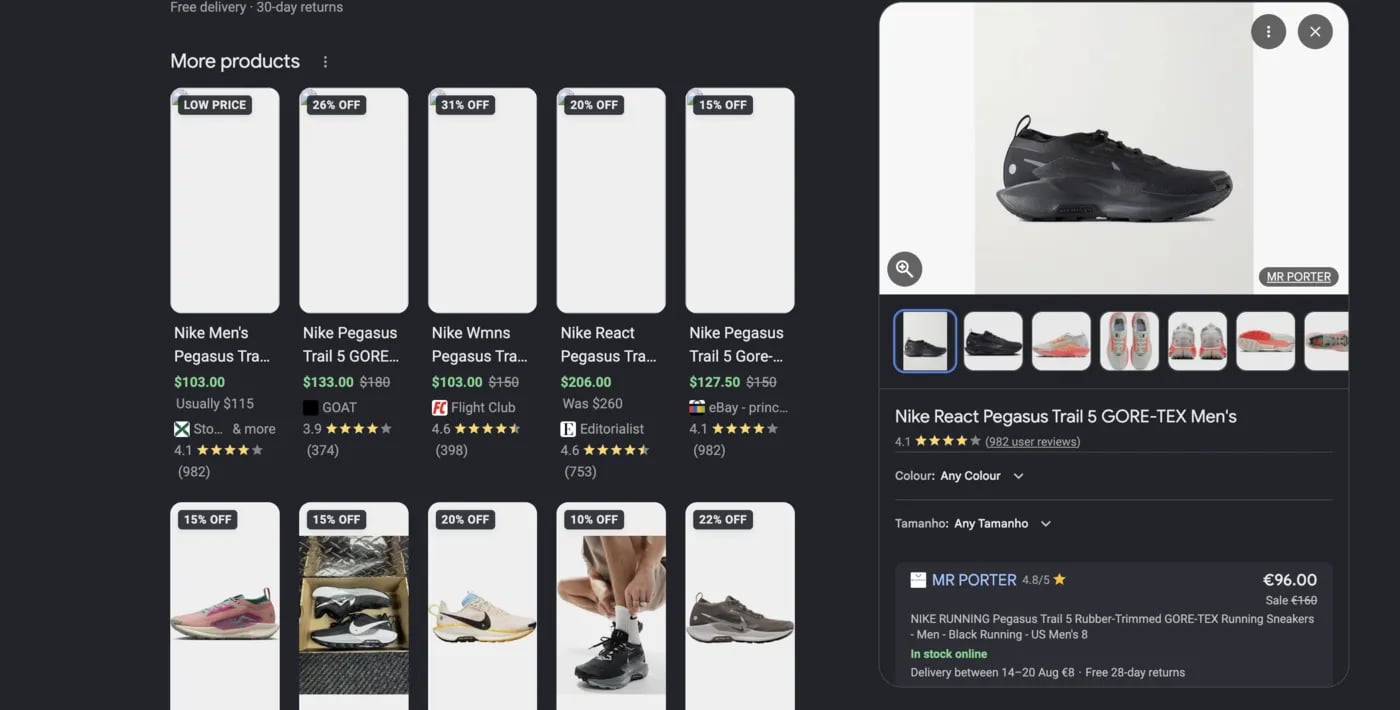
A [shopping card](/docs/api-reference/endpoint/google/shopping-cards) opens a Google product panel, not a merchant page, and it carries no product URL. The card's `productResultToken` gets you that panel. Google AI Mode shopping cards and inline products have the same token.
 ## Get a token
Send a [Google Search](/docs/api-reference/endpoint/monitor-google) request with `device: "desktop"` (the default). Cards on the first results page carry a token when Google serves them with a panel reference. A [Google AI Mode](/docs/api-reference/endpoint/aimode/product-results) request returns a token on each shopping card and inline product that links to a Google product viewer. The token adds no cost to either request.
```json theme={null}
{
"title": "ASICS Women's Gel-Nimbus 28",
"position": 1,
"productResultToken": "nuzK-QgAV8BqrZdwQJYZopzdoFhpvKr-N2_YDZevwzg",
"category": "More products",
"store": "DICK'S Sporting Goods"
}
```
A token expires **five minutes after the scrape that issued it**. Time in the async queue counts against those five minutes, for the search and for the product request. If your search ran async, its tokens can expire before you read the result. Use the token immediately, or scrape again.
## Get the product
```bash cURL theme={null}
curl -X POST "https://api.cloro.dev/v1/monitor/google/product" \
-H "Authorization: Bearer YOUR_API_KEY" \
-H "Content-Type: application/json" \
-d '{
"productResultToken": "nuzK-QgAV8BqrZdwQJYZopzdoFhpvKr-N2_YDZevwzg"
}'
```
```json Response theme={null}
{
"success": true,
"result": {
"productResults": [
{
"title": "Apple - Refurbished Excellent - iPhone 17 Pro 256GB 6.3\" 5G Fully Unlocked, Deep - Blue",
"brand": "Apple",
"rating": 4.5,
"reviews": "14K",
"stores": [
{
"name": "Best Buy",
"link": "https://www.bestbuy.com/product/apple-iphone-17-pro-256gb-6-3-5g-fully-unlocked-deep-blue/J7XLKFSPR8/sku/12337127?ref=212&loc=marketplace",
"price": { "value": 1080.0, "currency": "USD", "raw": "$1,080.00" },
"shipping": "Delivery between May 13 – 25 $16.49",
"condition": "Pre-owned",
"buyingOptions": ["Pre-owned", "In stock", "Delivery between May 13 – 25 $16.49"]
}
],
"specifications": {
"general": { "Screen Size": "6.3 inches", "Built-in Storage": "256 gigabytes" }
}
}
]
}
}
```
The request takes only the token. The token keeps the query, locale and location of the request that issued it, so you cannot change them.
It costs 1 credit plus the 2-credit [sync surcharge](/docs/guides/providers#sync-request-surcharge), and only when it succeeds. It uses a concurrency slot. For async, send `taskType: "GOOGLE_PRODUCT"` with `payload: { "productResultToken": "..." }` to [`POST /v1/async/task`](/docs/api-reference/endpoint/create-async-task) or the batch endpoint. Async costs 1 credit.
If you send the product request async, set a high [`priority`](/docs/guides/making-requests/async#request-prioritization) (for example `10`). The default priority is 1, so the task waits behind your other queued tasks and the token can expire before the task starts.
## Errors
The failure reason is in `error.details.errorType`. No error is charged.
| Status | `errorType` | Cause |
| - | - | - |
| `404` | `productResultTokenUnknown` | cloro did not issue this token. |
| `410` | `productResultTokenExpired` | The token is older than five minutes. Scrape again. |
| `502` | `googleProductUpstreamEmpty` | Google returned no product data. |
| `502` | `googleProductUnparseable` | cloro could not parse Google's response. |
| `502` | `googleProductPayloadLayoutChanged` | Google returned a panel layout that cloro does not support. |
A failed async task has `status: "FAILED"` and the same `errorType` in `response.error.details`.
## Product structure
The response has one entry in `productResults`, with the same shape as the [right-rail product results](/docs/api-reference/endpoint/google/product-results).
Each entry describes one product cluster and its merchant offers.
| Field | Type | Description |
| - | - | - |
| `title` | string | Product cluster title, as Google displayed it |
| `stores` | array | Merchant offers. See [store structure](#store-structure) |
| `aboutTheProduct` | object | `description` (Google's prose blurb) and `features` (bullets, when shown) |
| `specifications` | object | Spec tables grouped by category. See [specifications](#specifications) |
| `images` | array | `mainUrl` and `thumbnailUrl` per image, often identical |
Only `title` is guaranteed (Google Search entries also always carry `stores`) — anything Google's panel omits is left out of the object rather than sent as `null`. Panels can also carry `rating`, `reviews`, `variants`, `relatedProducts` and `userReviews`, emitted under those names when present, though most carry none of them.
### Specifications
A category name mapped to a flat set of spec key/value pairs:
```json theme={null}
{
"specifications": {
"general": {
"Brand": "Sennheiser",
"Noise cancellation": "Yes"
}
}
}
```
Category names and spec keys arrive in the **response language** — a `country: "MX"` request returns `{"general": {"Marca": "Sennheiser"}}`. Iterate the object; don't read a hard-coded key like `specifications.general.Brand`.
### Store structure
| Field | Type | Description |
| - | - | - |
| `name` | string | Merchant name (e.g. `"Amazon"`) |
| `link` | string | Merchant product URL, passed through from Google verbatim |
| `price` | object | See [price shape](#price-shape). Omitted entirely when the displayed text can't be parsed |
| `installments` | string | Installment terms as displayed (e.g. `"for 24 mo, $0 now, $798.96 total"`) |
| `description` | string | Merchant's listing title, naming the exact SKU sold (e.g. `"iPhone 17 256GB White - Apple"`) — unlike `title`, which names the product overall |
| `buyingOptions` | array | Merchant badges in display order — stock status, rating, delivery promise, returns window. Google varies these per merchant and locale, so they stay an unparsed list of strings |
| `logo` | string | Merchant logo URL |
| `shipping` | string | Shipping cost or promise as displayed |
| `condition` | string | Item condition (e.g. `"New"`, `"Refurbished"`) |
| `rating` | number | Merchant rating |
| `reviews` | string | Merchant review count, abbreviated (e.g. `"384"`, `"2.3k"`) |
| `redirectLink` | string | Google's `/goto` redirect for `link`, when Google served one. See [redirect links](/docs/api-reference/endpoint/google/resolve-goto) |
Expect the first six on most offers and the rest only occasionally. Everything beyond `name` is optional and omitted when absent — Google shows different combinations per merchant, so an "Out of stock" listing may have no price or link at all.
`link` is not validated against the cluster. Google occasionally serves a merchant URL for an unrelated SKU, so an offer's link can point at a different product than its `description` names. Verify against `description` if link correctness matters.
### Price shape
| Field | Type | Description |
| - | - | - |
| `value` | number | Parsed numeric price; always present when `price` is emitted. On installment offers this is the monthly payment |
| `currency` | string | ISO 4217 code (e.g. `"USD"`, `"BRL"`, `"MXN"`, `"AED"`, `"JPY"`), or the displayed token verbatim when cloro can't map it. See [currency codes](#currency-codes) |
| `raw` | string | Visible price text verbatim (e.g. `"$149.99"`) |
`currency` here is an **ISO code** (`"USD"`), while [shopping cards](/docs/api-reference/endpoint/aimode/shopping-cards#price-and-oldprice) carry the symbol as displayed (`"$"`) and [inline products](/docs/api-reference/endpoint/aimode/inline-products#price-and-oldprice) carry either, depending on the data Google supplies. Normalize before comparing across surfaces.
### Currency codes
cloro maps the currency token Google displays next to the price to its ISO 4217 code. Multi-character and word tokens are recognized, so `"R$ 5.597,99"` returns `"BRL"`, `"MXN 19,499.00"` returns `"MXN"`, and `"3,399.00 د.إ"` returns `"AED"`. Yen written as `¥`, `¥` or `円` returns `"JPY"`.
A bare `$` doesn't name a market on its own, because Google writes US, Canadian and Australian offers the same way. On [AI Mode](/docs/api-reference/endpoint/aimode/product-results), cloro resolves a bare `$` from the request `country`: `CA` returns `"CAD"`, `AU` returns `"AUD"`, `NZ` returns `"NZD"`, `SG` returns `"SGD"`, `HK` returns `"HKD"`, and any other country returns `"USD"`. On [Google Search](/docs/api-reference/endpoint/google/product-results), a bare `$` always returns `"USD"`.
An explicit token always takes priority over the request country. A `country: "CA"` request that gets an offer displayed as `"R$ 5.597,99"` still returns `"BRL"`.
## OpenAPI
````yaml api-reference/openapi.json POST /v1/monitor/google/product
openapi: 3.1.0
info:
title: cloro
description: >-
API for monitoring AI responses across different providers and regions. One
request returns the engine's answer as structured JSON: parsed text, cited
sources, brand entities, shopping results, and ads, geo-targeted by country;
coverage varies by provider (`GET /v1/countries?model=` lists it).
## Authentication
Send your API key as `Authorization: Bearer `. Keys are self-serve from
the [dashboard](https://dashboard.cloro.dev/api-keys) and every account
starts on a free tier of 500 monthly credits. One key grants every endpoint;
there are no per-key scopes today.
## Versioning and deprecation
The version is in the URL path. Every endpoint lives under `/v1/`; there is
no version header or query parameter.
Within a version, changes are additive: new endpoints, new optional request
fields, and new response fields can appear at any time. A client must ignore
response fields it does not recognize. A breaking change gets a new version
path (`/v2/`) rather than reusing an existing one.
A deprecated endpoint says so in its own responses, not only in a changelog:
`Deprecation` (RFC 9745) carries the date the deprecation took effect,
`Sunset` (RFC 8594) the date the endpoint stops responding, and a `Link`
header with `rel="deprecation"` points at the replacement. There is a
minimum of six months between the two dates for any generally available
endpoint. Nothing is deprecated today.
## Rate limits
Every authenticated response carries `X-RateLimit-Limit` and
`X-RateLimit-Remaining`, so a client can self-throttle from the response it
already has. Scrape endpoints (`/v1/monitor/*` except
`/v1/monitor/google/goto`) also send the `X-Concurrency-*` headers once a
request passes validation, and the `X-Credits-*` headers on a `200`. Every
response carries `X-Request-ID` and `X-Latency-Ms`.
A `429` has one of three codes: `RATE_LIMIT_EXCEEDED` (one-second window,
clears almost immediately), `CONCURRENCY_LIMIT_EXCEEDED` (scrape endpoints;
clears when your in-flight jobs finish) or `QUEUE_LIMIT_EXCEEDED` (async
submission; clears as queued tasks start processing). None carries
`Retry-After`, and the IETF `RateLimit-*` header names are not sent.
## Errors
Every 4xx and 5xx response uses the `Error` envelope: `{ "success": false,
"error": { "code", "message", "details", "timestamp" } }`. `error` is always
an object. Branch on `error.code`, a stable machine-readable identifier;
`message` is for a human reading a log, and `details` appears only when
there is extra context. A `503` (`SERVICE_UNAVAILABLE`) is temporary: retry
after the number of seconds in its `Retry-After` header.
license:
name: MIT
url: https://opensource.org/licenses/MIT
version: 1.0.0
contact:
name: cloro support
email: support@cloro.dev
termsOfService: https://cloro.dev/terms/
servers:
- url: https://api.cloro.dev
description: Production server
security:
- bearerAuth: []
paths:
/v1/monitor/google/product:
post:
summary: Get a Google shopping card product
description: >-
Return the product panel that a Google Search shopping card or a Google
AI Mode product opens: merchant offers, description, specifications,
reviews, images and related products. Send the `productResultToken` from
a Google Search `result.shoppingCards` card, or from a Google AI Mode
`result.shoppingCards` or `result.inlineProducts` entry.
Costs 1 credit, plus the 2-credit sync surcharge, and only when the
request succeeds. A token expires five minutes after the scrape that
issued it. If you send the request async, set a high `priority`, so that
the token does not expire in the queue.
operationId: getGoogleProduct
requestBody:
description: The token from a Google Search shopping card
content:
application/json:
schema:
$ref: '#/components/schemas/GoogleProductRequest'
required: true
responses:
'200':
description: The product panel for the token
content:
application/json:
schema:
$ref: '#/components/schemas/GoogleProductResponse'
'400':
description: Bad Request - Invalid parameters
content:
application/json:
schema:
$ref: '#/components/schemas/ValidationError'
'401':
description: Unauthorized - Invalid or missing API key
content:
application/json:
schema:
$ref: '#/components/schemas/AuthenticationError'
'403':
description: Forbidden - Insufficient credits or access denied
content:
application/json:
schema:
$ref: '#/components/schemas/ForbiddenError'
'404':
description: >-
Not Found - The token is not recognized (`error.details.errorType`:
`productResultTokenUnknown`)
content:
application/json:
schema:
$ref: '#/components/schemas/NotFoundError'
'410':
description: >-
Gone - The token has expired (`error.details.errorType`:
`productResultTokenExpired`). Scrape again for a new token.
content:
application/json:
schema:
$ref: '#/components/schemas/NotFoundError'
'429':
description: Too Many Requests
headers:
X-Concurrent-Limit:
description: Maximum number of concurrent requests allowed
schema:
type: integer
example: 10
X-Concurrent-Current:
description: Current number of concurrent requests
schema:
type: integer
example: 11
X-Concurrent-Remaining:
description: Number of remaining concurrent slots available
schema:
type: integer
example: 0
X-Credits-Remaining:
description: Number of credits remaining in user account
schema:
type: integer
example: 4
X-Credits-Charged:
description: Number of credits charged for this request
schema:
type: integer
example: 0
X-Latency-Ms:
description: >-
Server-side processing time for this request, in milliseconds.
Excludes network transit.
schema:
type: integer
example: 12
X-RateLimit-Limit:
$ref: '#/components/headers/XRateLimitLimit'
X-RateLimit-Remaining:
$ref: '#/components/headers/XRateLimitRemaining'
content:
application/json:
schema:
$ref: '#/components/schemas/ConcurrentLimitError'
'499':
description: Client Closed Request - Request was canceled
content:
application/json:
schema:
$ref: '#/components/schemas/CanceledError'
'500':
description: Internal Server Error
content:
application/json:
schema:
$ref: '#/components/schemas/InternalError'
'502':
description: >-
Bad Gateway - Google returned no product data, or a layout cloro
cannot parse
content:
application/json:
schema:
$ref: '#/components/schemas/ExternalServiceError'
components:
schemas:
GoogleProductRequest:
required:
- productResultToken
type: object
properties:
productResultToken:
description: >-
The `productResultToken` from a Google Search shopping card, or from
a Google AI Mode shopping card or inline product. The token carries
the query, locale and location of the request that issued it, so the
request takes no other field.
type: string
minLength: 1
maxLength: 512
example: nuzK-QgAV8BqrZdwQJYZopzdoFhpvKr-N2_YDZevwzg
additionalProperties: false
GoogleProductResponse:
type: object
required:
- success
- result
properties:
success:
type: boolean
example: true
result:
type: object
required:
- productResults
properties:
productResults:
type: array
description: >-
One entry: the product panel of the card that issued the token.
Same shape as Google Search and AI Mode `productResults`. Only
`title` is always present.
items:
$ref: '#/components/schemas/ProductResult'
ValidationError:
type: object
properties:
success:
type: boolean
example: false
error:
type: object
properties:
code:
type: string
example: VALIDATION_ERROR
message:
type: string
example: Request validation failed
details:
type: array
description: >-
One entry per invalid field. Sent on request-body validation
errors.
items:
type: object
properties:
field:
type: string
example: prompt
message:
type: string
example: Prompt cannot be empty
timestamp:
type: string
format: date-time
example: '2025-01-15T12:00:00.000Z'
AuthenticationError:
type: object
properties:
success:
type: boolean
example: false
error:
type: object
properties:
code:
type: string
enum:
- MISSING_API_KEY
- INVALID_API_KEY_FORMAT
- INVALID_OR_EXPIRED_API_KEY
example: MISSING_API_KEY
message:
type: string
example: Missing or invalid API key
timestamp:
type: string
format: date-time
example: '2025-01-15T12:00:00.000Z'
ForbiddenError:
type: object
properties:
success:
type: boolean
example: false
error:
type: object
properties:
code:
type: string
enum:
- INSUFFICIENT_CREDITS
example: INSUFFICIENT_CREDITS
message:
type: string
example: Insufficient credits
timestamp:
type: string
format: date-time
example: '2025-01-15T12:00:00.000Z'
NotFoundError:
type: object
properties:
success:
type: boolean
example: false
error:
type: object
properties:
code:
type: string
example: RESOURCE_NOT_FOUND
message:
type: string
example: Route not found
details:
type: object
properties:
id:
type: string
example: /v1/invalid-endpoint
timestamp:
type: string
format: date-time
example: '2025-01-15T12:00:00.000Z'
ConcurrentLimitError:
type: object
properties:
success:
type: boolean
example: false
error:
type: object
properties:
code:
type: string
example: CONCURRENCY_LIMIT_EXCEEDED
message:
type: string
example: Concurrency limit exceeded
details:
type: object
properties:
limit:
type: number
example: 10
timestamp:
type: string
format: date-time
example: '2025-01-15T12:00:00.000Z'
CanceledError:
type: object
properties:
success:
type: boolean
example: false
error:
type: object
properties:
code:
type: string
example: REQUEST_CANCELED
message:
type: string
example: Request was canceled by client
timestamp:
type: string
format: date-time
example: '2025-01-15T12:00:00.000Z'
InternalError:
type: object
properties:
success:
type: boolean
example: false
error:
type: object
properties:
code:
type: string
example: INTERNAL_SERVER_ERROR
message:
type: string
description: >-
For example `Maximum retries exceeded` when every attempt
failed, or `Internal server error` for an unexpected failure.
example: Maximum retries exceeded
timestamp:
type: string
format: date-time
example: '2025-01-15T12:00:00.000Z'
ExternalServiceError:
type: object
properties:
success:
type: boolean
example: false
error:
type: object
properties:
code:
type: string
example: EXTERNAL_SERVICE_ERROR
message:
type: string
example: goto resolve request failed
details:
type: object
properties:
service:
type: string
example: google
timestamp:
type: string
format: date-time
example: '2025-01-15T12:00:00.000Z'
ProductResult:
type: object
description: >-
One product cluster and its merchant offers. Only `title` is guaranteed;
anything Google's panel lacks is omitted, never sent as `null`.
required:
- title
properties:
title:
type: string
description: >-
Product cluster title, as Google displayed it. Empty when the page
has no product heading.
example: Apple iPhone 17
stores:
type: array
description: >-
Merchant offers. Always present on Google Search entries; omitted on
AI Mode when Google lists none.
items:
type: object
required:
- name
properties:
name:
type: string
description: Merchant name
example: Apple
link:
type: string
format: uri
description: Merchant product URL, passed through from Google verbatim
example: https://www.apple.com/shop/buy-iphone/iphone-17
redirectLink:
type: string
description: >-
Google's `/goto` redirect for this link, in the absolute form
`POST /v1/monitor/google/goto` accepts. Present only when
Google served the link as a redirect — the sibling link field
holds the destination cloro resolved it to.
example: >-
https://www.google.com/goto?url=CAESaAHrOzAVev0pi_wnTxm1qpiZTmMyAllabLr1or10ZCfvJKPk
price:
type: object
description: Offer price. Omitted when the displayed text can't be parsed.
required:
- value
- currency
properties:
value:
type: number
description: >-
Parsed numeric price. On installment offers, the monthly
payment.
example: 799
currency:
type: string
description: ISO 4217 code, or the displayed token when it maps to none
example: USD
raw:
type: string
description: Visible price text verbatim
example: $799.00
installments:
type: string
description: Installment terms as displayed
description:
type: string
description: Merchant's listing title, naming the exact SKU sold
example: iPhone 17 256GB White - Apple
buyingOptions:
type: array
description: >-
Merchant badges in display order, such as stock status,
delivery promise and returns window
items:
type: string
logo:
type: string
format: uri
description: Merchant logo URL
shipping:
type: string
description: Shipping cost or promise as displayed
condition:
type: string
description: Item condition
example: New
rating:
type: number
description: Merchant rating
reviews:
type: string
description: Merchant review count, abbreviated
example: 2.3k
aboutTheProduct:
type: object
description: Google's description of the product
properties:
description:
type: string
description: Prose blurb
features:
type: array
description: Feature bullets, when shown
items:
type: string
specifications:
type: object
description: >-
Spec tables: each category name maps to key/value pairs. Category
names and keys arrive in the response language.
additionalProperties:
type: object
additionalProperties:
type: string
example:
general:
Brand: Apple
Storage: 256 GB
images:
type: array
items:
type: object
required:
- mainUrl
properties:
mainUrl:
type: string
format: uri
thumbnailUrl:
type: string
format: uri
title:
type: string
rating:
type: number
description: Product rating
reviews:
type: string
description: Product review count
variants:
type: array
description: Product variants Google offers
items:
type: object
userReviews:
type: array
description: User reviews
items:
type: object
relatedProducts:
type: array
description: Related products
items:
type: object
headers:
XRateLimitLimit:
description: Requests allowed in the current window.
schema:
type: integer
example: 1000
XRateLimitRemaining:
description: Requests left in the current window.
schema:
type: integer
example: 997
securitySchemes:
bearerAuth:
type: http
scheme: bearer
description: >-
cloro API key as a bearer token. One key grants every endpoint in this
spec; per-key scopes are not available, so a client cannot request a
narrower permission. Keys are created and revoked in the
[dashboard](https://dashboard.cloro.dev/api-keys).
````
This documentation is built and hosted on [Mintlify](https://mintlify.com), a developer documentation platform.
## Get a token
Send a [Google Search](/docs/api-reference/endpoint/monitor-google) request with `device: "desktop"` (the default). Cards on the first results page carry a token when Google serves them with a panel reference. A [Google AI Mode](/docs/api-reference/endpoint/aimode/product-results) request returns a token on each shopping card and inline product that links to a Google product viewer. The token adds no cost to either request.
```json theme={null}
{
"title": "ASICS Women's Gel-Nimbus 28",
"position": 1,
"productResultToken": "nuzK-QgAV8BqrZdwQJYZopzdoFhpvKr-N2_YDZevwzg",
"category": "More products",
"store": "DICK'S Sporting Goods"
}
```
A token expires **five minutes after the scrape that issued it**. Time in the async queue counts against those five minutes, for the search and for the product request. If your search ran async, its tokens can expire before you read the result. Use the token immediately, or scrape again.
## Get the product
```bash cURL theme={null}
curl -X POST "https://api.cloro.dev/v1/monitor/google/product" \
-H "Authorization: Bearer YOUR_API_KEY" \
-H "Content-Type: application/json" \
-d '{
"productResultToken": "nuzK-QgAV8BqrZdwQJYZopzdoFhpvKr-N2_YDZevwzg"
}'
```
```json Response theme={null}
{
"success": true,
"result": {
"productResults": [
{
"title": "Apple - Refurbished Excellent - iPhone 17 Pro 256GB 6.3\" 5G Fully Unlocked, Deep - Blue",
"brand": "Apple",
"rating": 4.5,
"reviews": "14K",
"stores": [
{
"name": "Best Buy",
"link": "https://www.bestbuy.com/product/apple-iphone-17-pro-256gb-6-3-5g-fully-unlocked-deep-blue/J7XLKFSPR8/sku/12337127?ref=212&loc=marketplace",
"price": { "value": 1080.0, "currency": "USD", "raw": "$1,080.00" },
"shipping": "Delivery between May 13 – 25 $16.49",
"condition": "Pre-owned",
"buyingOptions": ["Pre-owned", "In stock", "Delivery between May 13 – 25 $16.49"]
}
],
"specifications": {
"general": { "Screen Size": "6.3 inches", "Built-in Storage": "256 gigabytes" }
}
}
]
}
}
```
The request takes only the token. The token keeps the query, locale and location of the request that issued it, so you cannot change them.
It costs 1 credit plus the 2-credit [sync surcharge](/docs/guides/providers#sync-request-surcharge), and only when it succeeds. It uses a concurrency slot. For async, send `taskType: "GOOGLE_PRODUCT"` with `payload: { "productResultToken": "..." }` to [`POST /v1/async/task`](/docs/api-reference/endpoint/create-async-task) or the batch endpoint. Async costs 1 credit.
If you send the product request async, set a high [`priority`](/docs/guides/making-requests/async#request-prioritization) (for example `10`). The default priority is 1, so the task waits behind your other queued tasks and the token can expire before the task starts.
## Errors
The failure reason is in `error.details.errorType`. No error is charged.
| Status | `errorType` | Cause |
| - | - | - |
| `404` | `productResultTokenUnknown` | cloro did not issue this token. |
| `410` | `productResultTokenExpired` | The token is older than five minutes. Scrape again. |
| `502` | `googleProductUpstreamEmpty` | Google returned no product data. |
| `502` | `googleProductUnparseable` | cloro could not parse Google's response. |
| `502` | `googleProductPayloadLayoutChanged` | Google returned a panel layout that cloro does not support. |
A failed async task has `status: "FAILED"` and the same `errorType` in `response.error.details`.
## Product structure
The response has one entry in `productResults`, with the same shape as the [right-rail product results](/docs/api-reference/endpoint/google/product-results).
Each entry describes one product cluster and its merchant offers.
| Field | Type | Description |
| - | - | - |
| `title` | string | Product cluster title, as Google displayed it |
| `stores` | array | Merchant offers. See [store structure](#store-structure) |
| `aboutTheProduct` | object | `description` (Google's prose blurb) and `features` (bullets, when shown) |
| `specifications` | object | Spec tables grouped by category. See [specifications](#specifications) |
| `images` | array | `mainUrl` and `thumbnailUrl` per image, often identical |
Only `title` is guaranteed (Google Search entries also always carry `stores`) — anything Google's panel omits is left out of the object rather than sent as `null`. Panels can also carry `rating`, `reviews`, `variants`, `relatedProducts` and `userReviews`, emitted under those names when present, though most carry none of them.
### Specifications
A category name mapped to a flat set of spec key/value pairs:
```json theme={null}
{
"specifications": {
"general": {
"Brand": "Sennheiser",
"Noise cancellation": "Yes"
}
}
}
```
Category names and spec keys arrive in the **response language** — a `country: "MX"` request returns `{"general": {"Marca": "Sennheiser"}}`. Iterate the object; don't read a hard-coded key like `specifications.general.Brand`.
### Store structure
| Field | Type | Description |
| - | - | - |
| `name` | string | Merchant name (e.g. `"Amazon"`) |
| `link` | string | Merchant product URL, passed through from Google verbatim |
| `price` | object | See [price shape](#price-shape). Omitted entirely when the displayed text can't be parsed |
| `installments` | string | Installment terms as displayed (e.g. `"for 24 mo, $0 now, $798.96 total"`) |
| `description` | string | Merchant's listing title, naming the exact SKU sold (e.g. `"iPhone 17 256GB White - Apple"`) — unlike `title`, which names the product overall |
| `buyingOptions` | array | Merchant badges in display order — stock status, rating, delivery promise, returns window. Google varies these per merchant and locale, so they stay an unparsed list of strings |
| `logo` | string | Merchant logo URL |
| `shipping` | string | Shipping cost or promise as displayed |
| `condition` | string | Item condition (e.g. `"New"`, `"Refurbished"`) |
| `rating` | number | Merchant rating |
| `reviews` | string | Merchant review count, abbreviated (e.g. `"384"`, `"2.3k"`) |
| `redirectLink` | string | Google's `/goto` redirect for `link`, when Google served one. See [redirect links](/docs/api-reference/endpoint/google/resolve-goto) |
Expect the first six on most offers and the rest only occasionally. Everything beyond `name` is optional and omitted when absent — Google shows different combinations per merchant, so an "Out of stock" listing may have no price or link at all.
`link` is not validated against the cluster. Google occasionally serves a merchant URL for an unrelated SKU, so an offer's link can point at a different product than its `description` names. Verify against `description` if link correctness matters.
### Price shape
| Field | Type | Description |
| - | - | - |
| `value` | number | Parsed numeric price; always present when `price` is emitted. On installment offers this is the monthly payment |
| `currency` | string | ISO 4217 code (e.g. `"USD"`, `"BRL"`, `"MXN"`, `"AED"`, `"JPY"`), or the displayed token verbatim when cloro can't map it. See [currency codes](#currency-codes) |
| `raw` | string | Visible price text verbatim (e.g. `"$149.99"`) |
`currency` here is an **ISO code** (`"USD"`), while [shopping cards](/docs/api-reference/endpoint/aimode/shopping-cards#price-and-oldprice) carry the symbol as displayed (`"$"`) and [inline products](/docs/api-reference/endpoint/aimode/inline-products#price-and-oldprice) carry either, depending on the data Google supplies. Normalize before comparing across surfaces.
### Currency codes
cloro maps the currency token Google displays next to the price to its ISO 4217 code. Multi-character and word tokens are recognized, so `"R$ 5.597,99"` returns `"BRL"`, `"MXN 19,499.00"` returns `"MXN"`, and `"3,399.00 د.إ"` returns `"AED"`. Yen written as `¥`, `¥` or `円` returns `"JPY"`.
A bare `$` doesn't name a market on its own, because Google writes US, Canadian and Australian offers the same way. On [AI Mode](/docs/api-reference/endpoint/aimode/product-results), cloro resolves a bare `$` from the request `country`: `CA` returns `"CAD"`, `AU` returns `"AUD"`, `NZ` returns `"NZD"`, `SG` returns `"SGD"`, `HK` returns `"HKD"`, and any other country returns `"USD"`. On [Google Search](/docs/api-reference/endpoint/google/product-results), a bare `$` always returns `"USD"`.
An explicit token always takes priority over the request country. A `country: "CA"` request that gets an offer displayed as `"R$ 5.597,99"` still returns `"BRL"`.
## OpenAPI
````yaml api-reference/openapi.json POST /v1/monitor/google/product
openapi: 3.1.0
info:
title: cloro
description: >-
API for monitoring AI responses across different providers and regions. One
request returns the engine's answer as structured JSON: parsed text, cited
sources, brand entities, shopping results, and ads, geo-targeted by country;
coverage varies by provider (`GET /v1/countries?model=` lists it).
## Authentication
Send your API key as `Authorization: Bearer `. Keys are self-serve from
the [dashboard](https://dashboard.cloro.dev/api-keys) and every account
starts on a free tier of 500 monthly credits. One key grants every endpoint;
there are no per-key scopes today.
## Versioning and deprecation
The version is in the URL path. Every endpoint lives under `/v1/`; there is
no version header or query parameter.
Within a version, changes are additive: new endpoints, new optional request
fields, and new response fields can appear at any time. A client must ignore
response fields it does not recognize. A breaking change gets a new version
path (`/v2/`) rather than reusing an existing one.
A deprecated endpoint says so in its own responses, not only in a changelog:
`Deprecation` (RFC 9745) carries the date the deprecation took effect,
`Sunset` (RFC 8594) the date the endpoint stops responding, and a `Link`
header with `rel="deprecation"` points at the replacement. There is a
minimum of six months between the two dates for any generally available
endpoint. Nothing is deprecated today.
## Rate limits
Every authenticated response carries `X-RateLimit-Limit` and
`X-RateLimit-Remaining`, so a client can self-throttle from the response it
already has. Scrape endpoints (`/v1/monitor/*` except
`/v1/monitor/google/goto`) also send the `X-Concurrency-*` headers once a
request passes validation, and the `X-Credits-*` headers on a `200`. Every
response carries `X-Request-ID` and `X-Latency-Ms`.
A `429` has one of three codes: `RATE_LIMIT_EXCEEDED` (one-second window,
clears almost immediately), `CONCURRENCY_LIMIT_EXCEEDED` (scrape endpoints;
clears when your in-flight jobs finish) or `QUEUE_LIMIT_EXCEEDED` (async
submission; clears as queued tasks start processing). None carries
`Retry-After`, and the IETF `RateLimit-*` header names are not sent.
## Errors
Every 4xx and 5xx response uses the `Error` envelope: `{ "success": false,
"error": { "code", "message", "details", "timestamp" } }`. `error` is always
an object. Branch on `error.code`, a stable machine-readable identifier;
`message` is for a human reading a log, and `details` appears only when
there is extra context. A `503` (`SERVICE_UNAVAILABLE`) is temporary: retry
after the number of seconds in its `Retry-After` header.
license:
name: MIT
url: https://opensource.org/licenses/MIT
version: 1.0.0
contact:
name: cloro support
email: support@cloro.dev
termsOfService: https://cloro.dev/terms/
servers:
- url: https://api.cloro.dev
description: Production server
security:
- bearerAuth: []
paths:
/v1/monitor/google/product:
post:
summary: Get a Google shopping card product
description: >-
Return the product panel that a Google Search shopping card or a Google
AI Mode product opens: merchant offers, description, specifications,
reviews, images and related products. Send the `productResultToken` from
a Google Search `result.shoppingCards` card, or from a Google AI Mode
`result.shoppingCards` or `result.inlineProducts` entry.
Costs 1 credit, plus the 2-credit sync surcharge, and only when the
request succeeds. A token expires five minutes after the scrape that
issued it. If you send the request async, set a high `priority`, so that
the token does not expire in the queue.
operationId: getGoogleProduct
requestBody:
description: The token from a Google Search shopping card
content:
application/json:
schema:
$ref: '#/components/schemas/GoogleProductRequest'
required: true
responses:
'200':
description: The product panel for the token
content:
application/json:
schema:
$ref: '#/components/schemas/GoogleProductResponse'
'400':
description: Bad Request - Invalid parameters
content:
application/json:
schema:
$ref: '#/components/schemas/ValidationError'
'401':
description: Unauthorized - Invalid or missing API key
content:
application/json:
schema:
$ref: '#/components/schemas/AuthenticationError'
'403':
description: Forbidden - Insufficient credits or access denied
content:
application/json:
schema:
$ref: '#/components/schemas/ForbiddenError'
'404':
description: >-
Not Found - The token is not recognized (`error.details.errorType`:
`productResultTokenUnknown`)
content:
application/json:
schema:
$ref: '#/components/schemas/NotFoundError'
'410':
description: >-
Gone - The token has expired (`error.details.errorType`:
`productResultTokenExpired`). Scrape again for a new token.
content:
application/json:
schema:
$ref: '#/components/schemas/NotFoundError'
'429':
description: Too Many Requests
headers:
X-Concurrent-Limit:
description: Maximum number of concurrent requests allowed
schema:
type: integer
example: 10
X-Concurrent-Current:
description: Current number of concurrent requests
schema:
type: integer
example: 11
X-Concurrent-Remaining:
description: Number of remaining concurrent slots available
schema:
type: integer
example: 0
X-Credits-Remaining:
description: Number of credits remaining in user account
schema:
type: integer
example: 4
X-Credits-Charged:
description: Number of credits charged for this request
schema:
type: integer
example: 0
X-Latency-Ms:
description: >-
Server-side processing time for this request, in milliseconds.
Excludes network transit.
schema:
type: integer
example: 12
X-RateLimit-Limit:
$ref: '#/components/headers/XRateLimitLimit'
X-RateLimit-Remaining:
$ref: '#/components/headers/XRateLimitRemaining'
content:
application/json:
schema:
$ref: '#/components/schemas/ConcurrentLimitError'
'499':
description: Client Closed Request - Request was canceled
content:
application/json:
schema:
$ref: '#/components/schemas/CanceledError'
'500':
description: Internal Server Error
content:
application/json:
schema:
$ref: '#/components/schemas/InternalError'
'502':
description: >-
Bad Gateway - Google returned no product data, or a layout cloro
cannot parse
content:
application/json:
schema:
$ref: '#/components/schemas/ExternalServiceError'
components:
schemas:
GoogleProductRequest:
required:
- productResultToken
type: object
properties:
productResultToken:
description: >-
The `productResultToken` from a Google Search shopping card, or from
a Google AI Mode shopping card or inline product. The token carries
the query, locale and location of the request that issued it, so the
request takes no other field.
type: string
minLength: 1
maxLength: 512
example: nuzK-QgAV8BqrZdwQJYZopzdoFhpvKr-N2_YDZevwzg
additionalProperties: false
GoogleProductResponse:
type: object
required:
- success
- result
properties:
success:
type: boolean
example: true
result:
type: object
required:
- productResults
properties:
productResults:
type: array
description: >-
One entry: the product panel of the card that issued the token.
Same shape as Google Search and AI Mode `productResults`. Only
`title` is always present.
items:
$ref: '#/components/schemas/ProductResult'
ValidationError:
type: object
properties:
success:
type: boolean
example: false
error:
type: object
properties:
code:
type: string
example: VALIDATION_ERROR
message:
type: string
example: Request validation failed
details:
type: array
description: >-
One entry per invalid field. Sent on request-body validation
errors.
items:
type: object
properties:
field:
type: string
example: prompt
message:
type: string
example: Prompt cannot be empty
timestamp:
type: string
format: date-time
example: '2025-01-15T12:00:00.000Z'
AuthenticationError:
type: object
properties:
success:
type: boolean
example: false
error:
type: object
properties:
code:
type: string
enum:
- MISSING_API_KEY
- INVALID_API_KEY_FORMAT
- INVALID_OR_EXPIRED_API_KEY
example: MISSING_API_KEY
message:
type: string
example: Missing or invalid API key
timestamp:
type: string
format: date-time
example: '2025-01-15T12:00:00.000Z'
ForbiddenError:
type: object
properties:
success:
type: boolean
example: false
error:
type: object
properties:
code:
type: string
enum:
- INSUFFICIENT_CREDITS
example: INSUFFICIENT_CREDITS
message:
type: string
example: Insufficient credits
timestamp:
type: string
format: date-time
example: '2025-01-15T12:00:00.000Z'
NotFoundError:
type: object
properties:
success:
type: boolean
example: false
error:
type: object
properties:
code:
type: string
example: RESOURCE_NOT_FOUND
message:
type: string
example: Route not found
details:
type: object
properties:
id:
type: string
example: /v1/invalid-endpoint
timestamp:
type: string
format: date-time
example: '2025-01-15T12:00:00.000Z'
ConcurrentLimitError:
type: object
properties:
success:
type: boolean
example: false
error:
type: object
properties:
code:
type: string
example: CONCURRENCY_LIMIT_EXCEEDED
message:
type: string
example: Concurrency limit exceeded
details:
type: object
properties:
limit:
type: number
example: 10
timestamp:
type: string
format: date-time
example: '2025-01-15T12:00:00.000Z'
CanceledError:
type: object
properties:
success:
type: boolean
example: false
error:
type: object
properties:
code:
type: string
example: REQUEST_CANCELED
message:
type: string
example: Request was canceled by client
timestamp:
type: string
format: date-time
example: '2025-01-15T12:00:00.000Z'
InternalError:
type: object
properties:
success:
type: boolean
example: false
error:
type: object
properties:
code:
type: string
example: INTERNAL_SERVER_ERROR
message:
type: string
description: >-
For example `Maximum retries exceeded` when every attempt
failed, or `Internal server error` for an unexpected failure.
example: Maximum retries exceeded
timestamp:
type: string
format: date-time
example: '2025-01-15T12:00:00.000Z'
ExternalServiceError:
type: object
properties:
success:
type: boolean
example: false
error:
type: object
properties:
code:
type: string
example: EXTERNAL_SERVICE_ERROR
message:
type: string
example: goto resolve request failed
details:
type: object
properties:
service:
type: string
example: google
timestamp:
type: string
format: date-time
example: '2025-01-15T12:00:00.000Z'
ProductResult:
type: object
description: >-
One product cluster and its merchant offers. Only `title` is guaranteed;
anything Google's panel lacks is omitted, never sent as `null`.
required:
- title
properties:
title:
type: string
description: >-
Product cluster title, as Google displayed it. Empty when the page
has no product heading.
example: Apple iPhone 17
stores:
type: array
description: >-
Merchant offers. Always present on Google Search entries; omitted on
AI Mode when Google lists none.
items:
type: object
required:
- name
properties:
name:
type: string
description: Merchant name
example: Apple
link:
type: string
format: uri
description: Merchant product URL, passed through from Google verbatim
example: https://www.apple.com/shop/buy-iphone/iphone-17
redirectLink:
type: string
description: >-
Google's `/goto` redirect for this link, in the absolute form
`POST /v1/monitor/google/goto` accepts. Present only when
Google served the link as a redirect — the sibling link field
holds the destination cloro resolved it to.
example: >-
https://www.google.com/goto?url=CAESaAHrOzAVev0pi_wnTxm1qpiZTmMyAllabLr1or10ZCfvJKPk
price:
type: object
description: Offer price. Omitted when the displayed text can't be parsed.
required:
- value
- currency
properties:
value:
type: number
description: >-
Parsed numeric price. On installment offers, the monthly
payment.
example: 799
currency:
type: string
description: ISO 4217 code, or the displayed token when it maps to none
example: USD
raw:
type: string
description: Visible price text verbatim
example: $799.00
installments:
type: string
description: Installment terms as displayed
description:
type: string
description: Merchant's listing title, naming the exact SKU sold
example: iPhone 17 256GB White - Apple
buyingOptions:
type: array
description: >-
Merchant badges in display order, such as stock status,
delivery promise and returns window
items:
type: string
logo:
type: string
format: uri
description: Merchant logo URL
shipping:
type: string
description: Shipping cost or promise as displayed
condition:
type: string
description: Item condition
example: New
rating:
type: number
description: Merchant rating
reviews:
type: string
description: Merchant review count, abbreviated
example: 2.3k
aboutTheProduct:
type: object
description: Google's description of the product
properties:
description:
type: string
description: Prose blurb
features:
type: array
description: Feature bullets, when shown
items:
type: string
specifications:
type: object
description: >-
Spec tables: each category name maps to key/value pairs. Category
names and keys arrive in the response language.
additionalProperties:
type: object
additionalProperties:
type: string
example:
general:
Brand: Apple
Storage: 256 GB
images:
type: array
items:
type: object
required:
- mainUrl
properties:
mainUrl:
type: string
format: uri
thumbnailUrl:
type: string
format: uri
title:
type: string
rating:
type: number
description: Product rating
reviews:
type: string
description: Product review count
variants:
type: array
description: Product variants Google offers
items:
type: object
userReviews:
type: array
description: User reviews
items:
type: object
relatedProducts:
type: array
description: Related products
items:
type: object
headers:
XRateLimitLimit:
description: Requests allowed in the current window.
schema:
type: integer
example: 1000
XRateLimitRemaining:
description: Requests left in the current window.
schema:
type: integer
example: 997
securitySchemes:
bearerAuth:
type: http
scheme: bearer
description: >-
cloro API key as a bearer token. One key grants every endpoint in this
spec; per-key scopes are not available, so a client cannot request a
narrower permission. Keys are created and revoked in the
[dashboard](https://dashboard.cloro.dev/api-keys).
````
This documentation is built and hosted on [Mintlify](https://mintlify.com), a developer documentation platform.