
Your AI SEO Competitive Analysis Template for 2026

On this page
Your competitor analysis spreadsheet is a relic. If you’re still tracking keywords and backlinks alone, you’re fighting yesterday’s war while competitors win the future of search.
A modern competitive analysis template is more than a list of domains and authority scores. Visibility now gets won inside AI answers and complex SERP features, and across channels most teams aren’t tracking at all.
For teams that want to wire this template into a live data pipeline rather than a quarterly spreadsheet, cloro’s competitor analysis API returns the SERP signals — organic positions, sponsored ads, AI Overview citations, PAA — that fill most of the columns below.
Why your old competitive analysis is obsolete

The game has changed. For years, the playbook was simple. Track your rival’s keyword rankings, monitor their backlink velocity, and keep an eye on their domain authority.
Two measurements show why that template is now incomplete. Our SERP feature census, now 69,817 scored Google SERPs across 41 markets, found People Also Ask on 93.8% of US results and an AI Overview on 85.4%, so most of a competitor’s visibility on a question-shaped query sits in blocks a rank column never records. And across roughly 13,000 AI answers from six engines, citation depth varied about twentyfold, from Google AI Mode at 17.7 sources per answer to Perplexity at 1.3, so “are they cited” is a different question per engine rather than one row.
The template below adds those columns. A rival can be behind you on organic position and ahead of you everywhere the buyer actually looks. Those metrics still matter, but they’re no longer the full story.
Your competitors aren’t only aiming for the top ten blue links. They’re getting cited as the source in Google’s AI Overviews, surfacing in Perplexity, and winning customers in SERP features that push your organic results below the fold.
The shift from keywords to structured outputs
This is why marketing intelligence tools are failing many teams right now. They can’t deliver the depth or speed today’s market needs. Your old spreadsheet doesn’t have a column for “AI Overview Citations” or “Mentions in Gemini,” and that’s a meaningful blind spot.
You might think you’re leading on organic rankings while a competitor quietly becomes the go-to entity for AI-powered search, capturing high-intent traffic before a user ever sees a traditional results page.
The new benchmark for success isn’t only ranking on Google. It’s becoming a trusted entity within Google’s AI ecosystem and other assistants. That requires a shift in how we measure competitive performance.
To stay ahead you need a framework that covers the whole picture:
- Traditional SEO performance. Backlink profiles, domain authority, and organic keyword footprints still indicate foundational strength.
- SERP feature dominance. Who owns the featured snippets for your money keywords? Who is all over the “People Also Ask” boxes and video carousels?
- AI-generated visibility. Which brands are consistently cited in AI Overviews and conversational assistants? This is where future authority is being built.
- Brand signals. Beyond SEO: social media presence, content strategy, and pricing are all part of a complete intelligence picture.
This guide gives you a competitive analysis template for this new era. It’s built for SEO agencies and in-house teams who need to move beyond legacy metrics.
Understanding the analysis template

Most templates are stuck in 2022, tracking vanity metrics that miss AI answers and SERP features. The framework below fixes that and drops straight into any spreadsheet tool.
Building a competitive analysis template in Excel or Google Sheets
Put your own company in row 2 as the baseline and one competitor per row below it. Add the glossary fields further down as column headers, then freeze the header row and the name column. Format metric columns as numbers so you can sort and chart them, and add a green-to-red color scale so a rival that beats you on a metric stands out. Keep qualitative fields like UVP in wrapped text cells. The download below opens in Excel, and HubSpot and Smartsheet also publish free Excel versions.
The four fronts of modern competitive intel
The template covers four fronts. Most teams stop at the first one, which is a mistake.
SEO performance is the foundation: domain authority, backlink quality, and organic keyword footprint. These metrics still indicate a competitor’s historical strength and investment in search.
SERP and AI visibility is where most templates fail. Track how often competitors show up in dynamic SERP features like featured snippets, and more importantly, their visibility inside AI Overviews and assistants like Perplexity.
Marketing and brand signals capture the rest of the strategy: social media, content plays, and core messaging. Are they running a podcast? Spending on LinkedIn ads?
Product and pricing ties marketing to the business model. Analyzing features, pricing tiers, and unique value proposition shows how competitors position themselves and convert traffic into revenue.
Breaking down the template fields
Filling in numbers alone is useless. A high domain authority means nothing if a competitor has zero visibility in AI Overviews. The insights come from connecting data points.
A good competitive analysis template forces you to think strategically. The value comes from seeing the relationship between a competitor’s SEO, their AI visibility, and their business strategy.
The glossary below covers what to track, why it matters, and where to find the data.
Template field glossary: metrics that matter in 2026
Every column in the spreadsheet, explained:
| Metric/Field | Description & Purpose | Data Source Example |
|---|---|---|
| Domain Authority (DA) | A 1-100 score predicting a site’s ranking potential. Use it to quickly gauge a competitor’s overall SEO strength and backlink equity. | SEO tools like Ahrefs, Moz, or Semrush |
| Backlink Profile | The quantity and quality of links pointing to a site. A strong profile is a massive indicator of authority to search engines. | Ahrefs’ “Backlinks” report or similar tools |
| Organic Keywords | The number of non-branded keywords a competitor ranks for. This reveals the true breadth of their content strategy and top-of-funnel reach. | Semrush’s “Organic Research” or Ahrefs’ “Site Explorer” |
| AI Overview Visibility | How often a competitor is cited in Google’s AI Overviews. This is the most critical metric for future-proofing your SEO. | Manual checks or automated tools like cloro |
| SERP Feature Presence | Tracks ownership of high-visibility features like Featured Snippets, People Also Ask, and Video Carousels. These often steal clicks from #1. | Manual SERP analysis or rank tracking tools |
| Marketing Channels | Identifies main traffic sources (e.g., social, direct, paid). This shows you their customer acquisition playbook and where their budget goes. | Similarweb or Semrush’s “Traffic Analytics” |
| Content Strategy | A qualitative look at their blog, videos, and social content. Note their primary themes, formats (guides vs. case studies), and post frequency. | Competitor’s website and social media profiles |
| Pricing Model | Documents their pricing tiers, free trials, and overall strategy (e.g., premium, budget). Essential for understanding market positioning. | Competitor’s pricing page and sales materials |
| Unique Value Prop (UVP) | The core promise they make to customers. It’s how they answer the question, “Why should I choose you?” | Website homepage, “About Us” page, and ad copy |
Filled out, these fields build a multi-dimensional profile of each competitor and surface strategic advantages before they become obvious.
Download the template — and auto-fill it from live SERPs
Here’s the template. Copy the Google Sheet or grab the CSV — one row per competitor, one column per field in the glossary above.
Most templates stop there: a blank grid you fill in by hand once a quarter. The columns that actually decide the modern SERP — organic position, share of voice, AI Overview citations, SERP-feature ownership — go stale the day after you type them.
So don’t type them. Populate them from live SERP data on a schedule. cloro’s competitor monitoring API returns organic positions, sponsored ads, AI Overview citations, and People Also Ask as structured JSON — one call per keyword × country × device. The script below queries your keyword set, computes share of voice and SERP overlap, and writes the numbers straight into the sheet.
The flow behind it is simple: send one request per keyword with your API key, cloro fetches and parses the live SERP, and you get structured JSON back for the script to read.
import requests, gspread
from urllib.parse import urlparse

CLORO_KEY = "YOUR_API_KEY"
KEYWORDS  = ["competitive analysis template", "seo competitor analysis", "..."]
RIVALS    = ["ahrefs.com", "semrush.com", "moz.com"]   # one per template row, in order
YOU       = "yoursite.com"

def serp(keyword):
    r = requests.post(
        "https://api.cloro.dev/v1/monitor/google",
        headers={"Authorization": f"Bearer {CLORO_KEY}"},
        json={"query": keyword, "country": "US", "device": "desktop",
              "include": {"aioverview": {"markdown": False}}},   # AI Overview must be requested
    )
    r.raise_for_status()
    return r.json()["result"]

def host(url):
    return urlparse(url).netloc.replace("www.", "")

# accumulate the four auto-filled columns per rival
slots    = {r: 0 for r in RIVALS}   # top-10 appearances -> share of voice
pos_sum  = {r: 0 for r in RIVALS}   # sum of positions   -> average position
overlap  = {r: 0 for r in RIVALS}   # keywords where you AND the rival rank
ai_cites = {r: 0 for r in RIVALS}   # AI Overview citations

for kw in KEYWORDS:
    result = serp(kw)
    ranks  = {host(o["link"]): o["position"] for o in result.get("organicResults", [])[:10]}
    aio    = result.get("aioverview") or {}          # null when the SERP has no AI Overview
    cited  = {host(s["url"]) for s in aio.get("sources", [])}
    for r in RIVALS:
        if r in ranks:
            slots[r]   += 1
            pos_sum[r] += ranks[r]
            if YOU in ranks: overlap[r] += 1
        if r in cited: ai_cites[r] += 1

sheet = gspread.service_account().open("Competitor Analysis").sheet1

# one row per rival, in RIVALS order: write the competitor to col A and its metrics to F:I,
# so the row label and its numbers always come from the same source (no ordering mismatch).
# Two writes on purpose — a single A:I range would overwrite the B–E columns you fill by hand.
for i, r in enumerate(RIVALS, start=2):
    avg_pos = round(pos_sum[r] / slots[r], 1) if slots[r] else ""
    sov     = round(slots[r] / len(KEYWORDS) * 100, 1) if KEYWORDS else 0
    sheet.update(range_name=f"A{i}", values=[[r]])                          # competitor domain
    sheet.update(range_name=f"F{i}:I{i}",                                   # avg pos, SoV, overlap, AI cites
                 values=[[avg_pos, f"{sov}%", overlap[r], ai_cites[r]]])
Each /v1/monitor/google call returns the structured page under result — the fields the script reads look like this:
{
  "success": true,
  "result": {
    "organicResults": [{ "position": 1, "title": "…", "link": "https://ahrefs.com/…" }],
    "aioverview": { "sources": [{ "position": 1, "url": "https://semrush.com/…", "label": "…" }] }
  }
}
The script writes one row per rival — the competitor domain in column A, then the four derived columns (average organic position, share of voice, SERP overlap, and AI Overview citations) in F–I. Because both the label and its numbers come from the same RIVALS entry, the rows can’t drift out of sync. Schedule it daily and the template stops being a quarterly snapshot — it becomes a live feed. The rest of this guide is about reading that feed.
How to populate your competitive analysis template
Start with who you’re really fighting against, then move to data collection.
Identifying your true competitors
You don’t compete with everyone. Analyzing five relevant competitors deeply beats skimming twenty who don’t matter.
Sort them into categories to clarify the threats and opportunities:
- Direct competitors. They sell a similar product to the same audience. If a customer is looking at you, they’re looking at them. Think Asana vs. Trello.
- Indirect competitors. They solve the same problem differently. For a project management tool, an indirect competitor could be a spreadsheet template or a shared note-taking app.
- Aspirational competitors. The market leaders you want to learn from. They may not be in your weight class today, but their strategy, brand, and product set the standard.
Pick three to five direct competitors, one to two indirect, and one or two aspirational. That gives you a balanced view without causing analysis paralysis.
Gathering SEO and marketing data
With your list set, lay the foundation with baseline metrics that show each competitor’s digital strength and history.
You can pull most of this data from well-known SEO and marketing tools. For domain authority, backlink profile, and organic keywords, platforms like Ahrefs, Moz, and Semrush are the standard. They give a fast snapshot of a competitor’s SEO maturity.
For marketing channels, a tool like Similarweb shows what percentage of traffic comes from direct, search, social, or paid ads. That tells you where the budget is going. For a deeper look at SEO strategy, see our guide on using a Google Rank Tracking API.
Tracking SEO competitor rankings. Rankings are the one column that changes every day, so treat competitor ranking as a monitored signal, not a one-time entry. For each keyword in your set, record where each rival’s domain lands across the organic top 10, the AI Overview sources, and the SERP features — per country and device. Sampled daily, the deltas tell you who is gaining, who is slipping, and which queries just added an AI Overview that buried the blue links. We cover the monitoring setup end to end — including a 30-day share-of-voice study — in SEO competitor tracking. To reconstruct which keywords a rival ranks for in the first place, see how to find competitor keywords straight from the SERPs.
Capturing SERP and AI data
This is where the analysis gets an edge. Tracking visibility inside AI Overviews and dynamic SERP features isn’t optional anymore. The data is harder to find and won’t show up in most standard SEO dashboards.
Manual data collection
Manual checks give you a gut feel for what real users see.
- Query key terms. Search your most important keywords on Google. Look for the AI Overview at the top. Who is getting cited? Write it down.
- Check AI assistants. Go to Perplexity, Gemini, and ChatGPT. Ask the questions your customers ask, like “What is the best tool for X?” Note every brand mentioned.
- Analyze SERP features. Who owns the featured snippets, “People Also Ask” boxes, and video carousels? These features pull attention away from the #1 organic spot.
The manual process is insightful but doesn’t scale. For ongoing analysis you need automation.
Automated data collection at scale
Manually tracking AI and SERP visibility across regions and assistants is impractical. Results change quickly and the time cost is high.
A scraping API is built for this. A tool like cloro lets you programmatically capture structured outputs from assistants like Gemini and Perplexity instead of typing queries and copy-pasting answers.
For example, you could run a script that queries “best competitive analysis template” across ten countries daily. It returns a clean JSON object containing:
- The full text of the AI-generated answer.
- A list of every cited source and its URL.
- Any embedded product carousels or entity data.
That shifts data collection from a sporadic chore to a continuous pipeline. The structured data feeds directly into your template, so your analysis reflects what’s happening now, not last quarter.
Turning competitive data into actionable insights
A spreadsheet full of competitor data is a start, not a finish line. Raw data is noise. The value is in turning it into strategic decisions by connecting a competitor’s SEO footprint, AI visibility, and business strategy to find your opening.
The shift is from a static spreadsheet to a live business intelligence tool. You stop looking at what competitors are doing and start understanding why, and what you’ll do about it.
From data points to strategic narratives
Every row in your template tells a story. A competitor with low domain authority but high visibility in AI Overviews is running a modern playbook, bypassing old SEO moats with structured content. Another with a huge backlink profile but poor product reviews is coasting and ripe for disruption.
Your job is to read these stories. Hunt for patterns and contradictions:
- Connect SEO to product. If a competitor’s highest-ranking content is disconnected from their most profitable products, that’s a conversion gap.
- Link SERP features to brand. Owning “People Also Ask” boxes for problem-aware keywords is a strong top-of-funnel content engine.
- Correlate AI visibility with pricing. If AI assistants constantly recommend a competitor’s budget plan for “best value” queries, that’s a clear positioning signal.
This kind of thinking helps you anticipate competitor moves and spot weaknesses early. A 2025 Crayon report found that 44% of companies still operate with zero visibility into competitor moves. More on that gap on Shopify’s blog.
Visualize your market position with a positioning map
A positioning map is an effective way to see where you stand. It’s a two-axis graph that plots competitors based on two attributes that matter to customers. It forces focus.
For example, map your market by:
- Price (Y-axis): from budget to premium.
- Feature set (X-axis): from simple/niche to full-suite/all-in-one.
Plot yourself and your competitors. If you’re all jammed into one quadrant, that’s a commoditized market where it’s tough to stand out. An empty quadrant, say “Premium and Simple,” is a gap that doubles as a business plan.
A positioning map makes strategic gaps tangible. It turns abstract data into a visual representation of uncontested territory.
Run a SWOT analysis for each competitor
The classic SWOT (Strengths, Weaknesses, Opportunities, Threats) analysis sharpens with hard data from your template. For each key rival, ask evidence-backed questions:
- Strengths. Where do they dominate? (e.g., strong brand recognition, high AI Overview visibility for informational terms.)
- Weaknesses. Where are they bleeding? (e.g., poor customer reviews, reliance on an outdated tech stack.)
- Opportunities. What external trends could they ride? (e.g., a new social platform their audience is adopting.)
- Threats. What could damage their business? (e.g., new privacy laws that gut their ad strategy.)
This helps you predict their next move and build a counter. A competitor with a documented weakness in customer support is a prime target for a campaign highlighting your service. Reporting systems built on this template surface those weaknesses as continuous signal rather than one-off audits.
Real-world scenario: justifying a new content strategy
Imagine you’re an in-house SEO at a B2B SaaS company. Your competitive analysis template uncovers a useful insight: your top three competitors win on old-school SEO metrics but have zero citations in AI Overviews for high-intent, bottom-of-funnel keywords.
The data lays it out:
| Competitor | Domain Authority | Organic Keywords | AI Overview Citations (High-Intent) |
|---|---|---|---|
| Competitor A | 78 | 15,000 | 0 |
| Competitor B | 72 | 12,500 | 0 |
| Competitor C | 68 | 9,000 | 0 |
That’s a strategic opening. You can walk into a budget meeting with a clear business case instead of asking for money for “more blog posts.”
Your pitch: “Our competitors are fighting over blue links but are invisible in the AI answers shaping purchase decisions. By investing $X in a series of structured, expert-led content pieces designed for AI consumption, we can become the source for our most valuable keywords and capture qualified leads before they see a traditional SERP.”
Backed by evidence from your competitive analysis template, the request becomes an investment with a measurable path to ROI. With an automated tool like cloro, you can keep the data fresh and base strategy on the current reality of SERPs and AI assistants.
How to build a competitor analysis SEO report
A template is the grid. A competitor analysis SEO report is what you deliver from it — the recurring artifact a stakeholder actually reads. The difference matters: the analysis is the one-time exercise, the report is the standing deliverable you ship on a cadence. Get the report right and the template earns its keep every week instead of once a quarter.
A useful report has five parts:
- Executive summary. Two or three sentences: who gained, who slipped, what changed in the AI answers. Lead with the decision, not the data.
- Ranking and position deltas. Each rival’s movement across your keyword set since the last report — organic top 10, week over week.
- Share-of-voice table. The percentage of top-10 slots each domain owns across the set. This is the single number executives remember.
- AI Overview citation ownership. Who Google, Perplexity, and ChatGPT cite for your money keywords. The blind spot most reports still omit.
- SERP-feature ownership + SWOT. Who holds the featured snippets and PAA boxes, distilled into a one-line strategic call per rival.
Run it on two cadences: an automated weekly snapshot for the fast-moving rows (rankings, share of voice, AI citations) and a quarterly deep-dive where you re-score the whole template and refresh the SWOTs. The reason to automate the weekly cut is simple — 44% of companies admit to having zero competitor visibility, per a 2025 Crayon report, and the gap is almost always a reporting cadence nobody can sustain by hand. For ten report formats you can copy — pricing, hiring, reviews, content gaps — see our competitive intelligence examples; for the tools that generate them, our best competitive intelligence tools breakdown.
A completed sample report (worked example)
Theory is cheap. Here’s the report run for real on a niche everyone knows — project-management SaaS — so you can see the shape of the output, and the kind of finding it surfaces.
Real snapshot, not a mock-up. cloro data from
POST /v1/monitor/google(withinclude.aioverviewset), US / desktop, captured July 2026 across a fixed 10-keyword set: project management software, best project management software, project management tools, task management software, kanban board software, gantt chart software, team collaboration software, work management software, project tracking software, agile project management tools. Average position is the mean of each domain’s best organic position across the keywords where it ranks (top 20 captured); share of voice counts only the keywords where it holds a top-10 slot; AI Overview citations count the keywords whose AI Overview cited the domain. Google showed an AI Overview for all 10 queries. SERPs shift daily — treat this as a dated snapshot.
| Competitor | Avg. organic position | Share of voice | AI Overview citations |
|---|---|---|---|
| Asana | 8.2 | 30% (3 / 10 keywords) | 5 / 10 keywords |
| monday.com | 16.2 | 10% (1 / 10 keywords) | 2 / 10 keywords |
| Trello | 8.3 | 20% (2 / 10 keywords) | 0 / 10 keywords |
Reading the report: the two surfaces tell different stories, which is the whole reason to track both. Asana leads on each — a top-10 organic slot for 3 of the 10 keywords (average position 8.2 where it ranks) and a citation in 5 of the 10 AI Overviews. monday.com is the case a rankings-only template would miss: it barely ranks organically for this set — one top-10 slot and an average position of 16.2, mostly page two — yet Google cites it in 2 of the 10 AI Overviews, AI-answer visibility beyond its organic footprint. Trello is the mirror image: it holds a top-10 slot for 2 keywords (as high as #2 for “kanban board software”) but wasn’t cited in a single AI Overview this snapshot — present in the blue links, absent from the AI answer. One structural note behind the organic numbers: the very top of these SERPs belongs to review and listicle sites — project-management.com, wrike.com, projectmanager.com — so for the tool brands the organic opening is often getting into those lists, not out-ranking them. The method behind the share-of-voice column — computing it from scraped SERPs — is documented in SEO competitor tracking.
Automating intelligence gathering
Manual competitive analysis is a losing game. A spreadsheet filled with last month’s data is a historical document, not a strategy tool. To stay ahead, build automated intelligence gathering into your workflow. That often means using tools like proxies for web scraping to get the data you need, when you need it.
This is a shift from reactive analysis to proactive intelligence. Automation gives you a real-time pulse on competitor moves, turning a static report into a live dashboard.
The point is to turn raw data into a clear action plan.
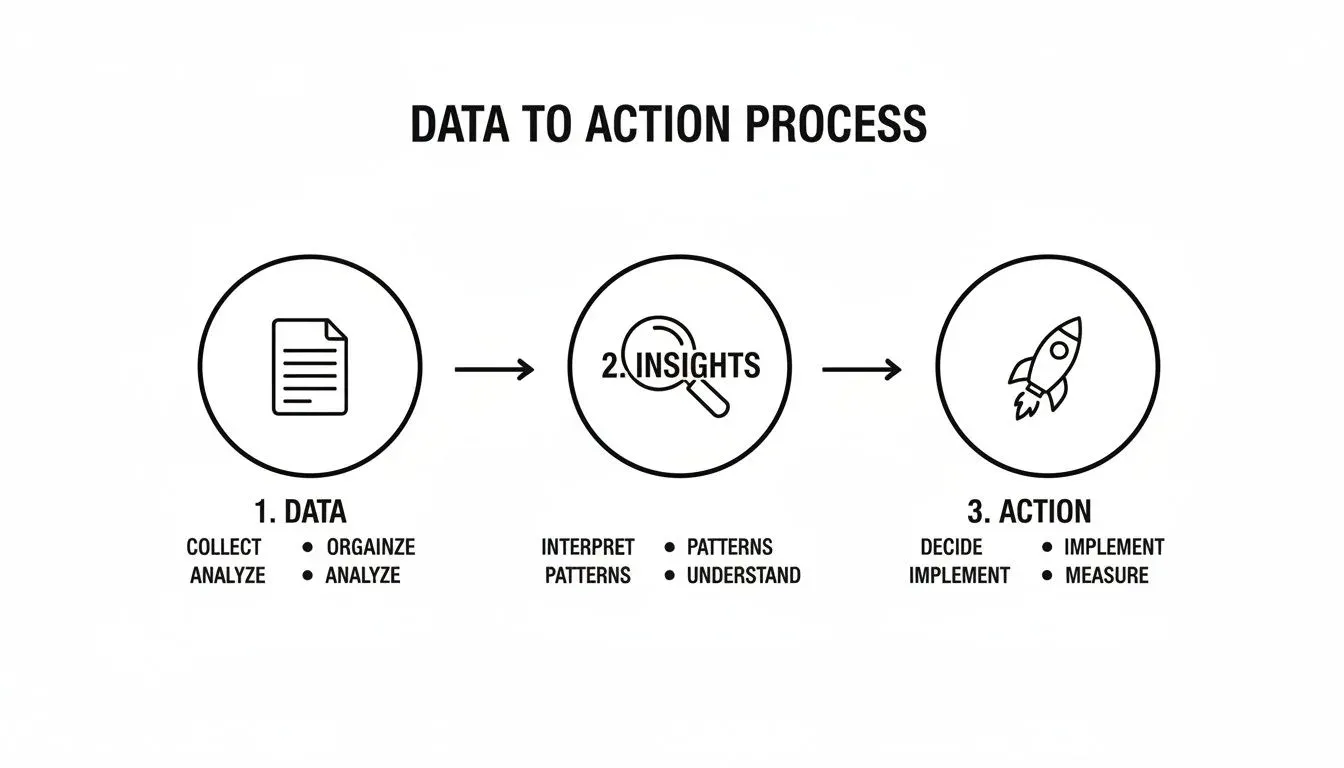
Data only matters when it leads to insights, and insights only matter when they drive action.
Building a continuous monitoring system
The heart of an automated system is an API that pulls data from SERPs and AI assistants. Manually checking competitor mentions in AI Overviews or Perplexity doesn’t scale.
A scraping API like cloro acts as the central nervous system for competitive intelligence. Automated API calls can track competitor visibility across regions, search engines, and AI models, so a rival’s move shows up the same day it happens instead of surfacing weeks later in a manual audit.
A workflow might:
- Query your top 20 keywords in Google’s AI Overview every morning across five countries.
- Ask Perplexity “who is the best X for small businesses” daily and log every brand mentioned.
- Monitor SERP features like shopping carousels and “People Also Ask” for new competitor presence.
That gives you a constant stream of structured data flowing into your database or your spreadsheet. It’s the difference between a single snapshot and a live feed. For more on the possibilities, see our deep dive on what you can build with a SERP API.
From raw data to instant alerts
Collecting data is half the value. The other half is what you do with it. Once you have a live feed, you can build alerts for critical competitor movements as they happen.
The goal is to shrink the time between a competitor’s move and your response. An alert that a rival just got cited in an AI Overview for a money keyword is more useful than finding out in a quarterly report.
Useful alert triggers:
- New AI citation. Get a Slack notification when a competitor appears in an AI Overview where they weren’t cited before.
- SERP feature loss. Get an alert if you lose ownership of a Featured Snippet for a high-value keyword.
- Price change detected. Monitor competitor pricing pages and get an email when tiers change.
Instead of playing catch-up, your team can react quickly with the data needed for a counter-move.
Quantifying the benefits of automation
Automating competitive intelligence has clear ROI. Removing repetitive data-gathering frees your team for strategic work instead of manual entry.
The real payoff isn’t a soft “saves time” claim — it’s the difference between a report that reflects this morning’s SERP and one that reflects last quarter’s. The manual version has a hard ceiling: a human can hand-check maybe a dozen keywords across a couple of AI assistants before the data is stale on arrival. The auto-fill script has no such ceiling — the same run covers your full keyword set across countries and devices, on a schedule, for a fixed cost per call. You stop paying analysts to copy numbers into cells and start paying only for the SERP data itself. The template fills itself; your team spends its time on the one thing automation can’t do — deciding what to do about what the report surfaces.
Benchmarking beyond your own numbers
Plenty of teams track their own social engagement but never benchmark it against rivals: measuring your own numbers is only half the picture. A template like the free social media version from Crux Creative can help teams see rivals’ posting frequency and ad spend. For B2B teams especially, these insights reveal how much of the pipeline LinkedIn really drives. More stats in the digital marketing report from WordStream.
Automate your competitive analysis and get a real-time view of AI answers and search results. cloro provides the structured data you need to monitor competitors, track AI visibility, and make smarter decisions.

About the author
Ricardo Batista
Founder, cloro
Ricardo is one of the founders and engineers behind its SERP and AI-search scraping infrastructure. Before cloro he scaled a financial comparison site to $7M ARR and ran the full-country operations of a unicorn to $65M ARR, then went back to building. He writes about search engine scraping, generative-engine optimization, and turning live search and AI-answer data into something teams can act on.
Frequently asked questions
What should a competitive analysis template include in 2026?
Four pillars: traditional SEO metrics (domain authority, backlinks, organic keywords), SERP feature ownership (featured snippets, PAA, video carousels), AI visibility (citations in Google AI Overviews, Perplexity, ChatGPT, Gemini), and brand/product signals (marketing channels, content strategy, pricing, UVP). A template that only tracks the first pillar is already obsolete.
How do I track competitor visibility in AI Overviews?
Either manually — running your top queries across Google, Perplexity, Gemini, and ChatGPT and logging cited domains — or programmatically with a SERP/AI scraping API like cloro that returns structured JSON containing every cited source. Manual checks work for spot-checks; automation is the only realistic option for tracking dozens of keywords across multiple regions on a daily cadence.
What should a competitor analysis SEO report include?
Five parts: an executive summary (who gained, who slipped, what changed in the AI answers), ranking and position deltas across your keyword set, a share-of-voice table (percentage of top-10 slots each domain owns), AI Overview citation ownership (who the assistants cite for your money keywords), and SERP-feature ownership condensed into a one-line SWOT per rival. Run the fast-moving rows — rankings, share of voice, AI citations — on a weekly automated cadence, and re-score the full template in a quarterly deep-dive.
How do I track a competitor's search rankings?
Treat competitor ranking as a monitored signal, not a spreadsheet entry you update by hand. For each keyword in your set, pull the live results page and record where the rival's domain lands across the organic top 10, the AI Overview sources, and the SERP features — per country and device. Sample daily and diff each SERP against the previous run to catch gains, slips, and newly-appearing AI Overviews. cloro returns those rows as JSON from one call per query, so you compute share of voice with your own methodology. The full setup, with a 30-day study, is in SEO competitor tracking.
How can I create a competitive analysis template in Excel?
Put your own company in the first data row as a baseline and one competitor per row below it. Use the fields as column headers (domain authority, backlinks, organic keywords, AI Overview visibility, SERP features, marketing channels, content strategy, pricing, UVP), freeze the header row and name column, format metrics as numbers, and add a color scale so gaps against rivals stand out. HubSpot and Smartsheet also publish free Excel versions.
How many competitors should I include in a competitive analysis?
Three to five direct competitors, one or two indirect competitors (different solution, same problem), and one or two aspirational competitors (market leaders you want to learn from). Tracking more than nine creates analysis paralysis without adding strategic value — depth on the right rivals beats breadth across irrelevant ones.
How often should I refresh competitive analysis data?
Run a tiered cadence: daily or weekly automated tracking for fast-moving signals like AI Overview citations, SERP feature ownership, and ad copy; quarterly deep-dives where you re-score the full template, run fresh SWOTs, and adjust strategy. Anything less frequent than weekly on the automated side and you're navigating with a stale map.
What's the difference between competitive analysis and competitive intelligence?
Competitive analysis is the structured exercise of comparing your competitors against you on a defined set of metrics — usually a one-time or quarterly snapshot. Competitive intelligence is the continuous discipline of monitoring competitor moves and turning them into decisions. A good template supports both: it's the snapshot artifact for the analysis, and it becomes a living dashboard once you wire automation into it.
Can I use the same template for B2B and B2C?
Yes — the four-pillar structure is universal. The specific data points shift: B2B focuses on LinkedIn, G2 reviews, demo conversion, and decision-maker content; B2C focuses on Instagram, TikTok, ad creative, and retail channel performance. Keep the columns the same and adjust the data sources you pull from.
Related reading

Competitive Intelligence Examples: 10 Workflows to Copy
Explore 10 competitive intelligence examples: pricing, hiring, reviews, SERP features, AI visibility, content gaps, and market expansion signals.
Best Rank Tracking Software 2026: 12 Tools Tested
Compare the 12 best rank tracking software tools for 2026 by daily cadence, accuracy, and enterprise scale, scored against live SERP data.
Best AI SEO Tools 2026: 11 Dashboards Compared
We compared 11 AI SEO tools across citation tracking, content optimization, and full suites. Compare pricing, engine coverage, and the real trade-offs.