

AI Search
How to Scrape Copilot: WebSocket Events and Citations
Learn how to scrape Microsoft Copilot: capture WebSocket events, parse Bing-grounded citations, and compare DIY automation with managed APIs.
Get the real Copilot UI responses: Bing-grounded sources, inline shopping cards, and Bing maps with place data. All the data Azure OpenAI never returns. Markdown out, any country, any scale.
4.7 · 53 reviews
cloro extracts the Bing-grounded sources Copilot cites, so you see which domains win Copilot answers. The same key gets you ChatGPT, Perplexity, Gemini, AI Overview, and AI Mode, so you can track your full AI-visibility footprint from one integration instead of building a separate one per engine.
Copilot is the only major AI search surface that grounds against Bing, not Google. Your competitive landscape on Copilot is different, and the Microsoft Graph / Azure OpenAI APIs return none of the surface that drives it.
Microsoft hardens Copilot's anti-automation to punish headless-browser patterns within hours. DIY pipelines hit success-rate cliffs that look fine in a small test and collapse at production volume. cloro absorbs the access fight so your Copilot monitoring keeps running across Bing's update cycle.
Copilot re-ranks its Bing-cited sources per session and per country. The same prompt can return a different top-source on every run, and Bing's regional indexes diverge meaningfully. A single API call tells you nothing; you need repeated sampling to see the real distribution. cloro routes per `country` so you can capture the regional divergence directly. Copilot almost always cites, and it cites few. Across roughly 2,500 prompts per engine it grounded 97.5% of answers but averaged only 4.6 sources, and 91.8% at 4.5 sources when re-measured on 2026-08-19. That thin citation set is the most stable figure on the six-engine panel in that study (grounding study). Its citation slots are the scarcest of any reliably grounding engine, which makes presence harder to win and worth more once you have it.
Azure OpenAI returns ungrounded model output. The Bing Search API returns SERP rows. The Microsoft Graph API exposes M365 tenant data. None of them returns the Bing-cited Copilot answer a real user reads on Copilot.com. Surfer's analysis measured ~20% overlap between API responses and the rendered UI across LLMs. cloro loads the live Copilot page and returns that answer, so you measure what a Copilot user actually reads, not a synthetic stand-in from an unrelated API.
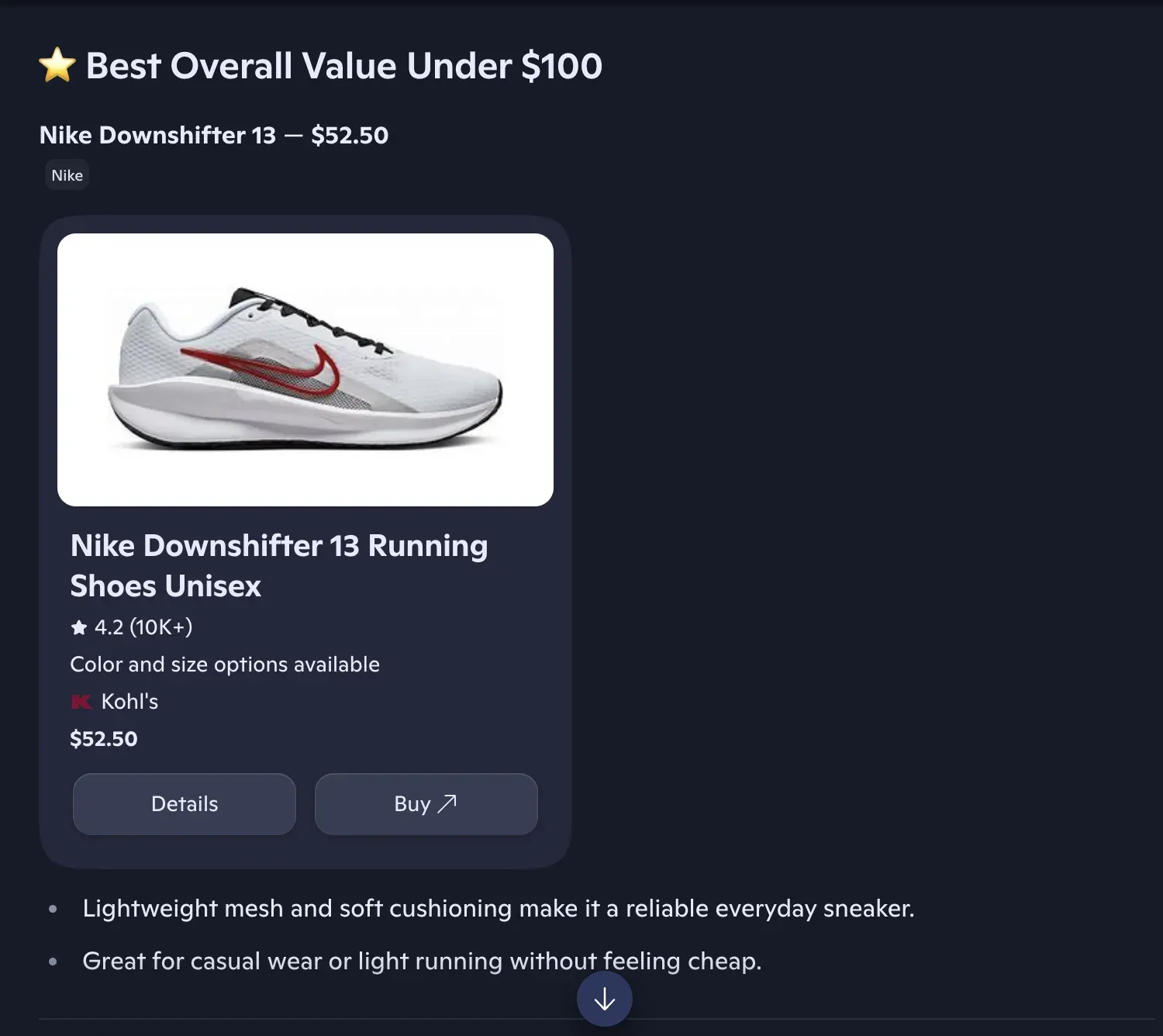
Copilot embeds inline shopping cards (price, ratings, seller) and Bing maps place entries (with reviews, photos, coordinates) directly inside the answer, alongside the Bing-grounded source citations. None of this lives in any Microsoft API. cloro returns `shoppingCards`, `map`, and `sources` as structured JSON in one response, so you can track product placement and local-pack visibility on Copilot without stitching together separate feeds.
Send a prompt, cloro runs it on Copilot, you get JSON back: markdown, Bing-grounded sources, shopping cards, and Bing maps.
from cloro import Cloro

client = Cloro(api_key="sk_live_your_api_key_here")

response = client.monitor.copilot(
    prompt="What do you know about Tesla's latest updates?",
    country="US",
    state="CA",
    include={"markdown": True},
)

print(response["result"]["text"]){
"success": true,
"result": {
"text": "Based on my analysis of Tesla's...",
"html": "https://storage.cloro.dev/results/copilot-result-page.html",
"markdown": "### Tesla Recent Analysis\n\nBased on my analysis of Tesla's recent developments...",
"sources": [
{
"position": 1,
"url": "https://tesla.com/blog/fsd-beta-v12",
"label": "Tesla FSD Beta v12 Update",
"description": "Latest improvements in Tesla's..."
}
],
"shoppingCards": [
{
"position": 1,
"product": {
"name": "Model Y",
"brand": "Tesla",
"price": "$43,990",
"currency": "USD",
"rating": 4.5,
"reviewCount": 2847,
"imageUrl": "https://example.com/tesla-model-y.jpg",
"productUrl": "https://tesla.com/modely",
"description": "All-electric compact SUV..."
}
}
]
}
}Start free. Price per credit drops as your volume grows — see every tier below.
| Plan | Price / mo | Credits | Per 1k | Concurrency | Seats | Support |
|---|---|---|---|---|---|---|
| Free | $0 | 500 | — | 1 | 1 | Documentation assistant |
| Lite | $30 | 37,500 | $0.80 | 10 | Unlimited | |
| Hobby | $100 | 250,000 | $0.40 | 20 | Unlimited | |
| StarterPopular | $250 | 650,000 | $0.39 | 50 | Unlimited | |
| Growth | $500 | 1,350,000 | $0.37 | 75 | Unlimited | Priority email |
| Business | $1,000 | 2,800,000 | $0.36 | 100 | Unlimited | Priority email |
| Enterprise 2K | $2,000 | 5,871,025 | $0.34 | 135 | Unlimited | Slack |
| Enterprise 3K | $3,000 | 9,306,606 | $0.32 | 175 | Unlimited | Slack |
| Enterprise 4K | $4,000 | 12,756,261 | $0.31 | 215 | Unlimited | Slack |
| Enterprise 5K | $5,000 | 16,391,783 | $0.31 | 255 | Unlimited | Slack |
| Enterprise | $5,000+ | Increased concurrency, overages on credits and credit discounts for annual contracts.Know more | ||||
Bing Search returns raw SERP data (the URLs, not the Copilot answer). Azure OpenAI returns model output without Bing grounding. Neither shows you what a user reading copilot.microsoft.com actually sees. cloro extracts the rendered Copilot UI, including the Bing-cited sources panel that drives brand visibility. Measuring that panel alongside the other engines is the AI visibility tracking use case.
Bing's index refreshes on a different cadence than Google's: roughly every 24–48 hours for high-traffic queries, longer for the long tail. Copilot's citations track that. Daily cloro sampling on the same prompt typically shows 1–3 source changes per week; more for trending topics. Every cloro request hits Copilot live so you catch each shift.
Bing's index weighs different signals than Google: different domain authority, different freshness curves, different sub-domain handling. Sites that rank well on Google can be invisible on Copilot and vice versa. cloro lets you measure the Copilot-specific picture without conflating it with Google data.
More than most teams expect. Bing maintains separate regional indexes (Bing US, Bing UK, Bing DE, Bing JP), each with its own ranking signals and content freshness. From our sampling, Copilot's per-country citation overlap on the same prompt averages around 30%. If you're a global brand, you need country-level Copilot tracking to know what each market actually sees.
cloro targets the public copilot.microsoft.com consumer surface, the one that matters for organic brand visibility. M365 Copilot lives inside enterprise tenants with different behavior and access controls; it's out of scope.
Yes. The `result.map` array contains Bing maps place entries (each with reviews, photos, coordinates, and contact info) when the prompt has local intent. Combined with `shoppingCards` for shopping intent, you get the full set of Copilot rich-result objects, none of which live in Azure OpenAI or the Bing Search API.
Bing's per-country indexes × the prompts you care about = typically 6–15 permutations per tracked query. Sync polling against Microsoft's anti-automation at that volume needs a job queue, retries, and a residential-proxy budget. Realistic in-house cost: $4–7k/month before engineering time. cloro's Hobby plan ($100/month) absorbs the whole permutation matrix.
Learn how to scrape Microsoft Copilot: capture WebSocket events, parse Bing-grounded citations, and compare DIY automation with managed APIs.
We tested 10 LLM visibility tools (also sold as AI visibility trackers and checkers) on real brand-monitoring workflows across ChatGPT, Perplexity, and Gemini. What works, what doesn't.

Compare the best AI search engines for research and developers: ChatGPT, Perplexity, Gemini, Copilot, Brave, You.com, Exa, Tavily, and more.