
The AI Brand Visibility Measurement Framework for 2026

On this page
The first 18 months of AI brand visibility measurement produced a lot of dashboards and very few decisions. Vendors raced to ship UIs that turned a single AI-mention number into a vanity metric, executives nodded at the chart, and nobody acted because the chart didn’t tell anyone what to do. The fix is a measurement and tracking framework that separates what to measure from what to do about it, so your AI brand visibility tracking drives action instead of just compiling.
This post is the framework we use, broken down into the four metrics that matter, the engines you actually have to cover, and the decision tree that turns the numbers into a playbook. If you’ve already read our LLM visibility tracking tools roundup, this is the layer underneath: what to measure with whichever tool you picked.
The framework in one sentence
Measure four metrics across at least three engines, weekly, on a query set split between branded, category, and use-case intent. Tie each metric to a specific corrective action so the report drives a decision instead of compiling a dashboard.
Everything below expands one piece of that sentence.
The four metrics, and what each one means when it moves
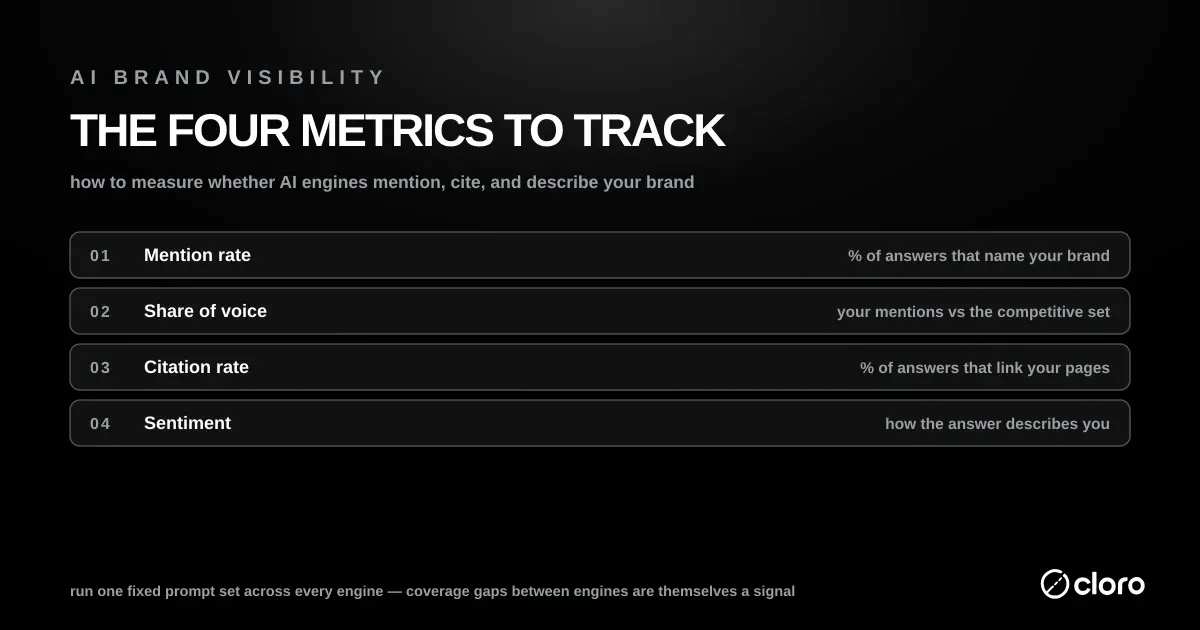
The metric pyramid for AI brand visibility has four levels. Each one answers a different question, so each one tells you a different thing when it moves.
| Metric | Question it answers | If it’s low | If it spikes |
|---|---|---|---|
| Mention rate | Do you appear at all? | You’re invisible in the category. Build topical authority and citation-worthy content. | Awareness moved. Audit which engines drove the lift; replicate the input. |
| Share of voice | How much air time vs competitors? | Competitors own the conversation. Compare their citation patterns; find what they have that you don’t. | You took share. Confirm the lift isn’t a temporary content event, then double down on whatever caused it. |
| Citation rate | Do mentions drive traffic? | You’re getting awareness but no clicks. Improve source-attribution patterns — data-rich content with stable URLs ranks for citation. | Engines are linking out to you. Audit which content earns citations and produce more of that shape. |
| Sentiment | Are mentions positive? | Negative recommendations. Investigate the cause (a public incident, comparative review, social signal). | Net-positive recommendation. Keep doing what you’re doing — and check whether the sentiment is brand-driven or category tailwind. |
The temptation is to compute a composite “AI visibility score” by weighting these four. Resist it. The takeaway: the composite hides the dimension that’s broken, and the corrective action depends on which dimension is broken.
How each metric is computed
The four metrics are only comparable week over week if everyone computes them the same way. These are the definitions we standardize on, and the ones any AI brand visibility measurement framework should pin down before the first run. For a worked example you can check rather than take on trust, the AI Visibility Leaderboard applies exactly these definitions to twelve software categories every week and publishes the underlying snapshot.
Mention rate
Mention rate is the share of answers in your query set that name your brand at least once. Divide the answers that mention you by the total answers run, per engine and in aggregate. Count a brand once per answer even when it appears multiple times — repetition inside a single response is not additional visibility.
Share of voice
Share of voice is your mention count divided by the combined mention count of you plus your tracked competitor set, over the same query run. Because an AI answer can name several brands at once, the denominator is a sum of overlapping mentions rather than a fixed 100%. Fix the competitor set for the quarter so the trend line stays comparable.
Citation rate
Citation rate is the share of your brand mentions that carry a clickable link back to a domain you own. Divide answers that link to you by answers that mention you — not by the total query set — so the metric isolates whether a mention converts into a traffic opportunity. A brand can post a high mention rate and a low citation rate at once, which is the exact gap the framework is built to surface.
Sentiment
Score the language around each mention as positive, neutral, or negative. Classify at the mention level, then roll up to a per-engine share of positive mentions. Because AI-generated prose is register-consistent, a standard classifier scores it reliably without a custom model.
How the four metrics map to the IAB’s 4 P’s
The IAB has published Measuring Visibility in the AI Era, a shared vocabulary for this category. Marketing Dive’s summary reports that the IAB found more than 20 AI visibility vendors with little consistency between their methods, and cites McKinsey CMO surveys showing only 16% of brands track AI search performance systematically. The framework ranks four P’s:
| IAB layer | What it covers | Where it sits in this framework |
|---|---|---|
| Presence | Mention rate, citation rate, share of voice, visibility momentum | Mention rate, share of voice, citation rate |
| Prominence | Placement and ranking order in the answer | Add a position field to each mention |
| Portrayal | Sentiment, framing, hallucination and factual error rates | Sentiment, plus a factual-accuracy check |
| Persuasion | Recommendation strength, post-citation click-through | AI referral sessions in your analytics |
The IAB also separates directional measurement, good for early signals, from decision-grade measurement, which needs enough sample size, prompt coverage, cadence and reproducibility to move budget. Treat a week-1 program as directional, and hold budget decisions until the engine coverage, query set and cadence below meet the decision-grade bar.
Engines: the minimum defensible coverage
One measured fact should set the tier order before user counts do. Across roughly 2,500 prompts per engine, our grounding study found five of six engines ground their answers in live sources 91-98% of the time, while Gemini grounded 41.1% on that July reading. Re-measured on 2026-08-19 Gemini was at 70.7% and the spread across the panel had narrowed, so the ordering is the durable part and the rate is not. That is a different kind of engine for measurement purposes: on an ungrounded answer there is no citation to win, so a low mention rate on Gemini may be reporting the engine’s behaviour rather than your visibility. Track it, and record grounded and ungrounded answers separately, or the metric quietly conflates the two.
A measurement program that covers only ChatGPT is reportable but not defensible. Your CMO will eventually ask why you don’t track Perplexity, and “we don’t have integration” is not a credible answer in 2026. The coverage tier list:
- Tier 1 (mandatory). ChatGPT, at roughly 900 million weekly active users the largest AI assistant; Perplexity, which cites the sources behind its answers; and Google AI Overview, which Google has extended to over a billion users. Single-engine and two-engine programs miss material brand-visibility signal.
- Tier 2 (strongly recommended). Gemini and Google AI Mode. AI Mode runs on a custom version of Gemini and is built into Search, so both pull heavily from Google’s index and amplify or attenuate SEO moves in real time.
- Tier 3 (industry-dependent). Copilot and Grok. Copilot is embedded across the Microsoft 365 apps, so it matters if your buyers work inside Word, Excel, and PowerPoint; Grok scans X and the live web, so it matters in real-time and news-adjacent verticals.
The reason single-engine coverage fails is that the engines disagree. A brand can hold a strong share of voice in Perplexity, which leans on fresh citations, while barely appearing in ChatGPT, which leans on training data and a narrower retrieval set. Track one engine and you extrapolate its bias onto the whole market; track the Tier-1 three and the disagreements themselves become signal about where your content is and isn’t landing.
Tools like cloro’s AI visibility tracking cover all 7 through a single API, which removes the integration cost as a coverage decision driver. At that point coverage is a question of credit budget, not engineering bandwidth.
The query set: the most under-rated decision
The query set is what you actually measure. Get it wrong and the framework gives you precision-looking numbers about the wrong question. The right query set has three intent buckets in roughly equal proportions.
Branded queries (~30%)
Queries that include your brand name. “What does [brand] do”, “[brand] reviews”, “[brand] vs [competitor]”. These measure how AI engines characterize you when the buyer already knows your name. Low mention rate here means you’re invisible even when prompted by name, usually a sign of thin training data or a recent rebrand.
Category queries (~30%)
Queries about your product category that don’t name any brand. “Best CRM for B2B SaaS”, “alternatives to Salesforce”, “top SEO tools 2026”. These measure whether you appear at all in unprompted recommendation. This is the bucket most worth optimizing, because it’s where buyers live before they know your name.
Use-case queries (~40%)
Queries describing the job-to-be-done your product solves. “How to monitor brand mentions in ChatGPT”, “what’s the cheapest way to scrape Google SERPs”, “how do I track AI search visibility”. These measure recommendation at the highest-intent moment in the buyer journey. Slight skew toward this bucket because mentions here disproportionately convert.
A 100-query set split 30/30/40 is a defensible starting point. Refine quarterly based on which queries actually moved.
Sentiment: what it tells you that mention rate doesn’t
Either you appeared in an answer or you didn’t; mention rate is binary. Sentiment is the qualitative layer on top, and it’s the one that catches reputational risk before it shows up in revenue.
A brand at 40% mention rate with 90% positive sentiment is in a different position from a brand at 40% mention rate with 60% negative sentiment. The first is winning. The second is being recommended-against in a way that mention rate alone won’t surface. Standard NLP libraries (or the AI engines themselves, if you ask them to score) handle sentiment classification reliably on AI-generated prose, because the register is consistent and the structure predictable.
Most platforms (Peec AI, OtterlyAI, Profound, AthenaHQ) compute sentiment automatically; if you’re rolling your own with cloro’s API, pipe the response text through a sentiment classifier as a post-processing step. The cost is negligible. We covered the share-of-voice angle in more depth in share of voice in the AI era.
Cadence: weekly by default, daily only for a crisis
Daily monitoring at steady state is the most common mistake in AI brand visibility tracking programs. AI engines do not update citation patterns fast enough to make daily measurement informative; you burn API credits and produce statistical noise. Reserve daily for events: PR incidents, product launches, competitive moves where you need to see the engines respond in near-real-time. After the event, return to weekly.
Weekly cadence catches the meaningful drift, gives you enough samples to compute share of voice with reasonable confidence intervals, and keeps API spend predictable. Monthly is acceptable as a floor. Anything less frequent and you’re reporting historical artifacts.
The decision tree
Once you have weekly numbers across three engines, decisions follow this tree:
- Mention rate flat or falling and competitors flat. Category attention is shrinking. Rebalance investment toward use-case intent queries; the buyers who are still searching are deeper in the funnel.
- Mention rate flat and competitors rising. You’re losing share. Audit which competitors are rising on which queries; find the citation pattern they have that you don’t.
- Mention rate rising and citation rate flat. You’re getting awareness without traffic. Improve source-attribution patterns: data-rich content with stable canonical URLs.
- Mention rate rising and citation rate rising. Net win. Confirm it’s not a temporary content event; if it’s structural, double down on the input.
- Sentiment flips negative on a specific competitor query. Investigate immediately. Either a public incident, a comparative review, or a coordinated social signal. Don’t wait for the trend to stabilize.
This isn’t a complete decision matrix, it’s the start of one. Build the version that fits your category over the first 90 days of measurement.
From framework to AI brand visibility tracking program
The framework above is the what. Turning it into a running AI brand visibility tracking program is the how, and it comes down to three operational decisions you make once and revisit quarterly.
- Instrumentation. Decide whether you query engines by hand, script the API yourself, or buy a platform. A spreadsheet and three browser tabs is a legitimate week-1 AI brand visibility tracker; it stops scaling around the time you add your fourth engine or your second analyst.
- Storage. Every weekly run is a row. Land the raw responses somewhere queryable — a warehouse table, not a screenshot — so share-of-voice trends survive longer than whichever dashboard vendor you picked.
- Ownership. One person owns the query set and the weekly cadence. AI brand visibility tracking dies the week it becomes nobody’s job.
A dedicated AI brand visibility tool collapses the first two decisions into a single API across all seven engines, but the third is yours regardless of what you buy.
Choosing an AI brand visibility tracking tool
Most teams start in a spreadsheet and graduate to a dedicated AI brand visibility tracking tool the moment the manual run stops fitting in one analyst’s week. The market splits into three shapes, and the search modifier you used to get here usually signals which one you need:
- Tracking software / platforms (Profound, Peec AI, OtterlyAI, AthenaHQ). Full dashboards with sentiment, competitor share of voice, and alerting built in. Best when AI brand visibility tracking is a standing program with an owner and a monthly report to leadership.
- AI brand visibility trackers and checkers. Lighter, often free point tools that score a single brand across a handful of engines. Useful for a one-off audit or a baseline read, not a defensible trend line.
- Tracking APIs. You own the query set, cadence, and storage; the vendor owns engine coverage. Best when you already run a warehouse and want the tracking data to live next to the rest of your marketing analytics.
Whichever shape you pick, judge the tool against the framework above: does it cover the Tier-1 engines, export raw responses (not just screenshots), and let you version the query set so the trend line stays comparable? For a head-to-head of the leading platforms, see our LLM visibility tracking tools roundup; for the build-it-yourself API route, cloro’s AI visibility tracking covers all seven engines behind one endpoint, and AI search visibility tools: build vs buy walks the decision end to end.
Common mistakes
- Composite score thinking. Bundling mention rate + citation rate + sentiment into one number hides the dimension that’s broken. Track the four separately, the way the sections above do.
- Tracking only branded queries. Branded queries measure existing awareness; they tell you nothing about category presence.
- Personalized testing environments. Logging into AI engines with your work SSO produces personalized answers that don’t match what your prospects see. Use clean accounts or API access.
- Treating Peec AI vs OtterlyAI vs Profound as substitutes. They optimize for different audiences: marketing teams vs analyst teams vs enterprise. We compared them in LLM visibility tracking tools.
- Over-investing in dashboard polish before the data is stable. Spend the first 90 days getting the metrics right and the query set tuned. The dashboard will design itself once you know what numbers actually drive decisions.
Where to start
Ship this in week 1: 50 queries across the three intent buckets, weekly runs against ChatGPT + Perplexity + AI Overview, the four metrics computed manually in a spreadsheet, one share-of-voice chart shown to leadership monthly. That’s all. Once the program survives 90 days and you know what “normal” looks like in your category, expand engine coverage and consider a dashboard tool to reduce the manual reporting cost.
If the spreadsheet phase ends and you want to skip building the dashboard yourself, cloro’s AI visibility tracking provides the API layer for all 7 engines and integrates with the data warehouse you already operate. For a build-vs-buy walkthrough, see AI search visibility tools: build vs buy.

About the author
Ricardo Batista
Founder, cloro
Ricardo is one of the founders and engineers behind its SERP and AI-search scraping infrastructure. Before cloro he scaled a financial comparison site to $7M ARR and ran the full-country operations of a unicorn to $65M ARR, then went back to building. He writes about search engine scraping, generative-engine optimization, and turning live search and AI-answer data into something teams can act on.
Frequently asked questions
What is AI brand visibility?
AI brand visibility is the degree to which a brand is named, cited, or recommended in answers generated by large language models — ChatGPT, Perplexity, Gemini, Google AI Overview, Copilot, and others. It is the AI-era equivalent of organic search visibility, but the surface is conversational rather than ten blue links, the ranking signals are different, and the measurement framework has to account for engine fragmentation. A brand can rank #1 organically and still have low AI brand visibility — and vice versa.
How do I set up AI brand visibility tracking?
Start with a fixed query set split across branded, category, and use-case intent, run it weekly against ChatGPT, Perplexity, and Google AI Overview, and record mention rate, share of voice, and citation rate for every run. The core requirement of AI brand visibility tracking is consistency: the same queries, the same engines, the same cadence, week over week, so the trend line is comparable. Manual tracking in a spreadsheet is fine to start — move to an API or a dedicated tool once you outgrow three engines or one analyst.
Why isn't a single 'AI visibility score' enough?
Because AI brand visibility is multi-dimensional: mention rate (do you appear at all), share of voice (how much air time vs competitors), citation rate (do mentions drive traffic), and sentiment (positive/negative). A single composite score hides the dimension that's actually broken. A brand could have 40% mention rate but 5% citation rate — solid awareness but no traffic capture. The fix for low citation rate (publishing data-rich content with clear source attribution) is different from the fix for low mention rate (building topical authority and Reddit-style social proof). One score, two diagnoses, two playbooks.
Which AI engines do I have to measure?
At minimum: ChatGPT (largest single AI traffic source), Perplexity (citation-density leader, cleanest engine for source-rate measurement), and Google AI Overview (above-the-SERP placement reaches the most users). A defensible 2026 measurement program covers at least 5 of the 7 major engines (ChatGPT, Perplexity, Gemini, AI Overview, AI Mode, Copilot, Grok). Single-engine programs are reportable but not defensible.
How is share of voice computed for AI?
Same denominator logic as traditional share of voice, different numerator. Run a fixed query set against each AI engine, count how many answers mention your brand vs how many mention each competitor, normalize. The complication is that AI answers can mention multiple brands in a single response, so unweighted counts are appropriate (one mention = one point regardless of position in the answer). Some platforms weight by mention prominence (first vs later in the answer), but the marginal precision rarely justifies the complexity.
What's the simplest measurement program a brand can run in week 1?
Pick 50 queries split across branded, category, and use-case intent. Run them weekly against ChatGPT, Perplexity, and AI Overview. Compute mention rate, share of voice (vs your top 3 competitors), and citation rate. Report the three numbers monthly. That's it. Anything more elaborate is premature optimization until you have 90 days of trend data to know what 'normal' looks like.
Related reading
AI Share of Voice: How to Measure Brand Visibility
AI share of voice measures how often your brand appears in ChatGPT, Perplexity, Gemini, and AI Overviews versus competitors. Learn the formulas.
Best LLM & AI Visibility Tools 2026: 12 Tested
We tested 12 LLM visibility tools (also sold as AI visibility trackers and checkers) on real brand-monitoring workflows across ChatGPT, Perplexity, and Gemini. What works, what doesn't.
ChatGPT Visibility Tracker: Track Your Brand Mentions
Learn how a ChatGPT visibility tracker works, run a free manual baseline, and compare the best tools to monitor your brand mentions in AI search.