
Best LLM & AI Visibility Tools 2026: 12 Tested

On this page
Which tool should you use to track AI search visibility?
The best LLM visibility tracking tool depends on the team: Gauge for B2B SaaS GEO (Generative Engine Optimization) work, Profound for enterprise compliance, Meteoria or Omnia for a small team that wants every prompt re-run daily, and the Semrush or Ahrefs add-on if you already pay for the suite.
The 12 best LLM visibility tools at a glance
| Tool | Starting price | Best for |
|---|---|---|
| Gauge | $599/mo | B2B SaaS teams focused on GEO |
| Profound | $99/mo (Starter), $1,500 to $2,000+ enterprise | Enterprise brands needing compliance-grade AI intelligence |
| Peec AI | $2,000/mo | Teams wanting deep competitor analysis + clickstream correlation |
| Semrush AI Toolkit | $99/mo add-on | Existing Semrush users wanting basic AI visibility |
| OtterlyAI | $29/mo | Marketing teams and agencies wanting monitoring plus optimization |
| Track My Visibility | $89/mo | Brands and agencies that want tracking plus page-level fixes |
| RadarKit | $29/mo | Brands and agencies tracking several countries or local markets |
| Omnia | €79/mo | Small teams wanting monitoring plus execution, not just a dashboard |
| Meteoria | €75/mo | Small teams and agencies that want every prompt re-run daily |
| Evertune | Custom | Teams wanting prompt-level share-of-voice analytics |
| aiclicks.io | $59/mo (Starter) | Teams wanting tracking + content creation in one workflow |
| Ahrefs Brand Radar | $199/mo add-on | Existing Ahrefs users |
The takeaway: the price spread across these 12 tools tracks scope more than quality. Cheaper tools cover fewer engines and skip sentiment or competitor-gap analysis; the priciest tools add engine breadth, compliance certification, and dedicated support that most single-brand teams don’t need. The decision tree later in this guide matches a tool to your team size and budget.
The infrastructure layer underneath. These 12 LLM visibility tools sit at the dashboard layer: they run scheduled queries against AI engines, parse the responses, and show citation data in a UI. Several pull their raw data from API providers one layer down, and that layer is compared in its own section below; for ChatGPT specifically, the ChatGPT brand mentions API guide covers the integration end to end. If you only need a one-off read rather than ongoing tracking, Semrush’s free AI Search Visibility Checker is the most complete free snapshot, but it is not a substitute for the trend history a tracking tool builds.
What these tools measure, in brief
Every tool here runs a fixed set of prompts against the AI engines on a schedule, parses the answers, and reports four things: whether your brand was mentioned, whether a page of yours was cited as a source, how that compares with named competitors (share of voice), and how the engine described you (sentiment and accuracy). The definitions and the traps in each metric are in AI visibility metrics; the difference between LLM observability (your app’s telemetry) and LLM visibility (what models say about your brand) is covered in what AEO is, and the weekly-cadence argument in AI search tracking. This page is about which tool to buy, so it stops there.
How we tested
A roundup is a snapshot of editorial judgement at one date. The AI visibility platforms leaderboard is the standing measurement beside it: which of these tools the engines name and cite, re-scored weekly and free to cite.
Each tool below is scored on six axes:
- Engine coverage. Which of ChatGPT, Perplexity, Gemini, Copilot, Google AI Overview and AI Mode it actually queries.
- Citation fidelity. Real source URLs with parsed labels, or screenshots and approximations.
- Update frequency. Weekly, daily, or on demand.
- Reporting depth. Mention rate, share of voice, citation rate, sentiment, prompt patterns.
- Pricing fairness. Whether the entry tier covers the prompts most teams need.
- Methodology transparency. Whether the vendor says how prompts are submitted and sampled.
Where pricing has changed since we checked, we noted it. Where a vendor’s marketing claim didn’t match what we observed, we said so.
Enterprise-grade LLM visibility tracking platforms
The platforms in this tier are built for larger teams with dedicated budgets and more complex multi-brand or multi-market tracking needs.
Gauge
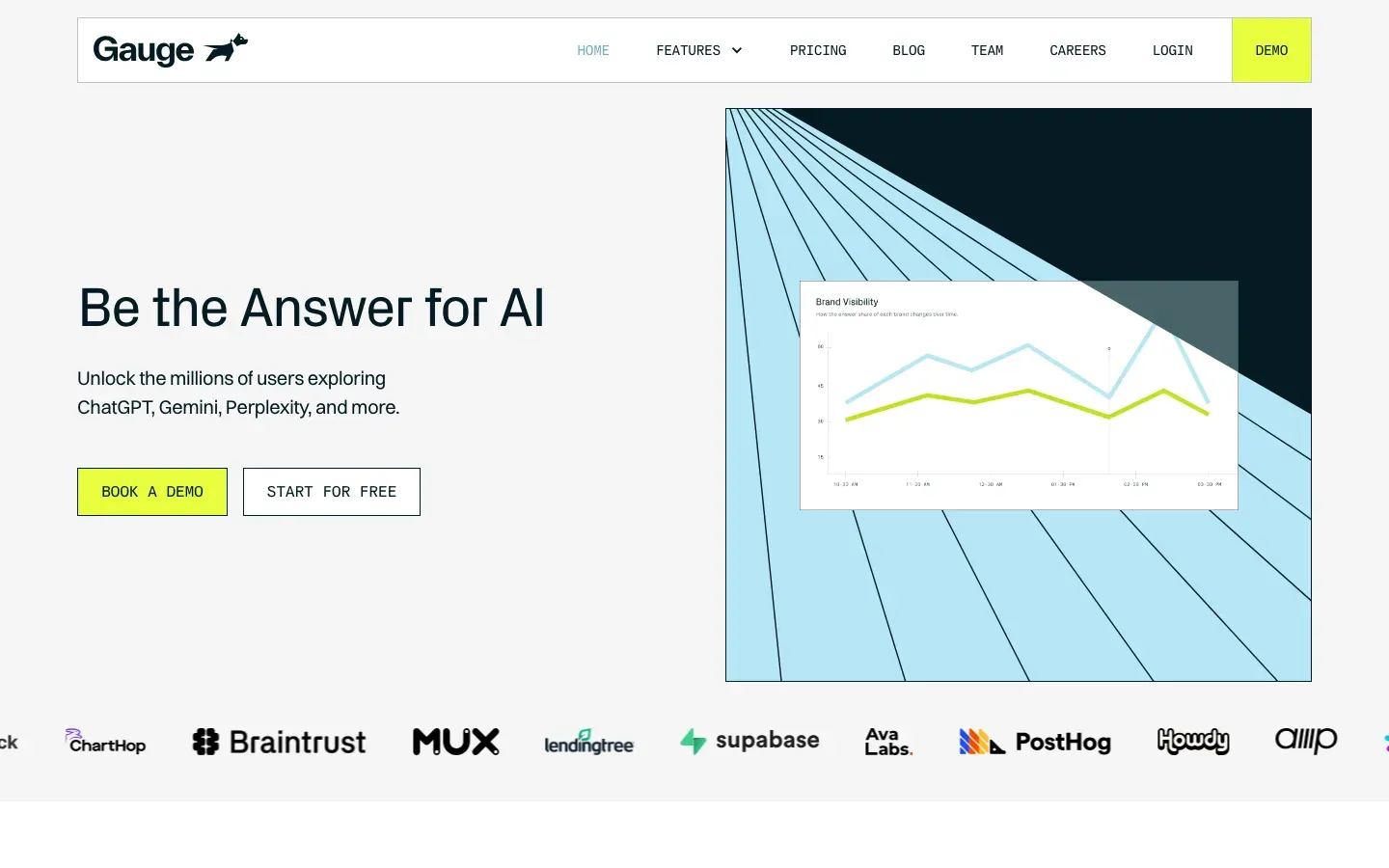
Best for: B2B software and SaaS companies focused on Generative Engine Optimization (GEO)
Gauge tracks brand presence across ChatGPT, Perplexity, Gemini, and Google AI Overviews, with a focus on surfacing optimization opportunities rather than just monitoring numbers.
Key features:
- Brand rankings and prompt intelligence across AI platforms, refreshed daily.
- Competitor mention tracking and citation opportunities.
- Action Center with specific optimization recommendations.
Pricing: Growth at $599/month (600 prompts, daily runs, email + chat support); Enterprise custom. Free tier available.
What we found: Gauge’s Action Center is one of the better implementations of the “what do I do with this data” layer, turning mention-rate gaps into content recommendations. Pricing sits between the mid-market dashboards and Profound.
Profound
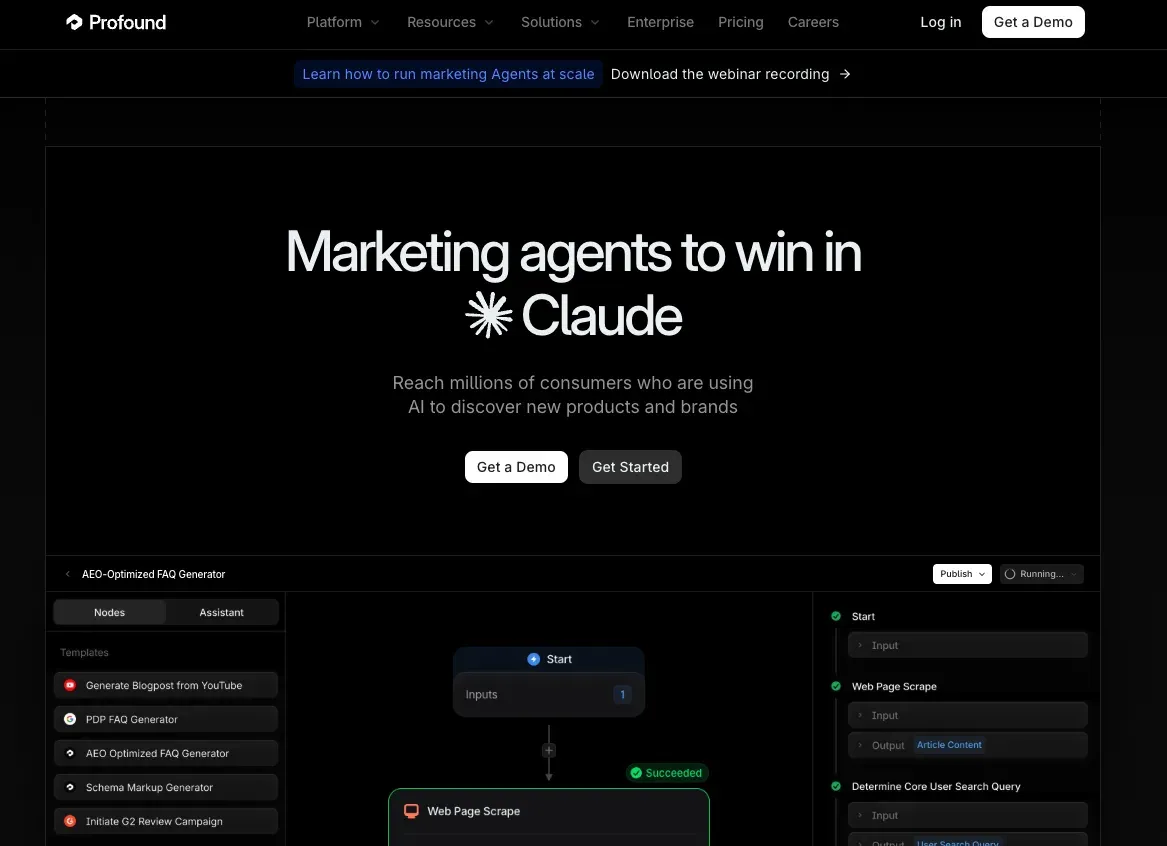
Best for: Enterprise brands requiring compliance-grade AI intelligence
Key features:
- Monitoring across 10+ platforms, with sentiment analysis and context mapping.
- ISO-certified security and compliance, custom API access.
- Dedicated support and strategic consulting.
Pricing: Starter at $99/month, Growth at $399/month, Enterprise typically $1,500 to $2,000+/month depending on platform coverage and seat count per Digital Elevator’s 2026 AEO pricing guide. Backed by a $96M Series C at a $1B valuation per Fortune, Profound is the G2 Winter 2026 AEO Leader.
What we found: Best fit for teams with a dedicated AI search function and the budget for the category leader’s full feature set; the enterprise tier pays for platform breadth (10+ engines including DeepSeek, Meta AI, Grok), compliance and support. If that is more than you need, our roundup of Profound alternatives compares six cheaper dashboards plus the build-your-own API route.
Peec AI
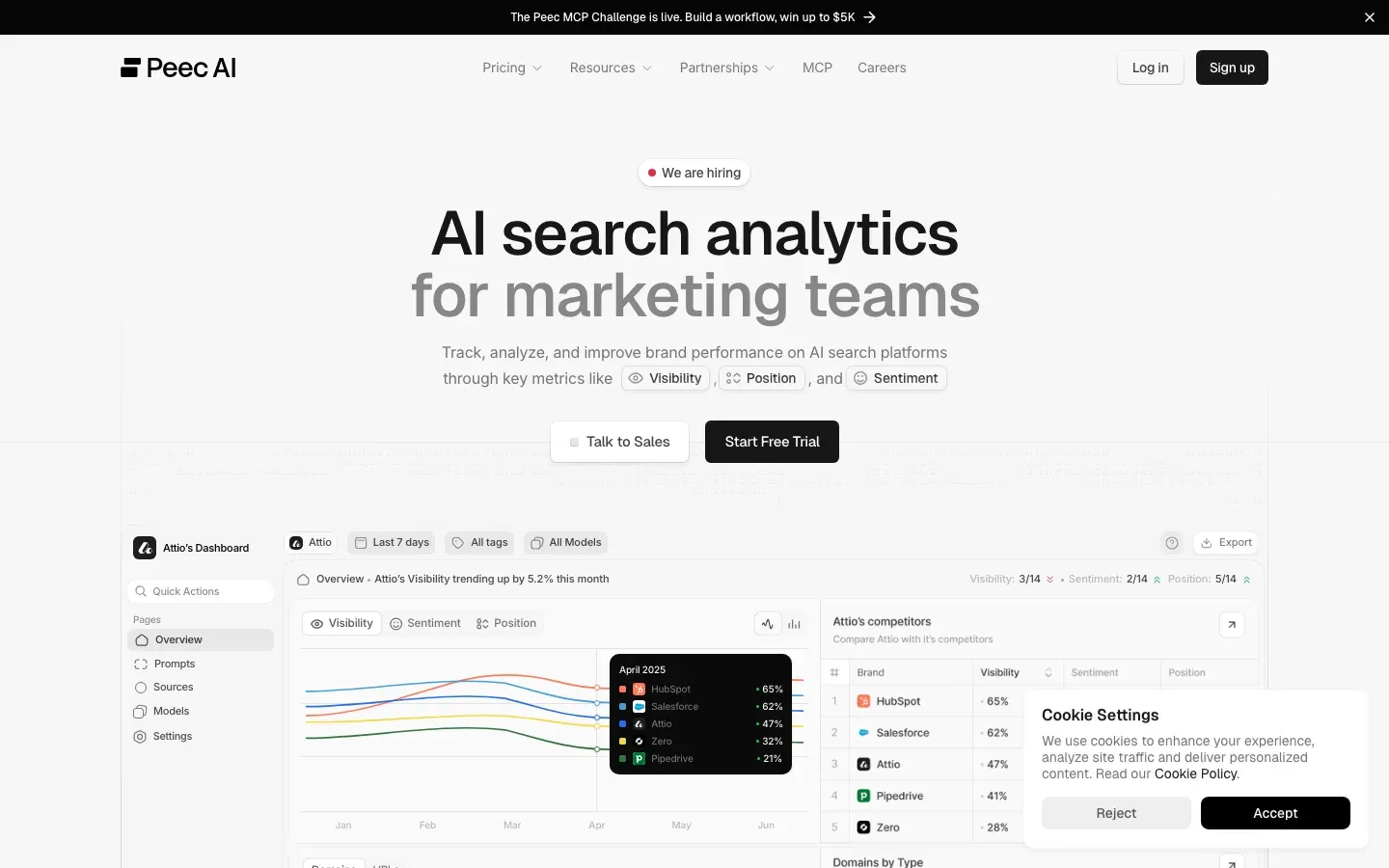
Best for: Companies wanting deep technical insights and competitor analysis
Key features:
- Real-time citation tracking across ChatGPT, Perplexity, Claude.
- Advanced competitor intelligence and gap analysis.
- Clickstream data integration for traffic correlation.
- Custom prompt building and testing capabilities.
- Historical trend analysis with detailed reporting.
Pricing: $2,000 to $5,000/month
What we found: The clickstream integration is genuinely useful. It lets you correlate AI mention rate with actual traffic changes, which most tools can’t do. The price puts it in enterprise territory for most teams.
Mid-market LLM visibility tools
These LLM visibility tracking tools offer solid tracking depth at a price point that works for growing teams and agencies without dedicated AI search budgets.
Semrush AI Visibility Toolkit
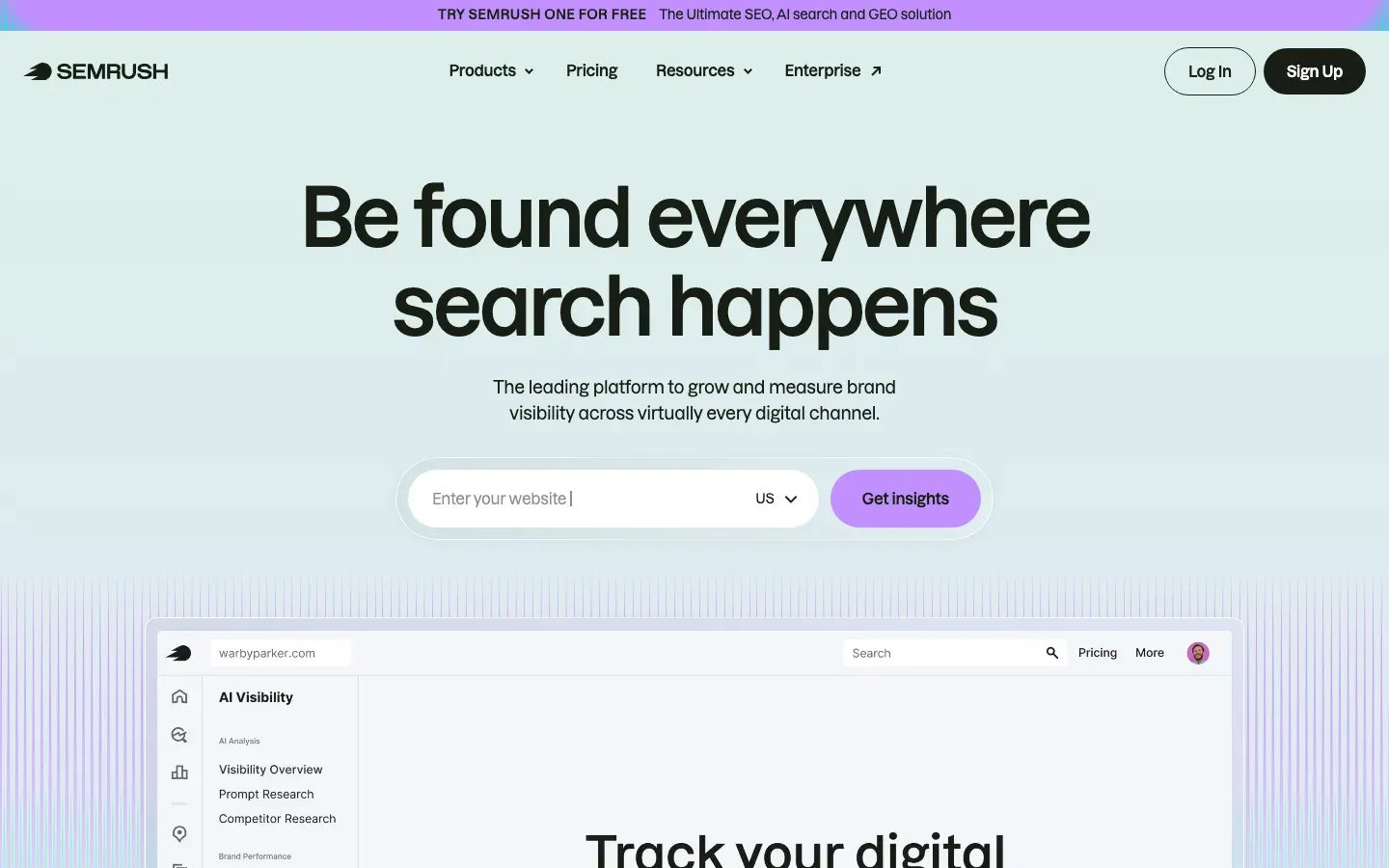
Best for: Marketing teams already on Semrush who want basic AI visibility without switching platforms
An add-on to the Semrush platform, launched in late 2025, and the lowest-friction start for a team already paying for Semrush.
Key features:
- AI Visibility Score built on 130M+ prompts across 8 regions; 25 prompts included, $60/month per 50 more.
- Up to 9 competitors, an AI SEO Audit, Business Landscape reports and sentiment analysis.
- A free AI Search Visibility Checker with limited functionality.
Pricing: $99/month as a standalone add-on; included in Semrush One plans at $199 to $549/month. Additional domains and users at $99 each.
What we found: Coverage is the limit: ChatGPT, Google AI Overviews and Google AI Mode only, with Perplexity, Claude and Copilot absent. Fine if Google’s surfaces are what you care about. Pricing escalates quickly too: one extra teammate and 50 extra prompts take the total to $258/month.
OtterlyAI
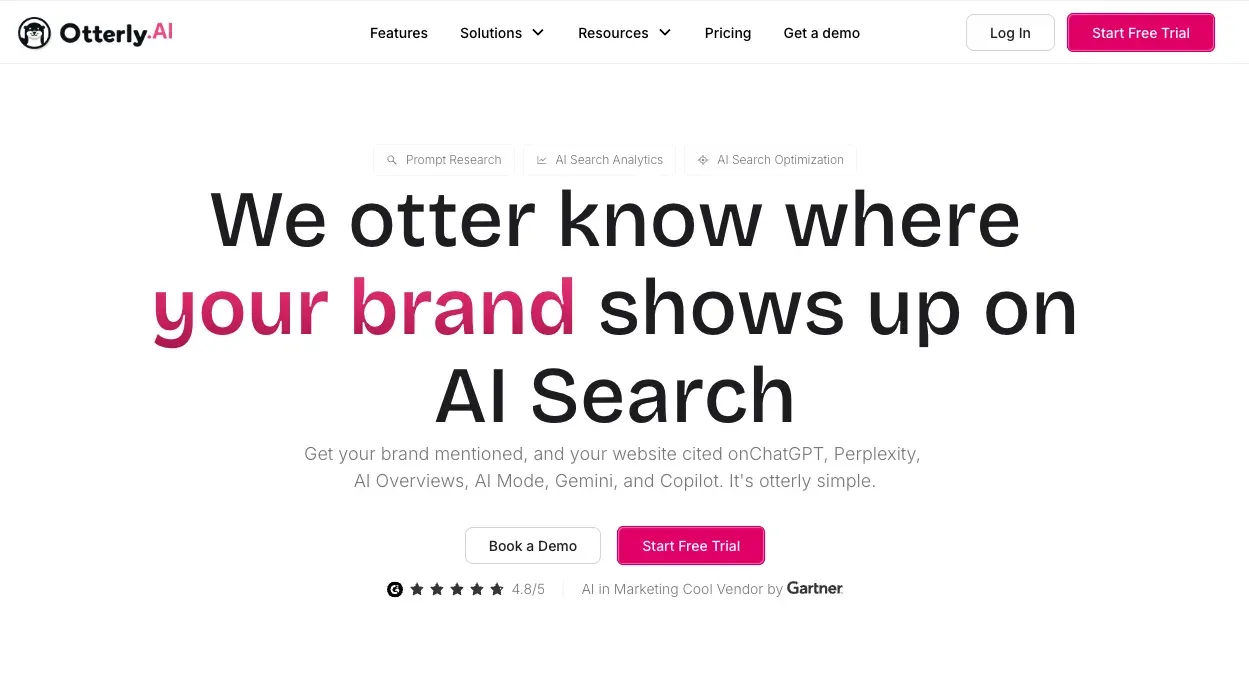
Best for: Marketing teams and agencies wanting monitoring plus optimization
Key features:
- ChatGPT Ads and Shopping tracking.
- Recommendations.
- GEO Audit.
- Agent Analytics.
Pricing: $29/month
What we found: The cheapest way into the category at $29/month, and it pairs monitoring with an optimization layer: the GEO Audit says what to change, and Agent Analytics shows which AI crawlers reach your pages. ChatGPT, Google AI Overviews, Perplexity and Copilot are on every plan; Claude, Gemini and Google AI Mode are add-ons, so price the engines you need before comparing to a flat-rate tool. API and MCP sit on the higher tiers.
Track My Visibility
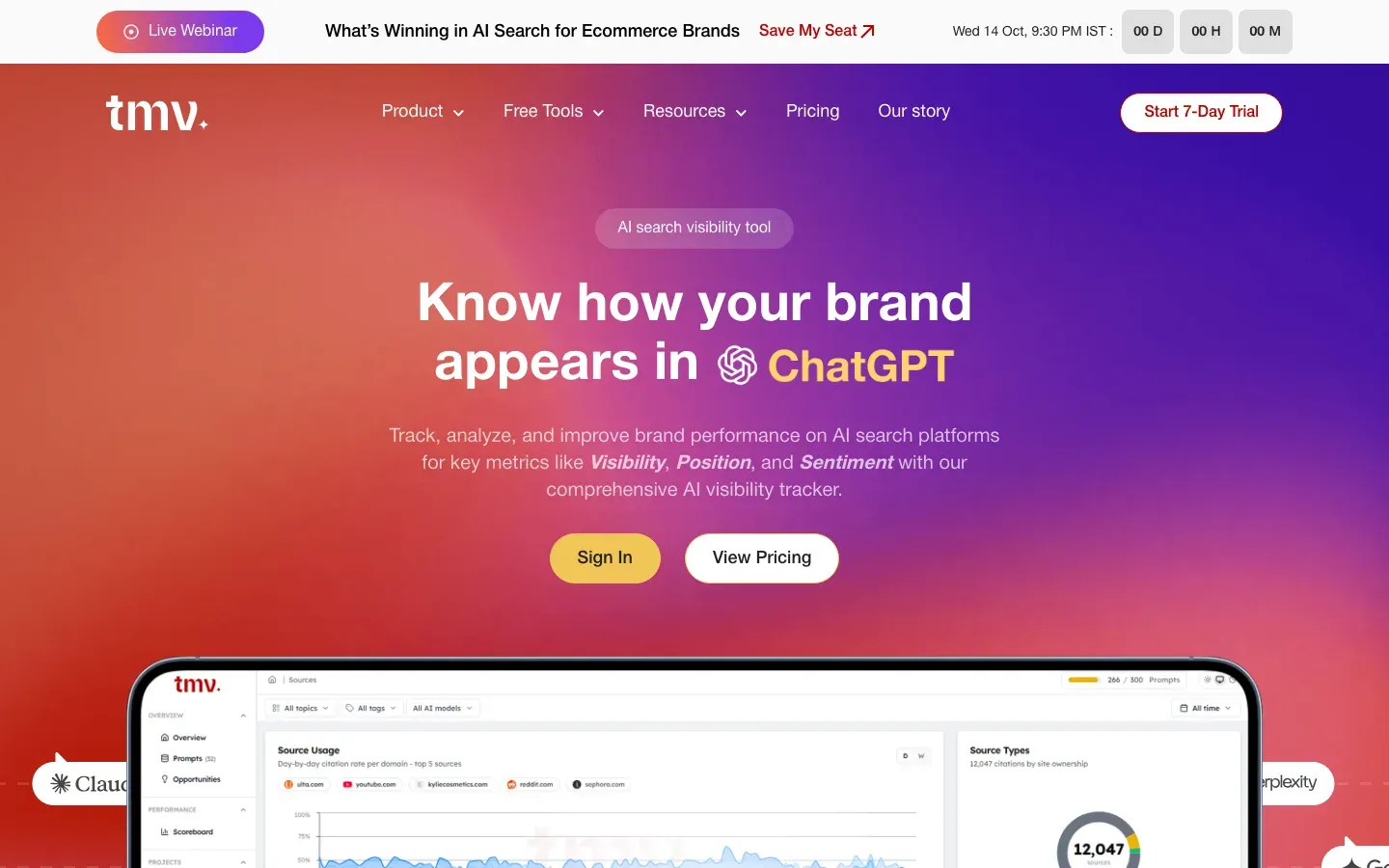
Best for: Brands, SEO teams and agencies that want to track AI search visibility, find the gaps and know what to fix
Track My Visibility (TMV) is an AI search visibility platform that monitors brand mentions, citations and competitor share of voice across ChatGPT, Google AI Overview, Gemini, Perplexity and other AI platforms. Its focus is turning that data into fixes: instead of only reporting where a brand appears, it lists the content gaps, citation opportunities and technical issues that may limit visibility.
Key features:
- Prompt-level monitoring of brand mentions, recommendations and competitor appearances.
- Citation and source tracking: which URLs and domains the engines cite.
- Competitor share-of-voice analysis.
- An Opportunities module with page-specific recommendations on what to fix first.
- Reports on brand performance, competitor comparisons and change over time.
Pricing: A 7-day trial costs $5 (15 prompts, one website, one AI platform). Discover is $89/month (50 prompts a day, two websites, three AI platforms), Growth is $219/month (150 prompts, four websites) and Pro is $429/month (300 prompts, six websites, four AI platforms). Agency plans are custom. Yearly billing gives two months free, which brings Discover to $74/month.
RadarKit
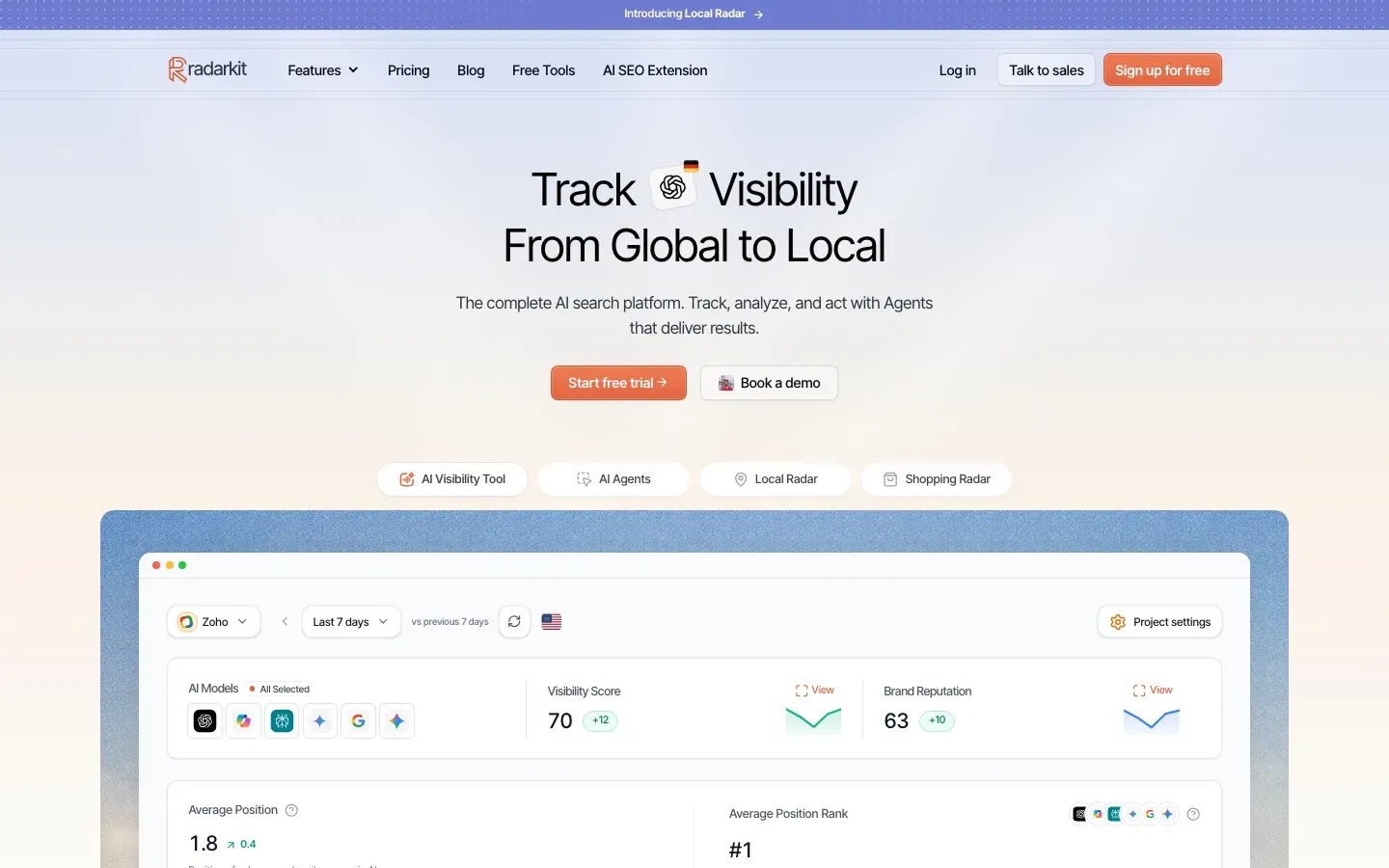
Best for: Brands and agencies tracking AI visibility across several countries or local markets
RadarKit is an AI visibility tracker built around localized tracking. RadarKit says it runs prompts through 4G private proxies of real users, so the results show what people in each market see. It covers ChatGPT, Google AI Overviews, Google AI Mode, Gemini, Perplexity and Copilot on every plan.
Key features:
- Localized tracking in 50+ countries, with state and city tracking on the Enterprise plan.
- Answer data per prompt: brand mentions, cited URLs, rankings inside the answer and the full response.
- Competitor share of voice, sentiment and query fan-out.
- MCP and API access on every plan.
Pricing: Lite is $29/month (15 prompts, refreshed every 72 hours), Growth $79/month (50 prompts, daily), Pro $139/month (100 prompts, daily), and Enterprise is custom. Every plan starts with a 7-day trial.
Omnia
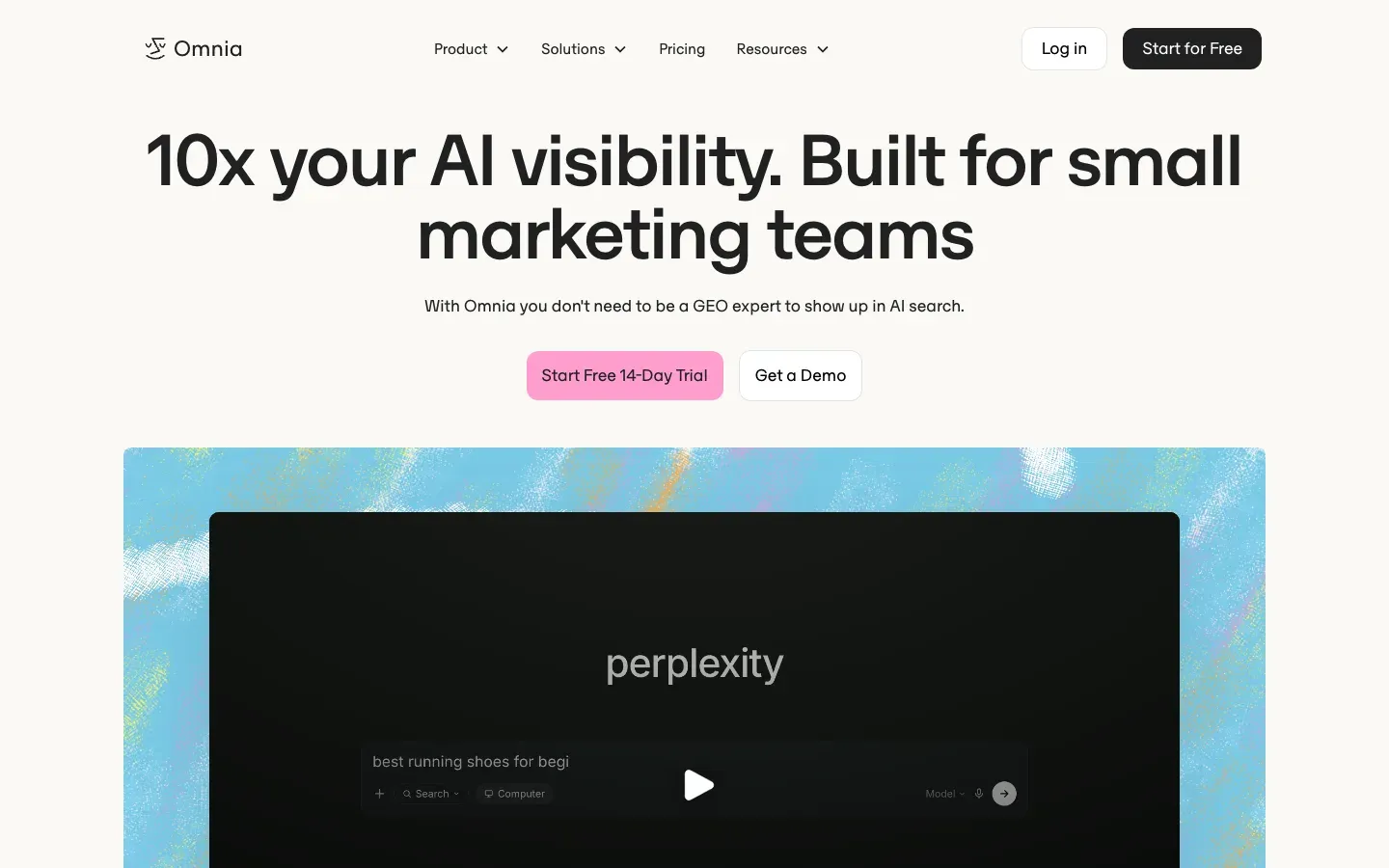
Best for: Small marketing teams that want the visibility gap acted on, not just reported
Omnia tracks brand mentions and share of voice across ChatGPT, Perplexity, Google AI Overview, Google AI Mode, Claude, Copilot, and Gemini: four engines on by default, the other three unlocked per account. What separates it from the rest of this tier is Omnio, an agent layer sitting on top of the monitoring data: instead of a report telling you a citation dropped, Omnio runs the work that addresses it, site audits, answer pages, structured data, comparison content, competitor profiling, digital PR pitches, grounded in the account’s own citation and share-of-voice history.
Key features:
- Omnio agent: runs GEO work against the monitoring gaps, with every publish, send, or spend action gated on approval.
- Daily monitoring with mention rate, share of voice, and citation-level source tracking.
- Sentiment analysis on every tier.
- Unlimited brands, countries, and languages, including on the entry plan.
- REST API and an MCP server, read and write, on every paid tier.
Pricing: Growth at €79/month for 25 prompts, Pro at €279 for 100, Enterprise from €499 for 200 or more. 14-day trial, no card. Insight credits are a second meter on top of prompts: 150, 600, and 1,500 a month by tier, 30 credits per insight, and unused credits roll over rather than expiring.
What we found: Two things are unusual at this price. Omnia ships an agent that acts on the gap it finds, which matters for a team too small to staff the follow-through, and its API and MCP land on the €79 entry tier where the rest of this guide treats both as an enterprise upsell. Data exports are held back to Pro, and four of the seven engines are on by default.
Meteoria
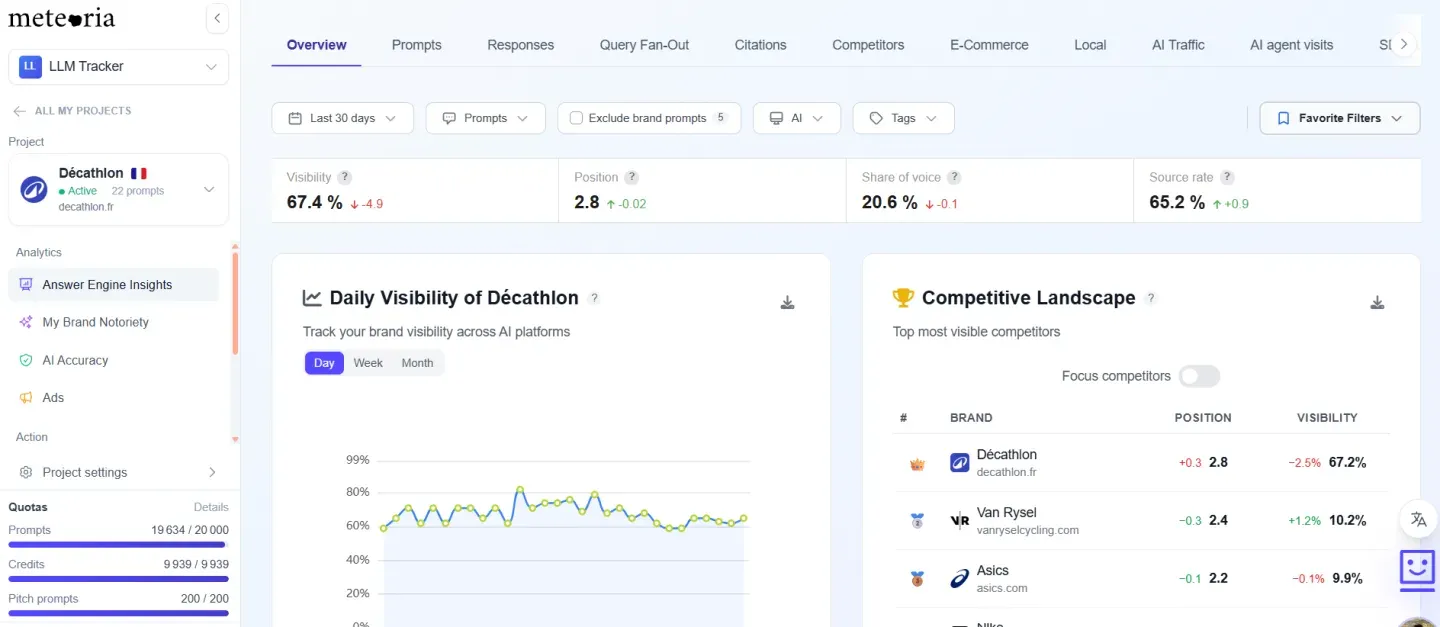
Best for: Small teams and agencies that want the whole prompt set re-run every day rather than weekly
Meteoria is a French GEO platform that runs your prompts daily and reports which brands and sources the answers carry. Its framing is the useful one: not only whether you appear, but which domains and pages the engines pulled to build the answer you appear in.
Key features:
- Daily runs of the full prompt set on every tier, not a weekly refresh.
- Visibility, average position, share of voice and source rate on one overview, with a competitive landscape ranking your brand against the rest of the category.
- Query fan-out reporting on the sub-queries an engine issues before it answers.
- Source and citation analysis showing which domains feed the answers in your category.
- An AI accuracy view for answers that describe the brand wrongly, plus sentiment and brand notoriety reporting.
- Local visibility, e-commerce, AI traffic and AI agent visit views alongside the prompt tracking.
- Content crawl analysis and a Google Analytics integration.
- Multi-project and multi-brand accounts.
Pricing: Starter €75/month for 25 daily prompts, Pro €175 for 100, Advanced €420 for 300; Businesses and Agencies from €300 with custom support. Annual billing gives two months free, and the trial runs 7 days.
What we found: Daily cadence on a €75 tier is the unusual part; most tools at this price refresh weekly and sell daily as an upgrade. Our own take is that weekly is enough for most programmes, so treat it as headroom. Check engine coverage in a demo: the homepage lists seven engines, the product page describes three as daily. No public API is documented, so budget for a dashboard purchase.
Evertune
Best for: Teams measuring brand presence inside AI search and wanting prompt-level analytics on how their category gets answered.
Key features:
- AI brand-search tracking across ChatGPT, Perplexity, and Gemini.
- Prompt-level breakdown of how often a brand surfaces vs. competitors for category queries.
- Reporting designed around share-of-voice in AI answers.
Pricing: Custom (contact required).
What we found: Evertune is analytics and reporting rather than monitoring and alerting: which prompts surface which brands, and where the share-of-voice gaps are, rather than a notice that a citation count moved.
aiclicks.io
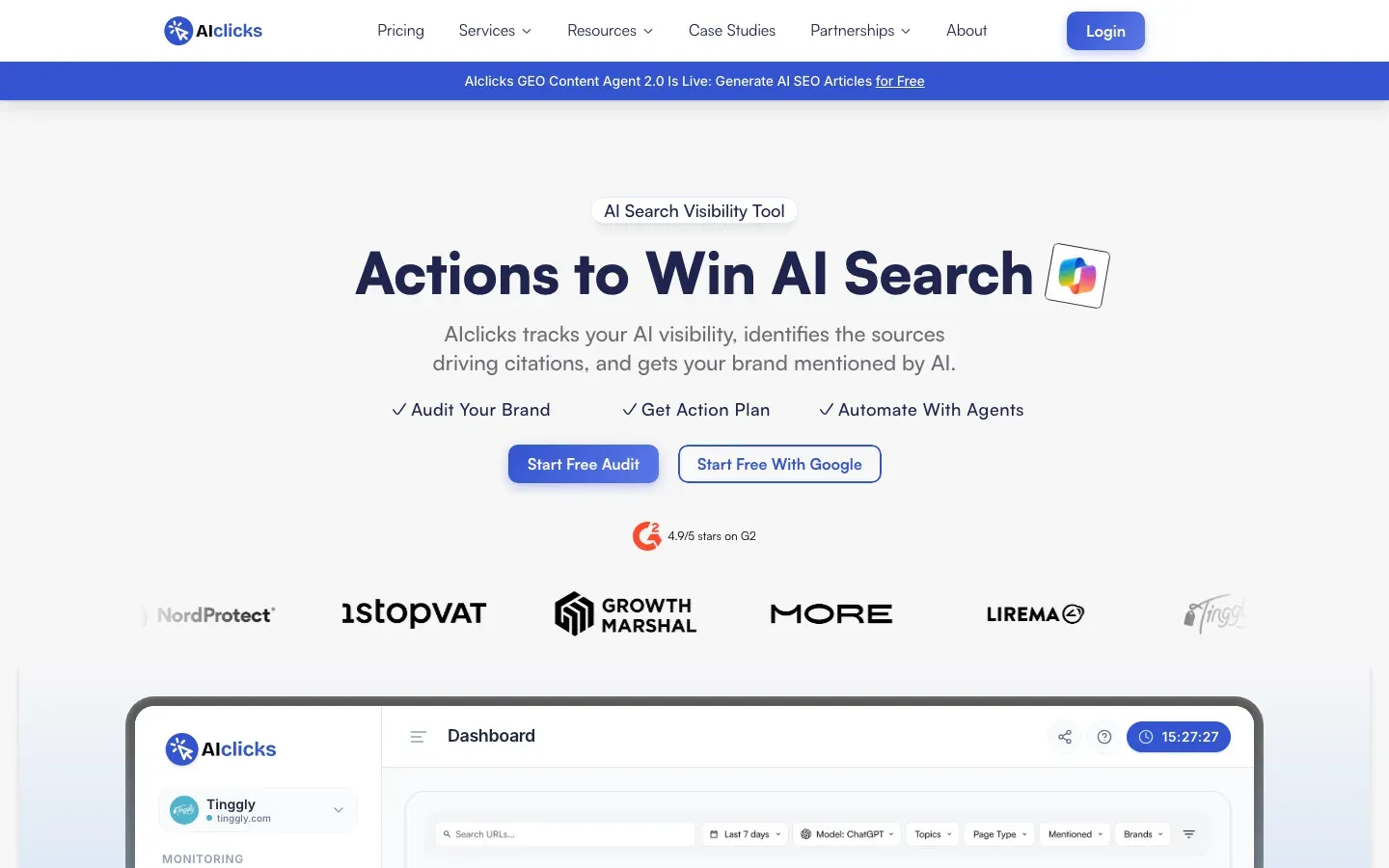
Best for: Teams wanting to track and optimize AI search visibility in one workflow
aiclicks.io covers ChatGPT, Perplexity, Gemini, Copilot, and AI Overviews, with a built-in content creation workflow alongside the tracking features.
Key features:
- Prompt-level visibility and performance analysis.
- Brand mentions, citations, and sentiment tracking.
- Competitor benchmarking and gap analysis.
- AI-optimized content creation workflows with built-in writer.
- Google Search Console integration for technical health.
- Large prompt database covering multiple AI platforms.
Pricing: Starter $59/month (30 prompts, 3 LLMs), Pro $189/month (150 prompts, API and MCP), Business $499/month (300 prompts, 6 LLMs); Enterprise custom. Yearly billing cuts up to 29%, and the trial runs 3 days.
What we found: Combining tracking and content creation in one tool is useful for a solo operator or small team since it reduces the number of tabs you need. The Search Console integration is a practical touch, giving you a side-by-side view of classic search and AI visibility in the same dashboard.
Budget-friendly LLM visibility tools
Ahrefs Brand Radar
Best for: Existing Ahrefs users who want AI visibility without a second subscription
Key features:
- AI tracking for AI Overviews, AI Mode, ChatGPT, Perplexity, Gemini and Copilot.
- Two months of historical data.
- Integration with Ahrefs’ extensive SEO data.
- Brand mention monitoring across web and AI.
Pricing: add-on to an Ahrefs plan, $199/month for one AI engine or $699/month for all engines with 2,500 custom-prompt credits
What we found: Brand Radar fits naturally into the workflow of teams already running Ahrefs for traditional SEO. The AI tracking is built on top of Ahrefs’ substantial prompt corpus. Brand Radar monitors brand visibility across 467M+ monthly prompts per its own product page, and the integration with the rest of the Ahrefs suite is the strongest in the legacy-SEO-plus-AI category.
The authority-to-citation thesis behind the product is supported by Ahrefs’ own 75,000-brand correlation study, which found that branded web mentions and YouTube mentions outperform raw backlink metrics as AI visibility predictors.
DIY approaches for technical teams
Teams with engineering resources sometimes want to build custom LLM visibility pipelines rather than buy a dashboard product. The two most common approaches are scraping-based and API-based.
Hybrid approach
Most engineering teams that go DIY end up with a hybrid: an off-the-shelf tool or API for data collection, with custom analysis and reporting built on top. This gets you to production faster and keeps the maintenance surface small. Feeding structured citation data into a data warehouse and building views from there tends to produce more useful dashboards than any off-the-shelf tool’s built-in reporting.
Another option is to separate AI-search data collection from the visibility dashboard itself. Olostep’s web data API fetches and structures results from ChatGPT, Perplexity, Gemini, Microsoft Copilot, Google AI Overview and Google AI Mode through batch requests and a named parser per platform. That gives engineering and SEO teams a data layer for running AI-search queries at scale, comparing results across engines, running SQL-like queries over the results to pull out insights, and feeding structured output into their own monitoring or reporting.
Which LLM visibility tools offer an API?
Short answer: most of the 12 dashboards above are not API-first, and the ones that expose an API gate it to their higher tiers. If programmatic access is a hard requirement, treat it as a filter to apply before you shortlist, not a box to tick afterwards.
Vendors use the word “API” for three different things: a scheduled CSV or Sheets export, a read API over the dashboard’s own stored results, and a raw data API where you submit any prompt to any surface and get the parsed answer back. Only the third is infrastructure, and it is a different product category from the dashboards above. API access also moves between pricing tiers often enough that any list is stale within a quarter, so confirm against the vendor’s current docs.
One exception worth flagging: Omnia ships both a REST API and an MCP server on every paid tier rather than gating them to an enterprise plan, which is unusual for a dashboard-first tool at this price. Data exports are the part it holds back to the middle tier.
RadarKit is another: its pricing page lists MCP and API access on every plan, from the $29 Lite tier.
The API infrastructure layer
The 12 LLM visibility tools above are all dashboard products. If you need the raw data layer (structured AI answers you can store, join with other datasets, and pipe into your own reporting), these are the APIs that return it. Prices are each vendor’s live rate as of 2026-09-02, in the unit that vendor bills on, because no two of them bill on the same one. cloro is priced at Lite, its $30 tier, so the comparison is against an entry plan rather than a volume one.
| API | AI surfaces returned | Batch or async | Price, live |
|---|---|---|---|
| cloro | ChatGPT, Perplexity, Gemini, Copilot, Grok, Google AI Overview, Google AI Mode, plus Google Search and Google News | Async with webhooks | 4 to 7 credits per AI answer at $0.80 per 1,000 credits on Lite, so $3.20 to $5.60 per 1,000 answers |
| Olostep | ChatGPT, Perplexity, Gemini, Copilot, AI Overview, AI Mode, through a named parser per platform | Batch requests | $99 for 200,000 requests, about $0.50 per 1,000 |
| Bright Data | ChatGPT, Perplexity, Gemini, Copilot, Grok, AI Mode and Google SERP, each as a dataset scraper | Async, poll a snapshot | $1.50 per 1,000 records pay as you go |
| DataForSEO | ChatGPT, Gemini, Claude, Perplexity, AI Overview (AI Optimization API) | Live | $0.60 per 1,000 tasks live, plus the model’s own token charges |
| SerpApi | AI Overview inside the Google SERP and a Google AI Mode endpoint. No ChatGPT or Perplexity | No | $150 for 15,000 searches, $10 per 1,000 |
| ScrapeGraphAI | General LLM scraping API. No named AI-search parser on its pricing page | Not stated | $100 for 100,000 credits; the credit cost of an AI answer is not stated |
Olostep. Best for teams already scraping with Olostep. A named parser per platform across ChatGPT, Perplexity, Gemini, Copilot, AI Overview and AI Mode, batch submitted, and at $99 for 200,000 successful requests the lowest per-request price here. The output is the parsed page, not a citation schema, so share-of-voice math is yours to build.
Bright Data. Best for teams already on a Bright Data contract. Each engine is its own dataset scraper (ChatGPT, Perplexity, Gemini, Copilot, Grok, AI Mode, Google SERP), submitted as a URL and collected by polling a snapshot. $1.50 per 1,000 records pay as you go, $1.30 on the $499 Scale plan. Seven scrapers means seven payload shapes to normalise.
DataForSEO. Best for teams that need Claude, which no other row returns. LLM Responses covers ChatGPT, Gemini, Claude, Perplexity and AI Overview at $0.60 per 1,000 tasks live, with the model’s token charges billed on top, so a long answer costs several times the task fee.
SerpApi. Best for Google-only AI visibility. AI Overview comes back inside the normal Google SERP response and AI Mode has its own endpoint, both parsed. No ChatGPT or Perplexity, and at $10 per 1,000 searches the most expensive row per call.
ScrapeGraphAI. Best for teams that want an LLM-driven scraper for arbitrary pages and will point it at AI engines themselves. Its pricing page lists a search endpoint at 2 to 5 credits per result and no AI-search parser by name, so per-answer cost and coverage are yours to establish.
Verdict. None of the LLM visibility tools above replaces this layer, and on the raw per-answer figure cloro is not the cheapest row; Olostep and Bright Data return the rendered answer for less. cloro’s price buys the parsing: every citation with its URL, position, label and description, the engine’s fan-out queries in the same payload, and nothing charged on a failed extraction. Pick cloro if you want that across every consumer AI surface from one endpoint. Pick Bright Data or Olostep if you already pay them and will own the parsing, DataForSEO if Claude is a hard requirement, and SerpApi only if the question is Google’s AI Overview and AI Mode and nothing else.
cloro
Best for: Teams that want the data rather than someone else’s dashboard: engineers building custom tracking, multi-tenant agency tools, or BI feeds, and SEO and ops teams piping the same data into Sheets, Slack, or a CRM through n8n, Zapier, or MCP
cloro is not a dashboard. It’s an API that returns raw LLM data for you to store and model yourself. One endpoint covers ChatGPT, Perplexity, Gemini, Copilot, Google AI Overview, Google AI Mode, Google Search, and Google News. It returns structured JSON with parsed source URLs, query fan-out terms, and shopping card data, not screenshots.
Key features:
- Single unified API endpoint across all major AI search surfaces.
- Structured JSON responses: cited source URLs with position, label, and description per citation.
- Query fan-out terms showing which sub-queries the AI explored internally.
- Async + webhook support for high-volume batch workloads.
- A
countryparameter per request and prompts in any language, so non-English prompts and local markets run through the same endpoint. - Credits only deducted on successful extraction; failed requests don’t cost you.
- 99.99% uptime SLA; 1,000,000,000+ monthly API calls.
Pricing:
| Plan | Monthly | Credits | Cost per 1,000 credits | Concurrent jobs |
|---|---|---|---|---|
| Lite | $30 | 37,500 | $0.80 | 10 |
| Hobby | $100 | 250,000 | $0.40 | 20 |
| Growth | $500 | 1,350,000 | $0.37 | 75 |
The full ladder, from Free to Enterprise, is on the pricing page; the Free tier refreshes its 500 credits every month. Start with the API docs, or skip the code entirely and run cloro from the n8n node, Zapier app, or MCP server.
What we found: Buying a per-seat dashboard beats building on an API until around 50,000 queries/month or 10+ tracked clients, and then the math flips. At that scale, per-call API pricing undercuts per-seat dashboard pricing by a meaningful margin. Below that threshold, a managed dashboard is faster to stand up. The async endpoint is the right choice for nightly batch jobs; sync adds +2 credits per request but returns results inline.
How to choose: a working decision tree
Matching the LLM visibility tools above to a situation:
- You want the category leader’s dashboard, with sentiment and brand-description alerting built in: Profound.
- You’re already paying for Semrush: the Semrush AI Toolkit add-on is the lowest-friction starting point, with the caveat that Perplexity and Copilot coverage is absent.
- You’re already paying for Ahrefs: Ahrefs Brand Radar is good enough for visibility checks before committing to a second tool.
- You’re an agency managing visibility for many brands: Meteoria, which prices per prompt rather than per seat, or Omnia.
- You’re a solo operator with one brand and a small budget: aiclicks.io or OtterlyAI to start.
- You want every prompt re-run daily rather than weekly, on a small budget: Meteoria runs its whole prompt set each day from the €75 entry tier, where most tools at that price refresh weekly.
- You’re a small marketing team that wants the gap acted on, not just flagged: Omnia. Its Omnio agent runs the fix (audits, answer pages, structured data, PR pitches) against your own monitoring data, with approval gates on anything that publishes or sends.
- You’re an engineer building a custom dashboard, multi-tenant tool, or BI feed: cloro, compared against the other APIs above.
If you frame the same buying decision around answer engine optimization rather than raw LLM tracking, our best AEO tools comparison ranks these platforms by engine coverage, citation intelligence, API access, and price.

About the author
Ricardo Batista
Founder, cloro
Ricardo is one of the founders and engineers behind its SERP and AI-search scraping infrastructure. Before cloro he scaled a financial comparison site to $7M ARR and ran the full-country operations of a unicorn to $65M ARR, then went back to building. He writes about search engine scraping, generative-engine optimization, and turning live search and AI-answer data into something teams can act on.
Frequently asked questions
What's the difference between LLM observability and LLM visibility monitoring?
LLM observability tracks the technical performance of the models your own application calls (tokens, latency, cost, traces, and error rates), using tools like Datadog LLM Observability, LangSmith, and Helicone. LLM visibility monitoring tracks what LLMs say about your brand in their answers: mention rate, citations, and share of voice across ChatGPT, Perplexity, Gemini, and Google AI Overviews. Observability is engineering telemetry for your AI features; visibility monitoring is a marketing and SEO surface. This guide covers visibility monitoring.
What is an LLM visibility tracking tool?
An LLM visibility tracking tool monitors whether and how your brand appears in answers generated by large language models. ChatGPT, Perplexity, Gemini, Google AI Overview, Copilot, AI Mode. The tool runs target queries on a schedule, extracts the AI response and citation list, and reports your brand's mention rate, share of voice versus competitors, and citation count over time.
What's the best LLM visibility tool in 2026?
It depends on your needs. For a polished enterprise dashboard, Profound leads. For a small team that wants every prompt re-run daily at a low price, Meteoria and Omnia are the strongest options. If you already pay for Semrush or Ahrefs, their AI add-ons are the lowest-friction start. Engineers who want the raw citation data rather than a dashboard should look at the API layer at the end of this guide.
What is the difference between an LLM visibility checker and an LLM visibility tracker?
A checker is a one-off read: you run a prompt set now and see whether your brand is named. A tracker runs the same prompts on a schedule and keeps the history, so mention rate becomes a trend you can act on. The practical consequence is that a checker cannot tell you whether last month's content work moved anything, because it stores nothing between runs. Free tools are almost always checkers; every paid tool in this guide is a tracker or better.
Which LLM visibility tools offer an API?
Most of the 15 dashboards in this guide are not API-first, and those that do expose one gate it to higher tiers and rate-limit it against the prompt allowance you already bought. Vendors also use "API" for three different things: scheduled CSV exports, a read API over their own stored results, and a raw data API you can send any prompt to. Only the third can back a product feature. Confirm against current vendor docs, since API access moves between tiers frequently, and see cloro's AI visibility API for the raw-data layer.
Is there a free AI visibility checker?
Yes, several vendors offer a free AI visibility checker for a quick one-off read on how your brand appears in AI answers. Semrush's free AI Search Visibility Checker and the limited tiers of tools like Ahrefs Brand Radar let you spot-check a handful of prompts without a paid plan. Free checkers are fine for a single snapshot, but they don't build the citation history, share-of-voice trend, and change detection that a paid AI visibility tool provides, for ongoing monitoring you need scheduled tracking, not a one-time check.
What is AI rank tracking?
AI rank tracking measures a brand's inclusion in AI-generated answers using prompts as the core unit of measurement, rather than traditional keyword-to-URL position. Instead of asking 'what position does my URL rank at?', it asks 'does my brand appear in the AI answer for this query, and is my URL cited as a source?'
What is citation rate in AI search?
Citation rate is the share of AI-generated answers that include a specific URL as a cited source. It is the primary KPI for AI SEO work, replacing traditional click-through rate. A page can rank #1 in organic search and still have a near-zero citation rate in AI answers. The two metrics are largely independent.
How often should LLM visibility tracking run?
Monthly is the floor for trend monitoring. Weekly is appropriate for active brand-management programs. Daily is overkill. AI engines don't update citation patterns that fast, and you'll burn API credits without learning anything new. Crisis situations (PR events, product launches) justify daily checks for the duration of the event.
Can I track LLM visibility without a paid tool?
For under ~20 queries, yes. You can run them manually and track results in a spreadsheet. Above that, the data structures you'll build (citation history, share-of-voice tracking, change detection) are essentially what these tools provide off the shelf, and at small scale a $40 to 100/month tool will pay for itself in saved hours within the first week.
What metrics do LLM visibility tools actually track?
The four foundational metrics are: (1) mention rate: % of target queries that include your brand; (2) share of voice: your mentions divided by total competitor mentions; (3) citation rate, % of mentions that include your URL as a source; (4) sentiment, whether the mention is positive, neutral, or negative. Some tools layer additional features like prompt-pattern analysis and competitor gap reporting on top.
Which AI visibility platform reports the most complete metric set?
No platform in this roundup reports all five well, so pick by the metric you report to the business. Evertune is built around share of voice, Peec AI and Gauge lead on citation-level detail, Profound treats sentiment and accuracy as first-class, and OtterlyAI is the strongest on citation rate at a budget price. Read the metric definitions in our AI visibility metrics guide before comparing numbers across tools.
How do LLM visibility tools differ from traditional SEO tools?
Traditional SEO tools (Ahrefs, Semrush, etc.) track classic Google rankings. What URL appears at what position. LLM visibility tools track whether your brand is named or cited in an AI-generated answer, which is a different surface with different ranking factors. The two complement each other; neither replaces the other in 2026.
Related reading
Best AI SEO Tools 2026: 11 Dashboards Compared
We compared 11 AI SEO tools across citation tracking, content optimization, and full suites. Compare pricing, engine coverage, and the real trade-offs.
ChatGPT Visibility Tracker: Track Your Brand Mentions
Learn how a ChatGPT visibility tracker works, run a free manual baseline, and compare the best tools to monitor your brand mentions in AI search.

How to Make ChatGPT Recommend Website Pages Like Yours
Learn how to get ChatGPT to recommend your website: content structure, authority signals, and technical fixes that lift your link inclusion rate.