
GEO Checklist: 12 On-Page Changes That Win Generative Search
This is the 12-item on-page checklist we run on content programs to actually move AI citation rate. It’s not a theory list — every item has been tested across multiple categories over the past 18 months, ordered by impact-per-effort, and includes the why, the how, and the expected impact. If you implement the top 3 items rigorously, you’ll see meaningful citation-rate movement within 4–6 weeks. The full 12-item program typically delivers the citation-rate plateau within 12–16 weeks.
If you want the conceptual framing first, see what is GEO and GEO services compared for the agency and platform landscape.
How to use this checklist
The 12 items are sequenced by impact per editorial hour. The top 3 are the highest-leverage items; the bottom 4 are small refinements worth doing once the bigger items are landed. Don’t try to do all 12 simultaneously — the editorial focus dilutes and time-to-impact slows. Instead, take the top 3 first, measure the citation-rate response over 4–6 weeks, then layer in the next batch.
For measurement, you need a tool that tracks citation rate across AI engines on weekly cadence. We’ve used cloro’s API for the underlying data and either built a custom dashboard or paired with Peec AI for the visualization layer.
Tier 1 — Highest impact, do these first
1. Add original first-party data
Why it matters: AI engines preferentially cite content with first-party data because it’s the most-distinctive content in their training and retrieval surfaces. A post with “we surveyed 500 marketers and 67% reported X” gets cited as the canonical source; a post that summarizes other people’s data gets cited rarely if at all.
How to do it: identify 3–5 questions in your category where original data would be valuable. Run small surveys (Typeform, Google Forms), pull internal analytics where you have it, or run public benchmarks against competitor products. Publish the data with clear attribution and a stable canonical URL.
Expected impact: 3–5× citation rate lift on the specific queries where the data is relevant. The single highest-leverage change in this list.
2. Open every post with a clear “X is Y” definition
Why it matters: AI engines lift definitions verbatim when answering “what is X” queries. Content that opens with a crisp definitional sentence gets cited as the canonical answer; content that opens with throat-clearing (“In today’s digital landscape…”) gets skipped over.
How to do it: every post on a definable concept opens with one sentence in the form “X is Y” — a complete, standalone definition that an AI could quote without context. Edit existing posts to add this if missing.
Expected impact: 2–3× citation rate on definitional queries, with a smaller halo effect on related queries.
3. Add structured comparison tables
Why it matters: AI engines lift comparison tables verbatim when answering comparison queries (“X vs Y”, “best X for Y”). The tabular structure is unambiguously parseable and the data is concise — exactly the shape LLMs preferentially cite.
How to do it: any comparison post (X vs Y, best of category, alternatives) gets at least one comparison table with consistent columns. Place the table near the top of the post for easy AI extraction.
Expected impact: 2–4× citation rate on comparison queries.
Tier 2 — Mid-impact, do these next
4. Add explicit timestamps and “updated” dates
Why it matters: AI engines preferentially cite recent content for non-evergreen queries. A visible “Updated 2026” line signals freshness; absent or stale dates push the post down the citation order.
How to do it: every post displays the publish date and (if applicable) the most-recent update date prominently near the title. Update older posts that still rank — even if the content changes are minor.
Expected impact: 30–60% citation rate lift on time-sensitive queries.
5. Add FAQ sections with FAQPage schema
Why it matters: AI engines disproportionately cite FAQ-formatted content because the Q-and-A structure is a perfect summarization unit. FAQPage schema makes the structure machine-readable and accelerates ingestion into AI training and retrieval pipelines.
How to do it: every substantive post gets 4–6 FAQ items addressing People-Also-Ask-style questions. Mark up with FAQPage schema (most blog templates support this from frontmatter; ours emits it automatically when faqs: is present in frontmatter). For deeper schema discussion, see schema markup for AI.
Expected impact: 50–80% citation rate lift on PAA-style queries.
6. Add author bylines and credentials
Why it matters: AI engines have started weighting author credibility, similar to E-E-A-T signals in SEO. Anonymous content gets cited less; author-attributed content with visible credentials gets cited more.
How to do it: every post displays an author byline. For YMYL-adjacent topics (legal, medical, financial), add credentials inline (“Written by [Name], former [credential]”). For non-YMYL topics, a byline alone is sufficient.
Expected impact: 20–40% citation rate lift, larger on YMYL-adjacent content.
7. Use distinctive, opinionated framings
Why it matters: AI engines cite content that stakes out a clear position more often than bland summaries. “Most [X] are wrong about [Y]” or “Stop doing [Z]” framings get pulled into answers as a counterpoint or perspective; non-committal “it depends” content gets skipped.
How to do it: every post earns a thesis. Bland descriptive titles (“A guide to X”) get rewritten as opinionated framings (“Why X is broken in 2026” or “The right way to do X”). The opinion has to be defensible, not just clickbait.
Expected impact: 25–50% citation rate lift on opinion-adjacent queries.
8. Add internal links with descriptive anchor text
Why it matters: AI engines use internal-link patterns to understand topical clusters. Descriptive anchor text (“our GEO checklist” rather than “click here”) signals which content covers which topic, and the cluster signal compounds across the site.
How to do it: every post links to 3–5 related posts with anchor text that includes the target post’s primary keyword. Audit existing posts for “click here” / “learn more” patterns and rewrite.
Expected impact: 15–30% citation rate lift, mostly indirect through stronger topical authority.
Tier 3 — Refinements, do these last
9. Add visible source citations within the body
Why it matters: content that cites sources gets cited as a source. Visible citation patterns inside your content (with linked references) signal to AI engines that this is a high-citation-quality piece, and the citation pattern propagates to how you’re cited downstream.
How to do it: any factual claim or stat gets a linked source nearby. Use <a href> inline rather than a footnote pile at the bottom; AI engines preferentially cite content where attribution is co-located with the claim.
Expected impact: 10–20% citation rate lift, larger on data-heavy content.
10. Optimize for excerpt-friendly paragraphs
Why it matters: AI engines extract paragraph-sized chunks when generating answers. Paragraphs that stand alone — make sense without surrounding context — get extracted and cited. Paragraphs that depend on the prior paragraph for context get skipped.
How to do it: every paragraph in long-form content can stand alone. The first sentence makes the point; the rest of the paragraph supports it. Ban the “as I mentioned earlier” / “as we’ll see below” pattern from body copy.
Expected impact: 10–20% citation rate lift on long-form content.
11. Use semantic HTML headings consistently
Why it matters: AI engines use heading hierarchy to understand content structure. Posts with clean H1 → H2 → H3 hierarchy get parsed cleanly; posts that skip levels or use headings cosmetically (large bolded text instead of H2) confuse the parser.
How to do it: H1 is the post title (one per page). H2s are major sections. H3s are sub-sections. Don’t skip levels (no H1 → H3). Most blog platforms emit this correctly from Markdown; verify your specific template.
Expected impact: 5–15% citation rate lift, mostly indirect through better content parsing.
12. Add canonical and structured data signals
Why it matters: schema markup is how content tells AI engines “this is an article”, “this is a how-to”, “this is a comparison”. The free Google Rich Results Test validates the most-important schema types. Schema markup is a cheap, additive win.
How to do it: Article or BlogPosting schema on every post (most blog templates emit this automatically). HowTo schema on tutorial posts. FAQPage schema on FAQ-bearing posts (covered in item #5). Validate via the Rich Results Test before publishing.
Expected impact: 5–15% citation rate lift, larger when schema was previously missing.
How to measure the impact
Track citation rate weekly using a measurement tool — cloro’s API, Peec AI, OtterlyAI, or similar. Compute 4-week rolling averages and compare before/after each tier. Don’t compare day-to-day numbers; AI engines have enough variance that single-day comparisons are noise.
Expected timeline:
- Tier 1 (items 1–3) implemented week 1 → measurable citation-rate movement weeks 4–6
- Tier 2 (items 4–8) implemented weeks 2–4 → cumulative lift visible weeks 6–10
- Tier 3 (items 9–12) implemented weeks 5–8 → final plateau weeks 12–16
If you don’t see movement within 6 weeks of Tier 1 implementation, the issue is usually content quality (the original data isn’t actually distinctive, the definitions aren’t actually clear) rather than a tooling or measurement problem. Audit a few specific queries manually in the AI engines and compare the cited content to yours.
Bottom line
The 12 items are not novel individually — most appear in any half-decent SEO checklist. What’s distinctive is the ordering by GEO-specific impact, the citation-rate measurement loop that makes the checklist falsifiable, and the editorial discipline of running it as a sequenced program rather than a one-shot audit.
Start with the top 3. Measure the response. Then layer in the rest. The citation-rate plateau usually arrives within 12–16 weeks of starting the program, and the floor it establishes typically holds for 6–12 months before the next AI-engine model update shifts the optimization surface again.
For the platform and agency landscape, see GEO services compared. For the broader strategic framing, see what is GEO.
Frequently asked questions
Which GEO change has the biggest impact on citation rate?+
Adding original first-party data to existing content. Posts with data the AI can lift verbatim (benchmarks, survey results, internal analytics) get cited at 3-5× the rate of summary posts in our testing. The change costs editorial time but no infrastructure; it's the highest-leverage single move on this checklist.
How long does it take to see GEO changes reflected in AI citations?+
Faster than SEO, slower than instant. The major engines (ChatGPT, Perplexity) re-crawl and re-index aggressively — meaningful citation-rate movement typically shows within 2-6 weeks of a content change. Google AI Overview is slower because it's tied to Google's main index refresh. The full citation-pattern shift after a comprehensive GEO program typically takes 8-16 weeks.
Do these changes also help SEO?+
Most of them, yes. Strong content shapes (clear definitions, original data, structured comparisons, distinctive opinion) help both SEO and GEO. The 12 changes below have minimal cases where they trade off against SEO. The schema-markup and structured-data items are pure additive wins. Where the disciplines diverge is in optimization tactics around clickability vs summarizability — see [what is GEO](/blog/what_is_geo/).
Should I run all 12 changes at once or sequence them?+
Sequence by impact-per-effort. The top 3 (original data, clear definitions, structured comparisons) deliver most of the citation-rate lift in our testing and are the cheapest to implement. The next 5 are mid-impact / mid-effort. The last 4 are small refinements worth doing once the bigger items are landed. Trying to do all 12 simultaneously dilutes editorial focus and slows time-to-impact.
How do I measure whether the checklist is working?+
Track mention rate and citation rate weekly across your top 5 AI engines using a measurement tool ([cloro's API](/ai-visibility-tracking/), Peec AI, OtterlyAI, or similar). Compare 4-week rolling averages before and after each major change. Don't compare day-to-day numbers; AI engines have enough variance that single-day comparisons are noise. We laid out the measurement framework in [AI brand visibility measurement framework](/blog/ai-brand-visibility-measurement-framework/).
Related reading
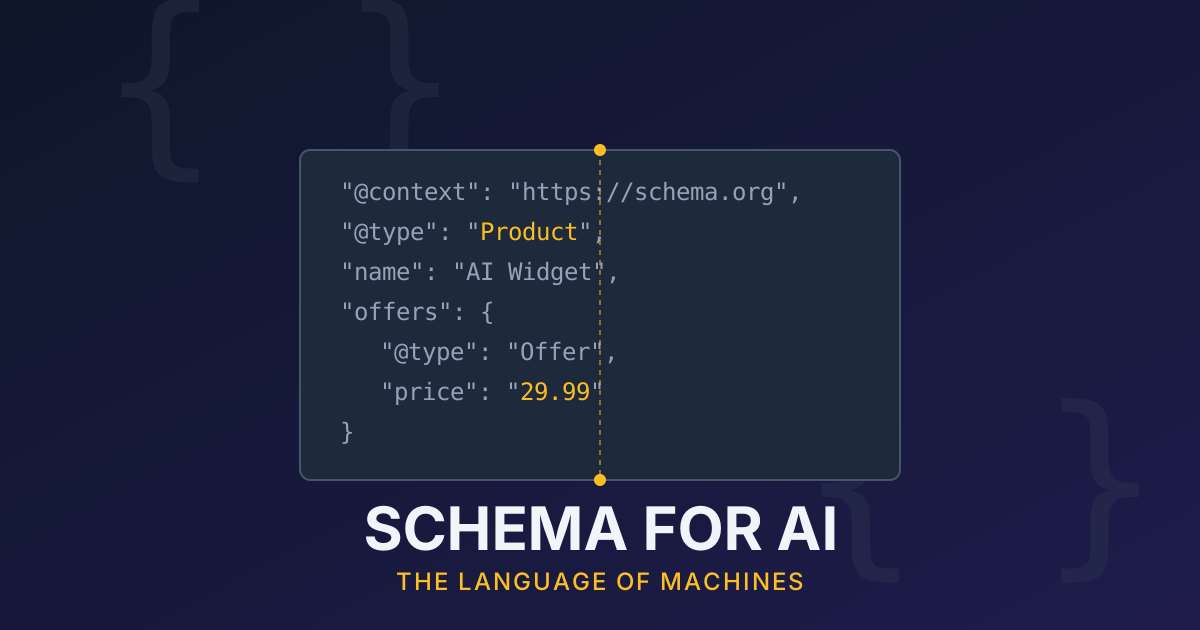
Schema markup for AI: speaking the language of machines
Schema markup isn't just for Google anymore. Learn how structured data helps ChatGPT, Gemini, and Perplexity understand your content and cite your brand.

What is Generative Engine Optimization (GEO)?
The complete guide to optimizing your content for AI search engines like ChatGPT, Perplexity, and Google AI Overviews.
GEO Services in 2026: 7 Platforms and Agencies Compared
GEO services compared — measurement platforms, specialist tools, and agency engagements. We tested 7 options on real generative engine optimization workflows. Honest breakdown.