
GEO Services in 2026: 7 Platforms and Agencies Compared

On this page
The GEO services market is roughly 18 months old in 2026 and still consolidating. We tested 7 options that span the spectrum from full-service agencies to self-serve platforms (Profound, Peec AI, OtterlyAI, AthenaHQ, Brandlight, FirstAnswer.ai, and a representative GEO agency engagement) on the same brand-monitoring workflow over four weeks. What each option is good at, where each one falls short, and which to pick depending on your team’s setup.
If you’re earlier in the decision and want the conceptual framing, see what is GEO.
The seven options
| Option | Type | Mid-tier price | Best for |
|---|---|---|---|
| Profound | Platform (enterprise) | Enterprise tier | Enterprise programs with brand-intelligence teams |
| Peec AI | Platform (mid-market) | $200–400/mo | Marketing teams, dashboard-first |
| OtterlyAI | Platform (analyst-leaning) | $250–500/mo | Analyst-led teams, citation-rate focus |
| AthenaHQ | Platform (enterprise) | Enterprise tier | Audience-segmented enterprise reporting |
| Brandlight | Platform (mid-market) | $200–400/mo | Cleanest competitor-tracking workflow |
| FirstAnswer.ai | Platform (specialist) | Plan-dependent | AI-answer-quality analysis |
| GEO agency (representative) | Managed service | $5K–15K/mo retainer | Brands without an in-house content team |
1. Profound: enterprise platform
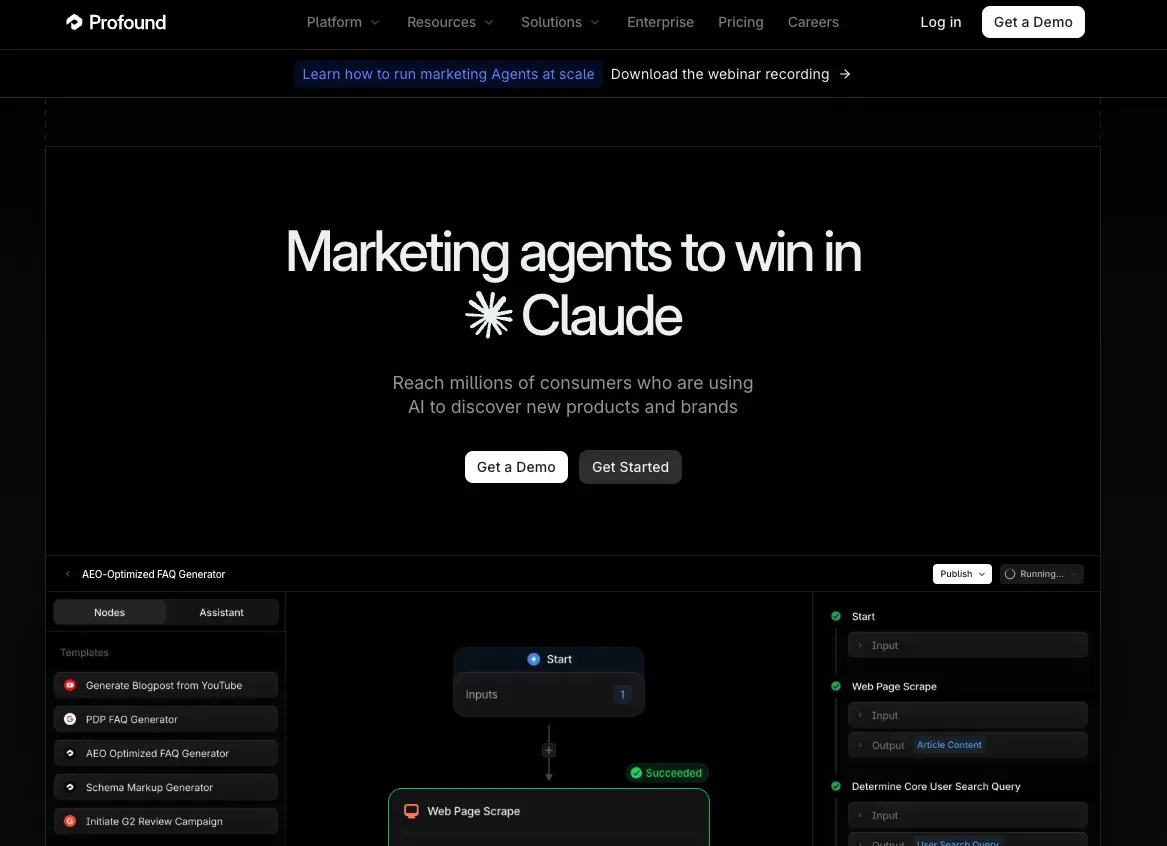
Profound is the polish standard. Strong AI Overview reporting, deep competitive-intelligence workflows, mature SOC 2 and procurement story. Pricing starts north of where mid-market budgets land.
Pick if you have enterprise budget, a dedicated brand intelligence function, and polished stakeholder reporting matters.
Where it loses. Price point excludes mid-market, and data-model lock-in limits custom segmentation. We covered Profound alternatives at length in Profound alternatives: 5 AI brand monitoring platforms compared.
2. Peec AI: best mid-market dashboard-first platform
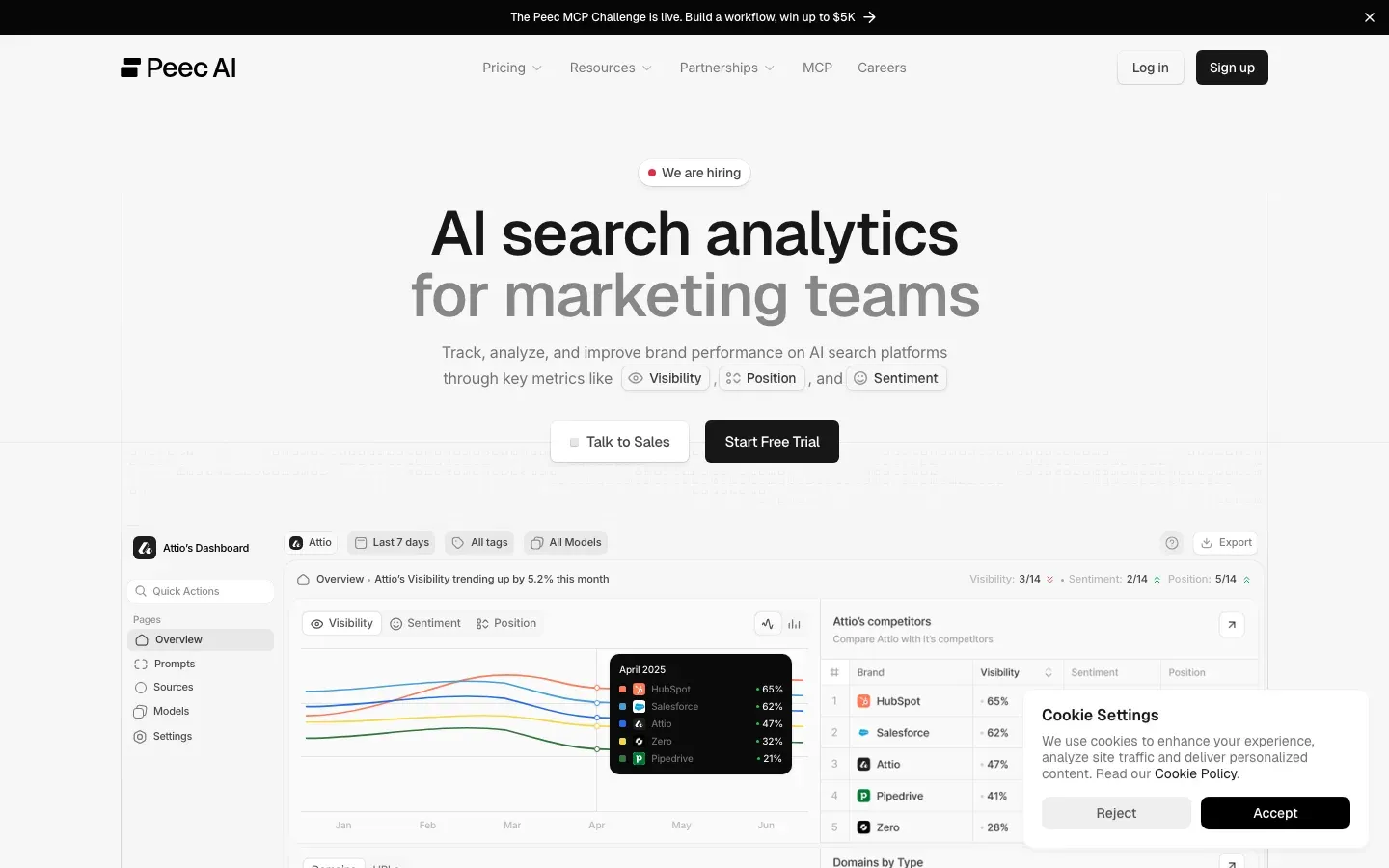
The most polished mid-market dashboard. Marketing-team-friendly UI, strong competitor-tracking workflows, and the recurring stakeholder report ships out of the box.
Pick if the marketing team owns the program, you want a dashboard-first posture, and you’re on a mid-market budget.
Where it loses. Limited custom segmentation, plus data-model lock-in. See LLM visibility tracking tools.
3. OtterlyAI: analyst-led platform
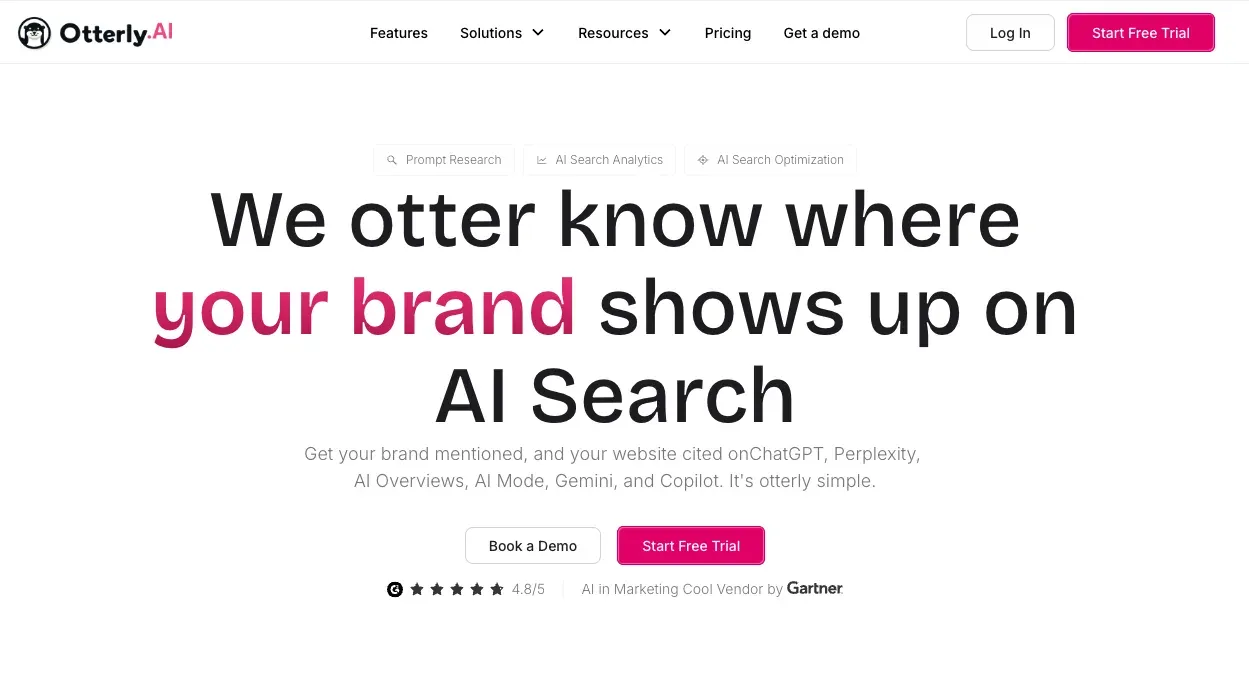
Middle ground between Peec AI’s polish and a fully data-warehouse-driven approach. First-class CSV export, with citation rate as a primary metric.
Pick if you have an analyst on the team, citation rate matters, and you need balanced UI/data.
4. AthenaHQ: enterprise audience-segmented platform
Profound’s enterprise polish plus stronger audience-segmented reporting. Share of voice by buyer persona, product line, or geo.
Pick if you’re enterprise and audience segmentation is a primary use case.
5. Brandlight: cleanest competitor-tracking workflow
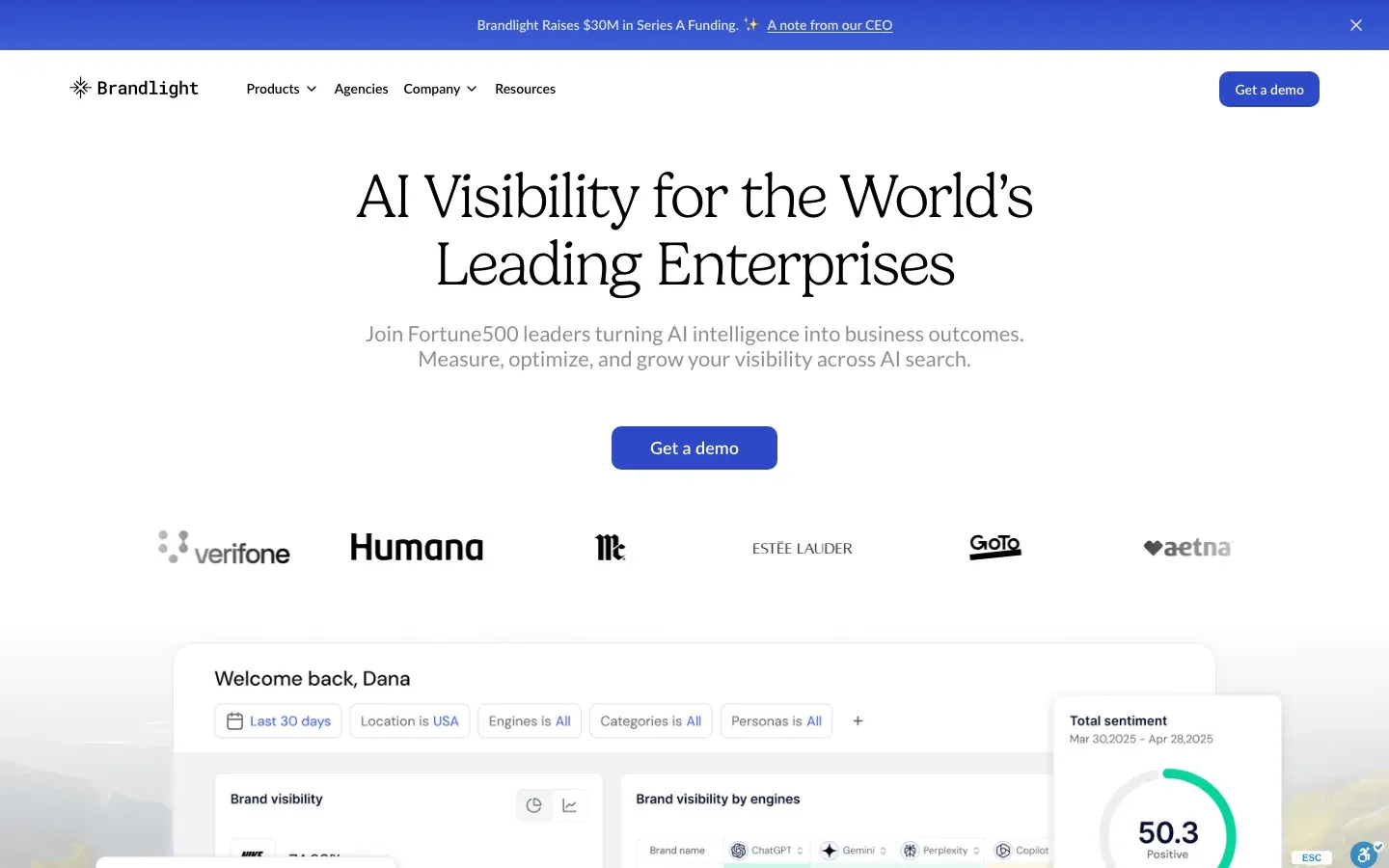
The cleanest UI for “track 5–10 competitors, fixed query set, weekly diffs”. If competitor tracking is your single primary use case, Brandlight delivers.
Pick if competitor tracking is the primary GEO workflow and you’re on a mid-market budget.
6. FirstAnswer.ai: answer-quality specialist
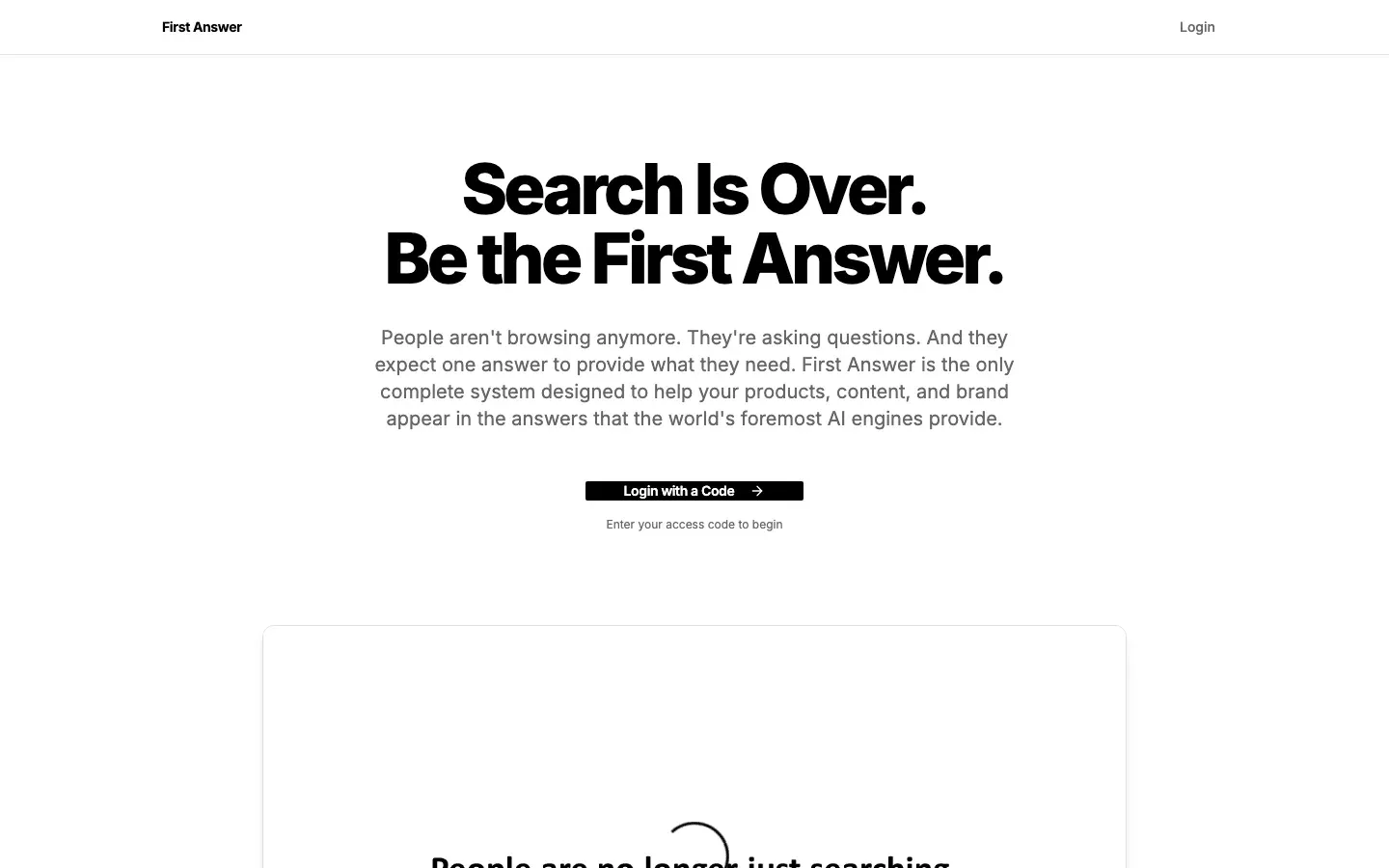
Differentiates on answer-quality analysis. Not just whether you appeared, but how the AI characterized you (positively, negatively, completely, partially).
Pick if AI-answer-quality is a primary concern, or you have brand reputation risk in AI answers.
7. GEO agency (representative): managed service
A typical GEO agency engagement bundles measurement, strategic content guidance, and execution. The agency handles the platform decision (usually pairing Peec AI or Profound with their own analyst team), produces or restructures content for GEO outcomes, and reports monthly.
Mid-market retainer: $5K–15K/month. Enterprise: $15K–50K/month including content production.
Pick if you have no in-house content team, want managed execution, and are willing to pay for the convenience of a single point of contact.
Where it loses. Agencies vary wildly in maturity for an 18-month-old discipline. You’re paying for analyst time that may not be more sophisticated than your in-house team would be after a brief training investment.
Decision tree
| Your situation | Pick |
|---|---|
| In-house content team, mid-market budget, marketing-team-led | Peec AI or Brandlight |
| In-house team, analyst-leaning, citation-rate focus | OtterlyAI |
| Enterprise, polished stakeholder reporting | Profound or AthenaHQ |
| AI-answer-quality is the primary concern | FirstAnswer.ai |
| No in-house content team, want managed execution | GEO agency |
| Hybrid: mid-market platform for departmental + enterprise platform for board | Two platforms in parallel |
What to ask before signing with a GEO agency
The market is young and quality varies. Before committing to a $5K+/month retainer, ask:
- Which engines do you cover and how often? Anything less than 5-engine coverage on weekly cadence is below market in 2026.
- What’s your measurement methodology? Mention rate, citation rate, share of voice, and how each is computed. Vague answers are a red flag.
- What does your content production process look like? Hand-drafted by analysts, AI-assisted with editorial review, or fully AI-generated? The first two are defensible. The third is risky.
- Can I see anonymized client outcomes? Mention rate before/after on a real engagement, with timeline. If they can’t share, they’re either too new or the outcomes aren’t compelling.
- What happens if I want to leave? Data ownership, content ownership, cancellation terms.
What to ask before signing with a GEO platform
For the dashboard-first platforms (Peec AI, OtterlyAI, Profound, AthenaHQ, Brandlight, FirstAnswer.ai):
- Engine coverage and pricing tier. Tier 1 (ChatGPT, Perplexity, AI Overview) should be standard at mid-tier. Coverage of AI Mode/Copilot/Grok should be explicit, not buried in plan footnotes.
- Data export. CSV, API access, integration with your warehouse: what’s available at which tier.
- Custom segmentation. Can you slice mention rate by content cluster, audience segment, or competitor cohort? Or only by the platform’s pre-defined slices?
- SLA on engine updates. When OpenAI ships a new ChatGPT model that changes citation patterns, how fast does the platform reflect it?
- Pricing transparency. Is the pricing on the public site representative, or is “contact us” the floor? The latter is fine for enterprise but should not be the case for $200–500/month tiers.
Bottom line
For most teams in 2026, the right answer is a platform, not an agency. Agencies make sense for brands without in-house content capacity, but the platforms have matured enough that a competent in-house team plus 6–12 hours of GEO training can replicate most of what an agency provides at one-tenth the cost.
The platform pick depends on your audience. Peec AI for marketing teams, OtterlyAI for analysts, Profound or AthenaHQ for enterprise, Brandlight for competitor-tracking-led programs. For a deeper four-way comparison of the most-shortlisted platforms, see LLM visibility tracking tools. For the broader Profound alternatives breakdown, see Profound alternatives: 5 AI brand monitoring platforms compared.
Frequently asked questions
What are GEO services?+
GEO services are platforms, specialist tools, or agency engagements that help brands optimize for citation in AI-generated answers (ChatGPT, Perplexity, Gemini, Google AI Overview). They typically combine measurement (which queries does the brand appear on, with what citation rate), strategic content guidance (what content shapes earn AI citations in the brand's category), and execution (writing or restructuring content for GEO outcomes). The market is roughly 18 months old in 2026, so the field is still consolidating.
Should I hire a GEO agency or use a self-serve platform?+
Depends on your existing content team. Brands with a mature content function should bring GEO in-house with a measurement platform (Peec AI, OtterlyAI, Profound, AthenaHQ) plus a 6-12 hour training investment for the existing team. Brands without a content function or with limited bandwidth get faster results from a GEO agency that handles measurement, strategy, and execution as a managed service. The hybrid pattern (in-house team + agency for specialist content production) is also common.
How is GEO different from regular SEO services?+
GEO services optimize for AI citation specifically — content shapes that LLMs preferentially cite, structured data that AI training pipelines preferentially ingest, source-attribution patterns that drive citation rate. Regular SEO services optimize for traditional rank position. The two disciplines overlap (the underlying inputs of strong content and topical authority are shared), but the measurement surfaces and tactical layer differ. We covered this in detail in what is GEO.
What does a GEO service cost?+
Self-serve platforms run $200-500/month at the mid-tier (Peec AI, OtterlyAI, Brandlight) and enterprise tier (Profound, AthenaHQ) at the upper end. Mid-market GEO retainers run $5K-15K/month for managed measurement-and-strategy programs. Larger enterprise programs that include content production can run $15K-50K/month.
Which engines do GEO services usually cover?+
Coverage parity has improved across the market in 2026. The mature platforms (Peec AI, OtterlyAI, Profound, AthenaHQ) and most agencies cover the major engines (ChatGPT, Perplexity, Gemini, Google AI Overview) as standard. Coverage of the longer-tail engines (AI Mode, Copilot, Grok) is plan-dependent for the platforms and uneven across agencies.
Related reading

GEO Checklist: 12 On-Page Changes for AI Citations
Use this GEO checklist to improve AI citations: crawler access, schema, answer-first content, internal links, authority signals, and tracking.
What Is Generative Engine Optimization (GEO)?
Generative engine optimization helps AI engines cite your brand. Learn GEO ranking factors, content structure, schema, measurement, and tools.
Profound Alternatives: 5 AI Brand Monitors (2026)
Profound alternatives compared — Peec AI, OtterlyAI, AthenaHQ, Brandlight, FirstAnswer.ai. Engine coverage, pricing, dashboard depth, and when each one fits.