
Cheapest SERP API 2026: True Cost-per-Call Compared

On this page
Looking for the cheapest SERP API in 2026? Here are the 5 options ranked by true cost-per-call, with the hidden fees that rarely show up on pricing pages: per-engine billing, browser-rendering surcharges, AI Overview add-ons, and minimum-commit penalties. cloro wins at production volume; DataForSEO wins pay-as-you-go below 100k calls/month. Full pricing table below the methodology.
The “cheapest” headline price often isn’t the cheapest real price. We ran the numbers across five providers, computed cost per useful response (Google Search + AI Overview parsing included) at production volume, and pulled the hidden fees out into a single table. Here’s what the real cost-per-call actually looks like.
Table of contents
- What “cheapest” actually means in 2026
- Cheapest SERP API providers at a glance
- Cheapest SERP API providers, ranked by true cost
- When the cheapest option costs you more
- How to choose
What “cheapest” actually means in 2026
Most “starting at $X/month” landing pages quote the cheapest endpoint with the fewest features. To compare apples to apples, compute cost per call at your actual volume, with the features you actually need.
Four hidden cost lines to watch for:
- Per-engine billing. Some providers treat Google and Bing as separate products with separate quotas. If you need both, your real per-call cost can double.
- Browser rendering surcharges. Static-HTML scraping is cheap but breaks on AI Overview, “People Also Ask,” and other dynamic SERP elements. Browser rendering typically adds a 2–5× multiplier on top of the base rate.
- AI Overview / AI Mode add-ons. Several providers charge a separate fee for parsing the AI-generated answer block. Without it you get the 10 blue links from 2022, not the SERP your users actually see.
- Overage and minimum-commit fees. Annual contracts can look cheaper per call but lock in a floor that doesn’t scale down if usage drops mid-year.
Your real cost is the headline plus all of the above. Here’s the at-a-glance ranking, with per-provider detail below.
Cheapest SERP API providers at a glance
| Provider | Per-call (Google Search) | AI Overview included? | All-in per call (w/ AIO) | Min monthly |
|---|---|---|---|---|
| cloro | ~$0.0012 | ✅ base rate | ~$0.0012 | $100 |
| TrajectData (ValueSERP / Scale SERP) | ~$0.002 | Partial / add-on | ~$0.003 | $50 |
| Serper | ~$0.001–$0.003 | Limited | ~$0.002–$0.005 | varies |
| DataForSEO | $0.0006–$0.003 | Add-on (~$0.001 extra) | ~$0.0016–$0.004 | $0 (PAYG) |
| SerpApi | ~$0.01 | ✅ | ~$0.01 | $50 |
The “All-in per call” column is the number that matters for any 2026 monitoring workload, because AI Overview parsing is non-optional on roughly 30% of commercial Google queries. On that metric cloro is the cheapest. The headline DataForSEO rate of $0.0006 only applies to the lightest static-HTML endpoint with no AI Overview parsing; layer that on and cloro pulls ahead. Prices are approximate as of early 2026 — confirm against current provider docs before signing. Per-provider deep dives follow.
Cheapest SERP API providers, ranked by true cost
Pricing snapshots are accurate as of early 2026. Every provider on this list has changed pricing at least once in the past 18 months — confirm against current docs before committing.
1. cloro — true cheapest with full feature parity
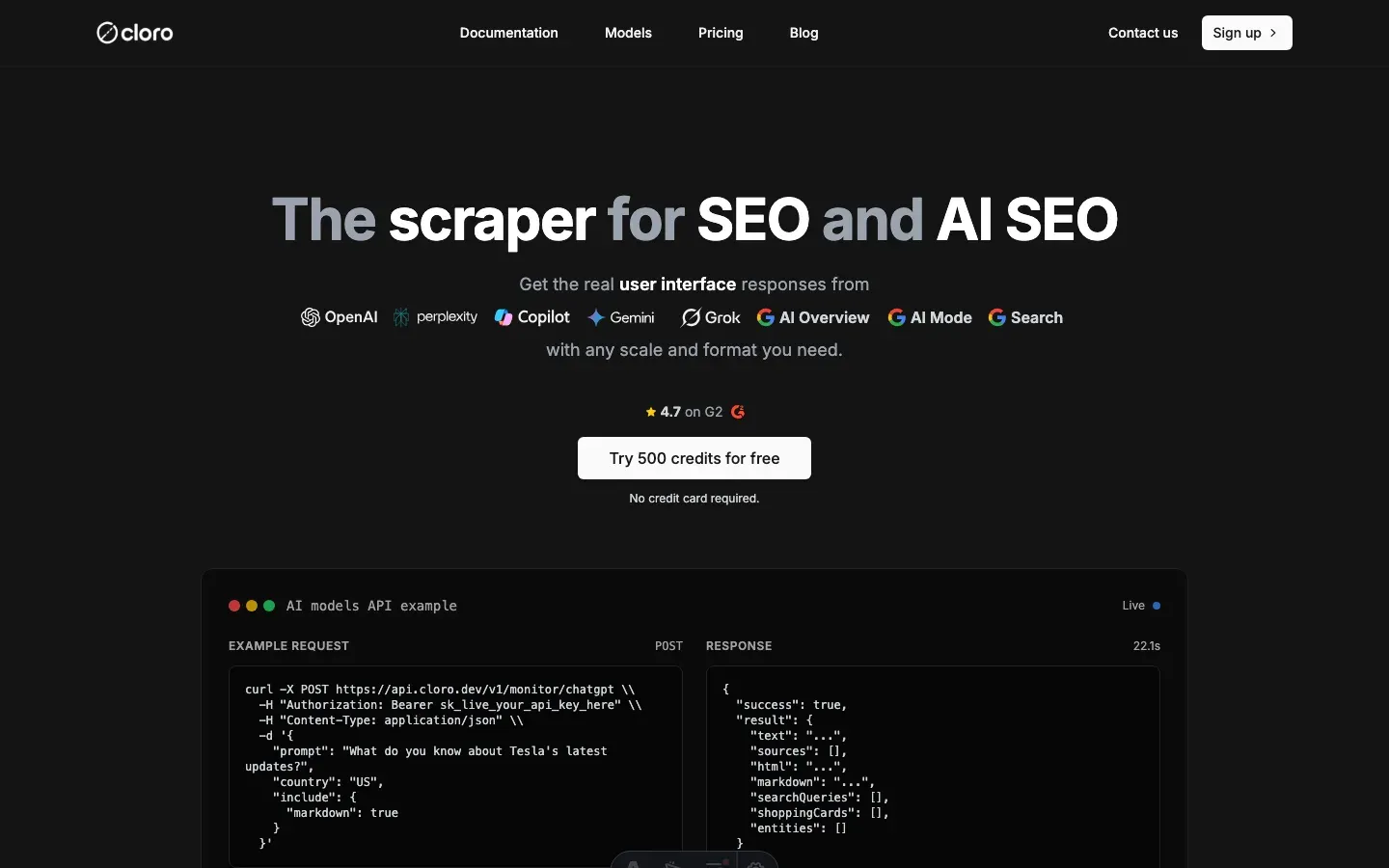
Starting price: $0.0012 per Google Search call on Hobby ($100/mo for 250,000 requests; Google Search costs 3 credits/call from a pool priced at $0.0004/credit).
cloro is the cheapest SERP API on this list when measured on real per-call cost with full features included. The credit model scales continuously: the Growth plan ($500/mo, 1.56M requests) brings Google Search to $0.00096/call. AI Overview, AI Mode, ChatGPT Search, Perplexity, Gemini, and Copilot all draw from the same credit pool. No per-engine billing, no surprise subscription lines. (cloro does not scrape Bing directly — for Bing SERP data, see SerpApi or DataForSEO below.)
Why it’s actually cheap: AI Overview parsing is included at the base credit rate (5 credits, ~$0.002 on Hobby). Dynamic SERP rendering is handled by default with no surcharge. Async webhooks and global country targeting are standard on all plans. No minimum commit beyond the monthly plan, which is cancellable month-to-month.
Where it isn’t the cheapest: under ~25,000 queries/month, where pay-as-you-go providers skip the monthly floor entirely.
For AI SEO teams: cloro returns parsed AI Overview citations and sources alongside the traditional SERP in a single API call. That’s the workflow covered in our AI SEO guide.
2. TrajectData (ValueSERP & Scale SERP) — cheapest pay-as-you-go for static SERPs
Starting price: ~$0.002 per Google Search call.
TrajectData operates both ValueSERP (the budget product) and Scale SERP (the high-volume tier). The legacy valueserp.com and scaleserp.com domains redirect to the unified TrajectData site. For most evaluations the two products are interchangeable; choose Scale SERP for sustained high-volume usage and priority support.
The headline pricing is genuinely competitive for static-HTML Google scraping. The gap versus cloro opens when you add AI Overview parsing, which requires an additional integration step and costs extra on TrajectData, whereas cloro bundles it in the base rate.
Best for: pure rank tracking on classic SERP layouts where you don’t need AI Overview content.
3. Serper — fast and cheap for high-volume rank tracking
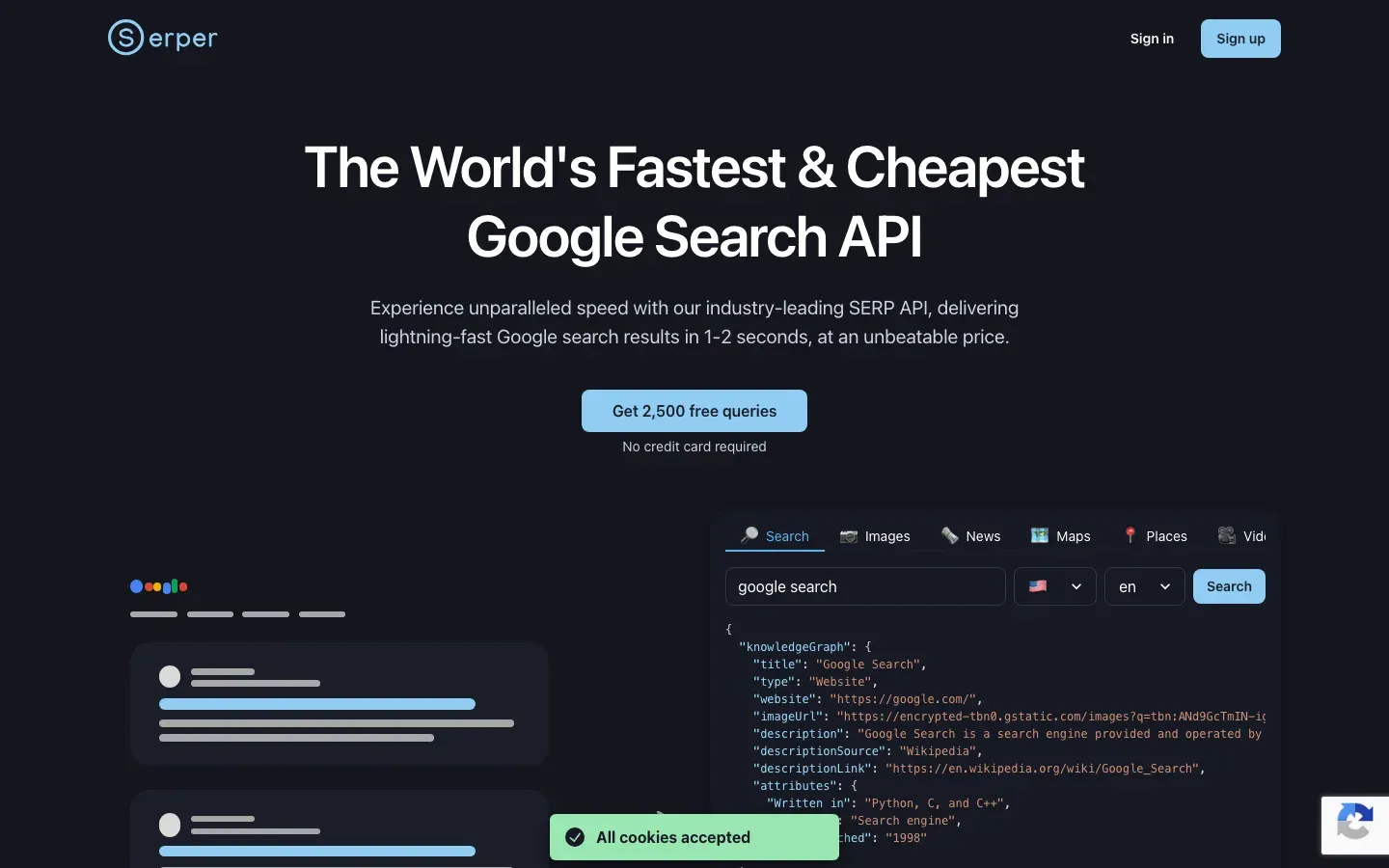
Starting price: roughly $0.001 per call on the highest-volume tiers, with lower-volume plans closer to $0.002–$0.003/call.
Serper competes on speed and simplicity. The API is developer-friendly with clean JSON output and a sub-200ms median response time at scale. The trade-off: dynamic-element parsing (AI Overviews, PAA, rich results) is more limited than cloro. Worth evaluating if your use case is position-only rank tracking on a fixed Google keyword set where you don’t need AI Overview data.
Not a fit for multi-engine tracking or workflows that require AI Overview citations.
4. DataForSEO — cheapest pay-as-you-go with no monthly minimum
Starting price: $0.0006–$0.003 per Google Search call depending on endpoint and volume. No monthly minimum — prepay $50 and pay only for what you call.
DataForSEO is the cheapest option for very low volumes because there’s no monthly floor. At $0.0006/call on the lightest endpoint, it undercuts every subscription provider. The trade-off is API ergonomics: task-based async patterns instead of synchronous calls, and AI Overview parsing costs extra as an add-on. Teams already comfortable with DataForSEO’s enterprise-style API will find this workable. Teams building greenfield scraping infrastructure often find the learning curve adds hidden time cost.
Best for occasional research workflows, one-off audits, or any use case that doesn’t justify a monthly subscription. For buyers comparing managed alternatives at production volume, see our DataForSEO alternatives breakdown.
5. SerpApi — not the cheapest, but frequently compared
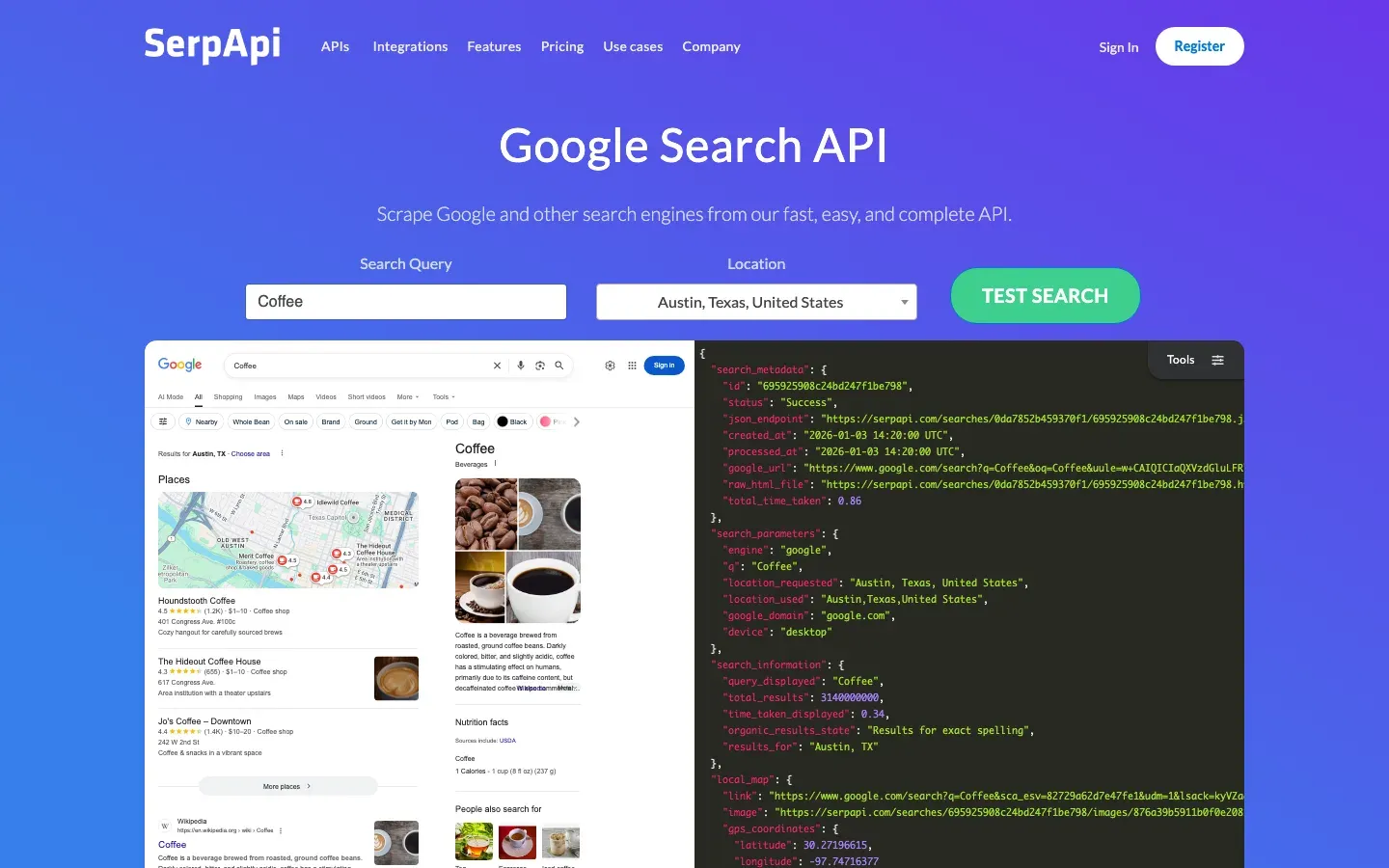
Starting price: ~$0.01 per call on entry tiers, 5–10× cloro’s cost at equivalent production volume.
SerpApi is established, reliable, and well-documented. It is not cheap. It shows up in “cheapest SERP API” searches because of brand recognition and longevity, not price. If cost is the deciding factor, SerpApi won’t win this comparison. If proven uptime and a large library of pre-built parsers matter more than price, it’s still a legitimate option. For a side-by-side with managed competitors, see our SerpApi alternatives breakdown.
When the cheapest option costs you more
A few failure modes turn a cheap API into an expensive mistake.
AI Overview blindness. As of 2026, roughly 30% of commercial Google queries surface an AI Overview block, and that share continues to grow. A provider that doesn’t parse AI Overview content leaves you with a 2022-era SERP. Saving $0.0008 per call is irrelevant if you’re systematically missing the data your stakeholders need. This matters especially for AI SEO monitoring workflows where the AI-generated answer block is the primary data point.
Per-engine billing surprise. Providers that separate Google and Bing into distinct subscriptions look cheap until the day you need to track Bing visibility. At that point the “cheapest” option doubles in effective cost overnight.
Annual-commit lock-in. Annual prepayment discounts look attractive in a spreadsheet. They get expensive when volume changes: you either pay overage on top if you scale up, or eat unused commitment if you scale down. Month-to-month plans cost slightly more per call but preserve flexibility.
Treat the headline price as a floor, not a ceiling. Run a one-week pilot at your real query mix and compute cost per useful response, not cost per call. The difference often reverses the rankings.
If you are still deciding between building vs. buying, see our breakdown of web scraping vs. SERP APIs for the full cost model.
Model your spend before committing
Before you commit to a provider, model your real cost at three volume points instead of trusting the homepage “starting at $X” number. Headline prices are marketing surfaces. The actual price depends on plan tier, feature mix, and overage behavior at your scale.
Here is what the same query mix (70% Google organic + 20% AI Overview + 10% shopping/dynamic) costs across providers at three monthly volumes:
| Provider | 25K calls/mo | 250K calls/mo | 2.5M calls/mo |
|---|---|---|---|
| cloro | ~$30 (Hobby floor) | ~$100 (Hobby) | ~$1,000 (Growth+) |
| TrajectData (ValueSERP / Scale SERP) | ~$50 | ~$500 | ~$2,500 |
| Serper | ~$25 | ~$250 | enterprise quote |
| DataForSEO | ~$15–60 | ~$150–600 | ~$1,500–3,000 |
| SerpApi | ~$250 | ~$2,500 | ~$25,000 (high tier) |
These are directional ranges; your actual quote depends on your specific feature mix and any custom-tier negotiations. The relative ordering is stable across volume points: providers that bill Bing separately, surcharge AI Overview, or apply overage rates pile on cost faster than the per-call headline suggests.
A 5-step modeling framework
- Measure your current call volume broken down by feature (organic results, AI Overview, shopping cards, ads).
- Get the provider’s per-feature, per-country pricing. Usually requires sales contact for accurate numbers above mid-tier.
- Model 12 months of growth at 30–50% YoY (typical for a maturing monitoring program). Add 20–30% buffer for AI Overview surcharges if applicable.
- Compute the all-in effective cost per 1,000 calls, not just the headline rate.
- Compare against your cost-per-useful-response budget. The metric that actually matters is dollars per data point, not dollars per call.
What to ask the sales team
Five questions that surface the actual price:
- Effective cost per 1,000 calls at my actual volume (provide the volume).
- Per-feature pricing breakdown: which Google features cost extra?
- Geographic targeting: flat-rate for all countries, or surcharges for specific regions?
- Overage rate beyond the monthly quota?
- All-in price per 1,000 calls including all of the above. Get one number you can compare.
If the sales team can’t give you a single all-in number for your specific scenario, the pricing is more complex than the homepage suggests, and the surprise will land 6 months in when the bill spikes.
How to choose
A working decision tree based on volume and feature requirements:
- Under 5,000 queries/month, no AI Overview need: DataForSEO PAYG (no monthly floor) or TrajectData (ValueSERP / Scale SERP).
- 5,000–250,000 queries/month, AI Overview required: cloro’s SERP API on Hobby. $0.0012/call fully loaded, AI Overview included.
- Over 250,000 queries/month, multi-engine, AI features: cloro’s SERP API on Growth or Business. Per-credit cost falls below $0.001/call, and all engines draw from the same pool.
- Need Bing SERP without a separate subscription: DataForSEO is the best fit on this list. (cloro doesn’t scrape Bing directly — for the Bing migration story specifically, see our Bing Search API retirement guide.)
- Prioritizing historical reliability over price: SerpApi. More expensive, but the longest track record in the space.
For the full 2026 comparison covering features beyond price (accuracy benchmarks, AI engine support), see our SERP API comparison.
For most production use cases, cloro is the cheapest SERP API: lower cost per call than any provider that includes AI Overview parsing by default, with no per-engine billing and no minimum beyond the monthly plan. Start with 500 free credits to verify the cost against your actual query mix before committing.
Frequently asked questions
Is there a free SERP API?+
No production-grade SERP API is fully free. Free tiers typically cap you at 100–1,000 calls per month and exclude AI Overview parsing and browser rendering. A handful of providers offer a small free trial allowance — use it to test against your real query mix before paying.
What's the cheapest SERP API per call?+
As of early 2026, cloro is the cheapest full-featured option: roughly $0.0012 per Google Search call on the Hobby plan ($100/mo for 250k requests at 3 credits/call), dropping to $0.00096 on the Growth plan. DataForSEO can reach $0.0006 per call on its lightest endpoint with no monthly minimum, but AI Overview parsing costs extra. TrajectData clusters around $0.002 per call for static-HTML scraping.
Why is the headline 'cheapest' often more expensive in practice?+
Four hidden cost lines inflate the real price: (1) per-engine billing that counts Google and Bing as separate subscriptions, (2) browser-rendering surcharges of 2–5× the base rate, (3) AI Overview add-ons charged separately from the base call, and (4) annual-commit minimums that don't scale down when usage drops.
Does cheap mean unreliable?+
Not automatically, but the two often travel together. The cheapest providers typically use static-HTML scraping, which fails on AI Overview blocks and the dynamic SERP elements Google has been rolling out since 2024. Test with your actual query mix — not a synthetic benchmark — before committing to any plan.
Should I just build my own SERP scraper?+
Under roughly 1,000 queries per month and with no AI Overview requirement, a self-built scraper with a residential proxy can undercut any paid API. Above that threshold, proxy rotation, CAPTCHA solving, and Google's ongoing HTML changes push the real cost above a paid API. For AI Overview parsing specifically, building your own is rarely cost-effective at any volume.
Related reading
Best SERP API 2026: 8 Tested, Ranked by Real Cost
Benchmark of 8 SERP APIs — AI Overview parsing depth, true cost at 100k calls/month, and which one beats SerpApi on AI coverage. 2026 tested results.
Python SERP Scraper: Call the cloro SERP API in 2026
Two ways to get Google results in Python: scrape directly (fragile) or call a SERP API (stable). Working code for both, plus AI engine tracking.
Best Python Scraping Libraries in 2026: 6 Compared
Compare the 6 best Python scraping libraries for 2026: requests with BS4, Scrapy, Playwright, httpx, and Selenium, plus when to skip them entirely.