
Profound Alternatives: 6 AI Brand Monitors Compared (2026)

On this page
If you’ve outgrown Profound’s pricing, hit the limits of its engine coverage, or run into team-fit issues with its enterprise polish, this post is for you. Profound itself is strong — it frames AI search as a competitive channel to be measured rather than a black box — so the question is whether its enterprise depth fits your team and budget. We tested 6 Profound alternatives on the same AI brand monitoring workflow (Peec AI, OtterlyAI, AthenaHQ, Brandlight, FirstAnswer.ai, and Scrunch AI) and laid out what each one is good at, how the pricing compares, and whether the right move is to switch from Profound or add a second tool alongside it. The answer is “add” more often than “switch.” We also cover the seventh option most comparison posts skip: not buying a dashboard at all, and building your own tracking on cloro’s AI visibility tracking API instead.
If you’re earlier in the decision and looking at the broader market, our LLM visibility tracking tools roundup covers the full market including Profound itself.
What Profound costs, and why teams leave it
Profound is the enterprise-tier AI brand monitoring platform: strong dashboard polish, deep competitive-intelligence workflows, mature SOC 2 and enterprise procurement story, and pricing that starts north of where most mid-market budgets land. Its core surfaces — Prompt Volumes for what people ask AI, and Answer Engine Insights for how AI represents your brand — are built for competitive intelligence (Profound). The product is good. People look for alternatives for one of three reasons: price, a specific engine coverage gap, or team-fit (the platform’s enterprise polish is overkill for smaller teams).
The published plan ladder shows where the price and coverage reasons come from. Per Frase’s September 2026 read of Profound’s pricing page, Starter is $99 a month for ChatGPT tracking only, with 50 prompts and one seat. Growth is $399 a month for three answer engines, 100 prompts and three seats. Up to nine engines, API access and SSO sit on Enterprise, which is a custom quote. So a team that needs Perplexity or Google AI Overviews next to ChatGPT starts at $399, and a team that needs the API starts at a sales call.
Profound alternatives at a glance
Six dashboard tools, side by side. Prices are entry/mid-tier starting points; confirm engine coverage against your own audience before committing. Which of them the AI engines themselves put forward is tracked separately on the AI visibility platforms leaderboard, re-scored weekly.
| Tool | Starting price | Engine coverage | Type | Best for |
|---|---|---|---|---|
| Profound | $99/mo (ChatGPT only); Enterprise by quote | 10+ engines (ChatGPT, Perplexity, Gemini, Copilot, AI Overviews) | Enterprise dashboard | Enterprise competitive intelligence |
| Peec AI | ~$200/mo | ChatGPT, Perplexity, Gemini | Dashboard | Marketing teams on mid-market budgets |
| OtterlyAI | ~$250/mo | ChatGPT, Perplexity, Gemini | Dashboard + CSV export & read API | Analyst-led teams needing exportable data |
| AthenaHQ | Enterprise | 8+ LLMs, multi-region | Enterprise dashboard | Audience-segmented enterprise reporting |
| Brandlight | $200–400/mo | ChatGPT, Gemini, Perplexity, Copilot, Grok | Dashboard | Cleaner competitor tracking |
| FirstAnswer.ai | Plan-dependent | ChatGPT, Gemini, Copilot, Perplexity | Dashboard (answer-quality) | AI-answer-quality analysis |
| Scrunch AI | ~$250/mo (350 prompts) | Broadest — ChatGPT, Claude, Perplexity, Gemini, Meta AI, AI Mode, AI Overviews | Dashboard | AI-native focused tracking |
The takeaway: if price is the driver, Peec AI, OtterlyAI, and Brandlight all undercut Profound’s enterprise floor; AthenaHQ is the closest match to Profound’s own enterprise tier; Scrunch AI and FirstAnswer.ai are specialists (engine breadth and answer quality, respectively) rather than full replacements.
What AI brand monitoring actually measures
Before you compare Profound alternatives, get clear on the metrics. Every AI brand monitoring tool tracks a similar core set. The differences are in depth, naming, and which metric each platform treats as primary.
If two tools disagree on your numbers, it is almost always a definition or sampling difference, not a data error. Our AI brand visibility measurement framework walks through the full metric stack in detail.
Mention rate: does the model know you exist?
Mention rate is the share of tracked prompts where the AI names your brand at all. It answers the simplest question in AI brand monitoring: does the model know you exist? A rising mention rate means your brand is entering the model’s answer set for the queries you care about. Track it per engine, because a brand can be well known in ChatGPT and invisible in Gemini.
Share of voice: the number executives ask about first
Share of voice compares your mention rate to your competitors’ across the same prompt set. It is the metric executives ask about first. A 40% share of voice means you appear in roughly two of every five relevant answers, ahead of or behind named rivals. Our guide to AI share of voice covers how to define a fair competitor set so the number holds up.
Citation rate: distinct from mention rate
Citation rate measures how often the AI links to or names your own domain as a source. It is distinct from mention rate: a model can recommend you without citing you, or cite a third party who recommends you. Teams that care about referral traffic and source authority weight citation rate heavily. See our breakdown of how LLM citations work for why the two metrics diverge.
Sentiment and answer quality: not just whether you appear, but how
Sentiment captures how the AI characterizes your brand, not just whether it appears. A model can mention you accurately, partially, or with an outdated claim. Answer-quality analysis flags misrepresentation before it spreads, which is why some AI brand monitoring tools specialize here. This is the dimension FirstAnswer.ai leans into most.
How we compared these Profound alternatives
We ran each of the five alternatives against the same AI brand monitoring workflow we would use to evaluate Profound itself. That means the same tracked brand, the same competitor set, and the same prompt list across engines. Scoring each tool on identical inputs is the only way to compare them fairly. We weighed five dimensions.
Engine coverage
Coverage is which AI surfaces the tool actually queries: ChatGPT, Perplexity, Gemini, Google AI Overviews, AI Mode, Copilot, and Grok. A cheaper AI brand monitoring tool that skips the engine your buyers use is not a saving. Confirm coverage against your own traffic before you commit.
Metric depth
Depth is how far past mention rate an AI brand monitoring tool goes. Every platform reports mention rate and share of voice. Fewer expose citation rate, per-persona segmentation, or answer-quality sentiment as first-class metrics. Match the depth to the questions your stakeholders actually ask.
Dashboard and reporting
Reporting is how easily a non-technical stakeholder can read the output. Profound sets the polish benchmark here. The AI brand monitoring alternatives trade some of that polish for price, so decide how much the dashboard matters versus the raw data underneath it.
Data export and API
Export is whether an analyst can pull the underlying numbers into a spreadsheet or a warehouse. Closed data models look clean but limit custom analysis. Teams with a data analyst should weight CSV export and a read API heavily.
Pricing and procurement
Pricing posture is where each AI brand monitoring tool sits relative to Profound’s enterprise floor, and whether SOC 2, custom contracts, and a dedicated CSM are standard or plan-dependent. SOC 2 itself is an examination of a provider’s controls across security, availability, processing integrity, confidentiality, and privacy (AICPA), so an enterprise security review will ask which tier includes it. Procurement friction is a real cost for enterprise buyers, even when the sticker price is lower.
1. Peec AI — best for marketing teams who want polish at mid-market pricing
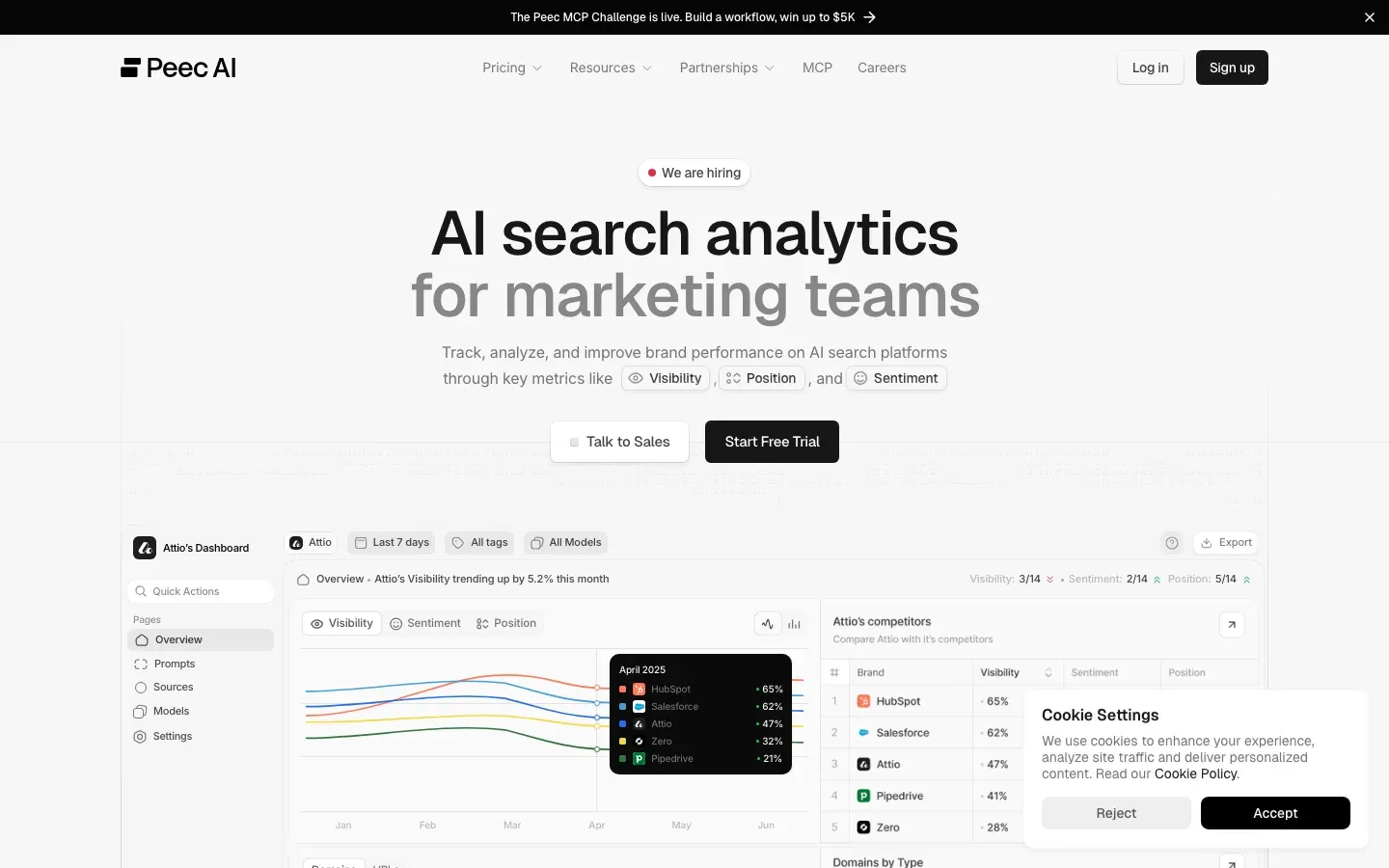
Starting price: ~$200/month entry; mid-tier $300–400/month.
Peec AI tracks brand visibility across ChatGPT, Perplexity, and Gemini, and it is built for marketing teams. That is Profound’s dashboard-first posture at roughly a third to a fifth of the price. The UI isn’t quite as polished as Profound’s, but it’s polished enough.
Share-of-voice charts are clean, competitor comparisons are intuitive, and the recurring stakeholder report ships out of the box. For marketing teams that picked Profound primarily for the dashboard, Peec AI usually delivers most of the value at a fraction of the price.
Where it differs from Profound. Enterprise-tier reporting depth, the breadth of competitive-intelligence features, and the procurement story (SOC 2, custom contracts, and dedicated CSM are plan-dependent at Peec AI vs standard at Profound).
Pick Peec AI if budget is the primary driver, the marketing team is the primary audience, and dashboard polish matters but enterprise-tier polish is overkill.
2. OtterlyAI — best for analyst-led teams that need exportable data
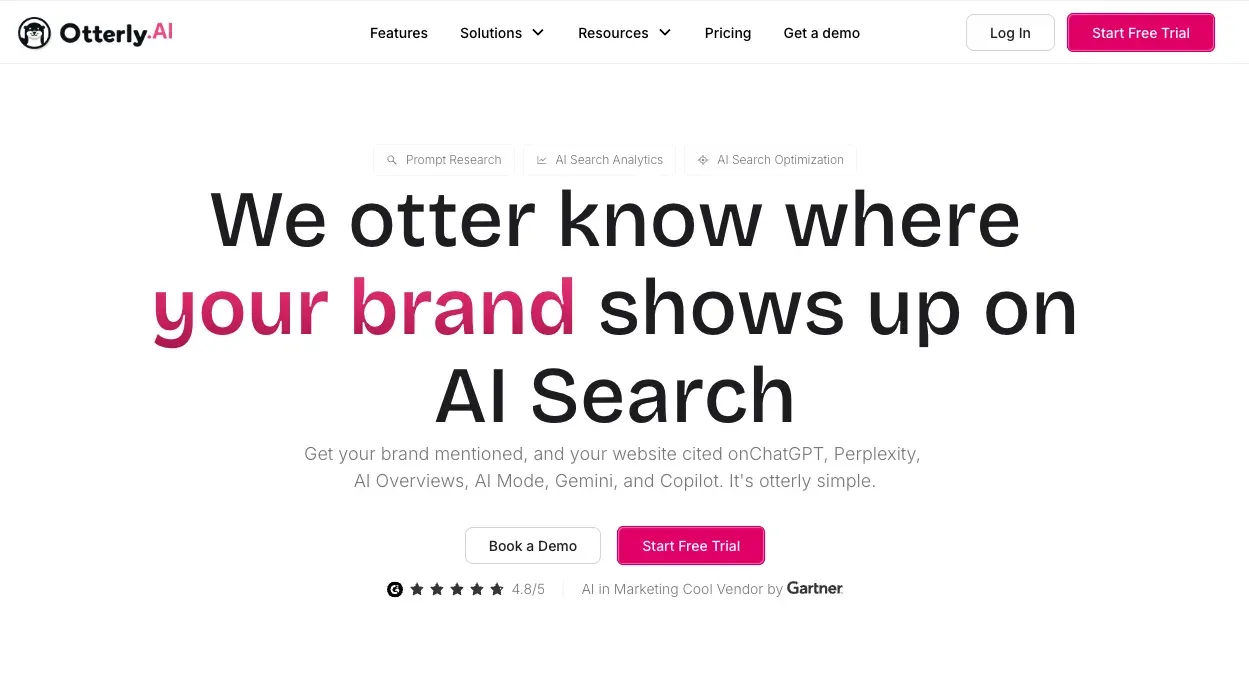
Starting price: ~$250/month entry; mid-tier $400–500/month.
OtterlyAI sits between dashboard polish and analyst flexibility. Compared to Profound, it gives up some UI sheen but exposes more of the underlying data: first-class CSV export, a reasonable read API, and citation rate as a primary metric (Profound treats that as secondary). For teams that found Profound’s data model too closed, OtterlyAI is the obvious step.
Where it differs from Profound. Dashboard polish for non-technical stakeholders, the sales-ready board-level executive report, and the breadth of competitive-intelligence features.
Pick OtterlyAI if there’s a data analyst on the team, citation rate is a primary metric, and you want a balance between dashboard convenience and data accessibility.
3. AthenaHQ — best for enterprise programs with audience-segmented reporting
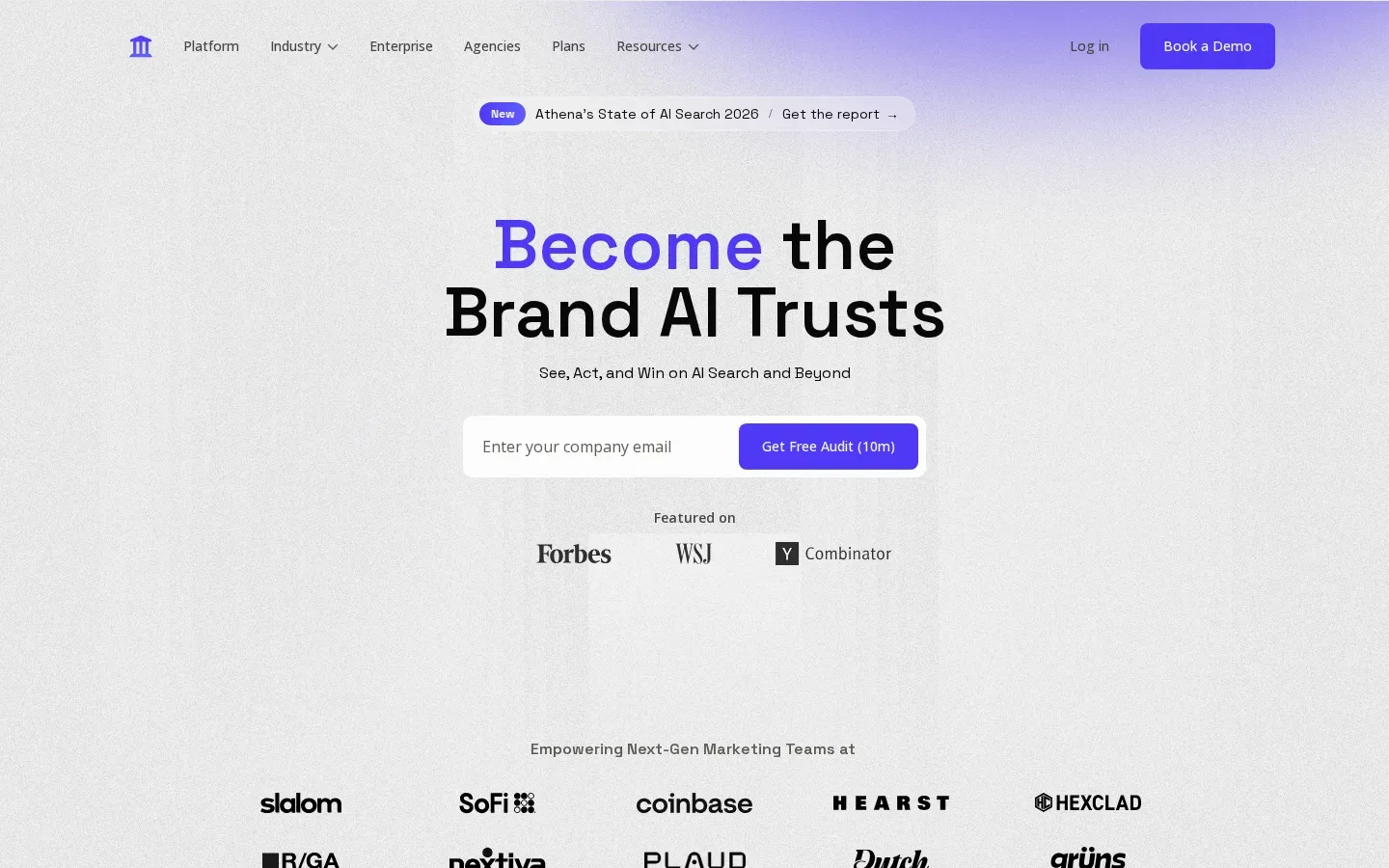
Starting price: enterprise-tier; pricing is plan-dependent and typically starts at the upper end of the alternatives bracket.
AthenaHQ targets a similar enterprise audience with comparable polish, monitoring across 8+ LLMs with persona-level audience segmentation, multi-region tracking, executive dashboards that feed BI tools like Tableau and Looker so stakeholders see AI-visibility metrics alongside the rest of their reporting instead of in a separate tool, plus CSV export and an API. The reporting workflows are mature, the executive-level dashboards are stakeholder-ready out of the box, and the SOC 2/procurement story is built for enterprise sales cycles. AthenaHQ’s edge is the depth of audience-segmented reporting (share of voice by buyer persona, product line, or geographic region), which is harder to set up in Profound.
Where it differs from Profound. Brand recognition and the specific competitive-intelligence features Profound built its reputation on.
Pick AthenaHQ if you’re enterprise, you need polished stakeholder reporting, and audience-segmented analysis is a primary use case.
4. Brandlight — best for cleaner competitor-tracking workflows
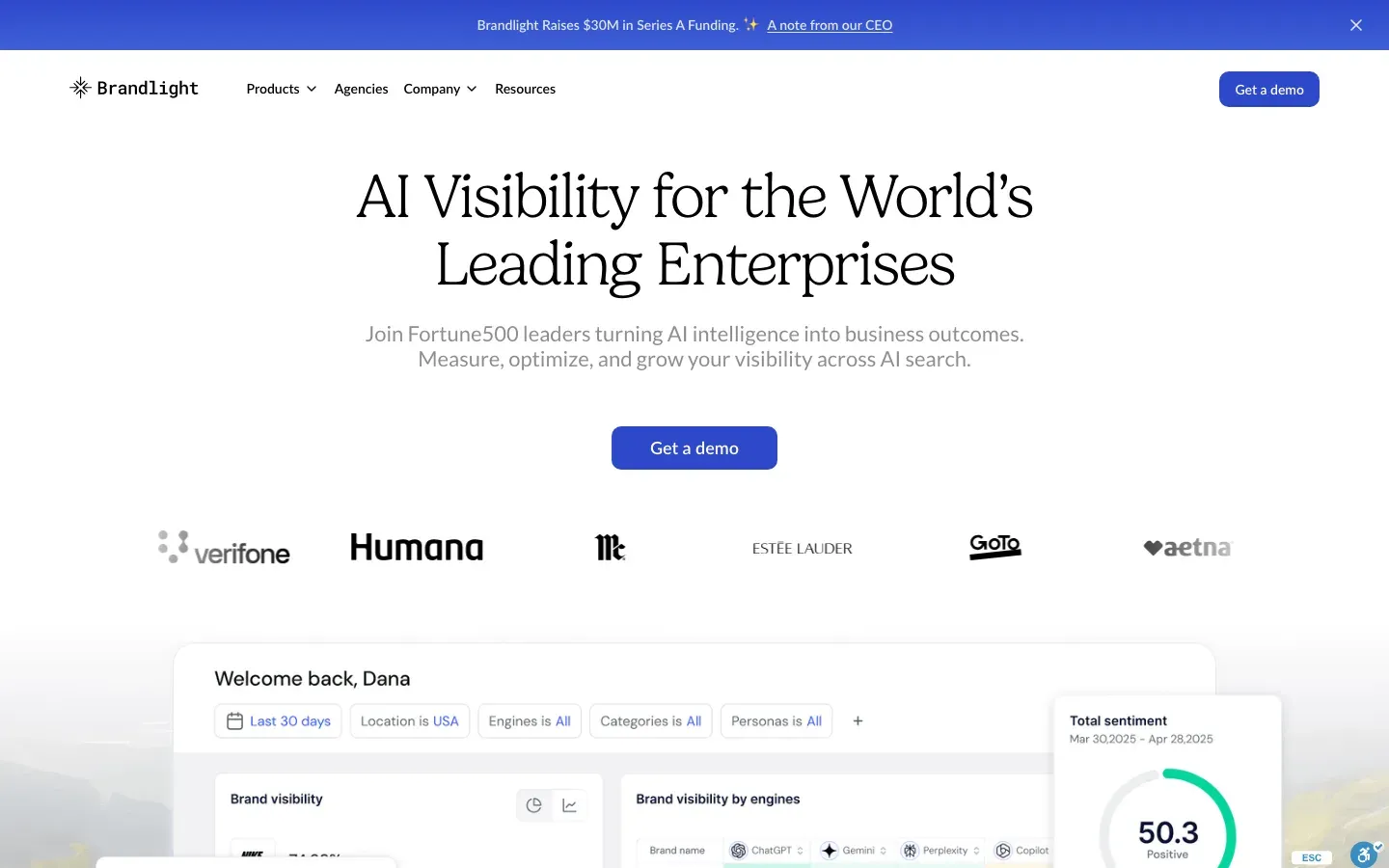
Starting price: similar to Peec AI range, $200–400/month at the mid-tier depending on competitor count and query volume.
Of the dashboard-first tools we tested, Brandlight has the cleanest competitor-tracking UI. If the primary value you got from Profound was tracking 5–10 competitors across a fixed query set with weekly diffs, Brandlight does that workflow as well or better at a lower price. Its engine coverage spans ChatGPT, Gemini, Perplexity, Copilot, and Grok, and it markets itself as a top-ranked AEO platform.
Where it differs from Profound. Enterprise reporting depth, custom segmentation flexibility, and the procurement story.
Pick Brandlight if competitor tracking is your primary use case, on a mid-market budget, with a dashboard-first posture.
5. FirstAnswer.ai — best for AI-answer-quality analysis
Starting price: plan-dependent.
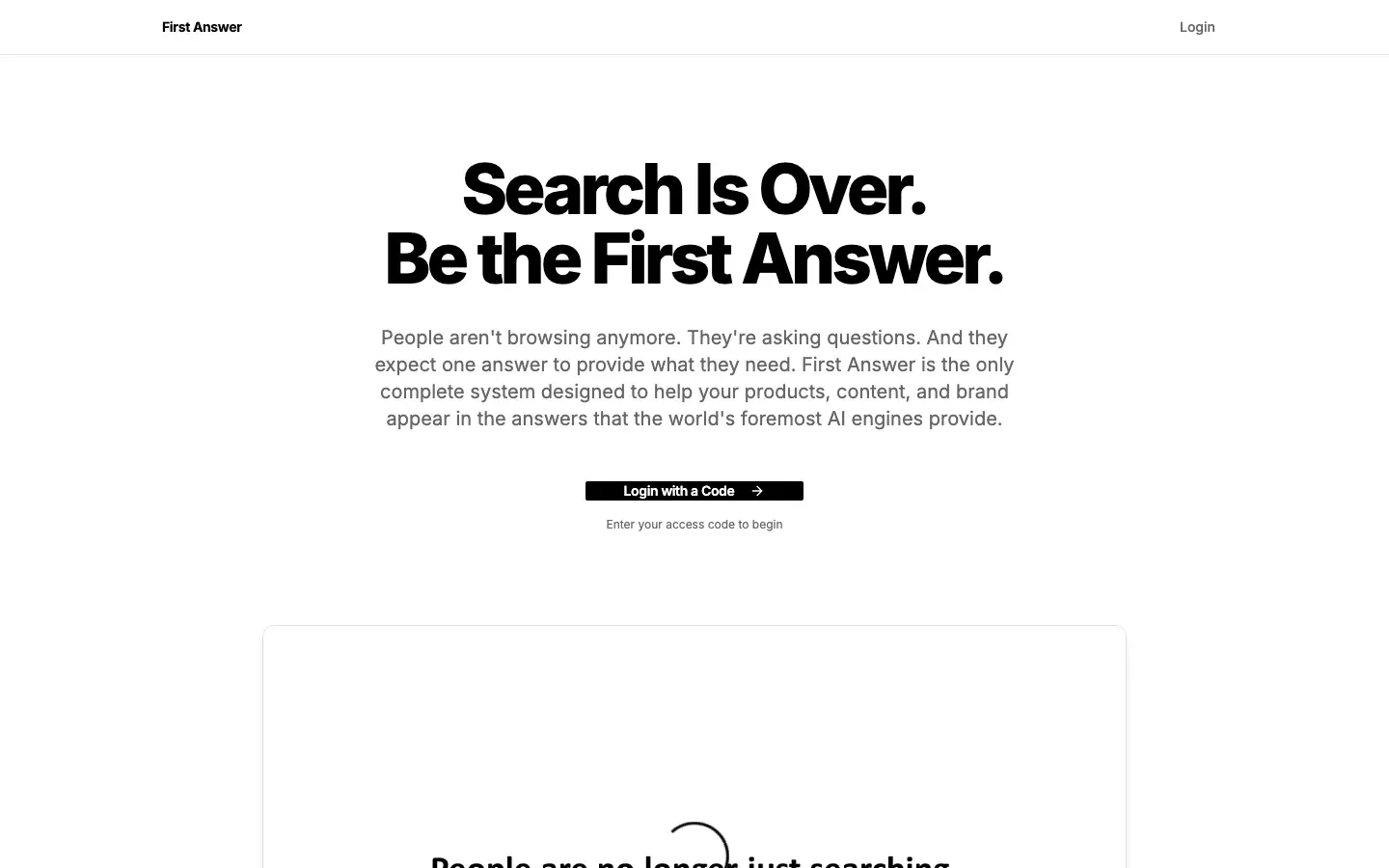
FirstAnswer.ai tracks whether and how often your brand is mentioned and cited across ChatGPT, Gemini, Copilot, and Perplexity, then returns GEO recommendations for improving how you show up. Beyond a simple appeared-or-not signal, it focuses on the answer itself — which sources the model leaned on and how you were represented next to competitors. For brand teams worried about misrepresentation in AI answers, that answer-level focus is its niche among the alternatives.
Where it differs from Profound. Narrower category focus (answer-quality vs full-spectrum brand monitoring), and a lighter dashboard.
Pick FirstAnswer.ai if AI-answer-quality analysis is a primary concern and brand reputation is at risk in AI answers.
6. Scrunch AI — best for AI-native focused tracking
Starting price: ~$250/month for 350 prompts.
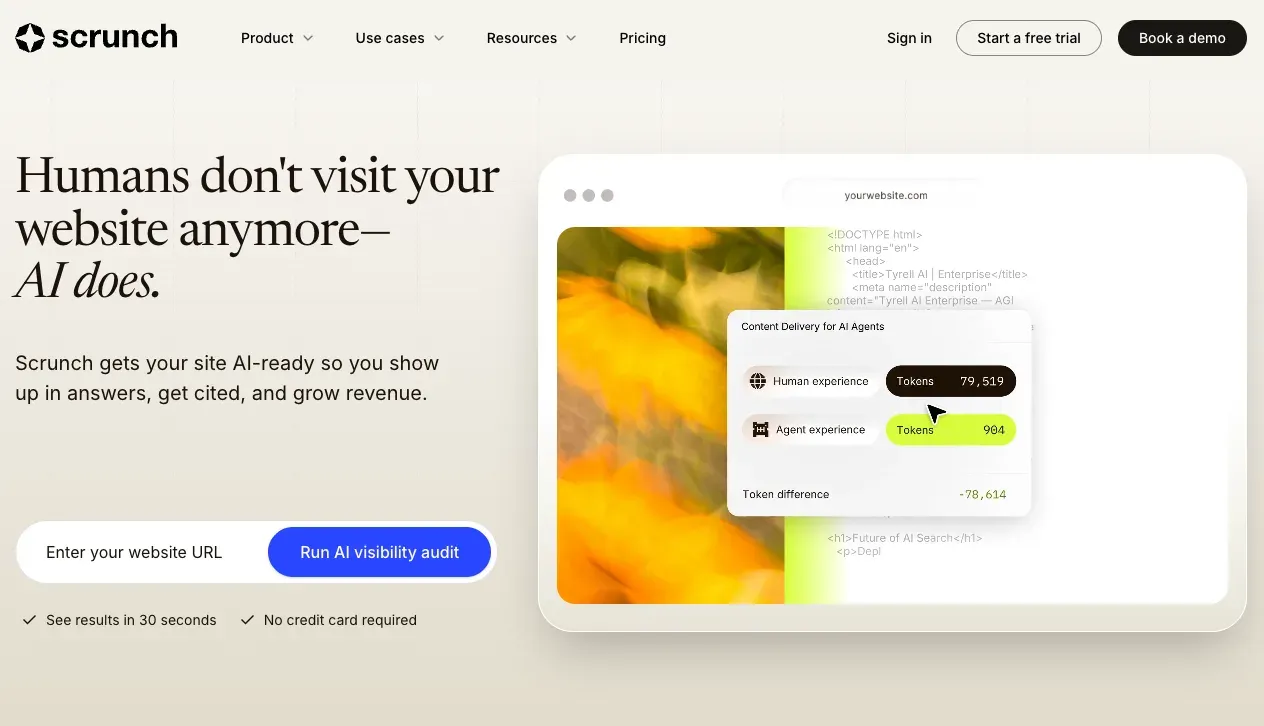
Scrunch AI launched in 2024 and tracks brand presence across the widest engine set of any tool here — ChatGPT, Claude, Perplexity, Gemini, Meta AI, Google AI Mode, and AI Overviews — at the prompt level with daily refresh. Its edge is that AI-native breadth plus a GA4 integration that ties AI citations back to referral traffic, so you can see behaviour after the citation, not just the mention. It’s backed by a $15M Series A (Decibel) and used by 500+ brands including Lenovo and SKIMS. If your buyers have largely moved their discovery into AI answers, Scrunch’s coverage is the most complete of the mid-market options.
Where it differs from Profound. Enterprise reporting depth and the competitive-intelligence workflows Profound built its reputation on; Scrunch’s optimization/recommendations layer is still in beta, so it’s a monitoring tool first.
Pick Scrunch AI if AI-native engine coverage is your top priority, you want daily prompt-level refresh, and tying AI visibility to GA4 referral traffic matters to you.
If you want the raw data instead of a dashboard
Starting price: usage-based API — pay per query, no per-seat fee.
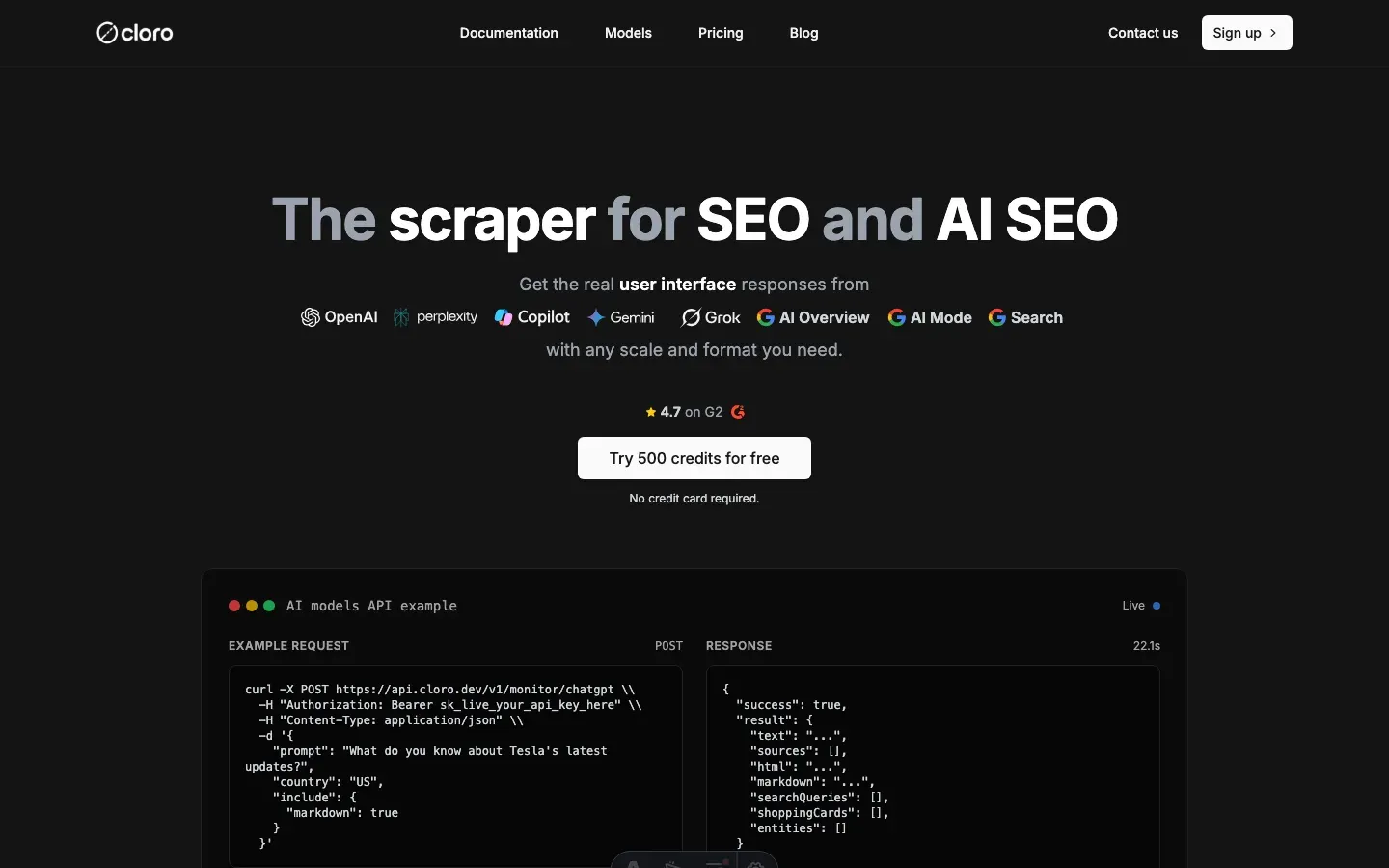
Every tool above is a dashboard you log into. cloro is the layer underneath: the AI visibility tracking API that returns the raw mention, citation, and share-of-voice signal from ChatGPT, Perplexity, Gemini, AI Overviews, and the rest as structured data instead of a chart. Several dashboard tools in this category run their tracking on exactly this kind of engine-query layer — so this is the honest “buy the ingredient, not the meal” option.
It isn’t for everyone, and pretending otherwise would be dishonest. If you want a polished report to hand a stakeholder on Monday, buy one of the dashboards above. cloro is for the team that wants to own the pipeline: pull the same signal into your warehouse, compute share of voice by buyer persona or content cluster the way you define it, feed it into Looker or Metabase next to the rest of your BI, and skip per-seat pricing entirely. That’s the build side of the AI search visibility build vs buy decision, and cloro’s AI-data API is what makes building viable rather than a from-scratch integration against every engine.
Pick cloro if you have (or want) a data function, need custom segmentation the dashboards don’t expose, or would simply rather feed BI than log into one more tool.
Quick integration guides: per-engine READMEs with Python, cURL, and Node.js requests: chatgpt-scraper, gemini-scraper, perplexity-scraper, google-ai-overview-scraper.
Engine coverage: what to verify before you switch
Engine coverage is the single most common reason a Profound alternative fails in practice. An AI brand monitoring tool can nail the dashboard and still miss the surface where your buyers actually ask questions. Before you switch, map your own audience to engines, then confirm the tool queries each one.
Which engines matter for your brand
Not every engine matters equally for every brand. A developer-tools company lives and dies in ChatGPT and Perplexity. A consumer retail brand cares more about Google AI Overviews — the AI-generated summaries Google now places above the classic list of links (Google) — and AI Mode, because that is where high-intent shopping queries land. Our guide to AI Overview tracking tools covers why the Google surfaces behave differently from the chat assistants.
Coverage gaps to test for
The gaps that catch teams out are the newer surfaces. Google AI Mode — the generative-search experience Google launched in May 2025, which fans one question out into many background queries (Google) — and Grok are the two most likely to be missing or plan-gated in a mid-market tool. Copilot coverage is inconsistent across the category. Ask each vendor which engines are included at your tier, not just which engines they support somewhere in the product.
Sampling and refresh cadence
Two tools can both claim ChatGPT coverage yet disagree on your numbers. The reason is sampling: how many prompt runs per day, at what temperature, from which region. A tool that samples once a day will miss the volatility a tool sampling hourly captures. Ask about refresh cadence and prompt volume, because they drive how stable your reported metrics are.
Non-English prompts and local markets
Asking “bestes CRM für Kleinunternehmen” is not the German translation of an English result, it is a different answer with a different citation set. Language and country are two separate settings, and a tool that only exposes one of them will report a number that does not describe the market you sell into. The prompt language decides which answer the model generates; the requesting country decides which sources it reaches for.
Country matters even when the prompt stays in English, because Google personalises results on the requesting IP’s location rather than on the query alone, and the location is inferred from that IP (Google). A tool sampling everything from one region is reporting that region’s answers under your brand’s global name.
So verify three things before you switch, and treat a vague answer as a no:
- Can you set the prompt language per prompt, rather than translating and hoping?
- Can you set the requesting country independently of the language, so you can run an English prompt from Germany and a German prompt from Germany and compare them?
- Are the results segmented by market in the output, or pooled into one average that hides a market where you are absent?
If the answer to any of those is no, the raw-API route below is usually the cleaner fix, because cloro’s AI visibility tracking API takes the country as a request parameter and returns each market as its own row, leaving the segmentation to you rather than to a vendor’s default.
How to run your own Profound alternatives comparison
The right pick depends on your brand, so run a short bake-off rather than trusting any single review. Most of these AI brand monitoring tools offer a trial or a demo dataset, which is enough to compare like for like.
Build one fixed prompt set
Write 20 to 40 prompts that reflect how real buyers describe your category. Keep the list identical across every tool you test. A shared prompt set is the only way to compare mention rate and share of voice without confounding the results.
Score the same competitor set
Pick the same five to ten competitors in every tool. Share of voice is meaningless unless the denominator matches, so lock the competitor list before you start. This also surfaces which tool handles competitor entity resolution most cleanly.
Decide whether you need monitoring or monitoring plus fixes
The tools split into two shapes. A monitor-only tool reports citation share, sentiment and rival movement, and the work to fix a gap happens in your other tools. A loop tool also feeds that gap into research, drafting and publishing, per Frase’s category breakdown. In this list, FirstAnswer.ai returns GEO recommendations and Scrunch AI’s optimization layer is in beta; the rest are monitoring first. If your content team is small, the second shape saves a handoff. If you already run a content workflow, monitoring is enough.
Weight the trade-off you actually care about
Rank the five dimensions above by what your stakeholders actually ask for. Marketing-led teams weight the dashboard and the reporting, analyst-led teams weight export and metric depth, and enterprise buyers weight procurement.
The best Profound alternative is the one that scores highest on your top dimension, not on the average. For a broader build-versus-buy view, see AI search visibility: build vs buy.
Switch or add?
Most mature programs that pick a Profound alternative don’t actually switch. They add. The pattern:
- Keep Profound for board-level reporting and the workflows where its polish earns the price tag.
- Add a mid-market tool (Peec AI or Brandlight) for departmental reporting that doesn’t need enterprise polish.
- Optionally add a specialist tool (FirstAnswer.ai for answer-quality, OtterlyAI for analyst-tier slicing, Scrunch AI for AI-native coverage).
- Or add the cloro AI-data API for the custom analysis no dashboard exposes — share of voice by persona, citation-source breakdowns — fed straight into your own BI.
Total cost ends up similar to Profound enterprise alone, and you get tooling that fits each audience.
If you do want to switch, the right replacement depends on what you used Profound for:
| What you used Profound for | Switch to |
|---|---|
| Marketing-team executive dashboard | Peec AI or AthenaHQ |
| Analyst data exports + citation rate | OtterlyAI |
| Competitor tracking | Brandlight |
| AI-answer-quality monitoring | FirstAnswer.ai |
| Enterprise audience-segmented reporting | AthenaHQ |
| AI-native focused tracking | Scrunch AI |
| Combination of the above | Pair two of the alternatives |
If none of those is the row you are in because you want the raw signal rather than a finished report, that is the API-layer option described above.
Bottom line
The enterprise-tier polish standard is still Profound; the alternatives trade some of that polish for a lower price (Peec AI, OtterlyAI, Brandlight), analyst flexibility (OtterlyAI), audience segmentation (AthenaHQ), or specialist depth (FirstAnswer.ai).
If you’re switching for budget reasons, Peec AI is the safest bet. It’s the closest match to Profound’s dashboard-first posture at a fraction of the price. For a fuller comparison of the four most-shortlisted platforms, see LLM visibility tracking tools, or the wider field ranked as best AEO tools.

About the author
Ricardo Batista
Founder, cloro
Ricardo is one of the founders and engineers behind its SERP and AI-search scraping infrastructure. Before cloro he scaled a financial comparison site to $7M ARR and ran the full-country operations of a unicorn to $65M ARR, then went back to building. He writes about search engine scraping, generative-engine optimization, and turning live search and AI-answer data into something teams can act on.
Frequently asked questions
Why look for Profound alternatives?
Three common reasons: (1) pricing — Profound's enterprise positioning means starting prices that don't fit mid-market budgets; (2) engine coverage gaps relative to specific 2026 needs (AI Mode, Grok); (3) team-fit — Profound's polish is built for enterprise brand-intelligence functions; smaller teams may want a more lightweight platform. The six alternatives below address one or more of these concerns, plus cloro for teams that would rather build on an API than buy a dashboard.
How much does Profound cost?
Per a September 2026 read of Profound's pricing page, Starter is $99 a month for ChatGPT tracking only (50 prompts, one seat), Growth is $399 a month for three answer engines (100 prompts, three seats), and Enterprise is a custom quote that adds up to nine engines, API access and SSO.
Which Profound alternative is the most affordable?
Peec AI and Brandlight both start in the $200-400/month range, well below Profound's enterprise floor. OtterlyAI is comparable, $250-500/month at the mid-tier, and Scrunch AI starts around $250/month for 350 prompts. AthenaHQ is also enterprise-tier, comparable to Profound's pricing. FirstAnswer.ai pricing is plan-dependent.
Which Profound alternative has the best dashboard?
Among the alternatives, Peec AI has the most marketing-team-friendly UI; AthenaHQ has the strongest enterprise reporting workflows; Brandlight has the cleanest competitor-tracking views. None of the four match Profound's polish at the enterprise tier, but all three are strong enough for most stakeholder reporting needs at significantly lower price points.
Can I use a Profound alternative for the same workflow?
For the core mention-rate / share-of-voice / citation-rate metrics, yes — every platform in the alternatives list covers the foundational metrics. Where alternatives diverge from Profound is the depth of competitive intelligence features (Profound's strongest area) and the polish of board-level executive reporting. For most teams the alternatives are sufficient; for enterprise teams with dedicated brand-intelligence functions, Profound's depth may still justify the price.
Should I switch from Profound or just add a second tool?
Most mature programs add rather than switch. Keep Profound for board-level reporting where its polish earns the price tag; add a mid-market tool (Peec AI or Brandlight) for departmental reporting that doesn't need enterprise polish. The total cost stays in a similar range to Profound enterprise alone, and you get appropriate tooling for each audience.
Is there an API that returns this data raw instead of in a dashboard?
Yes — cloro is the AI visibility tracking API that returns the raw mention, citation, and share-of-voice signal from ChatGPT, Perplexity, Gemini, AI Overviews and the rest as structured data instead of a dashboard. It's the build side of the build vs buy decision: rather than paying per seat for a dashboard, you pull the same signal into your own warehouse and BI and define share of voice however you need. Pick it if you have a data function, need custom segmentation the dashboards don't expose, or would rather feed BI than log into another tool; pick a dashboard (Peec AI, OtterlyAI, Scrunch AI) if you want a polished report without building anything.
Which AI visibility API supports non-English prompts and local markets?
Look for one that treats prompt language and requesting country as two separate settings. The language decides which answer the model generates; the country decides which sources it reaches for, because Google personalises results on the requesting IP's location rather than on the query alone. cloro's AI visibility tracking API takes the country as a request parameter and returns each market as its own row, so an English prompt run from Germany and a German prompt run from Germany are separate, comparable series rather than one pooled average. Before buying any tool, check that you can set language and country independently and that the output stays segmented by market. A pooled global number hides the markets where you are absent.
Related reading
Best LLM & AI Visibility Tools 2026: 12 Tested
We tested 12 LLM visibility tools (also sold as AI visibility trackers and checkers) on real brand-monitoring workflows across ChatGPT, Perplexity, and Gemini. What works, what doesn't.
Best AEO Tools 2026: 14 Answer Engine Platforms Compared
We compared 14 AEO tools on engine coverage, citation intelligence, API access, and price. See which answer engine optimization tool fits your team.
AI Search Visibility Build vs Buy: What Each Costs
Should you build or buy AI search visibility tracking? Compare platform costs, API spend, engineering hours, maintenance, and break-even points.