
SearchApi Alternatives: 5 SERP APIs Tested (2026)
We tested 5 SearchApi alternatives in 2026 on Google feature depth, AI Overview parsing, engine breadth, and real per-call pricing. See which fits.
4.7 · 53 reviews
Why teams switch from SearchApi
Issues users run into with SearchApi
No AI Overview or citation parsing
SearchApi supports Google's AI Mode but doesn't expose AI Overviews, citations, or knowledge panels in a structured way. You'll need to parse raw HTML. cloro returns all three as parsed fields, with no parser to maintain.
Monthly subscription required
Requires monthly commitments even for light usage. No true pay-as-you-go for occasional needs. cloro bills per call, so a light month costs what it uses.
Subscription pricing without AIO parsing
SearchApi starts at $40/month and runs in the $4–$10 per 1,000 range depending on tier. None of those tiers include AI Overview parsing in the response. cloro returns AI Overview in the default envelope at $1.25–$2.00 per 1,000 (n=10) on a per-call model, so you're not paying extra or building a parser to get it.
Quick comparison
How cloro compares to SearchApi
cloro
SearchApi
SearchApi (searchapi.io) is a breadth-first play: one credential that reaches Google (including AI Mode) plus Bing, YouTube, ChatGPT, Perplexity, and 40-plus other engines under a single request shape. That surface count is the selling point, and it trades per-engine depth for it. So if you’re weighing SearchApi alternatives in 2026, the question is whether you want that wide-but-shallow reach or something that goes deeper on the surfaces you actually query.
Most teams looking for a SearchApi alternative land there for one of two reasons. Either the 40-engine breadth is more than they use (they only ever hit Google) and they want deeper feature parsing plus lower per-call cost; or they want the AI surfaces (AI Overview, ChatGPT, Perplexity) returned as clean structured fields rather than an AI Mode endpoint that doesn’t parse the AI Overview block. SearchApi is fast (sub-second on most engines) and priced on pay-per-successful-search monthly bundles, which suits steady, predictable volume.
The best replacement depends on which of those two motivations is yours. We tested five.
The 5 best SearchApi alternatives at a glance
| Tool | Model | Entry price | Google SERP rate (~1k) | AI Overview |
|---|---|---|---|---|
| cloro | Parsed AI-native SERP API | $30/mo (free tier: 500 credits/mo) | $1.25–$2.00 /1k (n=10 + AIO) | ✅ deep, default |
| SerpApi | Multi-engine SERP API | $25/mo (1k searches) | ~$9–$15 /1k | ✅ parsed, cited |
| DataForSEO | Horizontal SEO platform | PAYG (60+ endpoints) | $2 /1k | ⚠️ +cost, shallower |
| Serper | Lightweight Google SERP | $50/mo (2,500 free) | $0.30–$1 /1k | ❌ no structured |
| Bright Data | Proxy + SERP layer | Business ~$999/mo | ~$1–$1.50 /1k | ⚠️ DIY parse |
The five split on two axes that matter for a SearchApi replacement: how deeply the API parses Google’s modern SERP (AI Overview block, hydrated PAA, ad sitelinks), and the pricing model (per-call pay-as-you-go versus monthly bundles versus proxy infrastructure). SearchApi sits in the wide-breadth, monthly-bundle corner; every alternative below moves you along one of those axes.
How we tested, and what these numbers rest on
Comparison pages are easy to write and hard to trust, so here is the basis for every claim above.
The cloro rows are measured. On 2026-08-19 we ran 15 AI-Overview-prone commercial and informational queries through cloro’s Google endpoint. 14 of the 15 returned a fully parsed AI Overview object, carrying the answer text, a markdown rendering, sources, citationPills, relatedLinks and videos, at a mean of 8.5 sources per overview. That run is the evidence behind cloro’s AI Overview column. One implementation detail if you benchmark us yourself: the field populates only when include.aioverview is sent, and without that flag it is absent whether or not Google rendered an overview, which produces a convincing-looking zero.
The SearchApi and other vendor rows come from each vendor’s own documentation and pricing pages, linked inline throughout. We did not run those APIs under our own keys for this comparison. So read a ❌ or ⚠️ as “not documented as a first-class parsed field” rather than as a test we ran and they failed. Where a vendor has shipped something since we last checked, their documentation is the authority and this page is not.
Pricing moves and none of these figures are quotes. List prices change without notice and promotional rates are common, so treat the per-1,000 rates as the shape of the market rather than a number to budget against, and open the linked pricing page before you commit.
We make one of the products in this table. cloro is listed first because this is our site, not because a neutral panel ranked it there. The measurements above are reproducible and the competitor links go to primary sources; use both to discount our framing.
What SearchApi is actually built for
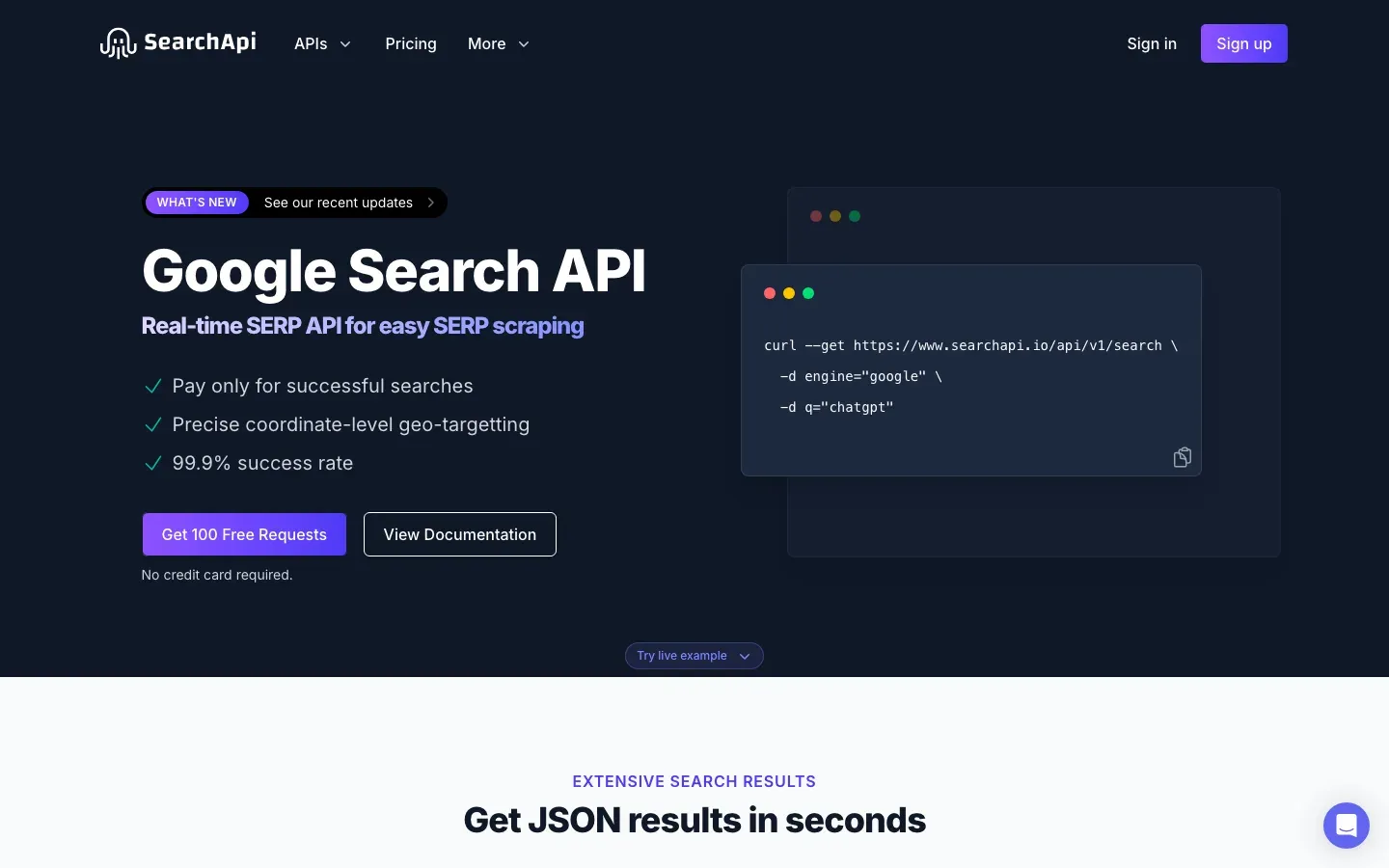
SearchApi is a multi-engine SERP and AI-search API: Google (with AI Mode), Bing, YouTube, ChatGPT, Perplexity, and 40-plus engines through one credential and one request shape. It bills on pay-per-successful-search. The Developer plan runs about $40/month for 10,000 searches, and the Production plan about $100/month for 35,000 (roughly $2.86 per 1,000), per SearchApi’s pricing page. Latency is sub-second on most engines. That bundle is exactly right when your workload genuinely spans many engines; it’s more surface than you need when it doesn’t.
Where multi-engine breadth earns its keep
SearchApi’s surface is hard to beat one-for-one when the workload genuinely spans many engines:
- Market research comparing organic rankings on Google, Bing, and regional engines for the same query.
- App and video visibility work that pulls YouTube alongside classic search in one pipeline.
- Geographic SERP work that needs several regional engines under one auth.
- Vertical research touching News, Images, and other Google sub-products through a single integration.
The integration savings compound: one auth, one rate-limit, one billing relationship. If you actually use 10-plus of those engines, the consolidation is the whole value proposition, and no depth-first tool replaces it cleanly.
Where Google-only depth matters more
For a workload anchored to Google, the breadth-first approach leaves features on the table. AI Overview now shows on a large share of commercial queries, and SearchApi exposes Google’s AI Mode endpoint, the chat-style answer surface, without structurally parsing the AI Overview block that appears on standard SERPs with its cited source list and embedded sponsored ads. You get the endpoint, not the parsed block.
People Also Ask has the same shape of gap. Returning the question text is easy; hydrating each question with its expanded answer is the part a breadth-first API deprioritizes. Sponsored ad sitelinks and position-tagged related searches are part of the modern SERP too, and parsing those cleanly from rendered HTML is per-engine work that a 40-engine product spreads thin.
A Google-focused product can invest in exactly those surfaces instead, and that is the trade the alternatives below either sharpen or reverse.
The 5 real SearchApi alternatives, tested
1. cloro: best for deep, AI-native Google parsing
cloro’s SERP API goes the other way, deep on Google rather than wide across engines. One endpoint family returns parsed JSON for Google Search and News, Google AI Overviews and AI Mode, plus ChatGPT, Perplexity, Copilot, Gemini, and Grok, with the actual cited source URLs each AI surface used. Where SearchApi hands you an AI Mode endpoint, cloro returns the AI Overview block itself: organic results, ads, AI Overview with citations, People Also Ask, and related searches in a single response envelope.
That cross-surface coverage is what changed in 2026: track classic rank without tracking AI citations and you now miss half the SERP. cloro also fits existing pipelines through n8n, Zapier, LangChain, and MCP, with no service to build first. Sync calls cover single lookups; async/batch with webhook delivery pushes large query sets back, so nothing sits polling.
Pros: AI Overview parsed by default, with block text and cited source URLs. One API across Google and every major AI surface. Self-serve signup with a free 500-credit trial. Per-call pricing with no monthly search bundle to size.
Cons: Depth-first on search intelligence. It doesn’t ship the 40-engine catalog SearchApi does (no Naver, Baidu, App Store, and other verticals). Newer than the longest-running SERP APIs.
Pricing: Credit-based from $30/month (Lite, 37,500 credits at $0.80 per 1,000 credits), with Hobby at $100/month for 250,000 credits at $0.40 per 1,000 and rates scaling down to $0.31 per 1,000 on the largest self-serve tier and $0.25 on a custom Enterprise contract. A Google call is 3 credits at n=10, +2 with AI Overview, landing at $1.25–$2.00 per 1,000 at n=10 with AIO. The entry-tier rate is a ceiling, not what you settle at. See the pricing page for full tiers.
2. SerpApi: best for the widest engine catalog
SerpApi is the broadest engine catalog in the category: Google, Bing, Baidu, Yandex, eBay, YouTube, and 80-plus others, with parsing depth SearchApi doesn’t match on the long tail. Founded in 2015, it’s the most mature option here, with documentation that’s the category gold standard and AI Overview parsed with cited sources. If you picked SearchApi for breadth but want deeper per-engine parsing, SerpApi is the like-for-like upgrade.
The catch is price: SerpApi’s monthly bundles run higher per call than SearchApi at every tier, and top-100 work is expensive because each 10-result batch counts as a search.
Pros: Widest engine catalog anywhere. Mature, reliable when Google ships UI changes. AI Overview parsed with cited sources.
Cons: Highest effective per-call rate in this list (~$9–$15 /1k depending on tier). Monthly bundle creates friction at spiky or ad-hoc volume.
Pricing: Starter $25/month (1,000 searches), Developer $75/month (5,000), Production $150/month (15,000), Big Data $275/month (30,000), roughly $15/1k down to $9/1k effective (SerpApi pricing).
3. DataForSEO: best for horizontal SEO breadth at low base rates
DataForSEO is a different shape: a horizontal SEO platform with 60-plus endpoints (SERP, backlinks, on-page, keyword data, business data) rather than a focused search API. On the SERP slice specifically it runs $2 per 1,000, returning in about 6 seconds. A roughly 80% SERP price cut in September 2025 sharpened its standalone value.
If SearchApi’s monthly bundles feel expensive for high-volume Google-only work, DataForSEO’s pay-as-you-go $2/1k Live rate avoids the bundle.
Pros: Low per-call SERP rate at n=10. One vendor for the full SEO program if you need backlinks and on-page too.
Cons: AI Overview enrichment roughly doubles the first-page cost (~$4/1k) and parses shallower than purpose-built tools. 60-plus endpoints are integration overhead for a SERP-only consumer.
Pricing: Pay-as-you-go, SERP $2/1,000 in real time; AI Overview roughly doubles the first-page cost (DataForSEO pricing).
4. Serper: best lightweight Google SERP at the budget tier
Serper positions on speed and price: fast, sub-second Google SERP responses, a generous free tier of 2,500 queries, and per-call rates from $0.30 to $1 per 1,000. It’s the budget pick for a lightweight tool or research project that only needs Google organic results and doesn’t require structured AI Overview parsing.
Pros: Lowest entry price among reliably-built SERP APIs. Fast even at load. Generous free tier for evaluation.
Cons: No structured AI Overview field. You handle that extraction yourself. Narrow vertical coverage versus SearchApi’s 40 engines; no multi-engine breadth. Smaller documentation and ecosystem.
Pricing: Free tier (2,500 queries); paid plans from $50/month, effective $0.30–$1 per 1,000 (Serper pricing).
5. Bright Data: best for proxy + SERP scraping at scale
Bright Data runs one of the largest residential proxy networks on the planet, 72M-plus IPs across 195-plus countries, with a SERP API layered on top. It’s the right tier for very high volume or workloads where the proxy layer matters as much as the parsing layer, but onboarding is an enterprise sales motion and AI Overview is not a clean parsed field.
Pros: Unmatched proxy scale and infrastructure. Rigorous compliance and country/city targeting. SERP API rides on that network.
Cons: Enterprise pricing and procurement (Business tier near $999/month) unfriendly to small teams. AI Overview requires DIY parsing on top of raw access. Proxy-first ergonomics feel layered on for SERP-only work.
Pricing: SERP API ~$1–$1.50 per 1,000 at higher-volume tiers; committed plans (Business ~$999/month) are where the effective rate drops (Bright Data pricing).
SearchApi alternatives: price and coverage compared
Headline rates mislead once you account for AI Overview parsing and pagination. The number that matters is what you pay for a real production Google call, n=10 with the AI Overview block parsed, not the cheapest base rate with the modern SERP features stripped out.
| Vendor | Model | Google SERP rate (~1k) | AI Overview | Onboarding |
|---|---|---|---|---|
| cloro | Parsed AI-native SERP API | $1.25–$2.00 (n=10 + AIO) | ✅ deep, default | Self-serve, free tier 500 credits/mo |
| SearchApi | Multi-engine + AI search | ~$2.86 /1k (Production) | ⚠️ AI Mode only, no AIO block | Self-serve |
| SerpApi | Multi-engine SERP API | ~$9–$15 /1k | ✅ parsed, cited | Self-serve |
| DataForSEO | Horizontal SEO platform | $2 /1k | ⚠️ ~$4/1k, shallower | Self-serve |
| Serper | Lightweight Google SERP | $0.30–$1 /1k | ❌ none | Self-serve |
| Bright Data | Proxy + SERP layer | ~$1–$1.50 /1k | ⚠️ DIY parse | Sales-led, KYC |
Headline takeaways:
- Cheapest base rate: Serper ($0.30–$1/1k), which strips AI Overview entirely and trades away all multi-engine breadth. DataForSEO is $2/1k, with AI Overview extra on a shallower parse.
- AI Overview parsed by default at n=10: cloro ($1.25–$2.00/1k with the AIO block, citations, and PAA). SearchApi’s AI Mode endpoint doesn’t return that field.
- Widest engine catalog: SerpApi, if the reason you’re on SearchApi is breadth and you want more of it, at a higher per-call rate.
- Infrastructure scale: Bright Data, when the proxy layer matters as much as the parse, at an enterprise price and with a DIY AI Overview parser.
For the price-only view see Cheapest SERP API 2026; for the full managed-API roundup see Best SERP APIs in 2026.
Decision tree: which SearchApi alternative to pick
- On SearchApi for Google, but want the AI Overview block parsed (not just AI Mode) plus ChatGPT/Perplexity/Gemini citations through one API? cloro.
- On SearchApi for breadth and want more of it with deeper per-engine parsing? SerpApi, 80-plus engines, cited AI Overview.
- High-volume Google-only work, pay-as-you-go with no bundle? DataForSEO at $2/1k Live.
- Lightweight tool or research project at the budget tier, no structured AI Overview needed? Serper.
- Scraping at massive volume where the proxy layer matters as much as the parse? Bright Data.
The bottom line
SearchApi is breadth-first: 40-plus engines under one credential, priced on monthly bundles, with AI Mode exposed but the AI Overview block left unparsed. The right SearchApi alternative depends on why you’d leave. If you want more breadth with deeper parsing, SerpApi is the upgrade; if you want the cheapest base Google rate, DataForSEO or Serper undercut it; if you need proxy scale, Bright Data is the tier.
But if the reason you’re looking is that you only ever query Google and want the modern SERP, AI Overview with citations, hydrated PAA, ad sitelinks, returned as clean structured JSON, the answer isn’t another multi-engine bundle. cloro returns all of it in one self-serve call at $1.25–$2.00 per 1,000 (n=10 + AIO), across Google and every major AI surface, with a free 500-credit trial to baseline your own keywords before you commit.
Feature comparison
How the two stack up, feature by feature
| Feature | cloro | SearchApi |
|---|---|---|
| Platform Support | ChatGPT, Perplexity, Copilot, Google, Gemini, Grok | Google (with AI Mode), Bing, Yahoo, and 35+ more |
| AI Overview Scraping | Native support with parsed citations | Google AI Mode supported |
| Response Speed | < 2 seconds average | < 1 second average |
| Geolocation Support | Comprehensive coverage for all major markets | 100+ countries |
| Pricing Model | Credit-based by AI model | Monthly subscription, pay for successful searches |
| AI Platform Coverage | 6+ AI platforms monitored | Google only (with AI Mode) |
| Structured Data | Rich parsed objects, citations | Good SERP parsing, AI Mode responses |
| Cost at High Volume | Credit-based, model-specific pricing | Per-search costs add up |
The verdict
If you only need Google Search results with sub-second response times and don't mind monthly subscriptions, SearchApi is excellent. But for AI platform coverage, extended Google parsing (AI Overviews, citations), and per-call billing that lands at $1.25–$2.00 per 1,000 (n=10 + AIO) vs. SearchApi's $4–$10 per 1,000 subscription tiers, cloro offers comprehensive multi-platform support that SearchApi can't match.
Frequently asked questions
What's the main difference between SearchApi and cloro?
SearchApi is breadth-first: 40-plus engines under one credential, from Google and Bing to Naver, Baidu, YouTube, and the App Store. cloro's SERP API is depth-first on Google, investing in the modern SERP envelope. So SearchApi gets you more engines, and cloro gets you more of each Google feature.
Does SearchApi parse AI Overview?
SearchApi exposes Google's AI Mode endpoint, the chat-style answer surface, but not the AI Overview block that appears on standard SERPs, with its parsed source list and embedded sponsored ads. cloro returns AI Overview structurally in the default response, with no raw-HTML parsing required.
Is SearchApi faster than cloro?
Slightly. SearchApi averages under 1 second on most engines versus cloro's under 2 seconds. For Google-anchored monitoring, the feature depth cloro adds (AI Overview, hydrated PAA, sponsored sitelinks, position-tagged related searches) usually matters more than the sub-second speed difference.
How does the pricing compare?
SearchApi runs a monthly subscription in the $4–$10 per 1,000 range depending on tier and engine, without structural AI Overview parsing. cloro's per-call model (3 credits plus 2 per additional page plus 2 for AI Overview), billed at $0.40/1k credits on Hobby, $0.31/1k on the largest self-serve tier, and $0.25/1k on a custom Enterprise contract, lands at $1.25–$2.00 per 1,000 at n=10 with AI Overview kept in the default response.
When should I pick SearchApi over cloro?
Pick SearchApi when your workload genuinely spans 10+ search engines under one integration, or when App Store, Google Play, YouTube, or other vertical engines are on your roadmap. Pick cloro when Google is your dominant target, AI Overview parsing belongs in the default response, and you don't need Naver, Baidu, or other vertical engines.
Related comparisons
Each page maps cloro's SERP API against one alternative on pricing, AI Overview coverage, and developer experience. Compare SearchApi with the rest of the field:
Apify Alternative: 5 Scraping & SERP APIs Tested (2026)
We tested 5 Apify alternatives in 2026 — managed SERP APIs vs actor marketplaces, AI Overview, and real pricing. See which fits without maintaining actors.
Best Bright Data Alternatives: 5 Proxy and SERP APIs (2026)
We tested 5 Bright Data alternatives in 2026 on parsed Google SERPs, AI Overview, real per-1,000 pricing, and setup time. See which proxy or SERP API fits.
Best DataForSEO Alternatives: 5 SERP APIs Tested (2026)
We tested 5 DataForSEO alternatives in 2026 on AI Overview support, real per-call pricing, and developer experience. See which SEO data API fits.
Oxylabs Alternatives: 5 Proxy & SERP APIs Tested (2026)
We tested 5 Oxylabs alternatives in 2026 — proxy scale, parsed SERPs with AI Overview, real per-1,000 pricing, and setup time. See which fits your workload.
ScrapeDO Alternatives: 5 SERP & Scraping APIs Tested (2026)
We tested 5 Scrape.do alternatives in 2026 — parsed SERPs with AI Overview vs cheap raw HTML, reliability, and real per-1,000 pricing. See which fits.
ScraperAPI Alternatives: 5 SERP APIs Tested (2026)
We tested 5 ScraperAPI alternatives in 2026 — parsed SERPs, AI Overview, real credit-vs-per-call pricing, and success rates. See which scraping API fits.
ScrapingBee Alternatives: 5 SERP APIs Tested (2026)
We tested 5 ScrapingBee alternatives in 2026 — JS rendering vs parsed SERPs, AI Overview, and real credit-vs-per-call pricing. See which scraper fits.
SerpApi Pricing vs 5 SerpApi Alternatives Tested (2026)
SerpApi pricing in 2026: published tiers, the real per-1,000 cost at n=10 and n=100, and 5 SerpApi alternatives tested on price and AI Overview support.
Serper Alternative: 5 SERP APIs Tested (2026)
We tested 5 Serper alternatives in 2026 on AI Overview parsing, structured SERP depth, and real per-call pricing. See which SERP API actually fits.