
Technical Guides
12 Best Competitive Intelligence Tools (2026 Review)
We tested 12 competitive intelligence tools across SEO, social, sales enablement, and AI search. See pricing, who each is for, and the honest weak spots.
A typical CI suite bundles SERP data with backlinks and traffic estimates, then hides the raw signals behind a UI. cloro returns just the SERP slice, as JSON: any competitor's organic positions, ads, AI Overview citations, and PAA appearances for any query, country, and device. Whatever scoring methodology your team has, you can run it on the response yourself.
4.7 · 23 reviews
Where do competitors rank? Which ads are they running? Are they cited in the AI Overview for the queries that matter? Are they showing in PAA, related searches, or sponsored slots? cloro returns every SERP element that informs competitor positioning, parsed and position-tagged, in one JSON response.
Competitor analysis comes in two product shapes: full CI suites (all-in-one dashboards with their methodology baked in) and SERP data primitives (cloro — raw structured response, your methodology applied in your code). Teams that need their CI methodology consistent across vendor changes pick the primitive. Here's why.

Pull the same competitor through three CI suites in the same week and you get three different "strength" numbers: 67 on one (organic-weighted), 71 on another (backlink-weighted), 4,210 on a third (traffic-modeled). None of those numbers map cleanly to whatever your team actually reports. cloro returns the SERP fields directly, including rank_group, rank_absolute, and the full envelope, so you can run your own share-of-voice math against the same data each time.
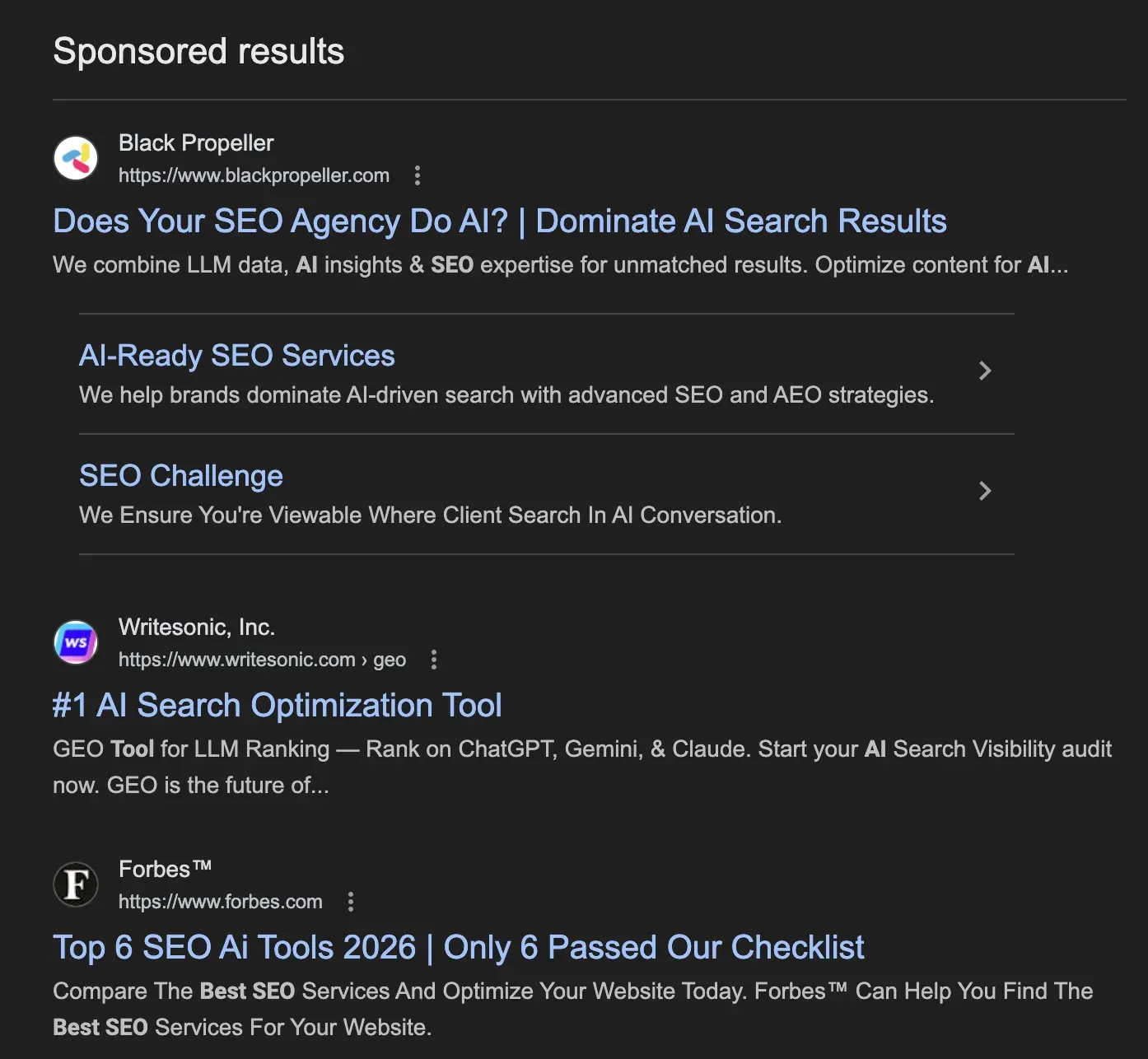
SERP ads rotate hourly with competitor bids and budget pacing. CI suites refresh ad data weekly. cloro returns parsed `ads[]` on every call — sample hourly across your top 100 commercial queries and you see exactly when a competitor enters the auction, raises bids, or pauses.
AI Overview renders on ~40% of commercial queries — competitors cited in the source list capture the answer-traffic that organic position 1 used to win. CI suites are still building this; cloro returns `aioverview.sources[]` (position, URL, citation context) per call alongside the standard SERP.
Tracking 50 competitors × 500 keywords is 25,000 cells of SERP data. CI suites cap this with per-competitor and per-keyword bundles. cloro is flat per-call: 500 keywords × 50 competitor-presence checks happens in one batch of 500 calls. Your detection is a warehouse query, not a per-row upcharge.
One call per query × country × device. Filter the response for any competitor domain across organic, ads, AI Overview, and PAA. Roll up to your warehouse for share-of-voice math, ad-rotation tracking, or AI Overview citation auditing.
import requests

# Your keyword set + the competitor you're auditing.
keywords = ["best project management software", "asana alternatives", "trello alternatives"]
competitor_domain = "monday.com"

results = []
for query in keywords:
    response = requests.post(
        "https://api.cloro.dev/v1/monitor/google",
        headers={
            "Authorization": "Bearer sk_live_your_api_key_here",
            "Content-Type": "application/json",
        },
        json={
            "query": query,
            "country": "US",
            "device": "desktop",
            "include": {"aioverview": {"markdown": True}},
        },
    )
    data = response.json()["result"]

    # Detect competitor across every SERP surface
    organic_pos = next((r["position"] for r in data["organicResults"]
                        if competitor_domain in r["link"]), None)
    in_ads = any(competitor_domain in a["domain"] for a in data.get("ads", []))
    aio_sources = data.get("aioverview", {}).get("sources", []) or []
    in_aio = any(competitor_domain in s["url"] for s in aio_sources)
    aio_position = next((s["position"] for s in aio_sources
                         if competitor_domain in s["url"]), None)

    results.append({
        "query": query,
        "competitor": competitor_domain,
        "organic_position": organic_pos,
        "in_ads": in_ads,
        "in_aioverview": in_aio,
        "aioverview_position": aio_position,
    })

# Each row is now competitor-presence per query across all SERP surfaces.
# Aggregate to share-of-voice; alert on entry/exit; diff over time.
print(results){
"success": true,
"result": {
"organicResults": [],
"ads": [],
"peopleAlsoAsk": [],
"relatedSearches": [],
"aioverview": {}
}
} Pick a plan that fits your volume. Price per credit drops as you scale.
Credit cost per request varies by provider. The figures below are for async/batch requests; sync requests add a +2 credit surcharge.
Google News uses the same pricing as Google Search.
No. cloro is the SERP data primitive that CI tools build on. Full suites bundle SERP, backlinks, traffic, and site-audit into one dashboard. cloro provides the SERP slice as raw JSON so your methodology stays in your code. Most enterprise CI programs use both: a suite for breadth, cloro for SERP-data depth.
Five per call: organic position, sponsored-ad presence (with bid position and creative), AI Overview citation (URL + position), PAA appearance, and named-in-related-searches. Every signal in one structured JSON response.
Sample `/v1/monitor/google` hourly, persist `ads[]` per call, diff adjacent hours in your warehouse. Detect: new advertiser entry, bid changes (position shift), advertiser pause, block-position shifts (top-of-page → bottom = quality-score signal). 100 keywords × hourly = 72k calls/month — fits in the Hobby plan with headroom.
Three framings of the same endpoint. Rank tracking watches your own positions. SERP monitoring watches every SERP element for changes. Competitor analysis is the inverse — fix a competitor domain, watch where they appear across your keyword set.
Yes. For a fixed keyword set, count where each competitor (including you) appears across organic top-10, ads, and AI Overview citations, weight by position, divide by total. The math runs against the SERP rows in your warehouse — methodology stays yours.
PPC competitor research is a specific application of the ad-monitoring loop. Inspect `ads[]` for a target competitor's domain across your tracked queries to track: which queries they bid on, where they rank in the auction, when they enter and exit, and what creative they run. No separate product — same SERP call, different aggregation.
Out of scope. cloro is the SERP data layer (organic, ads, AI Overview, PAA, related). For backlink graphs, traffic-estimate tools, and crawler-based site audit, use the dedicated tools your team already has. Most CI programs pay for adjacent tools anyway; cloro fills the SERP-data gap at a fraction of the per-call cost of bundled suites.
We tested 12 competitive intelligence tools across SEO, social, sales enablement, and AI search. See pricing, who each is for, and the honest weak spots.

Build a modern competitive analysis template that tracks SEO, AI Overviews, and brand signals to outperform your competition in 2026.

Explore 10 competitive intelligence examples: pricing, hiring, reviews, SERP features, AI visibility, content gaps, and market expansion signals.