
Serper Alternative: 5 SERP APIs Tested (2026)
We tested 5 Serper alternatives in 2026 on AI Overview parsing, structured SERP depth, and real per-call pricing. See which SERP API actually fits.
4.7 · 53 reviews
Why teams switch from Serper
Issues users run into with Serper
No AI Overview support
Serper exposes basic Google Search results only. You don't get AI Overviews, citations, or any AI-generated content that now dominates the SERP. cloro parses the AI Overview with its cited sources, so you see who Google's answer names.
Basic feature set
Optimized for speed rather than feature depth. You get traditional organic results, without knowledge panels, citations, or AI-generated content parsing. cloro returns those in the same response, so one call covers the whole page.
Per-query pricing at scale
Serper's per-request model scales from $1 per 1,000 queries at entry level to $0.30 per 1,000 at high volume. For consistent high-volume usage, cloro offers more predictable pricing, so you can budget monitoring spend without re-checking which per-query tier you've crossed.
Quick comparison
How cloro compares to Serper
cloro
Serper
Serper is the fast-and-cheap corner of the SERP-API market. It does one thing: it returns Google search results as JSON, in well under a second, at a per-query rate that drops toward $0.30 per 1,000 at volume, and it does that one thing well. If you’re shopping for a Serper alternative, it’s usually because that deliberately thin envelope has become a constraint, not because Serper is slow or expensive.
Most teams searching for Serper alternatives in 2026 want one of two things Serper doesn’t return: structured AI Overview parsing (the generative block now rendering on a large share of commercial queries), or the deeper SERP fields, hydrated People Also Ask, ad sitelinks, position-tagged related searches, that turn a one-off lookup into a monitoring signal. Serper’s free 2,500-query tier and sub-second latency are genuinely hard to beat for lookups; they just don’t cover the modern feature mix.
So the question behind every Serper alternative is what you actually need more of: SERP parsing, search engines, or AI surfaces, and what a call costs once AI Overview is in the response. We tested five.
The 5 best Serper alternatives at a glance
| Tool | Model | Entry price | Google SERP rate (~1k) | AI Overview |
|---|---|---|---|---|
| cloro | Parsed AI-native SERP API | $30/mo (free tier: 500 credits/mo) | $1.25–$2.00 /1k (n=10 + AIO) | ✅ deep, default |
| SerpApi | Multi-engine SERP API | $25/mo (1k searches) | ~$9–$15 /1k (tier-dependent) | ✅ parsed |
| SearchApi | Multi-engine + AI search | ~$40/mo (10k searches) | ~$2.86 /1k (Production) | ⚠️ not structured |
| DataForSEO | Horizontal SEO platform | $2 /1k | $2.00 /1k | ⚠️ ~2× first page |
| Bright Data | Proxy + SERP layer | PAYG; Business ~$999/mo | ~$1–$1.50 /1k | ⚠️ not a clean field |
The alternatives split on two axes a Serper user actually feels: how much of the SERP is parsed for you (basic organic vs. the full modern envelope with AI Overview) and how much reach you get beyond Google (one engine, many engines, or a whole SEO platform). Serper sits at the thin-envelope, Google-only corner of both. Every option below moves you outward on one axis or the other.
How we tested, and what these numbers rest on
Comparison pages are easy to write and hard to trust, so here is the basis for every claim above.
The cloro rows are measured. On 2026-08-19 we ran 15 AI-Overview-prone commercial and informational queries through cloro’s Google endpoint. 14 of the 15 returned a fully parsed AI Overview object, carrying the answer text, a markdown rendering, sources, citationPills, relatedLinks and videos, at a mean of 8.5 sources per overview. That run is the evidence behind cloro’s AI Overview column. One implementation detail if you benchmark us yourself: the field populates only when include.aioverview is sent, and without that flag it is absent whether or not Google rendered an overview, which produces a convincing-looking zero.
The Serper and other vendor rows come from each vendor’s own documentation and pricing pages, linked inline throughout. We did not run those APIs under our own keys for this comparison. So read a ❌ or ⚠️ as “not documented as a first-class parsed field” rather than as a test we ran and they failed. Where a vendor has shipped something since we last checked, their documentation is the authority and this page is not.
Pricing moves and none of these figures are quotes. List prices change without notice and promotional rates are common, so treat the per-1,000 rates as the shape of the market rather than a number to budget against, and open the linked pricing page before you commit.
We make one of the products in this table. cloro is listed first because this is our site, not because a neutral panel ranked it there. The measurements above are reproducible and the competitor links go to primary sources; use both to discount our framing.
What Serper is actually built for
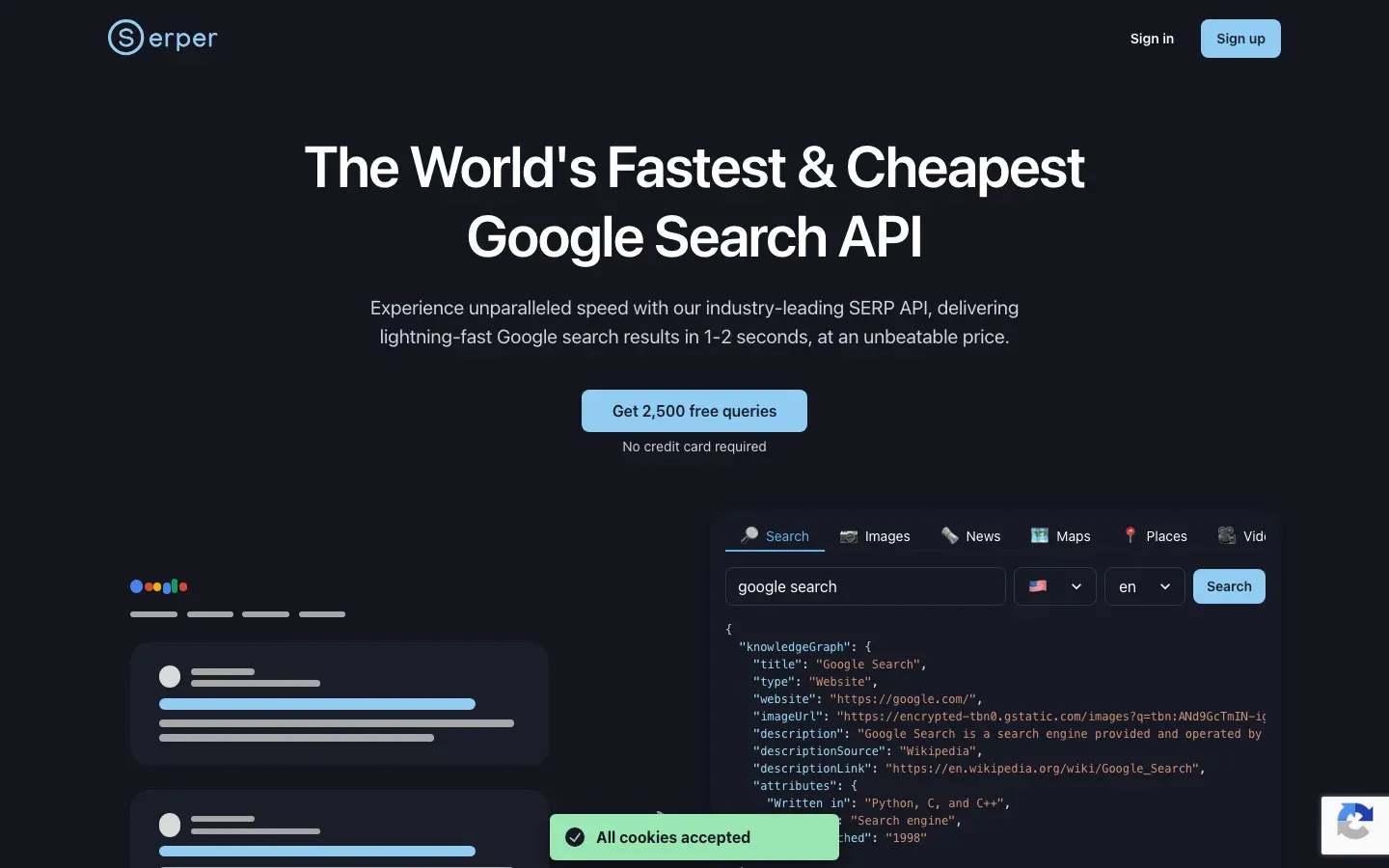
Serper is a single-purpose Google SERP API optimised for latency and price. It returns organic positions, answer-box and knowledge-graph fields when present, top-stories and image hints, and a flat related-searches list, in sub-second time, from a free tier of 2,500 queries and paid plans starting near $50/month at per-query rates between $0.30 and $1 per 1,000 (Serper pricing). There’s no proxy pool to manage, no task queue, no async polling: you call one endpoint and parse a compact JSON body. That minimalism is the whole product.
Where speed-and-simplicity earns its keep
For workloads that match its envelope, Serper is hard to beat:
- LLM tool-call chains that need a fast Google lookup inside a tight latency budget. The sub-second response is the product.
- One-off research lookups embedded in a product flow, where “what ranks for X right now” is the entire question.
- Free-tier hobby projects and prototypes that fit inside the 2,500-query monthly quota.
- High-volume basic rank checks where the only signal you need is an organic position and a URL.
If that describes your work, most of this page is moot. Serper’s price and latency are the right trade.
Where the thin envelope becomes the bottleneck
For SERP monitoring and rank tracking against the modern Google feature mix, the fields Serper omits are exactly the change signals you need.
The AI Overview block is the big one: Serper doesn’t return it, so on queries where AIO renders you get no text, no source list with positions, no embedded ads or videos, and no read on the surface increasingly sitting above the organic results. People Also Ask arrives as question text without the expanded answers, so tracking how Google answers a query means a second scrape. Some ad metadata is exposed but the sitelinks structure isn’t, and sitelink rotation is half the paid-SERP change signal. Related searches come back as plain strings, with no positions and no click URLs.
The teams hitting these gaps either bolt a parser layer onto Serper for the missing fields, or move to a SERP API that returns the modern envelope by default. The five below cover both instincts.
The 5 real Serper alternatives, tested
1. cloro: best for parsed, AI-native SERP data
cloro’s SERP API is the opposite bet from Serper: instead of the thinnest fast envelope, it returns the deepest parsed one. One endpoint family covers Google Search and News, Google AI Overviews and AI Mode, plus ChatGPT, Perplexity, Copilot, Gemini, and Grok, with the actual cited source URLs each AI surface used. A Google response ships organic results, ads (with sitelinks), AI Overview parsed into text and citations, hydrated PAA, and position-tagged related searches in one body. Latency runs ~1–2 seconds, slower than Serper’s sub-second, faster than scraping and parsing rendered HTML yourself. It fits existing pipelines through n8n, Zapier, LangChain, and MCP, with no service to build first. Sync calls cover single lookups; async/batch with webhook delivery pushes large query sets back, so nothing sits polling.
Pros: AI Overview parsed by default, with block text and cited source URLs. One API across Google and every major AI surface. Self-serve signup with a free 500-credit trial. Clean single-envelope response, no parser to maintain.
Cons: Not built to beat Serper on raw latency or on the cheapest basic-lookup rate. Focused on search intelligence. No vertical Maps/Jobs/e-commerce endpoints. Newer than the longest-running SERP APIs.
Pricing: Credit-based from $30/month (Lite, 37,500 credits at $0.80 per 1,000 credits), with Hobby at $100/month for 250,000 credits at $0.40 per 1,000 and rates scaling down to $0.31 per 1,000 on the largest self-serve tier and $0.25 on a custom Enterprise contract. A Google call is 3 credits at n=10, +2 with AI Overview, roughly $1.25–$2.00 per 1,000 at n=10 with AIO. The entry-tier rate is a ceiling, not what you settle at. See the pricing page for full tiers.
2. SerpApi: best for multi-engine breadth
SerpApi is the widest engine catalog in the category. Beyond Google it parses Bing, Baidu, Yandex, eBay, YouTube, and 80+ others at the same depth, with AI Overview parsed on Google and documentation that’s the category benchmark. Founded in 2015, it’s the mature incumbent for teams that need more than one engine under a single auth. The trade-off versus Serper is price: SerpApi’s bundle plans run an effective ~$15 per 1,000 at the Starter tier down to ~$9 per 1,000 at the Big Data tier, well above Serper’s per-query rate.
Pros: Broadest engine coverage. Mature, reliable, well-documented. AI Overview parsed with cited sources.
Cons: Much higher effective per-call rate than Serper. Monthly bundles create friction at spiky or ad-hoc volume.
Pricing: Starter $25/month (1,000), Developer $75/month (5,000), Production $150/month (15,000), Big Data $275/month (30,000) (SerpApi pricing). See our SerpApi alternatives breakdown for the full tier math.
3. SearchApi: best mid-tier with AI search surfaces
SearchApi sits between Serper and SerpApi on both price and coverage. It parses Google (including AI Mode), Bing, and YouTube, plus ChatGPT and Perplexity through one API, at an effective rate around $2.86 per 1,000 at production scale, cheaper than SerpApi, dearer than Serper, and with more AI-surface reach than either. The caveat: AI Overview isn’t structurally parsed the way cloro or SerpApi return it, so if AIO citation tracking is the goal, verify the field shape before you commit.
Pros: Multi-engine plus AI-surface coverage at mid-tier pricing. Cleaner API than a horizontal platform. ChatGPT and Perplexity responses parsed.
Cons: AI Overview not structurally parsed. Narrower engine catalog than SerpApi. Bundle pricing, same spiky-volume friction.
Pricing: from ~$40/month (10,000 searches); Production ~$100/month (35,000 searches, ~$2.86/1k) (SearchApi pricing). See SearchApi alternatives for the detail.
4. DataForSEO: best when you need the whole SEO platform
DataForSEO is a horizontal SEO data platform with 60+ endpoints spanning SERP, backlinks, on-page audits, and keyword research. On the SERP slice specifically, it runs $2 per 1,000 and returns in about 6 seconds. Enabling AI Overview roughly doubles the first-page cost (~$4 per 1,000). It’s the right pick when you need SERP data alongside other SEO surfaces under one vendor, but it’s more platform than a Serper user typically wants.
Pros: One vendor for SERP plus backlinks, on-page, keywords. Live mode returns in about 6 seconds.
Cons: 60+ endpoints is integration overhead for a SERP-only consumer. AI Overview doubles first-page cost and parses shallower than cloro/SerpApi.
Pricing: SERP $2/1,000 in real time; AIO ~doubles first-page cost (DataForSEO pricing). See DataForSEO alternatives for the full comparison.
5. Bright Data: best when the proxy layer matters too
Bright Data is a proxy-first vendor (72M+ residential IPs across 195+ countries) with a SERP API layered on the infrastructure. Its Google SERP rate lands around $1–$1.50 per 1,000 at volume, but onboarding is an enterprise sales motion (KYC, committed plans; Business near $999/month) and AI Overview isn’t returned as a clean parsed field. It’s the right alternative only if you need the proxy network as much as the SERP data, otherwise it’s far more machinery than a Serper replacement calls for.
Pros: Massive proxy scale and geo coverage. SERP API on proven infrastructure. Enterprise compliance posture.
Cons: Sales-led onboarding, not self-serve. AI Overview not a clean parsed field. Enterprise minimums unfriendly to small or spiky workloads.
Pricing: SERP API ~$1–$1.50 per 1,000 at volume; Business plans near $999/month (Bright Data SERP pricing).
Serper alternatives: price and coverage compared
Headline per-query rates flatter Serper because the number that matters is what’s in the response. A $0.30/1,000 call that returns basic organic positions isn’t cheaper than a $2/1,000 call that returns parsed AI Overview and PAA if you then spend weeks building the parser Serper leaves out.
| Vendor | Model | Google SERP rate (~1k) | AI Overview | Onboarding |
|---|---|---|---|---|
| Serper (incumbent) | Lightweight Google SERP | $0.30–$1.00 | ❌ none | self-serve |
| cloro | Parsed AI-native SERP API | $1.25–$2.00 (n=10 + AIO) | ✅ deep, default | self-serve |
| SerpApi | Multi-engine SERP API | ~$9–$15 (tier) | ✅ parsed | self-serve |
| SearchApi | Multi-engine + AI search | ~$2.86 (Production) | ⚠️ not structured | self-serve |
| DataForSEO | Horizontal SEO platform | $2 /1k | ⚠️ ~2× first page | self-serve |
| Bright Data | Proxy + SERP layer | ~$1–$1.50 | ⚠️ not clean | sales-led |
Headline takeaways:
- Cheapest base rate: Serper itself ($0.30–$1/1k), without a structured AI Overview. DataForSEO is $2/1k.
- Best parsed AI Overview: cloro (default) and SerpApi (parsed); SearchApi, DataForSEO, and Bright Data each carry a caveat.
- Lowest total delivered cost for parsed Google + AI Overview: cloro, because the AIO parser, citation extraction, and PAA hydration are already done, so there is nothing left for you to build or maintain.
- Widest engines: SerpApi. Most complete SEO platform: DataForSEO. Proxy scale: Bright Data.
For the price-only view see Cheapest SERP API 2026; for the full managed-API roundup see Best SERP APIs in 2026.
Decision tree: which Serper alternative to pick
- Just need faster or cheaper basic Google lookups and no AI Overview? Stay on Serper. Nothing here beats it on that specific job.
- Need parsed AI Overview plus ChatGPT/Perplexity/Gemini citations through one API? cloro.
- Need 80+ search engines including Baidu, Yandex, eBay, YouTube under one auth? SerpApi.
- Want mid-tier multi-engine + AI search at a lower rate than SerpApi? SearchApi.
- Need SERP data alongside backlinks, on-page audits, and keyword APIs from one vendor? DataForSEO.
- Need the proxy network as much as the SERP data? Bright Data.
The bottom line
Serper is a fast lookup primitive: the thinnest, cheapest Google SERP envelope, returned in under a second. The best Serper alternative depends on which part of that envelope you’ve outgrown. If you need more engines, SerpApi covers breadth and SearchApi the mid-tier AI surfaces. DataForSEO is the pick when you want a whole SEO platform behind the SERP data, and Bright Data when you need the proxy pool too. But if the reason you’re leaving is that Serper’s basic response no longer covers the modern SERP, AI Overview, hydrated PAA, ad sitelinks, position-tagged related searches, the answer is a parsed SERP API, not another thin one. cloro returns all of it in one self-serve call, across Google and every major AI surface, with a free 500-credit trial to baseline your own keywords before you commit.
Feature comparison
How the two stack up, feature by feature
| Feature | cloro | Serper |
|---|---|---|
| Platform Support | ChatGPT, Perplexity, Copilot, Google, Gemini, Grok | Google Search only |
| AI Overview Scraping | Native support with parsed citations and sources | Not supported |
| Setup Time | 5 minutes self-service | 10 minutes with API key |
| Response Speed | < 2 seconds average | < 1 second average |
| Geolocation Support | Comprehensive coverage for all major markets | 100+ countries |
| Structured Data | Rich parsed objects, citations, AI overviews | Basic SERP parsing |
| LLM Visibility Tracking | Built-in ChatGPT, Perplexity, Copilot monitoring | Not available |
| Pricing Model | Credit-based by AI model | Per-request, $1 per 1,000 queries at scale |
The verdict
If you only need Google Search results and speed is your only concern, Serper is a solid choice with a generous free tier. But if you're tracking modern SEO and AI visibility, Serper won't hand you AI overviews or the deeper structured data, and it only reads Google.
Frequently asked questions
Is cloro faster than Serper?
Serper is slightly faster for Google Search only (< 1 second vs < 2 seconds). However, cloro supports 6+ AI platforms while Serper only supports Google. For most teams, platform coverage and structured data matter more than millisecond-level speed differences.
Can I use both Serper and cloro?
Yes. Many teams use Serper for basic Google scraping and cloro for AI platform monitoring. They sit fine side by side if you have the budget for both.
How much will I save switching from Serper to cloro?
It depends on your usage and what you need from each call. Serper's pricing scales from $1 per 1,000 queries at entry level to $0.30 per 1,000 at high volume but doesn't include AI Overview parsing. cloro's page-driven Google endpoint runs $1.25–$2.00 per 1,000 at n=10 with AI Overview included (3 base credits + 2 for AIO, billed at $0.40/1k credits on Hobby, $0.31/1k on the largest self-serve tier, and $0.25/1k on a custom Enterprise contract).
Does cloro offer the same SERP parsing as Serper?
cloro provides richer SERP parsing than Serper. We extract AI overviews, citations, knowledge panels, and structured objects, not just basic organic results, so you get the full page in one response instead of stitching together separate calls. Plus we do this across ChatGPT, Perplexity, and Copilot, not just Google.
What makes cloro different from Serper?
Platform coverage is the big differentiator. Serper = Google only. cloro = 6+ AI platforms. cloro also includes AI visibility tracking, citation extraction, and AI overview parsing out of the box – no add-ons required.
Related comparisons
Each page maps cloro's SERP API against one alternative on pricing, AI Overview coverage, and developer experience. Compare Serper with the rest of the field:
Apify Alternative: 5 Scraping & SERP APIs Tested (2026)
We tested 5 Apify alternatives in 2026 — managed SERP APIs vs actor marketplaces, AI Overview, and real pricing. See which fits without maintaining actors.
Best Bright Data Alternatives: 5 Proxy and SERP APIs (2026)
We tested 5 Bright Data alternatives in 2026 on parsed Google SERPs, AI Overview, real per-1,000 pricing, and setup time. See which proxy or SERP API fits.
Best DataForSEO Alternatives: 5 SERP APIs Tested (2026)
We tested 5 DataForSEO alternatives in 2026 on AI Overview support, real per-call pricing, and developer experience. See which SEO data API fits.
Oxylabs Alternatives: 5 Proxy & SERP APIs Tested (2026)
We tested 5 Oxylabs alternatives in 2026 — proxy scale, parsed SERPs with AI Overview, real per-1,000 pricing, and setup time. See which fits your workload.
ScrapeDO Alternatives: 5 SERP & Scraping APIs Tested (2026)
We tested 5 Scrape.do alternatives in 2026 — parsed SERPs with AI Overview vs cheap raw HTML, reliability, and real per-1,000 pricing. See which fits.
ScraperAPI Alternatives: 5 SERP APIs Tested (2026)
We tested 5 ScraperAPI alternatives in 2026 — parsed SERPs, AI Overview, real credit-vs-per-call pricing, and success rates. See which scraping API fits.
ScrapingBee Alternatives: 5 SERP APIs Tested (2026)
We tested 5 ScrapingBee alternatives in 2026 — JS rendering vs parsed SERPs, AI Overview, and real credit-vs-per-call pricing. See which scraper fits.
SearchApi Alternatives: 5 SERP APIs Tested (2026)
We tested 5 SearchApi alternatives in 2026 on Google feature depth, AI Overview parsing, engine breadth, and real per-call pricing. See which fits.
SerpApi Pricing vs 5 SerpApi Alternatives Tested (2026)
SerpApi pricing in 2026: published tiers, the real per-1,000 cost at n=10 and n=100, and 5 SerpApi alternatives tested on price and AI Overview support.