
ChatGPT Ads Penetration Study: 51% in the US

On this page
Two months after our May 2026 measurement caught ChatGPT ads spiking from 0.42% to 26.5% of responses, the surface has churned and re-settled. 51.0% of US responses, 53.6% Canadian, 49.8% Australian, and, new since May, 18.8% Japanese responses now carry a paid ad, measured over the 7 days ending 2026-07-03 across cloro’s monitoring corpus. Everywhere else remains at or near zero.
Between those two measurements the rate did not hold steady. It crashed from ~26% in late May to under 1% by mid-June, then re-spiked around 2026-06-26 and has held in the 18–20% band overall for the last week. What looked in May like an overshoot now looks like the surface finding its floor a second time, with Japan added and Canada and Australia both climbing to near-parity with the US.
This post leads with what the corpus shows today. The May 2026 spike and the original April-May study sit below as context. The core question is no longer whether the surface is sparse, which it clearly isn’t, but what its steady state looks like under active tuning.
This ChatGPT ads penetration study is cloro’s third read of the same surface. Each pass re-scans one monitoring corpus with the same detection logic. That design lets us separate a one-off spike from a durable trend. A single snapshot can’t do that. Three snapshots across a throttle-and-recovery cycle can.
Headline: US 51%, Canada 54%, Australia 50%, Japan 19%
| Metric | Apr-May 2026 | 2026-05-26 spike | 7 days ending 2026-07-03 |
|---|---|---|---|
| Overall ad penetration | 0.42% | 26.5% | 12.2% |
| US ad penetration | ~0.5% | 49.1% | 51.0% |
| Canada ad penetration | — | 33.6% | 53.6% |
| Australia ad penetration | — | 19.8% | 49.8% |
| Japan ad penetration | 0% | 0% | 18.8% |
| Ads per ad-bearing response | 1 | 1 | 1 |
Overall dropped from May’s 26.5% to July’s 12.2% not because the lead markets cooled, which they didn’t, but because cloro’s corpus rebalanced toward markets that don’t yet see ads (DE, FR, BR, IL, AE, MX all at or near zero and each contributing 900–2,100 rows in the trailing 7 days). Weighted correctly, the lead-market rate has climbed, not fallen.
The structural format is unchanged. Ads still render as a single Sponsored card under the response sources, one placement per response. What changed since May is that (a) the rate cycled through a large dip before restabilizing, (b) Canada and Australia caught up to the US, and (c) Japan lit up.
Daily trend over the last 30 days makes the churn visible. From result rows tagged CHATGPT with status SUCCESS:
| Week | Overall ad rate | Note |
|---|---|---|
| 2026-06-03 → 06-09 | 1.3% | Post-spike reversion |
| 2026-06-10 → 06-16 | 0.7% | Deepest trough (0.05% on 06-14) |
| 2026-06-17 → 06-23 | 2.1% | Early recovery |
| 2026-06-24 → 06-30 | 8.5% | Re-ramp (455 ad rows on 06-26) |
| 2026-07-01 → 07-03 | ~19% | Current plateau |
The 2026-05-26 headline was real but early: the May-to-June dip and re-plateau, detailed in the next section, show the current levels holding above that spike in the lead markets.
The ad rate crashed, then came back higher
Three things happened between the two measurements, all interesting.
The May spike didn’t hold. The 2026-05-26 measurement caught 26.5% overall / 49.1% US. Within 8 days the rate had crashed to ~1%; by 2026-06-14 it hit 0.05%, effectively the same near-zero floor as the original April-May study. If the daily monitoring loop had been the only signal, someone reading it on June 15 would reasonably have concluded “OpenAI walked the ramp back.”
Then it came back, higher. Ad volume started climbing again around 2026-06-19, jumped hard on 2026-06-26 (455 ad rows, 20.9% penetration), and has held in the 18–20% overall / ~51% US band since 2026-07-01. Whatever OpenAI did during the June trough, whether pulling inventory, retuning auctions or throttling by cohort, appears to have shipped a version that clears more consistently.
Japan lit up. Zero to 18.8% in six weeks, with a distinct Japanese advertiser layer that wasn’t visible in either prior measurement. Japan is now the fourth market in the surface after the US/CA/AU trio, and its distinct catalog (auto marketplaces, telco/mobile, domain registrars, JP-branded SaaS) suggests OpenAI hasn’t just widened English coverage. They’ve opened a second inventory channel with its own auction pool. The timing tracks OpenAI’s own market plans: Japan was named alongside the UK, Brazil, South Korea, and Mexico when the company expanded the ads pilot beyond its original US, Canada, Australia, and New Zealand footprint in May.
The May post’s structural takeaway, that AI-native ad surfaces can sustain 25-50% penetration in lead markets, has now been re-verified through a full cycle of throttling and re-ramp. The question worth tracking is no longer whether the surface stays sparse. It’s whether the pattern (spike → dip → re-plateau → geographic expansion) is a rollout signature or an ongoing tuning cycle, and where the next market lights up.
What a ChatGPT ad looks like
Here’s one in the wild, an SAP “AI Cloud ERP” placement rendered inline beneath the response sources:
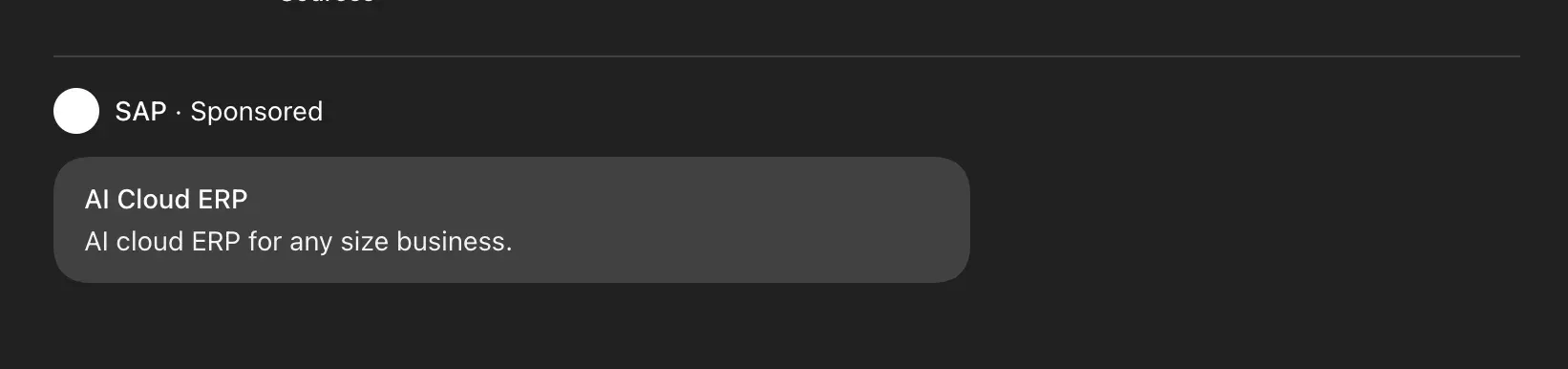
ChatGPT ads are returned in a response.result.ads[] array. Each entry has a brand object (name, URL, favicon) and a cards[] array with the creative (image, title, body, deep-linked URL), served from bzrcdn.openai.com and tagged with utm_source=chatgpt.com&utm_medium=src. So these are unambiguously paid placements, not organic recommendations.
We exclude the other commercial surfaces in ChatGPT’s response payload: inlineProducts[] (multi-merchant product comparison rows) and shoppingCards[] (single-merchant product cards). Those are commercial but not unambiguously paid; including them would change the question. We covered them separately in our ChatGPT shopping post.
Is it a paid ad, or just a recommendation?
This is the question every ChatGPT ads penetration study has to answer first. A Sponsored card is not the same as an organic product mention. cloro counts a response as ad-bearing only when the paid signals line up.
The ads[] array, the bzrcdn.openai.com host, and the utm_source=chatgpt.com tag all have to be present. Organic recommendations carry none of those markers. That gate is what keeps the reported ChatGPT ads penetration rate honest. A loose definition would inflate every number in this post.
Who sees ChatGPT ads?
Not every ChatGPT user. OpenAI’s advertising announcement scoped the test to logged-in adults on the Free and Go ($8/month) tiers. Plus, Pro, Business and Enterprise subscriptions carry no ads, accounts that OpenAI predicts belong to someone under 18 are excluded, and ads are not eligible near health, mental health or politics.
That scope matters when you read a penetration rate. Our figures are rates over a monitoring corpus that skews toward commercial queries (see Methodology), so they measure how dense the surface is where ads are allowed, not the share of all ChatGPT users who see one. The topic rule shows up in third-party data too: Adthena measured healthcare at 0.45% ad frequency, against a platform average of about 3.3%.
Only four countries see ChatGPT ads
Four countries now carry essentially all the ad load. Everywhere else is at or near zero.
The May “US carries almost the entire share” story has broken. Canada now edges out the US and Australia matches it. The surface is expanding to the full English-speaking block, not just the American market. And Japan is the first non-English market to light up meaningfully, adding a distinct Japanese advertiser layer (Carsensor, U-NEXT, Honda, Audi Japan, NURO 光, SOMPO, ahamo) that wasn’t visible in any prior measurement.
UK is still at zero after 372 responses in the trailing 7 days, which is notable given how deeply English-speaking the market is: the gating factor is clearly not language.
An independent monitor puts a far larger sample behind the same reading: search-intelligence firm Adthena logged a 0.00% ChatGPT ad frequency across 169,560 UK scrapes in June, zero of the 29,237 ad items it catalogued that month across all markets. The gate looks like access timing rather than language: ChatGPT ads only went live in the UK on 2026-06-06, well after the US/CA/AU trio, and UK inventory has yet to ramp.
What the country split tells advertisers
The ChatGPT ads penetration map does not track population or GDP. It tracks where OpenAI has switched inventory on, and so far only four markets are live; everywhere else is a switch waiting to flip.
For a brand, that makes ChatGPT ad reach effectively binary right now. You either sell into the US, Canada, Australia, or Japan, or your ChatGPT ads penetration is still zero. Planning around a smooth global ramp would misread the data. The pattern so far is abrupt, per-market activation, not a gradual worldwide rollout.
Advertiser mix
Top 20 advertisers by cumulative placements across the 7 days ending 2026-07-03, aggregated across all countries:
| # | Advertiser | Placements | Category |
|---|---|---|---|
| 1 | Carsensor (カーセンサー) | 131 | JP auto marketplace |
| 2 | Booking.com | 78 | Travel |
| 3 | Lovable | 38 | B2B SaaS (vibecoding) |
| 4 | amaysim / Alinta Energy | 33 | AU telco/energy |
| 5 | Top10.com | 32 | Aggregator |
| 6 | Zoho Corporation | 30 | B2B SaaS |
| 7 | Coterie Baby | 26 | Consumer commerce |
| 8 | Onamae.com (お名前.com) | 25 | JP domain registrar |
| 9 | Flip TV Australia | 23 | AU telco |
| 10 | Monday.com | 23 | B2B SaaS |
| 11 | Inference R&D | 23 | B2B SaaS (inference) |
| 12 | Samsung (US) | 22 | Consumer commerce |
| 13 | Expedia | 20 | Travel |
| 14 | Pivotree | 19 | B2B SaaS |
| 15 | BISSELL | 17 | Consumer commerce |
| 16 | iHerb | 16 | Consumer commerce |
| 17 | Luxury Escapes | 16 | Travel |
| 18 | DSW | 16 | Consumer commerce |
| 19 | ZoomInfo | 16 | B2B SaaS |
| 20 | Best Buy | 16 | Consumer commerce |
The full trailing-7-day snapshot with the tail down to placement counts of 6 lives at docs/research/2026-07-03-chatgpt-ads-penetration-refresh.md.
Two shifts vs the May 26 mix stand out. First, Japan is the largest single geographic contributor to the advertiser pool now. Carsensor alone leads the entire list, and roughly a fifth of the top 80 (17 entries) is Japanese (U-NEXT, NURO 光, アウディ = Audi Japan, 楽楽クラウド, クラブツーリズム, 本田技研工業 = Honda, SOMPO Direct, ダスキン = Duskin, ahamo, WECARS, HP Japan, 株式会社アペックスライン). None of these were visible in the May 26 sample. Second, the May-2026 consumer-commerce headline names (e.l.f. Cosmetics, Pottery Barn, IKEA, Ralph Lauren, Macy’s) don’t appear in the current top 80. They’ve either rotated out or reduced spend enough to fall below the intraday-buyer floor. Amazon, Best Buy, Target, DSW, Home Depot, JCPenney, L.L.Bean, Samsung, Coterie, iHerb, Faire, Hungryroot, Volcanica Coffee, ALO, and PlantPaper cover the current consumer-commerce layer.
The B2B SaaS layer is also different. Cursor is gone from the current sample; Lovable is now the dominant vibecoding advertiser (rank 3 overall). Adtech itself is now buying inside ChatGPT: Criteo appears in the trailing 7 days. Crowdstrike, ZoomInfo, Monday.com, Zoho, Oracle, New Relic, Greenhouse, Recruiterflow, Talroo, and Oxylabs cover the mid-market SaaS tail. Notably, Profound, a competitor in AI brand visibility, has dropped out of the sample entirely versus its confirmed presence in the May 26 snapshot.
Travel came in strong: Booking.com is #2 overall, Expedia #13, Luxury Escapes #17, Hilton in the top 25. Telco/connectivity is now a discrete category (AT&T, Xfinity, Optus, Boost Mobile, Visible by Verizon, ahamo, amaysim, Flip TV) which was not the case in May.
Can you buy ChatGPT ads yet?
cloro measures the rendered placement, not the buy side. So this ChatGPT ads penetration study can confirm which brands appear, not how they secured the slot. What the payload shows is still informative on its own.
On the buy side, OpenAI has in fact opened access: it launched a self-serve Ads Manager to all US businesses on 2026-05-05, dropping the six-figure minimum that gated the February pilot and switching to CPC bidding. Yet the rendered pool cloro sees is still dominated by large direct advertisers and affiliate aggregators, not the long small-business tail an open auction eventually produces. So US self-serve is live, but inventory is still clearing mostly to bigger buyers, and outside the US the pilot remains at an earlier stage of that same access curve. The concentration at the top of the list is the tell.
ChatGPT’s ad rate dwarfs Google’s AI ad surfaces
The April-May read put ChatGPT (0.42%) between Google’s two ad surfaces: classic SERP sponsored slot at 1.05%, in-AI-Overview at 0.24%. Today, ChatGPT’s US rate is ~49× above Google’s classic SERP rate and ~200× above Google’s in-AI-Overview rate on the same query cohort, which is the reason a brand tracking share of voice on Google alone is now missing the surface with the densest ad load.
The overall vs US gap is worth reading carefully. Overall (12.2%) is depressed by the many countries in cloro’s corpus where ChatGPT still shows no ads. DE, FR, BR, IL, AE each contribute 700–2,000 rows and drag the mean down. In the four markets where ChatGPT ads are actually served, the rate looks nothing like a general-purpose search product’s ad load: it’s a fundamentally denser surface.
Microsoft Copilot, Perplexity, Google AI Mode, Gemini, and Grok have shown no paid ads in any of cloro’s measurements to date. ChatGPT and Google AI Overview remain the only AI engines running paid in-response placements at all.
The original April-May study (historical baseline)
The original headline, in full: 0.42% overall over the 19-day window (2026-04-14 to 2026-05-02), against the 1.05% and 0.24% Google rates covered above. The framing was “ChatGPT looks close to equilibrium for an AI-native ad surface around 0.2-0.5%.” Two subsequent measurements (2026-05-26 spike, 2026-07-03 update above) have superseded that framing.
The full April-May advertiser list (Rippling, Semrush, HubSpot, CrowdStrike, 11x AI, WSJ, Attio, Adobe Acrobat, Forbes, McAfee, Lenovo, Top10.com, Zapier, Pottery Barn, Shutterstock and Biom, 16 distinct brands across 19 days) remains useful context for how narrow the buyer pool was at launch. Only Top10.com is still in the current top 20; every other April-May advertiser has been displaced.
One observation from the April-May data still holds: AI labs are buying paid placements on Google’s AI Overview SERPs. chatgpt.com, perplexity.ai, and claude.ai all appeared in the Google sponsored-search slot on AI-Overview-triggering queries during that window. Whatever the public narrative about AI engines competing with Google Search, the labs are paying Google to drive traffic from those queries. That tells you something about where commercial intent still concentrates.
Methodology
The 2026-07-03 measurement is pulled directly from cloro’s production result table joined to prompt for country. Penetration rates are computed over every successful ChatGPT row in the trailing 7 days (15,304 responses) and trailing 30 days (61,913 responses). Country tables use the trailing 7 days only, filtered to countries with ≥20 responses in that window. The advertiser table aggregates response->'result'->'ads'->0->'brand' across the trailing 7 days. Full snapshot at docs/research/2026-07-03-chatgpt-ads-penetration-refresh.md.
Detection signals: ads return in response.result.ads[], served from bzrcdn.openai.com, with destination URLs tagged utm_source=chatgpt.com&utm_medium=src. Any one of those three is sufficient to identify a paid placement; we check all three for redundancy.
Prompt-mix caveat: cloro’s corpus skews toward brand, comparison, recommendation, and B2B-software queries, with strong US, JP, DE, FR, and BR weighting. Commercial-intent queries surface ads more often than general queries on any search surface, so the measured rates likely overstate what a uniform random sample of all ChatGPT prompts would show, particularly in the US, JP, and CA/AU. The four-market pattern (US/CA/AU/JP as ad-serving, everywhere else at zero) does not depend on prompt mix, however: even markets with heavy corpus coverage (DE 2,079 rows, FR 1,880, BR 979, IL 899, AE 931) register 0 ads across the 7-day window.
What’s still single-source: this is one independent measurement from one corpus, but it no longer stands alone. A separate monitor, Writesonic, measured the same 2026-05-26 surface and landed on 47.7% US penetration, 1.4 points off cloro’s 49.1%, with the wider gap in the two overall rates explained by corpus geography rather than any measurement disagreement. Treat the country point estimates as cloro-corpus signals; the qualitative shifts (Japan lighting up, Canada/Australia reaching US-level penetration, May spike reverting then re-plateauing) survive any reasonable prompt weighting, and the US headline is now externally corroborated.
If you want to track this for your own category, meaning which brands buy ChatGPT placements on your priority queries, how often and in which countries, that’s what cloro’s ChatGPT Ads API is built for. For the broader AI visibility tracking surface across every AI engine, the AI brand visibility tracker and AI brand visibility measurement framework walk through how it works; the monitoring guide has the detection logic in code.

About the author
Ricardo Batista
Founder, cloro
Ricardo is one of the founders and engineers behind its SERP and AI-search scraping infrastructure. Before cloro he scaled a financial comparison site to $7M ARR and ran the full-country operations of a unicorn to $65M ARR, then went back to building. He writes about search engine scraping, generative-engine optimization, and turning live search and AI-answer data into something teams can act on.
Frequently asked questions
Does ChatGPT have ads?
Yes, and the rate has stabilized at a high level in lead markets. Over the 7 days ending 2026-07-03, 51.0% of US responses in cloro's monitoring corpus contained a paid ad, alongside 53.6% in Canada, 49.8% in Australia, and 18.8% in Japan. Ads are returned in `response.result.ads[]`, served from `bzrcdn.openai.com`, tagged with `utm_source=chatgpt.com`.
Do all ChatGPT users see ads?
No. OpenAI limited ads to logged-in adults on the Free and Go tiers. Plus, Pro, Business and Enterprise plans are ad-free, accounts predicted to be under 18 are excluded, and ads do not appear near health, mental health or political topics.
How often do ads show up in ChatGPT?
In the US, roughly 1 in 2 responses over the last 7 days. Canada is slightly higher (54%), Australia essentially the same (50%), and Japan sits at ~19% after lighting up sometime in June. UK, France, Germany, Brazil, and most other markets remain at 0%. The overall global rate depends heavily on prompt mix; cloro's corpus averaged 12.2% across the last 7 days.
Which countries see ChatGPT ads?
As of 2026-07-03, four countries carry essentially all the ChatGPT ad load: US (51.0%), Canada (53.6%), Australia (49.8%), and Japan (18.8%). Netherlands sits at 3.6%. UK, France, Germany, Brazil, Mexico, Israel, UAE, India, and the ~30 other countries in cloro's corpus all measure at 0%. ChatGPT advertising is still an English-speaking-market product, with Japan as the one significant non-English addition since May.
When did ChatGPT ads launch, and which countries can buy them?
OpenAI began testing ChatGPT ads in the US on 2026-02-09 and opened a self-serve Ads Manager to all US businesses on 2026-05-05, dropping the six-figure minimum and adding CPC bidding. It then extended the pilot to the UK, Brazil, Japan, South Korea, and Mexico, joining the original US, Canada, Australia, and New Zealand markets. Availability and rendered penetration are not the same thing, though: in cloro's corpus, ads still concentrate in the US (51.0%), Canada, Australia, and, since June, Japan, while the UK measures near zero.
Is ChatGPT showing more or fewer ads than Google?
ChatGPT's US rate of 51% is roughly 49× Google's classic SERP sponsored slot (1.05% on AI-Overview-triggering queries) and ~200× Google's in-AI-Overview ad rate (0.24%). Two months after the May spike, the story is unchanged: ChatGPT operates a fundamentally denser ad surface than either Google product on the same query cohort.
Who is advertising on ChatGPT?
The current advertiser pool spans consumer commerce (Amazon, Best Buy, Target, Home Depot, DSW, JCPenney, L.L.Bean, Samsung, Hilton), travel (Booking.com, Expedia, Luxury Escapes), telco/connectivity (AT&T, Xfinity, Optus, Boost Mobile, Visible, ahamo), B2B SaaS (Monday.com, Zoho, ZoomInfo, Oracle, New Relic, Greenhouse, Crowdstrike, Oxylabs, Criteo, Lovable), affiliate aggregators (Top10.com, Capterra, Expert Market, CompareGround), and a heavy new layer of Japanese brands (Carsensor, U-NEXT, Honda, Audi Japan, NURO 光, SOMPO, ahamo, Duskin, WECARS).
Can I track when my brand appears in a ChatGPT ad?
Yes. cloro tracks paid placements across all seven major AI engines (ChatGPT, Google AI Overview, AI Mode, Perplexity, Copilot, Gemini, Grok) alongside organic mentions and citations. See the AI brand visibility tracker for how it works, or the technical monitoring guide for the detection logic.
Related reading
Does ChatGPT Have Ads? ChatGPT Ads Rollout Status in 2026
Yes, ChatGPT has ads: paid placements launched in February 2026 at $60 CPM, spiked to 26.5% in May, throttled to under 1%, then re-plateaued at 51% of US responses (54% CA, 50% AU, 19% JP) by July. See what shipped and what to track.
How to Monitor ChatGPT Ads (Technical Guide, 2026)
ChatGPT ads render as a `response.result.ads[]` array on the response, served from `bzrcdn.openai.com` and tagged `utm_source=chatgpt.com&utm_medium=src`. Here's how to detect them with cloro's API and build a real monitoring pipeline.
Google Ads Transparency vs SERP Ads: Which to Use When
The Google Ads Transparency Center archives past ads; live SERP ads are real-time sponsored results. Two different products, and when to use each.