
AI Search Engines: 10 Tools Compared for 2026

On this page
What is the best AI search engine, and how do the search data APIs compare?
The best AI search engine depends on the job: Perplexity for deep research and academic sourcing, ChatGPT Search for everyday questions, Google AI Mode for shopping and local queries, and Brave Search API, Exa, or Tavily for developer retrieval and RAG.
AI search engines return synthesized answers with citations instead of a bare list of links, and they now split into two distinct families. Some are consumer products built for human research, while others are APIs that feed agents, RAG systems, and developer workflows.
That distinction shapes everything that follows. Perplexity, ChatGPT, and Gemini optimize for a person reading an answer on a screen, whereas Exa, Tavily, Brave Search API, and similar tools optimize for structured retrieval inside applications. Both groups are AI search engines, but they are bought, measured, and optimized for in completely different ways.
This guide compares ten of the major AI search engines by use case, answer style, citation quality, and developer access, so you can match the right tool to the job. If your goal is brand measurement rather than research, start with AI search tracking once you understand the options below.
What defines an AI search engine?
An AI search engine is more than a chatbot. It is a hybrid system that pairs the real-time index of a traditional search engine with the reasoning capabilities of a Large Language Model (LLM).
Key characteristics:
- Conversational context. You can ask follow-up questions (“What about for a vegan diet?”) without restating context.
- Synthesis. The engine combines facts from multiple pages into a new answer rather than quoting one source.
- Citation-first. Unlike creative writing bots, AI search engines cite their sources, often with clickable footnotes.
- Multi-modal. They can read images and PDFs, and sometimes parse videos to find answers.
The shift in one line:
- Old search. “Show me documents that contain these keywords.”
- AI search. “Read these documents and tell me the answer.”
AI search engines vs. traditional search engines
Traditional search engines and AI search engines chase the same job — find information — but they hand back different things. A classic engine returns a ranked list of ten blue links and leaves the reading, comparing, and synthesizing to you. An AI search engine does that work itself and returns a written answer with the sources cited underneath.
The practical difference shows up as effort. On a classic results page you open four tabs, skim each one, and stitch together your own conclusion. On Perplexity or ChatGPT Search you read a single synthesized paragraph and click through only when you want to verify a specific claim. For simple factual questions that is genuinely faster, but for nuanced decisions it can flatten the trade-offs that live in the original sources.
For publishers, the shift rewrites the underlying deal. Traditional search sent a click in exchange for the answer living on your page, whereas AI search keeps the user on the results surface and cites you as a source. The value you capture moves from sessions to citations, which is exactly why brand visibility inside AI search engines has become its own measurement problem.
The major players of 2026
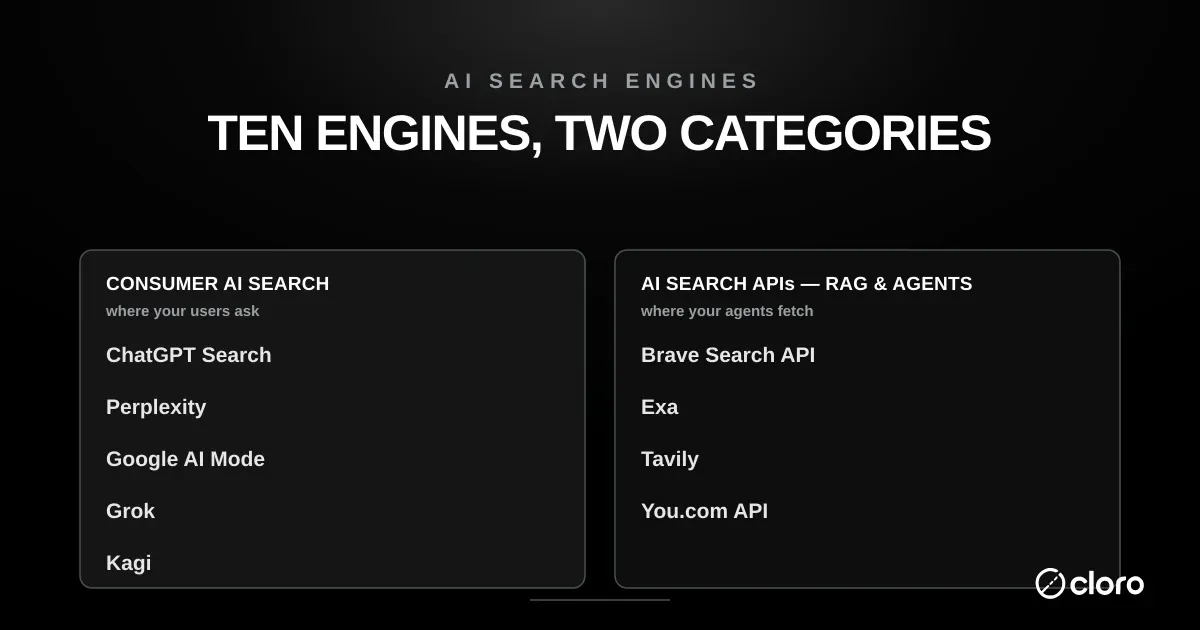
The market has fragmented well past a two-way fight between Google and Bing, and the players differ in a way the feature lists rarely capture. We measured grounding across six engines on roughly 2,500 prompts each, counting how often each answers from live sources rather than training memory:
| Engine | Grounded, Jul 05 | Grounded, Aug 19 | Grounded, Oct 07 |
|---|---|---|---|
| Perplexity | 94.9% | 99.2% | 99.9% |
| Google AI Overview | 91.2% | 94.3% | 91.9% |
| Copilot | 97.5% | 91.8% | 92.8% |
| Google AI Mode | 98.2% | 91.0% | 84.5% |
| ChatGPT | 98.4% | 78.9% | 97.6% |
| Gemini | 41.1% | 70.7% | 68.2% |
We show three dates because the movement is the finding. ChatGPT fell from top to second-bottom between July and August and was back at 97.6% by October, Gemini nearly doubled and then held, and Google AI Mode slid on every reading. One thing held throughout: Gemini grounds least of the six on all three dates. Treat any single grounding percentage as a dated observation rather than a property of the engine.
1. Perplexity AI: best for deep research and academic sourcing
Perplexity is the prosumer choice, positioning itself as a research engine rather than a generic search engine. It launched its Deep Research feature in February 2025, and that mode iteratively searches, reads documents, and reasons about what to do next to autonomously produce a cited report.
Perplexity is the best AI search engine for deep research, academic sourcing, and fact-finding, with prominent, granular citations under every claim.
- Standout feature. “Deep Research Mode” runs multiple structured queries to produce a mini-report.
- SEO impact. High visibility for authoritative, citation-dense content.
2. ChatGPT Search (OpenAI): best for everyday questions and coding help
ChatGPT Search is the mainstream giant, and by bolting real-time web access onto the world’s most popular chatbot, OpenAI turned millions of casual chatters into searchers. OpenAI launched ChatGPT search on October 31, 2024, pairing real-time web results with inline citations and a “Sources” button beneath each answer.
ChatGPT Search is the best AI search engine for everyday questions, lifestyle queries, and coding help, because it pairs real-time web results with a chatbot people already use daily.
- Standout feature. Personalization. It remembers your preferences across sessions, so answers get more relevant to you the more you use it.
- SEO impact. The main force driving the shift to GEO (Generative Engine Optimization).
3. Google AI Overviews (Gemini): best for shopping, local queries, and quick facts
Google AI Overviews is the incumbent’s defense, and Google has been anything but idle, because Gemini now sits at the top of the SERP for most informational queries. Google’s AI Overviews reached 2 billion monthly users across more than 200 countries, putting AI answers in front of more people than any standalone chatbot. Its newer AI Mode uses a “query fan-out” technique, issuing multiple related searches concurrently across subtopics before synthesizing a single answer.
Google AI Mode is the best AI search engine for shopping, local queries (“restaurants near me”), and quick facts, because it can reach Maps, Flights, and Hotels directly.
- Standout feature. Ecosystem integration (Maps, Flights, Hotels), so a shopping or local query resolves inside the answer instead of sending you to another app.
- SEO impact. Pushes organic links further down the page, which makes AEO (Answer Engine Optimization) critical.
4. Bing Copilot: best for corporate research inside Microsoft 365
The enterprise workhorse, deeply integrated into Windows and Office. Microsoft embeds Copilot directly in Word, Excel, PowerPoint, Outlook, and Teams, grounding answers in your calendar, emails, and documents through the Microsoft Graph.
Bing Copilot is the best AI search engine for corporate research and intranet-connected queries, because it grounds answers in your own calendar, email, and documents.
5. Grok (xAI): best for breaking news and trending topics
The real-time challenger. xAI pairs its conversational Grok model with a live web tool, and the company’s documentation notes the Web Search tool lets Grok “search the web in real-time and browse web pages” rather than answering from training data alone. That currency is what makes Grok useful for breaking news and fast-moving topics, where a stale index would quietly hand the reader an out-of-date answer.
Grok is the best AI search engine for breaking news, trending topics, and current-events questions, because its live web tool reads pages at query time instead of leaning on a stale index.
6. Kagi: best for ad-free, privacy-conscious research
The ad-free premium option. Kagi is a subscription-funded search engine that shows no ads, and its Quick Answer feature “uses AI to extract and summarize the important content from the search results” alongside a Kagi Assistant that can converse over those results. Because users pay directly, Kagi has no incentive to trade ranking position for advertising revenue, which is precisely why researchers who distrust ad-driven results gravitate to it.
Kagi is the best AI search engine for privacy-conscious power users who want ad-free, high-signal results, because the subscription removes any incentive to trade ranking position for ad revenue. The subscription is the product, so the price is public: Starter is $5 a month for 300 searches, Professional is $10 a month for unlimited searches, and Ultimate is $25 a month with unlimited use of the Universal Summarizer and Kagi Translate.
Consumer AI search engines compared:
| Engine | Best for | Citations | Primary goal |
|---|---|---|---|
| Perplexity | Deep research, academic sourcing | Prominent and granular | Research and accuracy |
| ChatGPT Search | Everyday questions, coding help | Inline links plus a Sources button | Conversation and utility |
| Google AI Overviews / AI Mode | Shopping, local, quick facts | Expandable source cards | Ecosystem and speed |
| Bing Copilot | Corporate research over Microsoft 365 | Inline links | Work context grounding |
| Grok | Breaking news, trending topics | Inline links | Freshness |
| Kagi | Ad-free, high-signal research | Inline links | No ad conflict of interest |
The takeaway: pick by job, not brand. Perplexity or Kagi for deep, ad-free research; ChatGPT Search or Copilot for daily use inside tools you already have; Grok for breaking news; Google AI Mode for shopping or local queries.
AI search engines for developers and RAG
Not every AI search engine is a chat box. A second category exposes retrieval as an API, so developers can feed clean, ranked web results straight into their own agents and RAG pipelines. These are the AI search engines that sit behind other products rather than facing consumers directly, and they compete on index quality, latency, and how cleanly their results drop into a context window.
7. Brave Search API: best for independent, privacy-first web results at scale
Brave runs its own index rather than reselling Google or Bing. Its documentation states the Brave Search API is “our own independent index of the Web” spanning more than 30 billion pages and refreshed by over 100 million page updates every day. That independence matters for grounding, because an answer engine built on a single upstream index quietly inherits that index’s blind spots and biases.
Brave Search API is the best AI search API for independent, privacy-first web results at scale, because it runs its own index of 30 billion-plus pages rather than reselling Google or Bing. It bills $5 per 1,000 requests, with $5 of credits a month on the free tier.
8. Exa: best for agentic retrieval and research pipelines
Exa is a search API purpose-built for models rather than for humans. It bills itself as “web search, built for AI agents”, exposing one API for search, crawling, and research agents while returning token-efficient excerpts instead of full pages. Feeding trimmed, relevant passages into a context window keeps retrieval cheap and keeps the model focused on the sentences that actually answer the question.
Exa is the best AI search API for agentic retrieval and research pipelines, because it returns token-efficient excerpts instead of full pages. It charges $7 per 1,000 searches for up to 10 results, adds $1 per 1,000 for each result beyond that, and includes 20,000 free requests a month.
9. Tavily: best for RAG apps that need cited sources
Tavily positions itself as a web search layer for language models. Its documentation describes an API built for LLMs and AI agents that bundles search, extraction, crawling, and research into a single interface tuned for retrieval-augmented generation. The appeal is that one call returns sourced, deduplicated results already shaped for a prompt, so teams skip the cost of building and maintaining their own scraper.
Tavily is the best AI search API for RAG apps and autonomous agents that need cited sources, because one call returns sourced, deduplicated results already shaped for a prompt. Its pricing is $0.008 a credit and a basic search spends one credit, so about $8 per 1,000; an advanced search spends two.
10. You.com API: best for enterprise agents that need auditable answers
You.com started as a consumer engine and now sells its retrieval stack to builders. Its API lets developers “search the web, extract clean content, and generate grounded answers” for agents and LLMs, and its Research API returns a structured list of source URLs behind every answer. Traceable citations are the real differentiator here, since a grounded answer that can point back to its sources is far easier to trust and to audit.
You.com API is the best AI search API for enterprise agents that need auditable, cited answers, because its Research API returns the structured list of source URLs behind every answer.
AI search APIs compared:
| API | Best for | Cost per 1,000 searches | What makes it different |
|---|---|---|---|
| Brave Search API | Independent web results at scale | $5 | Own index, 30B+ pages, 100M+ updates a day |
| Exa | Agentic retrieval and research pipelines | $7 (up to 10 results) | Token-efficient excerpts instead of full pages |
| Tavily | RAG apps that need cited sources | ~$8 (basic search) | Search, extract, crawl and research in one interface |
| You.com API | Enterprise agents that need an audit trail | Not published | Research API returns the source URLs behind each answer |
Those rates buy a clean web-search result. A SERP API answers a different question, what Google itself returned, and prices on another scale: cloro’s Hobby plan is $100 a month for 250,000 credits, and a Google Search call costs 3 credits, so roughly $1.20 per 1,000 queries, or $2.00 with the AI Overview parsed (5 credits). Pick the family that matches the job before you compare the numbers.
How they work: RAG explained
To understand how to rank, you need to understand the technology powering these engines: Retrieval-Augmented Generation (RAG). RAG was introduced by Lewis et al. in 2020 as a method that combines a language model’s parametric memory with a retriever over an external document index, so answers are grounded in retrieved sources rather than training data alone.
It works in three steps:
- Retrieval is the traditional search part: the engine searches its index, or the live web, for documents relevant to the query.
- Augmentation takes the text from the top results (your blog post, say) and feeds it into the LLM’s context window along with the user’s question.
- Generation is where the LLM reads your content and writes an answer, citing you as the source.
Why this matters for content creators. If your page is hard to parse (heavy JavaScript, popups, fluff), retrieval may succeed but generation will fail. The LLM will skip your messy content and read a competitor’s clean llms.txt instead.
The death of the click
This is the hardest part for digital marketers to accept: in the AI search era, traffic is a vanity metric. If Perplexity reads your article and gives the user the answer, there is no reason to click your link. You served the user, but you didn’t get the session.
There is a measured version of this. cloro’s machine search traffic study tracked machine-issued queries against its own Search Console for six months: 140,616 impressions, and zero clicks in every single month.
Does this mean SEO is dead? No, but the goal of SEO has changed: you are optimizing for influence rather than for clicks.
- Being cited in an AI answer builds brand authority.
- Being the source of truth trains the model to prefer your brand in future answers.
- Zero-click attribution is the new measurement challenge.
None of this means the work disappears; it simply relocates. The page still has to earn the citation, and earning it now depends on being the clearest, best-sourced explanation of a topic rather than the one with the most backlinks. In practice, the teams that win inside AI search engines treat every article as a machine-readable answer first and a marketing asset second.
Optimizing for the new gatekeepers
How do you survive in a world where the search engine does the reading for the user?
- Be the primary source, because AI engines lean on data. If you publish original statistics, studies, or contrarian viewpoints, you become the source node that others cite.
- Structure for machines with clear headings, bullet points, and schema markup, so a model skimming your page for an answer can lift the right passage instead of skipping past it.
- Welcome the bots. Don’t block
GPTBotorClaudeBotunless you have a paywall; they are the scouts for the new search engines, and our guide on AI crawlers covers how to manage them.
One caveat is worth stating plainly. Optimizing for AI search engines is not a separate discipline bolted onto SEO; it is the same fundamentals (clarity, authority, and structure) pointed at a machine reader instead of a human one. A page that a person finds easy to skim is usually a page a model finds easy to parse, so the two goals rarely pull in opposite directions.
How to choose an AI search engine
The right AI search engine depends on who is asking and why. A journalist chasing a fast-moving story, an analyst compiling a cited brief, and an engineer wiring retrieval into an app all optimize for different things. Weigh these factors before you commit to one:
- Freshness. If your questions turn on today’s events, favor engines with aggressive real-time crawling over ones that lean on a slower, periodically refreshed index.
- Citation quality. Prominent, granular footnotes let you verify claims in seconds, whereas buried or vague sourcing forces you to trust the model blindly.
- Access model. Consumer chat interfaces suit ad-hoc research, while APIs suit anything you need to automate, embed, or run at scale inside an application.
- Cost and privacy. Ad-supported engines are free but monetize your attention, while subscription engines charge money and remove that conflict of interest.
For marketers, there is a second lens worth naming: visibility. The AI search engine your customers actually use is the one whose answers you need to appear in, so measuring your presence across several AI search engines matters far more than picking a personal favorite.
The future of discovery
We are moving from a query-based web to an intent-based web. Soon, users won’t ask “best running shoes.” They will ask “Find me a pair of running shoes under $150 that are good for flat feet, available nearby, and have a return policy.”
The AI search engine will go out, read reviews, check inventory, and come back with a single recommendation. Will your brand be that recommendation? You can’t know if you aren’t tracking it, and traditional tools like Google Search Console are blind to this traffic; they can’t tell you what ChatGPT thinks of your brand.
Closing that blind spot means measuring three things across the AI search engines directly:
- Whether your brand is cited at all.
- What sentiment the answer carries.
- Which competitors appear above you in the same answer.
Search is rewriting itself, and the habits that worked on the old results page do not carry over. The engines above are the ones deciding what a user reads, so the practical question is which of them your customers use and whether your pages are in their answers.
See how cloro tracks visibility across the AI search engines.

About the author
Ricardo Batista
Founder, cloro
Ricardo is one of the founders and engineers behind its SERP and AI-search scraping infrastructure. Before cloro he scaled a financial comparison site to $7M ARR and ran the full-country operations of a unicorn to $65M ARR, then went back to building. He writes about search engine scraping, generative-engine optimization, and turning live search and AI-answer data into something teams can act on.
Frequently asked questions
What is an AI search engine?
An AI search engine uses Large Language Models to read, synthesize, and answer user queries directly, rather than just providing a list of links like traditional search engines.
How do I optimize for AI search engines?
Focus on 'Generative Engine Optimization' (GEO). Use clear structure, authoritative citations, unique data, and schema markup to make your content easy for AI models to parse and verify.
Will AI search replace Google?
AI search is capturing a significant share of informational queries, but Google is also adapting with its own AI Overviews. It's likely a hybrid future where both coexist.
How is an AI search engine different from a chatbot?
AI search engines are typically connected to a real-time web index and prioritize citations, so they tend to be more factual. Chatbots might generate answers from their training data, which can be less current.
What is RAG in the context of AI search?
RAG (Retrieval-Augmented Generation) is the core technology. It means the AI retrieves relevant documents (like your blog post) from the web, augments its context with that information, and then generates an answer, citing its sources.
Related reading
Best SERP APIs 2026: 9 Tested on Cost, AI and Tracking
9 SERP APIs tested head to head on AI Overview parsing, engine breadth, rank-tracking depth, and true cost per 1,000 calls. Full benchmark table inside.
Bing Search API Key in 2026: It's Retired. Use These Instead
5 ranked drop-in replacements for the retired Bing Search API v7, with API-key setup, cost comparison, and migration steps for your legacy code.
ChatGPT Grounding Study: 86% Commercial, 1% Informational
ChatGPT grounds almost every commercial prompt and almost no informational one. We re-ran our study without forcing web search, across 865 queries and 10 countries, and the split is 86.5% versus 0.9%.