
udm=14: what it does and why it does not fix poisoned SERPs

On this page
What is udm=14?
udm=14 is a Google search URL parameter that opens the Web tab of the results page. The Web tab shows only text links, without the AI Overview, People also ask, image and video carousels or the knowledge panel.
To use it, add &udm=14 to a Google search URL:
https://www.google.com/search?q=best+running+shoes&udm=14To make it your default, add a custom search engine in your browser (in Chrome: Settings, Search engine, Manage search engines and site search, Add) with this URL:
https://www.google.com/search?q=%s&udm=14Google launched the Web filter in May 2024. Its Search Liaison, Danny Sullivan, said it “shows only text-based links” (Search Engine Roundtable). Two days later Ernie Smith of Tedium showed that adding udm=14 to the URL opens it directly (Tedium), and built udm14.com around it. Interest came back in May 2026, after Google pushed AI further into Search (Tedium).
Does udm=14 still work?
Yes. We loaded it in a signed-out Chrome on 20 November 2026 and Google opened the Web tab. Google’s own tab bar now links to it as udm=web, which opens the same page.
Automated requests get blocked more often. In our test Google refused 25% of udm=14 requests with a 403 and none of the requests for the regular page (5% of those failed for other reasons, mostly rate limits).
Does udm=14 remove AI Overviews?
Yes. The Web tab has no AI Overview and no other SERP feature. When we requested udm=14 through DataForSEO, all 15 responses held organic results only.
The other udm values
udm picks the tab of the results page, and udm=14 is only one value. Google does not document the parameter. SerpApi compiled 24 values in June 2024 (SerpApi), and we checked the common ones in Chrome on 21 November 2026:
| Value | Opens | Checked on 21 Nov 2026 |
|---|---|---|
udm=1 | Places | Yes |
udm=2 | Images | Yes |
udm=7 | Videos | Yes |
udm=12 | News | Yes |
udm=14 | Web | Yes |
udm=18 | Forums | Yes |
udm=28 | Shopping | Yes |
udm=36 | Books | Yes |
udm=39 | Short videos | Yes (not in the 2024 list) |
udm=50 | AI Mode | Yes (not in the 2024 list) |
SerpApi’s list also has values for Jobs, Lodging, Flights, Trains and other tabs that show only in some countries. Google’s own tab links now also use named values: udm=web, udm=vids, udm=forums, udm=books and udm=short_vids. For the parameters that work beside udm (gl, hl, uule, tbs), see our Google search parameters guide.
Is the Web tab the same as the regular Google page?
The common assumption is that udm=14 gives the regular page minus the AI Overview and the other features, with the same organic results in the same order. We measured it, and the order changes.
How we measured it
We took 261 real US desktop searches from the traffic that passes through our API on 20 November 2026, a mix of short keywords and long questions. For each one, on a single logged-out session that we had first checked against our reference queries, we read three pages seconds apart:
- the regular page,
- the Web tab (
udm=14), - the regular page again.
The session, exit IP, location (New York) and minute are the same for all three. Between reads 1 and 2 only the tab changes, so any difference comes from the Web tab. Reads 1 and 3 give the noise floor: how much the regular page differs from itself.
We compared the top 10 organic results by domain, three ways:
- Sites kept: the share of the regular page’s top-10 sites that appear in the other page’s top 10.
- Same position: the share of the regular page’s top-10 positions held by the same site.
- Order (RBO): rank-biased overlap, one score from 0 to 1 for “same list, same order”, weighted toward the top positions the way rank tracking is.
Same sites, different order
| Sites kept @10 | Same position @10 | Order (RBO) | |
|---|---|---|---|
| Regular page, reloaded | 96% | 83% | 95% |
| Web tab (udm=14) | 81% | 64% | 74% |
The gaps are well outside the noise. The 95% confidence interval for sites kept is 94.6% to 97.1% for a reload and 77.2% to 84.9% for the Web tab. A site on the Web tab sits on average 0.74 positions away from where it sits on the regular page, against 0.25 for a reload. And 29% of the Web tab’s top 10 is missing from the regular page’s top 10.
The difference is uneven across queries. On the median query the Web tab keeps every site, and on one query in five it keeps 57% or fewer:
| Sites kept @10 | P10 | P20 | P50 | P80 | P90 |
|---|---|---|---|---|---|
| Regular page, reloaded | 88% | 89% | 100% | 100% | 100% |
Web tab (udm=14) | 17% | 57% | 100% | 100% | 100% |
The queries that move most are long questions, the kind that get an AI Overview, videos and forum threads on the regular page. The Web tab drops those blocks and fills the space with other links, which pushes the rest down.
A browser shows the same thing. In a signed-out Chrome in Spain, the regular page came back identical on reload for all 15 queries we tried. Its Web tab kept 74% of the regular page’s sites and put 30% of them at the same position. Here is one of them, read on 20 November 2026:
| # | Regular page | Web tab (udm=14) |
|---|---|---|
| 1 | runrepeat.com | runrepeat.com |
| 2 | runnersworld.com | runnersworld.com |
| 3 | womensrunning.co.uk | womensrunning.co.uk |
| 4 | irunfar.com | alastairrunning.com |
| 5 | reddit.com | youtube.com |
| 6 | theruntesters.com | irunfar.com |
| 7 | sixminutemile.com | sixminutemile.com |
| 8 | runningshoesguru.com | |
| 9 | rtings.com | |
| 10 | amazon.es |
The query is best running shoes, desktop, Spain, English. The top three hold. After that, reddit.com and theruntesters.com drop off the Web tab and irunfar.com moves down two places.
Why SERP APIs use udm=14: poisoned SERPs
Since September 2026 Google has answered a share of automated searches with a poisoned SERP: a normal-looking page where most of the sites that usually rank are replaced by weaker ones. It returns no error, so a rank tracker records it as a real ranking.
Poisoning hits the regular page and leaves the Web tab alone. We read our reference queries on 3 sessions that Google had put on its degraded tier. Their regular page held none of the sites the query usually shows.
The Web tab, fetched on the same sessions with the same cookies, came back as the full page on all 11 reads. That makes the Web tab an obvious way around poisoning, and at least one SERP API now uses it.
What does DataForSEO’s resolve_poisoned_results return?
On 16 November 2026, DataForSEO shipped a resolve_poisoned_results option for its Google organic SERP API. Its announcement sums up the approach as “let Google’s Web filter verify Google” (DataForSEO).
One extra request fetches the Web version of the search. When the regular page looks poisoned, its organic results are replaced with the ones from the Web page (DataForSEO), and each one is marked from_web. The option doubles the price of a request (pricing).
We ran it on 20 November 2026 against our reference queries (10 reads each) and on 15 queries in Spain over three rounds (45 reads per variant):
| Regular | resolve_poisoned_results | Plain udm=14 | |
|---|---|---|---|
| Degraded reads, reference queries | 30 of 30 | 0 of 30 | 0 of 30 |
| Poisoned reads, 15 queries in Spain | 31 of 45 | 0 of 45 | n/a |
Organic results marked from_web | n/a | 140 of 149 (round 1) | n/a |
| Queries where the organic results were replaced | n/a | 14 of 15 (round 1) | n/a |
The option does what it promises: the poisoned page is gone. The Web tab takes its place. In round 1 the option replaced the organic results on 14 of 15 queries, including four that were not poisoned, and the results line up with DataForSEO’s own plain udm=14 responses. On best running shoes, the regular response was poisoned (thetrendspotter.net, runnerclick.com, a Swedish blog), and the resolved response carried the same top sites as the Web tab in the table above: runrepeat, runnersworld, womensrunning, alastairrunning, irunfar.
The rest of the response stays as it was. 39 of the 45 resolved responses still carry an AI Overview, and most carry People also ask, videos or related searches. The Web tab has none of these, so they come from the regular page fetched in the same request, the page the option judged poisoned. A resolved response therefore pairs the Web tab’s organic list with the poisoned page’s AI Overview, a combination Google never served to anyone.
Why a Web-tab page is worse than a poisoned page for rank tracking
A poisoned page shows its error. It loses most of the query’s usual sites at once: on our reference queries, the degraded reads kept none of them. A rank tracker that compares each read with the keyword’s history catches that, drops the read and asks again. On our own reads, poisoning came and went per request: every degraded read of a reference query was followed by a full one, and in the Spain test every query got a clean page within three reads.
A Web-tab page hides its error. On the median query it keeps every usual site and moves some of them by a position or two, which is exactly what a real ranking change looks like. No history check flags it.
The tracker records that a site went from #4 to #6, the customer sees a drop, and the real page never showed it. A retry returns the same substitute.
For scale, here are the same 261 queries requested as an Android phone, a page that differs from desktop by design:
| Sites kept @10 | Same position @10 | Order (RBO) | |
|---|---|---|---|
| Regular page, reloaded | 96% | 83% | 95% |
| Web tab (udm=14) | 81% | 64% | 74% |
| Android request | 63% | 35% | 60% |
The Web tab sits between a reload and a different page. It is close enough to pass a history check, and different enough to move positions on a large share of queries.
How we handle poisoned SERPs
We return the regular page, the one a logged-out visitor sees, and we check our access to Google against reference queries whose correct first page we know (how that works). We still get degraded reads. In the 24 hours to 17:50 UTC on 20 November 2026, on the same reference queries and the same rule for every provider:
When one of our reads is degraded, it looks degraded. A customer who keeps history can drop it and ask again, and the retry is a new request that usually comes back clean. That costs a request. In exchange, what lands in the customer’s history is the page Google actually shows.
What this means if you track rankings
- Treat
udm=14as its own tab with its own ranking. It is a good way to read Google without the AI blocks, and a poor stand-in for the regular page’s positions. - Ask your provider what it returns when the page is poisoned. “Unpoisoned” can mean the regular page fetched again or a substitute from the Web tab. DataForSEO marks substituted results with
from_webin thechecksarray, so filter on it. - Keep a history check. A read that loses most of its usual sites at once is a data problem, so drop it and retry. A history check cannot catch a substitute page, which is why the substitute is the bigger risk.
- Check where the rest of the response comes from. If the organic results came from one page and the AI Overview from another, AI-visibility data built on that response mixes two pages.
Method
- Paired test. 261 real US desktop queries sampled from our production traffic, read on 20 and 21 November 2026 on logged-out sessions checked against our reference queries. Per query: regular page, Web tab (
udm=14), regular page again, seconds apart, on the same session. New York location,hl=en. Reads where Google refused a page were dropped: Google refused 25% ofudm=14requests with a 403, and 5% of regular-page requests failed, none with a 403. - Measures. Top 10 organic results compared by domain: sites kept, same position, mean position shift of shared sites, and rank-biased overlap (p = 0.9). Confidence intervals by bootstrap.
- Android. The same 261 queries requested through our API with
device: android, same market, read within hours of the paired test. - Browser check. 15 English queries in a signed-out Chrome in Spain on 20 November 2026: regular page, Web tab, and the regular page reloaded about 25 minutes later.
- Degraded sessions. Our reference queries read on 3 sessions that read degraded on the regular page, then with
udm=14on the same session and cookies, 11 reads. - DataForSEO. Google organic live advanced endpoint, 20 November 2026: our three reference queries 10 times each (US and Denmark, desktop), and 15 English queries in Spain in three rounds, each as a regular request, with
resolve_poisoned_results: true, and withudm=14. - Limits. The reference itself is not perfectly clean. On some queries the regular page we read was poisoned and the Web tab was right, so part of the Web tab’s gap is the reference’s error, and its true distance from the real page lies between our figure and the noise floor. The data covers two days, mostly US desktop.
If your rankings moved in ways Search Console does not explain, run the same keywords through cloro’s SERP API and compare.

About the author
Ricardo Batista
Founder, cloro
Ricardo is one of the founders and engineers behind its SERP and AI-search scraping infrastructure. Before cloro he scaled a financial comparison site to $7M ARR and ran the full-country operations of a unicorn to $65M ARR, then went back to building. He writes about search engine scraping, generative-engine optimization, and turning live search and AI-answer data into something teams can act on.
Frequently asked questions
What is udm=14?
A Google search URL parameter that opens the Web tab: a results page with only text links, without the AI Overview, People also ask, image and video carousels or the knowledge panel. Add &udm=14 to any google.com/search URL, or set https://www.google.com/search?q=%s&udm=14 as your browser's search engine.
Does udm=14 still work?
Yes. We loaded it in a signed-out Chrome on 20 November 2026 and Google opened the Web tab. Google's own tab bar now links to it as udm=web, which opens the same page. Automated requests get blocked more often: in our test Google refused 25% of udm=14 requests with a 403, and none of the requests for the regular page.
Does udm=14 remove AI Overviews?
Yes. The Web tab has no AI Overview. In our DataForSEO test, every udm=14 response held organic results only, with no AI Overview or other SERP feature.
What are the other udm values?
udm picks the tab of the results page. The ones we checked on 21 November 2026 are 1 Places, 2 Images, 7 Videos, 12 News, 14 Web, 18 Forums, 28 Shopping, 36 Books, 39 Short videos and 50 AI Mode. Google does not document the parameter, so values can change.
Is the Web tab the same ranking as the regular Google page?
No. On 261 real queries, read on the same logged-out session seconds apart, the Web tab kept 81.2% of the regular page's top-10 sites and put 63.9% of them at the same position. Reloading the regular page kept 95.9% and 82.7%.
Does udm=14 fix poisoned Google SERPs?
It avoids the poisoned page and returns a different one. On sessions Google had put on its degraded tier, the Web tab still came back as the full page. But its order differs from the regular page, so a rank tracker records positions the real page does not show, and nothing in the data marks them.
Is udm=14 good for rank tracking?
Not as a stand-in for the regular page. The Web tab reorders results on a large share of queries, about 29% of its top 10 is missing from the regular page's top 10, and Google blocks it more often for automated traffic. Track the regular page, and drop and retry a read that loses most of its usual sites.
Related reading
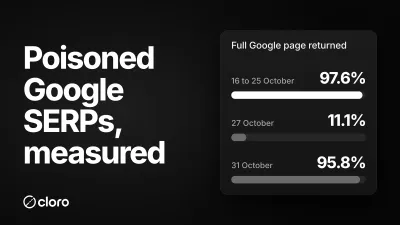
Poisoned Google SERPs: what we measured and how we fixed it
Since September 2026 Google answers some automated searches with a complete page of the wrong results. What we measured across SERP APIs, and how cloro fixed it.
Google Search URL Parameters: The Full List for 2026
Every Google search URL parameter in one table (q, gl, hl, uule, udm, tbs, start), what each one does, and which ones still work when you send the URL through an API.
Google goto URLs: what broke on 30 October and who fixed it
Google goto URLs hide where a search result leads. Google began holding them on 30 October and changed them again on 6 November. How SERP APIs compare.