
Google
Google Search API: Official vs SERP API
Google Search API options explained: Custom Search JSON API, DIY scraping, and modern SERP APIs. Compare limits, pricing, and real SERP coverage.
Your agent's "search the web" tool is only as good as the index behind it. Bing's API is retired; Brave, Tavily, and Exa search their own smaller crawls. cloro searches Google, returning the ranked results, snippets, and sources that users (and AI engines) actually see as parsed JSON your RAG pipeline or function-calling loop consumes directly.
4.7 · 53 reviews
A web search API lets your code run a web search and get the ranked results back as structured data — the programmatic version of typing a query into Google. Instead of HTML built for a browser, you get JSON built for a pipeline: ranked organic results with titles, URLs, and snippets, plus the surrounding elements (ads, People Also Ask, AI Overview) when you want them.
Demand for web search APIs has shifted from search-engine tooling toAI applications: RAG pipelines and agents need live web results to ground their answers in current facts and citable sources. What separates providers is the index behind the endpoint — cloro returnsGoogle's ranked results, so your application grounds on the same web the largest index sees.
Related guide
The practical routes to Google's results in 2026 — official APIs, their limits, and the scraping-API alternative.
Read the guideRelated guide
Microsoft retired the Bing Search APIs in August 2025. What happened and what to migrate to.
See the migration pathsEvery AI engine grounds its answers on web search. cloro gives your application the same move: query Google, get ranked results with titles, URLs, and snippets as structured JSON, and feed them straight into your model's context window, so answers arrive with sources a user can click. The same key also queries ChatGPT, Perplexity, Gemini, AI Mode, Copilot, and Grok when you need an engine's answer rather than search results.
The web-search-tool market split after Bing's API retirement: purpose-built AI search APIs with proprietary indexes on one side, Google SERP data on the other. If your users will compare your agent's answers against what Google (or a Google-grounded AI engine) says, the choice makes itself.
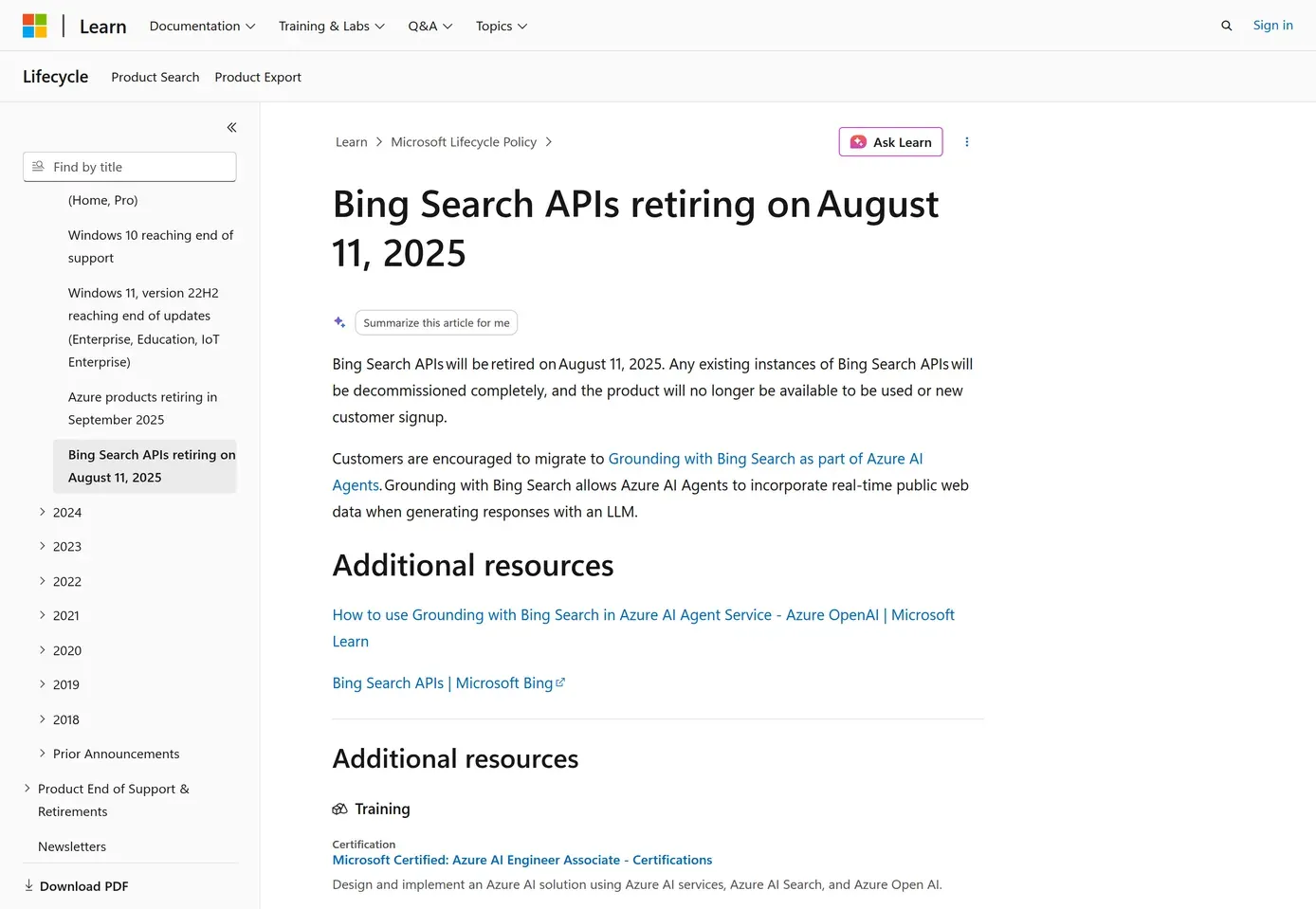
Microsoft retired the Bing Search API in August 2025, ending the only official general-web search API from a major engine and stranding thousands of production integrations. The replacement question isn't "which API has the same request shape", it's "which index do I want behind my search tool now that I'm forced to choose." cloro's answer: Google's, via one JSON endpoint, so the replacement tool your agent gets is grounded on the index its users already trust and fact-check against, not a smaller stand-in. See our Bing Search API retirement guide for the migration path.
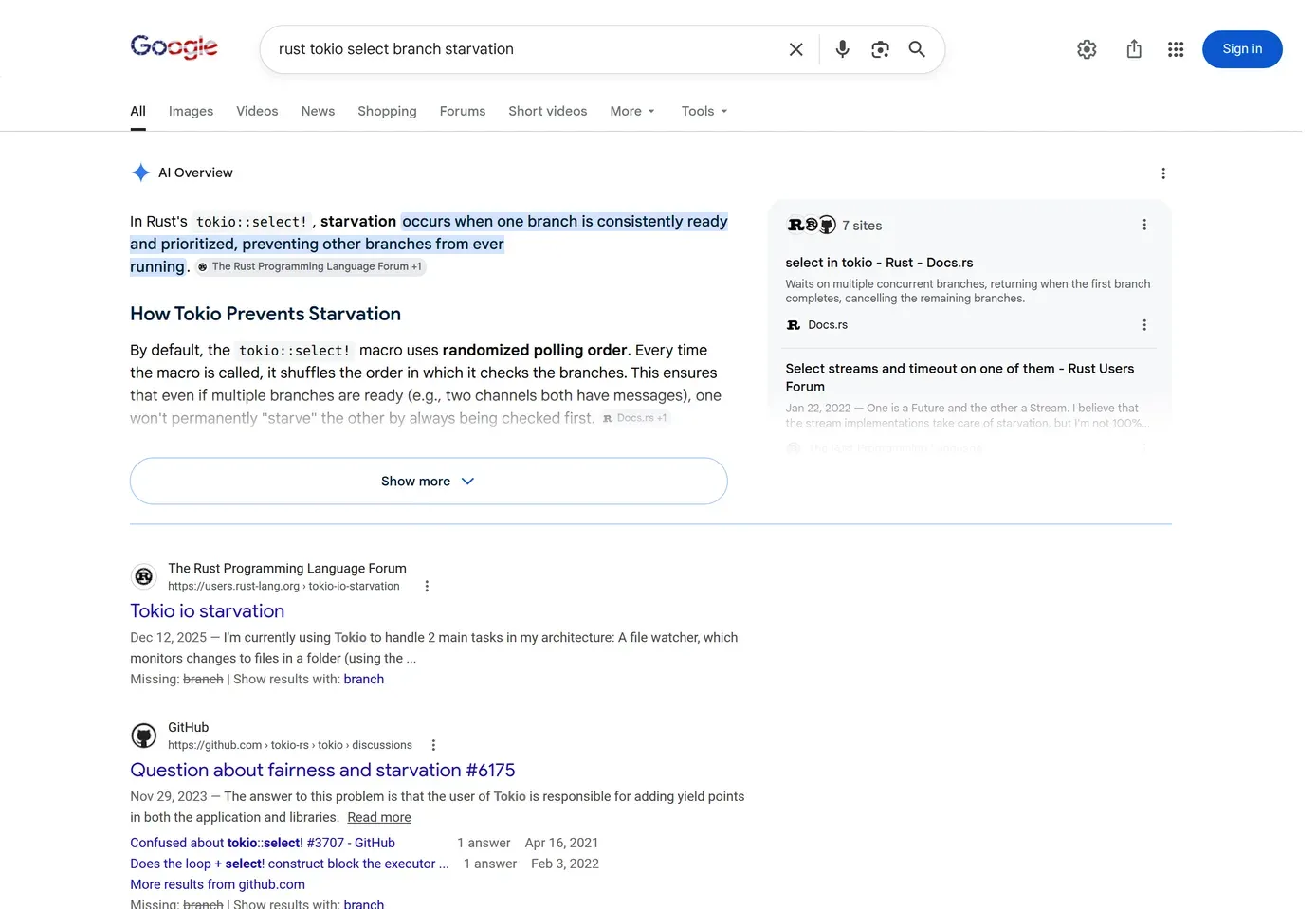
Brave Search API, Tavily, and Exa are real products solving the same job, but each searches its own crawl, a fraction of Google's coverage. For long-tail entities, fresh news, local results, and niche technical content, the difference shows up as your agent confidently answering "no results found", or worse, hallucinating to fill the gap. cloro returns Google's ranked results, so your grounding coverage is Google's coverage.
When ChatGPT or Gemini answers a question, it fans the prompt out into web searches and synthesizes from what comes back (see our query fan-out analysis). Building your agent's search tool on the same SERP data the engines see keeps your grounding consistent with theirs — your app cites the sources users can verify with a Google search, instead of a parallel web nobody else sees. The grounding rates back that up. Across roughly 2,500 prompts per engine, Google AI Mode grounded 98.2% of answers at 9.9 sources and AI Overview 91.2% at 9.1, reading 91.0% and 94.3% respectively on a 2026-08-19 re-measurement (grounding study). If the engines your users ask are reaching Google-shaped results, an agent grounded on a smaller index is answering from a different web.
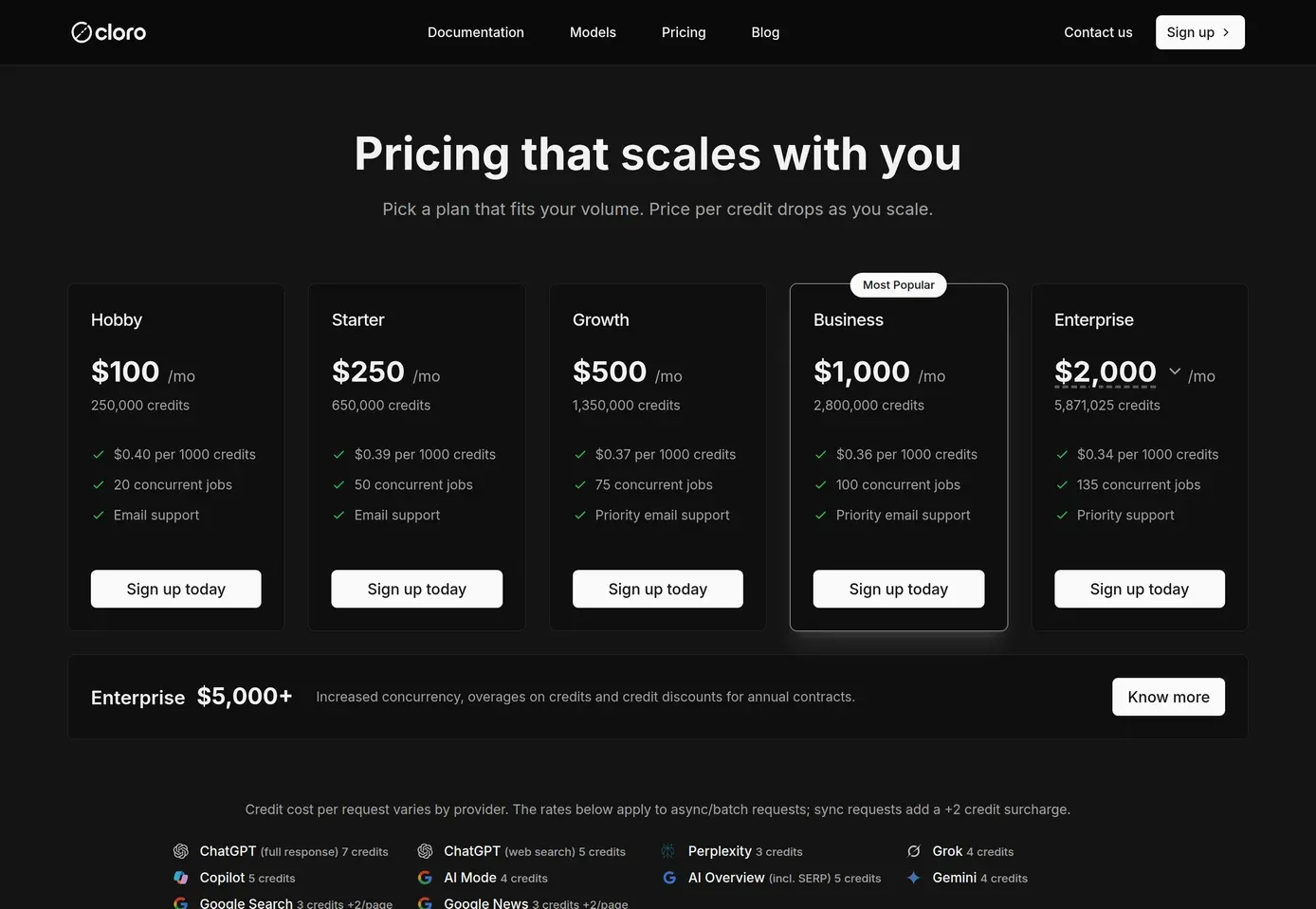
Most web search APIs price as subscription tiers with monthly minimums: the free tier is a trial, and the first paid tier charges you for capacity you may never use. cloro is pay-per-call: a Google search costs 3 credits, you start with free credits at signup, and you never pay for idle capacity. At Hobby ($100/month, 250k credits), that's ~83,000 searches — see pricing for the full math.
Four workloads AI teams ship on top of cloro web search.
Fetch ranked results at question time, pack them into the context window, and return answers that cite verifiable Google-ranked URLs.
Register web_search as a function-calling tool; the model decides when to search and gets ranked, citable JSON back in the loop.
Verify model outputs or user-submitted claims against live top-10 results before publishing — a search per claim, batched via async.
Swap the retired Bing endpoint for one POST call; map organicResults to your existing webPages.value shape and ship the same day.
Send a query, cloro runs the Google search, ranked JSON comes back. Two patterns cover most AI workloads: fetch ranked results and pack them into your prompt (RAG grounding), or register cloro as a function-calling tool and let the model decide when to search.
from cloro import Cloro

client = Cloro(api_key="sk_live_your_api_key_here")

# 1. Search the web for grounding context.
response = client.monitor.google(
    query="eu ai act enforcement timeline",
    country="US",
    device="desktop",
)
results = response["result"]["organicResults"]

# 2. Pack ranked results into the model's context window.
context = "\n\n".join(
    f"[{r['position']}] {r['title']}\n{r['link']}\n{r['snippet']}"
    for r in results
)

prompt = f"""Answer using only the web results below.
Cite sources by [number].

Web results:
{context}

Question: When does EU AI Act enforcement start for GPAI models?"""

# 3. Send the prompt to your LLM of choice. Citations map back
#    to real Google-ranked URLs your users can verify.
print(prompt){
"success": true,
"result": {
"organicResults": [
{
"position": 1,
"title": "EU AI Act: Implementation Timeline and Key Dates",
"link": "https://artificialintelligenceact.eu/implementation-timeline/",
"snippet": "Obligations for general-purpose AI models apply from August 2025, with full enforcement for high-risk systems phasing in through 2026–2027...",
"page": 1
},
{
"position": 2,
"title": "AI Act enters into force — European Commission",
"link": "https://commission.europa.eu/news/ai-act-enters-force",
"snippet": "The AI Act's staggered application means providers of GPAI models placed on the market must comply with transparency requirements...",
"page": 1
}
],
"peopleAlsoAsk": [
{
"question": "Is the EU AI Act already in force?",
"type": "LINK",
"snippet": "The AI Act entered into force in August 2024, but its obligations apply in stages..."
}
],
"relatedSearches": [
{
"query": "eu ai act gpai obligations"
},
{
"query": "ai act high risk systems deadline"
}
]
}
}Pick a plan that fits your volume. Price per credit drops as you scale.
| Plan | Price / mo | Credits | Per 1k | Concurrency | Seats | Support |
|---|---|---|---|---|---|---|
| Free | $0 | 500 | — | 1 | 1 | Documentation assistant |
| Lite | $30 | 37,500 | $0.80 | 10 | Unlimited | |
| Hobby | $100 | 250,000 | $0.40 | 20 | Unlimited | |
| Starter | $250 | 650,000 | $0.39 | 50 | Unlimited | |
| GrowthPopular | $500 | 1,350,000 | $0.37 | 75 | Unlimited | Priority email |
| Business | $1,000 | 2,800,000 | $0.36 | 100 | Unlimited | Priority email |
| Enterprise 2K | $2,000 | 5,871,025 | $0.34 | 135 | Unlimited | Slack |
| Enterprise 3K | $3,000 | 9,306,606 | $0.32 | 175 | Unlimited | Slack |
| Enterprise 4K | $4,000 | 12,756,261 | $0.31 | 215 | Unlimited | Slack |
| Enterprise 5K | $5,000 | 16,391,783 | $0.31 | 255 | Unlimited | Slack |
| Enterprise | $5,000+ | Increased concurrency, overages on credits and credit discounts for annual contracts.Know more | ||||
Credit cost per request varies by provider. The figures below are for async/batch requests; sync requests add a +2 credit surcharge.
ChatGPT full response includes query fan-out, ads, and shopping data. Google News uses the same pricing as Google Search. Grok is temporarily unavailable — requests to it fail, so do not size a plan around it.
Microsoft retired the Bing Search API in August 2025, directing developers toward grounding inside Azure AI Agents instead of a raw search endpoint. That ended the only official general-web search API from a major engine. cloro fills the same slot with a stronger index: `POST /v1/monitor/google` returns Google's ranked results as parsed JSON. Our Bing Search API guide walks through the retirement and migration in detail.
Brave Search API queries Brave's own independent index (genuinely impressive engineering) but a fraction of Google's coverage, which matters most on long-tail entities, fresh news, and niche technical queries where grounding gaps become hallucinations. cloro returns Google's ranked results instead of a proprietary index's. If your users would fact-check your agent against Google, ground on Google.
Yes — that's the primary workload for this page. Define a `web_search` function-calling tool in your agent framework (OpenAI tools, Anthropic tool use, LangChain, Vercel AI SDK — the pattern is identical), and have its executor call `POST /v1/monitor/google`. Map `organicResults[]` to `{rank, title, url, snippet}` and return that array as the tool result. The agent-tool code example above is copy-paste ready. Results arrive ranked and citable, so answer citations map to URLs your users can verify.
Fully-free general web search APIs don't survive. Running one against a real index costs real money, which is why free tiers are trials and "free" offerings get retired (see: Bing). cloro's honest version: free credits at signup to build and test your integration, then pay-per-call with no subscription minimum at 3 credits per search, so you pay for the searches your agent actually runs, not a monthly capacity guess. Details on the pricing page.
A Google search call is 3 credits (n=10 results); +2 credits per additional results page, +2 with AI Overview enrichment. The Hobby plan ($100/month, 250k credits) covers ~83,000 searches — enough for an agent product doing ~2,700 searches a day. Growth ($500/month, 1.35M credits) covers ~450,000 searches. If your pipeline also queries AI engines directly, those run 3–5 credits per call (ChatGPT web search 5, Perplexity 3, Gemini 4) on the same balance.
Synchronous calls suit interactive agent loops (one user question, one or two searches, results in the response path). For batch workloads (nightly RAG index refresh, fact-checking a document queue), use `POST /v1/async/task` with `taskType: "GOOGLE"` and a webhook URL: submit the batch, results land at your webhook as each completes, and you never burn interactive concurrency on background jobs.
Each response includes `organicResults[]` (position, title, link, snippet), `peopleAlsoAsk[]` (real user questions with answer snippets — useful for expanding agent research), and `relatedSearches[]` (query reformulations, useful for multi-hop retrieval). Optionally add `include.aioverview` (+2 credits) to get Google's AI Overview with its cited sources — see the Google AI Overview API for the full parsed shape. The full envelope is documented on the SERP API page.
Same endpoint, different workload. SERP monitoring snapshots queries on a cadence to detect change over time — an SEO and competitive-intel job. A web search API is request-driven: your application searches when a user or agent needs fresh information, and the result is consumed immediately as grounding context, not warehoused as a time series. Both bill from the same credit balance with the same key.
Google Search API options explained: Custom Search JSON API, DIY scraping, and modern SERP APIs. Compare limits, pricing, and real SERP coverage.
9 SERP APIs tested head to head on AI Overview parsing, engine breadth, rank-tracking depth, and true cost per 1,000 calls. Full benchmark table inside.
5 ranked drop-in replacements for the retired Bing Search API v7, with API-key setup, cost comparison, and migration steps for your legacy code.