
SEO
People Also Ask SEO: How to Optimize for PAA Boxes
Learn People Also Ask SEO: find PAA questions, use exact H2s, write 40-60 word answers, add FAQ schema, and track PAA citation changes over time.
cloro is not a search-volume database. Ahrefs, Semrush, and DataForSEO own that layer, and you should keep yours. cloro is everything a volume database can't give you because it only exists on the live SERP: People Also Ask mining, related-searches expansion, SERP-feature presence per keyword, and AI Overview triggering. Pull candidates from real SERPs, then enrich with volume from the provider you already pay for, so you know what to write and what format to build before you brief it.
4.7 · 53 reviews
Keyword research data comes in two layers. The first is the one every SEO knows: search volume, keyword difficulty, and CPC from a database vendor — historical estimates, refreshed on the vendor's schedule. The second layer is thelive SERP itself: the questions Google surfaces under People Also Ask, the related searches it suggests, which SERP features a keyword actually triggers, and who really ranks in the top ten today.
The two layers answer different questions. Volume data tells youhow many people search; live SERP data tells youwhat you'd be competing against right now — and it's the only layer that can, because it comes from querying real results pages rather than a quarterly crawl. cloro is the API for that second layer; keep your volume provider for the first.
One SERP call returns four expansion surfaces at once: People Also Ask questions, related searches, the organic top 10 (your difficulty proxy), and the AI Overview block. Your volume database tells you how often a keyword is searched; the live SERP tells you what Google thinks the keyword means, what format wins, and which adjacent queries exist.
Volume and difficulty scores answer "is this keyword worth it?" The live SERP answers everything else: what to write, what format Google rewards, which questions surround the keyword, and whether an AI Overview will eat the clicks. Those answers change weekly — and only a live SERP call has them.
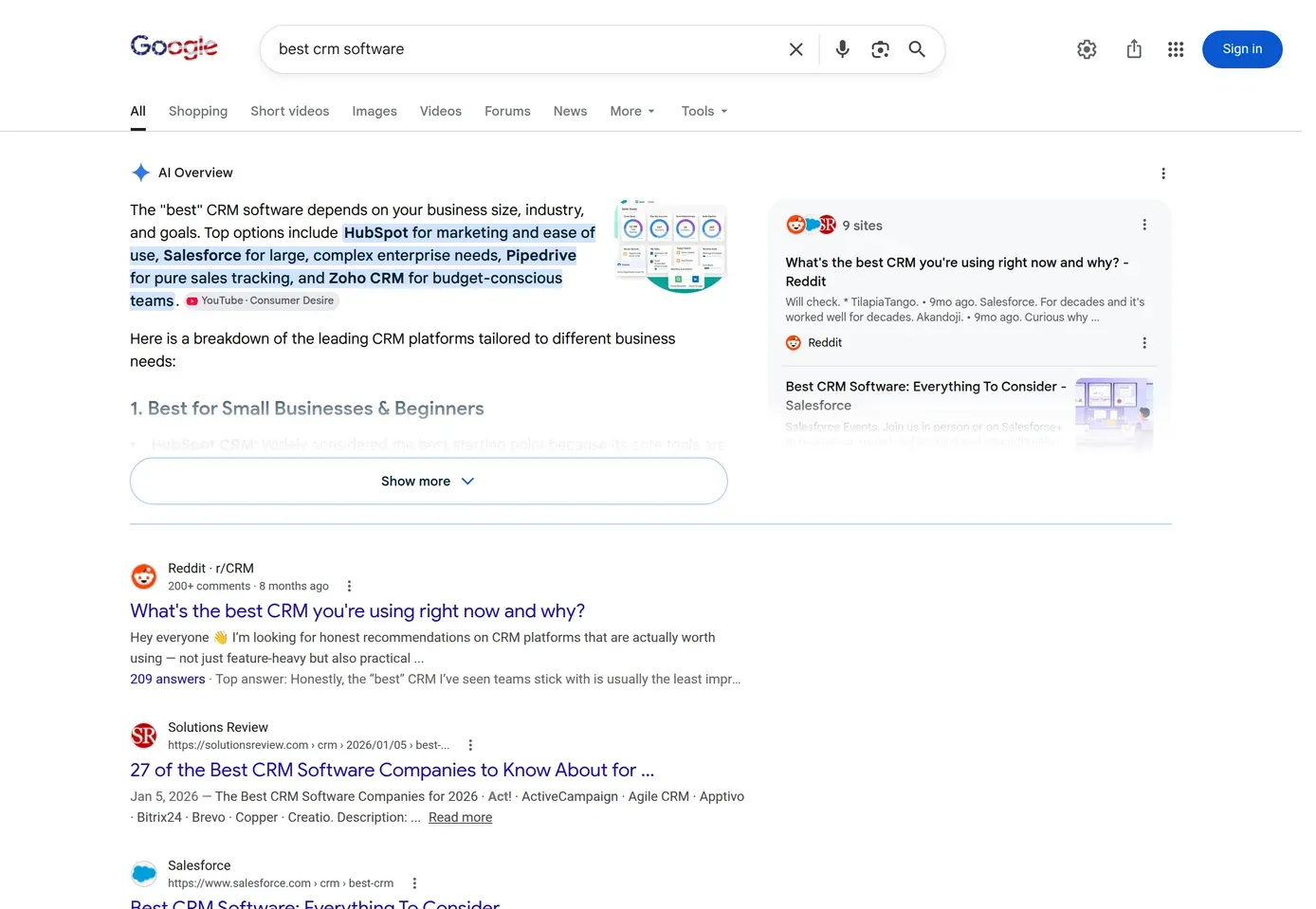
Every volume database is a periodically refreshed crawl, 30 to 90 days behind on long-tail terms. The SERP you'd actually compete on is the ground truth, and it reshuffles daily: new PAA questions, new related searches, features appearing and vanishing. cloro returns the live SERP per call, so your candidate list reflects what Google serves today, not what a crawler saw last quarter. See what's actually on a SERP in 2026. Daily is not a figure of speech here. Tracking 200 keywords every day for 30 days, across 5,755 consecutive-day pairs, the top organic result changed on 31.7% of days, and the most volatile keyword changed on 93% of them (rank volatility study). A database refreshed monthly is describing a page that has already been rearranged.
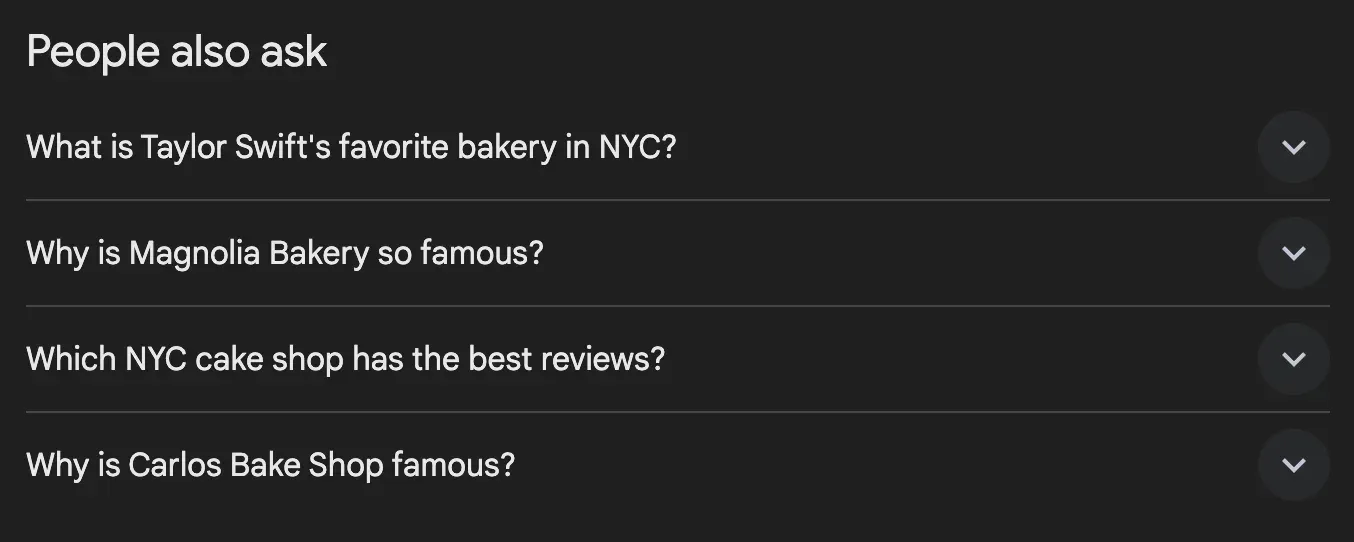
Every PAA question is a real query Google has mapped to your seed, and each question's own SERP carries more PAA questions. Recursively expanding that graph (seed → questions → query each question → collect new questions → dedupe) turns one seed into hundreds of long-tail candidates no keyword database surfaces, and a map of the questions your published pages never answer. There is no PAA export; the graph is only reachable by querying real SERPs. Recipe below, deep dive at PAA for SEO.
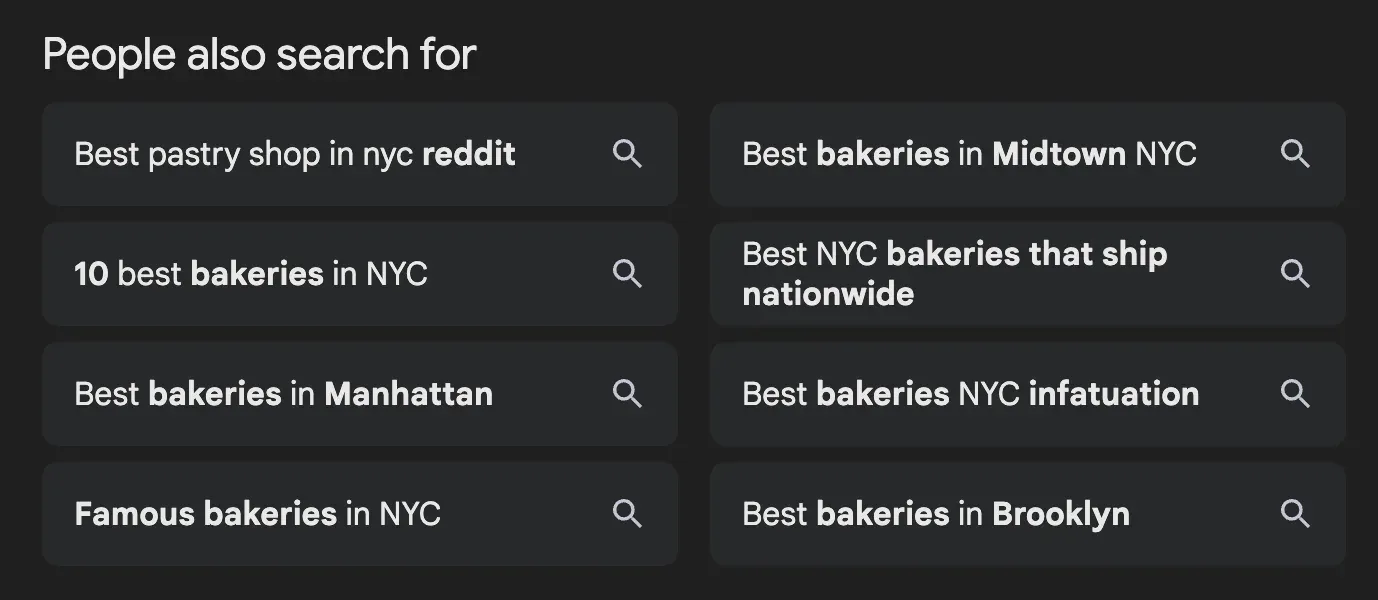
Whether a keyword triggers shopping results, a local pack, video carousels, or a featured snippet decides what you build — a product page, a location page, a video, a definition-first article. That's a per-keyword, per-country fact that shifts as Google retunes intent. cloro returns every parsed SERP element per call, so a `has_feature` flag per keyword is one field-presence check away and candidates sort by the format you would have to build. The same response carries a difficulty proxy for free: the domain mix actually ranking in the top 10.
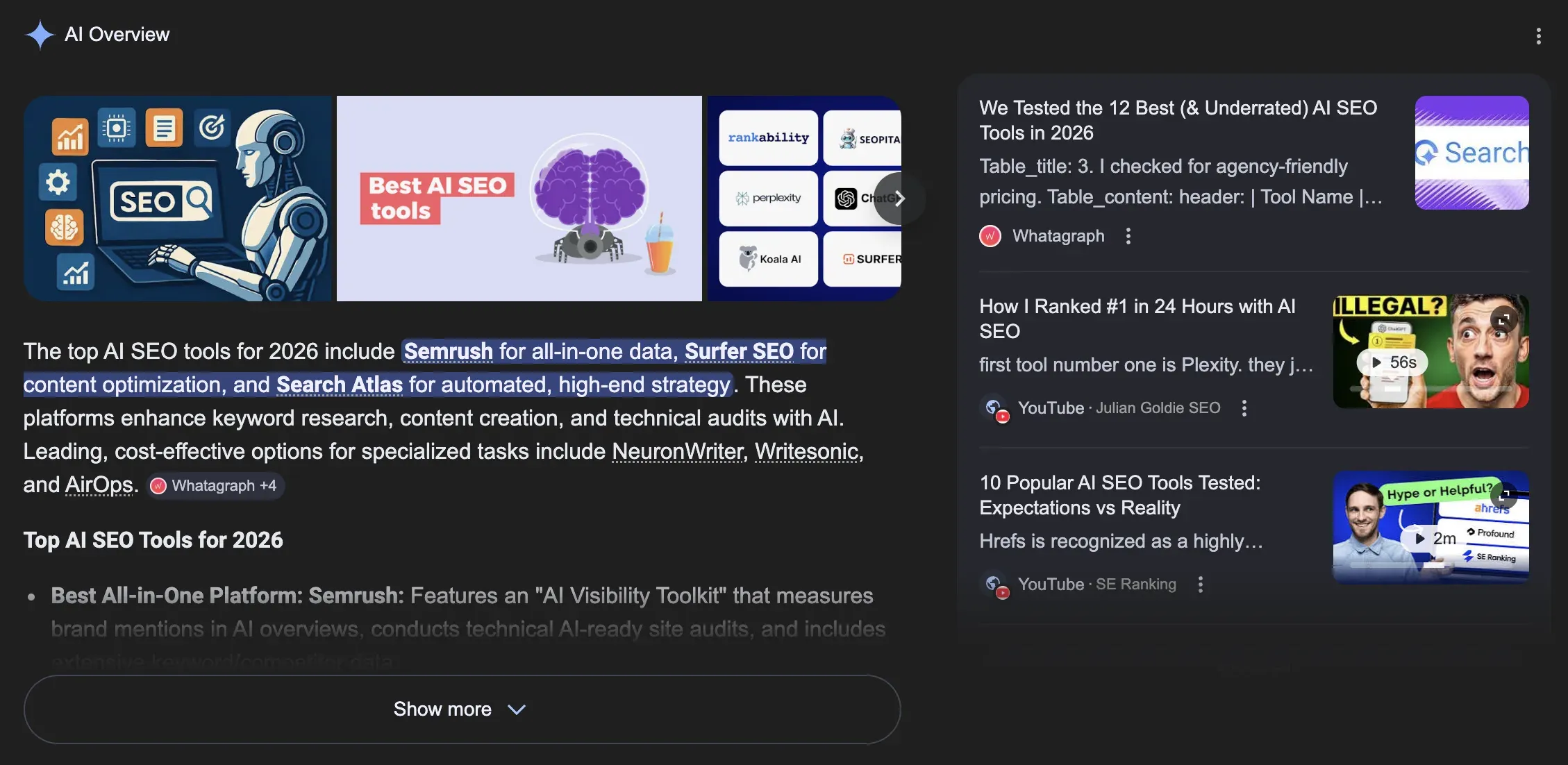
An AI Overview above position 1 rewrites the click-through curve for that keyword. A #3 ranking under an AI Overview is not the old #3. Whether a keyword triggers one, and which queries the AI engine fans out to when answering it (see query fan-out), is only measurable from live SERPs. No volume database carries an AI Overview column. cloro returns the full block (text, sources, citations) with one include flag, so you can discount a keyword's expected clicks before you commission the page.
Four keyword-research workflows teams ship on the live-SERP layer.
Recursively expand PAA from seed topics, diff the question graph against your published URLs, and hand writers the questions nobody on the site answers yet.
Flag every keyword in a customer's list with feature presence — shopping, local pack, video, AI Overview — and ship format recommendations as a product feature.
Measure what share of each topic cluster triggers an AI Overview, week over week, and re-forecast expected CTR before rankings even move.
Cluster keywords when their top-10 URLs overlap — the same-page-can-rank test. It's the clustering method that actually predicts cannibalization, and it needs live SERPs.
Both pipelines work the same way: send a query, cloro parses the live SERP, and you read the expansion surfaces off the JSON. Recursive PAA mining handles expansion, a SERP-feature audit handles scoring, and both write rows to your warehouse. Enrich them with volume from your existing provider and you have a keyword-research stack, not another subscription.
from cloro import Cloro

client = Cloro(api_key="sk_live_your_api_key_here")

def fetch_paa(query):
    res = client.monitor.google(query=query, country="US", device="desktop")
    return [q["question"] for q in res["result"]["peopleAlsoAsk"]]

# Seed -> PAA questions -> query each question -> collect new PAA -> dedupe.
seed = "keyword research"
seen = set()
frontier = [seed]

for depth in range(2):  # 2 levels deep typically yields 50-200 questions
    next_frontier = []
    for query in frontier:
        for question in fetch_paa(query):
            key = question.lower().strip()
            if key not in seen:
                seen.add(key)
                next_frontier.append(question)
    frontier = next_frontier

# Push to your warehouse, then enrich with volume from your existing provider.
print(f"{len(seen)} unique questions mined from one seed"){
"success": true,
"result": {
"organicResults": [],
"peopleAlsoAsk": [],
"relatedSearches": [],
"ads": []
}
}Pick a plan that fits your volume. Price per credit drops as you scale.
| Plan | Price / mo | Credits | Per 1k | Concurrency | Seats | Support |
|---|---|---|---|---|---|---|
| Free | $0 | 500 | — | 1 | 1 | Documentation assistant |
| Lite | $30 | 37,500 | $0.80 | 10 | Unlimited | |
| Hobby | $100 | 250,000 | $0.40 | 20 | Unlimited | |
| Starter | $250 | 650,000 | $0.39 | 50 | Unlimited | |
| GrowthPopular | $500 | 1,350,000 | $0.37 | 75 | Unlimited | Priority email |
| Business | $1,000 | 2,800,000 | $0.36 | 100 | Unlimited | Priority email |
| Enterprise 2K | $2,000 | 5,871,025 | $0.34 | 135 | Unlimited | Slack |
| Enterprise 3K | $3,000 | 9,306,606 | $0.32 | 175 | Unlimited | Slack |
| Enterprise 4K | $4,000 | 12,756,261 | $0.31 | 215 | Unlimited | Slack |
| Enterprise 5K | $5,000 | 16,391,783 | $0.31 | 255 | Unlimited | Slack |
| Enterprise | $5,000+ | Increased concurrency, overages on credits and credit discounts for annual contracts.Know more | ||||
Credit cost per request varies by provider. The figures below are for async/batch requests; sync requests add a +2 credit surcharge.
ChatGPT full response includes query fan-out, ads, and shopping data. Google News uses the same pricing as Google Search. Grok is temporarily unavailable — requests to it fail, so do not size a plan around it.
No, and we won't pretend otherwise. Search volume and KD come from clickstream panels and historical databases — Ahrefs, Semrush, and DataForSEO do that well, and cloro is not trying to replace them. cloro is the live-SERP layer: PAA questions, related searches, SERP-feature presence, AI Overview blocks, and the actual top-10 for any keyword, fresh per call. The working pattern is: discover candidates on cloro, enrich with volume from the provider you already pay for.
Query your seed keyword via `POST /v1/monitor/google` and collect `peopleAlsoAsk[]`. Each question is itself a query — send it back through the API and collect the new questions on its SERP. Dedupe (lowercase + trim), and repeat. Two levels of depth from one seed typically yields 50–200 unique questions; three levels can reach four figures. Every question in the graph is a real query Google associates with your topic — expansion data no keyword database exports.
A Google SERP call is 3 credits at n=10, +2 with AI Overview enrichment. A 10k-keyword audit is 10,000 × 3 = 30,000 credits without AI Overview, or 10,000 × 5 = 50,000 credits with it — either way a fraction of the Hobby plan's 250k credits at $100/month. On Growth ($500/month, 1.35M credits) you can re-audit 10k keywords with AI Overview enrichment weekly and still use under 90% of the plan. Full details at /pricing/.
Not a single score — a better proxy: look at who actually ranks. `organicResults[]` gives you the top-10 domain mix per keyword. Forum threads, UGC, or thin affiliate pages in the top 10 signal a winnable SERP regardless of what a KD score says; ten entrenched aggregators signal the opposite. Because it's computed from the live SERP, the proxy updates as fast as the SERP does — KD scores are recalculated on database refresh cycles. For tracking how those top-10s move over time, see /use-cases/rank-tracking/.
Pass `include: {"aioverview": {"markdown": true}}` on each call and record whether the `aioverview` field is populated. Trigger rate per topic cluster is then a GROUP BY in your warehouse. Teams run this weekly because trigger rates move as Google expands AI Overview coverage — a cluster that was 10% AIO last quarter can be 40% today, which changes the expected CTR of every ranking in it. For ongoing change detection on the same keywords, that workflow graduates into SERP monitoring.
Use `POST /v1/async/task` with `taskType: "GOOGLE"` and a webhook URL. Submit the whole candidate list in batches; results land at your webhook as each SERP completes, and your handler writes rows straight to the warehouse. For 10k+ keyword discovery or audit runs, async is the right pattern: the run finishes in the background instead of holding your concurrency. Sync is for exploration and small seed expansions.
Yes — this page is the keyword-research use case of the cloro SERP API. Same `POST /v1/monitor/google` endpoint, same response envelope (organicResults, peopleAlsoAsk, relatedSearches, ads, aioverview), same per-call pricing. What changes is the workflow you build on it: expansion and scoring here, position tracking and SERP-change detection on rank tracking.
Learn People Also Ask SEO: find PAA questions, use exact H2s, write 40-60 word answers, add FAQ schema, and track PAA citation changes over time.
PASF reveals what users wanted but didn't get from the page they just clicked. Here's how to mine it for SEO.
The complete guide to Google search parameters (gl, hl, uule, udm, tbs) to control location, language, time filters, and AI Overviews when you scrape at scale.
Mine PAA, expand related searches, audit SERP features and AI Overview presence, then enrich with volume from the database you already have. You know what to write and in what format before you brief it. Your code, our data. Pay only for the SERPs you pull.