
AI Search
Best LLM & AI Visibility Tools 2026: 10 Tested
We tested 10 LLM visibility tools (also sold as AI visibility trackers and checkers) on real brand-monitoring workflows across ChatGPT, Perplexity, and Gemini. What works, what doesn't.
Buyers now research brands by asking ChatGPT, Perplexity, and Gemini. cloro is the measurement API for AI search and LLM visibility tracking, and it tells you whether they find you. One call returns parsed citations, source URLs, positions, and labels across 7 engines in one response shape. Aggregate it into mention rate, share of voice, and competitive position. The data is yours, and so is the dashboard.
4.7 · 53 reviews
AI visibility is how often, and how prominently, AI engines cite your brand when they answer a buyer's question. Where classic SEO measures rank on a page of links, AI visibility measures citation inside a generated answer across ChatGPT, Perplexity, Gemini, AI Overview, AI Mode, Copilot, and Grok. Nobody publishes that number. The engines ship no dashboards, so you sample real responses on a fixed prompt set and aggregate over time. Most vendors sell that sampling as a hosted AI visibility tool, packaged AI visibility software you log into. cloro exposes the same signal as the raw API, so the data and the metric definitions stay yours.
An AI visibility score rolls those samples into a single number you can track week to week: a weighted blend of three inputs, measured against a competitor set.
Because it's computed from raw responses, you define the methodology, so the score matches whatever your team already reports. For the full metric definitions, see the AI brand visibility measurement framework. To see the score computed on real answers, the free AI Visibility Leaderboard publishes it weekly across twelve software categories, alongside the domains the engines cite to get there.
Four measurement workflows teams ship on cloro AI visibility tracking: warehouse share-of-voice dashboards, citation-drop alerts, content before-and-after, and client reporting.
Sample a fixed prompt set across all 7 engines daily, land the parsed citations in BigQuery, and compute mention rate and share of voice with your own weighting.
Fire an alert the day your mention rate drops on a tracked prompt, or a competitor overtakes your citation position on an engine that was yours last week.
Sample the prompt set before and after every content change, then diff citations per engine to see which edits earned a mention. The measurement half of generative engine optimization.
Per-tenant API keys plus your own report templates → agency-branded weekly AI visibility reports emailed from your domain, on your methodology.
AI visibility tracking comes in two product shapes. Packaged AI visibility software is a hosted dashboard on someone else's API: a login and the vendor's metric definitions. The API itself returns the raw structured response, so you pick what to measure and where it lands. Brand teams that need their data in their warehouse pick the API. Here's why.
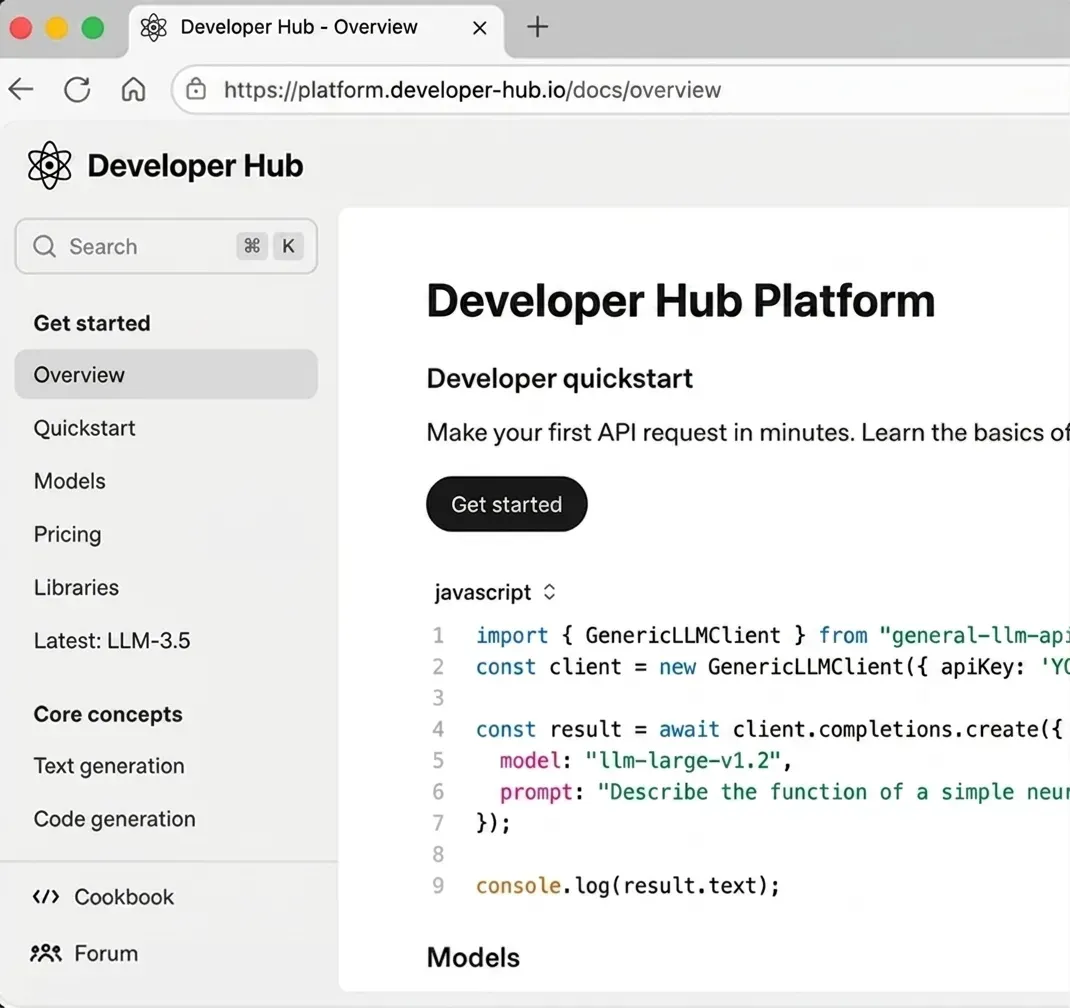
Hosted AI visibility trackers give you a UI. The `sources[]`, position data, and engine-specific objects stay locked behind it: no BigQuery export, no custom share-of-voice math, no integration with your existing rank-tracker. cloro returns the structured response, so those fields land in your own store next to your search and campaign numbers. The dashboard layer is yours.
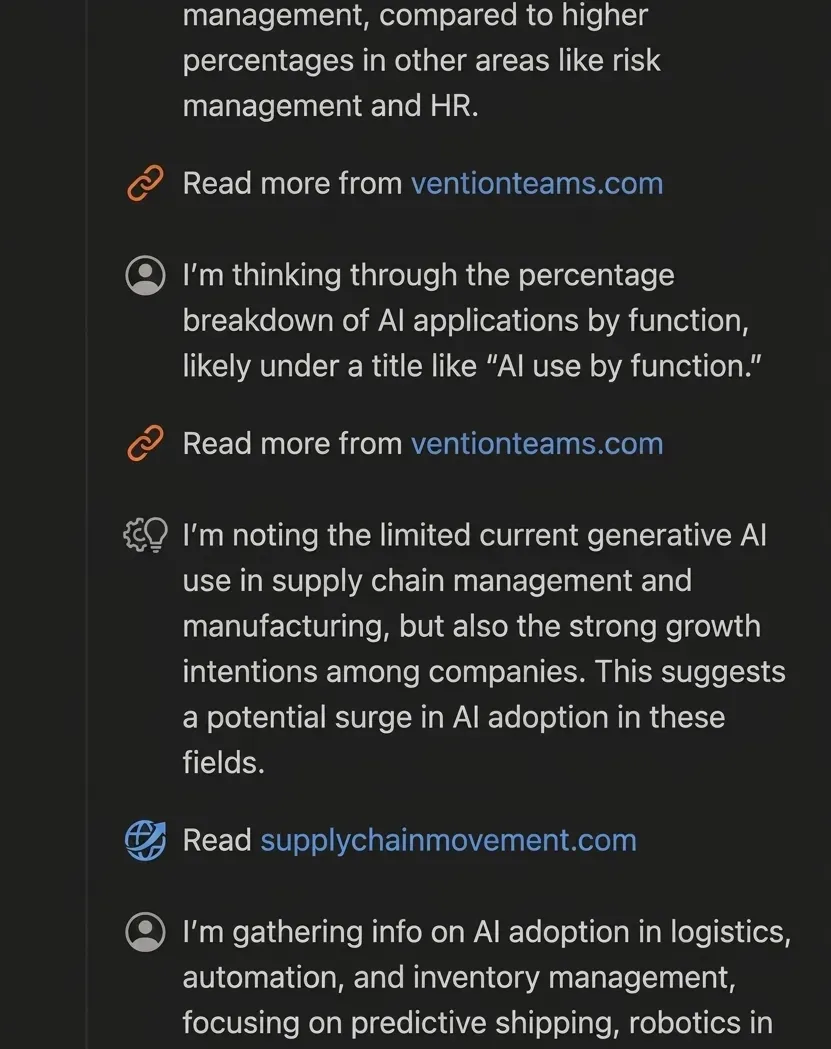
Ask an AI engine the same question twice and the answers differ, so one check tells you nothing. A mention rate comes from ongoing AI visibility monitoring: sample the same prompt set on a cadence and aggregate. No engine publishes it. A 100-prompt × 7-engine × daily loop ships 21k calls/month, inside the $100 Hobby plan, so the number you report is a trend, not one lucky or unlucky answer.
A brand cited #1 on ChatGPT can be invisible on Perplexity: citation overlap between engines on the same prompt is consistently under 30%. Track one engine and you get a single-channel report, and you find the gap only after a competitor owns the engine you never checked. cloro covers all 7 under one key. The engines are not interchangeable, and one of them behaves unlike the rest. Across roughly 2,500 prompts each, five of six grounded their answers in live sources 91 to 98% of the time while Gemini grounded just 41.1%. Re-measured on 2026-08-19 that same six-engine panel ran 70.7 to 99.2% with Gemini still last, so the ordering is durable and the rate is not (grounding study). On an ungrounded answer there is no citation to win, so a low mention rate there can be reporting the engine rather than your brand.
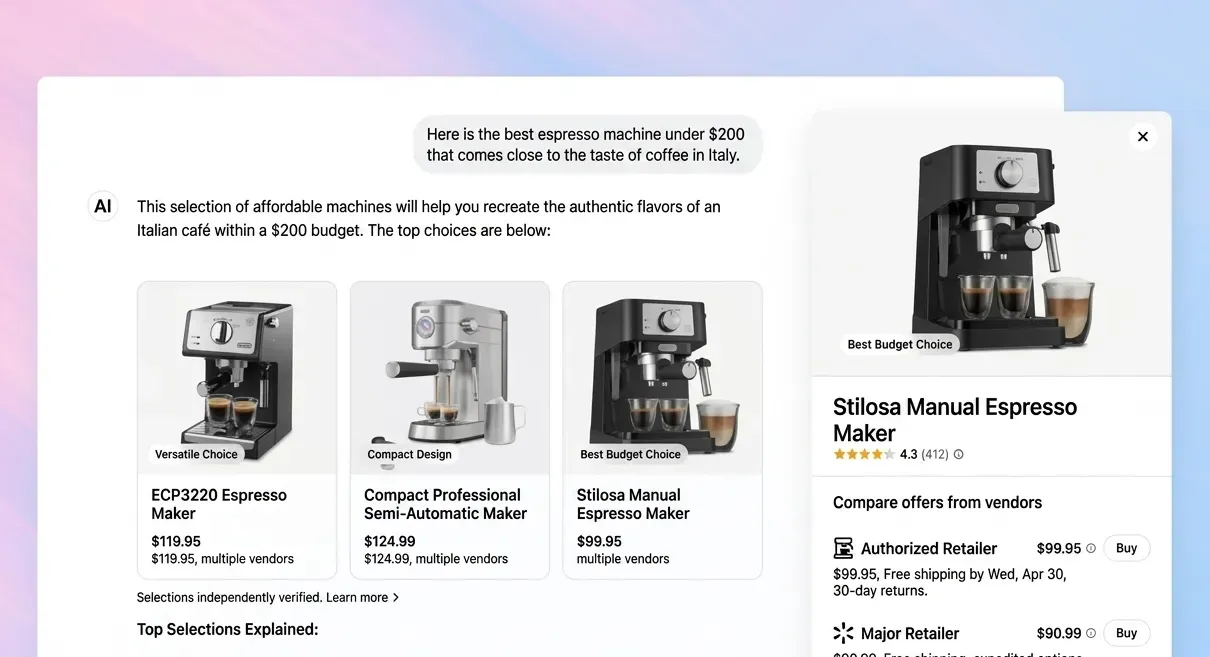
A hosted tool hands you its share-of-voice formula. Yours probably differs: which competitors count, what a top citation is worth, whether a shopping card is a mention. That math needs more than the answer paragraph, so cloro returns the full structured envelope per response: domain-classified citations, cited-position weighting, entity-recognized brands, and engine-specific objects (places, shopping cards, ads). That way your share-of-voice number reflects your own competitor list and your own definition of a mention, not a vendor's.
| Capability | Hosted dashboard | cloro API |
|---|---|---|
| Raw response export | Locked behind the UI | Full structured response, yours to store |
| Custom share-of-voice math | Vendor's formula only | Compute your own from raw fields |
| Warehouse / BigQuery integration | Rare or paid add-on | Native — it's just an API |
| Cross-engine coverage | Varies by vendor | All 7 engines, one key, one response shape |
| Who owns the dashboard | The vendor | You do |
Monitor your brand's presence in AI search engines by sampling real AI answers on a fixed prompt set and aggregating citations over time:
sources[], the pages each answer cited, into mention rate and share of voice with your own methodology.A 100-prompt × 7-engine × daily loop ships 21k calls/month, which fits inside the $100 Hobby plan.
Yes, one API covers all seven: cloro is the unified API for measuring how often AI search engines reference your content. Track AI search visibility across every engine under one key. ChatGPT, Perplexity, Gemini, AI Overview, AI Mode, Copilot, Grok. Same auth, shared credit pool, same response shape. Adding a new engine to your monitoring is a URL change, not a pipeline rewrite. Country-level sampling is a parameter, not a contract: run the same prompt per country to compare geographic search performance across AI models.
Send your prompt to each engine, read back the sources each answer cited, count the ones that are yours. One prompt, six monitor endpoints, one credit pool. Switch the URL, fan out across the AI search stack, classify by domain, aggregate.
from cloro import Cloro

client = Cloro(api_key="sk_live_your_api_key_here")

# One prompt. Every AI engine. Shared credit pool.
prompt = "best AI brand visibility tracking tools"
engines = ["chatgpt", "perplexity", "gemini", "aimode", "copilot", "grok"]

results = {}
for engine in engines:
    response = getattr(client.monitor, engine)(
        prompt=prompt,
        country="US",
        include={"markdown": True},
    )
    sources = response["result"]["sources"]
    mentioned = any("yourbrand" in s["url"] for s in sources)
    results[engine] = {"mentioned": mentioned, "citations": len(sources)}

print(results){
"success": true,
"result": {
"text": "Several tools track brand visibility across AI engines. cloro provides a unified API across ChatGPT, Perplexity, Gemini, AI Mode, Copilot, and Grok...",
"sources": [
{
"position": 1,
"url": "https://cloro.dev/use-cases/ai-visibility-tracking/",
"label": "AI Visibility Tracking — cloro",
"description": "Monitor brand mentions across ChatGPT, Perplexity, Gemini, AI Mode, Copilot, and Grok via one API."
},
{
"position": 2,
"url": "https://en.wikipedia.org/wiki/Generative_engine_optimization",
"label": "Generative engine optimization — Wikipedia",
"description": "Background on the discipline of optimizing content for AI-generated answers."
}
],
"markdown": "Several tools track brand visibility across AI engines. cloro provides a unified API across ChatGPT, Perplexity, Gemini, AI Mode, Copilot, and Grok..."
}
}Start free. Price per credit drops as your volume grows — see every tier below.
| Plan | Price / mo | Credits | Per 1k | Concurrency | Seats | Support |
|---|---|---|---|---|---|---|
| Free | $0 | 500 | — | 1 | 1 | Documentation assistant |
| Lite | $30 | 37,500 | $0.80 | 10 | Unlimited | |
| Hobby | $100 | 250,000 | $0.40 | 20 | Unlimited | |
| StarterPopular | $250 | 650,000 | $0.39 | 50 | Unlimited | |
| Growth | $500 | 1,350,000 | $0.37 | 75 | Unlimited | Priority email |
| Business | $1,000 | 2,800,000 | $0.36 | 100 | Unlimited | Priority email |
| Enterprise 2K | $2,000 | 5,871,025 | $0.34 | 135 | Unlimited | Slack |
| Enterprise 3K | $3,000 | 9,306,606 | $0.32 | 175 | Unlimited | Slack |
| Enterprise 4K | $4,000 | 12,756,261 | $0.31 | 215 | Unlimited | Slack |
| Enterprise 5K | $5,000 | 16,391,783 | $0.31 | 255 | Unlimited | Slack |
| Enterprise | $5,000+ | Increased concurrency, overages on credits and credit discounts for annual contracts.Know more | ||||
Five primary metrics, all aggregated from raw `sources[]` per response: mention rate (fraction of runs that cite your domain), citation position (where you appear in the cited list), share of voice (your citation rate vs competitors on the same prompt set), cross-engine coverage (how many of the 7 engines cite you), and entity recognition (whether engines correctly attribute claims to your brand vs misattribute or omit). All five are computed by your code from the response, so you can match them to whatever methodology your team already reports.
A packaged AI visibility platform gives you a dashboard and stops at its edges; the API gives you the data underneath. Three reasons teams pick the API. (1) Data ownership: citation data lands in your warehouse alongside the rest of your marketing analytics, not behind someone else's login. (2) Custom metrics: most teams already have a share-of-voice methodology their finance team reports, and computing it from raw responses means your AI numbers match your existing numbers. (3) Workflow integration: alerting, BigQuery ETL, dbt models, and Looker dashboards plug in as easily as any other API.
That is the shape most teams deploy it in. There is no UI to adopt and no seat model to negotiate, so the integration surface is a single REST endpoint per engine plus async webhook delivery for scheduled runs. The common pattern is a nightly batch into BigQuery or Snowflake, dbt models computing mention rate and share of voice on your own definitions, and the result joined to GA4, Search Console, and CRM data in whatever BI layer already carries your search reporting. Agencies and multi-brand teams run the same thing with per-tenant API keys, which keeps each client's data separated at the source rather than filtered in the report. Because the metrics are computed by your code from the raw response, the AI-visibility numbers reconcile against the search numbers you already publish instead of arriving as a vendor score nobody can audit.
Yes, because the architecture puts the data where you put it. The API returns each answer as JSON over a REST call; your pipeline writes it into your warehouse, in your region, under your retention policy, and every metric is computed there. There is no hosted analytics layer your compliance team has to audit as a second system of record, no seat-based SaaS holding a copy of your competitive analysis, and agencies isolate client data at the source with per-tenant API keys. For teams with formal residency or retention paperwork, the surface to review is one API integration rather than a vendor's entire dashboard stack.
The API response is the raw JSON export: every answer arrives as structured JSON (`text`, `markdown`, `sources[]` with positions and URLs, plus engine-specific fields), so there is no export step to wait on and no row limit to negotiate. CSV is one flattening step in your own pipeline; most teams write answers straight to BigQuery or Snowflake and let the BI layer export CSV on demand. The practical difference from dashboard exports: you get every field, per answer, at collection time, never the subset a vendor chose to expose on an export screen.
Yes. Prompts are free text in any language, and the country parameter localizes each request, so a German prompt from DE and a Portuguese prompt from BR return the answers users in those markets actually see. Two behaviors to plan for, both documented: some engines generate part of their internal search queries in English regardless of prompt language (ChatGPT shows a roughly 50/50 split), so group captured queries by language before comparing markets, and per-country availability differs by engine, so validate coverage with the countries endpoint before committing a market to a client report.
Daily on prompts that matter (typically 50–200 long-tail informational queries × 2–3 countries × 7 engines), hourly on a smaller crisis-sensitive subset. Engine-specific cadence floors apply: Grok needs hourly (real-time X content), and ChatGPT, Perplexity, and Gemini move on weekly+ scales for most queries. The async endpoints (`POST /v1/monitor/{engine}/async`) deliver via webhook, so high-throughput cross-engine monitoring doesn't burn sync concurrency.
Core fields are consistent across all six monitor endpoints: `text`, `markdown`, `sources` (with `position`, `url`, `label`, `description`), and the `country` parameter. Engine-specific fields ride alongside: `searchQueries` on ChatGPT and Grok, `places`/`shopping_cards` on Perplexity and AI Mode, and `confidence_level` on Gemini sources. One unified parser plus engine-specific accessors covers everything.
One key, one shared credit pool. Per-engine credit counts vary (ChatGPT web search 5, Perplexity 4, Gemini 4, AI Mode 4, Copilot 5, Grok 4) and a Google SERP call with AI Overview enrichment is 5 credits (3 base + 2 AIO). One prompt fanned across all six monitor engines is roughly 26 credits — so the Hobby plan ($100/month, 250k credits) covers ~10k cross-engine monitored prompts per month. Most production programs land on Growth ($500/month, 1.35M credits) when they expand to a full competitor-tracking prompt set.
Yes — for the AI search slice. Online brand monitoring traditionally covers social, news, and review surfaces (handled by established social-listening platforms). cloro covers the AI-search surface specifically: ChatGPT, Perplexity, Gemini, AI Mode, Copilot, and Grok. Most enterprise brand-monitoring stacks now run two pipelines — a social-listening tool for social/news/reviews, plus cloro for AI-engine citations. The two surfaces measure different signals and feed different reports.
Submit per-engine async batches (`POST /v1/monitor/{engine}/async`) and let webhooks fire as results land. For a 100-prompt × daily program this is the right pattern: sync polling across every monitor endpoint burns concurrency you don't need to spend, and async lets the orchestration layer (Airflow, Temporal, plain cron) drive the cadence.
We tested 10 LLM visibility tools (also sold as AI visibility trackers and checkers) on real brand-monitoring workflows across ChatGPT, Perplexity, and Gemini. What works, what doesn't.
Should you build or buy AI search visibility tracking? Compare platform costs, API spend, engineering hours, maintenance, and break-even points.

Set up AI visibility tracking in 30 minutes: choose prompts, query four AI engines, log mention and citation rates, and build a baseline CSV.