Scrape Google Shopping results straight from the rendered SERP as structured JSON: product title, structured price and oldPrice, store, rating, review count, and thumbnail. Send a card's productResultToken to get the product panel with every merchant offer. Monitor how your products, and your competitors', surface on commercial queries.
4.7 · 66 reviews
Four things the Google Search response gives you that the AI engines' shopping data does not.
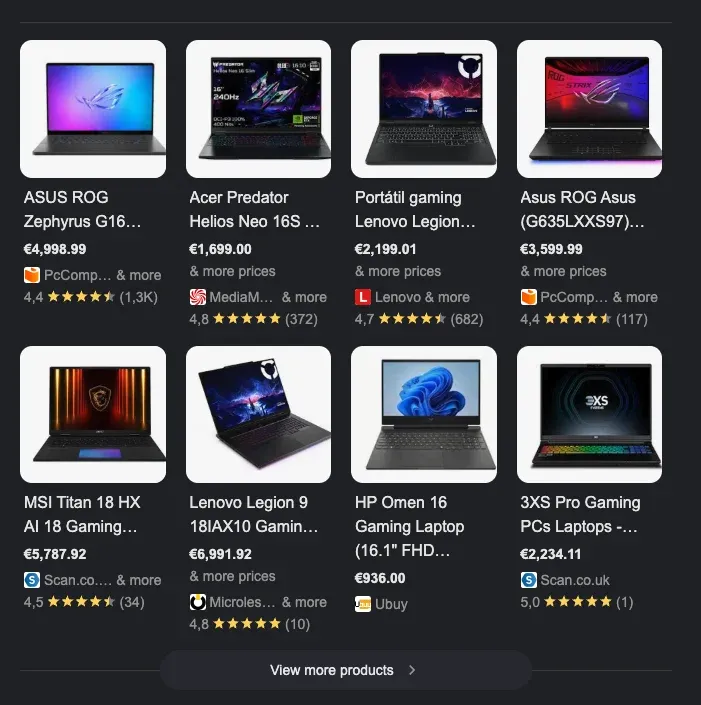
The "Popular products" and "More products" grids come back as shoppingCards with a category. The right-rail panel comes back as productResults with merchant offers, when Google shows it.
promoLabel carries the badge as Google displays it, such as "20% OFF", next to price and oldPrice. AI Mode does not render the badge.
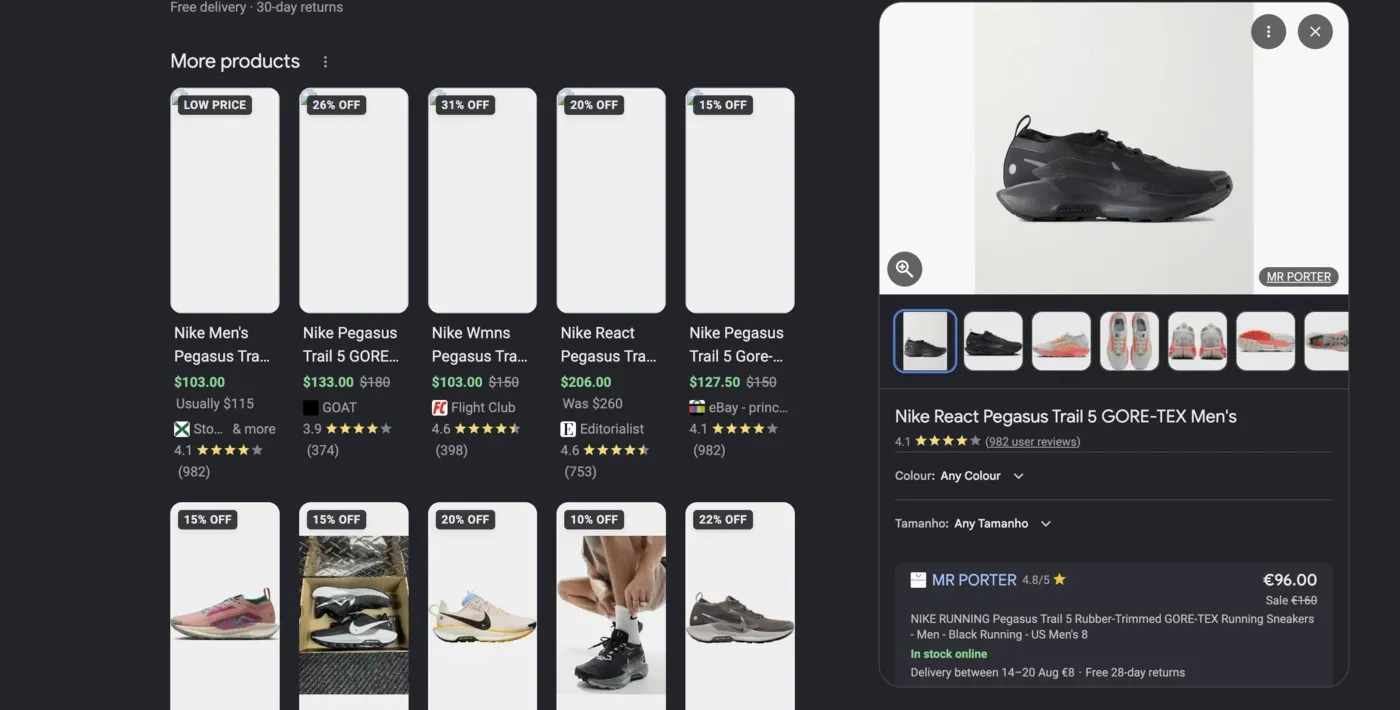
A card has no product URL: it opens a Google overlay. Its productResultToken (desktop, first page) gets the offers, specifications and reviews behind it.
Shopping cards come in the base 3-credit Google Search request with no flag, in the same response as the organic results and People Also Ask.
price and oldPrice are numeric, so discount tracking is arithmetic, not regex.
| Field | Type | Description |
|---|---|---|
| position | integer | 1-indexed rank across the whole shoppingCards array in DOM order. |
| title | string | Product title. |
| productResultToken | string | Token for the product panel the card opens. Send it to POST /v1/monitor/google/product within five minutes of the scrape. Desktop first-page cards only, when Google serves the card with a panel reference. Cards carry no product URL. |
| promoLabel | string | Discount badge as Google displays it, in the SERP language (e.g. "LOW PRICE", "20% OFF"). Present only on a card that carries it. |
| category | string | Parent section header text — distinguishes cards from coexisting shopping modules on the same SERP. |
| price / oldPrice | object | Structured pricing: numeric value, currency symbol, and visible raw text; oldPrice carries the pre-discount price. |
| store | string | Merchant / store name. |
| rating / reviews | number / string | Product rating and review count as displayed. |
| thumbnail | string | Product image URL. |
Query a product term, get the cards a shopper sees. The result.shoppingCards array captures organic product cards in DOM order; the category field carries each card's parent section header so you can tell coexisting shopping modules apart. Sponsored product cards land in result.ads with type: "SHOPPING_CARD". When Google shows the right-rail product panel, its merchant offers come back in result.productResults in the same call.
from cloro import Cloro

client = Cloro(api_key="sk_live_your_api_key_here")

response = client.monitor.google(
    query="wireless earbuds under 100",
    country="US",
    device="desktop",
)

print(response["result"]["organicResults"]){
"success": true,
"result": {
"shoppingCards": [
{
"position": 1,
"title": "SoundCore Liberty 4 NC Wireless Earbuds",
"productResultToken": "nuzK-QgAV8BqrZdwQJYZopzdoFhpvKr-N2_YDZevwzg",
"category": "Popular products",
"price": {
"value": 79.99,
"currency": "$",
"raw": "$79.99"
},
"oldPrice": {
"value": 99.99,
"currency": "$",
"raw": "$99.99"
},
"store": "Example Electronics",
"rating": 4.5,
"reviews": "12K",
"thumbnail": "https://encrypted-tbn0.gstatic.com/shopping?q=..."
}
]
}
}Pick a plan that fits your volume. Price per credit drops as you scale.
| Plan | Price / mo | Credits | Per 1k | Concurrency | Seats | Support |
|---|---|---|---|---|---|---|
| Free | $0 | 500 | — | 1 | 1 | Documentation assistant |
| Lite | $30 | 37,500 | $0.80 | 10 | Unlimited | |
| Hobby | $100 | 250,000 | $0.40 | 20 | Unlimited | |
| Starter | $250 | 650,000 | $0.39 | 50 | Unlimited | |
| GrowthPopular | $500 | 1,350,000 | $0.37 | 75 | Unlimited | Priority email |
| Business | $1,000 | 2,800,000 | $0.36 | 100 | Unlimited | Priority email |
| Enterprise 2K | $2,000 | 5,871,025 | $0.34 | 135 | Unlimited | Slack |
| Enterprise 3K | $3,000 | 9,306,606 | $0.32 | 175 | Unlimited | Slack |
| Enterprise 4K | $4,000 | 12,756,261 | $0.31 | 215 | Unlimited | Slack |
| Enterprise 5K | $5,000 | 16,391,783 | $0.31 | 255 | Unlimited | Slack |
| Enterprise | $5,000+ | Increased concurrency, overages on credits and credit discounts for annual contracts.Know more | ||||
Credit cost per request varies by provider. The figures below are for async/batch requests; sync requests add a +2 credit surcharge.
ChatGPT full response includes query fan-out, ads, and shopping data. Google News uses the same pricing as Google Search.
No. Google's own Shopping APIs, the Content API for Shopping (now deprecated) and its replacement the Merchant API, manage your own Merchant Center listings. They can't show you what shoppers see on a search. This Google Shopping API returns the rendered shopping results for any query: your products, competitors' products, prices and ratings as Google displays them.
The main SERP. These are the organic product-card modules ("Popular products", "More products") Google puts into regular search results for commercial queries, which is where most shopping impressions happen. They're returned in every base Google SERP call at no extra cost. AI Mode answers return their own shopping cards through the AI Mode endpoint.
Organic cards live in `result.shoppingCards`. Sponsored product cards are part of the paid surface and land in `result.ads` with `type: "SHOPPING_CARD"` and a `blockPosition` — see the Sponsored Ads API. Comparing the two tells you where you win organically vs. where competitors buy placement.
Send the card's productResultToken to POST /v1/monitor/google/product within five minutes of the search. It returns the product panel: each store with its link and price, the description, specifications, reviews, images and related products. It costs 1 credit, plus 2 for a sync request, and only when it succeeds. When Google shows the right-rail panel on the search itself, the same offers are already in result.productResults. See the product endpoint docs.
Yes. price and oldPrice are structured (numeric value, currency and raw text), so discount tracking is a subtraction, not a regex. Sample your product queries daily per country to catch competitor price moves and MSRP games as Google surfaces them.
A Google search is 3 credits on the async API, and its shopping cards and product results come with it at no extra cost. That is $1.20 per 1,000 searches on the $100 Hobby plan and $2.40 on the $30 Lite plan. A product panel request is 1 more credit. A sync request adds 2 credits. The Free plan gives 500 credits a month, which is about 166 searches.
Heavily. Mobile SERPs show more and different shopping modules, and card inventory is country- and city-sensitive. Use `device`, `country`, and `location`/`uule` to sample the surfaces your buyers actually see. The `productResultToken` comes on desktop first-page cards only.
The complete SERP: the right-rail product panel as productResults, organic results, ads, People Also Ask, related searches, and knowledge graph, in one call at one price.
