
Google Custom Search API Shutdown: What to Use Instead

On this page
What is actually happening
Google’s Custom Search JSON API page now opens by stating that the API is closed to new customers, and that existing customers have until January 1, 2027 to move. The published terms hold until then: 100 free queries a day, $5 per 1,000 above that, and a hard ceiling of 10,000 queries a day.
The change reaches past the JSON API. Per Brave’s summary of the announcement, every Programmable Search Engine created since January 20, 2026 must use the “Sites to search” setting, capped at 50 domains, and existing “Search the entire web” engines keep that option only until January 1, 2027.
Keys created days before the cutoff started failing with a plain 403 (Illustrious-Pen-7399 on r/googlecloud, January 2026):
I get 403 forbidden errors and nothing is wrong with the Engine ID (I can test it on the console) and a new API key ALSO does not work (even when enabled & restricted to google custom search API).
That ceiling is worth noting, because it tells you who this API was ever for. At 10,000 queries a day maximum, Custom Search was never infrastructure for a rank tracker or a monitoring product. It was a cheap way to bolt search onto an application, and a very large number of applications did exactly that.
What Google says to use instead
Two answers, and both are narrower than what they replace.
The API overview recommends Vertex AI Search for searching up to 50 domains, and a full web search solution for anything larger, which requires contacting Google.
The dedicated migration guide recommends Agent Search, described as Google-quality site-restricted search, deployed as a widget or through an API.
Together they describe one move. Google is replacing a general-purpose search API with a site-search product, and pointing anyone who wants the open web at a sales conversation.
That conversation has a price. An email from Google’s Programmable Search Engine team, posted on Hacker News, describes a planned enterprise Web Search Service at $15 per 1,000 requests with a minimum monthly fee of $30,000, with details due later in 2026. The minimum alone buys 2,000,000 requests a month, so the first-party open-web path starts well above what most Custom Search users ever spent.
What the official path costs you in work
The migration guide is not a swapped base URL. It describes:
- Enabling Agent Search in the Google Cloud Console.
- Creating an app configured for site search with AI mode.
- Turning on Enterprise edition features, which the guide makes mandatory for website search.
- Creating a data store and populating it with website content.
- Specifying the URL patterns to index.
Authentication changes too. Custom Search used an API key; Agent Search primarily expects OAuth 2.0, though the searchLite method still accepts an API key. The guide also notes that features like summaries and domain verification can carry additional indexing costs.
None of that is unreasonable for a site-search product. It is a lot of machinery if all you wanted was ten results as JSON.
The fork: which half of Custom Search were you using?
Answer this before you compare anything, because everything below branches on it.
You searched your own site or a fixed list of domains. Google’s path fits. Vertex AI Search and Agent Search are built for exactly this, the indexing model is a genuine upgrade over a Programmable Search Engine, and the AI features are real. Follow the migration guide.
You searched the open web. Google has no like-for-like replacement for you at self-serve pricing. What you want is a SERP API: send a query, get the live Google results page back as structured JSON.
The open-web replacements, priced
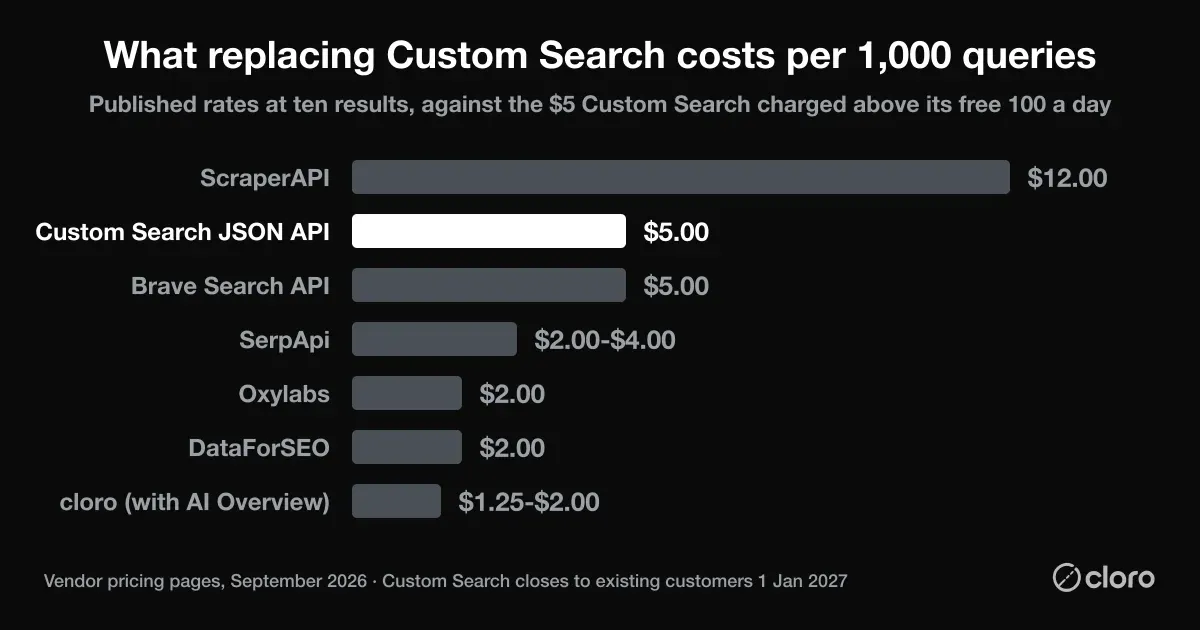
Every rate below is per 1,000 queries at ten results, which is the shape Custom Search returned, and every one is the vendor’s real-time mode.
| Option | Rate per 1,000 | Index | Parsed AI Overview |
|---|---|---|---|
| Custom Search JSON API (until 2027) | $5.00, capped at 10,000/day | Programmable Search Engine | No |
| DataForSEO | ~$2.00 | Yes, behind a flag that adds ~3s | |
| cloro | $1.25 to $2.00, AI Overview included | Yes | |
| SerpApi | $2.00 to $4.00 | Google plus 80+ engines | Yes, often a second billed call |
| Brave Search API | $5.00 | Independent index, not Google | No |
| ScraperAPI | ~$12.00 via its structured Google endpoint | No |
DataForSEO is the cheapest way to keep querying Google and the closest thing to a drop-in on price. SerpApi is the pick if Custom Search was one of several engines you queried, since it also covers Bing, Baidu, Yandex and a set of retail verticals. Brave Search API is the one to reach for if you would rather leave Google’s index entirely. ScraperAPI and Oxylabs both return Google through a structured endpoint, though both are general scrapers carrying the cost of every other target they support.
At $5 per 1,000, Custom Search sat above most of this category and roughly eight times the cheapest option, so for a lot of teams the shutdown is an unwelcome deadline attached to a cheaper bill. Google’s own planned open-web service, at $15 per 1,000 with a $30,000 monthly minimum, would sit at the top of this table. The other change is the ceiling. Custom Search stopped at 10,000 queries a day whatever you paid, and per-call vendors have no equivalent limit, so a workload that was shaped around that cap can be rebuilt around what it actually needs.
What the results page looks like now
If your Custom Search integration is a few years old, the page it was querying has changed underneath it. In cloro’s own SERP feature census we scored 65,945 results and found an AI Overview on 87.2% of US results and People Also Ask on 90.6%. Custom Search never returned either.
So a straight port of ten blue links reproduces the 2020 page. A user in 2026 sees something else. If the reason you queried Google was to know what Google says, the AI Overview and its cited sources are now part of that answer, and it is worth picking a replacement that returns them rather than adding a second migration later.
Migrating to a SERP API
The move is small compared with the official path. From Custom Search:
GET https://www.googleapis.com/customsearch/v1
  ?key=<key>&cx=<engine id>&q=serp+api
  Results: items[] → { title, link, snippet, displayLink }
To a SERP API, using cloro’s as the worked example:
POST https://api.cloro.dev/v1/monitor/google
  Authorization: Bearer <key>
  { "query": "serp api", "country": "US",
    "include": { "aioverview": { "markdown": true } } }
Results: result.organicResults[] → { position, title, link, snippet, displayedLink }| Custom Search | cloro |
|---|---|
q | query |
key query parameter | Authorization: Bearer header |
cx (search engine id) | not needed, there is no engine to configure |
items[] | result.organicResults[] |
title | title |
link | link |
snippet | snippet |
displayLink | displayedLink |
| — | position |
| — | result.aioverview, with cited sources |
The cx parameter disappearing is the part worth pausing on. A Programmable Search Engine was a configured object you maintained in a console; a SERP API has no equivalent, which removes a piece of state but also removes the site restriction it gave you. If that restriction was the point, you are in the site-search half of the fork above.
Whichever vendor you pick, port a real query set and diff it against your current Custom Search results before committing. Most of this category offers a free tier large enough for that: DataForSEO, SerpApi and cloro all do.
Do not wait for a first-party replacement
This has happened before, recently, and the outcome is on the record. Microsoft retired the Bing Search API v7 on August 11, 2025; the endpoints now return HTTP 410 Gone, and the official replacement was an agent product rather than a SERP API. Teams that waited for a like-for-like successor did not get one, and migrated under time pressure instead. Our Bing Search API guide covers how that played out.
Google has given more notice and a longer runway. The pattern is the same: the first-party path leads to an AI product with a different shape, and the like-for-like path is third-party. Pick early enough to run both in parallel for a month.

About the author
Ricardo Batista
Founder, cloro
Ricardo is one of the founders and engineers behind its SERP and AI-search scraping infrastructure. Before cloro he scaled a financial comparison site to $7M ARR and ran the full-country operations of a unicorn to $65M ARR, then went back to building. He writes about search engine scraping, generative-engine optimization, and turning live search and AI-answer data into something teams can act on.
Frequently asked questions
Is the Google Custom Search JSON API being shut down?
Yes. Google's own documentation states that the Custom Search JSON API is closed to new customers, and gives existing customers until January 1, 2027 to migrate. Until then the existing terms hold: 100 free queries a day, $5 per 1,000 additional queries, and a ceiling of 10,000 queries a day. After that date the API stops being an option, so any pipeline still calling it needs a replacement chosen before the end of 2026.
What does Google recommend as a replacement?
Two things, both site-restricted rather than general web search. The API overview points at Vertex AI Search for searching up to 50 domains, and the dedicated migration guide points at Agent Search, described as Google-quality site-restricted search deployed through a widget or an API. Anyone who used Custom Search to query the open web, rather than their own site, does not have a like-for-like path here.
How much work is the official migration?
More than a swapped endpoint. Google's migration guide describes enabling Agent Search in the Cloud Console, creating an app with site search in AI mode, turning on Enterprise edition features (mandatory for website search), creating a data store, and specifying the URL patterns to index. Authentication also changes: Custom Search used API keys, while Agent Search primarily expects OAuth 2.0, with the searchLite method still accepting an API key. Advanced features can carry additional indexing costs.
What are the alternatives if I searched the open web?
A SERP API, which returns the live Google results page as JSON. DataForSEO runs about $2.00 per 1,000, cloro about $1.25 to $2.00 per 1,000 at ten results with the AI Overview included, SerpApi $2 to $4 per 1,000 at ten results, and ScraperAPI near $12 per 1,000 through its structured Google endpoint. Brave Search API is $5 per 1,000 against an independent index rather than Google's.
Will a SERP API cost more than Custom Search did?
Usually less. Custom Search charged $5 per 1,000 queries above the free 100 a day, which sits above most SERP APIs in this category and well above the cheapest. The bigger change is the ceiling: Custom Search capped you at 10,000 queries a day no matter what you paid, and per-call vendors have no equivalent limit.
Is this the same as the Bing Search API retirement?
Same shape, different timeline. Microsoft retired the Bing Search API v7 on August 11, 2025, with endpoints now returning HTTP 410 Gone, and pointed developers at an agent product rather than a SERP API. Google is doing the same thing more slowly and with more notice. The lesson from the Bing shutdown applies here: teams that waited for a like-for-like first-party replacement did not get one.
Will Google offer a paid open-web search API after the shutdown?
It plans one. An email from Google's Programmable Search Engine team, posted on Hacker News, describes an enterprise Web Search Service at $15 per 1,000 requests with a minimum monthly fee of $30,000, with more details due later in 2026. That minimum equals 2,000,000 requests a month, so it targets large enterprises rather than the developers who used Custom Search.
Can I still create a Programmable Search Engine that searches the entire web?
No. Since January 20, 2026, new engines must use the 'Sites to search' setting, capped at 50 domains. Existing engines set to 'Search the entire web' keep working only until January 1, 2027, the same deadline as the JSON API.
Related reading

Migrate to cloro: Field-Level Guides for 6 SERP APIs
Request, response and cost mappings for moving to cloro from SerpApi, DataForSEO, Serper, Bright Data, ScraperAPI or Oxylabs, with working Python.
Bing Search API Key in 2026: It's Retired. Use These Instead
5 ranked drop-in replacements for the retired Bing Search API v7, with API-key setup, cost comparison, and migration steps for your legacy code.