
Best Media Monitoring Tools 2026

On this page
The best media monitoring tools do one thing reliably: they tell you who is talking about your brand, where, and how it sounds — before a story becomes a problem. The category is mature, the incumbents are well funded, and the buyer’s real question is no longer whether to monitor but which tool fits the workflow you already run.
This guide ranks 11 media monitoring tools for 2026 by the job each does best, with pricing and one weakness apiece. Then it covers the part every incumbent gets wrong: the AI blind spot. Reputations increasingly form inside AI answers, and almost none of these platforms watch that channel.
What media monitoring tools actually do
Media monitoring software collects, structures, and alerts on public mentions of your brand across news, social, broadcast, print, and the web, so a comms team can act without manual searching. The category splits into four jobs: earned-media and PR tracking, social listening, broadcast and print monitoring, and raw data access for teams that build their own view. Most media monitoring tools do one of those jobs well and treat the rest as checkboxes.
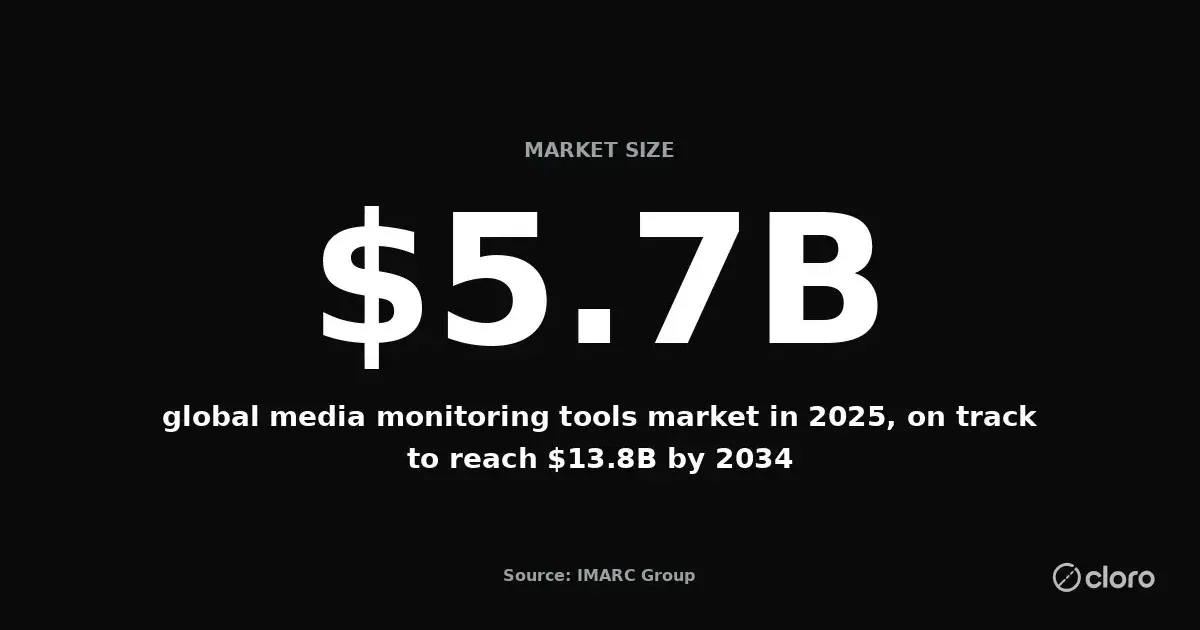
That distinction matters because “best” depends entirely on the job. A platform built for sales-ready social listening will not give a PR lead the broadcast clips and journalist database they need, and an enterprise media intelligence suite is overkill for a founder who wants alerts on one brand name. The market itself is substantial — the global media monitoring tools market was valued at USD 5.7 billion in 2025 and is on track to reach USD 13.8 billion by 2034 — which is why so many vendors crowd the space.
Examples of media monitoring in practice
Four jobs account for most of what teams use these tools for:
- Crisis detection. Real-time tools can alert you within 30 minutes of negative mentions or sentiment spikes, so comms can respond before a story spreads.
- Competitor share of voice. Comparing sentiment and visibility for your brand against rivals across social and news, the benchmark Hootsuite’s media monitoring product is built around.
- Campaign and press coverage. Counting the articles, clips, and posts a launch or press release earned, then reporting them to stakeholders.
- Customer complaints. Monitoring catches complaints and questions posted outside your official accounts, which lets support answer before the issue goes public.
The ranking below is organised around that reality. Each tool is placed by the single job it does better than the alternatives, not by feature count.
How we compared these media monitoring tools
We evaluated each tool on five practical checks rather than marketing feature lists. Those checks are coverage depth (which sources it actually reads), detection latency (how fast a breaking mention surfaces), export and API freedom, pricing transparency, and whether the workflow survives contact with a real team.
Pricing reflects publicly listed plans and quote ranges as of mid-2026; quote-only vendors are flagged as such. Where a vendor does not publish prices, we use the ranges from Brand24’s three-month test of 20 platforms, which also captured G2 and Capterra ratings. We deliberately weighted one thing the incumbents ignore — whether a tool sees AI answer engines — because that is where the category is heading.
What a good media monitoring tool has to cover
At minimum, a serious media monitoring tool needs real-time mention tracking, sentiment analysis, configurable alerts, and exportable reporting, the baseline that lets a team catch a story early, gauge its tone, and share it up the chain without digging through raw feeds. The differentiators are source breadth, historical data access, and honest sentiment accuracy. Keep those in mind as you read the list.
The 11 best media monitoring tools for 2026
Each tool below is placed by the single job it does best, with a homepage screenshot, pricing, and one weakness apiece.
1. Meltwater — best all-round enterprise media monitoring
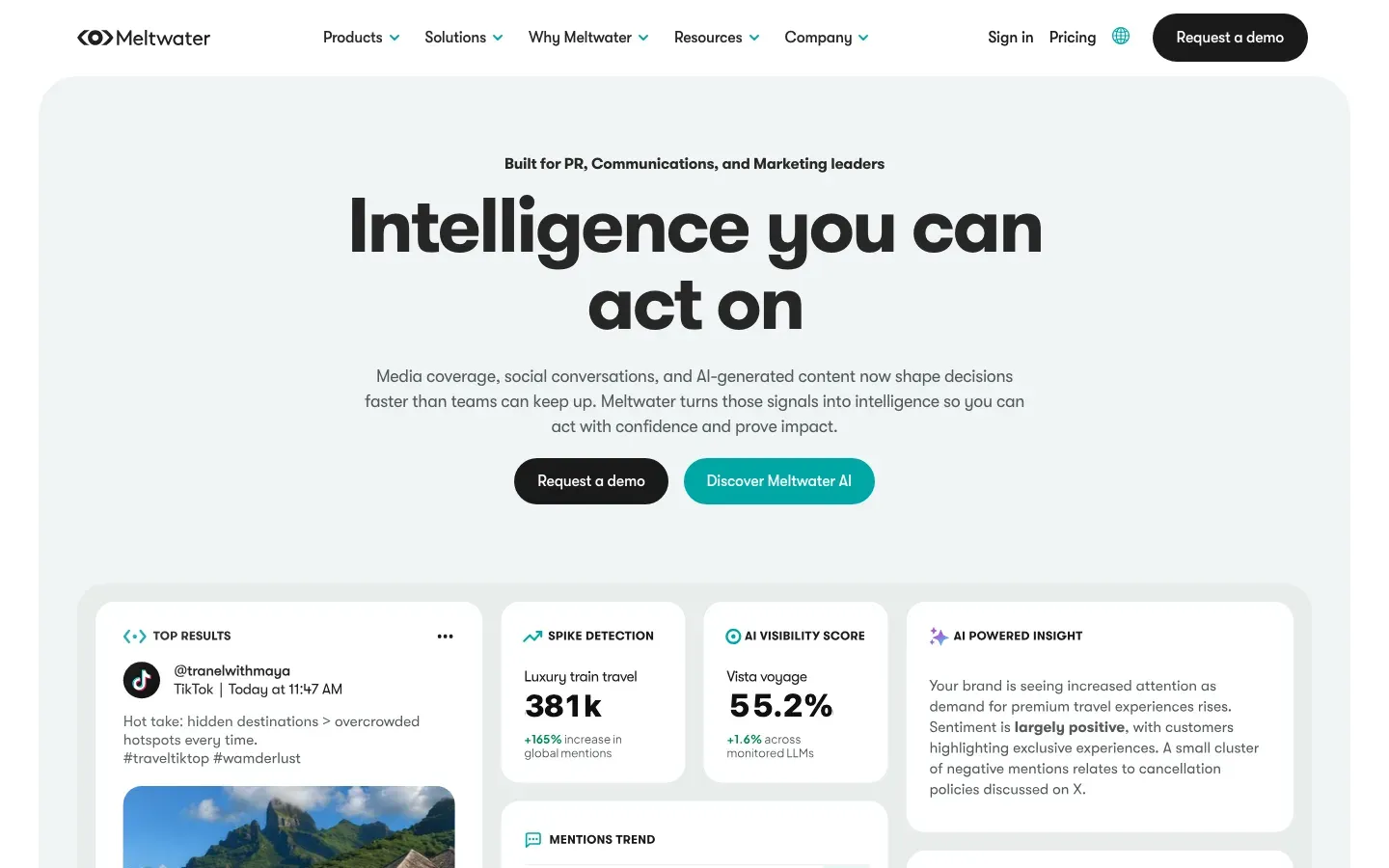
Best for: large PR and comms teams that need online, print, and broadcast in one place. Pricing: quote-only, typically five figures a year.
Meltwater is the enterprise default because it spans news, social, print, broadcast, and podcasts with custom mention scoring and rules-based automation. The breadth is the point — few platforms cover offline media this well. The weakness is the commercial experience: contracts are opaque and onboarding is heavy, so it rarely suits teams under a certain size.
2. Cision — best for PR teams that need a media database
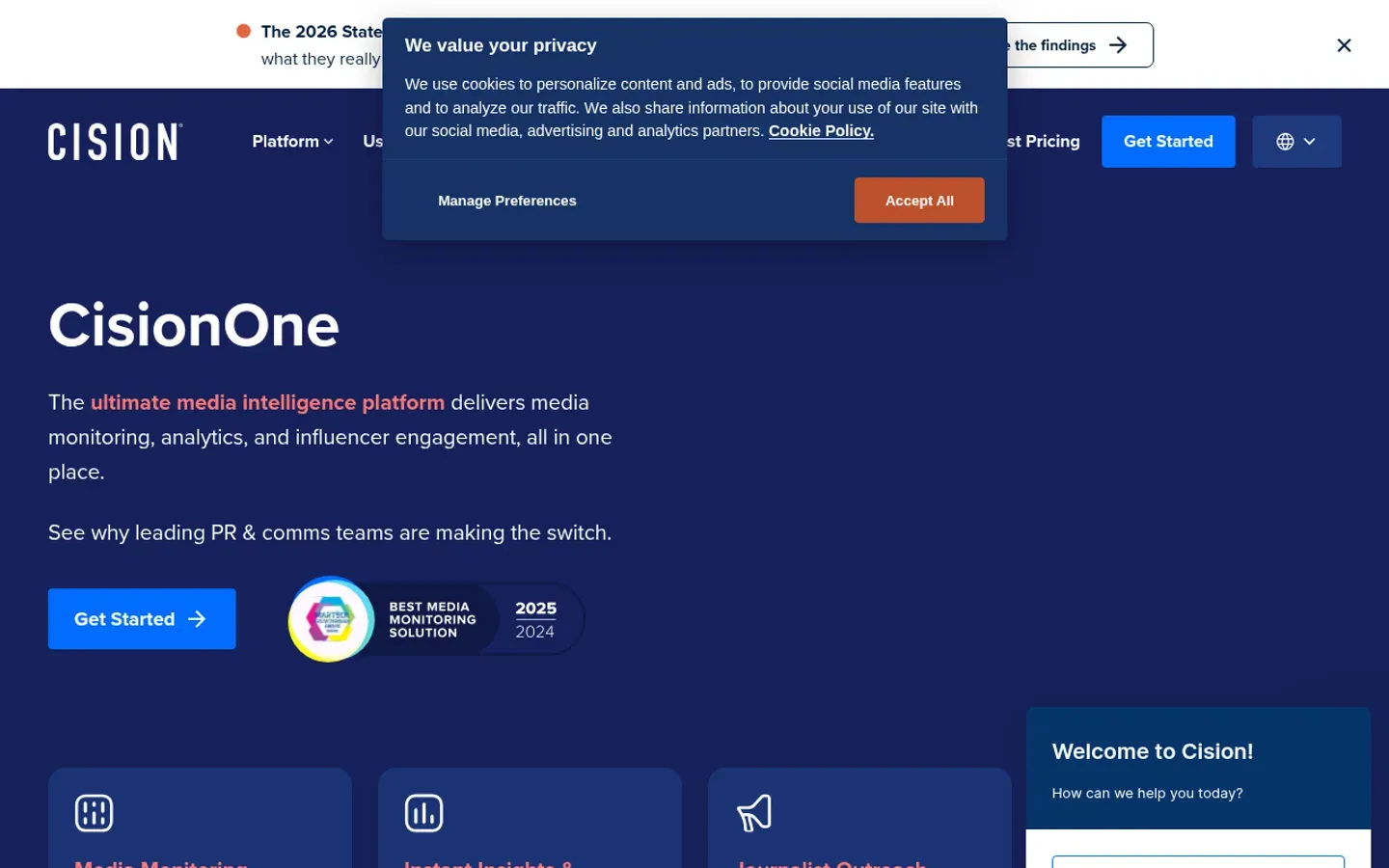
Best for: PR departments that pair monitoring with outreach and distribution. Pricing: quote-only, enterprise.
Cision pairs coverage tracking with the industry’s deepest journalist and outlet database, plus press-release distribution, so a workflow of pitch, distribute, then measure earned coverage stays in one system. Like Meltwater, it is priced and built for enterprises, and smaller teams pay for reach they will not use.
3. Brandwatch — best for enterprise consumer intelligence
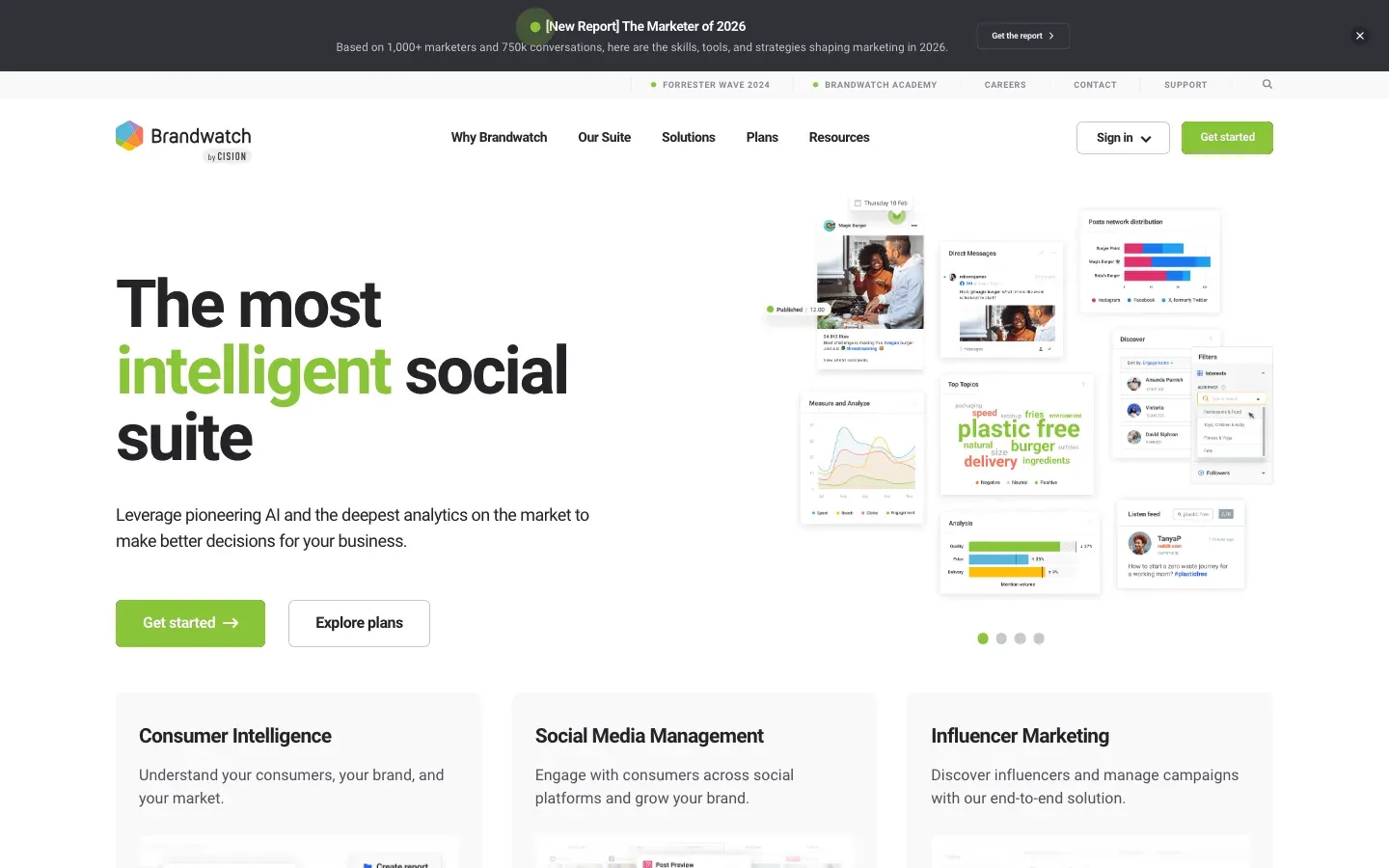
Best for: brand and insights teams that want deep social and demographic analysis. Pricing: quote-only.
Cost and a steep onboarding curve rule Brandwatch out for a lot of teams, and its coverage of some newer social networks is lighter than the rest of its reach suggests. What the price buys is depth on consumer intelligence: historical social analysis, image recognition for visual mentions, and detailed segmentation, letting insights teams profile audiences and catch visual mentions a text-only search would miss. It is a research platform as much as a monitor.
4. Brand24 — best value for mentions and sentiment
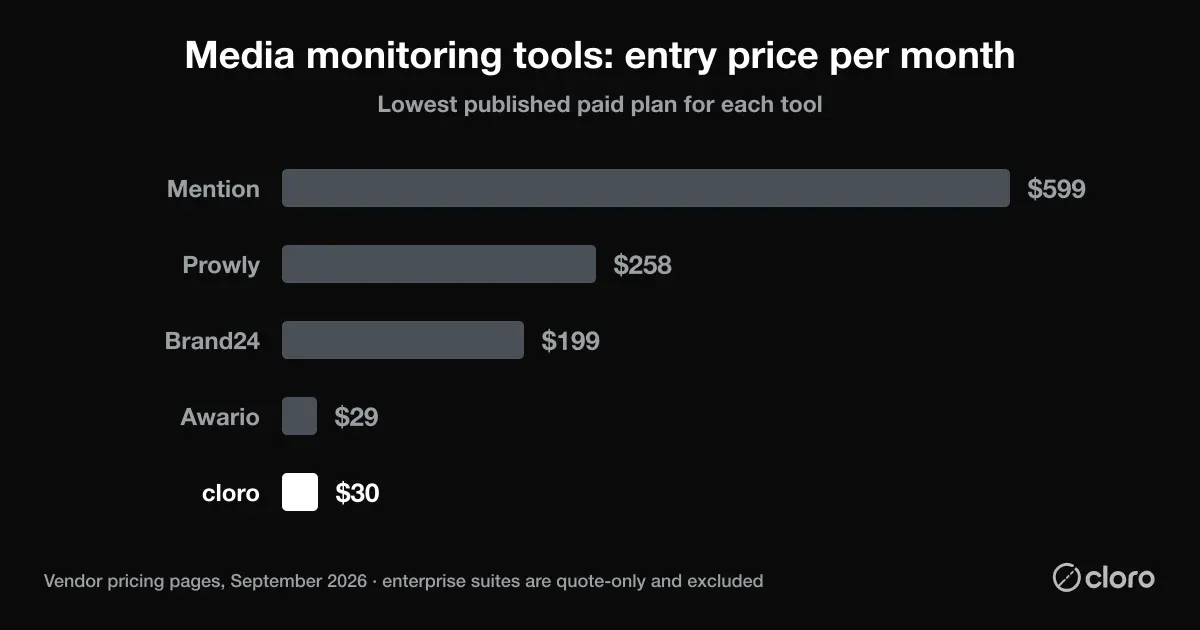
Best for: small and mid-market brands that want mentions, sentiment, and alerts without enterprise pricing. Pricing: from about $199/mo.
Brand24 is the value pick among media monitoring tools: real-time mentions across social and non-social sources, AI-boosted sentiment, and clean reporting at a fraction of enterprise cost. It is the reference point for this whole comparison because of Brand24’s three-month test of 20 platforms. The limits are shallow historical data and no social-management features.
5. Mention — best for collaborative and agency monitoring
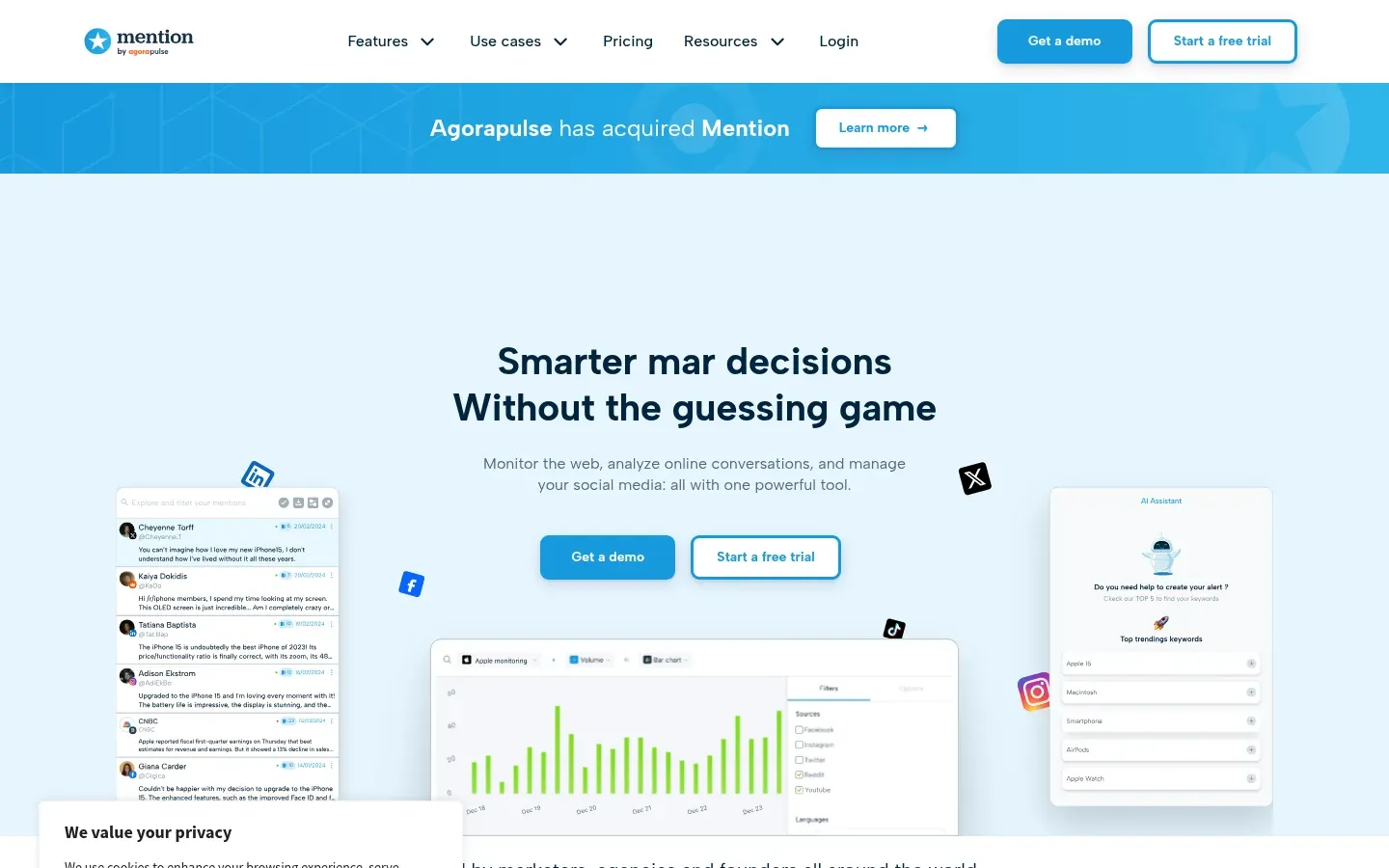
Best for: agencies and mid-sized teams that assign and share mentions. Pricing: from roughly $41/mo on entry plans, higher for full data access.
Mention, now part of Agorapulse, is built around team workflows: tag a mention, assign a task, share a report. That suits collaborative comms teams. Higher tiers add up to two years of historical access, and they are also where the deeper analytics and the wider social coverage sit, so an entry plan gives you the workflow without much of the analysis.
6. Talkwalker — best for enterprise social listening
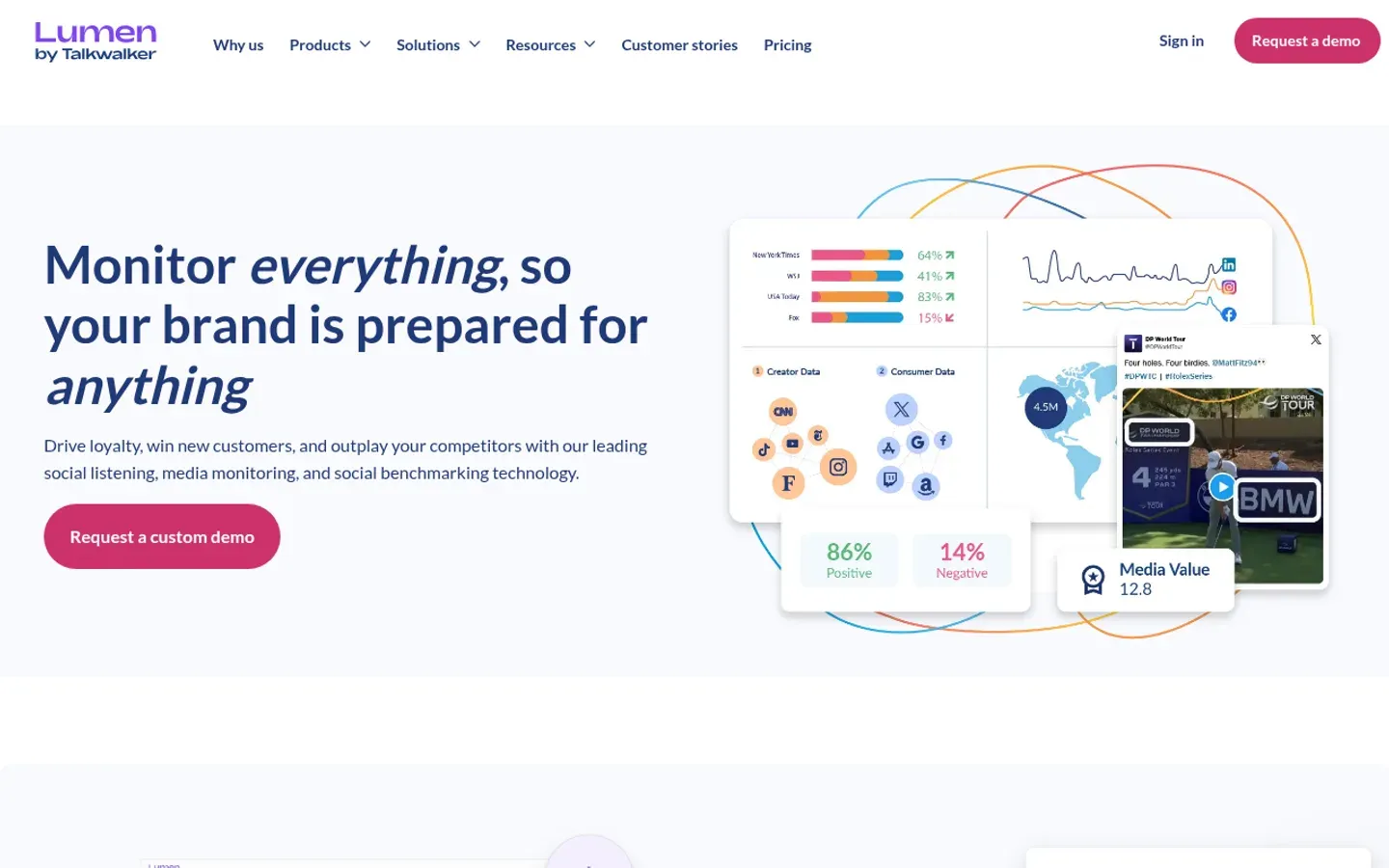
Best for: global brands that need multilingual listening and predictive analytics. Pricing: quote-only, typically starting around five figures a year.
Talkwalker covers earned and owned media in scores of languages, with predictive topic modelling and visual recognition across images, video, and audio, so a global team can track one launch across markets without stitching together separate per-language tools. For large multinational brands it is one of the most capable listening platforms available, though the UX trails that analytical depth and the learning curve is steep.
7. Prowly — best for PR outreach with light monitoring
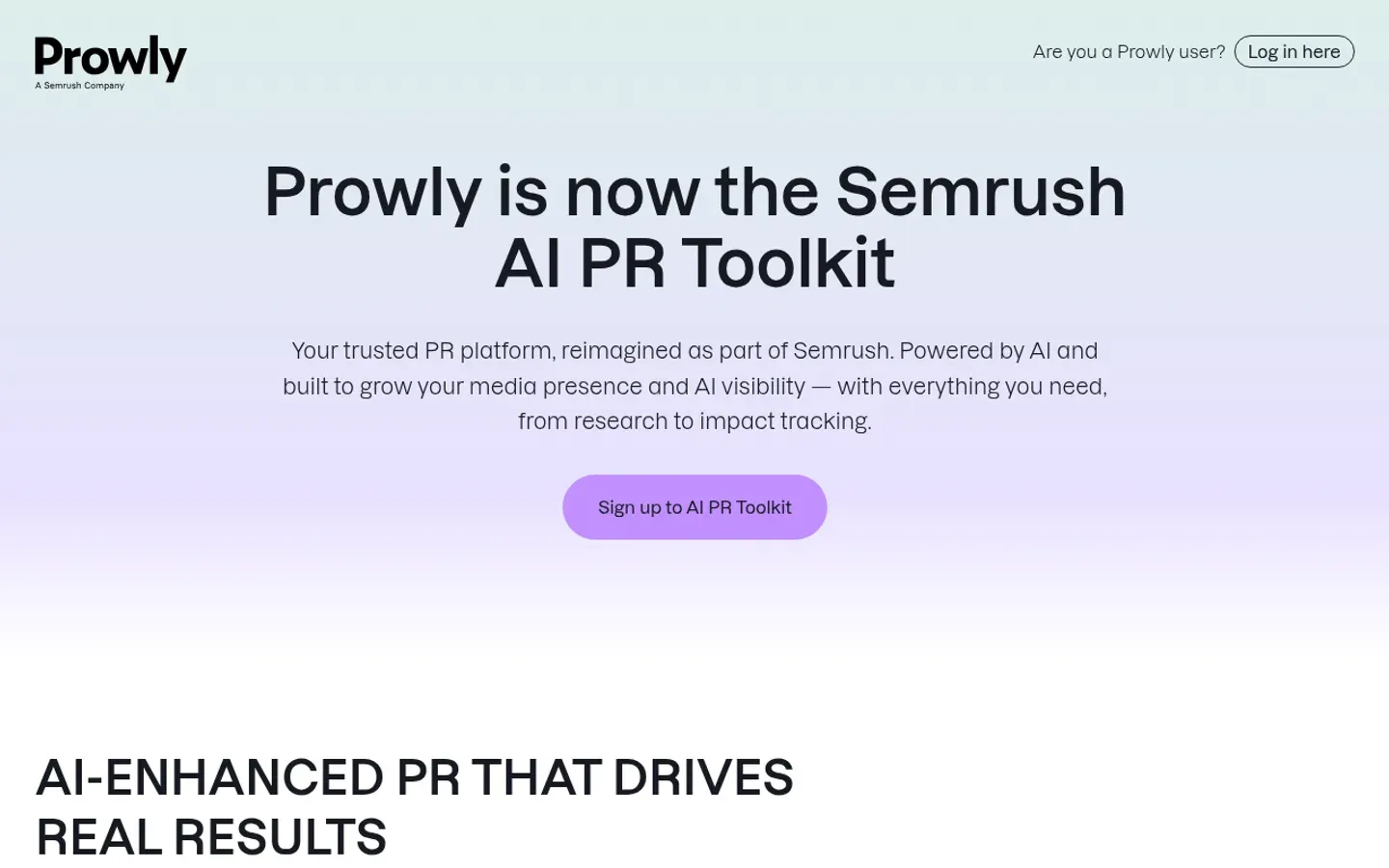
Best for: PR teams that lead with media relations and want monitoring attached. Pricing: from about $258/mo.
Prowly is a PR platform first: media database, press-release creation, and outreach, with monitoring bolted on to track campaign results. Deep mention analysis is not what it is for. But if your primary need is media relations and you want basic coverage tracking included, it is a tidy all-in-one.
8. Awario — best budget monitoring for small teams
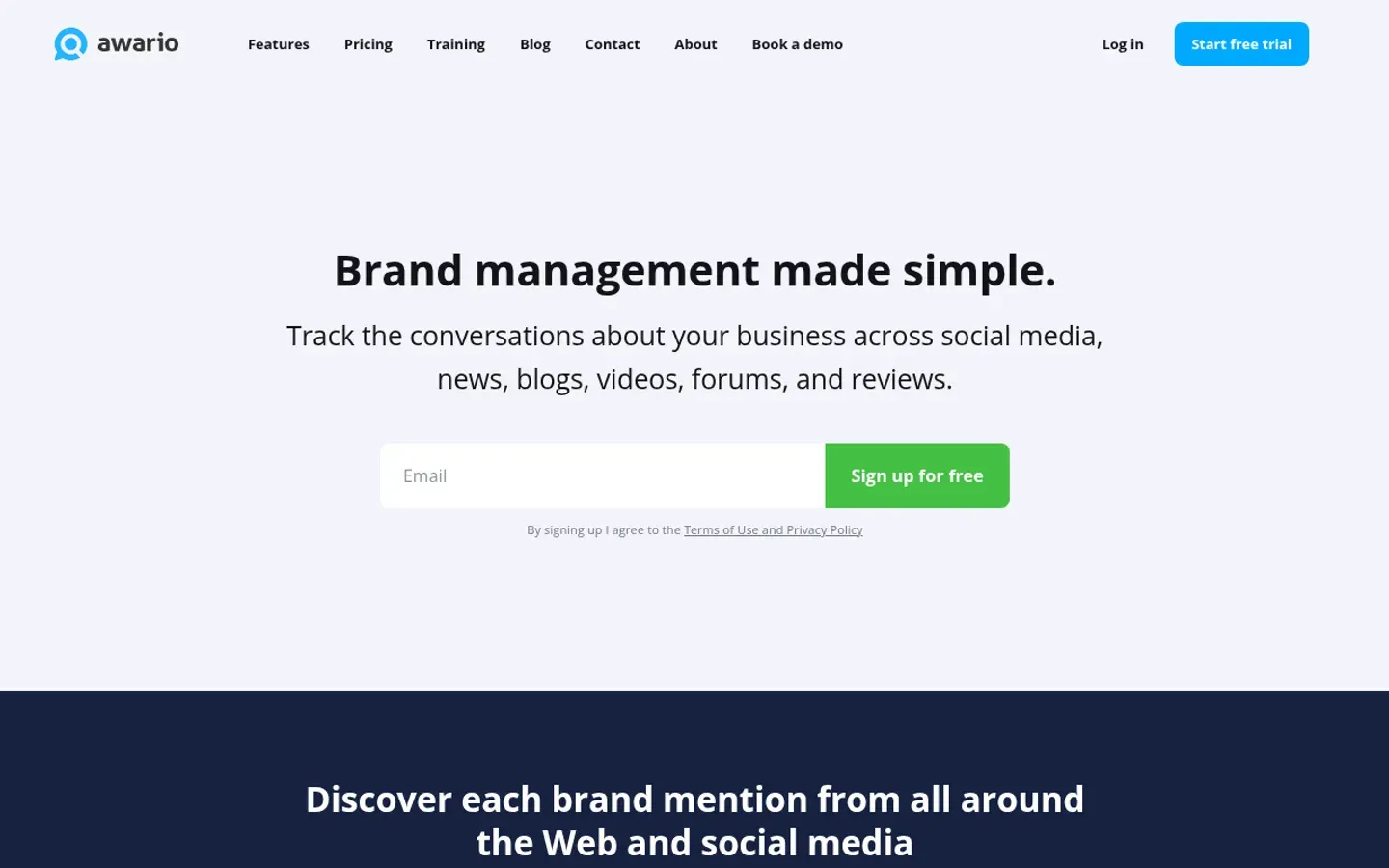
Best for: freelancers and small businesses on a tight budget. Pricing: from about $29/mo.
Awario is the low-cost entry point: mentions, Boolean search, sentiment, and a lead module for social selling. Analytics are shallow and coverage has gaps on some platforms, which is the trade you make at this price, but for basic needs it does the job cheaply.
9. Determ — best real-time monitoring for SMBs
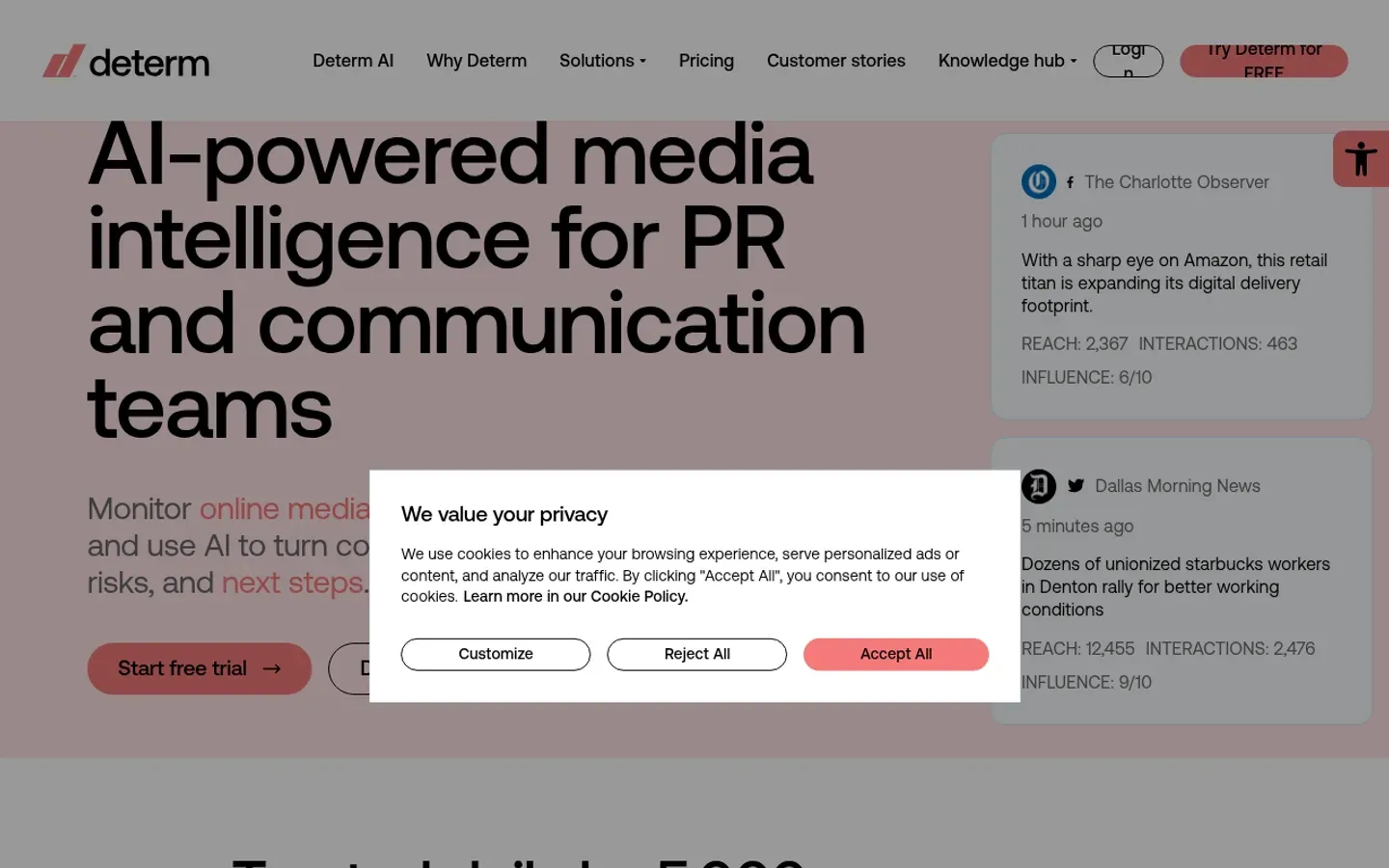
Best for: SMB teams that want fast, AI-assisted monitoring. Pricing: quote-only.
Determ, formerly Mediatoolkit, focuses on real-time mention tracking with an AI summariser and strong Boolean filtering, which makes it workable for teams without a dedicated analyst. Advanced analytics are lighter and social-platform coverage thinner than in the enterprise suites.
10. Google Alerts — best free starting point
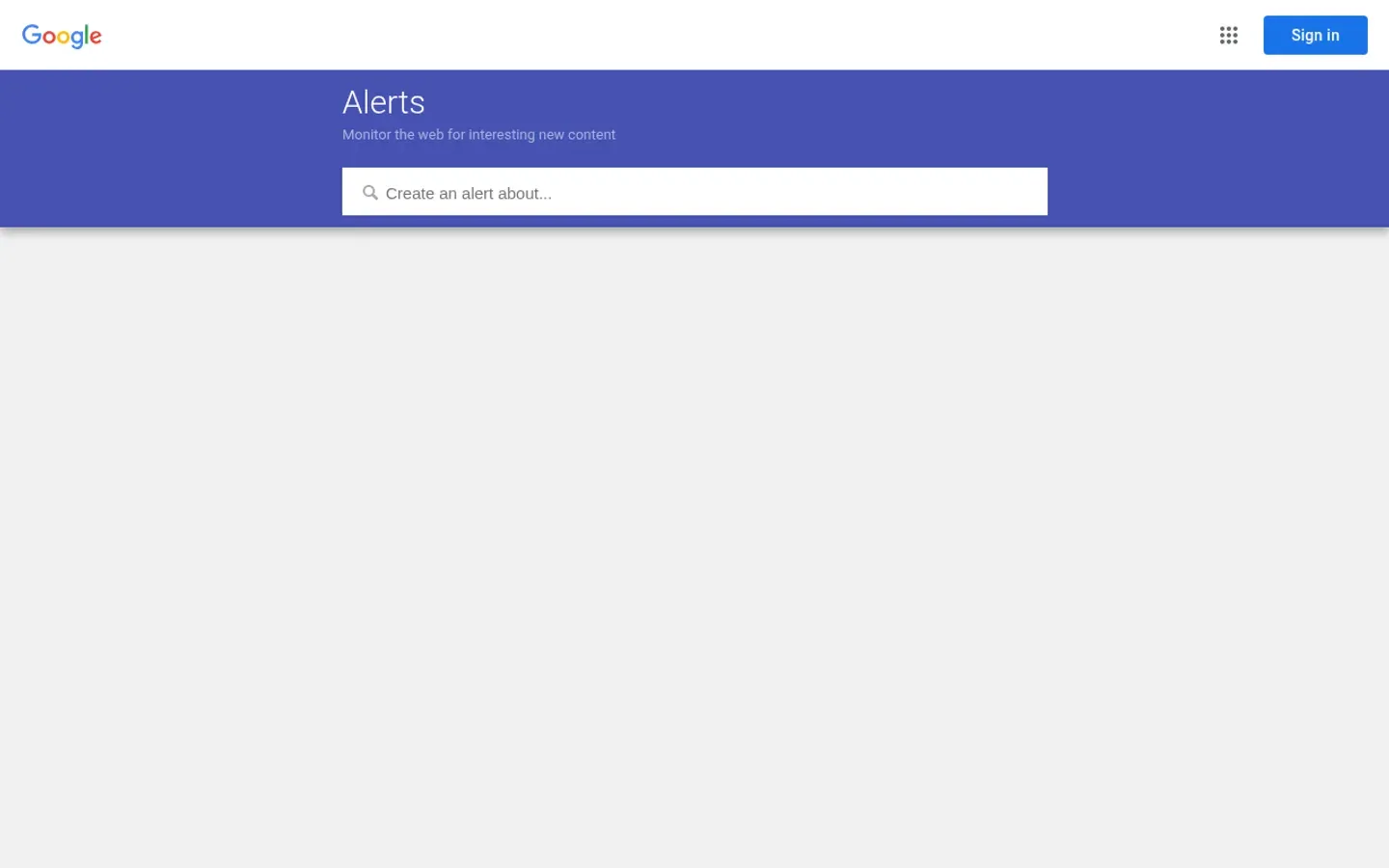
Best for: individuals and tiny teams monitoring one brand name for free. Pricing: free.
Google Alerts emails you when your keyword appears on news and blogs, and for a single brand it is a reasonable first step. But it is a supplement, not a system: no social coverage, no sentiment, no reporting, and it routinely drops or delays mentions. Treat it as a tripwire, not a monitor.
Enterprise teams reach the same verdict (document-me on r/AskMarketing, March 2026):
I’ve worked alongside our PR team on this, and yeah… Google Alerts just doesn’t cut it at enterprise level.
11. cloro — best for the data layer, including the AI half
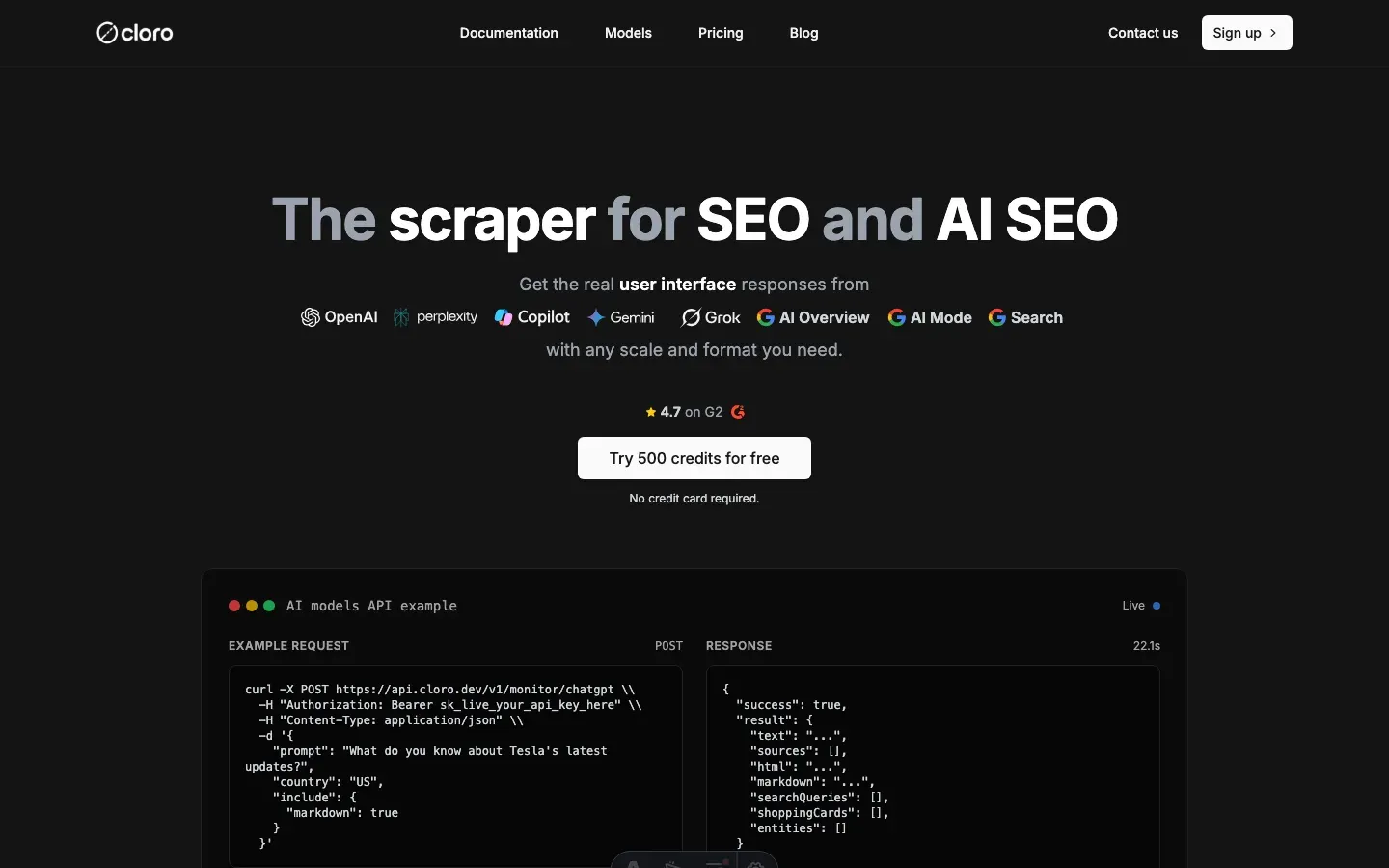
Best for: engineering and data teams that want to own their monitoring — and cover AI answers. Pricing: from $30/mo.
cloro is not a dashboard; it is a SERP API that returns structured Google News, search, and AI-answer results as JSON, so you build monitoring and alerting on your own terms. Uniquely on this list, it can pull what ChatGPT, Perplexity, and AI Overviews say about a brand — the channel the packaged tools omit. The trade-off is that it needs engineering to turn raw data into a workflow; it complements a dashboard rather than replacing the reporting UI.
Quick integration guides: google-news-scraper for news, plus chatgpt-scraper and perplexity-scraper for the AI half, each with Python, cURL, and Node.js requests.
The AI blind spot every media monitoring tool shares
Every tool above watches news, social, print, and broadcast, and none of them watch what AI answer engines say about you. That channel is no longer niche. ChatGPT alone reached 800 million people a week by late 2025, and buyers increasingly form impressions there before they ever reach a headline.
There is a second-order effect worth knowing about, because it runs the other way. Monitoring tools do their watching by issuing searches, and those searches land in the monitored site’s own analytics. cloro’s machine search traffic study found boolean monitoring strings, complete with -site: exclusion lists, sitting among the machine-issued queries that made up 18.9% of its Google query impressions. If you run one of these tools, you are already generating impressions on the domains you track.
The behaviour has already shifted. Surveys now show 59% of US consumers use generative AI for shopping research, and one in four say ChatGPT beats Google for it. For comparison, 84% of consumers used Google to vet businesses last year — AI answers are closing a gap that did not exist two years ago.
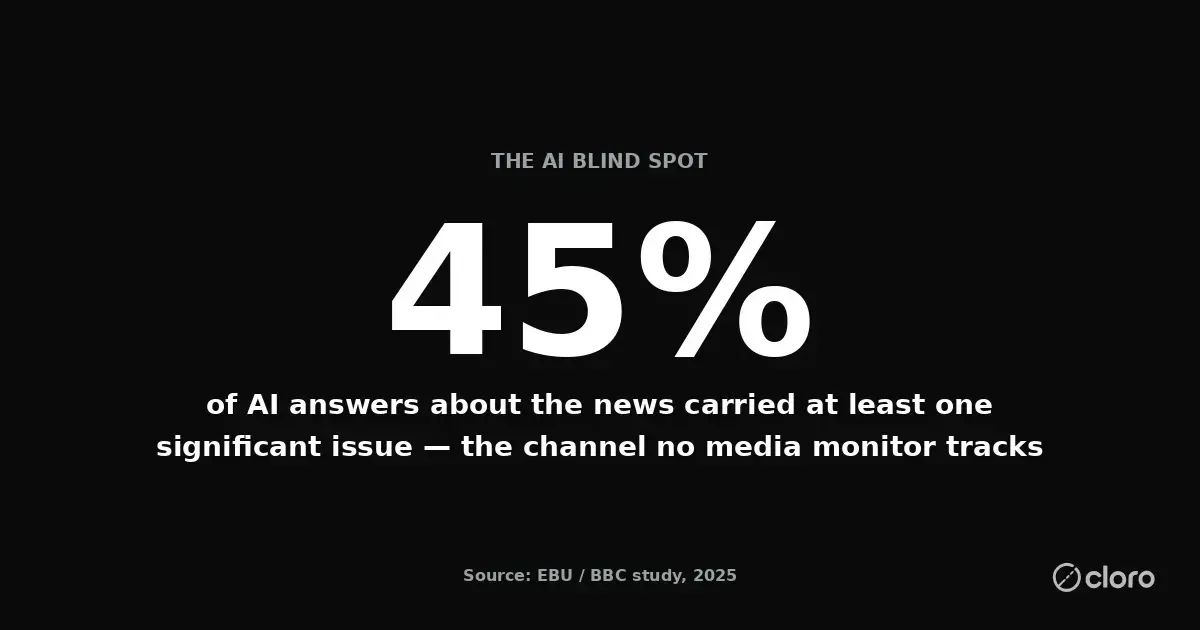
The problem is that those answers are frequently wrong about you. An international study coordinated by the EBU and led by the BBC found 45% of AI answers about the news carried at least one significant issue, and 31% had serious sourcing problems. A separate Columbia Tow Center review found the leading engines poor at citing news correctly. When an engine misattributes a story to your brand, no news monitor will ever flag it.
The usual next line is that Reddit is the single most-cited source in AI answers, so a thread you never saw can shape how millions of people are told to think about you. That was accurate when it was measured, and it is why so many monitoring vendors now advertise Reddit coverage. It is also the kind of claim a media monitoring tool should not be bought on, because we watched it stop being true.
Tracking the same figure continuously, Reddit’s share of ChatGPT’s cited sources fell to 0.20% in August 2026, and Reddit dropped out of ChatGPT’s top eight cited domains altogether. Across the five answer engines we monitor between 11 and 19 August 2026, the most-cited domain was youtube.com on Google AI Mode (5.41% of all citations) and on Perplexity (3.28%), shopify.com on ChatGPT (1.57%), and ikea.com on both Gemini (1.60%) and Copilot (1.27%). Those shares come from cloro’s own corpus, which is weighted toward what our customers track, so read them as shape rather than census.
The shape is the point for anyone choosing a tool. No source holds more than about 5% of any engine’s citations, the leader is different on every engine, and the leader on the biggest one changed inside a fortnight. A monitoring product whose AI coverage is a Reddit integration is selling you last quarter’s citation graph.
A traditional media monitoring tool tracks the press release; it does not track the AI summary that quietly reframes it. Closing that blind spot needs a tool that queries the answer engines directly and re-measures which sources they lean on, whether a dedicated AI share of voice tracker or an API you run yourself.
Build vs buy: when a news and AI-search API beats a subscription
For most comms teams, a packaged media monitoring tool is the right call — you get a UI, alerting, and reporting out of the box. But for engineering-led teams, alt-data desks, and anyone building their own product, buying a subscription can be the wrong shape entirely.
The build case is strong when you want to own the data, set your own alerting logic, or feed monitoring into a warehouse. A Google News endpoint plus AI-answer endpoints lets you pull coverage and AI results directly, at per-query cost that usually beats per-seat pricing at scale. It also gives you the one thing the packaged tools do not: structured AI-answer data alongside the news. Our guide to free news APIs and build-vs-buy walks through the trade-offs in detail.
The practical middle path is to run both. Keep a dashboard for the human comms workflow, and use an API through the news monitoring use case to cover the AI half and to own a clean data feed. That combination gives you the reporting UI teams like and the AI-answer coverage every incumbent still lacks.
How to choose a media monitoring tool
Start with the job, not the feature list. Most media monitoring tools cluster around one strength, so decide whether your priority is earned-media PR, social listening, broadcast, or raw data — that single answer eliminates most of the list. A PR team defaults to Cision or Meltwater; a value-focused brand starts with Brand24; a data team looks at an API.
Then set a budget honestly. The media monitoring tools on this list range from free to five figures a year, so decide whether you need an enterprise suite or an SMB plan before you demo anything. Ask each vendor which features are gated at your tier and what the mention and user limits are.
Finally, test before you commit and check the AI gap explicitly. Run a real brand through a trial, measure how fast it surfaces a known story, and ask directly whether it monitors ChatGPT, Perplexity, and AI Overviews. If reputation matters to you, pair whatever you pick with a way to watch AI answers — because in 2026, that is where the story often breaks first. For adjacent needs, see our guides to brand monitoring and competitive intelligence tools.

About the author
Ricardo Batista
Founder, cloro
Ricardo is one of the founders and engineers behind its SERP and AI-search scraping infrastructure. Before cloro he scaled a financial comparison site to $7M ARR and ran the full-country operations of a unicorn to $65M ARR, then went back to building. He writes about search engine scraping, generative-engine optimization, and turning live search and AI-answer data into something teams can act on.
Frequently asked questions
What is the best media monitoring tool?
It depends on the job. Meltwater and Cision are the enterprise defaults for PR teams that need broadcast, print, and a journalist database. Brand24 is the best value for small and mid-market brands that mainly need mentions and sentiment. Brandwatch and Talkwalker win for deep social and consumer intelligence. And if you need to monitor what AI answer engines say about you — which none of the incumbents cover — that gap is where cloro fits as a data layer.
How much do media monitoring tools cost?
Entry pricing ranges from roughly $29 a month for budget tools like Awario up to $599 a month for mid-market platforms, based on Brand24's tested roundup. Enterprise media intelligence suites such as Meltwater, Cision, and Talkwalker are quote-only and typically start in the five-figure annual range. Google Alerts is free but unreliable for anything mission-critical.
What is the difference between media monitoring and social listening?
Media monitoring tracks earned coverage — news articles, press mentions, broadcast, and print — where a journalist or outlet is talking about you. Social listening tracks conversations on social platforms where anyone can post. Most modern tools do both, but the balance differs: Cision and Meltwater lean toward earned media and PR, while Brandwatch and Sprout Social lean toward social.
Do any media monitoring tools track ChatGPT or AI Overviews?
Almost none do as of 2026. The established platforms monitor news, social, print, and broadcast, but they do not track what ChatGPT, Perplexity, Google AI Overviews, or Gemini say about your brand. That is the AI blind spot every incumbent shares, and closing it currently needs a dedicated AI-visibility tool or a SERP and AI-answer API you query yourself.
What are some examples of media monitoring?
Common examples are crisis detection (an alert within minutes of a spike in negative mentions), tracking competitor share of voice across news and social, measuring the coverage a campaign or press release earned, and catching customer complaints posted outside a brand's own accounts. A newer example is checking what ChatGPT, Perplexity, and AI Overviews say about a brand.
Is Google Alerts good enough for media monitoring?
Google Alerts is fine as a free first step for a single brand name, but it misses social platforms, has no sentiment analysis or reporting, and frequently drops or delays mentions. For any team where a missed story has a real cost, it is a supplement, not a system.
Can I build media monitoring instead of buying a tool?
Yes, if you have engineering resources and want to own the data. A news and SERP API lets you pull coverage and AI-answer results into your own warehouse and set your own alerting logic, which is often cheaper at scale than per-seat subscriptions and gives you the AI-answer data the packaged tools omit. It is more work up front but more flexible long term.
Related reading
12 Best Competitive Intelligence Tools (2026 Review)
We tested 12 competitive intelligence tools across SEO, social, sales enablement, and AI search. See pricing, who each is for, and the honest weak spots.
Brand Monitoring in 2026: News, Search, Social, AI
Brand monitoring in 2026 spans news, search, social, and reviews, plus AI answers no legacy tool tracks. The full surface map, the tools, and a DIY setup.
The Top 12 News API Free Options for Developers in 2026
12 news APIs with free tiers compared: request limits, keyword filters, source coverage, and paid-tier prices when you outgrow free.