
Best Rank Tracking APIs 2026: 10 Compared, 4 Tested

On this page
Google removed the num=100 parameter on 11 September 2025 (Locomotive Agency), and that changed the price of every rank tracking API. A check to position 100 became 10 requests on most APIs. A year later, vendors still quote the price of one page. The roundups that rank for this term print prices in five units (per request, per CPM, per task, per keyword, per month), so the cost of the check you actually run is not on the page.
The second change came in September 2026. Google started to answer some automated searches with a complete page of wrong results (Nozzle). The API reports success, so your tracker records a drop that did not happen.
This comparison prices ten rank tracking APIs per 1,000 Google checks at top 10 and top 100, from each vendor’s own pricing page. For the four APIs we benchmark every day, it adds two things we measured ourselves: how often each one returns a result and how fast, and how often the page it returns is the real one.
What is a rank tracking API?
A rank tracking API gives you Google positions for your keywords as data, so you can store and report on them in your own systems. Two kinds of product use the name, and they bill in different ways.
- Per-call SERP APIs (cloro, DataForSEO, SerpApi, Bright Data, SearchApi, Scrapingdog, Oxylabs). You send a keyword, a country and a device, and you get the results page back as JSON. You pay per request and you schedule the checks yourself.
- Rank trackers with an API (Keyword.com, SE Ranking, AccuRanker). You load a keyword list into the tracker, it checks the list on a schedule, and you pull the stored positions. You pay a monthly price for a keyword volume, whether you read the data or not.
With the first kind you can check any keyword in any market when you need it, and you get the whole results page. The second kind is cheaper per check when the list is fixed and the schedule is daily. The table below prices both per 1,000 checks.
Rank tracking API prices per 1,000 checks
The price of 1,000 Google checks, on the plan closest to $100 a month or pay as you go. A top-10 check reads the first page. A top-100 check reads to position 100.
| API | Type | Plan | Top 10 | Top 100 | AI Overview |
|---|---|---|---|---|---|
| cloro | Per-call API | Hobby, $100/month | $1.20 | $8.40 | +$0.80, parsed with sources |
| Keyword.com | Rank tracker | 2,000 keywords daily, $74 to $120/month | $1.23 (top 50) | $2.00 | Detection included |
| SE Ranking | Rank tracker | Core, $129/month | $2.15 | $2.15 | Tracked as a SERP feature |
| AccuRanker | Rank tracker | Expert, $764/month | $2.55 | Not published | Separate product (AccuLLM) |
| DataForSEO | Per-call API | Live, pay as you go | $2.00 | $20.00 | +$2.00 |
| SerpApi | Per-call API | Developer, $75/month | $15.00 | $150.00 | Included |
| Bright Data | Per-call API | Pay as you go | $1.50 | $1.50 (Top 100 call) | Included |
| SearchApi | Per-call API | Production, $100/month | $2.86 | Not published | Not in the rank tracking engine |
| Scrapingdog | Per-call API | Standard, $90/month | $0.45 | $4.50 | Included |
| Oxylabs | Per-call API | Basic, $100/month | $0.90 | $9.00 | Parsed |
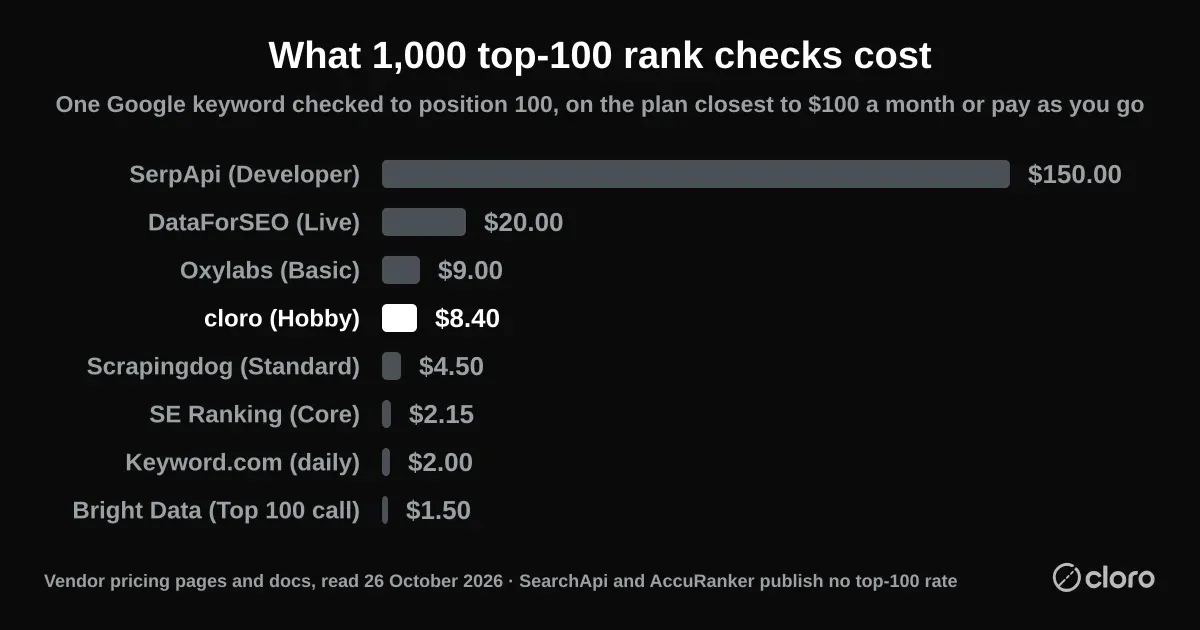
Depth decides the bill. At top 10, nine of the ten cost between $0.45 and $2.86 per 1,000. At top 100, the range is $1.50 to $150.00. Per-call APIs that bill each page separately (SerpApi, DataForSEO, Scrapingdog, Oxylabs) cost 10 times their top-10 price. SE Ranking returns the top 100 in every check at one price, and Keyword.com charges $2.00 for a top-100 check against $1.23 for a top-50 one. cloro charges 3 credits for the first page and 2 for each page after it, so its top-100 check costs 7 times its top-10 check.
How we read each price:
- Rank trackers charge for a keyword volume. We divided the monthly price by the checks it buys: keywords × 30 days. Keyword.com’s shallowest depth is top 50, so its top-10 figure is a top-50 check. SE Ranking’s figure is monthly billing; annual billing is $1.72.
- Bright Data’s top-100 figure is its Get Top 100 Google Results call, which bills one request “regardless of page depth” and runs as an asynchronous scraper job. Paging its SERP API 10 results at a time costs $15.00.
- SearchApi’s rank tracking engine accepts
num=100in one request, but SearchApi does not say how many searches that bills. - cloro’s rates are for async requests. A synchronous call adds 2 credits. A failed call costs nothing.
Which rank tracking APIs return the real Google page?
A low price per check does not help if the API returns the wrong page. Since September 2026, Google answers some automated searches with a weaker page of results, and nothing in the response says so. We measured this in our poisoned SERPs study: the same reference queries, whose correct first page we know, went through four SERP APIs throughout the day, and a failed call counts as wrong.
| API | Real page | Degraded page | Unclear | Failed |
|---|---|---|---|---|
| cloro | 98.0% | 0.8% | 1.2% | 0.0% |
| Oxylabs | 83.4% | 3.2% | 0.8% | 12.6% |
| SerpApi | 65.9% | 31.9% | 2.2% | 0.0% |
| DataForSEO | 33.1% | 61.8% | 5.1% | 0.0% |
The window is 16 to 18 October 2026. For a rank tracker, a degraded page reads as a ranking drop: SerpApi returned one on about a third of reads, DataForSEO on most of them, and both reported success. Oxylabs rarely returned a degraded page; its gap is failed calls, which a retry fixes. DataForSEO’s own account gives a lower figure after retries and a check against history (DataForSEO), so ask any vendor how it checks pages before you trust a drop.
We also send the same Google keyword searches to the same four APIs every day, one attempt each with no retries, to measure success rate and speed:
In our own measurement over the last 16 days, the same Google keyword searches went to cloro, Oxylabs, DataForSEO and SerpApi, one attempt each with no retries. The share that returned a result was 99.9% for cloro, 99.9% for SerpApi, 99.2% for DataForSEO and 93.3% for Oxylabs. The mean response time was 5.1 s for SerpApi, 6.0 s for DataForSEO, 6.1 s for Oxylabs and 7.0 s for cloro.
| API | Returned a result | Mean response time |
|---|---|---|
| cloro | 99.9% | 7.0 s |
| Oxylabs | 93.3% | 6.1 s |
| DataForSEO | 99.2% | 6.0 s |
| SerpApi | 99.9% | 5.1 s |
All four return a result on nearly every search, and they are within a few seconds of each other. When we published, cloro was the slowest of the four and SerpApi the fastest. For a daily rank tracking job that runs in the background, the real-page rate matters more than a few seconds a call.
How we compared the 10 APIs
We picked the ten from the vendors that rank for “rank tracking API” and the APIs that most roundups name. Each one sells Google position data through an API that a developer can call today.
- Price per 1,000 checks at top 10 and top 100, from each vendor’s pricing page and docs, read on 26 October 2026. Where a vendor publishes no rate, the table says so.
- Real-page rate, from our poisoned SERPs measurement (four APIs).
- Success rate and mean response time on Google keyword searches, from our daily benchmark (four APIs).
- AI Overview handling, from each vendor’s docs.
- Free allowance and MCP server, from each vendor’s site.
We did not measure Keyword.com, SE Ranking, AccuRanker, Bright Data (on Google keyword searches), SearchApi or Scrapingdog ourselves. Their sections use only what the vendor publishes. Vendor prices change often; check the pricing page before you buy.
The 10 best rank tracking APIs in 2026
1. cloro: best for the full results page and AI search from one API
cloro is a per-call API that returns the full Google results page as JSON: organic positions, ads, People Also Ask, related searches and the AI Overview with its cited sources. The same API returns answers from ChatGPT, Perplexity, Gemini, Copilot and Google AI Mode, so you can track where a brand appears in AI search with the same key and the same code.
- Price: Google Search costs 3 credits, +2 for each extra page of 10, +2 for the AI Overview. Hobby is $100 a month for 250,000 credits: $1.20 per 1,000 top-10 checks and $8.40 per 1,000 top-100 checks. A top-100 check is one request with
pages: 10. - Measured: 98.0% real-page rate on the reference queries, the highest of the four we test.
- Free: 500 credits a month, refreshed monthly.
- Geo: country, or city through
locationoruule. - MCP: yes, hosted at
mcp.cloro.dev. - Limits: Google only for search. Per-call billing costs more than a rank tracker for a fixed daily list to position 100.
2. Keyword.com: best price per check for a fixed Google keyword list
Keyword.com is a rank tracker that sells its API by keyword volume. Per its API pricing page, you pick a volume from 1,000 to 100,000 keywords, a weekly or daily update and a depth of top 50 or top 100, and pay “the same flat rate every month”. There are “no per-call charges and no monthly call limits”.
- Price: 1,000 keywords checked daily to top 100 cost $60 a month, so $2.00 per 1,000 checks. At top 50, 2,000 keywords daily cost $74.
- AI Overview: every request includes AI Overview detection.
- Engines: Google only.
- Free: 14-day trial, no card, 100 keywords.
- MCP: yes.
- Limits: no top-10-only plan, and you pay for the keyword volume each month whether you read it or not.
3. SE Ranking: best if you also want the SEO platform
SE Ranking’s rank tracking API is its Project API: you create projects, add keywords and pull daily positions. Per its API pricing page, project calls draw on “your subscription project limits, not credits”, so the price is the platform plan.
- Price: Core is $129 a month for 2,000 keywords tracked daily, so $2.15 per 1,000 checks. Each check returns the top 100.
- Engines: Google, Bing, Yahoo and YouTube, on desktop and mobile.
- AI Overview: tracked among 35+ SERP features. AI Overviews, AI Mode and ChatGPT tracking is an AI Search add-on at $89 a month.
- Free: 14-day trial.
- MCP: yes.
- Limits: you buy the whole SEO platform to get the API.
4. DataForSEO: best pay-as-you-go API with no subscription
DataForSEO sells its SERP API per request from a prepaid balance. Its Live mode returns a result in the same call, in about 6 seconds per its pricing page.
- Price: $0.002 per page of 10 results, so $2.00 per 1,000 top-10 checks. Each extra 10 results adds the base price, so a top-100 check costs $20.00 per 1,000.
- AI Overview: loading the asynchronous AI Overview adds the base price again.
- Measured: 33.1% real-page rate on the reference queries, the lowest of the four.
- Free: $1 trial credit. The minimum top-up is $50.
- MCP: yes.
- Limits: the most expensive per-call API here at top 100 after SerpApi.
5. SerpApi: best engine coverage beyond Google
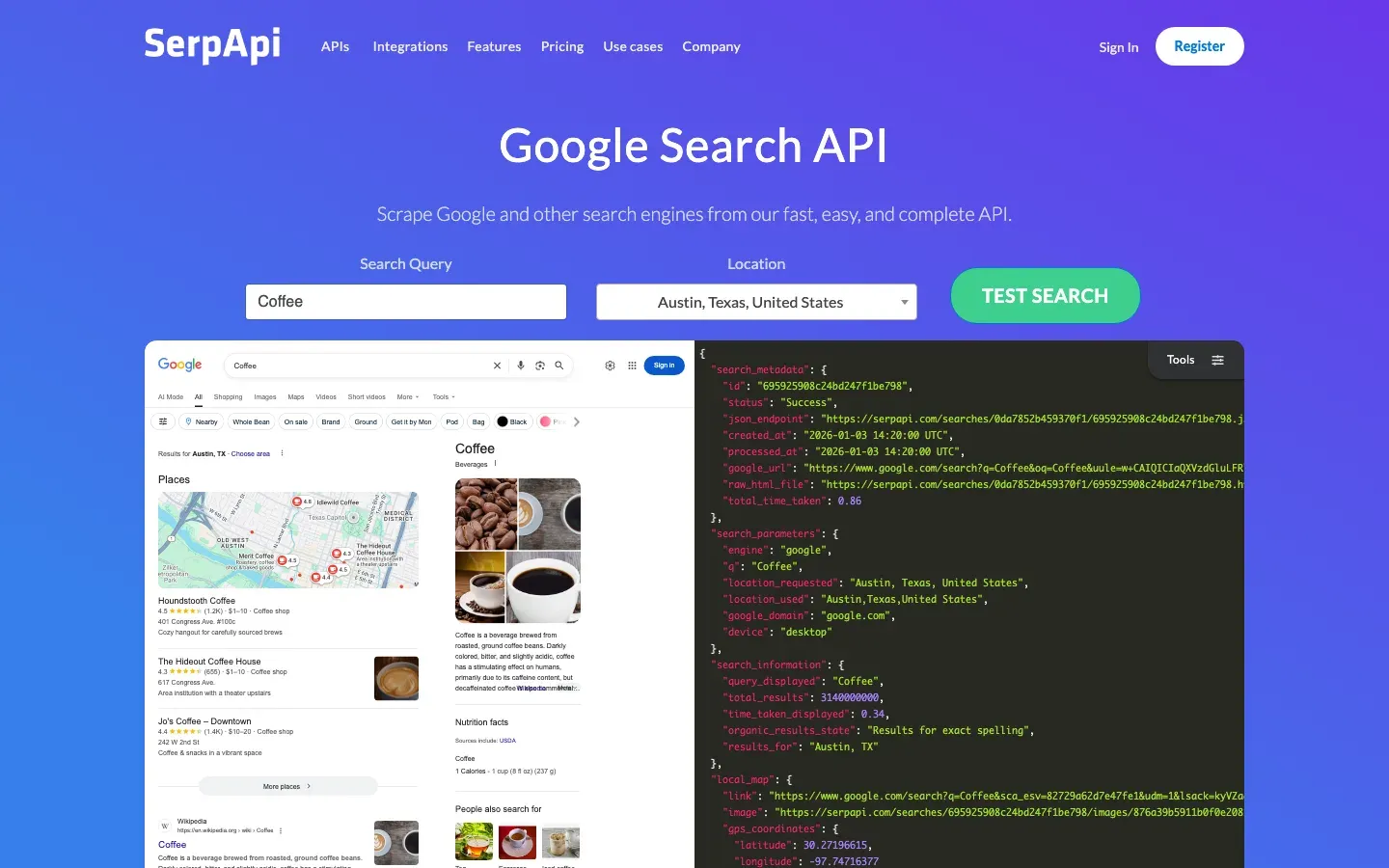
SerpApi covers many search engines besides Google. It bills per search, and per its pricing page “only successful searches are counted”.
- Price: Developer is $75 a month for 5,000 searches, so $15.00 per 1,000 top-10 checks. Google results page with
start10 at a time, so a top-100 check is 10 searches: $150.00 per 1,000. - AI Overview: included in the Google response. When Google loads it separately, you need a second call to the Google AI Overview API.
- Measured: 65.9% real-page rate on the reference queries. It returned a degraded page on about a third of reads.
- Free: 250 searches a month.
- MCP: yes, hosted.
- Limits: the highest price per check here, at every depth.
6. Bright Data: best price for a top-100 check from a per-call API
Bright Data sells a SERP API on top of its proxy network. Its pricing page lists pay as you go at $1.50 per 1,000 requests, with payment for successful requests only.
- Price: $1.50 per 1,000 top-10 checks. Its Get Top 100 Google Results call bills “one billable request, regardless of page depth”, so a top-100 check also costs $1.50 per 1,000. That call runs as an asynchronous scraper job.
- AI Overview: the
brd_ai_overviewparameter raises the chance of getting one, and adds about 5 to 10 seconds. - Free: 5,000 credits a month, shared with Bright Data’s other scraping products. Accounts on a subscription plan do not get them.
- MCP: yes.
- Limits: the top-100 price applies to the scraper job only. Paging the SERP API costs $15.00 per 1,000.
7. SearchApi: best dedicated rank tracking endpoint
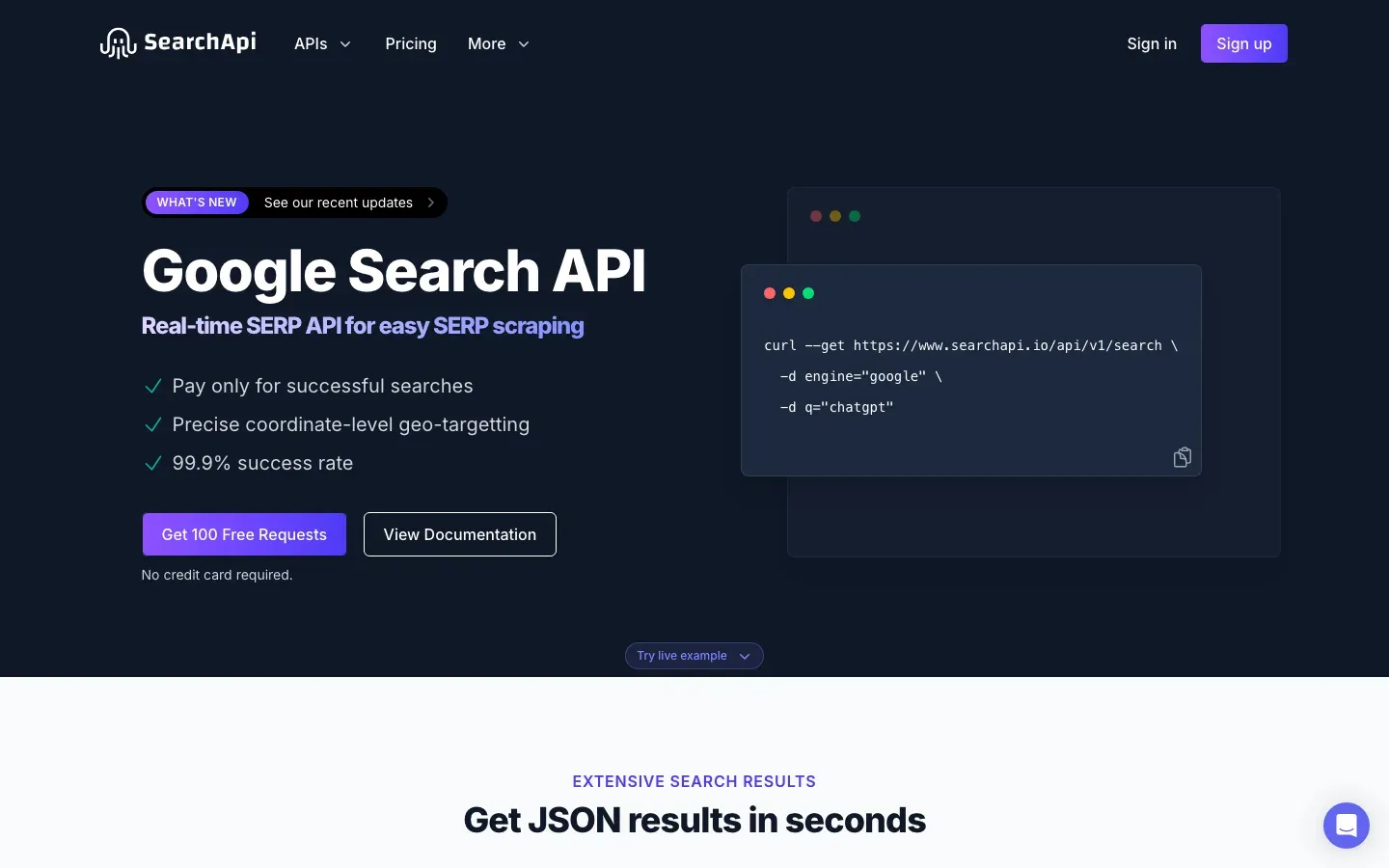
SearchApi has a Google Rank Tracking engine built for this job. Per its docs, num “can be customized from 1 to 100” and defaults to 100, so you get all positions in one request.
- Price: Production is $100 a month for 35,000 searches, so $2.86 per 1,000 top-10 checks. SearchApi does not publish how many searches a
num=100request bills. - AI Overview: the rank tracking engine returns organic rankings only. The regular Google engine returns the AI Overview.
- Free: 100 requests.
- MCP: yes.
- Limits: without a published top-100 rate, you cannot price a deep tracking program before you test it.
8. Scrapingdog: lowest top-10 price
Scrapingdog sells credits that work across its scraping APIs. Per its docs, a Google search costs 5 credits and returns up to 10 results per page.
- Price: Standard is $90 a month for 1,000,000 credits, so $0.45 per 1,000 top-10 checks and $4.50 per 1,000 top-100 checks (10 pages).
- AI Overview: included in the response. When Google loads it separately, a follow-up call costs 5 credits.
- Free: 100 credits. Failed requests are refunded.
- MCP: yes.
- Limits: Google results come 10 at a time, so depth multiplies the bill.
9. Oxylabs: low top-10 rate, with a high failure rate in our test
Oxylabs sells Google results through its Web Scraper API from a credit balance, priced per 1,000 results on its pricing page.
- Price: on Basic ($100 a month), Google without JavaScript rendering costs $0.90 per 1,000 results. Each page is “a separate fetch and charge”, so a top-100 check costs $9.00 per 1,000.
- AI Overview: parsed.
expand_aioexpands the block. - Measured: 83.4% real-page rate. Most of the gap was failed calls (12.6%). It returned a degraded page on 3.2% of reads.
- Free: a one-time $5 credit.
- MCP: yes, self-hosted.
- Limits: most of its failed calls in our test came on 17 and 18 October, so plan for retries.
10. AccuRanker: best for teams that want the dashboard first
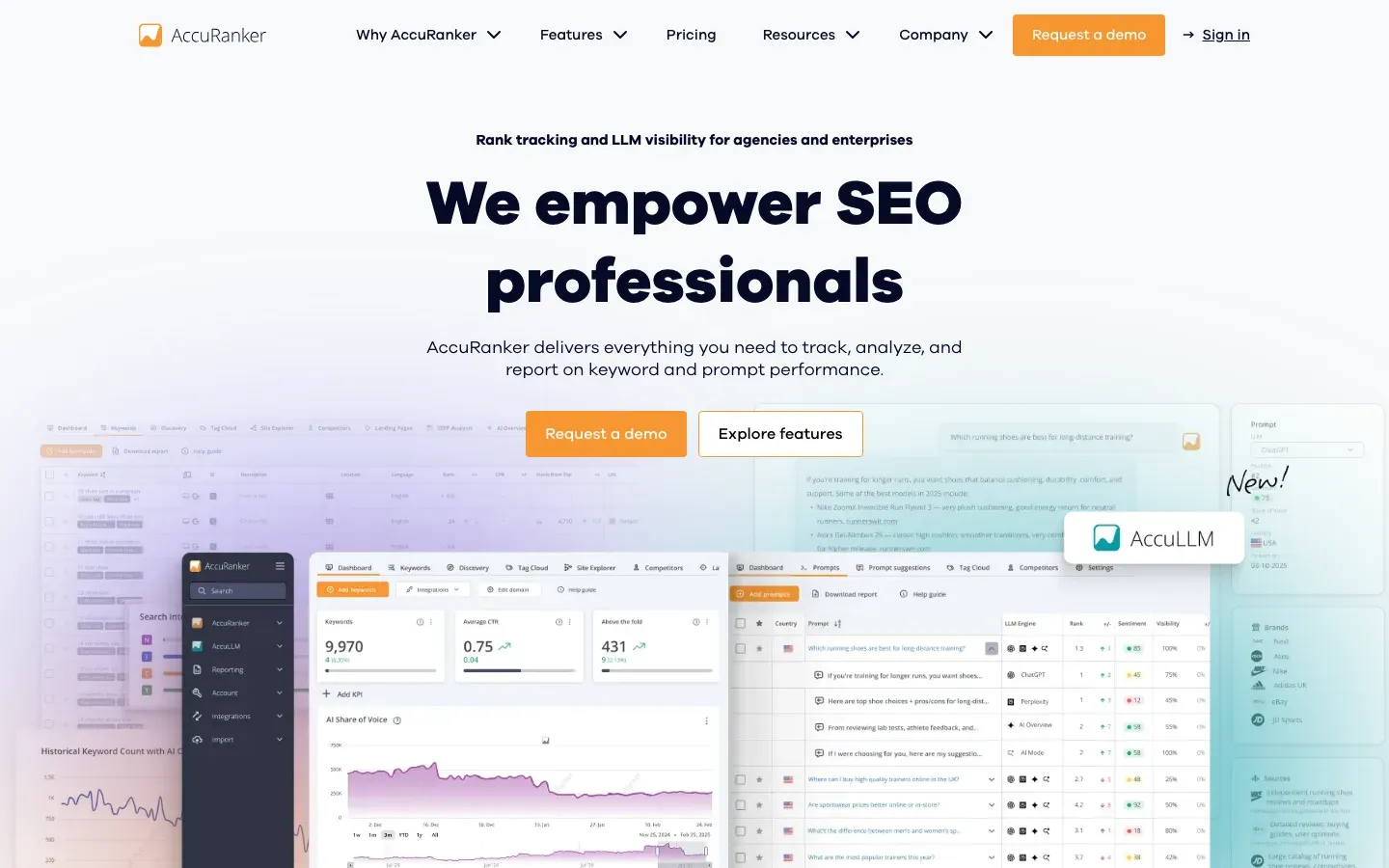
AccuRanker is a rank tracker with daily updates and on-demand refreshes. Per its pricing page, the read API starts on the Expert plan.
- Price: Expert is $764 a month for 10,000 keywords with an unlimited read API, so $2.55 per 1,000 daily checks. The Professional plan ($224) has no API.
- AI Overview: not on the rank tracker pages. AI Overviews, AI Mode, ChatGPT and Perplexity are in a separate product, AccuLLM.
- MCP: yes.
- Limits: the highest entry price for API access here.
Per-call API or rank tracker: what a real program costs
Price per check is easier to read as a monthly bill. Take 1,000 keywords, one market, desktop, checked daily: 30,000 checks a month.
| API | Top 100, daily | What it buys |
|---|---|---|
| Bright Data (Top 100 call) | $45 | Pay as you go, async job |
| Keyword.com | $60 | 1,000 keywords, daily, top 100 |
| SE Ranking (Core) | $129 | Up to 2,000 keywords, plus the SEO platform |
| Scrapingdog (Pro) | $200 | 1.5 million of its 3 million credits |
| cloro (Starter) | $250 | 630,000 of its 650,000 credits, with the full results page |
| DataForSEO (Live) | $600 | 300,000 pages of 10 results |
For a fixed list checked daily to position 100, a rank tracker or Bright Data’s Top 100 call costs the least. A per-call API costs more, and it is worth it in four cases:
- You do not need position 100. Most keywords that matter rank in the top 20. On cloro, a top-20 check costs 5 credits, so the same 1,000 keywords daily fit the $100 Hobby plan.
- Your list changes. A rank tracker bills a keyword volume each month. A per-call API bills what you run, so a one-off audit of 50,000 keywords costs the same as 50,000 checks.
- You need the whole page. Ads, People Also Ask and the AI Overview with its sources come back on the same call, so one request serves SERP monitoring and rank tracking.
- You track AI search too. Positions in ChatGPT, Gemini, Copilot or Google AI Mode answers need an API that reaches those engines. Our AI rank tracking guide covers how.
To build the pipeline yourself, our Google rank tracking API walkthrough has the Python and Node code, a storage schema and a scheduler. If you would rather buy a dashboard, our rank tracking software comparison covers twelve.

About the author
Ricardo Batista
Founder, cloro
Ricardo is one of the founders and engineers behind its SERP and AI-search scraping infrastructure. Before cloro he scaled a financial comparison site to $7M ARR and ran the full-country operations of a unicorn to $65M ARR, then went back to building. He writes about search engine scraping, generative-engine optimization, and turning live search and AI-answer data into something teams can act on.
Frequently asked questions
What is the best rank tracking API?
It depends on how you track. For a fixed keyword list checked daily to position 100, a rank tracker with an API costs the least per check: Keyword.com ($2.00 per 1,000) and SE Ranking ($2.15). For the full Google page, the AI Overview and AI search engines from one per-call API, cloro returned the real Google page on 98.0% of reads in our test, against 33.1% to 83.4% for the other three APIs we measured. For the lowest top-10 rate, Scrapingdog costs $0.45 per 1,000 on its Standard plan.
How much does a rank tracking API cost?
Per 1,000 Google checks to position 10, the ten APIs here cost from $0.45 (Scrapingdog Standard) to $15.00 (SerpApi Developer). To position 100, they cost from $1.50 (Bright Data's Top 100 call) to $150.00 (SerpApi Developer), because most per-call APIs bill each page of 10 results as a separate request. Prices are for the plan closest to $100 a month, or pay as you go, read on 26 October 2026.
Is there a free rank tracking API?
Several have a free allowance. cloro gives 500 credits a month, refreshed monthly, which is 166 top-10 checks. SerpApi gives 250 searches a month. Bright Data gives 5,000 credits a month, shared across its scraping products. SearchApi gives 100 requests and Scrapingdog 100 credits once. Keyword.com and SE Ranking have 14-day trials. None of these covers a daily tracking program, so treat them as a way to test the data.
Can a rank tracking API still return 100 results in one request?
Google removed the num=100 parameter on 11 September 2025, so a plain Google request returns 10 results. Some APIs still give you the top 100 in one request. SearchApi's rank tracking engine accepts num=100, Bright Data has a Get Top 100 Google Results call, and cloro takes pages up to 10 in one request. Rank trackers such as Keyword.com, SE Ranking and AccuRanker return the top 100 in each scheduled check. What changes between them is the bill: cloro charges 21 credits for 10 pages, DataForSEO and SerpApi charge 10 times their single-page price.
Why did my rankings drop overnight in my rank tracker?
Since September 2026 Google answers some automated searches with a complete page of wrong results, which a rank tracker records as a sudden drop. In our test from 16 to 18 October 2026, the share of reads that returned the real page ranged from 33.1% to 98.0% across four SERP APIs. If Search Console shows steady impressions and position for the same keyword, the tracker most likely read a degraded page. Our poisoned SERPs study has the checks to run.
What is the difference between a rank tracking API and a SERP API?
A SERP API returns the results page for one query when you call it, and you store and compare the positions yourself. A rank tracking API from a platform such as Keyword.com, SE Ranking or AccuRanker checks a keyword list on a schedule and lets you pull the stored positions. Many teams call a SERP API a rank tracking API when they use it for that job, which is why both kinds compete for the same searches.
Related reading
Poisoned Google SERPs: what we measured and how we fixed it
Since September 2026 Google answers some automated searches with a complete page of the wrong results. What we measured across SERP APIs, and how cloro fixed it.
Google Rank Tracking API: Python + Node Walkthrough
Build a rank-tracking API with Python and Node code, a storage schema, rate-limit patterns, and a GitHub Actions cron. Complete technical walkthrough.
Best Rank Tracking Software 2026: 12 Tools Tested
Compare the 12 best rank tracking software tools for 2026 by daily cadence, accuracy, and enterprise scale, scored against live SERP data.