
Ranking Beyond Google: Bing, YouTube, and AI Answers

On this page
Your rankings live on more than one search engine
If you are setting up rank tracking beyond Google, you have already noticed the gap most SEO dashboards leave open. They watch Google and nothing else, which made sense when Google was search. It is a weaker assumption every quarter.
Google still dominates. Statcounter’s latest numbers put it at 91.27% of the worldwide search market in June 2026, with Bing second at 4.68%. That four percent sounds ignorable until you translate it, and on US desktop Bing takes more than 12% of searches. Bing is the second-largest traditional search engine on earth, and its index quietly powers a set of AI answer engines whose usage keeps climbing.
Here is the part that catches teams off guard. A page’s Google position tells you almost nothing about where it ranks on Bing. The two engines crawl differently, and they weight links and freshness differently. Increasingly, they return different sites for the same query.
If you only track Google, you are not “mostly covered” on Bing. You are guessing. That is the gap this guide closes.
This guide comes in three parts. First, the data: we measured how far Bing’s page one drifts from Google’s. Second, the how-to: three ways to track Bing rankings, plus the surface almost everyone skips, which is YouTube.
Third, a short bridge to the AI answer engines, because that is where “search beyond Google” is actually heading. One note up front: no single piece of rank tracking software covers every one of these surfaces, so treat this as a map of which tool fits which. For the wider case that a single position number misleads on any engine, see tracking rankings across every SERP surface.
We measured it: how much Bing’s page one differs from Google’s
Everyone tracking Bing repeats the same line: “Bing results are different from Google.” Almost no one quantifies it. So we ran a small pilot to put a number on it.
How we ran the pilot
We took five commercial queries a rank-tracking buyer would actually care about. For each one, we captured Google’s top 10 organic results and Bing’s top 10 organic results on the same day. The conditions were held constant: US locale, desktop, personalization stripped, July 8, 2026.
We then reduced each result to its registrable domain and deduplicated per engine. Finally, we counted how many domains appeared on both first pages. The full query set, raw domain lists, and the scoring script are reproducible. This is a pilot, not a census, and we are labeling it as exactly that.
What the overlap looked like
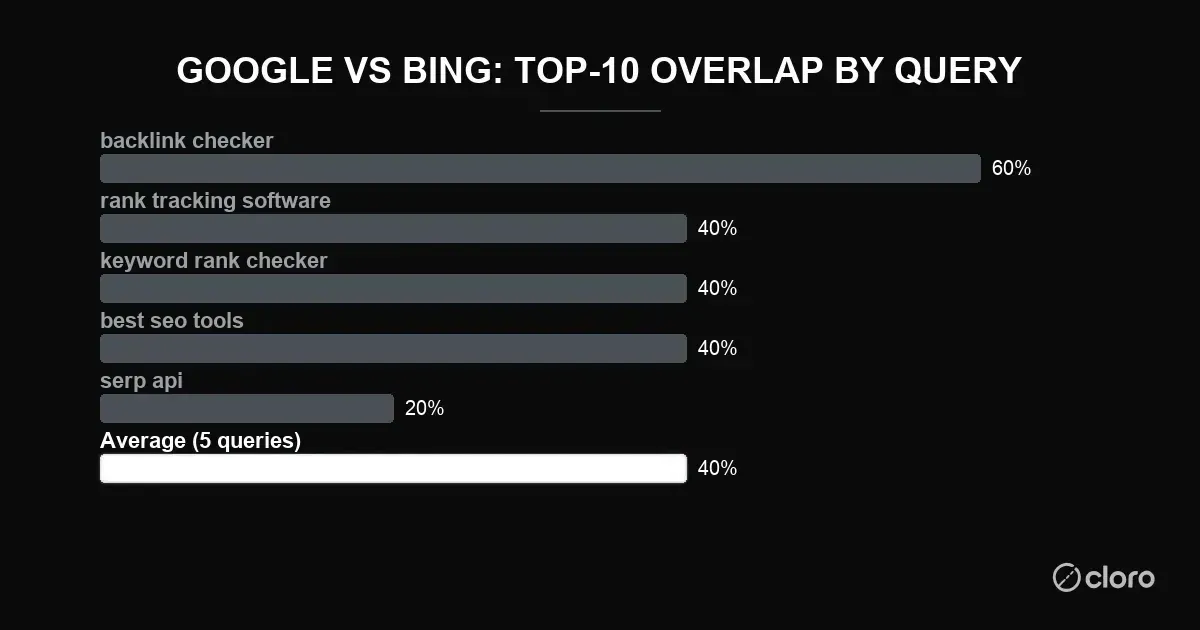
Across the five queries, Google and Bing shared a mean of 4 of 10 domains — a 40% overlap. The other ~60% of each first page was unique to that engine.
| Query | Domains shared by both top 10s | Top-10 overlap |
|---|---|---|
| backlink checker | ahrefs, semrush, seobility, seoreviewtools, smallseotools, neilpatel | 60% |
| rank tracking software | semrush, onelittleweb, marketermilk, zapier | 40% |
| keyword rank checker | ahrefs, semrush, seobility, smallseotools | 40% |
| best seo tools | backlinko, marketermilk, morningscore, zapier | 40% |
| serp api | serpapi, serper | 20% |
The spread runs from 60% down to 20%. Jaccard similarity, which also penalizes ordering and set size, averaged just 27.6%. Even at the friendly end, four in ten of the sites you compete with on Bing were absent from Google’s first page. On the “serp api” query, eight of Bing’s ten results were sites Google’s page one never showed.
Two honest caveats
The sample is five queries, so treat the 40% as directional, not a universal constant. Your niche will differ, and this pilot is the small version of a study you would scale to hundreds of queries before quoting it as a benchmark. Bing also occasionally collapses or removes organic rows, so for two queries we compared against the six-to-seven organic results Bing actually returned.
Neither caveat changes the conclusion. Bing is a genuinely different results page, and you cannot infer it from Google. That gap is the whole reason a dedicated Bing workflow exists.
Why Bing and Google diverge
The overlap gap is not random noise. Bing and Google run separate crawlers, separate indexes, and separate ranking models. Bingbot discovers and refreshes pages on its own schedule, so a page Google indexed hours ago may not be in Bing yet. A newer or thinner site can therefore rank on one engine while it stays invisible on the other.
The ranking signals are weighted differently too. Bing has historically leaned harder on exact-match keywords in titles and on-page text, while Google leans more on link authority and intent modeling. Bing also runs a smaller index than Google, so long-tail queries surface a different mix of pages. None of this is exotic — it is two engines making independent calls, which is exactly why a Google-only report cannot stand in for the Bing one.
How to track Bing rankings (three ways)
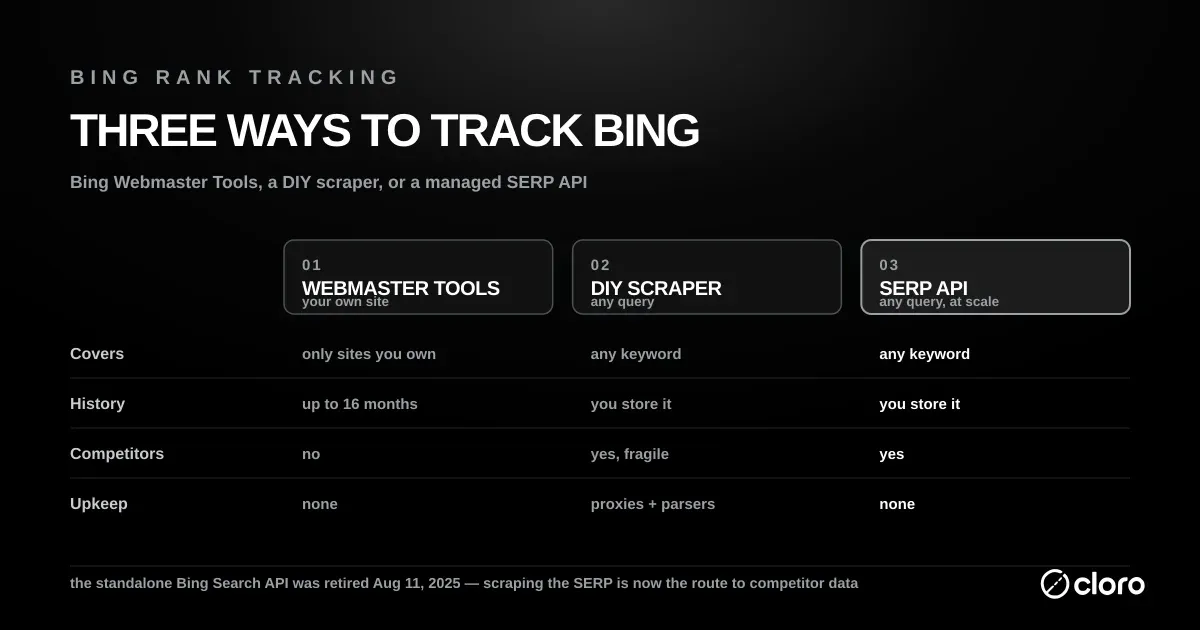
There is no single Bing rank checker that fits every team. There are three approaches, and the right one depends on your scope. The deciding question is simple: do you need only your own site, or arbitrary keywords and competitors?
1. Bing Webmaster Tools — free, accurate, own-site only
Microsoft’s own console reports the queries, impressions, average position, and clicks Bing actually served your verified site. Per Microsoft’s Bing Webmaster Tools guidance, the free tool tracks impressions, clicks, and average position across pages and keywords using up to 16 months of data. It is the Bing equivalent of Google Search Console: trustworthy first-party data, but blind to competitors. Use it as your baseline of truth, and do not expect it to follow a rival or a keyword you have not yet cracked.
2. DIY SERP scraping — full control, real maintenance
You can request bing.com/search?q=your+keyword and parse the organic positions yourself. Bing is friendlier to scrape than Google, but it is not free of defenses. Expect rate limits on suspicious patterns, rotating proxies at volume, and selectors that break when the page changes.
You also normalize the output yourself: strip ads and answer boxes, map each organic row to its position, and dedupe syndicated results. This is the same maintenance tax any DIY scraper carries — fine for a few dozen keywords, painful as a standing program.
3. A Bing-capable SERP API — positions at scale
For tracking many keywords or competitors, a SERP API that supports Bing returns structured position data without you running the proxy-and-parser stack. This is the standard programmatic pattern at scale. You send a keyword and a locale, and you get back ranked results ready to store. The same approach for Google covers the production architecture — scheduling, storage, and diffing runs over time — and it maps cleanly onto Bing.
One scope note, so you buy the right tool. cloro’s rank tracking API covers Google Search and the AI answer engines, not bing.com organic directly. If your job is raw Bing SERP positions, reach for Bing Webmaster Tools or a Bing-native SERP API. If you previously pulled Bing data from Microsoft’s own API, note that it no longer exists.
Microsoft retired the Bing Search APIs on August 11, 2025, decommissioning the endpoints entirely and pointing customers to Grounding with Bing Search for AI agents. That change has its own writeup — what happened to the Bing Search API and which third-party alternatives replaced it. It is also why scraping Bing or buying a SERP API is now the realistic choice.
A SERP API or an all-in-one tracker?
Paths 2 and 3 give you raw data. An all-in-one rank tracker with a Bing option trades that control for a finished interface. Pick the API when you build custom dashboards, run large keyword sets, or join Bing positions with your own business data. Pick an all-in-one tool when you want reports and white-labeling with no development work. Two common options that track Bing: SE Ranking starts at $52/month for 500 keywords, billed annually, and SEO PowerSuite Rank Tracker is a desktop app at $299/year with unlimited keywords. Many teams run both: the all-in-one for client reports, the API for the pipeline.
How often to check, and what to record
Whichever path you pick, tracking is a time series, not a one-off snapshot. Record each keyword’s position, the date, the engine, and the URL that ranked, then re-run on a fixed cadence. Weekly is enough for most commercial terms; daily only earns its cost for volatile, high-value queries. The value lives in the deltas, not the single number.
Log the full top 10, not just your own rank. Competitor movement on Bing is where the 40%-different first page actually bites, because the rivals beating you there may never appear in your Google view. That history is what turns the exercise from a vanity metric into a decision you can act on.
YouTube rank tracking: the second-biggest surface most trackers skip
Here is a surface bigger than Bing that your rank tracker almost certainly ignores. According to Backlinko’s YouTube usage data, YouTube is the second most-visited website in the world. The only site that pulls more traffic is its parent, Google.
The same report puts YouTube at over 2.58 billion active users, with 42.8% of all global internet users on it regularly. People do not just watch YouTube. They search it, constantly.
A “how to,” a product review, a head-to-head comparison — those are ranked results inside YouTube’s own engine. They also surface as video packs inside Google’s SERP. If your strategy includes video, “where do we rank” has a second answer you are probably not measuring.
How to track YouTube positions
The mechanics mirror Bing SERP scraping. For native YouTube rankings, scrape the YouTube results page for each target query and record the position of your video and your competitors’. For the video results that appear inside Google, a Google SERP tracker already captures them as part of the results page. cloro’s Google SERP endpoint returns those in-SERP video results as structured data.
That structured feed shows you when a YouTube video is intercepting a query you assumed was a blue-link fight. A video pack sitting above the organic list can absorb the clicks before a searcher ever reaches your page. What cloro does not do is track native YouTube-internal rankings, so pair a YouTube results scrape for that half of the picture. The point of YouTube rank tracking matches Bing’s: attention has moved to a surface your Google-only report cannot see.
The AI surfaces run on Bing’s index (a short bridge)
This bridge is worth your attention. There is a reason to care about Bing that has nothing to do with bing.com. Bing’s index is the retrieval layer under a growing set of AI answer engines.
Microsoft Copilot is the clearest example. Microsoft’s own documentation confirms that Microsoft 365 Copilot grounds its answers by sending generated queries to the Bing search service. ChatGPT’s web browsing, DuckDuckGo, and Yahoo lean on the same index in different ways.
DuckDuckGo is a useful tell here. During a 2024 Bing outage, DuckDuckGo stopped returning results, which showed how much of its page Bing quietly supplies. When a buyer asks Copilot for a recommendation, the sources it pulls are, in large part, Bing-grounded.
This reframes what “worth tracking” actually means. Bing’s ~5% of classic search undersells its true footprint, because the same index answers a share of AI queries that never touch bing.com. A brand can be nearly absent from Google’s blue links yet cited repeatedly in Copilot answers, or the exact reverse. Watching only Google positions hides both outcomes.
So the biggest “Bing” opportunity in 2026 is not the ten blue links on bing.com. It is the AI answers its index feeds. Tracking your presence in those answers is a different discipline from counting positions, and it is where the effort actually pays off.
We are not going to re-explain all of that here — the full AI search engine landscape already does. The relevant point for a rank-tracking plan is where it lands. Tracking your presence in those AI answers is exactly what cloro’s rank tracking API is built for. It returns Google Search alongside ChatGPT, Perplexity, Gemini, Copilot, Grok, AI Overview, and AI Mode in one JSON feed.
Which surface, which tool: a tracking map
Put it together and the plan stops being vague. Each surface has a method, and no single tool covers all of them. So match the tool to the surface.
| Surface | How to track it | Does cloro cover it? |
|---|---|---|
| Google organic | SERP API or a rank tracker | Yes — core |
| AI answers (Copilot, ChatGPT, Perplexity, Gemini, AI Overview) | AI-answer tracking; these are Bing- and Google-grounded | Yes — core |
| Bing organic | Bing Webmaster Tools (own site) or a Bing-native SERP API | No — use a Bing-native tool |
| YouTube (native) | Scrape the YouTube results page | No — pair a YouTube scrape |
| YouTube-in-Google (video packs) | Any Google SERP tracker | Yes — via the Google SERP endpoint |
The pattern is simple. Use cloro’s rank tracking API for Google and the AI answer surfaces where it is strongest. Then add a Bing-native tracker and a YouTube scrape for the two surfaces it does not claim. A complete stack matches each tool to its surface, instead of trusting one dashboard to do everything.
A tracker that pretends to do everything is usually weakest at the surface you actually opened this page for. The right-tool-per-surface stack is the one that survives contact with a real audit.
Google still captures most of the demand. But “most” is not “all,” and the gap is where competitors quietly win the buyers you cannot see. Measure Bing, YouTube, and the AI surfaces, and the blind spot disappears.

About the author
Ricardo Batista
Founder, cloro
Ricardo is one of the founders and engineers behind its SERP and AI-search scraping infrastructure. Before cloro he scaled a financial comparison site to $7M ARR and ran the full-country operations of a unicorn to $65M ARR, then went back to building. He writes about search engine scraping, generative-engine optimization, and turning live search and AI-answer data into something teams can act on.
Frequently asked questions
What is Bing rank tracking?
Bing rank tracking means monitoring your website's keyword positions on Bing's search results, separately from Google. It matters because the two engines return substantially different pages: in a July 2026 pilot across five commercial queries, Google and Bing page-one results shared a mean of only 4 of 10 domains (about 40% overlap), so your Google positions do not describe where you rank on Bing.
Can you track Bing rankings for free?
Partially. Bing Webmaster Tools reports your own verified site's Bing queries, impressions, clicks, and average position for free, but it cannot track competitors or keywords you do not already rank for. For arbitrary keywords or competitor tracking, you need to scrape Bing's results page yourself or use a Bing-capable SERP API.
How different are Bing and Google rankings?
Very different. In our five-query July 2026 pilot, Google's and Bing's top-10 organic results shared a mean of 4 of 10 domains (40% overlap; range 20% to 60%). Roughly 60% of each first page was unique to that engine, and on one query eight of Bing's ten results never appeared on Google's first page. You cannot reliably infer Bing positions from Google data.
Does cloro track Bing rankings?
Not bing.com organic directly. cloro's rank tracking API covers Google Search plus the AI answer engines: ChatGPT, Perplexity, Gemini, Copilot, Grok, AI Overview, and AI Mode. Because Copilot and ChatGPT web browsing are grounded in Bing's index, cloro tracks the Bing-powered AI surfaces. For classic Bing organic positions, use Bing Webmaster Tools or a Bing-native SERP API.
How do you track YouTube rankings?
Scrape the YouTube search results page for each target query and record your video's position, and separately capture the YouTube video packs that appear inside Google's SERP. YouTube is the second most-visited website in the world, so its rankings are a real surface that most rank trackers ignore.
Is it worth tracking Bing if it is only about 5% of search?
Often yes. Bing held 4.68% of worldwide search in June 2026, the second-largest share of any traditional search engine, and its index also feeds fast-growing AI answer engines like Microsoft Copilot and ChatGPT. So tracking 'Bing' is really a proxy for a set of surfaces larger than the 5% headline suggests.
Should I use a Bing rank tracker API or an all-in-one SEO tool?
Use a SERP API when you build custom dashboards, track large keyword sets, or join Bing positions with your own data. Use an all-in-one tracker with a Bing option when you want reports and white-labeling with no development work. SE Ranking starts at $52/month for 500 keywords billed annually, and SEO PowerSuite Rank Tracker is a desktop app at $299/year with unlimited keywords. Many teams use both.
Related reading
Bing Search API Key in 2026: It's Retired. Use These Instead
5 ranked drop-in replacements for the retired Bing Search API v7, with API-key setup, cost comparison, and migration steps for your legacy code.
How to Track SERP Rankings Beyond Blue Links
Learn how to track SERP rankings across organic results, maps, AI Overviews, PAA, snippets, ads, and zero-click features without false confidence.
Google Rank Tracking API: Python + Node Walkthrough
Build a rank-tracking API with Python and Node code, a storage schema, rate-limit patterns, and a GitHub Actions cron. Complete technical walkthrough.