
SEO Competitor Keywords: Reverse-Engineer Any Rival

On this page
Search Google for “seo competitor keywords” and look at who ranks. Every single page-one result is a paid tool or a guide that funnels you toward one: SpyFu at the top, then SE Ranking, SEO Sherpa, Mangools, Semrush, and Moz. The message is consistent: to see the keywords your competitors rank for, open your wallet. Even every step of Semrush’s own guide runs through a paid tool: Domain Overview, Organic Rankings, Keyword Gap, and Position Tracking, one subscription feature per step.
What none of those pages dwell on is that the data they sell is already public. A competitor’s keyword footprint is scattered across the search results themselves: the pages they rank on, the People Also Ask boxes, the related searches, the autocomplete suggestions, and the AI Overview citations. You can reconstruct it with nothing but SERP scraping and a spreadsheet. No seat license required.
This guide is the method. We reverse-engineer a real domain end to end, publish the full recovered-keyword table, and then spot-check it against live SERPs to show how precise a subscription-free approach actually is. Fair warning on the bias: cloro sells a SERP API, so when we get to automating this at scale we are describing our own product. The manual method below works with zero budget, and every number here is reproducible. That is the point.
SEO competitor keywords: why your business rivals aren’t always the ones to reverse-engineer
SEO competitor keywords are the search terms a rival ranks for that you want to rank for too. They are the raw material of a content plan: every term a competitor already earns traffic on is a term with proven demand and a proven path to the top of the page.
The trap is analysing the wrong competitors. SEO competitors are not always your business competitors. An SEO competitor is any site that shows up in search results for the terms you care about. A business competitor is a company that sells what you sell. A running-shoe brand competes commercially with other shoe brands, but in the SERPs it competes with Runner’s World and a dozen review blogs. Reverse-engineer the sites that actually occupy the results, not just the ones on your sales team’s whiteboard.
Once you have picked a domain, the footprint you are trying to recover is everything that domain touches on a results page: the organic terms it ranks for, the questions it appears under in People Also Ask, the phrases it shows up in under related searches, and increasingly the queries where it gets cited in the AI Overview. If you are fuzzy on what those SERP elements are, our explainer on what a SERP is maps every one of them. Each element is a leak. Put enough leaks together and you have the competitor’s keyword strategy.
The no-subscription method: query fan-out, People Also Ask mining, and autocomplete expansion
The whole method rests on one idea: the SERP is a database, and every query you run returns a few more rows of a competitor’s footprint.
The surfaces this method harvests are also the reliable ones. In our SERP feature census, 69,817 scored Google SERPs across 41 markets, People Also Ask rendered on 93.8% of US results and an AI Overview on 85.4%, against 98.2% for the organic list. So the PAA mining step below has something to mine on roughly nine queries in ten, which is what makes a no-subscription method viable at all. The sample leans toward conversational and commercial-research intent, so treat it as the rate on question-shaped queries. You expand outward from a seed until the new queries stop returning new keywords. Three engines drive that expansion.
Query fan-out starts with a seed, the competitor’s brand name and its two or three core topics, and branches into the natural variations searchers actually use: [brand], [brand] alternatives, [brand] vs, [topic] tool, best [topic] for [audience]. Each branch is a live search. The domains and titles that come back tell you which terms the competitor competes on. They also tell you who else is in the fight. This is exactly the “fan-out” that large language models perform when they answer a broad question: they silently expand it into many sub-queries. It is the step that returns the most for the least work.
People Also Ask mining turns the question boxes into a keyword tree. Run a seed query, record every PAA question, then expand the promising ones (clicking a PAA question loads more questions beneath it). Two or three levels deep, you have dozens of the exact questions your competitor’s content is built to answer. They arrive phrased in searcher language, not marketer language.
Autocomplete expansion completes the long tail. Type the competitor’s brand or a core topic into the search box and record the suggestions; then append each letter of the alphabet to surface more. Autocomplete is Google telling you, for free, which completions have real search demand.
Google Keyword Planner covers the paid-search side, including the Google Ads keywords a competitor is likely bidding on. It is free with a Google Ads account: choose Discover new keywords, then Start with a website, and enter the competitor’s URL. SE Ranking’s guide lists the limits: the ideas skew toward ad terms, similar keywords share grouped volume figures, and there is no side-by-side gap view. Use it to add paid intent to the list the three engines above produce, not to replace them.
Do all three by hand and it costs nothing but time. Automate them and you are making one API call per query. cloro is built for exactly this: cloro’s fan-out engine returns PAA and related searches as JSON on every Google Search call, replacing the manual clicking above with one response, and its ChatGPT full-response endpoint runs the query fan-out for you. And do not skip the AI Overview: it renders on about 40% of commercial queries, so the domains it cites are part of the modern footprint whether or not they hold organic position one.
Keyword research and competitor analysis, done from the SERP
This is where keyword research and competitor analysis stop being two separate jobs. The paid workflow calls the output a “keyword gap” and hides it behind a dashboard; you are going to build the same output from the rows you just scraped.
Take every keyword you recovered and do three passes. First, cluster by intent, grouping the terms into topics (informational “how to”, commercial “best tool”, navigational “brand + feature”). Second, filter to what you can realistically win, dropping the terms owned entirely by domains with far more authority than yours and keep the ones where the page-one results are beatable. Third, map each surviving cluster to a page you will write or improve.
That is the entire “keyword research competitor analysis” loop that subscription tools charge monthly for: recover terms a competitor ranks for, subtract the ones you already cover, prioritise the remainder. The only difference is that your source rows came from the live SERP instead of a vendor’s index, which means they are current, not a snapshot from the last crawl, and they cost nothing to refresh.
Worked example: reverse-engineering a keyword tool’s own keywords
For the worked example we picked a deliberately ironic subject: SpyFu, the paid competitor-keyword tool sitting at position one for our head term. We reverse-engineered its footprint using only the free method above: no SpyFu account, no Ahrefs, no Semrush. Everything below was captured from live Google SERPs on 9 July 2026 and is reproducible.
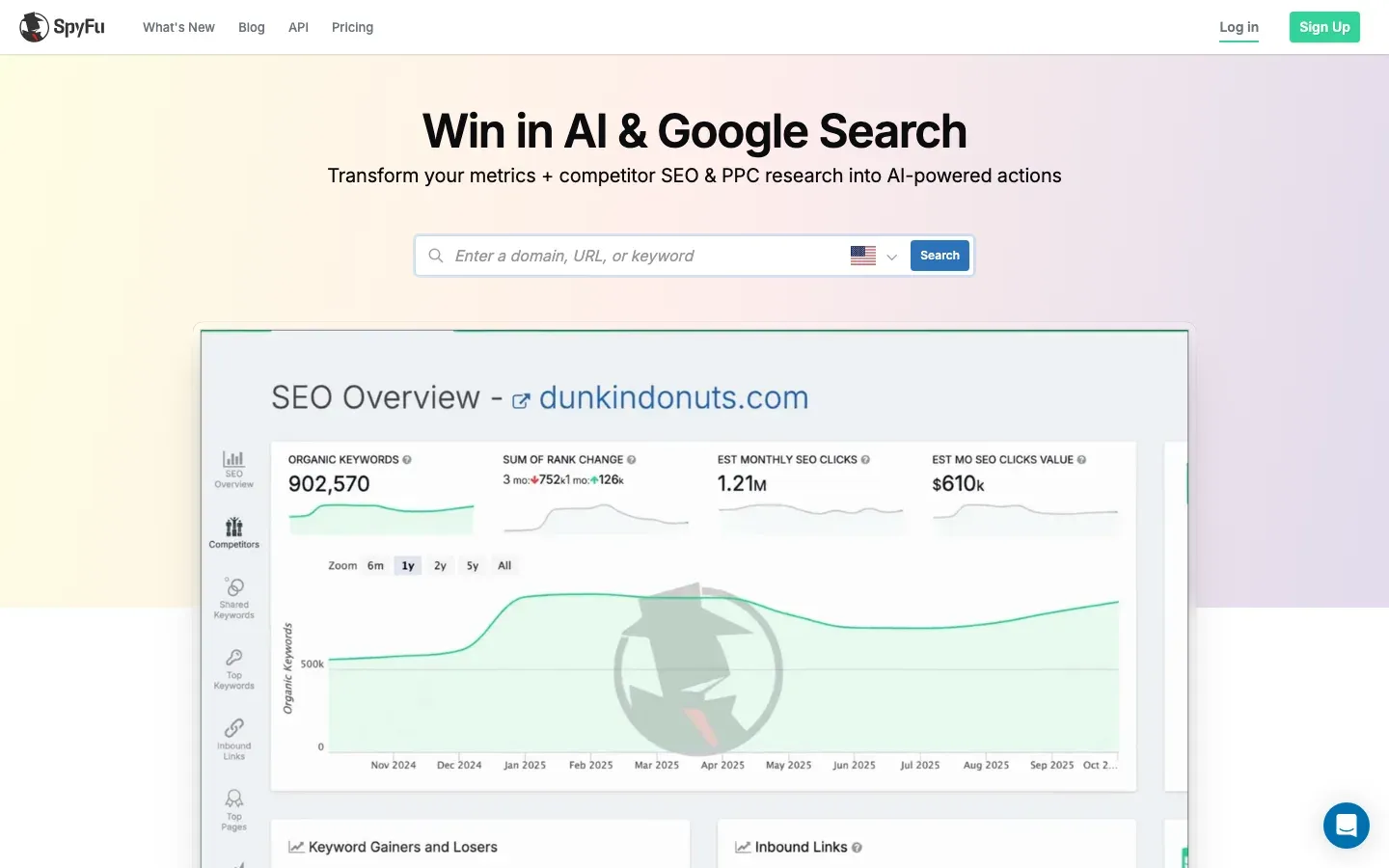
We seeded the fan-out with the brand (spyfu), the brand-plus-modifier (spyfu alternatives), and two category topics (seo competitor analysis tool, ppc competitor research). Here is the recovered footprint, every row traceable to a real SERP signal we observed:
| Recovered keyword | Recovered via | Observed intent |
|---|---|---|
| seo competitor keywords | Head-term fan-out, SpyFu ranks #1 | Commercial |
| seo competitor analysis tool | Category fan-out, SpyFu ranks #2 | Commercial |
| ppc competitor research | Category fan-out, SpyFu ranks #2 | Commercial |
| competitor keyword research tools | Brand SERP title (“Competitor Keyword Research Tools for Google Ads PPC & SEO”) | Commercial |
| google ads competitor keywords | Brand title fan-out (“…for Google Ads PPC”) | Commercial |
| download competitor keywords | Brand snippet (“Search for any competitor. Download their keywords.”) | Transactional |
| competitor ppc & seo | Brand snippet (“Learn competitors’ PPC & SEO tricks”) | Commercial |
| spyfu alternatives | Brand + “alternatives” fan-out, SpyFu’s own page ranks #3 | Commercial / navigational |
The fan-out also recovered SpyFu’s SEO-competitor set, the domains that repeatedly appear alongside it: Semrush, SE Ranking, Ahrefs, Moz, Mangools, and Similarweb. That single list, pulled from the “spyfu alternatives” results, is a ready-made target list for the next round of reverse-engineering. The takeaway: nothing in this table required a login; it was assembled from result titles, snippets, and rankings that anyone can read.
Validation: spot-checking the recovered keywords against live SERPs
A recovered keyword is a hypothesis until the live SERP confirms it. Validation is one search per keyword: run it, and check whether the subject domain actually appears on page one. That is the same precision test a paid tool runs internally. You are just doing it in the open.
We spot-checked the three non-brand category keywords from the table against live results:
- seo competitor keywords → spyfu.com at position 1. Hit.
- seo competitor analysis tool → spyfu.com at position 2. Hit.
- ppc competitor research → spyfu.com at position 2. Hit.
Three for three on the category terms, plus the brand terms that trivially resolve to SpyFu’s own pages. That is a small sample, and we are not going to dress it up as a precision percentage across the whole footprint. The honest read is that fan-out around a domain’s brand and core topics recovers terms it genuinely ranks for, and each one is cheap to confirm before you commit content to it. Terms that fail the spot-check are not wasted, either: a miss usually means the competitor is targeting the term without ranking yet, which is its own signal. To turn a one-time spot-check into ongoing monitoring, the same call feeds rank tracking, where you watch a competitor’s positions change over time.
When to reach for an API: keyword research competitor analysis at scale
The manual method has one real limit: it does not scale. Reverse-engineering one competitor across a handful of seeds is an afternoon. Doing keyword research competitor analysis across 50 competitors and 500 keywords is 25,000 searches, and no one is running those by hand.
That is the point where you automate, and the economics are the argument. cloro’s Google Search endpoint is 3 credits per call, at $0.40 per 1,000 credits on Hobby. A full 25,000-query sweep is 75,000 credits, about $30 of SERP data on Hobby, returned as JSON you drop straight into a spreadsheet or warehouse. Compare that to the seat-based model of the tools ranking for this keyword. SpyFu gates its API behind a $119/month plan, and most competitors price by the seat and the lookup. With the fan-out and PAA data arriving as structured JSON per call, the three engines from earlier become one loop your code runs on a schedule.
Whether you stay manual or automate, the strategy is identical. This piece sits between the Competitor Analysis use case and keyword research precisely because the two are the same motion. Start free, prove the method on one competitor, and reach for an API only when the spreadsheet gets too big to refresh by hand.

About the author
Ricardo Batista
Founder, cloro
Ricardo is one of the founders and engineers behind its SERP and AI-search scraping infrastructure. Before cloro he scaled a financial comparison site to $7M ARR and ran the full-country operations of a unicorn to $65M ARR, then went back to building. He writes about search engine scraping, generative-engine optimization, and turning live search and AI-answer data into something teams can act on.
Frequently asked questions
How do I find my competitor's keywords for free?
Read them off the SERP. Run your competitor's brand and core topics as searches, then record the organic terms they rank for, the People Also Ask questions they appear under, the related searches, and the autocomplete suggestions. Expanding those seeds outward, a technique called query fan-out, reconstructs the competitor's keyword footprint without any paid tool. Confirm each recovered term with a single live search before you act on it.
What keywords are my competitors using?
Search their brand name and core topics and record which result titles, snippets, and People Also Ask questions they appear under, then expand each seed with variations such as '[brand] alternatives' and 'best [topic] for [audience]'. For the paid side, enter their URL in Google Keyword Planner, which is free with a Google Ads account. Confirm each term with one live search to see whether they actually rank.
Can you do competitor keyword research without Ahrefs or Semrush?
Yes. Ahrefs and Semrush package SERP data that is already public into a dashboard and charge a subscription for access. The same terms are visible in the live results, PAA boxes, related searches, and autocomplete. The manual method costs only time; a SERP API automates it for a few dollars instead of a monthly seat license, but neither is required to get started.
What is query fan-out in SEO?
Query fan-out is expanding one seed query into the many related searches people actually run: variations, comparisons, questions, and long-tail completions. It is how AI search systems answer broad prompts (they silently branch into sub-queries), and it is the core engine for reverse-engineering a competitor: each branch you search returns another slice of the terms and domains competing in that space.
How accurate is SERP scraping for competitor keyword research?
Accurate enough to plan content around, and self-correcting. Because every recovered keyword is validated with a live search, you confirm the competitor actually ranks before committing. In our worked example, all three non-brand category terms we spot-checked returned the subject domain on page one. Terms that miss the spot-check are still useful signals, showing where a competitor is targeting but not yet winning.
Related reading
What Is a SERP? Search Engine Results Pages in 2026
Beyond the '10 blue links.' Learn the anatomy of a Search Engine Results Page, from organic rankings to AI Overviews, and how to dominate it.

12 Best Competitive Intelligence Tools (2026 Review)
We tested 12 competitive intelligence tools across SEO, social, sales enablement, and AI search. See pricing, who each is for, and the honest weak spots.

Your AI SEO Competitive Analysis Template for 2026
Build a modern competitive analysis template that tracks SEO, AI Overviews, and brand signals to outperform your competition in 2026.