
Enterprise Rank Tracking: Build-vs-Buy Economics

On this page
Every team that reaches serious scale runs into the same decision. You are tracking tens of thousands of keywords across countries and devices every day, and the monthly invoice from your rank tracker has started to look like a salary. Do you keep buying seats, or build enterprise rank tracking on a raw SERP API instead?
Most articles on this topic are single-vendor pitches dressed up as advice. Below is the actual math for enterprise rank tracking at 10,000, 100,000, and 1,000,000 keywords a day, with the per-call costs, the vendor quotes, and the caveats all on the table. cloro sells the build path, so treat the recommendation with healthy skepticism, but the numbers are real and you can reproduce every one of them from the linked pricing pages.
Below a few thousand keywords, buying wins. Somewhere past 25,000 keywords a day, the economics and the control flip hard toward building.
What enterprise rank tracking really means at scale
Enterprise rank tracking is a different problem from tracking a few hundred terms. At the enterprise tier you are fetching one search result page per keyword, per location, and per device, every single day, and then storing every snapshot so your reporting stays consistent over months.
The keyword counts get large fast. A single enterprise brand tracking 5,000 terms across three countries and two devices is already running 30,000 checks a day. An agency with fifty such clients is at 1.5 million. That volume is why enterprise rank tracking forces a build-versus-buy decision that small teams never have to make, and why the wrong choice compounds into either a bloated invoice or a fragile in-house system every month.
The buy path is a hosted tracker, one of the platforms in our rank tracking software roundup. You pay per keyword tracked and the vendor handles everything. For context, Semrush’s Advanced plan runs $455.67 a month and tracks 5,000 keywords daily, which is a fine deal until you need ten times that.
The build path is a SERP API. You send one HTTP call per query and get back structured results, then you own the scheduling, storage, and dashboards. cloro’s Rank Tracking API use case is built for exactly this pattern.
Build or buy? The short version
Buy a hosted tracker if you track a few thousand keywords, have no engineers to spare, and want charts that work out of the box. At that volume the savings do not pay for the build.
Build on a SERP API if you are past roughly 25,000 keywords a day, want warehouse-native reporting, need your own definition of “position”, or plan to resell tracking under your own brand. That is also the point where published tracker pricing stops and you start negotiating.
The rest of this guide costs out both paths so you can place yourself on that line.
The build-vs-buy TCO model: SERP economics at 10K, 100K and 1M keywords a day
Before the unit cost, settle the unit count, because at enterprise scale cadence is what multiplies the bill. We tracked 200 keywords daily for 30 days, giving 5,755 consecutive-day pairs, and compared the top organic domain day over day: the #1 result changed on 31.7% of consecutive days. The spread matters more than the average, since the most volatile keyword in the cohort changed on 93% of days while stable terms barely moved.
At 10,000 keywords a blanket daily cadence is therefore buying a great many identical results. Measuring each keyword’s own churn for a month and tiering the cadence from that number is the single largest lever on an enterprise tracking bill, and it comes before any per-SERP price negotiation. The cohort is customer-monitored queries, so read 31.7% as directional rather than a constant.
Start with the atomic unit: the cost of one rank check. One keyword, one location, one device, fetched once, returns one search result page. Across the major build-path providers, at live (real-time) pricing, that call costs:
- DataForSEO is pay-as-you-go with no minimum. DataForSEO lists $0.002 per SERP on Live, or $2 per thousand.
- Bright Data is the cheapest raw option. Bright Data’s SERP API runs $1.5 per 1,000 requests pay-as-you-go, so $0.0015 a call.
- SerpApi is the premium managed option. SerpApi charges $150 for 15,000 searches on its Production plan, which works out to about $0.01 per search.
- cloro lands near the low end. cloro bills Google Search at 3 credits per call, and on the Business plan credits cost $0.36 per thousand, so one check is roughly $0.0011.
Now scale that unit across a full month of daily tracking, at 30 days a month. One thing to get right before reading the table: a per-call rate is not a monthly bill. cloro’s plans are bought whole, so the cost is the smallest plan whose included credits cover the month, and at 3 credits a call the credit figure is triple the call figure.
| Keywords tracked daily | SERP calls per month | Credits needed | Build cost (cloro) | Raw API (DataForSEO Live) |
|---|---|---|---|---|
| 10,000 | 300,000 | 900,000 | ~$500 (Growth) | ~$600 |
| 100,000 | 3,000,000 | 9,000,000 | ~$3,000 (Enterprise) | ~$6,000 |
| 1,000,000 | 30,000,000 | 90,000,000 | ~$22,500 (custom, $0.25/1k) | ~$60,000 |
The marginal rate still matters, and it is what improves as you scale: $0.0011 a call on Business, falling to $0.00075 on a custom contract. But at 10,000 keywords a day you buy a plan with headroom you will not use, so the bill is $500 rather than the $324 the per-call arithmetic suggests. At the top row the effect reverses, and the custom rate beats the self-serve ladder outright.
One caveat before you take those figures to your CFO: they assume a single result page per check.
If you track the full top 100 rather than the top 10, cost rises with depth. At DataForSEO one SERP equals 10 results, so depth-100 tracking runs roughly ten times the shallow rate. Budget for the depth you actually report on.
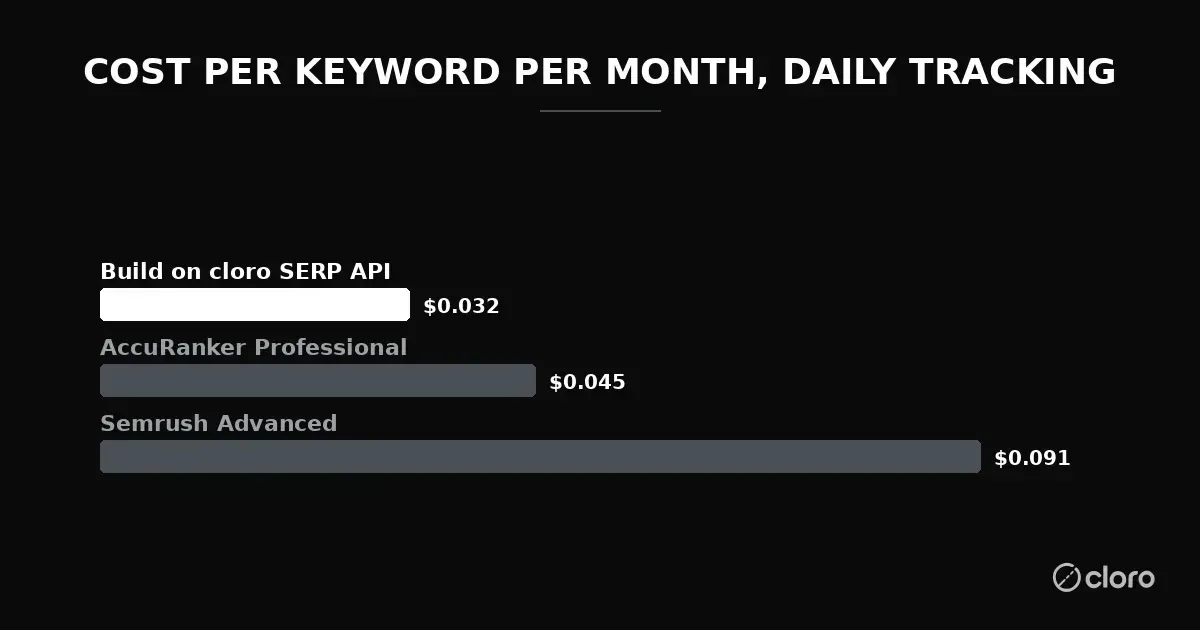
Hosted trackers, the buy path, bill per keyword tracked rather than per call, so the useful comparison is monthly cost per keyword. AccuRanker’s Professional plan is $224 a month for 5,000 keywords, which is about $0.045 per keyword each month. Semrush Advanced works out to roughly $0.091 per keyword. Nightwatch and the others cluster in the same $0.03 to $0.09 band.
Put the two paths side by side at the same cadence. Building on cloro costs about $0.032 per keyword per month of daily tracking. Buying costs $0.03 to $0.09 per keyword per month.
The takeaway: at a few thousand keywords the gap is trivial and the tracker wins on convenience. Past roughly 25,000 a day the savings start to outweigh the engineering work. At 100,000 the gap is real money, and at a million it is the difference between a line item and a hiring decision.
Sticker price is only part of the comparison. The build path bills you only for calls you actually make, so a keyword you pause stops costing money the same day. Hosted trackers bill for the plan tier regardless of how many of those keywords moved. That elasticity matters for seasonal campaigns and churny client rosters, where a third of tracked terms might sit idle in any given month.
The vendor pricing has a second limit. The published tiers simply stop. AccuRanker’s public tiers stop at $764/month for 25,000 keywords; beyond that you contact sales. Every major tracker does the same.
At true enterprise volume you have stopped comparing list prices. You are weighing a transparent per-call SERP rate against an opaque custom quote. That opacity, more than the raw cost, is why large teams build.
White-label rank tracking: the agency margin math
White label rank tracking is where the economics get most interesting, and it carries the highest cost-per-click of any keyword in this space. Agencies want more than cheap tracking. They want to resell it under their own brand at a markup.
The buy path for white label rank tracking is a rebrandable SaaS dashboard. AgencyAnalytics charges $20 per client each month plus $41.67 per 500 keywords for its rank tracker add-on. So a single client tracking 500 keywords under your logo costs about $62 a month before you mark it up. Nightwatch’s Agency plan is EUR 399 a month for 7,500 keywords, with white-label reports bundled from its Professional tier.
The build path for white label rank tracking is a white-label SERP tracking API running under your own dashboard. Tracking 500 keywords a day for one client on cloro costs about $16 a month in SERP calls, with no per-client SaaS fee and no per-seat charge. You keep the difference between that $16 and whatever you bill the client, and you own the interface, the position methodology, and the export format.
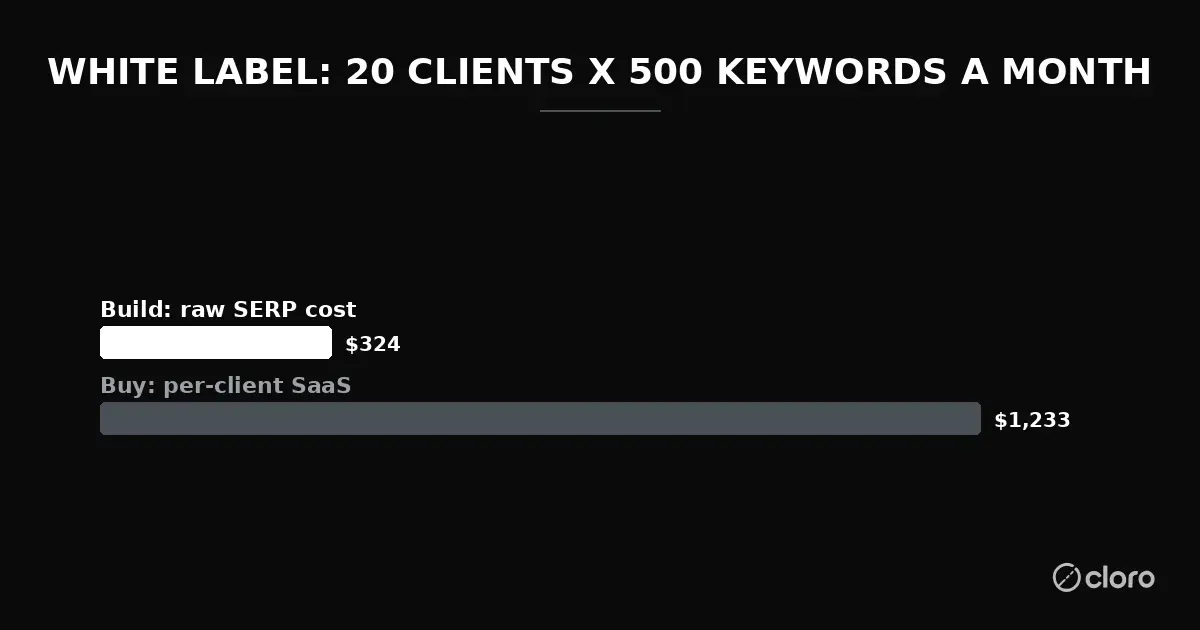
That margin compounds across a client roster. Twenty clients at 500 keywords each is a $1,233 monthly SaaS bill on the per-client model, versus roughly $324 in raw SERP cost on a build. Add the dashboard work you would do once, and the build still clears. For an agency, white label rank tracking is a product line with its own margin. Agencies at any real client count build the setup rather than rent it.
Track AI Overviews and SERP features next to positions
A position alone no longer tells you whether a ranking earns traffic. Position still matters: TapClicks cites FirstPageSage data showing the top three organic results take 68.7% of Google clicks. But as AgencyAnalytics notes, when an AI Overview, featured snippet or People Also Ask box answers the query above the organic results, a position-one ranking can still mean zero clicks.
So store the SERP features with every snapshot: whether an AI Overview rendered, whether your domain is cited in it, and which features sit above your first organic result. On cloro, capturing the AI Overview adds 2 credits to the 3-credit Google Search call, so budget two-thirds more credits for the keywords where you track it. Tracking it on the commercial subset, rather than the full keyword set, keeps that cost contained.
Reference architecture for enterprise-scale daily tracking
What makes enterprise rank tracking hard is everything around the SERP calls. A million checks a day is a distributed-systems problem, and getting it wrong shows up as missing data on the exact day a client asks about a ranking drop. Four patterns carry most of the weight.
Queueing: spread large volumes of rank checks over time
When you run hundreds of thousands of rank checks, firing them all at once is not practical. A queue spreads them across a time window and keeps you inside the API’s rate limits, so the run finishes instead of collapsing at the peak.
A scheduler enqueues one job per keyword-location-device each morning, and a fleet of workers pulls from the queue and calls the SERP API. A durable queue like SQS, Redis Streams, or a Postgres job table is enough to start.
Retries: survive transient failures without double-counting
SERP fetches fail for transient reasons: timeouts, captchas, the occasional bad gateway. Wrap every call in exponential backoff with jitter, and cap the retries so a permanently failing keyword does not loop forever.
Route exhausted jobs to a dead-letter queue you inspect daily. An idempotency key of keyword plus location plus device plus date keeps a retried job from writing a duplicate snapshot.
Dedup: fetch each SERP once, fan out to every tenant
At agency scale, many clients track the same keyword in the same market. Deduplicate by a canonical key of query, location, device, and date, fetch that SERP once, and fan the parsed result out to every client who needs it. On a shared keyword set this cuts SERP spend sharply, because you pay for the search once per day rather than once per tenant.
Storage: keep every snapshot so old reports still reconcile
A client asking about a ranking drop from March needs March’s data as it was, which an overwriting table cannot give them. Store append-only SERP snapshots, never overwrites, so historical reports stay reproducible. Keep both rank_absolute and rank_group plus the full SERP envelope, partition tables by date, and land it all in a warehouse your BI tools already read. Warehouse-native storage is what lets enterprise rank tracking answer questions months later, well past the point where today’s number is interesting. For the uptime, latency, and concurrency side of running this in production, cloro’s write-up on SERP API reliability at scale goes deeper than there is room for here.
None of this is exotic, but all of it is work, and it is the real cost of the build path that a raw per-call price hides. Budget for engineering time as well as API credits.
Build vs buy: how to actually decide
The decision comes down to volume, engineering capacity, and how much you care about owning your data.
Buy when you track under about 5,000 keywords, have no engineers to spare, and just need clean charts. At that scale a hosted tracker like AccuRanker’s $224 Professional plan, costed in the model above, genuinely beats building on total cost of ownership, because your engineering time is worth more than the savings.
Build when you cross roughly 25,000 keywords a day, want warehouse-native reporting, need a custom definition of “position,” or plan to resell tracking under your own brand. The tipping point usually arrives when your tracker invoice, your reporting limitations, and your margin ambitions all point the same direction at once. Past that ceiling the trackers go quiet on price anyway, and enterprise rank tracking on a SERP API gives you a transparent per-call rate that scales linearly to a million keywords and beyond.
To run the numbers for your own volume, the Rank Tracking API use case covers the call shape and the cloro pricing page has the credit rates used throughout this guide. If you are still deciding between building and buying a dashboard, the rank tracking software roundup compares the twelve managed platforms on cadence, geo-precision, and enterprise scale.

About the author
Ricardo Batista
Founder, cloro
Ricardo is one of the founders and engineers behind its SERP and AI-search scraping infrastructure. Before cloro he scaled a financial comparison site to $7M ARR and ran the full-country operations of a unicorn to $65M ARR, then went back to building. He writes about search engine scraping, generative-engine optimization, and turning live search and AI-answer data into something teams can act on.
Frequently asked questions
What is enterprise rank tracking?
Enterprise rank tracking is daily monitoring of search positions at large scale, typically tens of thousands to millions of keyword-location-device combinations checked every day, with every result stored for historical reporting. Unlike small-business tracking, it forces a build-versus-buy decision because the volume makes per-keyword SaaS pricing expensive.
Is it cheaper to build rank tracking on a SERP API or buy an enterprise rank tracker?
It depends on volume. Below about 5,000 keywords, buying a hosted tracker is cheaper once you count engineering time. Above roughly 25,000 keywords a day, building on a SERP API costs around $0.001 per check and scales linearly, while hosted trackers move to custom enterprise quotes, so building usually wins on both price and control.
What is white label rank tracking?
White label rank tracking is rank tracking that an agency resells to clients under its own brand. It can be rented as a rebrandable SaaS dashboard, or built by running a SERP API behind the agency's own interface, which removes the per-client software fee and lets the agency keep the full margin.
How many keywords can enterprise rank trackers handle?
Off-the-shelf trackers publish plans up to roughly 25,000 keywords; beyond that they switch to custom "contact sales" pricing. A SERP API has no such ceiling, so teams tracking hundreds of thousands or millions of keywords a day generally build on an API rather than buy a seat.
Related reading
Best Rank Tracking Software 2026: 12 Tools Tested
Compare the 12 best rank tracking software tools for 2026 by daily cadence, accuracy, and enterprise scale, scored against live SERP data.

SERP API Reliability at Scale: Uptime, Latency, Concurrency
SERP API reliability at 10k+ daily requests — uptime SLAs, latency under load, and concurrency across cloro, SerpAPI, DataForSEO, and Bright Data.

Google Alerts API: It Doesn't Exist, So Build This Instead
There is no Google Alerts API and never has been. Here's why free alerting lags breaking news, plus a full build-your-own alerts pipeline in Python.