
Best Local SEO Tools 2026: Tested Against Live Geo-SERPs

On this page
Local SEO tools used to answer one question: where do we rank in the map pack? In 2026 that question has a location attached to every answer, and the tools split by how well they handle it.
Broadly there are three kinds. Geo-grid trackers query rankings from dozens of points across a service area and draw a heatmap, because a business can be #1 on one block and off the map two miles away. GBP and citation suites manage the Google Business Profile, clean up listings, and chase reviews. And suite modules add a local layer to a general SEO platform you already run. “Local SEO software” and “local SEO tools” get used interchangeably (the search results for both terms return the same pages), so this guide treats them as one decision.
This is the local-first companion to our general best rank tracking software roundup. If you want the raw ranking data rather than a dashboard, skip to the API options at the end or read the local rank tracking use case. Everyone else: start with what a geo-grid actually measures, because it changes how you read every tool below.
What geo-grid rank tracking is (and why a single rank misleads)
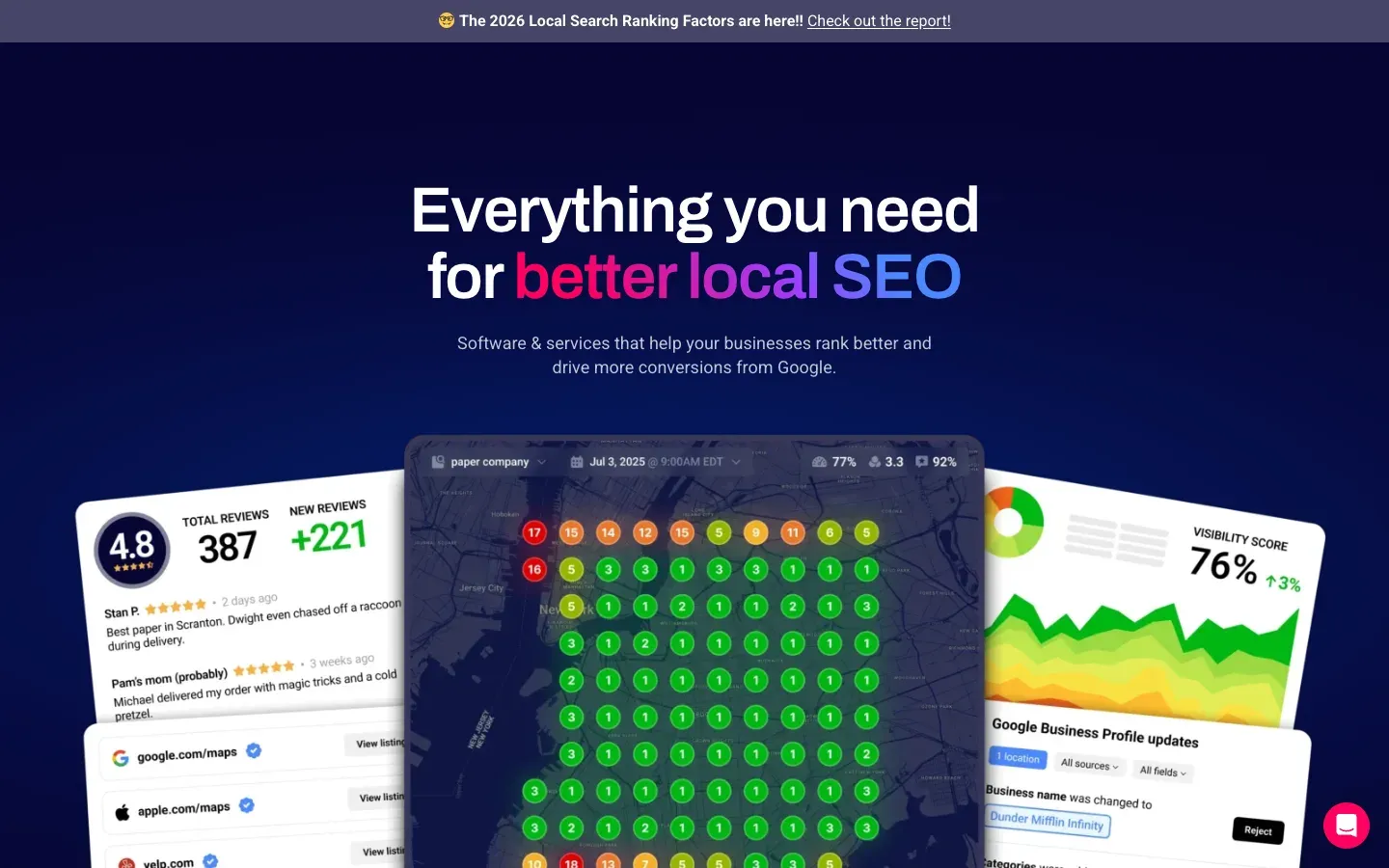
A geo-grid rank tracker lays a grid of scan points over a map (say a 5×5 or 9×9 grid across a city) and checks your ranking for a keyword from each point’s location, then colors each cell by position. The result is a heatmap of where you win and where you vanish, instead of one number that averages the whole city into a lie.
The reason this matters is mechanical. Google localizes results using the searcher’s location, encoded in the uule parameter. It is a canonical geotarget that lets a query “spoof its GPS coordinates without moving”, so a business ranking #1 in North Austin might be #10 in South Austin. A tool that geolocates by coarse country or region, or reports a single position per keyword, throws that variance away.
How much variance? In our own live-SERP grid (a 97-keyword × 20-city scrape), the top-10 results differed city-to-city by a mean local variance of 0.82 (0 = identical everywhere, 1 = completely different). “Emergency dentist” returned 19 different #1 results across 20 cities; “wine bar” and “pediatrician” hit a full 20. Point precision isn’t a nice-to-have for local; it’s the whole measurement. That is why a “geo grid rank tracker” is a distinct product category and why tools like Local Falcon exist at all. They turn that variance into something you can see and act on.
The 10 best local SEO tools for 2026
The list runs in rough order of how local-first each tool is: geo-grid specialists first, then all-in-one local suites, then the suite modules and the build-your-own APIs. Match the entry to your job. There is no universal winner.
1. Local Falcon: best geo-grid rank tracker
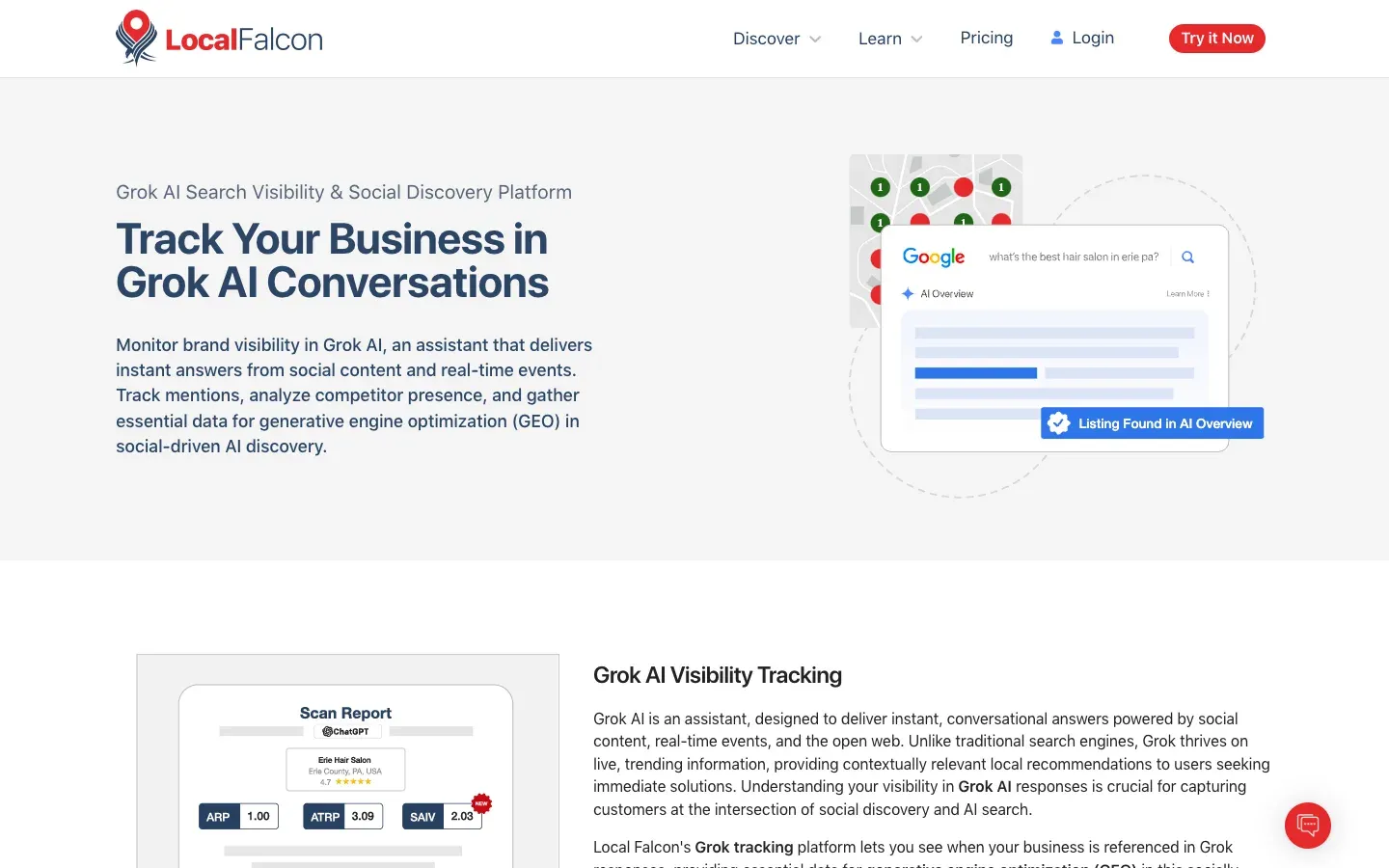
Local Falcon is the category-defining geo-grid tool. You pick a grid size (the 9×9 grid is its most popular) and a radius by market type. Radii run roughly two miles for urban, five for suburban, and ten for rural. Each scan returns a map grid you open as a Scan Report. It reports Share of Local Voice (SoLV) and Average Map Rank so you can track dominance across the whole service area, and it has added AI Search Visibility Tracking for answer engines.
If your question is “how far does my map-pack visibility reach from my storefront,” this is the cleanest answer on the market.
Best for: multi-location and service-area businesses proving map-pack reach. Watch out for: scan-credit pricing scales with grid size × keywords × frequency, so dense daily grids add up.
2. Local Viking: best budget geo-grid + GBP posting
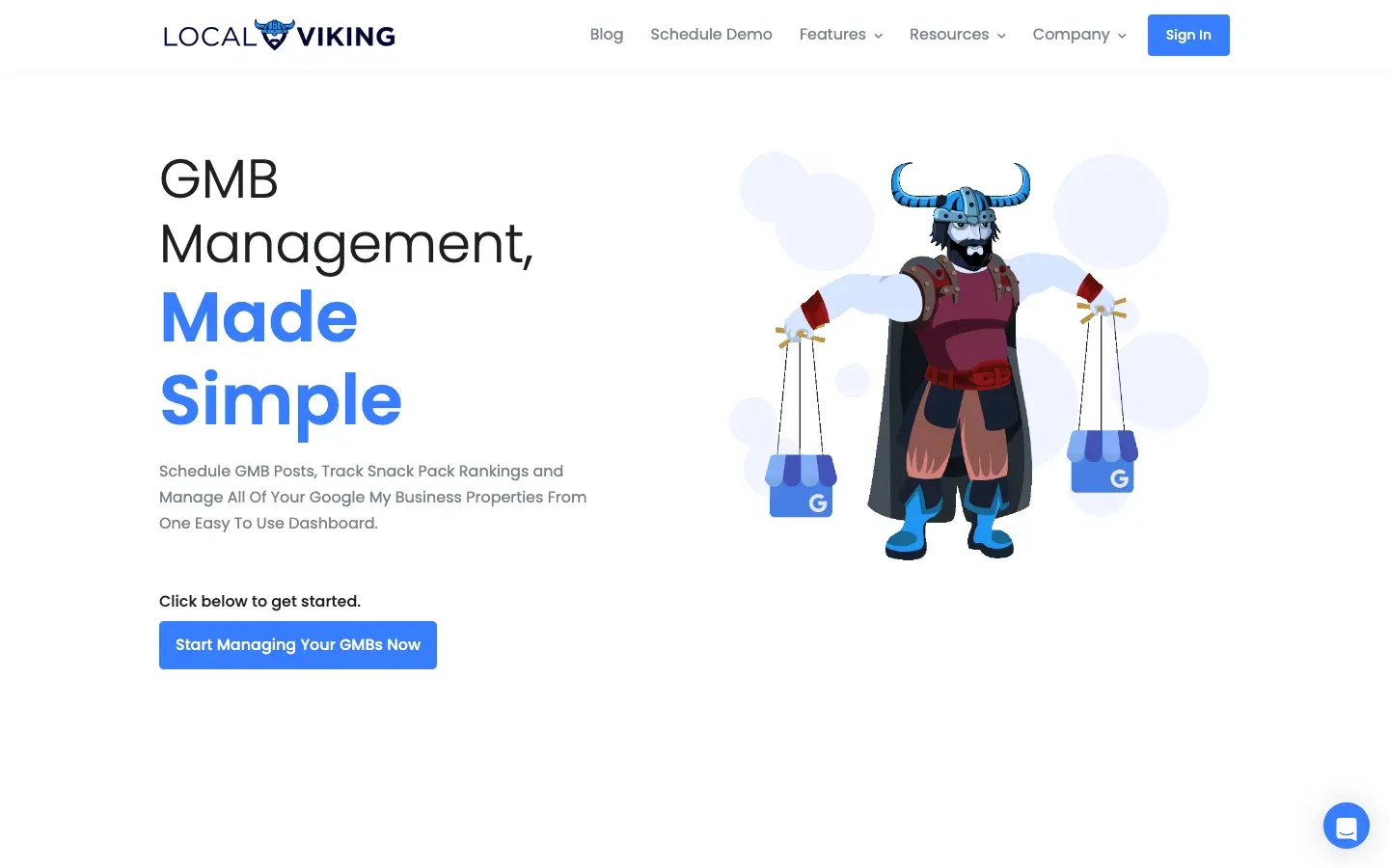
Local Viking pairs GeoGrid Visibility Tracking powered by the Google Places API with Google Business Profile post scheduling (recurring posts, bulk posting to multiple locations, suspension alerts) in one cheaper package. It is the most common Local Falcon alternative for teams that want geo-grid tracking and day-to-day GBP management without paying for two tools.
Best for: agencies wanting geo-grid + GBP posting in a single budget tool. Watch out for: the grid and reporting are less deep than Local Falcon’s; it is a workhorse, not a microscope.
3. BrightLocal: best all-in-one local suite
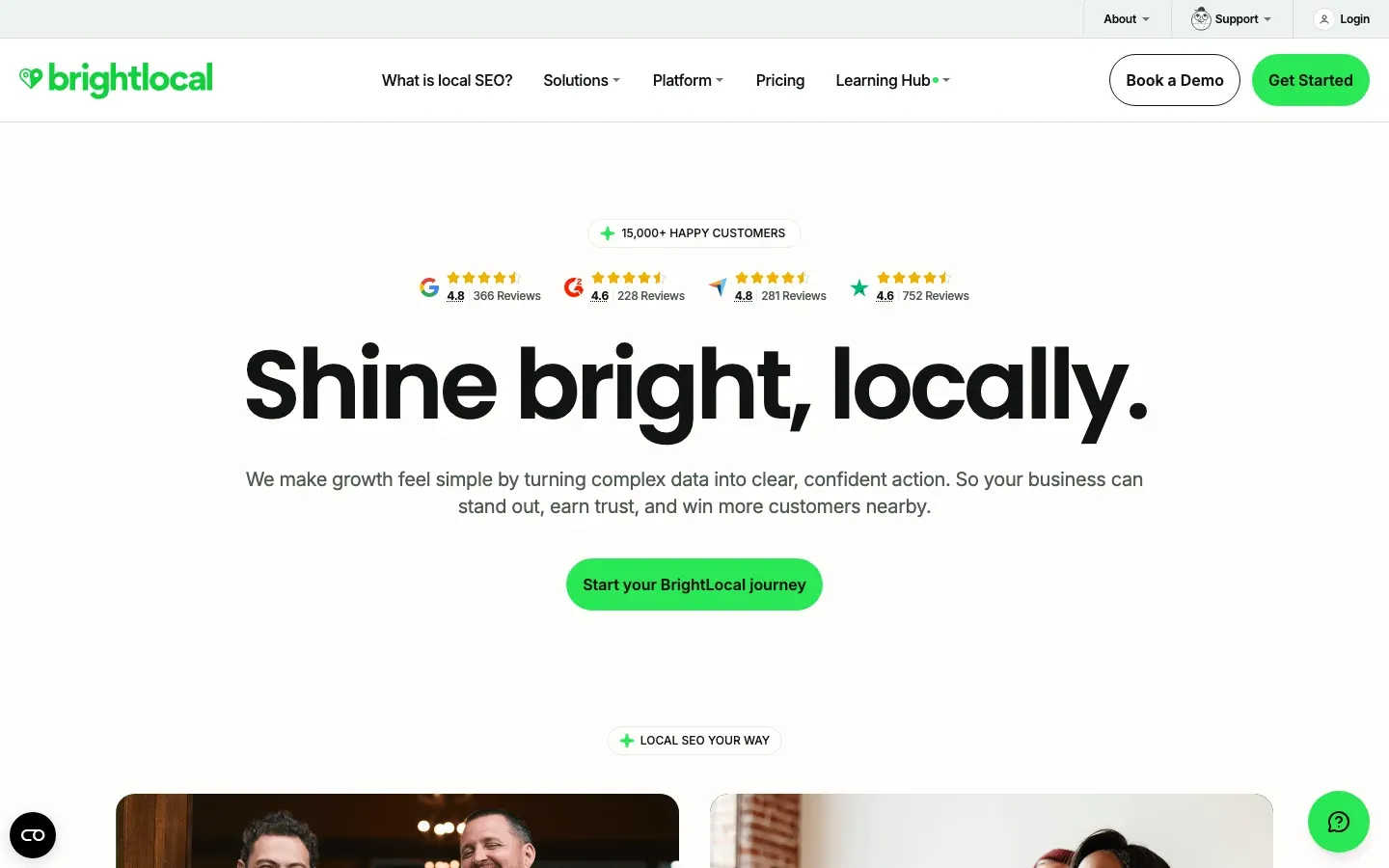
BrightLocal is the Swiss-army suite for local. It runs a Local Rank Tracker across Local Pack, Organic and Map results on Google and Bing, a Local Search Grid heatmap, a Citation Builder, GBP audits, and review management across 80+ review sites. For most small businesses and the agencies that serve them, it covers rank, citations, and reputation in one dashboard rather than three subscriptions.
Best for: SMBs and agencies wanting rank + citations + reviews in one place. Watch out for: the grid is solid but not as granular as a dedicated geo-grid specialist.
4. Whitespark: best for citations
Whitespark has been the citation authority since 2005 and now serves 150,000+ users; its Local Citation Finder and citation-building/listing-cleanup service are what it is known for, backed by a Local Rank Tracker, Local Ranking Grids, and GBP tools. Citations (consistent name, address, phone across the directories that feed local search) are unglamorous foundation work, and this is the tool built for it.
Best for: fixing the NAP and citation base before you chase rankings. Watch out for: if you don’t have a citation problem, you’re paying for its strongest muscle and using the rest.
5. Semrush Local: best if you already run Semrush
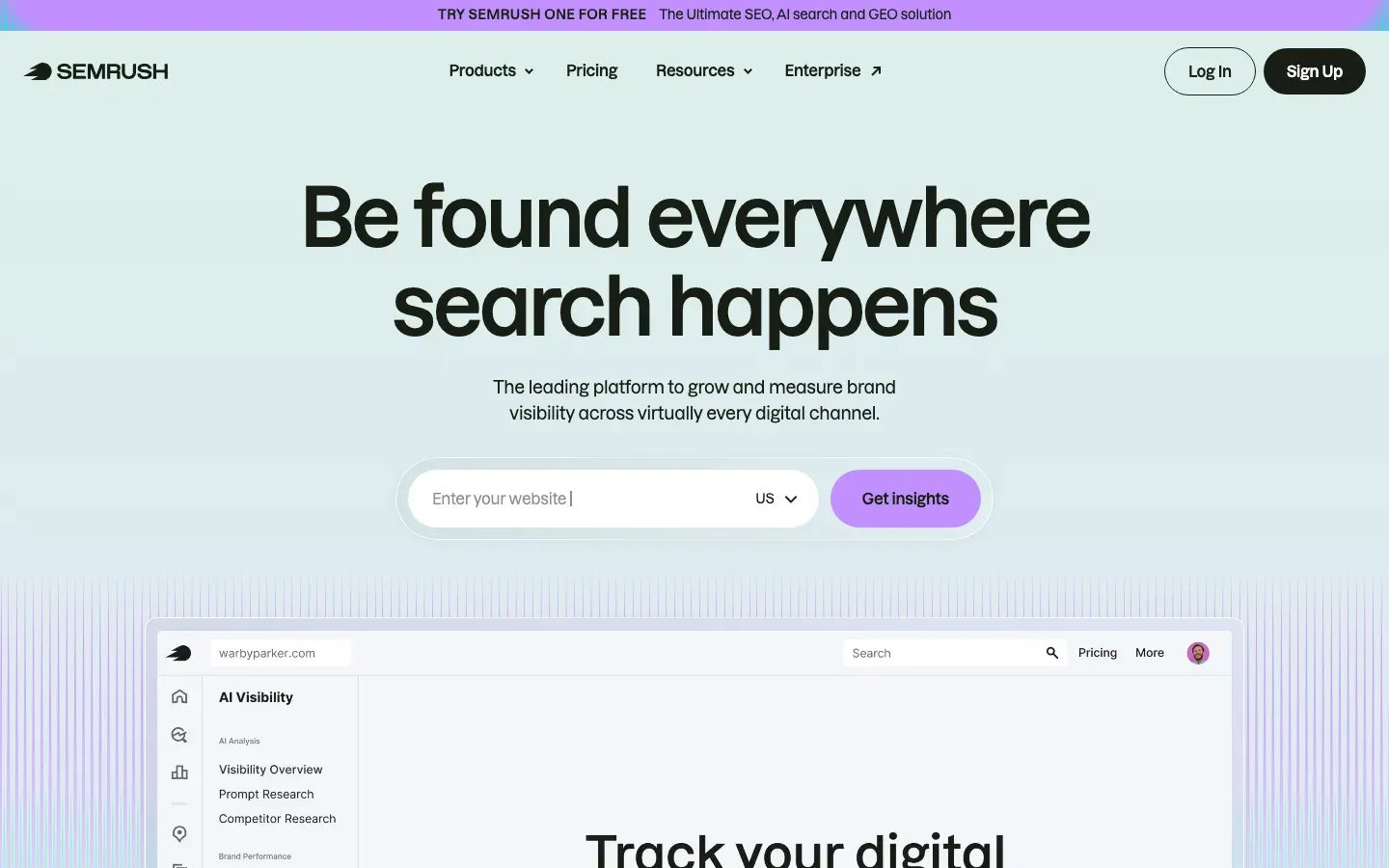
Semrush’s local layer adds a Map Rank Tracker for Google Maps and Position Tracking down to ZIP-code level and in local packs, plus Listing Management and Review Management. It rarely justifies a subscription on its own, but if your team already lives in Semrush for keywords and backlinks, the local module keeps everything in one report.
Best for: existing Semrush teams adding a local view. Watch out for: the Local toolkit is a paid add-on on top of the base plan.
6. Ahrefs: best for diagnosing why a local rank moved

Ahrefs isn’t a dedicated local suite, but its Rank Tracker targets by country, city, and device with daily updates, and its real strength is context: when a local keyword drops, you can pull the SERP history and inspect the backlinks and content of whatever page overtook you without leaving the tool. That diagnostic depth is why it stays on many local practitioners’ shortlists.
Best for: connecting a local drop to the pages and links that caused it. Watch out for: no geo-grid heatmap. This is city-level tracking, not a map of points.
7. SE Ranking Local: best value agency all-in-one
SE Ranking’s Local Marketing Tool bundles a Local & Map Rank Tracker, GBP Posts Scheduler, Listing Management and Reviews Management, is built to manage multiple client locations from one dashboard, and offers a White Label add-on. It undercuts the bigger suites while covering the agency essentials, which makes it the value pick for client work.
Best for: budget-conscious agencies needing white-label local reporting. Watch out for: white-label is an add-on, so price it into the plan.
8. GeoRanker: best local rank tracking API
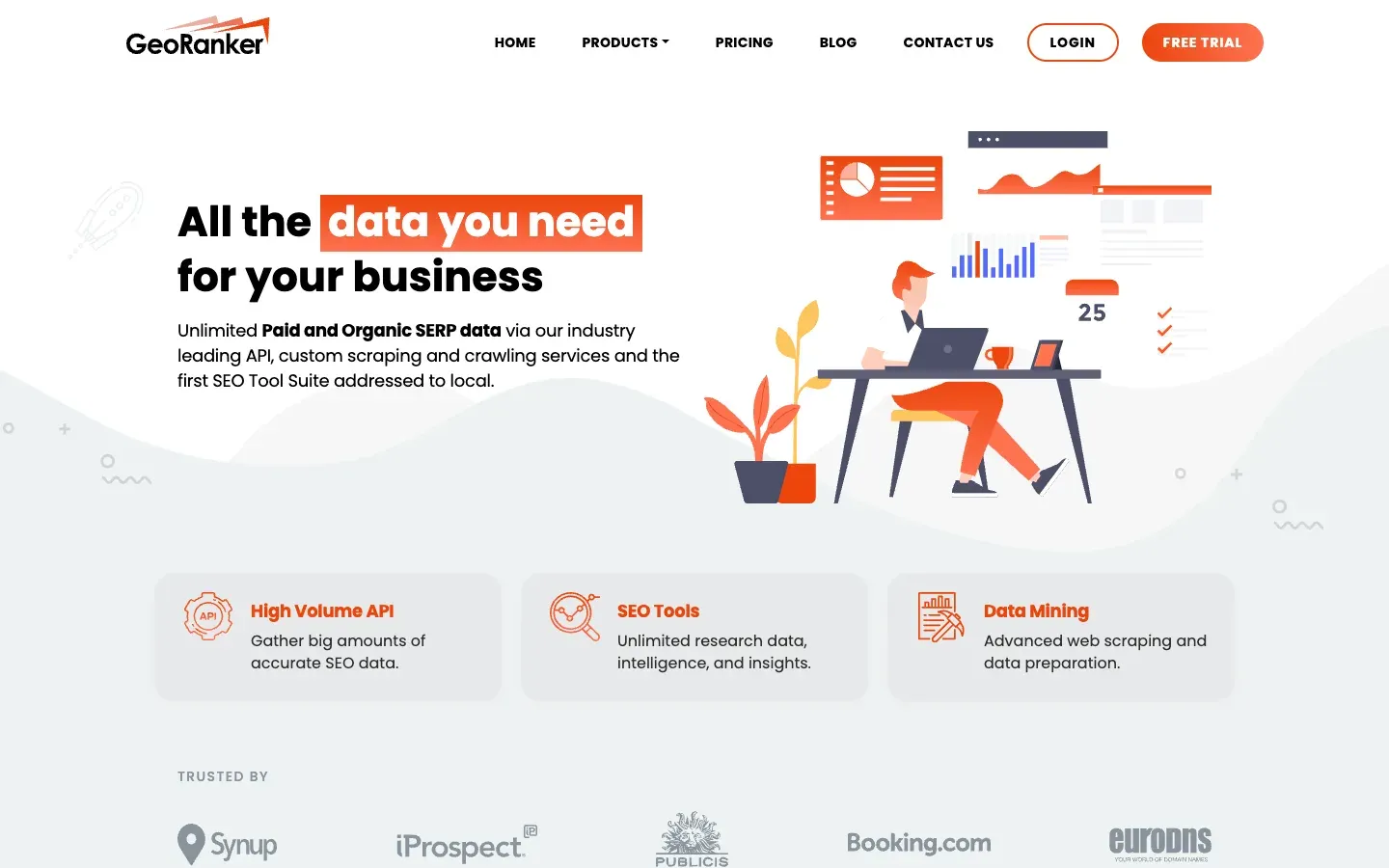
GeoRanker is the developer-flavored option: a Rank Tracker API returning fresh local keyword ranking data from any location, plus paid and organic SERP data, in a High Volume API suite. If you’d rather pipe local ranks into your own dashboard than click around someone else’s, it is a buy-not-build shortcut to the data layer.
Best for: developers and agencies wiring local ranks into custom reporting. Watch out for: you’re buying a data feed, not a polished UI. Someone has to build the front end.
9. Localo: best AI-guided tool for solo owners
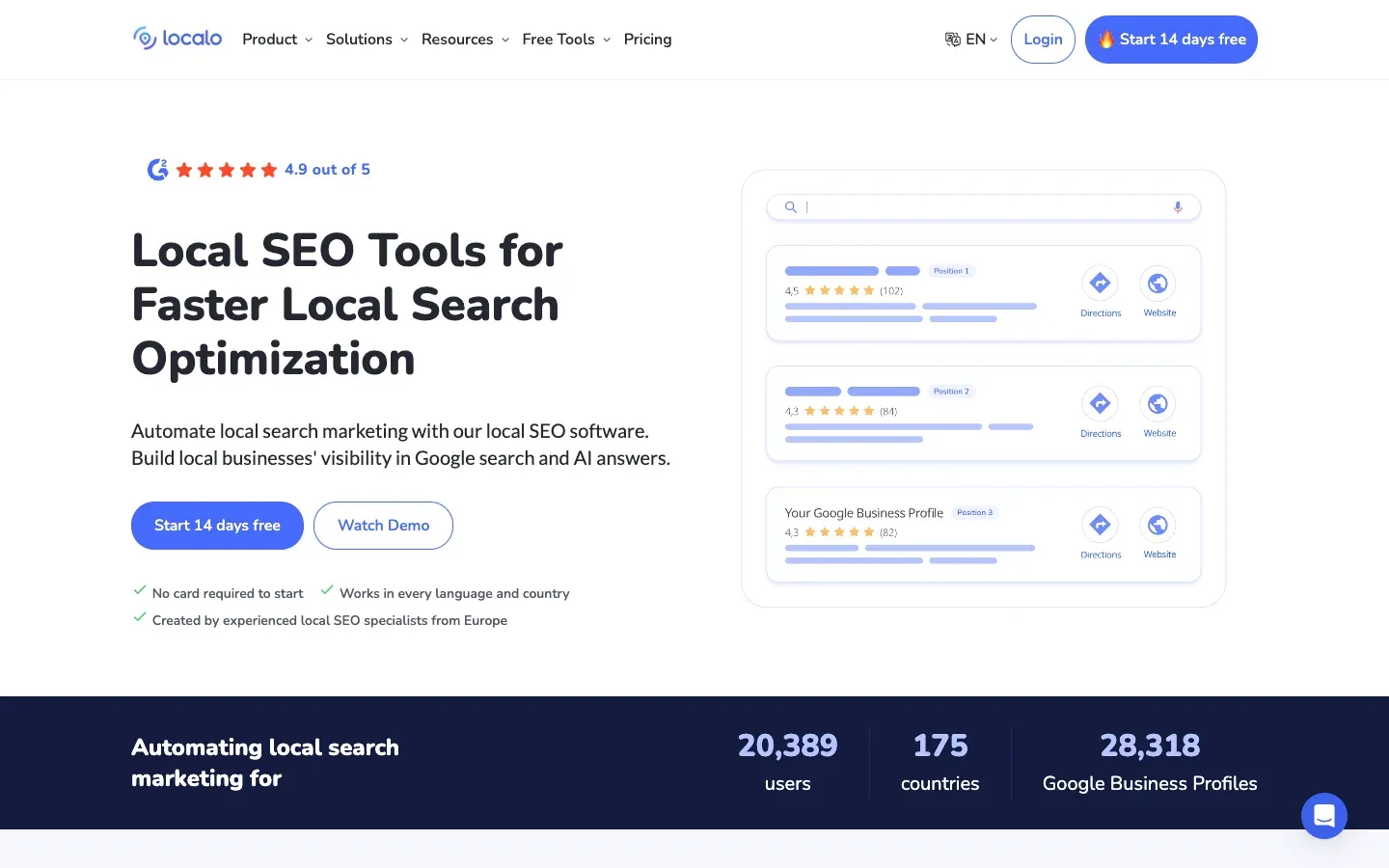
Localo ranks #1–2 for the head term itself and earns it with a different pitch: an AI-guided assistant that hands a single-location owner a prioritized task list for GBP optimization and local rank tracking, rather than a dashboard to interpret. For a busy owner who wants to be told what to do next, that guidance beats raw data.
Best for: solo and single-location owners who want guided tasks. Watch out for: the hand-holding that helps a beginner can feel thin for an agency running dozens of locations.
10. cloro: best for building your own local tracking
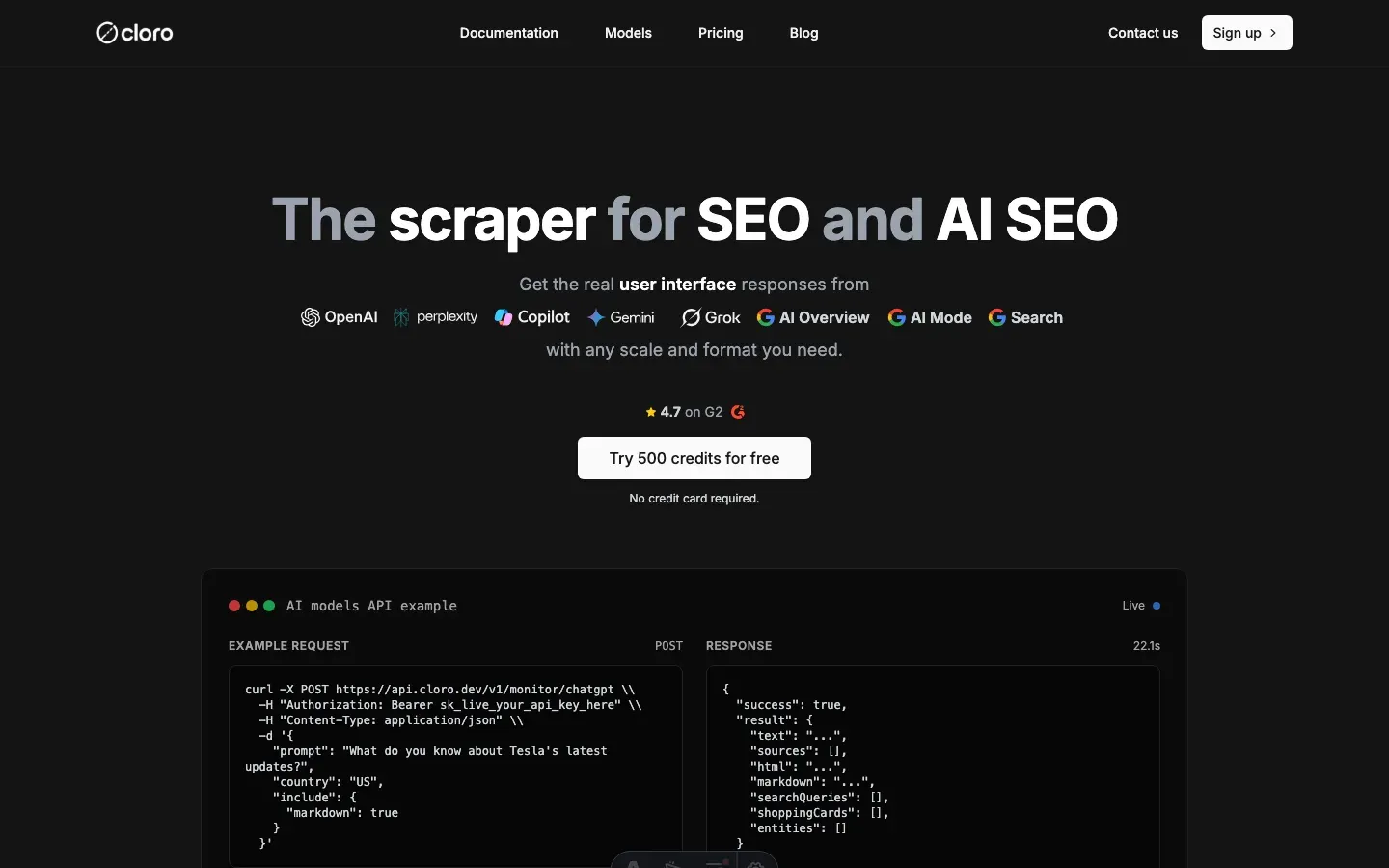
If none of the dashboards fit your workflow, skip the dashboard. cloro is a SERP-monitoring API that returns the same Google SERP a customer in a given city sees across roughly 100,000 geotargets, at the same per-call price as a country-level request, and handles the uule geo-targeting encoding for you so you get city-level results without doing the base64 math. You get structured local-pack and organic JSON to power your own tool, client reports, or geo-grid: the same kind of raw SERP data layer the dashboards above sit on top of.
Best for: teams productizing their own local tracking or geo-grid. Watch out for: it’s an API, not an app. You own the interface and the interpretation.
Quick integration guide: the google-search-scraper README walks through Python, cURL, and Node.js requests for geo-targeted SERPs, local-pack extraction, and per-city rank tracking.
Local SEO tools at a glance
| Tool | Category | Geo-grid | GBP / citations | API | Best for |
|---|---|---|---|---|---|
| Local Falcon | Geo-grid specialist | ✅ | Partial | ✅ | Map-pack reach across a service area |
| Local Viking | Geo-grid + GBP | ✅ | ✅ | — | Budget geo-grid + GBP posting |
| BrightLocal | All-in-one local | ✅ | ✅ | — | Rank + citations + reviews in one place |
| Whitespark | Citations + grids | ✅ | ✅ | — | Citation and NAP foundation |
| Semrush Local | Suite module | — | ✅ | ✅ | Existing Semrush teams |
| Ahrefs | Suite module | — | — | ✅ | Diagnosing why a rank moved |
| SE Ranking Local | Agency all-in-one | ✅ | ✅ | ✅ | Value white-label agency work |
| GeoRanker | Local rank API | ✅ | Partial | ✅ | Piping ranks into your own tool |
| Localo | AI local assistant | ✅ | ✅ | — | Guided solo/single-location |
| cloro | Data-layer API | Build it | Data only | ✅ | Building your own local tracking |
The takeaway: only SE Ranking Local checks all three boxes (geo-grid, GBP/citations, and an API). Everyone else trades one off, so picking on price alone usually means pairing a specialist tool with a second subscription, or a data feed, to cover what the first one skips.
What actually makes a local SEO tool accurate (and how we’d referee one)
Every tool on this list claims accurate local data. The claim is easy to make and hard to check, so don’t take it. Test it. Two things decide whether a local number matches reality, and neither is the vendor’s badge: geo-precision and freshness.
Geo-precision is the one most tools quietly fail. As covered above, our 20-city grid showed a mean local variance of 0.82 across the top-10. The difference between two neighborhoods is often the entire result set. A tool that can target at city or ZIP/point granularity is measuring the right thing; one that reports a regional average is measuring a fiction, however clean its SERP parsing looks.
Freshness is the second axis. Local rankings don’t sit still: in our rank-volatility study, the #1 organic result changed on 31.7% of consecutive days across a 200-keyword daily cohort. A weekly-refresh plan is therefore already stale on roughly a third of the daily movement: the position it shows you is last week’s. Daily is the floor for anything you report to a client.
So how would we referee a specific tool? With a controlled check you can run yourself, rather than a vendor comparison chart. Pick a keyword and an exact city or zip. Pull the tool’s reported position for that pair. In the same hour, pull a scrape geo-targeted to the same location (from a raw SERP API like cloro, or a manual incognito check with the location set) and compare the two. Repeat across a handful of your real keywords and markets. If the tool tracks a same-hour, same-location scrape within a position or two, trust it; if it drifts three-plus positions or can’t target the location at all, you’ve found its ceiling. That is the test that matters, and it’s the one we’d run before signing any contract. (We haven’t published a head-to-head accuracy score for these specific tools, so we won’t invent one. The method above is how you’d generate your own.)
Accuracy, in other words, is geo-precision × freshness verified against ground truth, not a number on a pricing page.
What local SEO tools cost, and whether you can do it yourself
Entry prices are lower than most SEO suites, but the headline plan rarely covers the whole job. These are the starting prices one 12-tool comparison lists, billed annually:
| Tool | Starting price | Free option |
|---|---|---|
| Google Business Profile | Free | Yes |
| Moz Local | $16/month per location | No |
| Local Falcon | $24.99/month | No |
| Semrush Local | $30/month add-on | No |
| BrightLocal | $31/month | 14-day trial |
| Localo | $32.42/month | 14-day trial |
| Whitespark | $33/month | Limited |
| SE Ranking | $103.20/month | 14-day trial |
Two costs sit outside those numbers. Local Falcon uses one credit per grid point, so an 11×11 scan costs about $0.40 and daily grids across many locations burn credits fast. Semrush Local is an add-on, so a team without Semrush pays the $139.95/month core plan first.
Can you do local SEO yourself?
Yes. A single-location owner can claim and complete the Google Business Profile, keep the name, address, and phone consistent across directories, ask for reviews, and check rankings with free tools. Google Business Profile is free but does not cover all of your SEO needs: it will not show where you rank across your service area or how competitors move. That is the point where a $16 to $33 tool pays for itself.
How to choose
Skip the feature-count comparison and pick on your actual job:
- Single location, owner-operated → Localo or BrightLocal. Guidance and coverage beat raw depth.
- Service-area, map-pack visibility → Local Falcon, or Local Viking if budget is tight. You need the geo-grid, not a single rank.
- Already paying for a suite → turn on Semrush’s or Ahrefs’ local layer before buying anything new.
- Agency, multi-client → SE Ranking for value white-label, BrightLocal if you also want citations and reviews.
- Building your own reporting → cloro or GeoRanker for the API data layer.
Then, whatever you pick, run the referee test above: one keyword, one exact city, the tool’s number against a same-hour geo-targeted scrape. Local SEO tools earn trust by matching ground truth, not by claiming to. Get that right and the tool becomes a steady read on where your customers actually find you, block by block.
If you’d rather own that data outright and build local tracking into your own product or client reports, cloro exposes the raw, geo-targeted SERP layer via a simple API: the same results your customers see, from ~100,000 locations, in structured JSON.
Local SEO agency software: multi-client and white-label
Agencies shop for something narrower than “local SEO tools”: local SEO agency software that is multi-client, multi-location, and ideally white-label. The requirements are specific. You need client sub-accounts so one login manages many businesses, bulk location handling so onboarding a franchise isn’t a hundred manual setups, scheduled reports, and white-label output so the dashboard and PDFs carry your brand, not the vendor’s.
Among the tools here, a few are built for it. SE Ranking’s Local Marketing Tool manages multiple client locations from one dashboard with a White Label add-on, which makes it the value pick for client work. BrightLocal’s suite and multi-location reporting suit agencies that also want citations and reviews under one roof; Whitespark scales to enterprise and multi-location citation work; and Local Viking’s bulk GBP posting across locations fits agencies whose deliverable is profile management, not just reports.
The other path suits teams that want the raw data rather than a finished dashboard. If your reports are a differentiator, an API lets you own them end to end: GeoRanker’s Rank Tracker API returns local ranking data from any location, and cloro returns the same city-level Google SERP your client’s customers see across ~100,000 geotargets as structured JSON you can pour into a branded dashboard or a geo-grid of your own. Be honest about the cost trade: off-the-shelf agency software is a monthly fee and zero engineering; the build-your-own path trades that fee for developer time and maintenance, and only pays off at the scale (or the margin) where a proprietary report wins the client.

About the author
Ricardo Batista
Founder, cloro
Ricardo is one of the founders and engineers behind its SERP and AI-search scraping infrastructure. Before cloro he scaled a financial comparison site to $7M ARR and ran the full-country operations of a unicorn to $65M ARR, then went back to building. He writes about search engine scraping, generative-engine optimization, and turning live search and AI-answer data into something teams can act on.
Frequently asked questions
What are local SEO tools?
Local SEO tools help a business rank in location-based search: the Google map pack, local organic results, and Google Business Profile. They fall into three groups: geo-grid rank trackers that map where you rank across a service area, GBP and citation suites that manage your profile, listings, and reviews, and local modules built into general SEO suites like Semrush and Ahrefs. 'Local SEO software' and 'local SEO tools' are used interchangeably and return the same search results.
What is the difference between local SEO tools and local SEO software?
There is no meaningful difference. The terms are used interchangeably, and searches for both return the same pages. 'Software' sometimes implies a fuller multi-feature platform (rank tracking plus citations plus reviews) while 'tools' can mean a single-purpose utility like a geo-grid tracker, but no line is drawn consistently across the industry. Shop by the job you need done, not the label.
What is a geo-grid rank tracker?
A geo-grid rank tracker lays a grid of scan points over a map (for example a 5x5 or 9x9 grid across a city) and checks your ranking for a keyword from each point's location, then draws a heatmap of where you win and where you disappear. It exists because local rankings vary block to block: in cloro's own 20-city grid, the query 'emergency dentist' returned 19 different number-one results across 20 cities. Local Falcon, Local Viking, and BrightLocal's Local Search Grid are common geo-grid tools.
What is the best local SEO tool for a small business?
For a single-location owner, Localo (AI-guided task lists) or BrightLocal (an all-in-one suite covering rank, citations, and reviews) are the usual best fits. Coverage and guidance matter more than depth at that scale. If your priority is proving map-pack visibility across a service area, a geo-grid tracker like Local Falcon is the better choice.
What is the best local SEO agency (white-label) software?
For multi-client, white-label local work, SE Ranking's Local Marketing Tool is the value pick: it manages multiple client locations from one dashboard with a White Label add-on. BrightLocal suits agencies that also want citations and reviews under one roof, and Whitespark scales to enterprise citation work. Agencies that want to own their reporting can build on a local rank tracking API such as cloro or GeoRanker instead of reselling a dashboard.
Do I still need a local SEO tool if I have a Google Business Profile?
Yes. Google Business Profile lets you manage your listing, but it doesn't tell you where you rank across a service area, track competitors, monitor citations, or measure your visibility block by block. A local SEO tool adds the geo-grid rank tracking, citation management, and reporting that GBP alone can't provide. Local rankings also vary enough by location that a single 'how am I doing' view is misleading without one.
Can I do local SEO myself?
Yes. A single-location owner can complete the Google Business Profile, keep name, address, and phone consistent across directories, ask for reviews, and check rankings with free tools. Google Business Profile is free but does not show where you rank across a service area or how competitors move, so most owners add a paid tool once they need that view. Entry plans start around $16 to $33 a month.
Related reading
Best Rank Tracking Software 2026: 12 Tools Tested
Compare the 12 best rank tracking software tools for 2026 by daily cadence, accuracy, and enterprise scale, scored against live SERP data.

Restaurant SEO in the AI Era: Where AI Gets Its Picks
Across 200 dining prompts × 6 AI engines, Google's AI Overview triggered on just 3% of 'best restaurants' queries; it defers to the local pack. Perplexity answered 100% of them but returned zero citations. The picks come from Reddit (22%), Google/Maps (19%), OpenTable (13%), and local 'best-of' lists (TimeOut, The Infatuation, Eater), almost never the restaurant's own site.

Hotel Travel SEO: Which Hotels ChatGPT Recommends
Travelers now plan trips inside ChatGPT, and when an AI answer recommends a hotel it cites Tripadvisor, Expedia, and Condé Nast Traveler far more than the property's own website. Direct hotel sites appear in about 6% of citations, and only for the largest chains. Hotel and travel SEO in 2026 is about being present in the sources AI reads.