
Attack Surface Management: The Search-Indexed Layer

On this page
Every security team has an inventory it trusts and a reality it doesn’t fully see. The inventory says you run a handful of internet-facing hosts. Reality includes a staging environment a contractor stood up in 2023, an S3 bucket someone made “temporarily” public, a status page on a third-party domain, and a config file that Google quietly indexed six months ago.
Attack surface management is the discipline of closing that gap. It means continuously discovering your own exposed assets before someone else catalogs them for you. NIST defines the underlying attack surface as the set of points on a system’s boundary where an attacker can try to enter, affect, or extract data, per the NIST glossary. External attack surface management (EASM) is the narrower job of keeping that boundary mapped from the outside.
Most external attack surface management programs lean on three well-understood discovery techniques: DNS and subdomain enumeration, certificate transparency, and IP/port scanning. Those techniques build an excellent host inventory. What they systematically underweight is a fourth layer that lives entirely inside search engines. Call it the search-indexed exposure layer: the specific pages, paths, files, and off-domain assets that a crawler has already found and published to its index.
This post maps where that layer fits. It shows a defensive build recipe for monitoring the layer against your own domains. And it shares a small own-scope study of cloro.dev that puts real, sanitized numbers on how the search-indexed view and the certificate view actually relate. The finding up front: they are complementary, not redundant, and treating the indexed layer as a first-class input closes a real blind spot.
What attack surface management actually covers
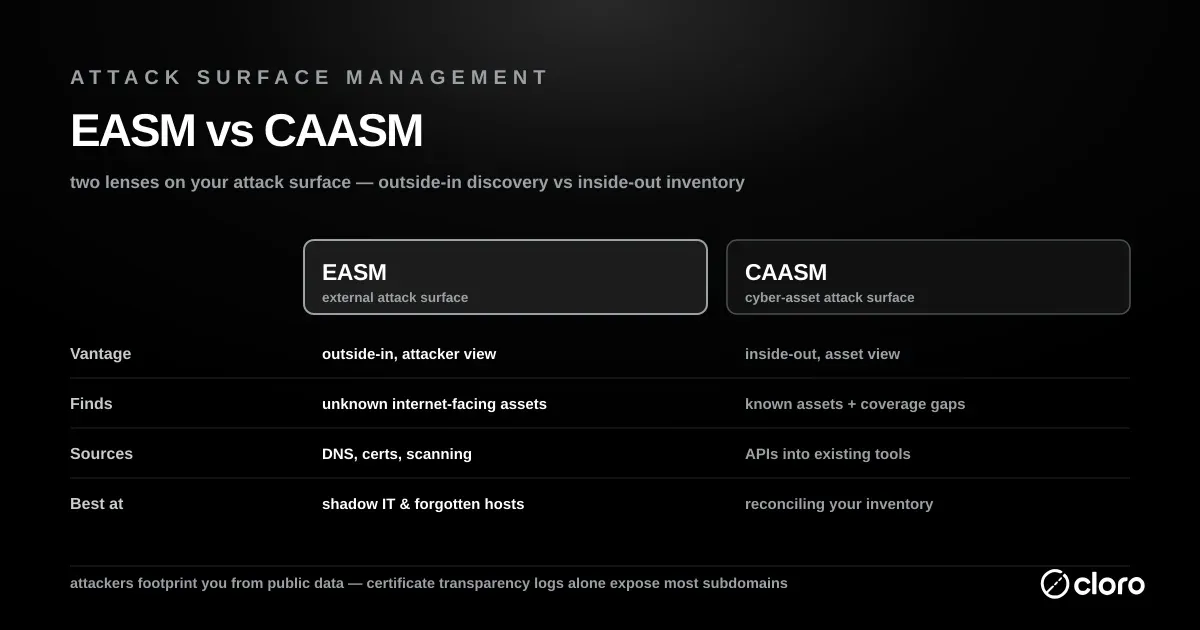
Attack surface management is the ongoing practice of answering one question on repeat: what of ours can an outsider reach right now? “External” (EASM) narrows that to the internet-facing surface: the assets reachable from the public internet without insider access. The workflow is always the same loop: discover → inventory → assess → monitor → repeat.
The reason it has to be a loop, not a one-time audit, is that the external surface only ever grows. Cloud resources spin up and down by the hour. Marketing stands up microsites on new domains. Acquisitions inherit someone else’s DNS.
SaaS integrations expose subdomains you don’t operate. A CMS auto-generates pages nobody reviews. Each of these is a new asset your last inventory doesn’t know about. The scale is not small: Wiz Research found that 39% of cloud environments had at least one significant exploitable risk in the past six months, and SentinelOne cites a study putting 30-40% of large-enterprise IT budgets into shadow IT. That is why attack surface management platforms sell continuous discovery rather than a one-off report.
EASM vs CAASM: outside-in versus inside-out
The two acronyms describe opposite directions of the same job. EASM starts from the internet and works inward, finding assets an outsider can reach, including ones nobody on your team knows exist. Cyber asset attack surface management (CAASM) starts from your own tools and works outward, pulling endpoint agents, cloud APIs, CMDBs, and identity providers into one inventory of assets you already own, internal ones included. EASM answers “what can the internet see?”; CAASM answers “what do we have?”. The two are complementary, not substitutes. Everything in this post sits on the EASM side.
Discovery itself is layered: no single technique sees everything, and each layer catches assets the others miss.
| Discovery layer | What it finds | Typical technique |
|---|---|---|
| DNS / subdomains | Hostnames under your domains | Subdomain enumeration, passive DNS, brute-force wordlists |
| Certificate transparency | Hosts that requested a TLS cert | crt.sh, certspotter, CT log monitoring |
| Cloud | Buckets, blobs, functions, misconfigured storage | Cloud provider APIs, bucket enumeration |
| Ports / services | Open ports and the services behind them | IP/port scanning, banner grabbing |
| Search-indexed | Pages, paths, files, and off-domain assets a crawler has indexed | Defensive site: operators, index monitoring |
The first four layers are what the mature EASM platforms are built around: Censys, Palo Alto Cortex Xpanse, Detectify, and Bishop Fox Cosmos. They do host and service discovery extremely well. The fifth layer is the one most programs touch only occasionally, by hand, when someone remembers to run a site: search. That gap is what this post is about.
Footprinting and subdomain enumeration: how you build a host inventory
Before the search-indexed layer makes sense, it helps to be precise about the two discovery techniques it complements. Both are core attack surface management discovery methods.
Footprinting
Footprinting is where attack surface management begins: the reconnaissance phase of building an asset inventory. You gather everything publicly knowable about an organization’s internet presence without touching its systems intrusively. For a defender working against their own org, footprinting pulls from passive sources such as WHOIS and registrar data, DNS records, certificate transparency logs, ASN/IP allocations, public code repositories, and search-engine indexes. The output is a candidate list of assets to inventory and assess.
The defining trait of good footprinting is that it is passive and own-scope. You read public records about assets you control. You do not probe someone else’s infrastructure. That distinction keeps the activity firmly on the defensive side of the line.
Attackers footprint the same way, which is exactly the point. MITRE ATT&CK catalogs this as Search Open Websites/Domains, where adversaries “search freely available websites and/or domains for information about victims that can be used during targeting.” If a search engine can hand that to an attacker, you want to have seen it first.
Subdomain enumeration
Subdomain enumeration is the technique for discovering hostnames under a domain you’re inventorying. There are two broad approaches.
- Passive enumeration reads existing public data sources (certificate transparency logs, passive DNS databases, and search-engine results) to list subdomains that have already been observed. It never queries the target’s own DNS aggressively, so it stays non-intrusive.
- Active enumeration resolves candidate names against DNS, typically from a wordlist (
api.,staging.,dev.,vpn.,admin.), to confirm which exist. Against your own domains this is routine hygiene; against domains you don’t control it can cross into unauthorized territory, so scope it carefully.
Certificate transparency is the single richest passive source here. Every publicly trusted TLS certificate is logged in public, append-only Certificate Transparency logs, and those logs name the hostnames each certificate covers. The logs are “publicly auditable so that it is possible for anyone to verify the correctness of each log and to monitor when new certificates are added,” per RFC 6962.
Monitoring those logs surfaces a subdomain the moment a certificate is issued, often before anything is even publicly linked. Tools like crt.sh and certspotter query the logs directly.
Here’s the nuance that matters for what follows: certificate and DNS enumeration give you the fuller host inventory. They see hosts whether or not those hosts are linked, crawled, or indexed anywhere.
What they don’t see is the content layer: which specific paths on those hosts are exposed and public. Nor do they see assets that live somewhere your certificates and DNS records never touch. That seam is exactly what the search-indexed layer fills.
The search-indexed exposure layer
Search engines run the most aggressive, most persistent crawler on the internet. It has been indexing your domains for years, and it remembers pages your team forgot they published. That gives the search index a property no scanner has: it reflects what has actually been made public and reachable, from the vantage point of the crawler that outsiders, and increasingly AI answer engines, rely on. For attack surface management, that vantage point is the one that counts.
Using search engines this way is a recognized reconnaissance technique, not a trick. OWASP’s Web Security Testing Guide documents search engine discovery reconnaissance as a standard information-gathering step, noting that “testers can use search engines to perform reconnaissance on sites and web applications.” Several classes of own-asset exposure show up in the index that a host-only inventory tends to miss:
- Indexed staging and dev pages shipped without a
noindexdirective or arobots.txtblock. - Exposed dashboards, config, and backup files (an
.env, a.sqldump, a directory listing) crawled because nothing stopped the crawler. - Leaked documents, such as an internal PDF, a spreadsheet, or a slide deck, indexed from a public folder.
- Off-domain and shadow-IT assets (a page about your org on a third-party platform, a public repository, a paste) that share your brand but never appear in your certificate or DNS baseline.
This is the same failure mode the Google Hacking Database catalogs: a categorized index of search queries that uncover “sensitive information made publicly available on the Internet.” Attackers keep that catalog. Defenders should run it against themselves first.
The defensive workflow to monitor this layer is a set of site:-scoped queries against your own domains only, run on a schedule, with alerting on anything new. The site: operator constrains every query to a domain you control. So you are only ever retrieving your own footprint from the public index.
A defensive dork pattern set (own-domain only)
These are footprinting queries pointed at a domain you own, with cloro.dev standing in for your domain. Each targets a class of accidental exposure so you can find and fix it.
site:cloro.dev inurl:staging
site:cloro.dev inurl:dev
site:cloro.dev inurl:admin
site:cloro.dev inurl:login
site:cloro.dev intitle:"index of"
site:cloro.dev filetype:sql
site:cloro.dev filetype:env
site:cloro.dev filetype:log
site:cloro.dev filetype:bak
site:cloro.dev ext:pdf confidential
Run once, this is a point-in-time audit. The value is in running it continuously. A page indexed next month is a new exposure you want to hear about the day it appears, not at the next quarterly review.
Wiring it to scheduled SERP monitoring
Doing this by hand doesn’t scale past one domain and one run. The programmatic version treats each dork as a monitored query and re-runs the set on a cadence. cloro’s /v1/monitor/google endpoint returns the parsed organic results for a query as structured JSON. You can diff today’s indexed URLs against yesterday’s and alert on the delta.
curl -X POST https://api.cloro.dev/v1/monitor/google \
  -H "Authorization: Bearer sk_live_your_api_key_here" \
  -H "Content-Type: application/json" \
  -d '{
    "query": "site:cloro.dev inurl:staging",
    "country": "US",
    "device": "desktop"
  }'
The response returns the indexed URLs matching that dork. Store the set of result URLs per query, then schedule the whole dork set to re-run daily or weekly. Fire an alert whenever a URL appears that wasn’t in the previous run. That new-URL event is the signal: a page you own just became publicly indexed, and someone should decide whether it should be.
To be explicit about scope, because it’s the whole game here: every query in this workflow is site:-locked to a domain you control. You are monitoring your own indexed footprint. If you extend this to any domain you don’t own, get written authorization first. And if a query ever surfaces a third party’s exposed asset, the correct move is responsible disclosure rather than access.
Own-scope data: certificate view vs. search-indexed view
To size how these two layers actually relate, rather than assert it, we ran both against a single domain we control, cloro.dev, in July 2026. This is one directional, own-scope, sanitized measurement, not a universal law. But it clarifies why the layers are complementary.
We built two independent views of the same attack surface:
- The certificate view. Certificate transparency logs (
crt.sh+ certspotter) forcloro.dev, giving every hostname that ever requested a TLS certificate under the domain. - The search-indexed view. A broad defensive
site:cloro.devsweep plus the dork set above, giving every indexed URL path on the public hosts.
Here’s how they compared:
| Measurement | Value |
|---|---|
| Hostnames surfaced by Certificate Transparency (crt.sh + certspotter) | 15 |
| — of those, actually search-indexed | 3 (20%) |
| — never search-indexed (app / infra surface) | 12 (80%) |
| — never-indexed hosts that read as infra (api / dashboard / auth / staging / storage / proxy) | ~8 |
Distinct indexed URL paths surfaced by the broad site: sweep | ~20 |
| Indexed hosts absent from the CT baseline | 0 |
Read that carefully, because the naive interpretation is wrong. This data does not say “search finds hidden subdomains scanners miss.” It says the opposite about hosts: certificate enumeration gave the fuller host inventory. Of the 15 hostnames, 80% are app/infra surface (api., dashboard., auth., staging., storage., proxy-style hosts) that is never search-indexed at all.
If you relied only on site: queries for host discovery, you’d have seen 3 hosts and missed 12. Certificate transparency is the right tool for host inventory, full stop.
So what is the search-indexed layer’s distinct contribution? Three things this study makes concrete:
- (a) The exposed path/content layer. The
site:sweep surfaced ~20 distinct indexed URL paths on the public hosts. Host enumeration never sees this. It tells youwww.cloro.devexists, not that/some/specific/indexed/pathis public and crawled. Exposure lives at the path level, and only the index shows it. - (b) Assets in the index but not in your baseline. The layer is built to catch hosts and pages that appear in search results but are absent from your certificate/DNS inventory: shadow IT, third-party-hosted pages, indexed pastes and repositories. For
cloro.devthis was 0, a tidy footprint and a genuine result to report as zero rather than inflate. But zero-for-us is not zero-in-general, because when this category is non-zero it finds assets no certificate log or DNS query could have surfaced. - (c) Continuous monitoring for new exposures. A point-in-time diff is useful once. The index changes daily, so scheduled re-runs turn the layer into an alarm for new indexed exposure over time.
The takeaway isn’t “replace your scanner.” The certificate view and the search-indexed view answer different questions: what hosts exist versus what content and off-baseline assets are publicly indexed. A program that runs only the first is blind to the second.
Integrating the layer into an EASM workflow
The search-indexed layer is an input to attack surface management, not a platform of its own. It slots into an existing EASM or vulnerability-management program at three points.
- Seed the inventory. Feed the indexed URLs and any off-baseline hosts into the same attack surface management inventory your certificate and DNS discovery populate. In practice, normalize the
site:results into your EASM tool’s asset list (Censys, Cortex Xpanse, Detectify, and Bishop Fox Cosmos all ingest external asset data) or into whatever CMDB your vuln-management process reads. The indexed-path findings become assets to triage like any other. - Prioritize by exposure class. An indexed
.env,.sql, or directory listing is a higher-severity finding than an indexed marketing page, and it should route straight to remediation. The fix is usually to add anoindexdirective, remove the file, and rotate any exposed secret. Note thatrobots.txtalone won’t deindex a page. Google is explicit that it “is not a mechanism for keeping a web page out of Google,” per the robots.txt reference. Tag findings by the dork class that surfaced them so triage stays fast. - Monitor continuously and alert on new exposure. Schedule the dork set to re-run on the cadence that matches your risk tolerance (daily for high-sensitivity orgs, weekly otherwise), and alert on any URL that wasn’t in the previous run. New indexed exposure is the event you care about; everything else is steady state. This is the same scheduled pattern mature attack surface management platforms use for their own discovery, applied to the index layer they underweight.
Because the whole workflow is site:-scoped to your own domains and reads only the public index, it slots in as passive, own-scope reconnaissance. That is the safest quadrant of an attack surface management program to automate and run continuously.
Where cloro fits (and where it doesn’t)
Be clear-eyed about positioning, because overclaiming here helps no one. cloro is not a full EASM platform. It doesn’t do IP/port scanning, cloud bucket enumeration, or service fingerprinting. For host and service discovery, the platforms named throughout this post (Censys, Palo Alto Cortex Xpanse, Detectify, Bishop Fox Cosmos) are the right tools, and certificate transparency plus DNS enumeration remain the backbone of any attack surface management program’s host inventory.
What cloro provides is one specific, underused input: the search-indexed exposure feed. It’s a SERP and AI-answer scraping API, so it turns the defensive site: workflow into structured, scheduled, diffable data. That means the indexed paths, files, and off-baseline assets host-centric discovery doesn’t see, delivered continuously so you catch new exposures as they’re indexed. The feed flows into your external attack surface management and vulnerability-management workflow; it doesn’t try to replace it.
The adjacent monitoring surface is worth connecting, too. The same brand-and-domain monitoring that catches an indexed exposure also catches an impersonation or typosquat page appearing in the index, the phishing and look-alike-domain overlap covered in brand protection monitoring. The broader defensive collection this feeds, tracking exposure and abuse signals across the indexed and AI-answer layers, is what cloro’s threat intelligence surface is built for.
If you want the search-indexed layer of your own attack surface monitored continuously (scheduled site: sweeps of your domains, structured results, and alerts the day a new page, file, or off-baseline asset gets indexed), that’s the feed cloro is designed to supply. New accounts get 500 free monthly credits, enough to baseline your own domains across the full dork set and see what the index already holds. Start at cloro’s threat intelligence use case.
Knowing which hosts you run is host inventory. Knowing what of yours the world’s crawler has already published is exposure management. The two are not the same picture, and mature attack surface management treats them as separate inputs.

About the author
Ricardo Batista
Founder, cloro
Ricardo is one of the founders and engineers behind its SERP and AI-search scraping infrastructure. Before cloro he scaled a financial comparison site to $7M ARR and ran the full-country operations of a unicorn to $65M ARR, then went back to building. He writes about search engine scraping, generative-engine optimization, and turning live search and AI-answer data into something teams can act on.
Frequently asked questions
What is external attack surface management (EASM)?
External attack surface management is the continuous discovery, inventory, and monitoring of an organization's internet-facing assets: the domains, subdomains, IP ranges, cloud buckets, certificates, exposed services, and indexed pages that an outsider could reach without credentials. The goal is defensive: find your own forgotten, misconfigured, or shadow-IT assets before they become a liability, and keep watching because the surface changes constantly. EASM platforms like Censys, Palo Alto Cortex Xpanse, Detectify, and Bishop Fox Cosmos combine several discovery techniques (DNS and certificate enumeration, IP/port scanning, and cloud discovery) into a managed inventory. The search-indexed layer covered in this post is one input into that inventory, not a replacement for it.
What is the difference between EASM and CAASM?
External attack surface management (EASM) maps your internet-facing surface from the outside in: the domains, hosts, certificates, and exposed services an unauthenticated outsider can reach. Cyber asset attack surface management (CAASM) works from the inside out, consolidating asset data from your existing tools (endpoint agents, cloud APIs, CMDBs, identity providers) into one queryable inventory that includes internal assets an outside scan never sees. They are complementary: EASM tells you what the internet can see, CAASM tells you what you own. The search-indexed exposure layer in this post is an EASM-side input. It reflects what a public crawler has already published about your assets.
Is search-indexed attack surface monitoring legal, and does it only cover my own assets?
The defensive workflow in this post is scoped entirely to assets you own or are explicitly authorized to assess. Running `site:yourdomain.com` queries against a search engine's public index only retrieves what has already been indexed and made public. It is passive reconnaissance of your own footprint, not intrusion. That said, scope discipline matters: only monitor domains you control, get written authorization before assessing anything you don't own, and if a query incidentally surfaces someone else's exposed asset, follow responsible-disclosure practice rather than accessing it. This is footprinting for defenders, not a scanning tool pointed at third parties.
Related reading

Brand Protection in 2026: Search and the AI Layer
Across 40 major brands and 6 AI engines (2,400 answers), 31%–72% of triggered answers cited only third-party domains, never the brand's own site. On Perplexity, the brand's own domain is cited in ~0% of answers. Trustpilot, BBB, ConsumerAffairs, and Reddit narrate your brand when you're absent.

Find All URLs on a Domain: 5 Methods to Map Every Page
From sitemaps to Python crawlers. Learn every method to discover every single page on a website, including hidden endpoints and orphan pages.

Google Search Operators: Complete List and Examples
We tested which Google search operators still work in 2026: site, -site and intitle at 100%, inurl at 74%, related at 44%, cache returns nothing.