
Google News API: What Exists in 2026 and What to Use Instead

On this page
If you are here after Googling “Google News API,” here is the blunt version. There is no official Google News API, and there hasn’t been one for years.
Google retired its News API back in 2011. That retirement was part of a broader shutdown of search-related Google APIs. Google has never shipped a Google News API replacement.
There is no key to request. There is no documentation to read. And there is no google.com endpoint that hands you news.google.com results as JSON.
That leaves a lot of developers stuck, because the need is real. Brand monitoring, PR tracking, competitive press coverage, finance signals, and LLM grounding all want programmatic access to what Google News surfaces. So the Google News API question is really a question about alternatives.
This guide maps what you can genuinely get in 2026: RSS, unofficial libraries, Custom Search, and a News-capable scraping API. It answers the four things everyone lands here for.
What is the alternative? Where are the docs? What does it cost? And is any of it free?
We also ran an original freshness study on the Google News SERP. It sampled 48 queries, roughly 8 hours apart. The results show why cached and RSS-only approaches quietly fall behind. A Python-first tutorial then walks through pulling structured, localized results from a Google News API alternative.
The reality check: what happened to the Google News API
The Google News API was one of several search APIs Google deprecated and shut down around 2011. It was never re-launched. This is the same pattern you see with other retired search products.
Read our writeup on the Bing Search API’s 2025 retirement and the story rhymes. A first-party API that developers depend on gets pulled. Then everyone scrambles for alternatives.
The confusion in 2026 comes from three things that look like a Google News API but aren’t:
- The Custom Search JSON API is a supported, documented Google API, but it searches a specific site or a curated set of sites you configure. It does not cover the aggregated, ranked, source-attributed news.google.com feed.
- The News API for News Reader / publisher-facing products are for news publishers syndicating content, not for consumers reading the Google News SERP.
- The Knowledge Graph API returns entities, not article-level news results.
None of these is a Google News API in disguise. None give you “the ranked list of news articles Google shows for query X in country Y.” That surface simply has no official API behind it. To read it programmatically, you have to render and parse the results page. That is where the real options begin.
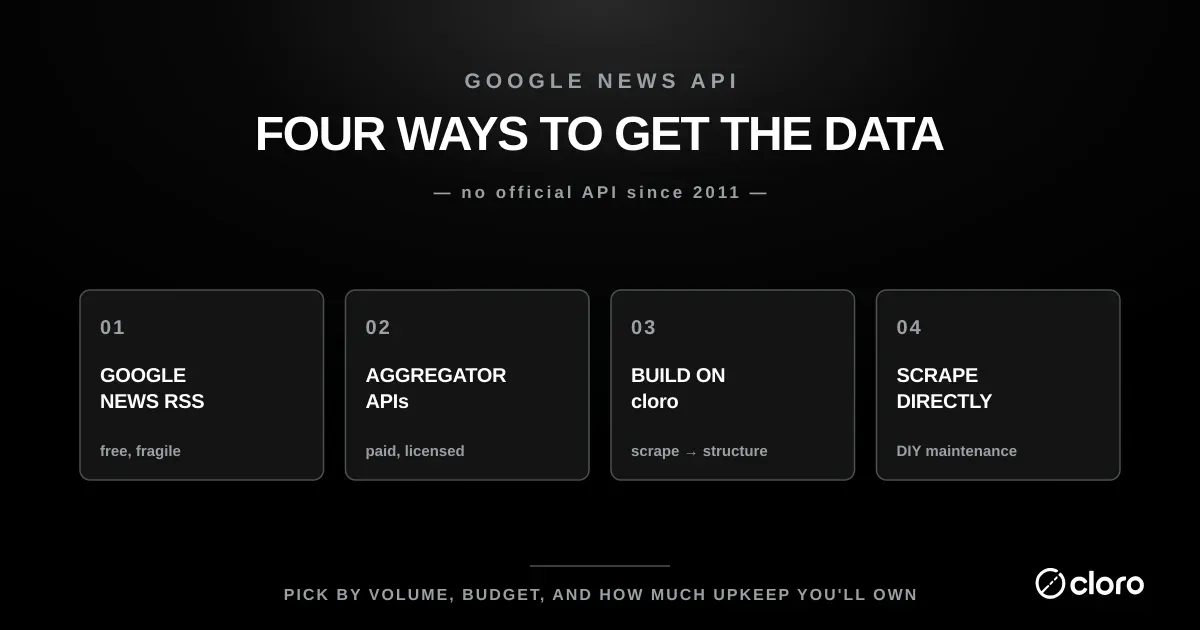
What you can actually get in 2026
Four paths, each with a different trade-off between effort, fragility, and coverage.
| Option | What it gives you | Metadata | Fragility | Best for |
|---|---|---|---|---|
| Google News RSS | Headlines + links per topic/query | Thin (title, link, pubdate, source name) | Low effort, aggressive rate limits, no ranking control | Occasional, lightweight pulls |
| Unofficial libraries / DIY scraper | Full SERP if it works | Full, when selectors hold | High: breaks on layout changes, gets blocked | Prototypes, tinkering |
| Custom Search JSON API | Web results from sites you configure | Structured, but not Google News | Low, but wrong surface | Site-scoped web search, not news |
| News-capable scraping API (cloro) | Live Google News SERP as parsed JSON | Full (title, link, source, date, snippet, thumbnail) | Low: maintenance absorbed by the provider | Structured, localized, at-scale monitoring |
1. Google News RSS is free, thin, and fragile
Google still exposes RSS feeds for Google News. They cost nothing and need no key. You can build a topic feed or a keyword feed and pull it as XML. It’s the fastest way to get something moving.
The limits show up quickly. RSS returns thin metadata: a title, a link, a publish date, and a source name. There is no snippet, no thumbnail, and no reliable position data. It gives you no control over ranking or result count, no real per-country or per-language localization beyond the feed’s own locale, and it rate-limits hard if you poll aggressively.
For anything past a lightweight pull, RSS is not a Google News API substitute.
If RSS is enough for your use case, don’t over-engineer it. We cover the exact feed URL patterns and their gotchas in the Google News RSS guide. Reach for something heavier only when RSS’s thinness or fragility actually bites.
Looking for alerts rather than a feed? Google Alerts is a related but different beast: email and notification driven, not a queryable API. We break down what you can and can’t automate with it in the Google Alerts API post.
2. Unofficial scrapers and libraries break
Search GitHub and you’ll find a dozen “Google News” Python packages that scrape news.google.com and hand you structured articles. When they work, they’re great. The problem is when.
A library that worked last month returns empty arrays today. news.google.com is one of Google’s more aggressively defended surfaces. Anti-automation kicks in fast. The SERP DOM ships layout changes that break CSS and XPath selectors within hours of a release.
The maintainer may or may not push a fix. Add residential proxies, JavaScript rendering, and CAPTCHA handling, and you’ve rebuilt a scraping stack, the same conclusion we reach in the deep dive on scraping Google Search. For a prototype, that is a viable path. In production, it is a maintenance liability, not a dependable Google News API.
3. Custom Search Engine doesn’t cover News
This is the most common wrong turn. Google’s Custom Search JSON API is real, supported, and documented. So people assume it is the answer.
It isn’t, because CSE searches a site or set of sites you configure, not the Google News aggregate. Point it at three news domains and you’ll get web-search-style results from those three domains. You do not get the ranked, deduplicated, source-attributed feed that news.google.com produces. For the Google News surface specifically, CSE is the wrong tool.
4. A News-capable scraping API, the durable option
The path that actually delivers “Google News results as JSON, for any query and country, that keeps working” is a purpose-built scraping API. cloro’s Google News endpoint renders the live Google News SERP and returns each article as parsed JSON (title, link, source, date, snippet, thumbnail, and position) with the browser fleet, proxy rotation, and selector maintenance handled for you. The endpoint returns roughly 10 results per query per page and accepts country/language localization, so you get the same data a DIY scraper would return without owning the anti-bot arms race.
If your use case is broad multi-source coverage rather than Google-News-specifically, that’s a different product category. Aggregators like NewsAPI.org, GNews, and GDELT pull from their own indexes. We compare those side by side in the free news API roundup; this guide deliberately stays in the Google-News lane.
How to choose a Google News API alternative
Match the tool to the job. For an occasional headline pull, Google News RSS is enough. For a throwaway prototype, an unofficial library gets you moving. For site-scoped web search, Custom Search fits, though it is not a Google News API.
For structured, localized, at-scale monitoring that keeps working, a News-capable scraping API is the durable Google News API alternative. The rest of this guide backs that choice with data. First it measures how fast the SERP moves. Then it shows how to pull it in Python.
Is Google News completely free?
Reading Google News is free, and so are its RSS feeds. Programmatic access is where the limits start, and the free tiers are built for testing, not production:
| Option | Free allowance | Main limit | First paid step |
|---|---|---|---|
| Google News RSS | Free, no key | Thin metadata, rate limits | None |
| GNews | 100 requests/day, up to 10 articles each | 12-hour delay, non-commercial use only | €49.99/month for 1,000 requests/day, real time |
| NewsAPI.org | Free for development | Its own index of 150,000+ sources, not Google News | Paid plan |
| cloro Google News | 500 credits/month | 3 credits per request, +2 per extra page | Paid plan |
At 3 credits a request, the cloro free tier covers about 166 single-page Google News pulls a month, enough to test a brand query set before you pay.
Freshness study: how fast the Google News SERP actually moves
The core argument for API-based monitoring over cached or RSS approaches is that the news SERP moves fast. We wanted a number, so we ran a small study in July 2026.
Method (directional, small sample). We scraped 48 news queries through cloro’s Google News endpoint, then re-scraped the same 48 queries in a second snapshot roughly 8 hours later, and compared the top-10 results per query. Treat these as directional signals from a small sample, not a precise law. The direction is clear.
What we found, in our sampling:
- ~31% of top-10 results turned over across the ~8-hour window. Put differently, 69.2% of stories survived into the next snapshot.
- Churn is bimodal. Fast-moving brand and topic queries saw roughly 50% of the top 10 replaced: half the visible SERP was different stories 8 hours later. Niche terms churned slowly, around 11%.
- The endpoint returned ~10 results per query, consistent with a single page of Google News.
Why it matters. If you cache Google News results for a few hours, or rely on RSS you poll infrequently, you are, for the fast-moving queries that usually matter most (your brand, your competitors, a breaking topic), serving a SERP that’s meaningfully stale. Roughly a third of the surface has moved in a workday’s worth of hours, and up to half of it for hot queries. That’s the case for polling critical queries on a short interval against a live API rather than trusting a cache. Check the cache rules of any API you buy, too: SerpApi’s Google News API serves a cached result for an identical query for up to 1 hour unless you force a fresh fetch.
The practical read: pick your polling cadence by query volatility. High-signal brand and crisis queries deserve tight intervals; stable niche queries can be sampled far less often without missing much.
Tutorial: pulling structured Google News results with Python
Here’s the fastest path from zero to parsed articles: send one POST, cloro renders and parses the live Google News SERP behind it, and you get structured JSON back. The endpoint is https://api.cloro.dev/v1/monitor/google/news. New accounts get 500 free monthly credits, so you can run this before paying anything.
Python
import requests

resp = requests.post(
    "https://api.cloro.dev/v1/monitor/google/news",
    headers={
        "Authorization": "Bearer sk_live_your_api_key_here",
        "Content-Type": "application/json",
    },
    json={
        "query": "openai",
        "country": "US",
        "language": "en",
        "pages": 1,
    },
)

data = resp.json()
for article in data["result"]["newsResults"]:
    print(f"{article['position']:>2}. {article['title']}")
    print(f"    {article['source']} | {article['date']}")
    print(f"    {article['link']}\n")
curl
curl -X POST https://api.cloro.dev/v1/monitor/google/news \
  -H "Authorization: Bearer sk_live_your_api_key_here" \
  -H "Content-Type: application/json" \
  -d '{
    "query": "openai",
    "country": "US",
    "language": "en",
    "pages": 1
  }'
The parsed JSON you get back
{
  "success": true,
  "result": {
    "newsResults": [
      {
        "position": 1,
        "title": "Major Climate Summit Reaches Historic Agreement",
        "link": "https://example.com/climate-summit-agreement",
        "snippet": "World leaders agreed on new climate targets at the summit...",
        "source": "The Guardian",
        "date": "2 hours ago",
        "page": 1,
        "thumbnail": "https://example.com/images/climate-summit.jpg"
      },
      {
        "position": 2,
        "title": "Climate Scientists Warn of Urgent Need for Action",
        "link": "https://example.com/climate-report",
        "snippet": "Scientists warn that immediate action is needed...",
        "source": "BBC News",
        "date": "5 hours ago",
        "page": 1,
        "thumbnail": "https://example.com/images/climate-report.jpg"
      }
    ]
  }
}
Every newsResults entry is monitoring-ready: position for ranking, source for the publisher, date as Google’s relative timestamp (“2 hours ago”), plus the snippet and thumbnail. Drop the array straight into a database. No HTML parsing on your side.
Localizing by country and language
Google News surfaces very different sources country-by-country, so localization isn’t optional for a global brand: monitoring without it systematically misses regional coverage. Pass country (an ISO-3166 code) to route through that locale, and language for the results language:
# German-language Google News, from a German locale
json={
    "query": "künstliche intelligenz",
    "country": "DE",
    "language": "de",
    "pages": 1,
}
Swap country to GB, IN, BR, or any market you cover, and re-run. Same shape out, localized sources in. To go wider than one page, bump pages. Each page is roughly 10 results. For the broader mechanics of localized SERP scraping, see the best SERP APIs comparison.
Four use cases (one snippet each)
Brand and news monitoring
Poll your brand name on a short interval and diff each snapshot against the last-seen set to catch new coverage the moment Google ranks it.
seen = set()  # persist this across runs

def new_coverage(brand):
    resp = requests.post(URL, headers=H, json={"query": brand, "country": "US"})
    fresh = []
    for a in resp.json()["result"]["newsResults"]:
        if a["link"] not in seen:
            seen.add(a["link"])
            fresh.append(a)
    return fresh  # alert on these
This is the backbone of the News Monitoring use case; see that page for the full brand-tracking pattern.
PR and campaign tracking
Track a launch keyword or campaign hashtag and measure pickup: how many outlets, which ones, and how fast the story climbs the SERP.
r = requests.post(URL, headers=H, json={"query": "acme series b funding", "country": "US"})
articles = r.json()["result"]["newsResults"]
print(f"{len(articles)} outlets covering the launch")
for a in articles:
    print(a["source"], "→", a["title"])
Finance and market signals
Run a ticker or company name on a tight cadence and feed the fresh headlines into your sentiment or event-detection pipeline. The freshness study above is exactly why finance use cases can’t tolerate a stale cache.
r = requests.post(URL, headers=H, json={"query": "NVDA earnings", "country": "US"})
for a in r.json()["result"]["newsResults"]:
    signal_pipeline.ingest(source=a["source"], headline=a["title"], when=a["date"])
Feeding news to LLM agents
Give an agent live, grounded news context by pulling the snippets and handing them to the model, far fresher than whatever was in its training cut-off.
r = requests.post(URL, headers=H, json={"query": user_topic, "country": "US"})
context = "\n".join(f"- {a['title']} ({a['source']}, {a['date']}): {a['snippet']}"
                    for a in r.json()["result"]["newsResults"])
answer = llm.complete(f"Using this fresh news, answer:\n{context}\n\nQ: {user_question}")
The bottom line
There is no official Google News API in 2026, and there won’t be. Google retired it in 2011 and moved on. Your real choices are RSS (free but thin and fragile), unofficial libraries (great until they break), Custom Search (real, but it doesn’t cover News), or a News-capable scraping API that returns the live Google News SERP as structured JSON. Given how fast the news SERP moves, roughly a third of the top 10 turning over in a workday and up to half for hot queries, the durable answer for anyone doing real monitoring is API-based, localized, short-interval polling.
Try cloro’s Google News endpoint with 500 free monthly credits: one API key, structured articles out, and the same credit pool covers Google Search and the AI answer engines too.

About the author
Ricardo Batista
Founder, cloro
Ricardo is one of the founders and engineers behind its SERP and AI-search scraping infrastructure. Before cloro he scaled a financial comparison site to $7M ARR and ran the full-country operations of a unicorn to $65M ARR, then went back to building. He writes about search engine scraping, generative-engine optimization, and turning live search and AI-answer data into something teams can act on.
Frequently asked questions
Is there an official Google News API in 2026?
No. Google retired its News API back in 2011 as part of a broader cull of search-related APIs and has never shipped a replacement. There is no google.com endpoint that returns news.google.com results as structured data. The programmatic options in 2026 are RSS feeds (fragile, thin metadata), unofficial scraping libraries (break and get blocked), the Custom Search JSON API (which does not cover Google News), or a News-capable scraping API like cloro that renders and parses the live Google News SERP for you.
Where is the Google News API documentation?
There isn't any, because the product doesn't exist. Searches for 'Google News API documentation' land on the retired API's dead pages, the unrelated Custom Search JSON API docs, or third-party libraries. If you need documented, structured Google News access, you're looking at a third-party scraping API. cloro documents a single POST endpoint (/v1/monitor/google/news) that returns article title, link, source, date, snippet, and thumbnail as JSON.
Is there a free Google News API?
Google's own RSS feeds are free and require no key, but they return thin metadata and rate-limit aggressively. Free aggregator tiers (NewsAPI.org, GNews, GDELT) exist but pull from their own indexes, not Google News specifically; see our free news API roundup. For free Google-News-specific structured data, cloro gives new accounts 500 credits to test the News endpoint before paying.
What is the best Google News API alternative?
It depends on what you actually need. For a lightweight, occasional headline pull, Google News RSS is fine. For broad multi-source coverage, a free aggregator works. For structured, localized, at-scale Google News data that survives Google's layout changes and anti-bot defenses, a purpose-built scraping API such as cloro's Google News endpoint is the durable option, returning the live Google News SERP as parsed JSON for any query and country.
Can I use the Google Custom Search JSON API for news?
Not really. The Custom Search JSON API (the modern, supported Google search API) is built to search a specific site or a curated set of sites you configure, and it does not index or return news.google.com's aggregated results. You can point it at a handful of news domains, but you get web-search-style results from those sites, not the ranked, deduplicated, source-attributed Google News feed. For the Google News surface specifically, CSE is the wrong tool.
How much does a Google News API cost?
Google charges nothing for RSS (it's just XML over HTTP) and nothing for the fact that the official API is gone. Third-party access is credit- or request-based: cloro runs on a single credit pool that also covers Google Search, AI Overview, AI Mode, ChatGPT, Perplexity, Gemini, and Copilot, and new accounts start with 500 free monthly credits. Aggregator pricing varies widely, so compare the free tiers first.
How fresh is Google News data, and does that affect caching?
Very fresh, which is exactly why cached and RSS-only approaches lag. In our July 2026 sampling of 48 news queries roughly 8 hours apart, about 31% of top-10 results turned over between snapshots, with fast-moving brand and topic queries seeing roughly half the top 10 replaced. If you cache news results for hours, you are serving a stale SERP. Poll critical queries on a short interval instead.
Is Google News completely free?
Reading Google News and its RSS feeds is free. Programmatic access has limits: GNews's free tier allows 100 requests a day with a 12-hour delay and no commercial use, with paid plans from €49.99 a month; NewsAPI.org is free for development but searches its own index, not Google News. cloro's Free tier gives 500 credits a month, and a Google News request costs 3 credits, so about 166 single-page pulls.
Related reading

The Top 12 News API Free Options for Developers in 2026
12 news APIs with free tiers compared: request limits, keyword filters, source coverage, and paid-tier prices when you outgrow free.

Bing Search API Key in 2026: It's Retired. Use These Instead
5 ranked drop-in replacements for the retired Bing Search API v7, with API-key setup, cost comparison, and migration steps for your legacy code.

Best SERP APIs 2026: 9 Tested on Cost, AI and Tracking
9 SERP APIs tested head to head on AI Overview parsing, engine breadth, rank-tracking depth, and true cost per 1,000 calls. Full benchmark table inside.