
Featured Snippet Optimization: How to Win Position Zero

On this page
Featured snippet optimization is the practice of formatting a page so Google can extract a single, self-contained answer and promote it to “position zero” — the box that sits above the ten blue links.
The winning pattern is simple but strict: rank on page one, match the snippet format Google already shows, put a 40 to 60 word direct answer under a heading that matches the query, and use lists or tables when the query calls for them.
This guide covers the four snippet formats, how Google actually selects a snippet, the exact HTML pattern that wins, and how AI Overviews reshaped the opportunity. For adjacent SERP features, pair featured snippet optimization with People Also Ask SEO and schema markup for AI.
What a featured snippet is
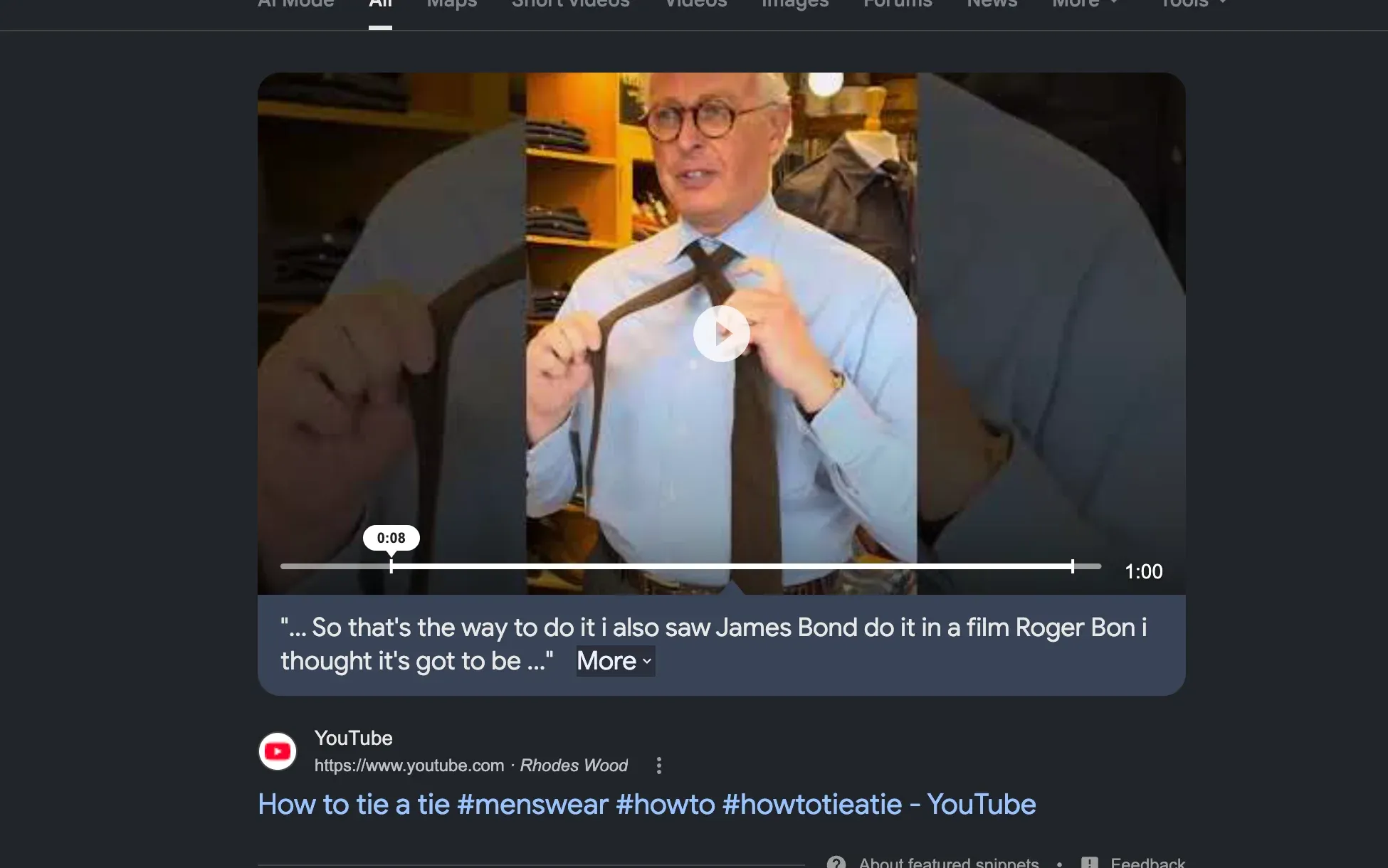
A featured snippet is a single page’s content elevated above the organic results, with the source URL shown beneath it. Google pulls a paragraph, list, table, or short video clip directly from the cited page. The user often gets their answer without clicking, but when they do click, the snippet occupies the most visible position on the page.
Snippets are common but not universal. Ahrefs’ large-scale study found roughly 12.29% of searches return a featured snippet, so the opportunity is broad without being present on every query — worth checking the live SERP before you invest in any single target.
Since Google’s January 2020 deduplication change, a page promoted to the featured snippet is removed from the regular page-one organic listings rather than shown twice. Google now counts the snippet as organic position one, not a bonus “position zero.” Winning the snippet therefore replaces your normal listing with the elevated one — it does not hand you a second slot on the page.
That distinction changes how you value the prize. Ahrefs’ analysis of two million snippets found the featured snippet captures about 8.6% of clicks while the result directly below it takes 19.6%, and a clean #1 with no snippet present earns roughly 26%. So the box is a decisive win for a page climbing from #2-#10, but not always a net gain for a page that already owns #1.
Three structural facts shape featured snippet optimization:
- Snippets are zero-sum. Exactly one URL wins the box, and every other ranking page on that query loses the snippet slot.
- Selection is decoupled from exact rank. Ahrefs found 99.58% of featured snippets come from pages already in the top 10, yet only 30.9% are pulled from the #1 result, so a better-formatted page at position 4 can leapfrog position 1 into the box. It is one of the few SERP features where a mid-rank page claims above-the-fold space.
- Snippets are volatile. Ownership rotates as competitors re-format their answers, so a snippet you win this month is defensible only while your answer stays the tightest match.
How Google selects a featured snippet
Google does not let you opt in. Its documentation states plainly that “Google systems determine whether a page would make a good featured snippet” and elevates it automatically. There is no tag, markup, or setting that requests the box.
That is the single most important fact in featured snippet optimization: you influence selection only through content and formatting, never through a technical flag. Google reads the page, finds the passage that most directly answers the query, and decides whether it is clearer than the current snippet.
You can, however, opt out. Google supports the nosnippet rule to suppress all snippets and the max-snippet directive to cap snippet length, though a low max-snippet value does not guarantee Google stops showing a featured snippet. Most teams never touch these, because the goal is to win the box, not block it.
Google also evaluates pages at the passage level, not only as whole documents. A single well-structured section — one heading and the paragraph beneath it — can win the box even when the rest of the page ranges across other subtopics. That is why featured snippet optimization works best as a per-section discipline: one tight question-and-answer block per target query, rather than a sprawling page that buries the answer three scrolls down.
It also means relevance and clarity beat length. Google is looking for the passage that resolves the query most directly, so a focused 50-word answer routinely outranks a 400-word section that circles the topic. Write the answer as if it will be read in isolation, because in the snippet it will be.
Because selection is content-driven, featured snippet optimization reduces to a formatting problem: give Google a passage that is easier to lift than anyone else’s.
The four snippet formats
Google picks one of four snippet formats based on the query and the source content. The format Google is already showing for a query is the format your page needs to match — format matching is the core of featured snippet optimization.
| Format | Triggers on | Source HTML pattern |
|---|---|---|
| Paragraph | Definitional (“what is X”), explanatory (“why does X”) | 40-60 word <p> directly under an H2 matching the query |
| List (numbered or bullet) | Procedural (“how to X”), enumerative (“types of X”) | <ol> or <ul> with 6-10 items under a matching H2 |
| Table | Comparative (“X vs Y”), conversion (“X to Y”) | <table> with 4-6 columns and 5-10 rows |
| Video | Demonstrative (“how to tie a tie”, “how to fold a fitted sheet”) | YouTube video with timestamped chapters; Google selects the relevant clip |
How long should a featured snippet paragraph be?
A featured snippet paragraph should run 40 to 60 words. Google’s paragraph snippets average 40 to 60 words, which is long enough to answer completely and short enough to render without truncation. Below 40 words the answer usually loses to a fuller competitor; above 60, Google cuts it mid-sentence.
Paragraph snippets are the most common format and the easiest to target. They answer definitional and explanatory queries, which is why the 40 to 60 word block sits directly under a heading that matches the question.
The biggest mistake teams make is writing a paragraph answer for a query Google is already showing as a list, or vice versa. Format mismatch loses to format match every time, regardless of which page is “better.”
Check the existing SERP before writing the page. If the current snippet is a numbered list, write a numbered list. If it is a table, write a table.
The exact featured snippet optimization pattern that wins
The pattern in one line: match the query in the heading, answer within the format’s length cap directly beneath it, and Google lifts the passage automatically. Here’s the HTML that wins paragraph snippets:
<h2>What is [exact query]?</h2>
<p>[Definitional answer in 40-60 words]. The first sentence
should stand alone as a complete answer. Use the next 1-2
sentences to qualify, add the most important context, or
name an example. Stop at 60 words.</p>
<p>[Optional 2-3 sentence expansion that's NOT part of the
cited block — Google rarely pulls beyond the first paragraph.]</p>
For list snippets:
<h2>How to [exact query]</h2>
<ol>
  <li><strong>[Step name].</strong> Brief 10-15 word description.</li>
  <li><strong>[Step name].</strong> Brief 10-15 word description.</li>
  ...
</ol>
For table snippets:
<h2>[Query, e.g. "X vs Y comparison"]</h2>
<table>
  <thead><tr><th>Attribute</th><th>X</th><th>Y</th></tr></thead>
  <tbody>
    <tr><td>Row label</td><td>X value</td><td>Y value</td></tr>
    ...
  </tbody>
</table>
Three rules apply across all formats. First, the heading wording must match the query as closely as possible — Google does fuzzy matching, but exact match wins ties, and ties are common.
Second, the opening sentence must answer in isolation. A reader — or an LLM — who sees only the first sentence should understand the answer, with no throat-clearing before it.
Third, stay under the format’s length cap. Google truncates over-length answers mid-sentence, so a 40-60 word paragraph or a 6-10 item list nearly always beats a bloated “comprehensive” block. When you exceed the cap, Google either cuts your answer awkwardly or picks a tighter competitor instead.
The same pattern that wins featured snippets also makes a page eligible for People Also Ask citations and AI Overview citation. The investment compounds across three citation surfaces.
Featured snippets vs AI Overviews: partial substitution, not replacement
The relationship is partial substitution, not clean replacement.
On many definitional queries Google now serves an AI Overview where it previously served a paragraph snippet. Semrush’s 2025 tracking showed AI Overviews growing from 6.49% of queries in January to a peak of 24.61% in July before settling near 15.69% by November, and featured snippets now appear less often when an AI Overview is present.
Our own sampling puts the ceiling higher than that. In the SERP feature census, 65,945 scored Google SERPs from cloro’s monitoring corpus, an AI Overview rendered on 87.2% of US results and People Also Ask on 90.6%. The gap between 24.61% and 87.2% is mostly query mix rather than disagreement: that corpus is customer AI-visibility monitoring, so it leans toward the conversational and commercial-research questions that trigger an AI Overview most reliably, while Semrush sampled a broader spread. Read the low number as the all-of-Google floor and the high one as what you should expect on precisely the definitional, question-shaped queries a snippet strategy targets. That last step is no longer an inference. On a fixed query basket built to spread evenly across six query types, definitional queries returned an AI Overview 97.2% of the time and People Also Ask 100% of the time, against 9.2% and 44.4% for navigational ones. The queries a featured-snippet strategy goes after are the ones where an AI Overview is close to guaranteed, so plan for it rather than around it.
One caution the census added on its second run: that 87.2% is the US figure, and the market you target changes it. The census reads 61.0% in France and 67.9% in Germany, but those markets run their own tracked queries, so that comparison overstates the difference. Holding the questions fixed across markets narrows it to 66.0% for the US, 54.0% for France and 47.3% for Germany. The direction survives and the size does not: if your snippet strategy targets a non-English market the competition for the top of the page is somewhat lighter than a US-derived number implies, not dramatically so.
That reframes the optimization slightly. On the queries where you are most likely to win a snippet, you are also most likely to be sitting underneath an AI Overview, so the snippet is competing for attention rather than owning the top of the page.
But snippets hold their ground on several query types:
- Procedural queries.
how to [task]. Google still strongly prefers a list snippet over an AIO summary. - Video queries.
how to tie a tie,how to fold X. Video snippets dominate, and AIO rarely competes. - Conversion and reference.
cups to grams,mph to kph. Table snippets are stable. - Long-tail informational. AIO has a per-query confidence threshold; below it, snippets fill the slot.
This is why featured snippet optimization and AI Overview optimization increasingly converge. Build content for the format Google currently shows, and the same structure makes the page AIO-eligible if Google later flips the surface. See AI Overview tracking tools for measuring which queries Google has already flipped.
A featured snippet optimization workflow
A repeatable featured snippet optimization workflow has three sources of candidates, ranked by yield.
1. Pages that already rank top-10 but don’t own the snippet
This input pays back the fastest. You are already on the SERP, and because selection is decoupled from exact rank, the gap is structural rather than authority-based. You do not need more links — you need a better-formatted answer.
The workflow is mechanical:
- Pull your top-100 ranking keywords.
- For each, fetch the SERP and check whether the snippet is owned by a competitor.
- Inspect the winning snippet’s format and word count.
- Rewrite your existing section to match: exact-match heading, same format, target word count.
Run this steadily and you will reliably convert a share of attempted snippets within a few weeks, because the winning page is often just the one that formatted its answer for extraction first.
2. Queries with weak existing snippets
These are snippets where the cited page is thin, outdated, or off-topic. They cluster on long-tail informational queries where Google did not have a great option and picked something marginal.
To find them, pull your category’s long-tail queries via a SERP API, filter to queries where a featured snippet is present, and rank by snippet-source weakness — low authority, content older than two years, or an off-topic heading. Then write a focused, tightly formatted answer for the strongest candidates and let the format advantage do the work.
These queries are the cheapest wins because you are not fighting an entrenched incumbent. The current snippet holder earned the box by default, not by formatting for it, so a single well-headed section that answers the query in the right format usually displaces them. Target the weakest snippets first, then reinvest the time saved into the higher-competition queries where the payoff is larger.
3. PAA questions that lack snippet ownership
Some People Also Ask questions trigger their own featured snippet when searched as a standalone query. If you have already done the PAA SEO work, you are sitting on a list of question-shaped queries with answer-shaped content already on your pages.
Promote those answers to standalone, well-headed sections and you will often capture both the PAA citation and the snippet from the same block of content.
Measuring your featured snippet optimization
Winning a snippet is only half the job. You also need to know which boxes you hold, which you lost, and whether the wins actually moved traffic. Snippet ownership rotates week to week, so a one-time audit goes stale fast.
Track three signals over time. First, snippet ownership: for each target query, record whether you, a competitor, or nobody owns the box. Second, format drift: Google sometimes switches a query from a paragraph snippet to a list or a table, which quietly invalidates your existing formatting and hands the box to whoever matches the new format. Third, before-and-after click-through rate, so you can tell whether a snippet you won added traffic or simply relabelled your existing position-one clicks.
Pull all three on a schedule from a SERP API rather than spot-checking by hand. Automated snippet tracking turns featured snippet optimization from a one-off content sprint into a maintainable pipeline, and it catches format drift before a competitor does.
Common featured snippet optimization mistakes
Most failed featured snippet optimization traces to a handful of repeatable errors. Each one is easy to fix once you know to look for it, and fixing them is usually faster than writing new content, because the ranking is already there.
- Format mismatch. Writing a paragraph answer when Google is showing a list. Check the current SERP before you write.
- Over-length answers. A 200-word “comprehensive” answer does not win the box — it gets truncated. Lead with 40-60 words and put the depth below.
- Heading keyword inflation. “The Complete Guide to Featured Snippet Optimization in 2026” loses to “What is a featured snippet?” on the actual query. Match the query, not your brand voice.
- Chasing markup instead of structure. There is no schema that requests a snippet; Google selects from page content. Spend the effort on the heading and the answer, not on tags.
- Ignoring AIO substitution. If a query now shows an AI Overview and no snippet, snippet formatting alone will not recover the slot. Pick a different query or accept the substitution.
- Optimizing snippets in isolation. The same content structure also wins PAA and AI Overview citations, so build the page once and claim all three surfaces at the same time.
Featured snippet optimization rewards the team that formats the cleanest answer first, then measures which boxes it actually won.
cloro’s SERP API returns featured snippet text, format, and source URL alongside organic results, PAA, AI Overviews, and PASF, in a single structured response across 250+ locations. Stop guessing which snippets you can win.

About the author
Ricardo Batista
Founder, cloro
Ricardo is one of the founders and engineers behind its SERP and AI-search scraping infrastructure. Before cloro he scaled a financial comparison site to $7M ARR and ran the full-country operations of a unicorn to $65M ARR, then went back to building. He writes about search engine scraping, generative-engine optimization, and turning live search and AI-answer data into something teams can act on.
Frequently asked questions
What is a featured snippet?
A featured snippet is a single source promoted to 'position zero' on a Google SERP: a paragraph, list, table, or video pulled from a page and rendered above the organic results. Since Google's 2020 deduplication change the snippet counts as organic position one rather than an extra slot, so the cited page gets the most visible spot on the page and a strong authority signal on that query.
How do you get a featured snippet?
Match the query with an exact H2 or H3, answer in 40-60 words directly beneath the heading, and structure the answer in the format Google is already showing (paragraph, list, or table) for that query. You cannot mark up or request a snippet — Google selects it programmatically from your page content — so pages that match the existing snippet format win more often than pages that pick a different format.
What's the click-through rate on a featured snippet?
Ahrefs' study of two million snippets found the featured snippet itself captures about 8.6% of clicks, while the result directly below it takes 19.6%, and a clean #1 result with no snippet present earns roughly 26%. A snippet is a clear win for a page leapfrogging from position #2-#10 into the box, but not always a net gain for a page that already ranks #1. Track your own before-and-after CTR rather than assuming the box always adds traffic.
Are featured snippets being replaced by AI Overviews?
Increasingly. Semrush's 2025 tracking showed AI Overviews grew from 6.49% of queries in January to a peak of 24.61% in July before settling near 15.69% in November, and featured snippets now appear less often when an AI Overview is present. But snippets persist on procedural, video, and conversion queries below AIO's coverage threshold, and the same structured answer that wins a snippet is also what earns an AI Overview citation, so the optimization play overlaps.
How long should a featured snippet answer be?
40-60 words for paragraph snippets, 6-10 items for list snippets, 4-6 columns and 5-10 rows for table snippets. The paragraph figure comes from the observed length of Google's own paragraph snippets, which average 40 to 60 words. Google truncates longer answers mid-sentence and usually picks a competitor over an over-length answer. Shorter than 40 words tends to lose to a more complete competitor.
Do I need schema markup to win featured snippets?
No. Google's documentation says featured snippets are selected programmatically from a page's content, and there is no markup that requests the box. Structured data (Article, Product, and so on) helps Google understand a page and can earn other rich results, but it does not influence featured snippet selection — clean HTML structure, a heading that matches the query, and a tightly formatted answer are what win the snippet.
Related reading
How to Track SERP Features in 2026 (Free + API Methods)
How to track SERP features in 2026 — the seven that move traffic, the free ways to start monitoring today, and the API method that scales to millions of keywords.
People Also Ask SEO: How to Optimize for PAA Boxes
Learn People Also Ask SEO: find PAA questions, use exact H2s, write 40-60 word answers, add FAQ schema, and track PAA citation changes over time.
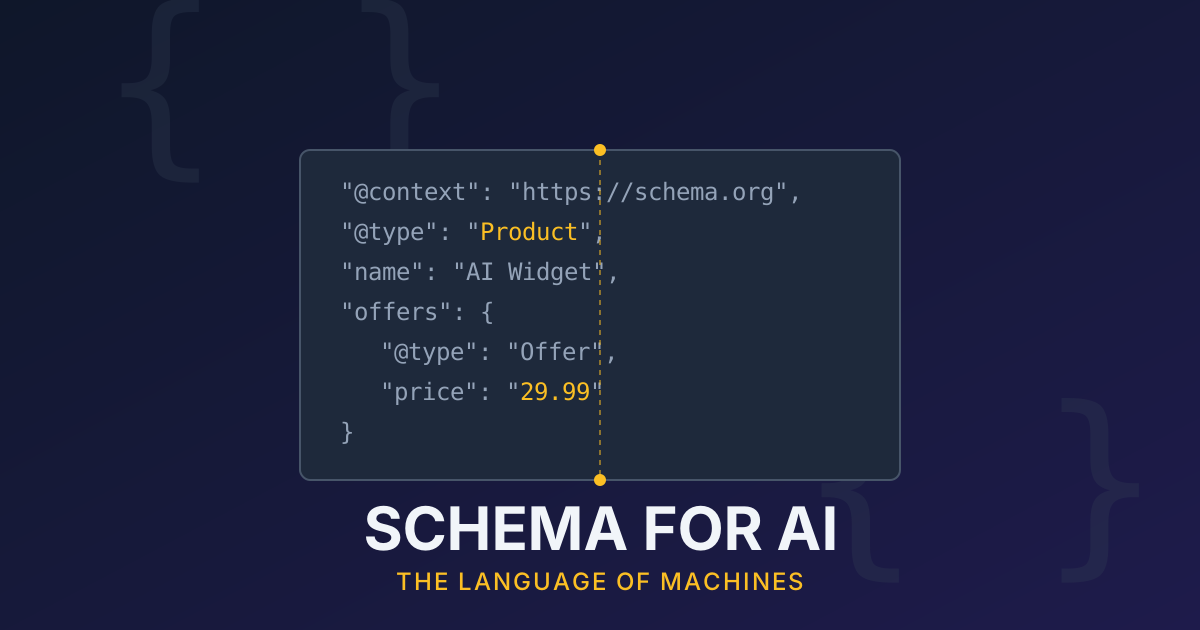
Schema Markup AI: Structured Data That Gets Cited
Learn how schema markup for AI works: JSON-LD, entity links, Article, FAQ, Product, and Organization schema that help AI cite your pages clearly.