
AI Overview Tracking Tools: 7 Options Compared

On this page
AI Overview tracking tools show whether Google cites your pages, mentions your brand, or gives the answer to competitors before users ever reach the blue links.
That is different from rank tracking. You need to know which queries trigger AI Overviews, which sources appear, how often your domain is cited, and whether visibility changes after content updates.
We compared 7 AI Overview tracking tools, four of them tested head-to-head on the same workflow. This guide compares coverage, reporting depth, pricing, and who each option fits. For multi-engine visibility, see LLM visibility tracking tools; for position-style tracking across ChatGPT, Claude, and the other engines, see AI rank tracking tools.
What AI Overview tracking actually measures
Before comparing tools, it helps to fix the vocabulary, because “tracking” means three distinct things at the AI Overview surface. A tool that is strong at one is not automatically strong at the others.
All three sit on top of a prior question: does the query trigger an AI Overview at all? It does not on every search. SE Ranking’s research found AI snippets on 64% of the keywords it checked, mostly long-tail queries, so a tracker’s first job is to report which of your terms show one.
Mention rate: the easiest signal to move
Mention rate is the share of your tracked queries where the AI Overview names your brand at all — in the summary text, whether or not it links to you. It is the broadest signal and the easiest to move, because brand mentions can come from third-party pages Google trusts, not just your own site. Every tool in this comparison reports mention rate, and their numbers agree closely once the query set is normalized.
Citation rate: the number that predicts clicks
Citation rate is narrower and more valuable: the share of queries where the AI Overview attaches a clickable source link to one of your URLs. Citation rate is the metric that actually predicts referral traffic, because a mention without a link sends no clicks. Tools diverge most here — some surface citation rate as a first-class metric, others bury it inside a mention report.
Source-URL position: why first place beats just being cited
The third signal is where your citation sits in the AI Overview’s source list. A first-position source carries more weight and visibility than one buried at position eight. Only the deeper dashboards expose source-URL position as a trackable field; most tools stop at “cited: yes/no.”
How we tested
We built a fixed panel of 50 commercial and informational queries in a single category, then ran that identical query set through all four tested AI Overview tracking tools over the same two-week window. The queries spanned evergreen head terms (“best CRM”), comparison intent (“X vs Y”), and question-shaped long-tail — the mix a real brand-monitoring program tracks. For each tool we measured four things: mention rate, citation rate, time-to-first-report, and the depth of the AI Overview-specific reporting surface (what fields you can actually export or chart).
To keep the comparison honest, every tool tracked the same 50 queries from the same US geo with personalization disabled, and we normalized mention counts against a single reference reading before comparing. This is an evaluation of reporting depth, speed, and price at a fixed workload — not a ranking of raw data accuracy, because the raw AI Overview data converged (see below). Numbers in this guide are point-in-time from that run; pricing reflects published entry and mid-tier plans at the time of testing.
The tools at a glance
Our shortlist is editorial. For the measured view of the same market, the AI visibility platforms leaderboard records which tools the engines name and cite when asked to recommend one, refreshed weekly.
| Tool | AI Overview depth | Other engines | Mid-tier price | Best for |
|---|---|---|---|---|
| Profound | Strongest | 5–7 | Enterprise tier | Enterprise programs with brand-intelligence teams |
| Peec AI | Strong | 5–6 | $200–400/mo | Marketing teams, dashboard-first |
| SE Ranking | Strong | 5 | $129–279/mo | Established SEO agencies and mid-market teams |
| OtterlyAI | Strong | 5 | $250–500/mo | Analyst-led teams, citation-rate focus |
| AthenaHQ | Strongest | 5–7 | Enterprise | Enterprise with audience-segmented reporting |
| HubSpot AEO | Strong | 3 | $50–800/mo | Small marketing teams, scalability, quick optimization insights |
| Honeyb | Strong | 7 | $63–159/mo (annual) | Small teams that want tracking plus articles written for the gaps |
The takeaway: AI Overview coverage itself no longer separates these tools, so the table above isn’t the decision. Reporting depth, price at your query volume, and which secondary engines you need are what actually decide the pick.
The layer underneath the dashboards. Every tool above is bought as a finished interface, and that is the right shape for a marketing team reporting to stakeholders. If your team would rather own the data, cloro’s Google AI Overview API sits a layer below: one API call returns the live AI Overview answer with its cited source URLs as structured JSON, billed per call (5 credits for AI Overview including the SERP around it) rather than per seat or per tracked prompt. It is not in the test above because it is not a dashboard and reports nothing on its own. The free tier is 500 credits a month, enough to baseline a small prompt panel before deciding whether you want to build or buy.
What to look for in an AI Overview tracking tool
Coverage parity is now table stakes: every serious tool tracks AI Overview as a first-class engine. The differences that matter for AI Overview tracking specifically show up in six places.
Citation-level, not just mention-level, reporting
The single biggest differentiator is whether the tool reports citation rate and source-URL position, or only whether your brand was named. Mention data is easy; citation data is what maps to referral traffic and to a concrete optimization workflow. If your program is SEO-led, weight this heavily.
Competitor share of voice: turns tracking into an action list
AI Overview is a zero-sum surface: the summary cites a handful of sources, and every competitor slot is one you did not get. A tool that reports AI Overview share of voice against a named competitor set — with weekly diffs — turns tracking into an action list instead of a vanity dashboard.
Personalization bypass: why manual checks break down
Google personalizes AI Overview by query, geo, and history, so a reading from your own logged-in browser is not representative. Any tool worth paying for reads AI Overview from clean, un-personalized sessions across geos. This is the main reason manual tracking breaks down past a handful of queries.
Export and reporting depth
Ask whether you can export the full citation list per query as CSV, chart source-URL position over time, and segment share of voice by product line or persona. Enterprise dashboards expose all three; mid-market tools usually stop at mention rate and a competitor chart. If your reporting lives in a warehouse or BI tool, also check for programmatic access: some suites pull AI Overview data into your stack via API or into AI assistants via MCP.
Market and language coverage
AI Overview answers change by country, so a US-only reading says little about how you appear in Germany or Brazil. If you sell in more than one market, confirm which countries a tool supports and whether it can filter results by language per market. Our own test read a single US geo, which the limits section below covers.
Price against your query volume
Pricing runs roughly on query count × refresh frequency. At about 100 queries a week the mid-market entry tiers are dramatically cheaper than enterprise plans, and for many teams the data is equivalent. Match the plan to the workload, not to the logo.
1. Profound: strongest AI Overview-specific dashboard
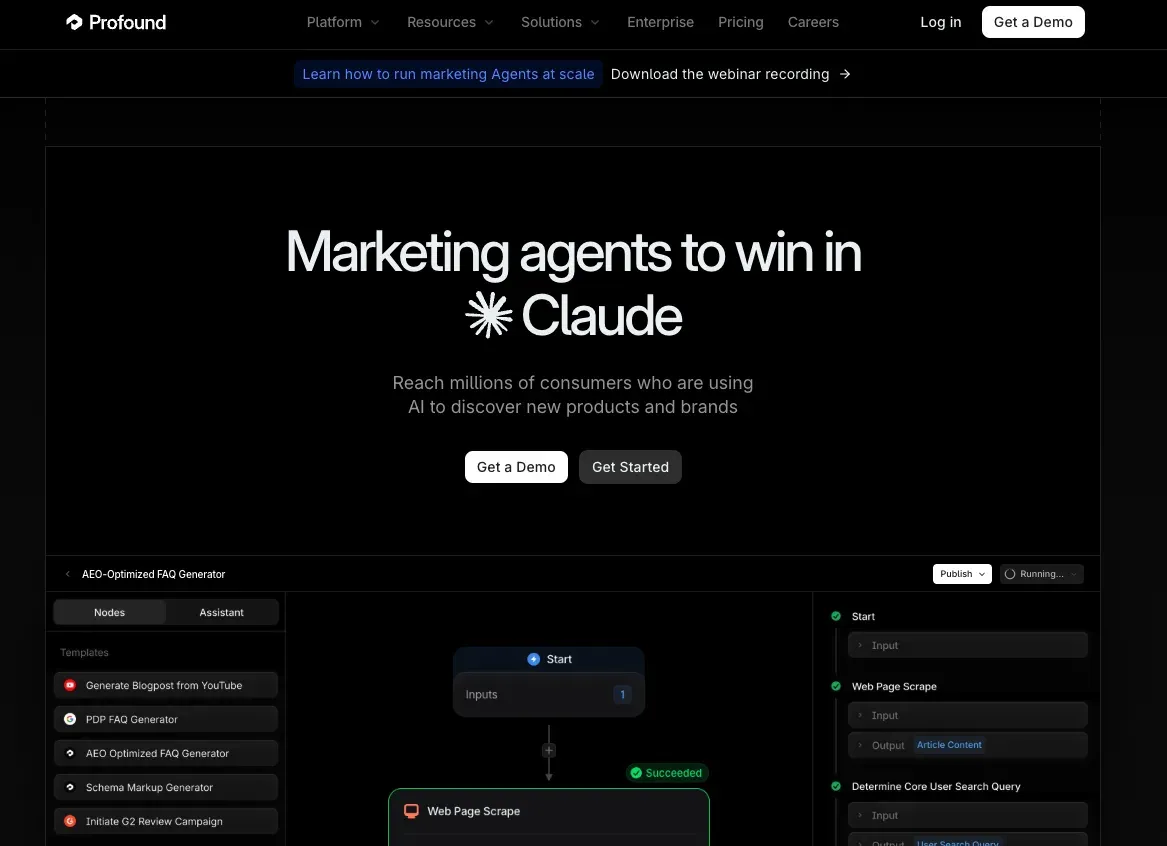
Starting price: enterprise tier; pricing plan-dependent.
Profound’s AI Overview reporting is the most polished among the dashboard-first tools. Citation source breakdowns, position-in-overview tracking, and competitive-overlap views are all first-class, so you can trace exactly where a citation was won or lost and which competitor picked it up. If your stakeholder audience is enterprise (CMO, brand intelligence director, multiple business units), Profound’s depth justifies its price.
AI Overview specifics: full citation list per query, source URL position, year-over-year trend at the AI Overview surface, audience-segmented share of voice.
Pick if: enterprise budget, dedicated brand intelligence function, polished stakeholder reporting matters.
2. Peec AI: best AI Overview tracking at mid-market pricing
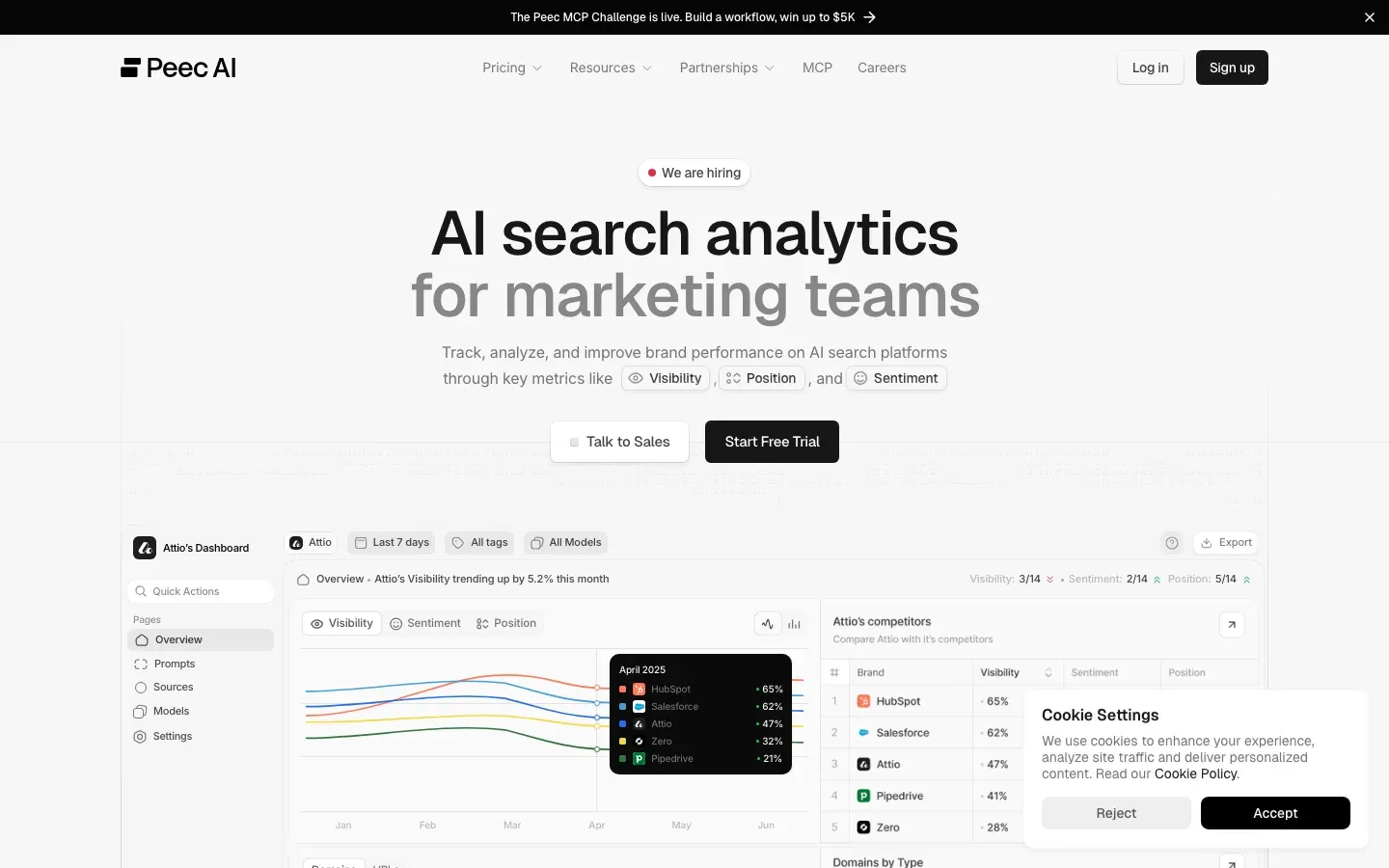
Starting price: ~$200/month entry; $300–400/month mid-tier.
Peec AI’s AI Overview reporting is competent and ships with the dashboard. For marketing teams that want AI Overview visibility tracked alongside ChatGPT, Perplexity, and Gemini in one UI, Peec AI delivers most of Profound’s value at a fraction of the price. The competitor-comparison view is particularly strong for AI Overview specifically.
AI Overview specifics: mention rate, citation list, share of voice vs competitors, weekly trend.
Pick if: mid-market budget, dashboard-first posture, marketing team is primary audience.
3. SE Ranking: AI Overview tracking tied to the wider SEO picture
Starting price: $129/month entry (Core); $279/month mid-tier (Growth).
SE Ranking’s AI Overviews Tracker reads AI Overviews from a different angle than the pure-play monitors: it reports AIOs visibility next to organic rankings, traffic through GA4 integration, keyword data, and competitive research, so a citation gain or drop can be read against whatever else moved that week. The platform reports which tracked prompts trigger AIOs and lets you analyze any competitors for presence in Google AI systems and other LLMs.
AI Overview specifics: brand mention and link (citation) tracking, top-3 placement share, cached AI answer text, competitor visibility monitoring, top-cited sources, historical trends, and prompt- and source-level Insights.
Pick if: you’re an SEO-led agency or mid-market team that wants AI Overview tracking connected to organic rankings and traffic.
4. OtterlyAI: best AI Overview citation-rate analysis
Starting price: ~$250/month entry; $400–500/month mid-tier.
OtterlyAI’s strongest single AI Overview feature is citation-rate analysis. Most platforms report whether you appeared. OtterlyAI reports whether you appeared with a clickable source link, which is the metric that actually predicts referral traffic. For SEO-led teams optimizing for AI Overview citations specifically, OtterlyAI’s data model maps directly to the optimization workflow.
AI Overview specifics: mention rate, citation rate (first-class metric), CSV export of full citation lists.
Pick if: SEO-led program, citation rate matters more than mention rate, analyst on the team.
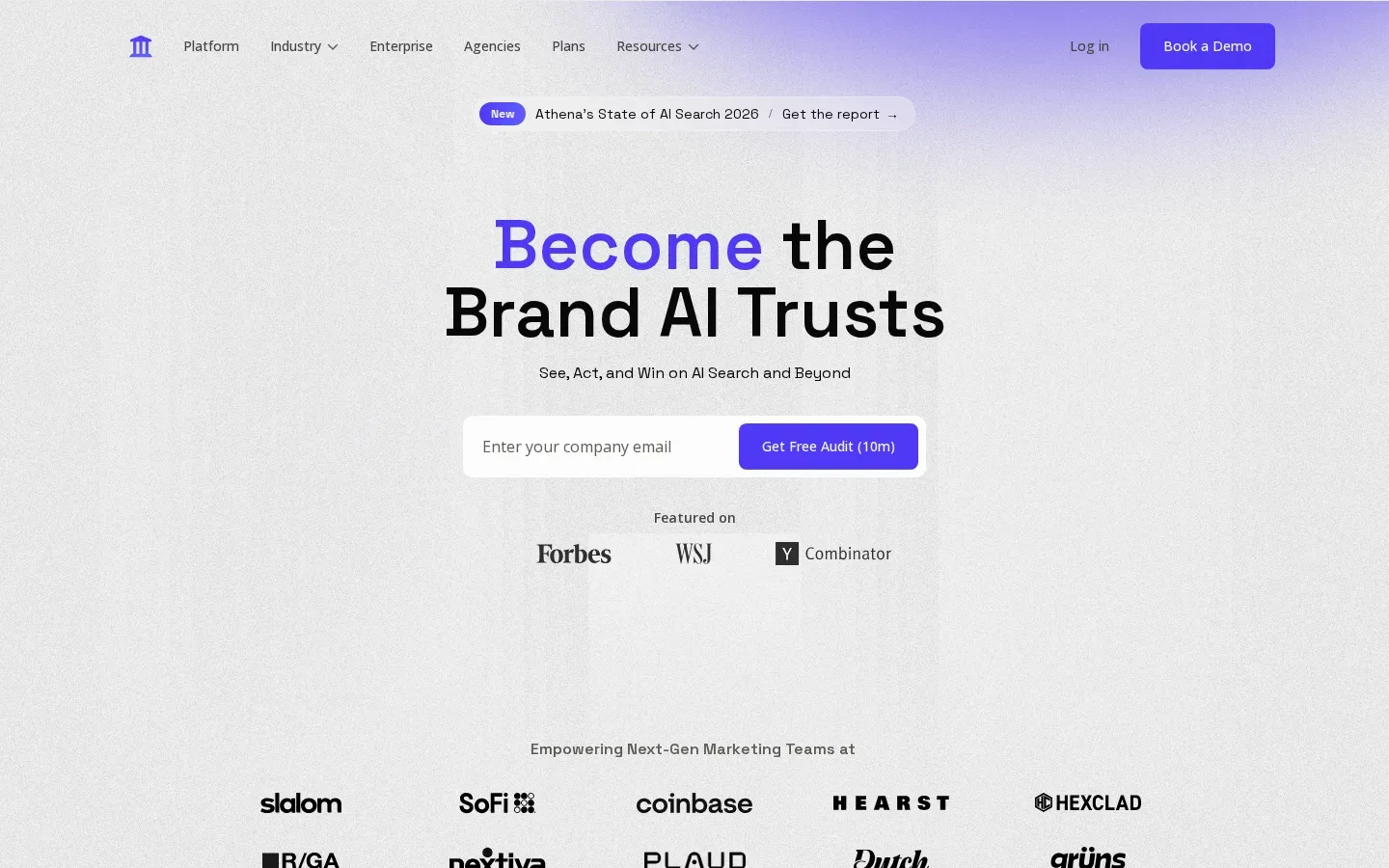
5. AthenaHQ: best for enterprise AI Overview programs with audience segmentation
Starting price: enterprise tier.
AthenaHQ matches Profound’s depth and adds stronger audience-segmented reporting. AI Overview share of voice by buyer persona, by product line, by geo: that segmentation flexibility is harder to set up in Profound. The enterprise procurement story is mature.
AI Overview specifics: mention rate, citation rate, audience-segmented share of voice, year-over-year.
Pick if: enterprise, audience segmentation is a primary use case, ready to invest in mature reporting.
6. HubSpot AEO: budget-friendly AI tracking with scalability

Starting price: $45/month for the standalone product; from $800/month for the AEO and Marketing Hub bundle.
HubSpot AEO stands out for its personalized AI optimization recommendations. It suggests optimization tasks from your existing performance metrics and lets you track the results of each one in the platform after you implement it.
HubSpot AEO’s native Marketing Hub integration adds the rest of the omnichannel toolset, from social listening and management to site optimization, which is where the AI search trust signals come from in the first place.
AI Overview specifics: mention rate, citation rate, competitor share of voice, and the option to read AI search and classic SEO performance side by side.
Pick if: you are a small business that wants an entry-level platform with the option to scale into a full omnichannel marketing suite.
7. Honeyb: best for tracking plus articles that close the gaps
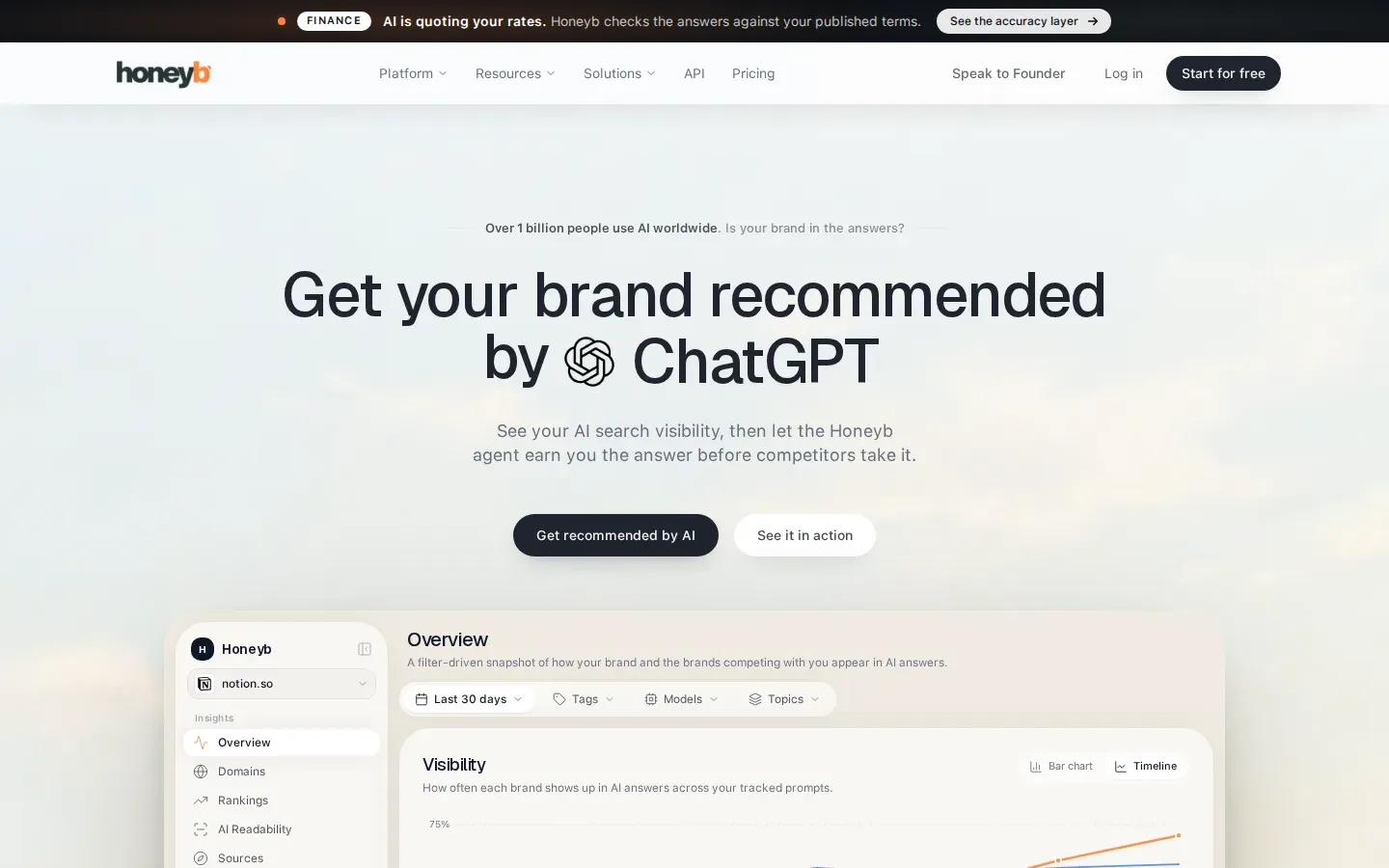
Starting price: $23/month billed annually for one engine; $159/month billed annually for all eight engines, AI Overview included.
Honeyb tracks how eight AI engines, including ChatGPT, Google AI Overviews and AI Mode, answer the prompts your buyers ask. It shows which competitors get named ahead of you, which sources each engine reads, and where answers get your facts wrong, then ranks the fixes. A built-in Content Agent writes the articles that close those gaps and publishes them to your CMS, and the Honeyb team can also work as your external team.
The plans scale by engines and prompts. The Minimum covers one engine of your choice and 10 prompts a day. Multi-Model ($63/month billed annually) covers three engines and 50 prompts. Full Spectrum ($159/month billed annually) covers all eight engines, Google AI Overviews and AI Mode included, with 100 prompts a day and 30 articles a month. API access and white-label reporting are on Enterprise only.
AI Overview specifics: brand mentions, competitor tracking, source citations with a domain-level breakdown, and ranked recommendations.
Pick if: a small team wants AI Overview tracking and the content work in one subscription, and is happy to pay annually.
How they actually compare on AI Overview
We ran the same 50-query workflow through all 4 tested tools for AI Overview specifically. Mention-rate numbers all converged within 5% of each other; the underlying engine APIs return consistent data, so the metrics agree once normalized. Where the tools diverged:
- Time to first AI Overview report: Peec AI (3 days) > OtterlyAI (5 days) > Profound and AthenaHQ (5–7 days)
- AI Overview citation depth: Profound (best dashboard surface for citations) > OtterlyAI (best citation-rate metric) > others
- AI Overview competitor analysis: Profound > Peec AI > others
- Cost for 100 queries/week × AI Overview only: Peec AI entry tier most cost-efficient at this volume
AI Overview tracking vs. AI Overview rank tracking
People search for “AI Overview rank tracking” and “AI Overview tracking tools” almost interchangeably, but they describe two different jobs. Classic rank tracking asks “what position does my URL hold in the ten blue links?” AI Overview tracking asks a different question: “was I named in the AI-generated summary above the links, and was I cited with a clickable source?”
The distinction matters because the summary sits above the organic results and answers many queries before a user ever scrolls to position one. A page can rank first organically and still be invisible in the AI Overview, or rank fifth organically and be the AI Overview’s top-cited source. All the tools in this list track AI Overview presence and citations rather than a numeric SERP rank — which is why we call them tracking tools, not rank trackers. If you need classic position data alongside AI Overview coverage, pair one of these with a conventional rank tracker, or use a tool that reports both.
Can you track AI Overview for free?
For a handful of queries, yes. A manual check in an incognito window with personalization off will tell you whether you appear in the AI Overview for five or ten terms. Past that, the personalization and geo variance Google applies makes manual spot-checks unreliable, and the arithmetic stops working — 50 queries checked weekly by hand is a part-time job that still produces inconsistent data. Most of the paid platforms offer a free tier or trial for evaluation, but production AI Overview tracking — a fixed query panel, un-personalized reads, weekly diffs, exportable citation lists — starts in the $200–300/month range for the mid-market tools.
Limits of this test
This was a fixed-workload comparison, not the last word, and a few caveats are worth stating plainly.
The query set was 50 terms in one category. A different category could shift the mention-rate gaps. Your own queries are the only ones that matter for your program.
We read from a single US geo. AI Overview varies by country. A tool’s geo coverage may weigh more for you than it did for us.
The window was two weeks. Citations drift. Evergreen terms are stable, but news-adjacent terms move fast, so a longer window would show more churn.
Pricing moves too. We used published entry and mid-tier plans at test time. Confirm the current number before you buy.
The raw AI Overview data converged across tools. So we scored reporting, speed, and price — not accuracy. If two tools disagree on a single query, treat it as noise, not signal.
Decision tree
| Your primary need | Pick |
|---|---|
| Polished enterprise reporting on AI Overview | Profound or AthenaHQ |
| Marketing-team dashboard, mid-market budget | Peec AI |
| Citation rate is the primary metric | OtterlyAI |
| Competitor tracking on AI Overview | Profound, or Peec AI on a mid-market budget |
| Audience-segmented enterprise reporting | AthenaHQ |
| AI Overview tracking alongside rankings and traffic in one SEO suite | SE Ranking |
| Entry-level budget, with room to scale into a full marketing suite | HubSpot AEO |
| Tracking plus articles written for the gaps | Honeyb |
When to use multiple
A non-trivial number of teams pair a mid-market platform with an enterprise-tier platform:
- Mid-market platform (Peec AI, OtterlyAI) for departmental reporting
- Enterprise platform (Profound, AthenaHQ) for board-level brand-intelligence reporting
Total cost is higher, but the audiences and use cases differ enough that the overlap isn’t wasteful. We covered this hybrid pattern in AI search visibility tools: build vs buy.
The pairing works because the two platforms answer different questions. The mid-market tool runs the day-to-day loop. The SEO team checks it weekly, watches citation rate on a fixed query set, and decides what to publish next. The enterprise tool runs the quarterly narrative. It rolls AI Overview share of voice up by product line and persona for a board deck no analyst wants to rebuild by hand. When one team owns both, the overlap is waste. When two teams with different reporting cadences each own one, it is not. Before committing to two tools, though, price the single-tool path first — a mid-market plan with a competitor add-on covers most programs, and a second subscription only earns its cost once board-level segmentation becomes a standing requirement rather than a one-off request.
A different pairing is a tracker plus a content tool, so the gaps the tracker finds get closed. PageLens puts both in one product: by its own description, it runs your buyer questions through Google daily, stores each Overview with its cited sources, then drafts pages aimed at the queries you miss and publishes them to your domain. Its Launch plan is $299/month for 100 prompts tracked weekly.
Bottom line
For pure AI Overview tracking, the tested tools cluster into three meaningful tiers, matching the decision tree above: enterprise polish (Profound, AthenaHQ) if you have the budget and the audience, a mid-market dashboard (Peec AI, OtterlyAI) for most teams, and an entry-level tracker (HubSpot AEO) when budget is the binding constraint.
If you only need AI Overview tracking and budget is the primary driver, the Peec AI entry tier is the most cost-efficient mid-market option. If you want enterprise polish and have the budget, Profound is the safest pick. For broader AI engine coverage beyond AI Overview, see LLM visibility tracking tools.

About the author
Ricardo Batista
Founder, cloro
Ricardo is one of the founders and engineers behind its SERP and AI-search scraping infrastructure. Before cloro he scaled a financial comparison site to $7M ARR and ran the full-country operations of a unicorn to $65M ARR, then went back to building. He writes about search engine scraping, generative-engine optimization, and turning live search and AI-answer data into something teams can act on.
Frequently asked questions
What is AI Overview tracking?
AI Overview tracking is the practice of monitoring whether and how a brand appears in Google's AI Overview — the AI-generated summary that sits above the standard SERP for the majority of informational queries in 2026. AI Overview pulls from a mix of Google's index and live web sources, blends the answer with citations, and personalizes by query and geo. AI Overview tracking measures mention rate, citation rate, and source-URL placement at the AI Overview surface specifically — separate from broader AI search tracking that covers other engines like ChatGPT and Perplexity.
Do AI Overviews appear for every search?
No. SE Ranking's research found AI snippets on 64% of the keywords it checked, mostly long-tail queries where Google can give a direct answer. That is why AI Overview tracking tools first report which of your tracked keywords trigger an AI Overview, then whether you are mentioned or cited in it.
Why track AI Overview separately from other AI engines?
Two reasons: (1) reach — AI Overview appears for the majority of informational Google queries in 2026, which means it sees more eyeballs than any individual conversational AI engine; (2) ranking signals — AI Overview pulls heavily from Google's index, so the moves that improve AI Overview visibility (structured data, fresh content, citation-worthy depth) are different from the moves that improve ChatGPT or Perplexity visibility. Tracking AI Overview separately lets you optimize specifically for the engine with the broadest reach.
Which tool has the best AI Overview coverage?
Coverage parity is high — every tool in this list covers AI Overview as a first-class engine. Where they differ is the depth of AI Overview-specific reporting: Profound and AthenaHQ have the strongest AI Overview-specific dashboards; OtterlyAI surfaces citation rate as a primary metric; Peec AI has the cleanest mid-market UI. If you only care about whether you appear in AI Overview, any of them is fine. If you want detailed AI Overview citation analysis, the depth differences start to matter.
How often do AI Overview citations change?
Less than you'd think. AI Overview citations are relatively stable for evergreen queries (think: 'best CRM', 'how to monitor brand mentions') and refresh weekly to monthly. Trending or news-adjacent queries refresh much faster, sometimes daily. Weekly tracking catches most meaningful drift; daily tracking is appropriate for news-heavy or competitive-volatile categories.
Can I track AI Overview without a paid tool?
For 5-10 queries, yes — manual checks in an incognito window work. Above that, the personalization layer Google applies to AI Overview makes manual tracking unreliable, and you need a tool that bypasses personalization. Free tiers exist on most platforms for evaluation; production tracking starts in the $200-300/month range for the dashboard-first tools.
Related reading
ChatGPT Ads Penetration Study: 51% in the US
ChatGPT ads over the last 7 days measure 51.0% of US responses, 53.6% CA, 49.8% AU, and, new since May, 18.8% JP. Everywhere else remains near zero. The surface reverted then re-spiked in June and now looks structural, not transient.
Best LLM & AI Visibility Tools 2026: 12 Tested
We tested 12 LLM visibility tools (also sold as AI visibility trackers and checkers) on real brand-monitoring workflows across ChatGPT, Perplexity, and Gemini. What works, what doesn't.
Profound Alternatives: 6 AI Brand Monitors Compared (2026)
Profound alternatives compared — Peec AI, AthenaHQ, Scrunch AI, OtterlyAI, Brandlight and FirstAnswer.ai. Pricing, engine coverage, and when each one fits.