
Schema Markup AI: Structured Data That Gets Cited

On this page
Schema markup AI work is not a new schema type. It is standard Schema.org structured data used more deliberately: JSON-LD, stable entity IDs, visible facts, and links that help AI systems understand what your page is about. The format itself is JSON-LD, a lightweight Linked Data format based on JSON that is easy for both humans and machines to read.
That matters because ChatGPT, Gemini, Perplexity, and Google AI Overviews all need clean signals before they cite or recommend a page. HTML tells humans how a page looks. Schema tells machines what the page means. A schema markup AI strategy simply closes the gap between the two.
This guide covers the schema types worth prioritizing, the JSON-LD examples to copy, and the mistakes that make AI extraction less reliable. Pair it with llms.txt and the GEO checklist when you want the full AI-readiness stack.
Schema vs structured data: is there a difference?
The two terms get used interchangeably, and for most practical purposes that is fine. Structured data is the broad concept: any organized, machine-readable description of a page’s meaning. Schema.org is the shared vocabulary that defines the types and properties, such as Article, Product, and Organization.
JSON-LD is the syntax you write that vocabulary in. So “schema markup” is really Schema.org vocabulary expressed as JSON-LD and embedded in your page. When people talk about a schema markup AI setup, they mean exactly this stack, chosen and validated so answer engines can lift facts cleanly.
Google recommends JSON-LD over the older Microdata and RDFa formats because it is the easiest solution to implement and maintain at scale. That single recommendation is why almost every modern schema markup AI workflow ships JSON-LD in a <script type="application/ld+json"> block rather than inline HTML attributes.
Why AI models love structured data
Before the mechanics, the size of the prize is worth stating, because schema work competes for the same hours as everything else. Across a frozen query basket run through five engines, our AI Search Index found citation presence sat in a tight 82-88% band across eight verticals, while query archetype swung it much harder: 91.2% for best-in-class answers against 80.7% for definitions. Structured data helps an engine attribute a specific claim to you, which is exactly what the low-citation formats need most, so the pages with the most to gain from schema are the definitional and how-to ones rather than the comparison pages that already get cited.
Large Language Models (LLMs) are prediction engines. They guess the next word based on the surrounding context.
When an LLM scrapes a raw HTML page, it has to work to separate signal from noise.
- “Is that $29.99 the price of the product, or the price of the accessory?”
- “Is ‘John Doe’ the author of the article, or the person mentioned in the third paragraph?”
Schema eliminates the guessing.
When you provide a Product schema, you’re handing the AI a database row. The workflow is always the same: you embed a JSON-LD block stating the fact in the page, the engine parses it during its normal fetch, and it reads that value directly instead of inferring one from the surrounding text.
{
  "@type": "Product",
  "name": "cloro Tracker",
  "offers": {
    "@type": "Offer",
    "price": "99.00",
    "priceCurrency": "USD"
  }
}
No ambiguity. The machine reads the fact without having to infer it. The common claim is that this clarity raises citation rates, but our own study below found no measurable difference in citations between pages with and without JSON-LD, so treat schema as a way to state facts cleanly, not as a citation lever.
The must-have schemas for 2026
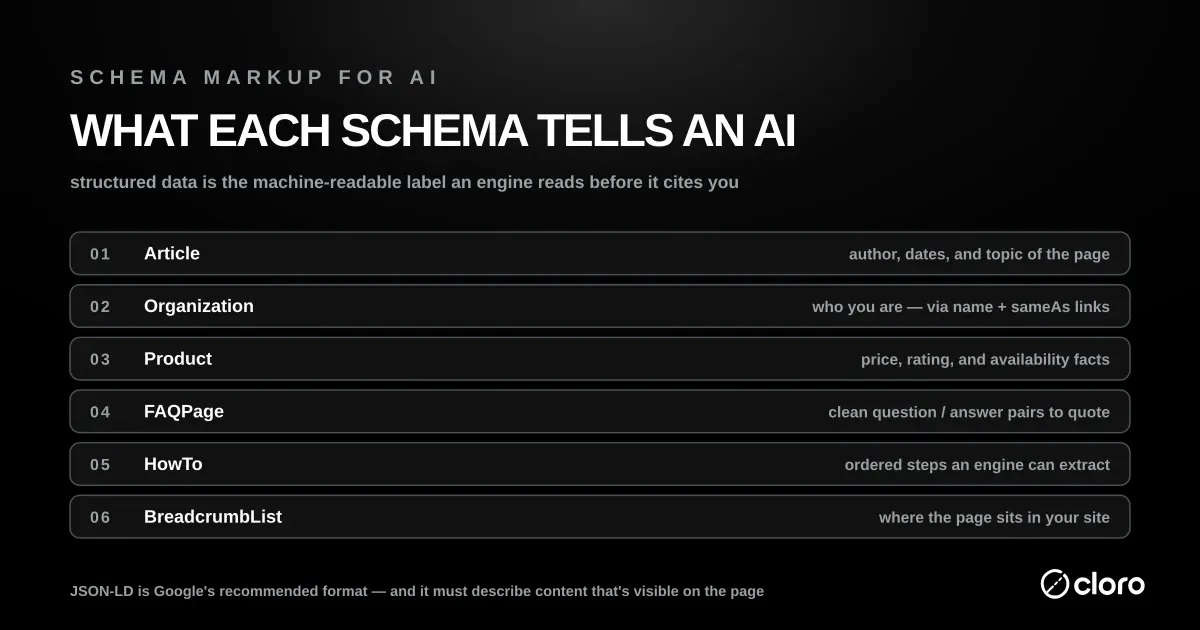
Forget about review stars for a moment. These four types do the heavy lifting in any schema markup AI stack, and each maps to a specific comprehension job an answer engine has to perform.
| Schema type | AI comprehension job |
|---|---|
Organization | Define who the brand is and link it to its verified profiles |
Author / ProfilePage | Attribute content to a real, qualified person (E-E-A-T: Experience, Expertise, Authoritativeness, Trustworthiness) |
FAQPage | Supply clean question-answer pairs the model can quote directly |
TechArticle / HowTo | Break a process into ordered, recitable steps |
These are the schemas that drive AI comprehension.
1. Organization (the knowledge graph)
Tells the AI who you are. Connects your website to your social profiles, logo, and founders. When someone asks “What is cloro?”, the AI pulls from this schema to generate the definition.
2. Author / ProfilePage
AI cares about who wrote the content. This is the core of E-E-A-T. It helps the AI verify the advice comes from a qualified human, not a hallucination.
3. FAQPage
The killer app for AEO (Answer Engine Optimization). Google retired the FAQ rich result from Search on 7 May 2026, so this schema no longer earns a rich result in Google itself. The case for keeping it is the AI-engine one: AI models are often trained on Q&A pairs, and a clean list of questions and answers feeds the model “training data” about your domain.
4. TechArticle / HowTo
For software and tutorials. Breaks down processes into discrete steps. When a user asks “How do I install X?”, the AI can recite your steps verbatim.
Add these if your business shape needs them
Three more types matter for specific businesses, per SEOptimer’s schema guide. LocalBusiness gives a location-based company’s address, opening hours, accepted payment methods and service area. Service spells out the services and practice areas a firm offers, the counterpart of Product for businesses that sell work rather than goods. Person on a team page lists each expert’s name, role and qualifications, which extends the Author job to people who do not publish articles.
Five JSON-LD examples with the AI angle
Below are copy-paste starting points for the schemas that influence AI extraction the most. Each is annotated with the AI-relevance angle, why this particular schema is worth your time when the goal is being cited by ChatGPT, Perplexity, or Google’s AI Overview.
1. Article: anchoring authorship and freshness
{
  "@context": "https://schema.org",
  "@type": "Article",
  "headline": "Schema markup for AI: speaking the language of machines",
  "datePublished": "2025-11-06",
  "dateModified": "2026-04-26",
  "author": {
    "@type": "Person",
    "name": "Rui Batista",
    "url": "https://cloro.dev/about/"
  },
  "publisher": {
    "@type": "Organization",
    "name": "cloro",
    "logo": { "@type": "ImageObject", "url": "https://cloro.dev/logo.png" }
  },
  "mainEntityOfPage": "https://cloro.dev/blog/schema-markup-ai/"
}
AI angle: LLMs increasingly weigh author and dateModified when choosing whom to cite. Google’s own Article structured data documentation lists author, datePublished, and dateModified among the recommended properties, and advises linking the author with url or sameAs so the engine can disambiguate who wrote it. A 2026 article with a real, linked author beats an undated 2022 article on the same topic, even when the older piece has more backlinks.
2. FAQPage: direct training data for answer engines
{
  "@context": "https://schema.org",
  "@type": "FAQPage",
  "mainEntity": [{
    "@type": "Question",
    "name": "Does ChatGPT read schema markup?",
    "acceptedAnswer": {
      "@type": "Answer",
      "text": "Yes. JSON-LD is one of the cleanest formats an LLM can parse for facts, pricing, and entities without hallucinating."
    }
  }]
}
AI angle: FAQ schema is structurally identical to instruction-tuning data. When an LLM is asked the question, your acceptedAnswer is the highest-probability completion, provided the answer is concise (under 60 words) and self-contained.
3. Organization: defining who you are once, everywhere
{
  "@context": "https://schema.org",
  "@type": "Organization",
  "name": "cloro",
  "url": "https://cloro.dev",
  "logo": "https://cloro.dev/logo.png",
  "description": "AI visibility and SERP API platform for tracking brand mentions across ChatGPT, Claude, Gemini, and Perplexity.",
  "sameAs": [
    "https://twitter.com/cloro_dev",
    "https://www.linkedin.com/company/cloro",
    "https://github.com/cloro-dev"
  ],
  "foundingDate": "2024-03-01"
}
AI angle: the canonical “who is X?” payload. When ChatGPT is asked “What is cloro?”, the model leans on the description field plus the sameAs graph to ground its answer. Skip this and you let competitors define you.
4. Product: pricing and availability without ambiguity
{
  "@context": "https://schema.org",
  "@type": "Product",
  "name": "cloro SERP API",
  "description": "Real-time Google SERP scraping API with 99.9% uptime, residential proxies, and automatic CAPTCHA solving.",
  "brand": { "@type": "Brand", "name": "cloro" },
  "offers": {
    "@type": "Offer",
    "price": "29.00",
    "priceCurrency": "USD",
    "priceValidUntil": "2026-12-31",
    "availability": "https://schema.org/InStock",
    "url": "https://cloro.dev/#pricing"
  },
  "aggregateRating": {
    "@type": "AggregateRating",
    "ratingValue": "4.8",
    "reviewCount": "127"
  }
}
AI angle: when a user asks “How much does cloro cost?”, the model with Product schema available answers in one shot. Without it, the model either hedges (“pricing varies”) or hallucinates a number. Pricing-shy SaaS teams routinely lose comparison-engine queries because of this.
5. HowTo: the format voice assistants love
{
  "@context": "https://schema.org",
  "@type": "HowTo",
  "name": "How to set up schema markup for AI",
  "totalTime": "PT15M",
  "step": [
    {
      "@type": "HowToStep",
      "position": 1,
      "name": "Identify your primary entity",
      "text": "Pick the single most important thing the page is about: a product, an article, an organization."
    },
    {
      "@type": "HowToStep",
      "position": 2,
      "name": "Generate JSON-LD",
      "text": "Use a schema generator or hand-write the markup, scoping to schema.org types."
    },
    {
      "@type": "HowToStep",
      "position": 3,
      "name": "Validate",
      "text": "Run the markup through Google's Rich Results Test before deploying."
    }
  ]
}
AI angle: HowTo is the only schema with explicit position ordering. Voice assistants reading instructions aloud rely on this field; without it, the assistant either skips your content or reads steps in the wrong order.
E-E-A-T and entity recognition: turning facts into a graph AI can follow
Google and AI models think in entities (concepts), not keywords. Schema connects these entities.
- Without Schema: “Steve Jobs worked at Apple.” (Just text).
- With Schema: entity “Steve Jobs” (Person) has an
affiliationrelationship with entity “Apple” (Organization).
By marking up your About and Team pages, you build a knowledge graph that AI can traverse. Entity linking is the most underrated part of the job, because it turns isolated facts into a graph the model can follow from person to company to product.
How each AI engine uses your structured data
Not every answer engine reads schema the same way, so a schema markup AI plan should account for how the major systems actually consume it.
ChatGPT and the search-augmented models
When ChatGPT browses live, it fetches the page and parses whatever structured data is present. JSON-LD gives it clean entity, pricing, and author facts without forcing the model to infer them from prose. For pages that end up in training corpora rather than live fetches, the same clean markup still travels with the text, so your facts are less likely to be garbled.
Perplexity and citation-first engines
Perplexity leans hard on citations, and it favors pages where the claim it wants to quote is unambiguous. A tight FAQPage or Article block gives it a self-contained, attributable sentence to lift. That is why a schema markup AI checklist should treat FAQ answers as quotable units, not as marketing filler.
Google AI Overviews and Gemini
AI Overviews sit on top of Google’s existing index, so the structured data you already ship for rich results feeds the same entity graph the overview draws from. Google is explicit that structured data must describe content visible to the user and warns against marking up information the reader cannot see. Get that wrong and you risk being ignored or, worse, hit with a manual action.
What we measured: schema does not separate cited pages from uncited ones
Everything above is the standard case for structured data, and it is worth testing rather than repeating, so we tested it.
We built a matched sample from cloro’s monitoring corpus over 11 to 19 August 2026. For each tracked prompt we took the URLs Google ranked organically, then split them by whether any of five AI engines (ChatGPT, Perplexity, Gemini, Google AI Mode, Copilot) also cited that exact URL for that same prompt. Same queries, same window, same ranking pool. The only difference between the two groups is the AI citation.
We then fetched 500 URLs from each group and parsed their markup: 405 cited pages and 395 uncited pages returned a 200.
| Cited by an AI engine | Ranked, not cited | |
|---|---|---|
| Any JSON-LD block | 63.5% | 61.0% |
Microdata (itemscope) | 19.5% | 15.4% |
Article | 22.7% | 22.5% |
FAQPage | 10.9% | 7.1% |
Organization | 44.9% | 47.6% |
The headline is a null result. Cited pages carry JSON-LD 2.4 percentage points more often than uncited ones, with a 95% confidence interval running from −4.3 to +9.2 points. That interval contains zero comfortably. On this sample, schema presence does not distinguish a page an AI engine cited from a page it ranked past.
Article, the type most often recommended for AI citation, is flat to a decimal place: 22.7% against 22.5%. Organization runs slightly lower on cited pages. FAQPage shows the largest gap in the expected direction and still does not reach significance, and we compared eighteen types, which is enough comparisons that a couple of near-misses are what chance produces.
The outside evidence is mixed in the same way. Evertune’s review of the debate notes BrightEdge research reporting higher AI Overview citation rates on pages with robust schema, next to early testing suggesting language models may strip markup during tokenization. Our sample tests one narrow step of that question, and on that step the markup made no measurable difference.
Read that carefully, because it is narrower than “schema is useless.”
What the test rules out is schema as a differentiator among pages that already rank. If Google has put you on page one and the engine is choosing which of those results to cite, our data says the choice is not being made on your markup. Two thirds of that pool has JSON-LD; it is table stakes, not an edge, and the marginal FAQPage block is not what wins you the citation.
What the test does not touch is everything schema does before that point: earning the ranking, feeding the knowledge graph, populating rich results, and stating your facts unambiguously so an engine describing your pricing gets it right. Those are real, they are the reasons in the sections above, and none of them are measured here.
The practical consequence is about sequencing. If you are not being cited and your pages already rank, adding another schema type is the wrong next move, and our numbers say you should expect roughly nothing from it. Look at whether the page answers the prompt in extractable form. Reach for schema markup for AI when your facts are wrong in AI answers or your entity is unclear, which is a different problem with a different fix.
Measuring whether your schema markup AI work pays off
Shipping schema is only half the job. You also need to know whether the AI systems actually changed how they describe and cite you.
Track two things. First, whether your facts appear correctly when you ask an engine about your brand, product, or pricing. Second, whether your pages get cited at all in AI answers for your target queries. cloro’s AI visibility tracking monitors brand mentions and citations across ChatGPT, Gemini, and Perplexity, which turns a schema markup AI rollout from guesswork into a measurable before-and-after.
If a competitor with weaker content is being cited instead of you, missing or inconsistent schema is one of the first things worth auditing.
Tools to generate schema automatically
Writing JSON-LD by hand is error-prone, so most teams bootstrap a schema markup AI implementation with a generator and then hand-tune the output. Use these tools to automate the first draft.
- Google Structured Data Markup Helper: the classic. Good for beginners, but manual.
- Schema Markup Generator (JSON-LD), by Max Prin: the industry standard for generating JSON-LD snippets quickly without writing code.
Many modern CMS plugins (Yoast, RankMath) handle the basics but fail at custom entity linking. You may need to inject custom JSON-LD into the head.
Validation checklist
Before you ship a new schema block, run through this list. It runs on every cloro deployment and catches most schema issues before they reach production.
- JSON parses cleanly. Paste it into any JSON validator. A trailing comma or unescaped quote will silently break the entire block.
-
@contextis exactlyhttps://schema.org. Nothttp://, not a typo. Engines will skip schema with a malformed context. -
@typematches the page’s primary intent. A blog post isArticleorBlogPosting, notWebPage. A product page isProduct, notArticle. - All required fields are present. Google’s Rich Results Test flags missing
headline,image,author, etc., depending on the type. - Dates are ISO-8601.
2026-04-26, notApril 26, 2026. - URLs are absolute.
https://cloro.dev/#pricing, never/#pricing. - The schema reflects what is actually on the page. Marking up a price of $29 when the page shows $49 is grounds for a manual penalty.
- Only one primary schema per page. Stacking
Article,Product, andServiceon the same URL confuses extractors. Pick the dominant entity. - Validated in Google’s Rich Results Test. If it doesn’t validate there, no engine will trust it.
- Re-tested after CMS publish. Some CMS layers strip JSON-LD or escape characters incorrectly during render.
Common mistakes that kill AI extraction
In our work auditing client schema, the same handful of schema markup AI mistakes show up across industries.
-
Marking up content that isn’t visible. Google’s docs are explicit: schema must describe content the user can actually see. Hidden FAQ accordions are fine; entirely fabricated FAQs added only to the schema are a manual-action risk. AI engines also down-weight invisible content.
-
Stuffing keywords into
descriptionfields. We’ve seendescriptionfields with 600 characters of repeated phrases. LLMs detect this pattern and discount the entire block. Keep descriptions to 1–2 natural sentences. -
Missing
sameAson Organization. Schema.org definessameAsas the URL of a reference page that unambiguously indicates the item’s identity, such as its Wikipedia page, Wikidata entry, or official profile. Without it, the AI can’t link your site to your LinkedIn, X, GitHub, or Crunchbase entity. Your brand becomes “an entity that might or might not be the same as the one mentioned elsewhere,” which kills confidence. -
Inconsistent author identity across posts. If your byline is “Jane Doe” on one post, “J. Doe” on another, and “Jane” on a third, AI can’t consolidate the authorship signal. Pick one canonical name and one canonical author URL, then reuse them everywhere.
-
Forgetting
dateModified. Stale articles read as untrusted. UpdatedateModifiedwhenever you make a substantive edit, but never lie about it. Engines cross-reference against the page’s last-modified header. -
Overlapping schema between site-wide and page-level templates. Two
Organizationblocks (one in the global header, one in the page) often disagree on details, and an engine reading both has no way to know which one is authoritative, so it may cite the stale copy. Pick one source of truth and import it everywhere.
Testing your implementation
Don’t publish and pray.
- Rich Results Test. Google’s official validator. If it fails here, it won’t work anywhere.
- Schema Markup Validator. The official Schema.org testing tool, useful because it validates any Schema.org type, not just the subset Google renders as a rich result.
- The “AI test.” Paste your raw HTML into ChatGPT and ask: “Extract the product pricing and return policy from this code.” If it struggles, your schema markup AI implementation is missing or broken.
The future: schema as an API
We’re moving toward a world where your website’s visual interface is for humans and your Schema/llms.txt is for agents.
Schema will function as a decentralized API. An AI agent booking a flight won’t click buttons. It will read the FlightReservation schema, find the Action endpoint, and execute the transaction directly.
If you aren’t marking up your content, you’re building a library with no card catalog, and the agents taking over discovery are the ones who need that catalog most. Map your entities, validate your JSON-LD, and the machines reading your page will get your facts right.

About the author
Ricardo Batista
Founder, cloro
Ricardo is one of the founders and engineers behind its SERP and AI-search scraping infrastructure. Before cloro he scaled a financial comparison site to $7M ARR and ran the full-country operations of a unicorn to $65M ARR, then went back to building. He writes about search engine scraping, generative-engine optimization, and turning live search and AI-answer data into something teams can act on.
Frequently asked questions
Does ChatGPT read Schema markup?
Yes. Structured data (JSON-LD) is one of the easiest ways for an LLM to parse entities, pricing, and facts from a webpage without hallucinating.
Which Schema is most important for AI?
`Organization` (for brand identity), `Product` (for shopping), and `FAQPage` (for Q&A extraction) are critical.
Can I use Schema to prevent hallucinations?
Yes. By explicitly stating facts in Schema, you provide a 'ground truth' that reduces the likelihood of the AI guessing incorrect details.
How does Schema markup help with E-E-A-T?
Schema helps AI models understand the identity of authors (`Author` schema), their affiliations, and the organization publishing the content (`Organization` schema), which contributes to establishing Experience, Expertise, Authoritativeness, and Trustworthiness.
How can I test my Schema markup implementation?
Use Google's Rich Results Test tool to validate syntax and identify errors. Additionally, you can paste your HTML into an LLM and ask it to extract specific facts to see if it understands your structured data.
Related reading
People Also Ask SEO: How to Optimize for PAA Boxes
Learn People Also Ask SEO: find PAA questions, use exact H2s, write 40-60 word answers, add FAQ schema, and track PAA citation changes over time.

Featured Snippet Optimization: How to Win Position Zero
Learn featured snippet optimization: match query format, write 40-60 word answers, use lists and tables, and win position zero in Google search.
How to Track SERP Features in 2026 (Free + API Methods)
How to track SERP features in 2026 — the seven that move traffic, the free ways to start monitoring today, and the API method that scales to millions of keywords.