
International Keyword Research: One Seed, 10 SERPs

On this page
Most international keyword research starts the same wrong way: take the keyword list that works at home, run it through a translator, and hand it to each new market. It feels efficient. It also quietly assumes that the same query means the same thing, faces the same competitors, and carries the same demand everywhere. None of that holds.
To show exactly how badly it breaks, we did the experiment. We picked one commercial seed, scraped it across ten of Google’s country editions on the same day, and measured how much the results actually had in common.
One seed, ten countries: the top 10 barely overlapped
We took a single high-intent retail seed (“running shoes”) and pulled Google’s organic top 10 for it in ten markets: the US, UK, Canada, Australia, Germany, France, India, Brazil, Japan, and South Africa. One query, one day, ten country-and-language settings. We looked only at organic web results, setting aside shopping units, map packs, and People-Also-Ask boxes so we were comparing like with like.
Then we normalised every result to its brand, so adidas.co.uk and adidas.com count as the same player. That is the conservative choice: it credits multinationals as one shared result instead of counting each country domain as different, which would only widen the gap. Even after that, the divergence was stark.
The average top-10 brand overlap between the US SERP and the other nine markets came to 17.4%. Measured across every possible pair of countries, the average overlap was just 14.6%. In other words, pick any two markets at random and roughly six of every seven ranking brands are different. The single query surfaced 58 distinct domains across the ten markets, representing 44 brands, and 31 of those brands appeared in only one country.
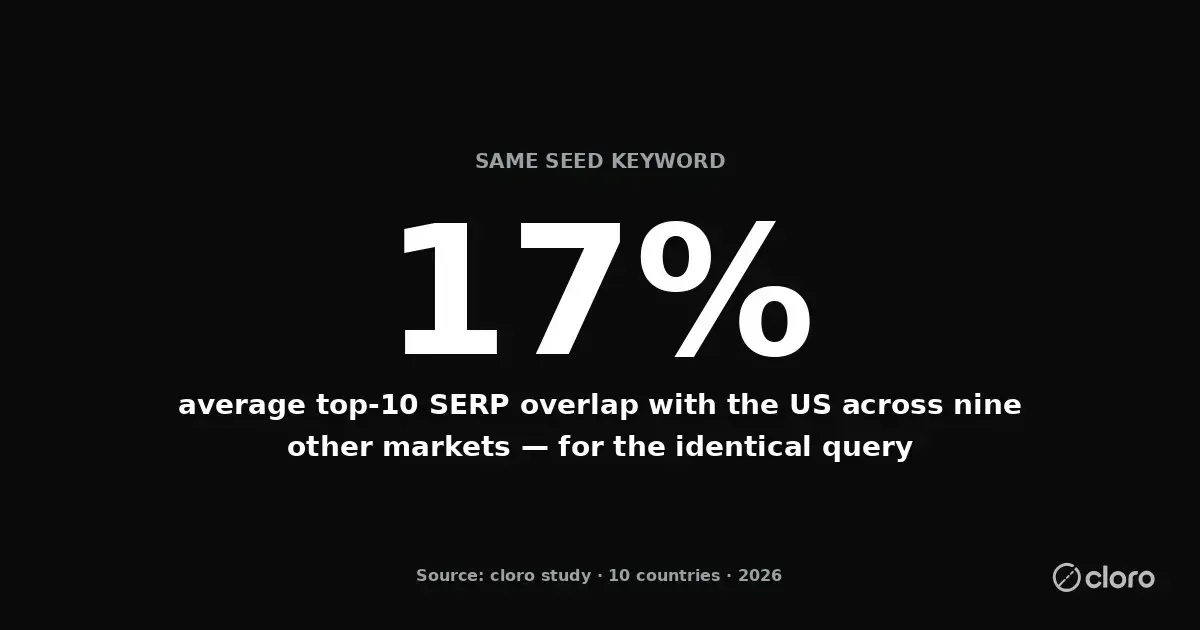
The outlier makes the point loudest. Australia’s top 10 shared not a single brand with the United States. Same word, same language, same search engine, and a completely different set of winners.
| Market | Top-10 brand overlap vs US | What the local top 10 looks like |
|---|---|---|
| Canada | 36% | adidas.ca, sportchek.ca, newbalance.ca, rtings |
| Brazil | 27% | netshoes.com.br, on Brasil, keeprunning.com.br |
| UK | 23% | adidas.co.uk, sportsdirect, sportsshoes, runnersneed |
| Germany | 17% | newbalance.de, running-point.de, afew-store, asics |
| Japan | 17% | abc-mart.net, yonex.co.jp, brooksrunning.co.jp |
| France | 15% | i-run.fr, decathlon.fr, running-conseil.com |
| South Africa | 13% | mrpsport, tekkietown, hi-tec, sportsmanswarehouse |
| India | 8% | myntra, flipkart, reebok.abfrl.in, campus, nivia |
| Australia | 0% | jd-sports.com.au, paceathletic, intersport, stylerunner |
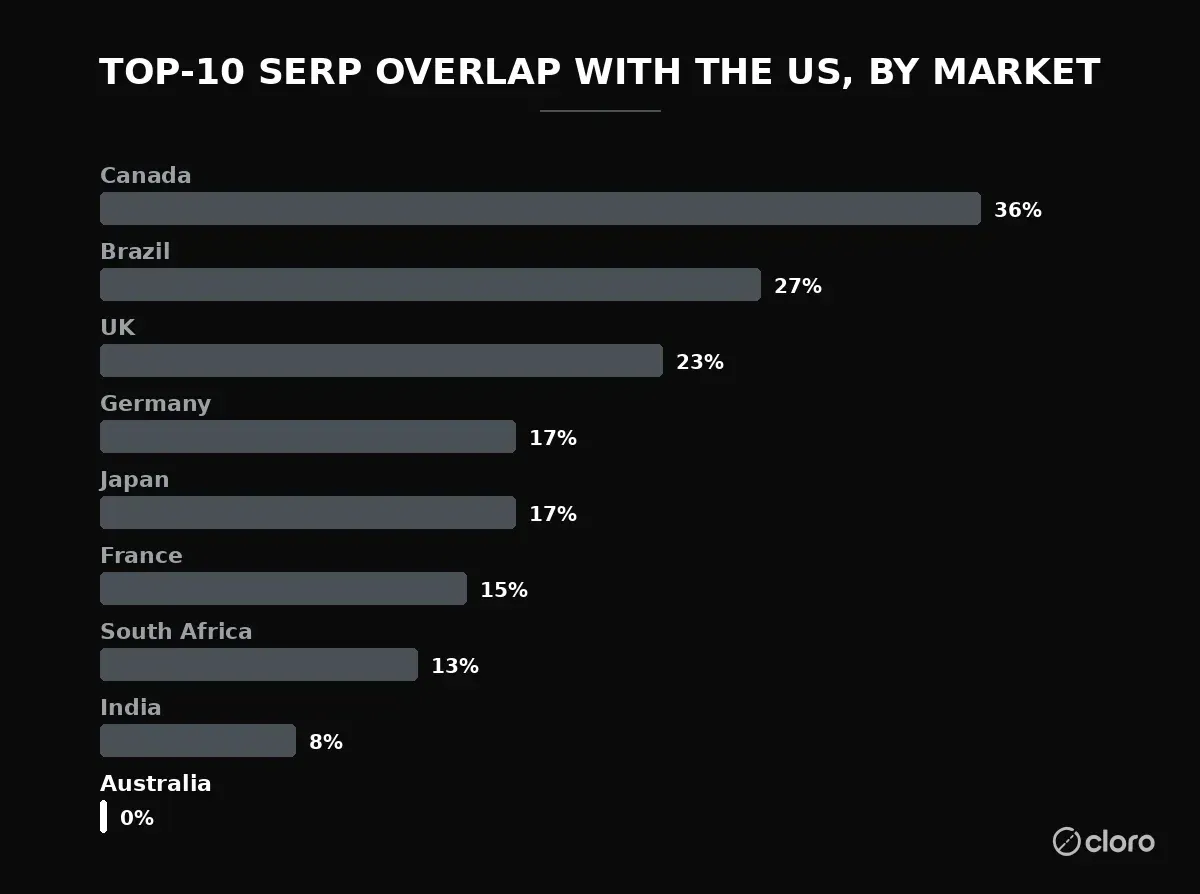
Only three brands showed up in half or more of the markets: adidas (8 of 10), the American publisher Runner’s World (7 of 10), and New Balance (5 of 10). Everything else was local. If your international keyword research assumes your home-market competitors are your global competitors, this table is the correction.
What actually changed from market to market
Two patterns explain the low overlap, and both matter for how you plan content.
The first is that commerce is local. The retailers ranking for “running shoes” are overwhelmingly country-specific: i-run.fr and Decathlon in France, Netshoes in Brazil, ABC-Mart and Yonex in Japan, Myntra and Flipkart in India, Sportsmans Warehouse and Mr Price Sport in South Africa. These are not translations of American stores. They are different businesses that own their market. A keyword plan built on US retail SERPs tells you nothing about who you are actually up against in São Paulo or Mumbai.
The second pattern is that editorial content travels further than commercial content. The one page that ranked almost everywhere was a single English “best running shoes” review from Runner’s World, which appeared in seven markets. Global buying-guide content can earn a broad footprint, but the transactional and category results underneath it reshuffle completely per country. That split (portable editorial, local commercial) is a useful lens when you decide which pages to localize first.
India adds a third wrinkle. Its top 10 overlapped with the US by just 8%, a single shared brand, because horizontal marketplaces own the query. Myntra, Flipkart, and Reebok’s India storefront rank where standalone specialists do in the West. A market can diverge not only in which stores rank but in what kind of result wins, and international keyword research has to capture that structural difference, not just swap the store names. The same seed can be a marketplace query in one country, a brand-store query in another, and an editorial query in a third.
The SERP furniture changes too. The People-Also-Ask questions arrived in the local language (“Welche Schuhe sind am besten fürs Laufen?” in Germany, “Qual é o melhor sapato para correr?” in Brazil), and the AI Overview and shopping units differ market to market. Ranking-position volatility by city and ZIP code is the domestic version of this same effect; cross borders and the reshuffle gets far larger.
Why brand-normalised overlap is the honest number
It would be easy to inflate these findings by counting adidas.de and adidas.com as different results. We deliberately did the opposite. Collapsing every domain to its brand means the 17% figure understates the raw divergence. The actual page-level overlap is lower still. The takeaway is conservative on purpose: even giving multinationals full credit, markets barely resemble each other.
The bigger trap: the keyword itself changes language
Divergent SERPs are only half the problem. The half that wrecks more keyword plans is that the seed you are researching is often the wrong word entirely.
Run “running shoes” through a country-volume check and the English term looks healthy in English-speaking markets: 174,000 monthly searches in the US, 69,000 in the UK, 28,000 in Canada. Then it falls off a cliff. In Germany the English phrase draws about 3,200 searches a month. That number invites a bad conclusion: small market, skip it.
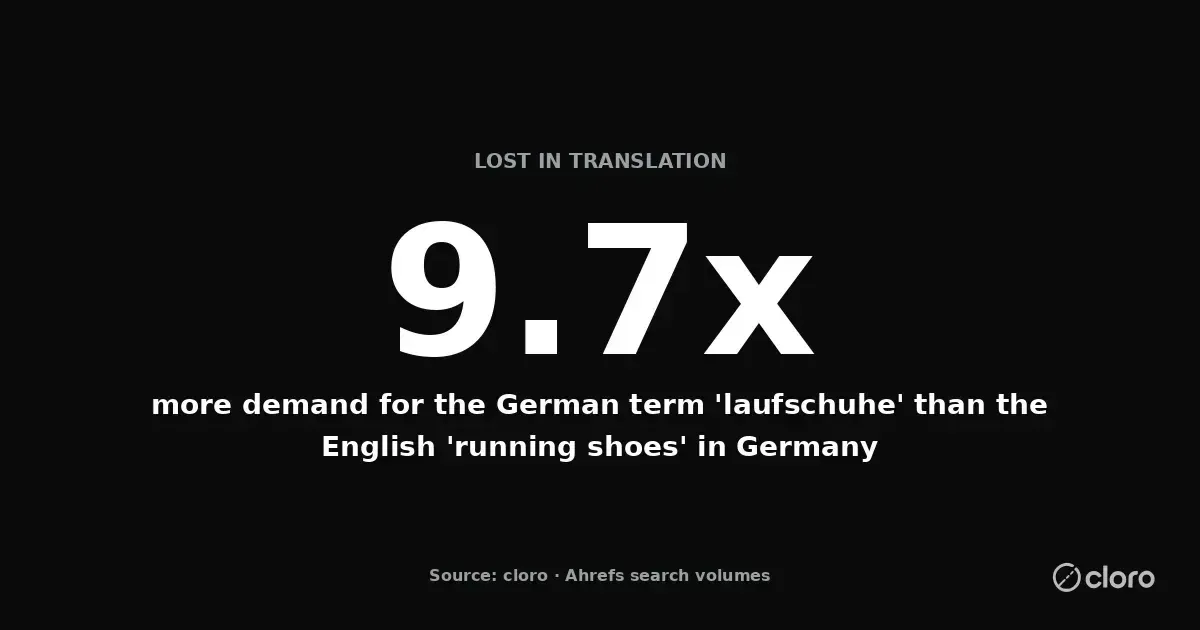
The conclusion is wrong because Germans do not search in English. They search laufschuhe, which pulls 31,000 searches a month, nearly 10× the demand the English seed reported for the same country. The market was never small; it was hiding behind the wrong word.
| Market | English “running shoes” | Local term | Local monthly searches |
|---|---|---|---|
| Germany | ~3,200 | laufschuhe | 31,000 |
| Japan | below the seed’s top-12 markets | ランニングシューズ | 78,000 |
| Brazil | below the seed’s top-12 markets | tênis de corrida | 9,800 |
| France | below the seed’s top-12 markets | chaussures running | 2,800 |
Japan is the sharpest example. The English “running shoes” does not even rank Japan among the seed’s top-12 markets, yet the katakana ランニングシューズ returns 78,000 searches a month. An English-only keyword tool would price Japan as a rounding error and miss one of the largest pools of demand in the study.
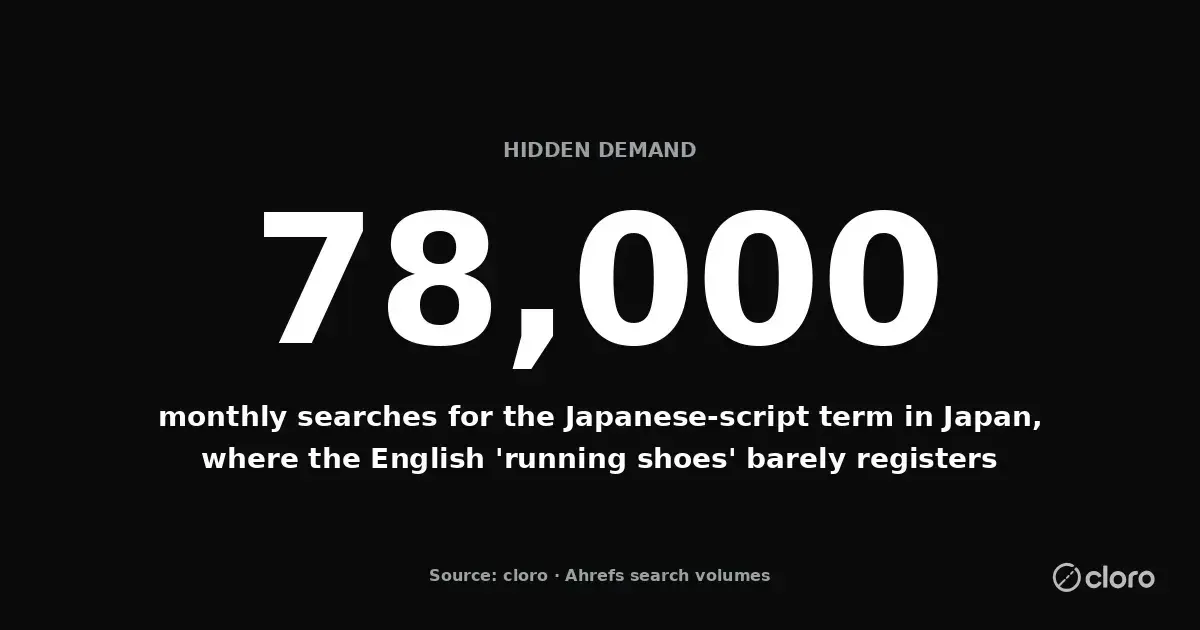 This is why localized keyword research cannot begin from a translated master list. The demand lives in words your seed list does not contain.
The mechanism behind the trap is easy to miss. Most keyword tools default to a single country and language, so a quick volume check silently measures demand in the wrong market and reports a real market as empty. Sound international keyword research means changing those defaults for every country, then following the local term wherever it leads, frequently to a head term that shares no words at all with your original seed. The seed is a thread to pull, not the answer.
It also tracks with the shape of the web. English accounts for just under half of all sites (W3Techs’ content-language survey puts it at 49.6% of websites whose language is known), so the majority of the web, and the searches behind it, happen in other languages. Multilingual keyword research is not a nice-to-have; it is where most of the addressable demand actually is.
The takeaway: international keyword research is per-market research, not translation
Put the two findings together: each market needs its own research, not a translated list. Every target country has its own head terms (often not translations of each other), its own volume distribution, its own ranking competitors, and its own SERP layout and intent mix. A keyword that is informational in one market can be transactional in another. The seed list is a starting point for discovery, not a plan to be copied.
That reframing changes the deliverable: instead of one master list mapped to N languages, you produce N market lists, each grounded in that country’s real searches and its real SERP. It is more work up front, but it is the difference between guessing a market and actually seeing it, and once you treat each market as a data pull rather than a translation, the work becomes mechanical and repeatable. There is no single “global” volume that summarises a term, since it fractures into different words with different demand in every market: skip the step and you inherit the seed’s blind spots in ten places at once.
A localized keyword research workflow with cloro
Here is the international keyword research loop we use, and the one the data above argues for. It is deliberately practical: a per-market pass you can run for every country on your roadmap.
1. Start from local demand, not your seed. For each market, find the local-language equivalent of your seed and check its volume in that country. If the local term outweighs the translated one, as laufschuhe did, it becomes your head term, and its variants become the list. Check difficulty and CPC per market as well: Veracontent notes that non-English keywords can carry search volume close to their English equivalents with much lower keyword difficulty and CPC.
2. Pull the SERP in the target country and language. Set the country and language explicitly. Google decides which localized page to serve from those signals, which is why you should tell Google about the localized versions of your own pages, and why your research has to read the SERP the same way a local user’s browser would.
3. Get the parameters right. Country (gl), language (hl), and location (uule) are what actually change the results. The mechanics live in our gl/hl/uule parameters guide; the short version is that these three inputs, not your office location, define which market’s Google you are looking at.
4. Read who ranks, per market. Capture the organic top 10 for each local head term and note the real competitors: the local retailers and publishers, not your home-market rivals. This is the step our study automated across ten countries at once.
5. Do it at scale. Running one query in ten countries by hand is tedious; running your whole seed set across every target market is not viable manually. A SERP API returns country-and-language-specific results programmatically, so the per-market pull becomes a script instead of a week of VPN juggling. The keyword research use case walks through wiring this into a repeatable pipeline.
Pitfalls that quietly wreck international keyword research
A few failure modes show up again and again once teams start international keyword research in earnest.
Proxy country ≠ SERP country. The most common mistake is assuming a proxy in Germany returns Germany’s SERP. It often does not. Google sets locale primarily from the gl and hl parameters, and per Google’s own documentation, it does not vary its crawler source by location to find page variations. Change the parameters, not just the IP.
Translation ≠ localization. A translated keyword is grammatically correct and commercially useless if nobody searches it. The laufschuhe gap is the whole argument in one word.
Assuming Google is universal. For the ten markets here, Google dominates, but plan for the exceptions before you commit budget. EC Innovations’ guide cites StatCounter figures of 56.23% search share for Baidu in China and 73.41% for Yandex in Russia, and Naver leads in South Korea. In those markets, research demand in the local engine’s own tool, such as Baidu’s keyword tool or Yandex Wordstat, because a plan that only reads Google will misjudge them.
One-and-done volume. Demand and SERPs drift, and they drift differently per market. A localized keyword research pass is a cadence, not a one-time export.
Your localized keyword research checklist
Use this international keyword research checklist per market when you expand into a new country. It keeps the process repeatable.
- Identify the local-language head term for each seed, and confirm its volume beats the translated version.
- Set gl, hl, and (where relevant) uule for the target market before pulling anything.
- Capture the organic top 10 per head term and list the real local competitors.
- Note the SERP layout (AI Overview, shopping, local pack, PAA), since intent shifts by market.
- Build a separate keyword list per country; never map one master list across languages.
- Re-pull on a schedule so the list tracks the market instead of aging out.
International keyword research done this way is more work than a translation pass, and it is the only version that survives contact with a real market. One seed taught us that ten countries share barely a sixth of their results and hide most of their demand behind local words. Treat every market as its own SERP, and you stop guessing.

About the author
Ricardo Batista
Founder, cloro
Ricardo is one of the founders and engineers behind its SERP and AI-search scraping infrastructure. Before cloro he scaled a financial comparison site to $7M ARR and ran the full-country operations of a unicorn to $65M ARR, then went back to building. He writes about search engine scraping, generative-engine optimization, and turning live search and AI-answer data into something teams can act on.
Frequently asked questions
What is international keyword research?
International keyword research is the process of finding the terms real people use in each target market (in their own language and their own Google edition) rather than translating one keyword list for every country. It treats each market as its own SERP with its own demand, competitors, and intent.
Why do search results differ so much between countries for the same keyword?
Google serves results based on the country (gl) and language (hl) of the query, and each market has its own retailers, publishers, and local sites competing. When we scraped one seed across 10 countries, the average top-10 overlap with the US was about 17%, and Australia shared no ranking brands with the US at all.
Is translating my keyword list enough for international SEO?
No. Translation gives you a grammatically correct phrase, not the phrase locals actually search. Germans search laufschuhe, not running shoes, and the German term has roughly ten times the volume of the English one in Germany. Localized keyword research starts from local demand, not a translated seed.
Does using a proxy in another country show me that country's Google results?
Not reliably. A proxy changes your IP, but Google sets locale mainly from the gl and hl parameters, and Google itself says it does not vary its crawler source by location. A German proxy with default US parameters can still return a US-flavoured SERP, which is why country and language should be set explicitly.
How many keywords should I research per target market?
Enough to cover the market's own head terms and their local-language variants, not a fixed number. Start by pulling the local-language equivalent of each seed, check its volume and SERP in that country's Google edition, and expand from the terms that actually rank there. The result is a per-market list rather than one translated master list.
Related reading
Google Search Parameters: 2026 URL Guide for Scrapers
The complete guide to Google search parameters (gl, hl, uule, udm, tbs) to control location, language, time filters, and AI Overviews when you scrape at scale.
Local Rank Tracking: How Rankings Change by City
The same keyword ranks differently in every city. Here is how much local rankings vary by geography, why the map pack changes week to week, and how to check Google Maps rankings programmatically across a city grid.

SEO Competitor Keywords: Reverse-Engineer Any Rival
Reverse-engineer any competitor's keyword footprint with free SERP scraping (query fan-out, PAA mining, and autocomplete), then validate the recovered terms against live results.