
B2B Keyword Research: What the SERPs Actually Show

On this page
Every B2B keyword research guide tells you to start with search volume. In a niche software market, that advice quietly falls apart. The term you most want to rank for might show 90 searches a month, or 300, or zero. All three numbers can be wrong at once.
So we stopped trusting the number and looked at the page instead. cloro read 60 live Google SERPs and found a split so clean it changes how B2B keyword research should work: the search results page tells you what the volume estimate can’t.
Why volume data breaks down in B2B and SaaS niches
Search volume feels like a hard number. It isn’t. It is a modelled estimate, and most SEO tools report search volume as an annual average: a single figure smeared across twelve months of seasonality, launches, and buying cycles.
That average is shaky even before you reach a niche. When Ahrefs checked Google Keyword Planner against clickstream data, the planner’s volumes were roughly accurate in only about 45% of cases. Better than a coin flip, but not something to bet a content roadmap on.
Now shrink the market. A consumer term like “air fryer” does hundreds of thousands of searches, so even a sloppy estimate lands in the right ballpark. A SaaS term like “feature flag software” does a couple of hundred. At that scale the averaging error can be larger than the signal, and a keyword worth writing can read as worthless.
This is the core problem with SaaS keyword research: the numbers are least reliable exactly where the stakes are highest. Our own cluster shows the mismatch. The head term b2b keyword research carries a keyword difficulty of 0 and an $11.00 CPC. Advertisers pay double digits per click for a keyword the difficulty score says is trivial to rank for.
Volume alone would have you skip it. The SERP says otherwise. Good B2B keyword research starts by admitting the estimate is noisy and looking for a second opinion, which is sitting on the results page.
AI Overviews cover B2B queries by default, while B2C rarely gets one
To measure how differently B2B and B2C results are built, we ran a controlled sample. We analyzed 60 commercial queries (30 B2B and SaaS software terms, 30 B2C consumer-product terms) and recorded the live Google SERP feature set for each from cloro’s SERP layer (United States, June 2026). A query counts as AI-Overview-present when Google renders an AI Overview above the organic results.
The gap was not subtle.
| Query type | Queries | AI Overview present | Shopping pack present |
|---|---|---|---|
| B2B / SaaS software | 30 | 30 (100%) | 2 (7%) |
| B2C consumer products | 30 | 3 (10%) | 28 (93%) |
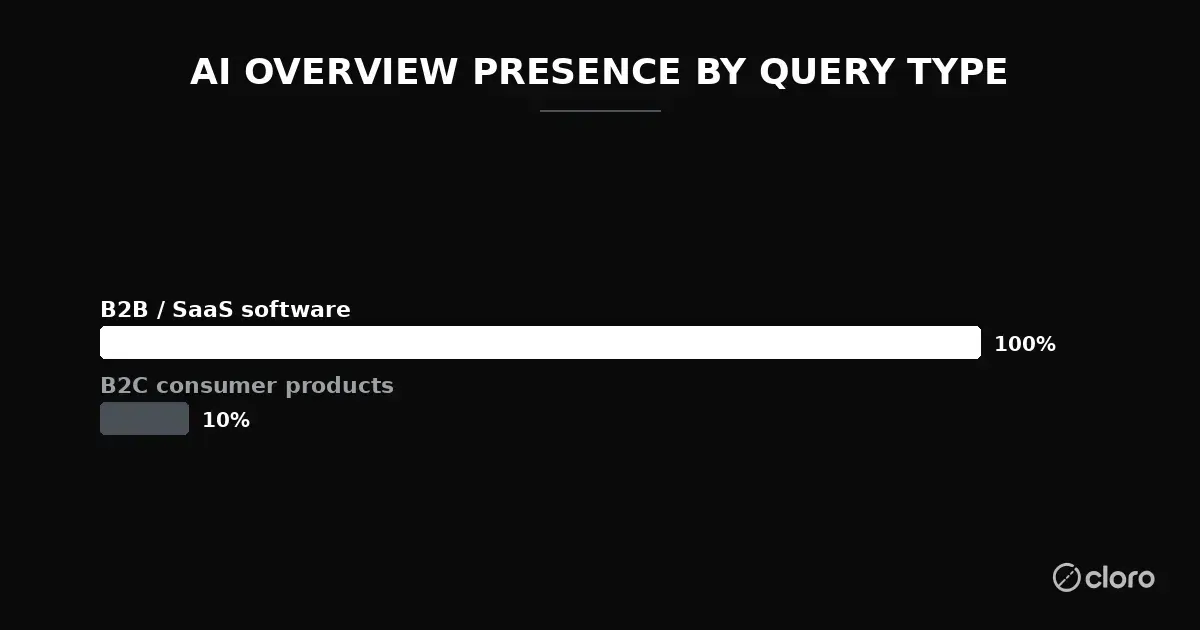
Every single B2B and SaaS software query, from “crm software” to “observability platform” to “single sign on solution”, triggered an AI Overview. On the consumer side only three did: “best coffee maker”, “sunscreen”, and “weighted blanket”. The other 27 consumer queries returned a Shopping carousel where the B2B queries returned a synthesized answer.
The two SERP layouts are built for different jobs. A B2C product query resolves into a grid of things to buy, so Google leads with Shopping. A B2B software query resolves into a decision to research, so Google leads with an AI Overview that summarizes options and definitions. That is the real difference this study surfaces, and it is invisible in a volume column.
The takeaway: you cannot run B2B keyword research with B2C instincts. The results page you are optimizing for is a fundamentally different page. It also sends fewer clicks: 68% of US Google searches ended without a click in the first four months of 2026, so on B2B terms the citation inside the AI Overview matters as much as the ranking.
Where B2B SaaS keyword research finds its seeds
The SERP validates keywords; it does not invent them. In B2B SaaS keyword research the best seeds come from the words buyers already use, and most of them read as zero volume in a keyword tool.
- Sales calls. Recorded calls show the pain points prospects name in their own words. Most tools report “zero volume” for those long-tail phrases, which is why competitors rarely target them. A project-management vendor might hear “project milestones” and comparisons with Asana again and again.
- Customer reviews. Your G2 and Capterra profiles, and your competitors’, collect pain points as customers describe them. Group the themes, then push the phrases into a keyword tool.
- Google Autosuggest. Type the seed into the search bar and note the completions. They are queries Google has seen, so they skip the volume question.
- Competitor sections. Filter a rival’s top pages by subfolder. BambooHR’s glossary drives nearly 50% of its organic traffic, a sign that definition pages carry real B2B demand.
Each seed then goes through the three SERP checks below.
What the B2B SERP tells you that volume can’t
An AI Overview on a query is a signal, not just a layout. It means Google has judged the query answerable and worth summarizing, a proxy for genuine, researched demand. When 100% of a keyword set shows one, you are looking at a category the engine treats as high-consideration by default.
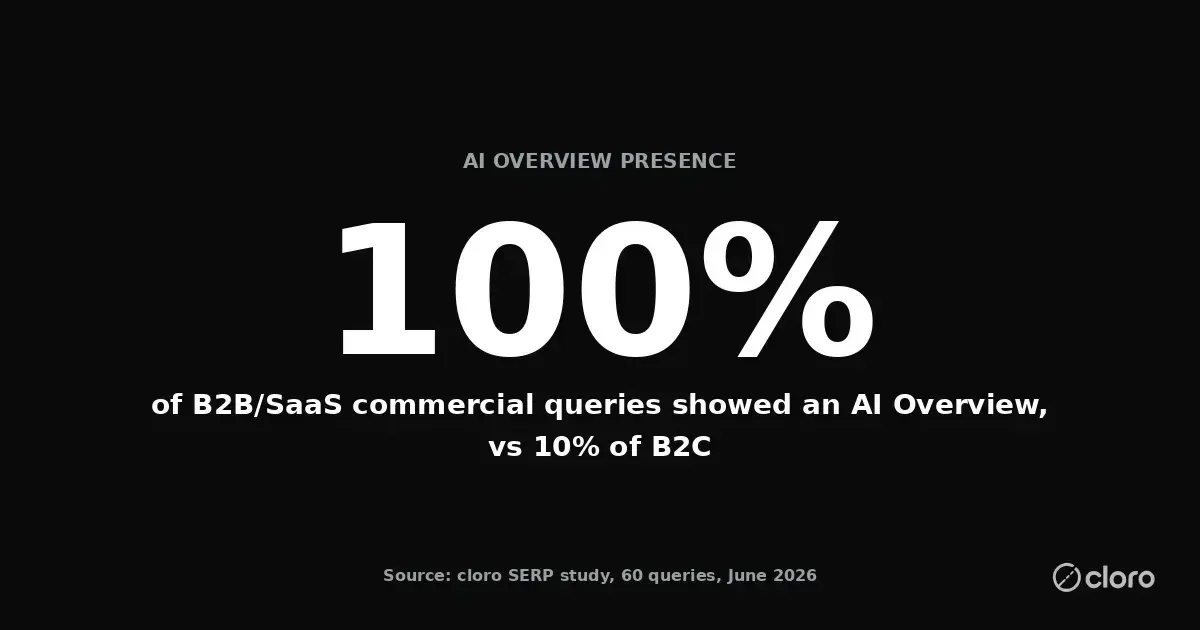
That signal is only getting louder. AI Overviews reached roughly 48% of all tracked queries by early 2026, up from about 31% a year earlier. Our B2B set sits at 100%: the leading edge of that curve, not the average.
Presence also changes the economics of ranking. Pew Research found that when an AI summary appeared, users clicked a result in just 8% of visits, versus 15% when no summary appeared. Roughly half the clicks evaporate.
For B2B keyword research that reframes the goal. On a query with an AI Overview, being cited inside the summary matters as much as ranking beneath it. You are optimizing to be the source the answer quotes, not only the tenth blue link under a box most people never scroll past. Volume tells you none of this; the SERP tells you all of it.
How to validate a niche keyword with SERP signals
The method that replaces volume-chasing is simple: pull the live SERP for a candidate keyword and read three signals before you decide. Each is a demand proxy that survives in thin niches where volume estimates collapse.
Does the query trigger an AI Overview?
An AI Overview is Google committing compute to answer the query. For B2B and SaaS terms it is the strongest single signal that a topic is worth covering, and, as the 60-query sample above confirms, it is almost always present. If a niche term renders one, treat the topic as validated demand even if the volume reads as a rounding error.
Are advertisers paying for the click?
Our head term shows an $11 CPC at difficulty 0, a combination that only looks irrational until you realize the buyers are worth it. Ads are the market voting with money. A visible CPC means someone has calculated that a click is worth paying for, which is the cleanest commercial-intent signal there is.
How deep is People Also Ask?
A long People Also Ask block is a map of real sub-questions, and it doubles as a keyword source. Recursively expanding PAA (the same query fan-out pattern AI engines use to decompose a prompt) turns one seed into a validated question set faster than any volume database. Depth here means the topic has genuine informational pull.
Read together, these three signals do what a volume number promises but rarely delivers: they tell you whether a keyword is worth the work. This SERP-first approach is the core of the cloro keyword research use case.
Worked example: a keyword set for a SaaS category
Take a real SaaS category from the study, “customer data platform”, and build a set without leaning on volume.
Start with the seed and pull its SERP. It renders an AI Overview, paid results, and a People Also Ask block: three green lights before a single volume number is checked. That is enough to commit to the category in B2B keyword research terms.
Now expand. Feed the PAA questions back as new seeds (“what is a customer data platform”, “cdp vs dmp”, “customer data platform for b2b”) and pull each SERP. Keep the ones that also trigger an AI Overview or carry a real CPC; drop the ones that return a thin, feature-less page. The SERP is the filter, so the low-volume long tail stays in play instead of being cut by a noisy estimate.
Score what survives by signal, not by size. A term with an AI Overview and paid results outranks a higher-volume term with neither, because the features prove the intent. In our sample even a 200-search term like “single sign on solution” cleared the bar, AI Overview and all: the kind of keyword volume-first SaaS keyword research throws away.
One caution keeps the method honest: the SERP is a snapshot, not a constant. Features shift as Google tunes its layouts, so a keyword that shows an AI Overview today may lose it next quarter, and a bare page may gain one. Re-pull the SERP on a schedule rather than treating a single read as permanent truth.
The output is a ranked set built on live evidence. Niche keyword research done this way trades a false-precision number for a set of signals you can actually verify on the page, and re-verify whenever the layout moves.
Turning SERP signals into a repeatable pipeline
Reading one SERP by hand is easy; reading them at the scale of a content program is not. The fix is to make the SERP itself the data source. Pull the organic results, People Also Ask, ads, and AI Overview for each candidate keyword through the cloro SERP API, write a row per keyword to your warehouse, and score in SQL.
The response envelope already carries every signal this method needs (organicResults, peopleAlsoAsk, ads, and aioverview), so the AI Overview flag from our study becomes a column you can filter on, not a screenshot. Enrich those rows with volume from your existing provider and you have a keyword-research stack, not a keyword-research subscription.
Scoring in SQL also makes the logic auditable. Instead of a gut call on a volume number, each keyword carries the exact features that qualified it, so a teammate can see why “single sign on solution” made the set and a higher-volume term did not. That transparency is what turns ad-hoc B2B keyword research into a process a team can trust and repeat.
From there the workflow flows downstream. The keywords that clear the signal bar become your content and rank tracking targets, and the AI Overview flag tells you which ones to optimize for citation rather than clicks. That is what mature B2B keyword research looks like in 2026: not a hunt for the highest volume number, but a read of what the SERP is actually doing on every query that matters.

About the author
Ricardo Batista
Founder, cloro
Ricardo is one of the founders and engineers behind its SERP and AI-search scraping infrastructure. Before cloro he scaled a financial comparison site to $7M ARR and ran the full-country operations of a unicorn to $65M ARR, then went back to building. He writes about search engine scraping, generative-engine optimization, and turning live search and AI-answer data into something teams can act on.
Frequently asked questions
Is B2B keyword research different from normal keyword research?
Yes. B2B and SaaS terms sit in thin, low-volume niches where reported search volume is an unreliable annual average, so you lean on live SERP evidence (result types, AI Overview presence, ads, and People Also Ask depth) instead of trusting the volume number alone.
Why is search volume unreliable for SaaS keywords?
Most tools report volume as a 12-month average, and independent checks put keyword-tool accuracy far below what most practitioners assume. In a niche doing a few hundred searches a month, that averaging error can be larger than the signal itself, so a keyword worth writing can look worthless.
How do you validate a keyword without good volume data?
Read the SERP. If Google renders an AI Overview, runs ads, and shows a deep People Also Ask block, real demand and commercial intent exist regardless of the volume estimate. The presence and mix of SERP features is a live demand signal that volume averages miss.
Do AI Overviews appear more on B2B queries?
In cloro's 60-query sample, AI Overviews appeared on 100% of B2B and SaaS commercial software queries and only 10% of B2C consumer-product queries. B2C SERPs were dominated by Shopping product grids instead, so B2B research has to account for the AI Overview by default.
What is the best keyword to target in the B2B keyword research cluster?
The head term b2b keyword research carries a keyword difficulty of 0 against an $11 CPC in cloro's data, the best value-per-difficulty ratio in the cluster, with saas keyword research and niche keyword research as supporting terms.
Related reading
Query Fan Out: How AI Search Expands One Prompt Into Many
Query fan-out turns one AI search prompt into many sub-queries. Learn how ChatGPT and AI Mode retrieve sources and how to optimize for it in 2026.

SEO Competitor Keywords: Reverse-Engineer Any Rival
Reverse-engineer any competitor's keyword footprint with free SERP scraping (query fan-out, PAA mining, and autocomplete), then validate the recovered terms against live results.
How to Track SERP Features in 2026 (Free + API Methods)
How to track SERP features in 2026 — the seven that move traffic, the free ways to start monitoring today, and the API method that scales to millions of keywords.