
Perplexity Search API vs Google: A Three-Way Study

On this page
Type a question into Perplexity and you get a clean, cited answer. So when a developer reaches for the “Perplexity Search API,” it’s natural to assume they’re getting a slice of that same experience. They aren’t.
There are actually three different things wearing the Perplexity-and-search label, and almost everyone conflates at least two of them. The Search API is one thing. The answer Perplexity shows its users is a second. Google, the page those answers are quietly built on top of, is a third. This is the only correlation study in our series where all three legs are worth measuring, because cloro can natively scrape the middle one that nobody else can.
So we measured. We ran the same 500 queries (stratified across informational, commercial, transactional, navigational, and local intent) through the Perplexity Search API and through cloro’s live Google SERP, the same day, and scored how much they actually agree. Then we mapped where the consumer answer layer sits between them. Here’s what the three webs really are.
The three “Perplexity webs” and why they’re not the same
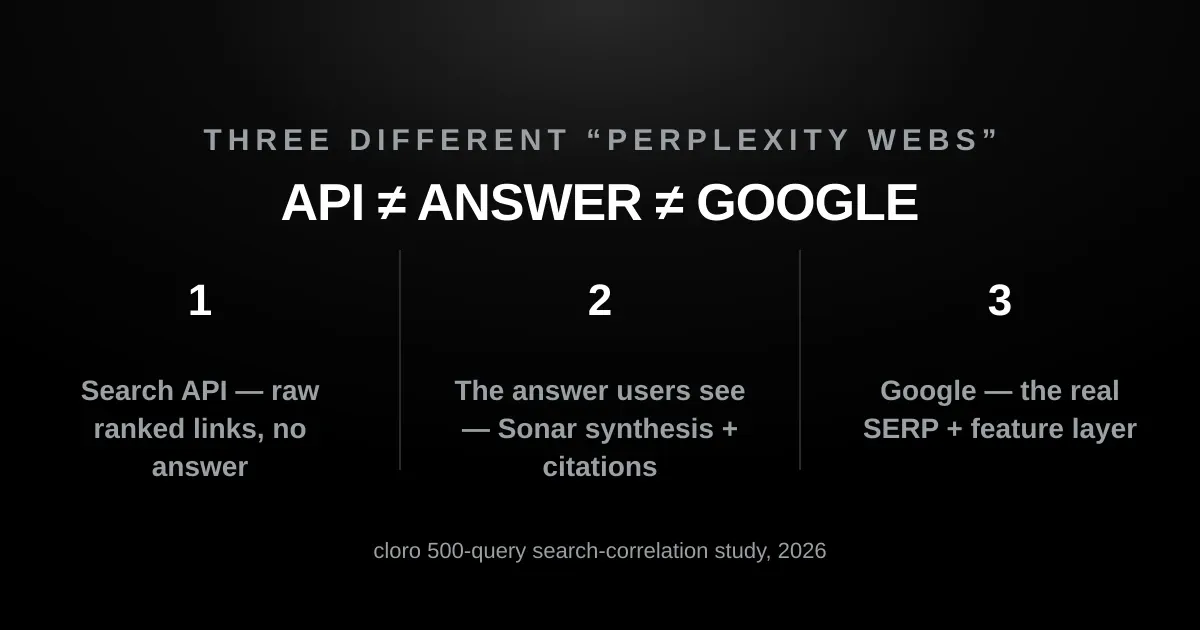
Start with the distinction Perplexity’s own documentation draws, because it’s the one people miss.
1. The Perplexity Search API. Call https://api.perplexity.ai/search and you get back a structured results[] array of title, url, snippet, date, and last_updated, and nothing else. Perplexity’s Search API is a raw retrieval layer: ranked links, no synthesis, no answer. It’s the piece almost nobody realizes exists as a standalone product.
2. What Perplexity shows users. The thing you actually think of as “Perplexity”, the paragraph of prose with numbered citations, comes from a different API, Sonar (chat completions with built-in web search). Perplexity’s docs are blunt about it: Sonar “returns a prose answer with citations, not a results array.” The model selects, reorders, and summarizes sources through its own reasoning. That selection is the product. The Search API doesn’t do any of it.
3. Google. The real SERP: the page with its own ranking, plus the AI Overview, People Also Ask, and shopping units that increasingly are the page.
The reveal is that the Perplexity Search API is neither of the other two. It’s not the answer engine users know, and it’s not Google. It’s a plain, Google-adjacent retrieval API, and to see where it actually lands you have to measure it against the real page.
What the Perplexity Search API actually is (and how to call it)
The Search API is a commercial retrieval endpoint on top of Perplexity’s own web index, which Perplexity’s launch post (September 2025) puts at hundreds of billions of webpages. The headline fact, and the one that reframes every “I’ll just use Perplexity’s API” decision, is that it returns no generated answer at all. In our 500-query run it produced a synthesized answer on exactly zero of them. That’s not a bug; answers are Sonar’s job, not /search’s.
Getting started is a single authenticated call:
curl -s "https://api.perplexity.ai/search" \
  -H "Authorization: Bearer $PERPLEXITY_API_KEY" \
  -H "Content-Type: application/json" \
  -d '{"query": "best crm software", "max_results": 10}'
Results come back under results[], each with a url, title, snippet, and, notably, a date and last_updated. That date field turns out to be one of the API’s genuine distinctives, as you’ll see below.
On price, the two Perplexity products bill very differently, and it’s worth being precise because the confusion costs money:
- The Search API is billed per request only. Perplexity’s published pricing is $5 per 1,000 requests, with no token costs. Ranked links, flat rate. It is not free: every successful request bills. The lever you have is batching. Per the Search API quickstart, one request can carry up to five queries and bills as a single request, though each query still counts against your rate limit.
max_resultsruns from 1 to 20 and defaults to 10. - The Sonar answer models add token pricing on top of a per-request fee: base Sonar is $1 per 1M input and output tokens plus roughly $5 to $12 per 1,000 requests by search-context size; Sonar Pro is $3 / $15 per 1M tokens plus $6 to $14 per 1,000 requests.
If you only need links, the Search API is the cheaper path. But “links” is the whole point. It’s not the answer, and, as we’ll see, it’s not the Google page either.
Perplexity Search API vs Google: how close, really?
This is where our own numbers come in. We compared the top 10 results from the Perplexity Search API against cloro’s live Google SERP for all 500 queries, on both exact URLs and domains.
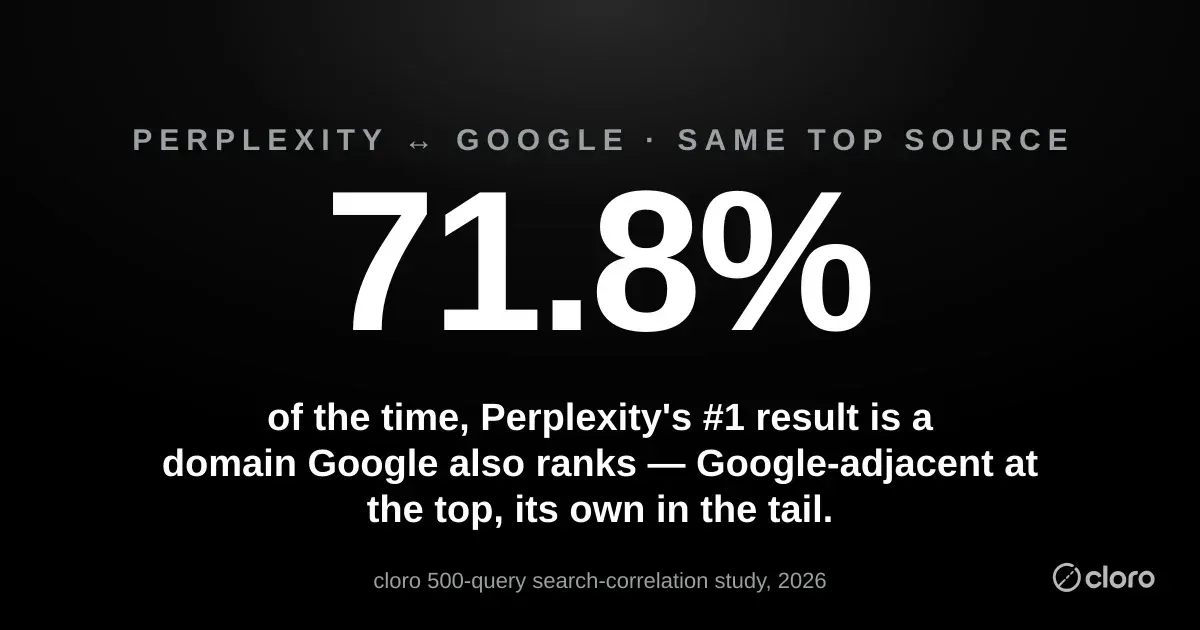
They draw on the same top sources. Perplexity’s #1 result came from a domain Google also ranks in its top 10 71.8% of the time. Google’s own top domain showed up in Perplexity’s top 10 on 72.8% of queries. Across the whole set, the two shared at least one domain on 98.4% of queries, essentially always, and roughly 49% of Google’s top-10 domains appeared somewhere in Perplexity’s results. Crucially, agreement is highest at the top: top-3 domain overlap (Jaccard 0.343) edged out the full top-10 (0.327). For the results that carry the most weight, Perplexity and Google are fishing from the same pool of authoritative sources.
The strict number is lower. If you demand the exact same URL in the same top-10 window, overlap is 32.9%. That’s real divergence, not a rounding artifact: Perplexity ranks the same web in a different order, prefers different specific pages on the same domains, and leans into its own tail. About a third of the exact links match; two-thirds are Perplexity’s own arrangement of a largely shared source set. It’s Google’s neighborhood at the top of the list, and increasingly Perplexity’s own picks as you go down.
Where it genuinely diverges, and where it’s arguably better. The Perplexity Search API attaches metadata Google’s organic block doesn’t expose: 99.8% of its results carried a machine-readable date (in our run, nearly every single result). If your app wants to filter or rank by recency at the API layer, Perplexity hands you something Google’s SERP simply doesn’t. That date-stamping is the API’s most distinctive trait, more so than its ranking, which mostly tracks Google at the top.
So if your agent grounds on the Perplexity Search API, it’s seeing substantially the top sources Google would show, dated, in Perplexity’s order. This is not some parallel web, and it is not the Perplexity answer either.
The gap: everything Google wraps around the links
There’s a genuine difference, and it lies one layer up: in what Google builds on top of the sources.
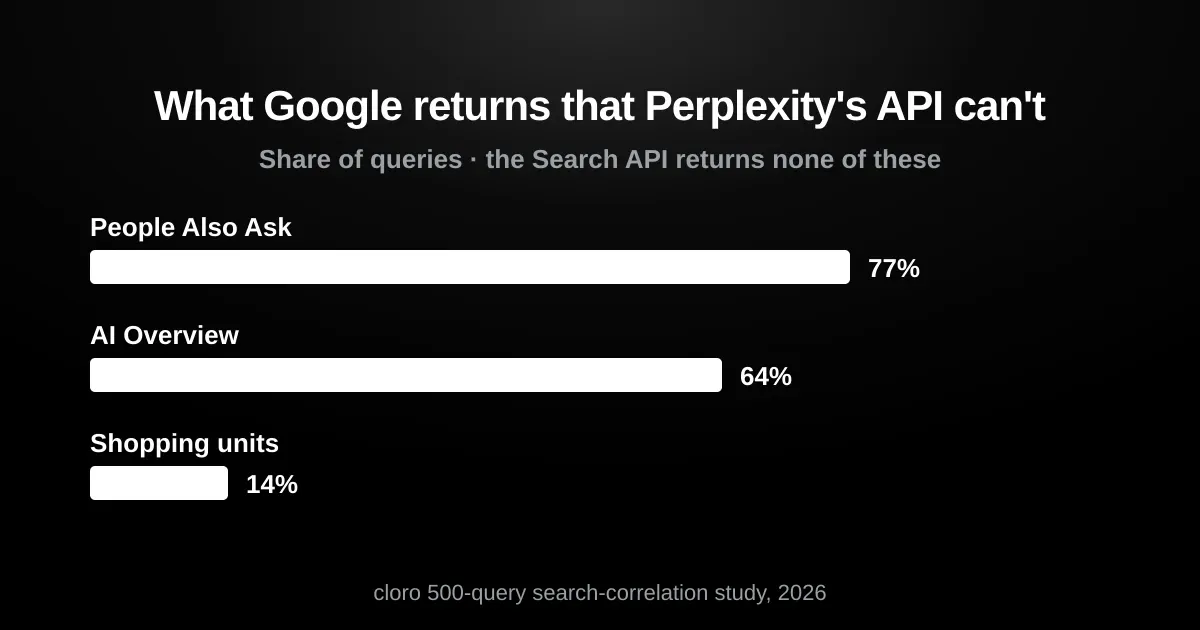
Because the Search API returns a plain results[] array, it structurally can’t return the Google-specific features that increasingly define the page. On those same 500 queries Google served a People Also Ask block on 77% of them, an AI Overview on 64%, and shopping units on 14%. The Perplexity Search API returns none of these. It gives you ranked, dated organic links, full stop.
This is the line that matters. The Search API can tell you which pages Google would surface. It can’t tell you what Google actually shows: the AI Overview that answers the query before any link, the questions people also ask, the products in the carousel. The twist unique to Perplexity is that it can’t tell you what Perplexity itself shows users either, because the synthesized answer lives in Sonar rather than /search. The API sits in the gap between two consumer surfaces and reproduces neither.
The middle leg: what Perplexity actually shows users
The three-way framing pays off here. The Search API is leg one, Google is leg three, and the leg most brands actually care about is the one in the middle: the answer Perplexity puts in front of a user, and which sources it cites.
That answer is not the Search API’s ranked list. Sonar selects and reorders sources through the model, so the citations a user sees can differ meaningfully from the raw /search ordering, the same way Perplexity’s ranking already diverges from Google’s. If your goal is brand visibility or AI-search SEO, the question shifts from “what does the Perplexity Search API return” to “when someone asks Perplexity about my category, do I get cited?”
Is Perplexity good for searching, as a user? For research, mostly yes. PCMag’s writer swapped Google for Perplexity for a week and preferred it for most tasks, crediting its sourced summaries and follow-up suggestions. Google stayed better for reviews and product searches, and Perplexity was caught hallucinating twice, once citing a statistic a real study never contained. That split is why the cited answer is worth monitoring on its own.
That’s a consumer surface, and you can’t get it from the retrieval API. cloro scrapes it natively: cloro monitors the Perplexity answer users actually see, with its parsed citation set, alongside Google’s AI Overview and the classic SERP. So the three-way study maps directly onto what you would actually monitor. One tool covers legs two and three; the Search API covers neither.
What this means for your stack
The result splits cleanly by use case.
Grounding an LLM or agent. The Perplexity Search API gives your model essentially Google’s top sources, dated and in Perplexity’s order, at a flat $5 per 1,000 requests. For retrieval and citation grounding, that’s a reasonable default. If you want the answer synthesized for you, that’s Sonar, at a higher, token-plus-request price.
Reproducing or measuring a consumer page. The moment you need what a human sees (Google’s AI Overview, People Also Ask, and shopping, or Perplexity’s actual cited answer), a retrieval API can’t give it to you, because it isn’t scraping either page. cloro returns the live Google results page with those features as structured JSON, and the live Perplexity answer with citations. cloro’s pricing starts at $30/mo (Lite), or $100/mo for 250,000 credits on Hobby; a Google Search request is 3 credits, which works out to roughly $0.93 to $1.20 per 1,000 queries, with the full feature layer attached.
| Backend | What you get | Price |
|---|---|---|
| Perplexity Search API | Raw ranked links, dated — no answer, no SERP features | $5 / 1,000 |
| Perplexity Sonar | The model-written answer with citations | $1/1M tokens + ~$5–$12 / 1,000 req |
| cloro (Google SERP + Perplexity) | The real Google page (AI Overview, PAA, shopping) + the live Perplexity answer | ~$0.93–$1.20 / 1,000 (Google) |
At volume, the question isn’t which is cheapest. These three buy different things:
| Monthly queries | Perplexity Search API | Perplexity Sonar | cloro (Google SERP) |
|---|---|---|---|
| 10,000 | ~$50 | ~$50–$120 + tokens | within the $100 base plan |
| 100,000 | ~$500 | ~$500–$1,200 + tokens | ~$93–$120 in credits |
| 1,000,000 | ~$5,000 | ~$5,000–$12,000 + tokens | ~$930–$1,200 in credits |
Pay for the one whose output you actually need: raw links (Search API), a synthesized answer (Sonar), or the consumer pages themselves (cloro).
Migrating from the Perplexity Search API to a Google SERP API
If you started on the Search API and hit the “I actually need the real page” wall, the swap is small, since both are a single HTTPS call:
Perplexity  →  POST https://api.perplexity.ai/search
               Header: Authorization: Bearer <key>
               Body:   { "query": "<query>", "max_results": 10 }
               Results: results[] → { url, title, snippet, date, last_updated }

cloro       →  POST https://api.cloro.dev/v1/monitor/google
               Header: Authorization: Bearer <key>
               Body:   { "query": "<query>", "country": "US",
                         "include": { "aioverview": { "markdown": true } } }
               Results: result.organicResults[] → { link, title, snippet, position }
               Plus:    result.aioverview, result.peopleAlsoAsk, result.shoppingCards
Point results[].url at result.organicResults[].link and your organic handling carries over unchanged. You’re mostly getting back the same top domains. Everything under result.aioverview, result.peopleAlsoAsk, and result.shoppingCards is surface area the Search API never had. Swap the endpoint for cloro’s Perplexity monitor and you also get the consumer answer’s citations, the middle leg.
When to use which
- Perplexity Search API: you want raw, dated, ranked links from a Google-adjacent index at a flat rate, and you don’t need an answer or Google’s feature layer. Good for grounding agents and RAG.
- Perplexity Sonar: you want the model to read the web and hand back a cited answer: the Perplexity experience as an API, at a token-plus-request price.
- A real SERP + AI-answer API (cloro): you need the pages users actually see: the Google SERP with its features, or the live Perplexity answer and who it cites, for rank tracking, SEO, or AI-visibility monitoring. The sources overlap; the pages don’t.
The headline everyone misses is that the “Perplexity Search API” is not Perplexity. It’s a retrieval layer that resembles Google at the top and diverges in the tail, dates almost everything, and answers nothing. Three webs, three different jobs. Be clear about which of them your product is really after.
This is one leg of a four-part study; every major search API went through the same 500-query test. See how Brave, Tavily, and Exa compare to the real Google SERP.
Need the real Google SERP and the live Perplexity answer, features and citations intact? See how cloro’s web search API returns them, or compare the field in our rundown of the best SERP APIs.

About the author
Ricardo Batista
Founder, cloro
Ricardo is one of the founders and engineers behind its SERP and AI-search scraping infrastructure. Before cloro he scaled a financial comparison site to $7M ARR and ran the full-country operations of a unicorn to $65M ARR, then went back to building. He writes about search engine scraping, generative-engine optimization, and turning live search and AI-answer data into something teams can act on.
Frequently asked questions
Is the Perplexity Search API the same as the Perplexity answer engine?
No, and this is the mistake most people make. Perplexity's /search endpoint returns raw ranked results: a structured JSON results[] array of title, url, snippet, date, and last_updated, with no generated answer. The synthesized answer with citations that you see in the Perplexity app is a different product: the Sonar chat-completions API. Perplexity's own docs draw the line explicitly: the Search API returns a results array, Sonar returns a prose answer. So building on the Search API gives you a retrieval layer, not the Perplexity experience users know.
How similar is the Perplexity Search API to Google?
Google-adjacent at the top, its own in the tail. Across 500 identical queries, the Perplexity Search API and Google's top 10 shared 32.9% of exact URLs, but agreement was much higher on the sources that matter: Perplexity's #1 result was a domain Google also ranks 71.8% of the time, Google's top domain appeared in Perplexity's top 10 72.8% of the time, and the two shared at least one domain on 98.4% of queries. Top-3 domain overlap (Jaccard 0.343) beat the full top-10, meaning the two agree more at the very top than deeper down.
How much does the Perplexity Search API cost?
The Perplexity Search API is billed per request only, at $5 per 1,000 requests, with no token-based costs. That is separate from Perplexity's Sonar answer models, which add token pricing (base Sonar is $1 per 1M input and output tokens) on top of a per-request fee of roughly $5–$12 per 1,000 requests depending on search-context size. If you only need ranked links, the Search API is the cheaper of the two.
Does the Perplexity Search API return an AI answer or SERP features?
Neither. In our 500-query run the Search API returned a generated answer on exactly zero queries. That is by design; answers come from Sonar, not /search. It also returns none of Google's result-page features: on the same queries Google rendered an AI Overview on 64%, People Also Ask on 77%, and shopping units on 14%. The Search API gives you ranked organic links (nearly all date-stamped), and nothing of the answer layer or the Google feature layer.
If I need what Perplexity or Google actually shows users, what do I use?
You need to monitor the consumer surfaces directly, which is exactly what cloro does. The Perplexity Search API can't tell you what Perplexity's answer engine cites, and no independent index can tell you what Google's page shows. cloro scrapes the live Perplexity answer with its citations and the live Google SERP with AI Overview, People Also Ask, and shopping as structured JSON, so you measure the pages people see, not a retrieval API that resembles them.
Is the Perplexity Search API free?
No. Every successful request is billed at $5 per 1,000 requests. You can lower the bill by batching: one request can carry up to five related queries and bills as a single request, although each query still counts against your rate limit.
Is Perplexity good for searching?
For research, mostly yes. In PCMag's week-long test the writer preferred Perplexity for most tasks because of its sourced summaries and follow-up suggestions, but Google stayed better for reviews and product searches, and Perplexity hallucinated twice. For developers, the Search API returns ranked links only; the cited answer users see comes from a different product.
Related reading
Brave Search API vs SERP API: Claude's Search Engine
Anthropic's Claude searches the web with the Brave Search API, not Google. So how close is Brave to Google? We ran 500 identical queries through both indexes. The answer is "closer than the headline number suggests," with one real exception.
Tavily vs Google Search: How Much SERP Do You See?
If your LangChain or LangGraph agent searches the web, it's probably searching with Tavily, not Google. So how close is Tavily to Google? We put the same 500 queries through both. It's the closest of any search API we've measured, but it reranks Google's sources into an order of its own.
Exa Search vs Google: Neural Search vs the Real SERP
Exa searches the web by meaning, not keywords. So how different is it from Google, really? We ran 500 identical queries through Exa and cloro's live Google SERP. The overlap is the lowest of any search API we've measured, and that's exactly the point.