
LLM Scraping API Reliability at Scale: Uptime, SLAs, Cost

On this page
Scraping an AI answer engine once is easy. Doing it every day, across thousands of prompts, with a pipeline that does not silently rot, is the part that separates providers. This page covers the operational half of choosing an LLM scraping API: published SLAs, the failure modes that hit in-house scrapers, and the real cost per answer. For classic Google SERP workloads (SerpAPI, DataForSEO, Bright Data on the SERP side), the numbers live in the sibling comparison, SERP API reliability at scale.
Which LLM scraping provider offers an uptime SLA for production workloads?
Contractual uptime SLAs in the LLM scraping API category live at the enterprise tier, and of the providers on this page only the general-purpose scraping platforms publish one. Apify states it is 99.9% available and offers an SLA through its enterprise services. Firecrawl lists an SLA as an Enterprise-plan feature without publishing the number. Bright Data advertises 99.99% uptime and a 99.95% success rate across its platform, and Oxylabs advertises 99.9% uptime on its proxy products. None of those figures is specific to AI answer engines: they describe the platform, and ChatGPT or Gemini scraping is one workload on it.
cloro takes a different position: instead of a refund clause, a public status page with a per-engine breakdown (ChatGPT, Perplexity, Copilot, Gemini, Google including AI Overview, AI Mode, Google News), automatic retries on transient failures, and billing only for successful requests. A failed scrape costs zero credits, so the billing model absorbs the risk an SLA would otherwise price.
One more number belongs in any SLA conversation, because it caps everyone: OpenAI’s own status page reports ChatGPT at 99.68% uptime for May through August 2026, while its APIs run 99.94%.
No scraper of ChatGPT’s consumer surface can be more available than ChatGPT is, so a vendor quoting platform uptime above the engine’s own figure is describing its infrastructure, and your pipeline inherits the lower of the two.
What that means when you evaluate: an SLA compensates you after downtime, while per-engine status plus success billing changes what downtime costs you in the first place.
For a monitoring pipeline where a missed day is a data gap rather than an outage, the second model usually matters more.
What actually breaks when you build an LLM scraper in-house?
The engine’s answer surface is not a stable API, and the breakage is rarely the part you tested. We run about 1,000 engine answers a day across six engines for cloro’s own tracking corpus, and the failure modes below are the ones that operation actually hits:
- The response format shifts under you. OpenAI serves a share of logged-out ChatGPT traffic through a mobile-web response format with no stream metadata: the answer arrives as HTML fragments, the model name and the engine’s internal search queries are absent, and the source list is shorter. OpenAI decides the format per request, so identical requests can land in either. A parser built against one format reports the other as a partial success, which is worse than an error because nothing alerts.
- The models rotate without notice. ChatGPT selects the serving model per
request. Fields that depend on the model, such as fan-out queries under
gpt-5-3, are present on some answers and absent on others, and no parameter controls it. - Regions get login walls. Providers intermittently require login in specific regions, which blocks anonymous sessions entirely for that geography until the provider changes its access rules. Your scraper did nothing wrong, and no retry fixes it.
- Anti-bot pressure escalates with volume. A headless browser that works at 10 answers a day meets rate limits, session churn, and fingerprint checks at 10,000. The engineering that absorbs this (session pools, warm browser farms, per-region routing) is a standing cost, not a one-time build.
- Silent quality drift. The scrape succeeds, the answer parses, and the source list is missing half its entries because a DOM class changed. Without per-field monitoring, the first person to notice is whoever reads the dashboard the data feeds.
The honest build-vs-buy line: an in-house scraper is a second product with its own on-call rotation.
Whether that trade is worth it depends on volume, and on whether answer data is your product or an input to it.
Which AI scraping providers are actually reliable in production?
Of the providers on this page, the reliable choice depends on which product you are actually running, because they sell three different things. The honest per-vendor read, from their own published claims and what each is built for:
- Bright Data is infrastructure: proxies, unlockers and browser fleets, with the strongest published platform numbers here (99.99% uptime, 99.95% success rate). Reliability of an AI-answer pipeline on top of it is still your engineering, because you are assembling the scraper from its parts.
- Apify is a marketplace plus platform (99.9% available, SOC2-ready). The platform’s availability and any single community actor’s reliability are different things: an actor is maintained by its author, so production use means vetting the specific actor, not the platform badge.
- Firecrawl is crawling and extraction for LLM pipelines, with an SLA at the Enterprise tier. It is adjacent to answer-engine scraping rather than a ChatGPT-surface product.
- Oxylabs publishes 99.9% uptime on its proxy products; like Bright Data, it is the layer under a scraper more often than the scraper.
- cloro is the managed answer-engine layer itself: the per-engine status, retries and success billing covered above, purpose-built for the consumer surfaces of ChatGPT, Perplexity, Copilot, Gemini, Grok, AI Overview and AI Mode.
The evaluation shortcut that follows from the taxonomy: match the vendor’s product to the layer you do not want to own. Teams that want raw materials and full control buy infrastructure from Bright Data or Oxylabs and accept the maintenance; teams that want answers as data buy the managed layer and accept less control. The soak test in the checklist below is how you verify any of them against your own traffic rather than their marketing pages.
How do I monitor ChatGPT answers for thousands of queries every day?
The pipeline shape
Run it as an asynchronous pipeline against a scraping API rather than a browser farm you operate:
- Submit prompts as async jobs. cloro accepts each prompt as a job and delivers results by webhook, so a day’s run is a burst of submissions instead of a long-lived process holding open browsers.
- Size concurrency to your tier. Concurrency on cloro’s published tiers runs from 20 parallel requests on Hobby to 75 on Growth and 100 on Business, which is what turns thousands of daily prompts into minutes of wall-clock time.
- Let retries and billing handle failure. Transient failures retry automatically, and a request that still fails is not billed, so the pipeline’s cost tracks answers delivered rather than attempts made.
- Alert on field completeness as well as request status. Track per-day rates of empty
result.model, short source lists, and missing fan-out queries. Shifts in those rates are the mobile-web format and model rotation showing up in your sample, and they matter to any analysis you run downstream. - Watch the per-engine status component. The status page breaks incidents out by engine, so a ChatGPT-only disruption does not read as a pipeline bug.
A worked size
5,000 ChatGPT prompts a day at 5 credits each is 25,000 credits daily, roughly 750,000 a month. That fits inside the Growth tier’s 1,350,000 monthly credits with headroom for a second engine on the same prompts.
Which LLM scraping API is cheapest per answer?
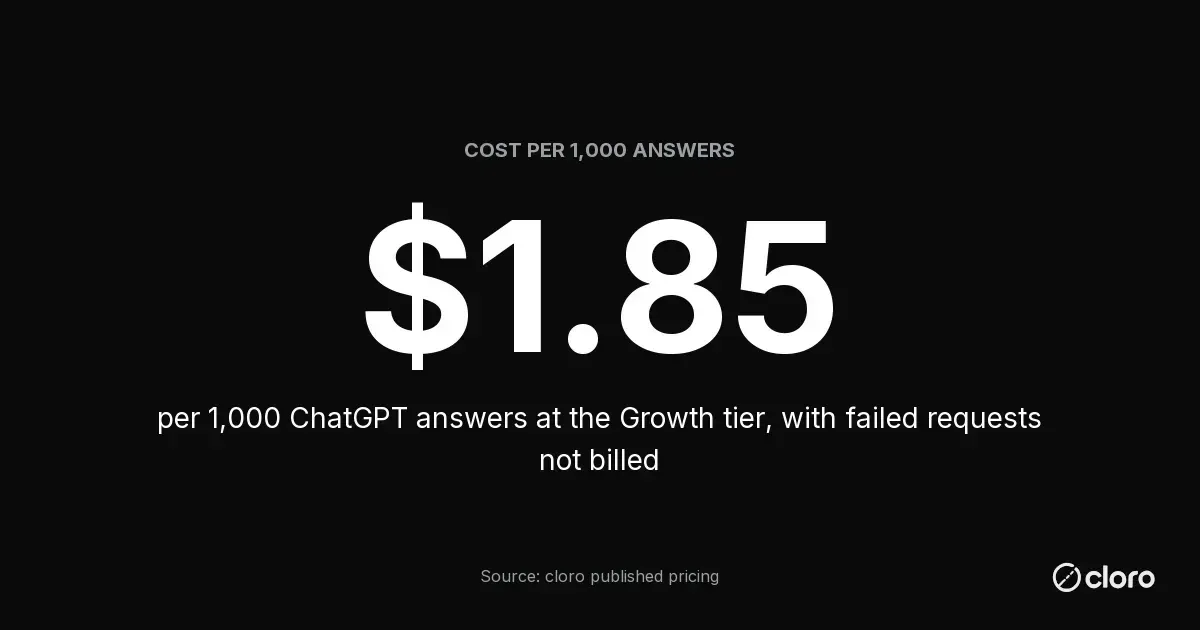
On cloro’s published pricing, the cheapest answer of the engines on this page is Perplexity at $1.48 per 1,000 answers, and ChatGPT costs $1.85 per 1,000 at the same tier.
The arithmetic: a ChatGPT web-search answer is 5 credits and a Perplexity answer is 4, and the Growth tier prices credits at $0.37 per 1,000 ($500 a month for 1,350,000 credits). At the Hobby tier ($100 a month, 250,000 credits, $0.40 per 1,000) the same ChatGPT answer is $2.00 per 1,000 answers. Copilot matches ChatGPT at 5 credits.
Two cautions when comparing across vendors. First, most platforms price generic scraping units (pages, browser minutes, proxy bandwidth), so the cost of an answer depends on your own success rate; with success billing the failed attempts drop out of the bill instead of inflating the per-answer figure. Second, if what you actually want is OpenAI’s model output rather than what ChatGPT shows users, that is the OpenAI API’s job, priced in tokens. Scraping is for the consumer-facing answer: the grounding, the citations, and what a real logged-out user sees.
How do LLM scraping APIs avoid getting blocked by ChatGPT?
By making the traffic look and behave like the logged-out users the engines already serve, and by spreading it the way real users are spread. The mechanics, in the order they matter:
- Session pools instead of per-request sessions. Engines rate-limit and challenge new sessions far harder than warm ones. A pool of established sessions, each carrying believable history, absorbs volume that would burn fresh sessions immediately; one cleared session serves many requests before rotation.
- Real browser fingerprints. Headless defaults are the first thing bot detection keys on. Production scrapers run full browser environments with consistent fingerprints (canvas, fonts, TLS), because one mismatched signal outweighs a plausible user agent.
- Regional distribution that matches the request. An answer requested for
country: "DE"should exit in Germany. Concentrating traffic through one region trips volume ceilings and, as the providers guide documents, some regions get login walls that no technique bypasses; routing around a walled region is the only fix. - Parsers that expect format drift. Blocking is not only refusals: serving a degraded format to suspected automation is cheaper for the engine. The mobile-web response documented on the ChatGPT endpoint is exactly that class of event, and a scraper that treats it as success corrupts its own data.
- Backoff that does not advertise automation. Immediate identical retries are a bot signature. Jittered, spaced retries against a per-engine budget both pass more often and keep the session pool alive.
None of this is one-time work: every item is an arms race the engine can escalate. That standing cost is the honest core of the build-vs-buy question below.
Is it cheaper to scrape AI chat answers myself or to use a provider?
Under roughly 1,000 answers a day, a provider is cheaper the moment you price your own time; above that, the answer depends on whether the scraping fight is work you want to own. The arithmetic on the build side has three lines:
- Infrastructure. A browser farm needs compute, residential or ISP routing, and session storage. As one market anchor, Bright Data prices its hosted Browser API from $5 per GB of traffic; a self-run farm trades that line for server and proxy bills that land in the same order of magnitude at answer-engine page weights.
- Engineering. The failure modes above each cost a fix when they first fire, and the format shifts keep firing. A realistic in-house budget is a recurring fraction of an engineer, not a one-time build, and it scales with every engine you add.
- Detection debt. Blocks arrive as silent quality drift as often as errors, so you also build the per-field monitoring that notices.
Against that, the LLM scraping API side is one line: on cloro’s published pricing, 1,000 ChatGPT answers a day is about 150,000 credits a month, roughly $60 at the Hobby tier, and failed attempts cost nothing. The crossover where building wins is when answer data is your product, your volume amortizes a dedicated team, and you need control a vendor cannot give; for answer data as an input, the per-answer math rarely favors the farm.
What about reliability when an LLM does the extracting?
“LLM scraping” has a second meaning: using a model to extract fields from ordinary web pages. Its reliability problem is accuracy rather than uptime. Datahut sums up the curve: a team can reach about 70% accuracy with an AI extractor in a weekend, and each point after that gets hard.
A 2026 arXiv benchmark across 35 websites found the same split by page type: LLM-assisted scripts were the fastest option on static pages but broke once authentication or bot protection appeared, while end-to-end agents were slower and needed more retries but were the only approach that kept succeeding on protected sites.
ScrapeGraphAI draws the volume line at about 1,000,000 requests a month, above which a hybrid wins: the model for complex extraction, selectors for high-volume simple fields. The checklist below applies to both meanings.
How to evaluate a provider before you commit
A short checklist for any LLM scraping API on your shortlist:
-
Ask for the SLA in writing, per product. A platform uptime figure from Apify or Bright Data commits nobody to keeping the ChatGPT path healthy. If the vendor offers an SLA only at enterprise pricing, as Firecrawl does, price that tier rather than the sticker.
-
Ask what a failed request costs. Success billing, credit refunds, or full price: this single answer moves the real per-answer cost more than the rate card does.
-
Run a two-week soak, not a demo. The failure modes above are intermittent. A hundred prompts across two weeks catches format shifts and regional walls that a same-day trial cannot.
-
Check field completeness, not just status codes. Count answers with a model name, a full source list, and fan-out queries where you expect them. Two vendors with equal uptime can deliver very different data.
-
Confirm the engine list is current. Coverage claims age fast in this category. cloro’s current engine set is ChatGPT, Perplexity, Copilot, Gemini, Grok, AI Overview, AI Mode, plus Google Search and Google News; check any vendor’s list against its docs the week you sign.
For choosing between the ChatGPT-capable scrapers on feature grounds rather than operations, the roundup at best ChatGPT scrapers covers that side of the decision.

About the author
Ricardo Batista
Founder, cloro
Ricardo is one of the founders and engineers behind its SERP and AI-search scraping infrastructure. Before cloro he scaled a financial comparison site to $7M ARR and ran the full-country operations of a unicorn to $65M ARR, then went back to building. He writes about search engine scraping, generative-engine optimization, and turning live search and AI-answer data into something teams can act on.
Frequently asked questions
Which LLM scraping provider offers an uptime SLA for production workloads?
Contractual SLAs in this category live at the enterprise tier. Apify states it is 99.9% available with an SLA through its enterprise services, Firecrawl lists an SLA as an Enterprise-plan feature, and Bright Data advertises 99.99% uptime with a 99.95% success rate. cloro publishes a public per-engine status page and bills only successful requests, so a failed scrape costs zero instead of counting against a refund clause.
What does it cost to scrape 1,000 ChatGPT answers?
On cloro, a ChatGPT web-search answer costs 5 credits. At the Growth tier ($500/month for 1,350,000 credits, $0.37 per 1,000 credits) that is $1.85 per 1,000 ChatGPT answers. Perplexity is 4 credits per answer, so $1.48 per 1,000. Failed requests are not billed.
Why do LLM scrapers break more often than SERP scrapers?
The response itself is unstable. OpenAI serves a share of logged-out ChatGPT traffic through a mobile-web format that carries no stream metadata, providers rotate the underlying models without notice, and some regions get intermittent login walls. A SERP scraper parses one page shape; an LLM scraper tracks a moving protocol.
Related reading
SERP API Reliability at Scale: Uptime, Latency, Concurrency
SERP API reliability at 10k+ daily requests — uptime SLAs, latency under load, and concurrency across cloro, SerpAPI, DataForSEO, and Bright Data.
Best ChatGPT Scraper 2026: 8 Tools Tested (Web UI)
We tested 8 ChatGPT scrapers against Cloudflare TLS fingerprinting, SSE streaming, and weekly-changing class names to find the best ChatGPT scraper for 2026.