
LinkedIn Articles vs Posts: AI Citations Fell 65%

On this page
LinkedIn is routinely described as the second most cited domain in AI search. We run a monitoring corpus that can check that claim directly, so we did.
Does AI cite LinkedIn articles?
Yes, and much less than it did at the start of 2026. Across 390,151 AI answers collected in the 30 days to 7 August 2026, linkedin.com was the 14th most cited domain, appearing in 1.61% of answers. YouTube led at 14.07% and Reddit followed at 11.30%. On a fixed prompt set measured monthly, LinkedIn’s share of answers fell by 65% between February and July 2026, and the Article surface specifically fell by 74%.
Articles carry almost all of what is left: they appear in 59.1% of LinkedIn-citing answers against 33.3% for feed posts and 4.2% for company pages. On the same corpus, a listicle on your own domain is cited more often than every LinkedIn Article on the internet combined.
LinkedIn AI search citations fell 65% in six months
A share of a growing corpus can fall without anything actually changing. Our monitoring corpus grew roughly 18 times between February and July 2026 as customers added brands and prompts, so any domain’s share could fall simply because the mix of questions changed.
To remove that, we held the questions still. The table below uses only the 116 prompts that ran in every one of the six months, restricted to the four conversational engines (ChatGPT, Perplexity, Google AI Mode, Copilot). Same prompts, same engines, same brands, six consecutive months.
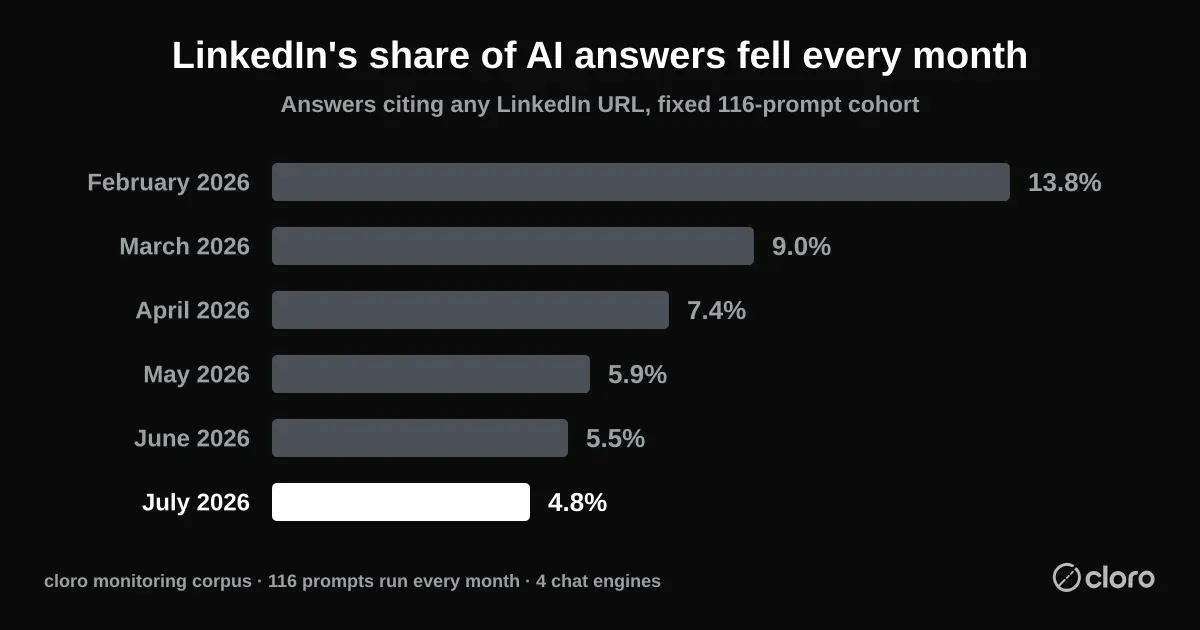
| Month | Answers | Any LinkedIn URL | LinkedIn Articles |
|---|---|---|---|
| February 2026 | 12,393 | 13.80% | 10.73% |
| March 2026 | 13,520 | 9.02% | 6.46% |
| April 2026 | 29,878 | 7.42% | 4.64% |
| May 2026 | 13,260 | 5.94% | 4.06% |
| June 2026 | 12,753 | 5.54% | 3.65% |
| July 2026 | 11,991 | 4.83% | 2.84% |
The takeaway: the decline is monotonic across all six months and nothing about the measurement changed between them, so this is a real, sustained trend to plan around, not a one-month blip.
One denominator check matters here. If engines simply cited fewer sources overall, every domain’s share would fall together. They did cite fewer. Average sources per answer went from 13.95 in February to 11.19 in July, a 20% drop, while the share of answers carrying any source at all stayed between 92% and 99%. A 20% thinning cannot produce a 65% fall, and as the next section shows, it did not apply evenly.
This is not a LinkedIn problem, it’s a shift in what counts as a citable source
Neither, which is the more interesting answer. On the identical 116-prompt cohort, the platforms moved in different directions.
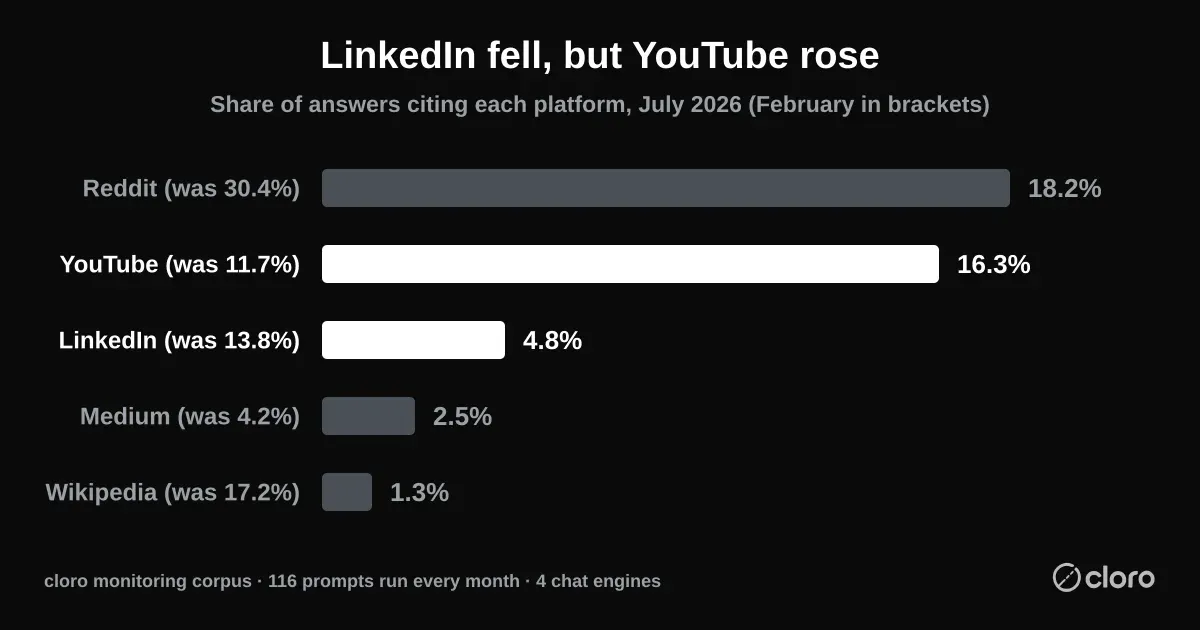
| Platform | February 2026 | July 2026 | Change |
|---|---|---|---|
| 30.43% | 18.18% | down 40% | |
| Wikipedia | 17.22% | 1.32% | down 92% |
| 13.80% | 4.83% | down 65% | |
| YouTube | 11.74% | 16.31% | up 39% |
| Medium | 4.24% | 2.47% | down 42% |
YouTube gained share while the text platforms lost it, and Wikipedia fell hardest of all. This is a rebalancing of what engines treat as a citable source, not a penalty aimed at LinkedIn. LinkedIn fell faster than Reddit and Medium and slower than Wikipedia.
That also updates advice we published ourselves. Our post on Reddit’s citation decline suggested professional platforms such as LinkedIn as a place to rebuild. On this data, LinkedIn was falling on the same curve, roughly one year later.
Which AI engines cite LinkedIn? The spread is more than a hundredfold
Averages hide almost everything here. The spread across engines is more than a hundredfold, measured over the 30 days to 7 August 2026.
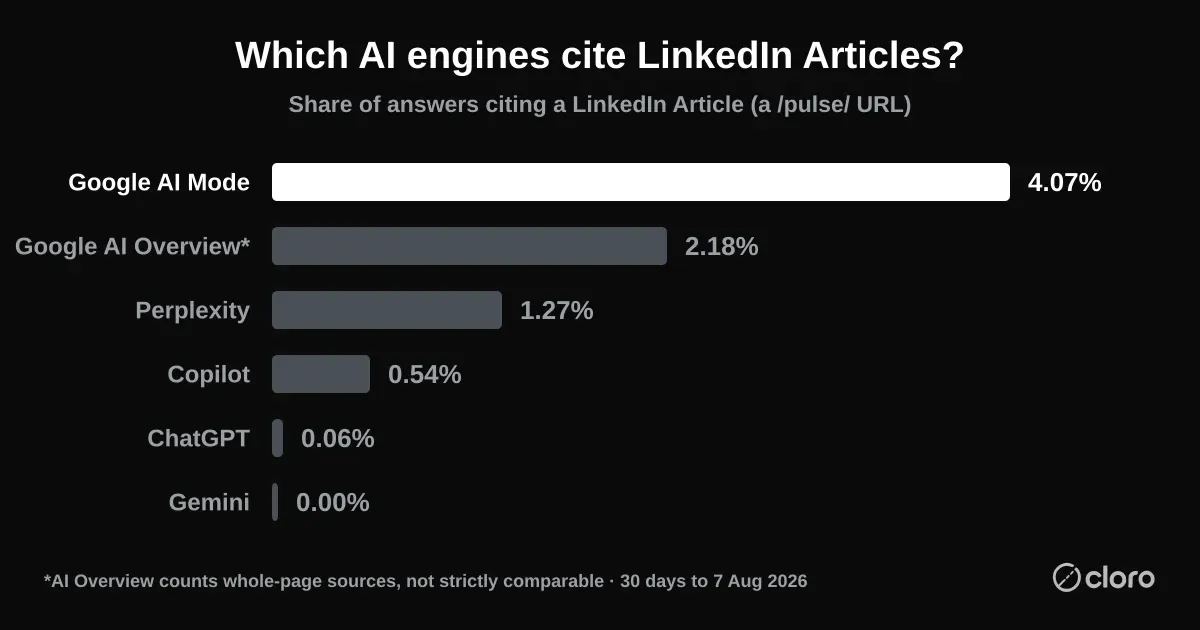
| Engine | Answers | Any LinkedIn | LinkedIn Articles |
|---|---|---|---|
| Google AI Mode | 53,636 | 6.20% | 4.07% |
| Google AI Overview | 56,364 | 3.97% | 2.18% |
| Perplexity | 55,611 | 2.29% | 1.27% |
| Copilot | 55,479 | 0.67% | 0.54% |
| ChatGPT | 56,276 | 0.57% | 0.06% |
| Google News | 56,362 | 0.08% | 0.05% |
| Gemini | 56,423 | 0.00% | 0.00% |
The Google AI Overview and Google News rows count sources present on the results page, which includes organic results alongside AI Overview citations, so they are not strictly comparable to the conversational engines. The four chat engines are directly comparable, and they are the four used in the trend above.
Gemini cited a LinkedIn URL once in 56,423 answers. That is not missing data. Gemini carried at least one source on 55.8% of its answers at 4.4 sources each, and on the same corpus it cited Reddit in 3.53% of answers and YouTube in 2.95%. It cites user-generated content; it does not cite LinkedIn. Our earlier work on grounding by engine covers why Gemini’s source behaviour differs from the rest.
Copilot is the only engine that cites LinkedIn more than Reddit. Copilot cited Reddit in 0.00% of answers and YouTube in 0.78%, against 0.67% for LinkedIn. Microsoft owns both Copilot and LinkedIn. We can measure the pattern; we cannot see the ranking system that produces it, so treat the ownership as context rather than cause.
LinkedIn articles vs posts: articles win, company pages barely register
The usual version of this question is about reach and engagement, which citation data cannot settle. What it does settle is which of the two gets quoted.
First, the two formats. A feed post is short, capped at about 3,000 characters, and gets its distribution up front: The InAcademy notes that a post usually peaks in its first week and is hard to find on LinkedIn after that. An article is long-form, published at a /pulse/ URL, stays on your profile, and can be indexed by search engines, so it can be found months later. Articles appear in 59.1% of LinkedIn-citing answers whereas feed posts appear in 33.3%, and company pages barely register at 4.2%. Of the 7,580 answers that cited any LinkedIn URL in the 30-day window:
| LinkedIn surface | Share of LinkedIn-citing answers |
|---|---|
Article (/pulse/) | 59.1% |
Feed post (/posts/) | 33.3% |
Company page (/company/) | 4.2% |
| Showcase page | 0.8% |
Personal profile (/in/) | 0.5% |
| LinkedIn Learning | 0.1% |
| Jobs | 0.1% |
Other (topic hubs, /advice/ collaborative articles) | 7.6% |
Shares are of answers, not of citations, and they total more than 100% because 5.8% of these answers cite several kinds of LinkedIn URL at once.
The takeaway: most brands concentrate their LinkedIn effort on the company page, which is the surface AI engines quote least, and on feed posts, which vanish from the feed in days. The long-form Article is the surface carrying almost 60% of LinkedIn’s remaining citation weight.
One caution against over-investing. The window holds 5,119 Article citations spread across 1,550 distinct URLs, and 62.6% of those URLs were cited exactly once. Citations spread thin rather than concentrating on a few evergreen Articles.
LinkedIn Article versus an owned listicle: it depends on the engine
This is the comparison that decides where the next hour of writing goes. Across all 390,151 answers in the window, each tied to a tracked brand:
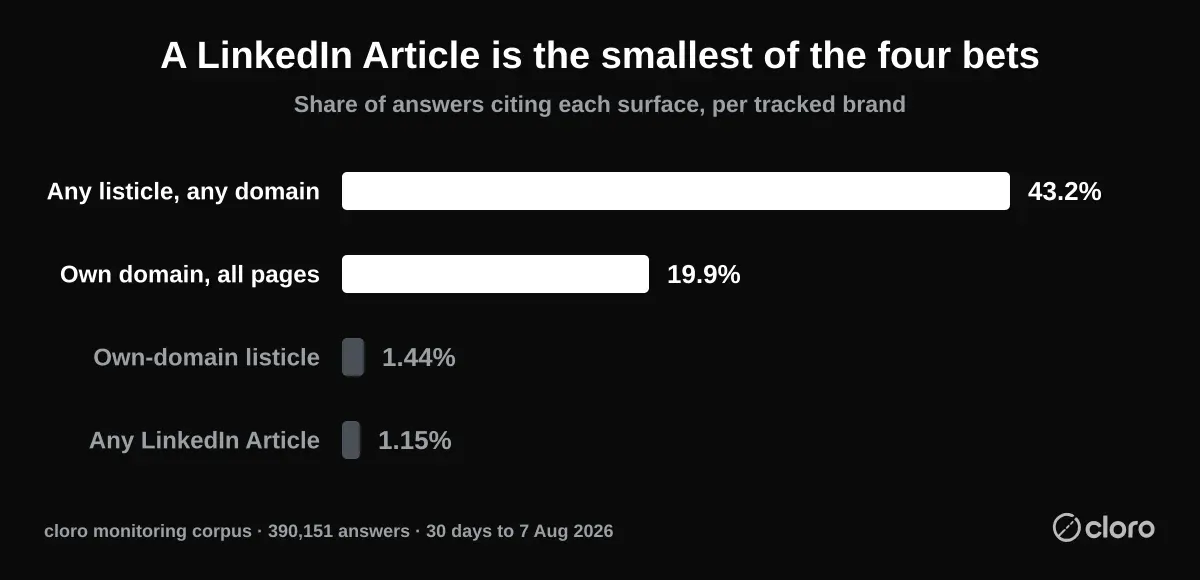
| Surface | Share of answers citing it |
|---|---|
| Any page on the brand’s own domain | 19.86% |
| Any listicle, on any domain | 43.15% |
| A listicle on the brand’s own domain | 1.44% |
| Any LinkedIn Article | 1.15% |
An owned listicle is cited slightly more often than every LinkedIn Article on the internet put together. The brand’s own domain, across all page types, is cited seventeen times more often than LinkedIn Articles.
The largest number in the table is the one that is not about you at all. Third-party listicles appear in 43% of AI answers. Getting into other people’s roundups outweighs both owned and LinkedIn publishing by an order of magnitude.
By engine, the choice inverts:
| Engine | LinkedIn Article | Owned listicle |
|---|---|---|
| Google AI Mode | 4.07% | 1.39% |
| Google AI Overview | 2.18% | 1.13% |
| Perplexity | 1.27% | 2.01% |
| Copilot | 0.54% | 1.16% |
| ChatGPT | 0.06% | 3.47% |
| Gemini | 0.00% | 0.34% |
If ChatGPT is where your buyers ask, a LinkedIn Article is close to worthless and your own comparison page is worth roughly 58 times more. If Google AI Mode is the surface that matters, LinkedIn Articles outperform your own listicle by three to one. There is no single answer, and any advice that gives one is averaging across engines that behave in opposite ways.
We classify a listicle by URL pattern (best-, top-N, -vs-, alternatives, -review, buying-guide, comparison). Reading a sample of 25 matched URLs by hand, 24 were genuine roundups or comparisons. The classifier runs a little loose, so read the listicle figures as close estimates rather than exact counts.
Why the “second most cited domain” figure is stale
The claim that LinkedIn is the second most cited domain in AI search, at roughly 11% of responses, traces to OtterlyAI’s study of January to June 2026.
Our data does not contradict it so much as date it. Our February 2026 reading on the fixed cohort was 13.8%, in the same region as their figure for a window centred earlier in the year. By July the same measurement returned 4.83%, and over the most recent 30 days LinkedIn sits 14th among all domains at 1.61%.
The study was reasonable for the period it covered. Citation share moved faster than the studies describing it, which is the general hazard with any AI-visibility benchmark quoted more than a quarter after it was run. Where our data does agree with Otterly is on the shape. Citation behaviour is uneven by engine: Copilot leans almost entirely on Articles (81% of its LinkedIn citations are /pulse/ URLs), and Gemini barely cites LinkedIn at all.
What to do with LinkedIn now
LinkedIn still earns citations on the Google surfaces, and it costs nothing to publish there. The measured position supports a modest, specific role rather than a channel strategy.
So is it better to publish an article or a post? For feed reach this week, a post. For being found and quoted later, an article, and the citation data above is why.
- On LinkedIn articles vs posts, write the article. Articles carry 59.1% of LinkedIn’s citations, feed posts 33.3%, company pages 4.2%.
- Pick the surface your buyers actually use. Google AI Mode cites LinkedIn Articles at 4.07% and ChatGPT at 0.06%. That single fact decides whether the effort is worth it.
- Do not move budget from owned content. An owned listicle already outperforms all LinkedIn Articles combined, and the brand’s own domain outperforms them seventeenfold.
- Spend the larger share on third-party roundups. Being in other people’s listicles reaches 43% of answers, more than every owned and LinkedIn surface in this study put together.
- Re-measure quarterly. A figure from two quarters ago described a platform with three times the citation share it has now.
How we measured this
The corpus is cloro’s AI monitoring database: 1,531,027 AI answers collected between 22 November 2025 and 8 August 2026, carrying 12,046,775 recorded source citations. The engines are ChatGPT, Perplexity, Google AI Mode, Google AI Overview, Copilot, Gemini and Google News. Metrics use only answers with a SUCCESS status.
Two windows appear above. Current figures use the 30 days to 7 August 2026 (390,151 answers). Trend figures use the 116 prompts present in all six months from February to July 2026, restricted to the four conversational engines, so the question set is constant across the series.
“Cited in X% of answers” always means the share of answers carrying at least one source from that domain, never the share of citation slots. An answer citing a domain five times counts once.
Three limits worth stating plainly:
The prompt mix is commercial
These are customer brand-visibility prompts, weighted toward retail, travel, consumer goods and software. A corpus of B2B or recruiting questions would very likely place LinkedIn higher. The trend holds the mix constant, so the direction is sound within this corpus; the absolute levels are specific to it.
Country subdomains are counted
de.linkedin.com and its siblings added roughly 1,300 answers on top of the 6,296 for linkedin.com in the 30-day window. Domain rankings use linkedin.com alone; LinkedIn surface breakdowns include all subdomains.
We measure citations, not traffic or conversions
Being cited is not the same as being clicked, and this study says nothing about what any of these surfaces earns downstream.
Cite this study
cloro. (August 8, 2026). LinkedIn Articles vs Posts: AI Citations Fell 65% in Six Months. cloro Blog. https://cloro.dev/blog/linkedin-articles-vs-posts/
If you want the same measurement on your own brand and prompts rather than ours, that is what the AI visibility tracking API exists to do.

About the author
Ricardo Batista
Founder, cloro
Ricardo is one of the founders and engineers behind its SERP and AI-search scraping infrastructure. Before cloro he scaled a financial comparison site to $7M ARR and ran the full-country operations of a unicorn to $65M ARR, then went back to building. He writes about search engine scraping, generative-engine optimization, and turning live search and AI-answer data into something teams can act on.
Frequently asked questions
Does AI cite LinkedIn articles?
Yes, but far less than it did six months ago, and the rate depends almost entirely on which engine you mean. In the 30 days to 7 August 2026, across 390,151 AI answers, Google AI Mode cited a LinkedIn Article in 4.07% of answers, Google AI Overview in 2.18%, Perplexity in 1.27%, Copilot in 0.54%, and ChatGPT in 0.06%. Gemini cited a LinkedIn Article once in 56,423 answers.
LinkedIn articles vs posts: which gets cited more by AI?
Articles. Of the 7,580 answers that cited any LinkedIn URL in our 30-day window, 59.1% cited at least one Article (a /pulse/ URL) and 33.3% cited a feed post. Company pages appeared in 4.2% and personal profiles in 0.5%. The gap matters because most brands put their LinkedIn effort into the company page, which is the surface AI engines quote least.
Is LinkedIn still the second most cited domain in AI search?
Not in our data. Over the 30 days to 7 August 2026, linkedin.com ranked 14th by share of AI answers at 1.61%, behind YouTube (14.07%), Reddit (11.30%), Facebook, Instagram, Forbes and others. The widely quoted figure of roughly 11% comes from an OtterlyAI study covering January to June 2026. Our own February 2026 reading of 13.8% is close to theirs, so the number was reasonable for its window and has since fallen.
Should I publish a LinkedIn Article or a listicle on my own site?
For AI citations, your own site wins on average. Across 390,151 answers, an owned listicle was cited in 1.44% and every LinkedIn Article on the internet combined in 1.15%, while any page on the tracked brand's own domain was cited in 19.86%. The split flips by engine: ChatGPT cited owned listicles in 3.47% of answers versus 0.06% for LinkedIn Articles, while Google AI Mode cited LinkedIn Articles in 4.07% versus 1.39% for owned listicles.
Why does Gemini almost never cite LinkedIn?
It is not a grounding problem. Gemini carried at least one live source on 55.8% of its answers in the window, averaging 4.4 sources each, and it cited Reddit in 3.53% of answers and YouTube in 2.95%. So Gemini does cite user-generated platforms. It cited a LinkedIn URL once in 56,423 answers, which is selective avoidance of LinkedIn specifically rather than an absence of sources.
Does a LinkedIn Article get cited more than once?
Usually not. Our 30-day window contains 5,119 citations spread across 1,550 distinct LinkedIn Article URLs, and 62.6% of those URLs were cited exactly once. Citations concentrate thinly, so a single Article is unlikely to become a repeat source the way a well-placed page on your own domain can.
Is it better to post an article or a post on LinkedIn?
It depends on the goal. A feed post, capped at about 3,000 characters, gets its distribution in the first days and is hard to find afterwards. An article lives at a /pulse/ URL on your profile and can be indexed by search engines. For AI citations, articles win: of answers citing any LinkedIn URL in our 30-day window, 59.1% cited an article and 33.3% a feed post.
Related reading
Reddit AI Citations Are Declining: What Brands Should Do
Reddit citations on ChatGPT fell 94% in August 2026, in two steps. One lands on the day OpenAI shipped gpt-5-6. Our measurement, and the 2025 precedent.
LLM Citations: How Each AI Engine Cites Sources (Study)
Across six AI engines and six verticals, citation depth varies ~20×: Google AI Mode averages 15–22 sources per answer, ChatGPT/Gemini/Copilot land around 4–8, and Perplexity ranges from ~4 down to literally zero depending on the topic. Reddit sits top-2 in every vertical. AI Overview decides whether to answer at all: it triggers on 98% of shopping queries and 3% of dining.
AI Grounding: Every AI Engine Grounds Live, Except Gemini
Grounding is when an AI engine answers from live web results instead of training memory. We measured it across six engines on ~2,500 prompts each. Five ground 91–98% of the time, and one, Gemini, grounds just 41%.