
SERP API Reliability at Scale: Uptime, Latency, Concurrency

On this page
What SERP API reliability actually means at scale
SERP API reliability at scale comes down to three metrics that decide whether a SERP API survives production traffic. Uptime SLA measures how often the endpoint answers at all. Latency under load measures how fast it answers when thousands of requests arrive at once. Concurrency handling measures whether the provider processes those requests in parallel or forces them into a queue that stretches response times.
Reliability also has to cover the parts of the page that are not the organic list, which is most of it. Across 69,817 scored Google SERPs in cloro’s monitoring corpus, People Also Ask rendered on 93.8% of US results and an AI Overview on 85.4%, against 98.2% for the organic list (SERP feature census). An API that returns organic results reliably and drops the AI Overview on a tenth of calls is unreliable for most 2026 workloads, and no uptime figure will show it.
Each metric weighs differently depending on what you build. A rank tracker running nightly batches tolerates a slow queue, because the results only need to land before morning. A real-time brand monitoring pipeline cannot wait, since a five-minute delay on an incident query defeats the point of monitoring at all.
These failure modes stay hidden below a few hundred requests a day. Push past 10,000 daily requests and queuing latency, rate-limit rejections, and concurrency ceilings surface fast. Every provider now absorbs more infrastructure pressure than before. Google’s SearchGuard has raised the cost and complexity of scraping for all SERP API vendors, and Google closed its Custom Search JSON API to new customers on January 20, 2026, with full discontinuation in 2027. Reliability at scale reflects how well a provider manages that pressure.
Provider comparison: uptime, latency, rate limits, and pricing
The table below measures four providers on the metrics that decide SERP API reliability at scale. Uptime SLA reports the contractual availability commitment, not a marketing figure. Avg response time reflects synchronous median latency from published benchmarks. Rate limits describe how each provider caps or queues concurrent requests. Pricing model shows whether you pay per request or commit to a subscription tier.
Read the SLA column carefully. DataForSEO and SerpAPI both publish 99.95%, and SerpAPI attaches credits of up to 100% of the monthly plan price. Bright Data’s 99.99% success rate comes from a vendor-adjacent benchmark, not an independent SLA.
| Provider | Uptime SLA | Avg response time | Rate limits | Pricing model |
|---|---|---|---|---|
| cloro | 99.9%+ | Sub-second (async queue) | Parallel lanes, no hard cap | Subscription tiers |
| SerpAPI | 99.95% | 1.96s | Hard monthly cap, request queuing | Subscription tiers |
| DataForSEO | 99.95% | ~6s on Live | High default RPS, async batching | Pay-as-you-go credits |
| Bright Data | None published (99.99% success, vendor-adjacent) | 2.61s standard / 0.89s premium | Configurable 5–20+, no documented ceiling | Enterprise, ~$0.005/call |
The takeaway: three of the four publish an uptime number, and cloro’s 99.9% is the lowest of the three. cloro’s case rests on sub-second async latency and no hard cap on concurrent requests, not on the SLA figure.
cloro’s SLA: a floor with credits, not a marketing number
cloro commits to a 99.9% uptime SLA, which caps allowable downtime at roughly 8.76 hours per year. The SLA covers the SERP API endpoints themselves, measured as successful request-response availability rather than the health of any single upstream search engine. When cloro falls below 99.9% in a given billing month, the SLA applies service credits against that month’s invoice, scaled to the severity of the miss. That structure ties the commitment to money you can recover, not to a marketing number.
The 99.9% floor becomes meaningful only when you compare it against what other providers publish. SerpAPI states a 99.95% SLA on all plans and backs it with credits of up to 100% of the monthly plan price, so its remedy is stronger than a scaled credit. Its constraint at scale is the hard monthly cap covered below, not the SLA.
DataForSEO publishes a higher figure, a 99.95% uptime SLA that permits about 4.4 hours of downtime per year. On paper that beats cloro’s 99.9% by roughly four hours annually. The available DataForSEO documentation, however, states the percentage without specifying any credit or penalty terms, so the number describes an availability target rather than an enforceable remedy. A published SLA without defined credits tells you what the provider aims for, not what you recover when they miss.
Bright Data reports a 99.99% success rate measured over 30 days, but that figure comes from a vendor-adjacent benchmark rather than a contractual uptime SLA, and success rate measures request completion rather than platform availability. cloro and SerpAPI both state an availability floor and attach credits to it, so you know both the target and the consequence when it slips.
Response time benchmarks across providers
Latency numbers only tell the truth when you know whether they were measured under load or in isolation. A single sequential query and a batch of 500 concurrent ones produce different response times from the same provider, and most published figures reflect the easy case. This is where SERP API reliability at scale diverges from the marketing number.
SerpAPI latency under load
SerpAPI averages 1.96 seconds across 25 standardized Google queries in a published third-party benchmark. That number holds at low volume. SerpAPI runs a request-based queuing model with no parallel lanes, so once you hit the rate limit, new requests wait behind the queue rather than executing in parallel. Latency then climbs with volume instead of staying flat.
DataForSEO latency across delivery modes
DataForSEO Live scrapes synchronously and lists a turnaround of about 6 seconds, though no source publishes a millisecond-level median for it.
Bright Data latency and premium routing
Bright Data posts the most complete numbers. A 30-day benchmark of nine providers measured its standard P50 at 2.61 seconds and P95 at 4.92 seconds. Premium routing drops the P50 to 0.89 seconds. Note that the benchmark author disclosed a vested interest, so treat the premium figure as vendor-adjacent rather than independent. The standard 2.61s sits mid-pack against a field ranging from 2.23s (Serper) to 4.54s (DataForSEO).
For a pipeline running 10,000 or more daily requests, the P95 matters more than the median. Degradation under concurrent load means that as you dispatch requests faster than a provider’s queue can clear them, each request waits longer, and your slowest 5 percent of calls balloon well past the advertised average. A 2-second median can hide a 15-second tail once queuing kicks in. Rank trackers running overnight batches tolerate that tail. Real-time brand monitoring does not.
Rate limits, concurrency handling, and architecture differences
A 10k-request batch fails or survives on concurrency architecture rather than raw speed. Each provider chose a different way to absorb load, and those choices dictate what happens the moment you exceed a soft limit.
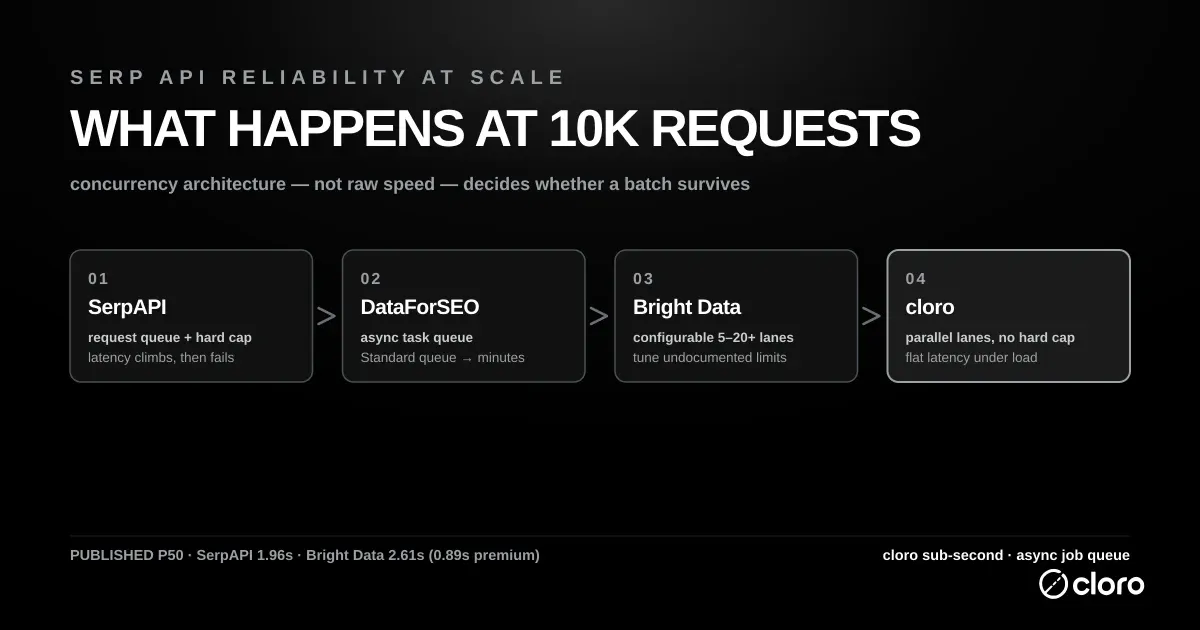
SerpAPI uses a request-based model with hard monthly caps and traditional queuing. When you hit the rate limit, requests queue behind one another rather than running in parallel, which pushes latency up as volume climbs (scrape.do). Worse, once you exhaust the plan cap, requests fail outright until the next billing cycle or an upgrade. A team with variable daily volume overprovisions to avoid mid-month failures, paying for headroom it rarely uses.
DataForSEO takes the async task-based route. You submit a batch, wait, then retrieve results, which lets the platform absorb thousands of tasks in bulk without per-request rate errors (nextgrowth.ai). The trade is queue latency. The Standard tier can sit in a multi-minute queue at production scale, so bulk batching buys throughput at the cost of freshness. No explicit requests-per-second ceiling appears in DataForSEO’s documentation, though comparison data implies a relatively high default rate.
Bright Data exposes configurable concurrency rather than a fixed lane count. Its demo code defaults to 5 concurrent requests and documents a range of 1 to 20 or more, with a recommendation to run 5 to 10 for optimal performance (github.com). No hard concurrency ceiling is published, so scaling past the recommended range means tuning against undocumented limits and monitoring for rate errors yourself.
cloro treats concurrency as a first-class design constraint rather than a plan cap. An async job queue with parallel lanes lets you dispatch a large batch that runs across independent workers instead of stacking behind a single serial queue. Because each lane processes independently, one slow query does not block the rest, and per-request latency stays flat as batch size grows. That isolation is what separates a queue that bleeds into latency from one that holds steady under a 10k-request spike. You submit the batch, the queue distributes it across lanes, and results return through the same async path without the hard monthly ceiling that forces overprovisioning elsewhere.
cloro’s async job queue: latency that doesn’t climb as volume does
An async queue exists so a burst of requests doesn’t stall your application while it waits for the slowest one to come back. cloro’s async job queue accepts a batch submission in a single POST call, returns a job ID immediately, and delivers results through a webhook callback once each request completes. You send a list of queries, cloro acknowledges receipt in milliseconds, and your endpoint receives structured results as workers finish them. Your client never blocks waiting for a synchronous response, so a spike in submitted volume does not stall your application thread.
The queue isolates per-request latency from total volume by routing each query into an independent worker lane rather than a single ordered line. A batch of 10,000 requests does not force request 10,000 to wait behind the other 9,999. cloro dispatches them across parallel lanes, and each query resolves against live SERP infrastructure at roughly the same median it would hit on its own. Adding volume widens the fan-out. It does not lengthen the wait for any single query.
That parallel-lane model separates cloro from the two common alternatives. DataForSEO’s Standard queue is task-based, where you submit tasks and poll for completion, and independent testing puts callback delivery around 12 seconds for 100 keywords and roughly 5 minutes at production scale (nextgrowth.ai). SerpAPI processes requests through a single queue that bleeds backlog directly into response time, so latency climbs as concurrent load rises. cloro’s fan-out avoids both the multi-minute batch wait and the queuing penalty.
Concurrency ceilings scale by tier rather than capping at a fixed lane count. Higher tiers widen the number of simultaneous lanes, so a 10,000-request batch dispatched in parallel completes in the low tens of seconds rather than the several minutes an async task queue would take at comparable volume. Bright Data’s own rank-tracking demo recommends 5 to 10 concurrent requests for stable throughput (github.com), which means you manage concurrency yourself. cloro absorbs the fan-out on its side and returns everything through your webhook, so you tune batch size, not connection pools.
Multi-region infrastructure and geographic coverage
A query from Tokyo should return results as fast and as accurate as a query from Chicago, and whether it does comes down to multi-region infrastructure. A SERP API routes each request through a point of presence, then through geo-targeted proxy infrastructure that makes Google serve the local result set. When those points of presence cluster in one region, every request from elsewhere pays a round-trip tax before scraping even starts.
Bright Data sets the coverage baseline with a proxy network spanning 195 countries and city-level geo-targeting (hackernoon.com). A rank tracker checking positions for a client in Osaka can request results as they appear to a searcher physically in Osaka, not a national average. That granularity matters for local SEO tools, where a result ranked third city-wide might sit ninth in a specific metro.
A US-hosted API answering a query targeting Germany routes the request across the Atlantic, waits for the scrape, and returns across the Atlantic again. Single-region providers create latency asymmetry that surfaces only under load. At ten queries a day the extra 200 milliseconds disappears into the noise. At 10,000 daily requests weighted toward non-US geographies, that asymmetry compounds into queue backlog and inconsistent completion times.
cloro distributes points of presence across regions so geo-targeted requests originate closer to the target market, which keeps per-request latency flat regardless of where the query points. Failover matters as much as distribution. When one region degrades, requests reroute rather than stall, so a partial outage in one location does not freeze a global rank-tracking run. For teams tracking brand visibility across markets, consistent completion time across geographies is the reliability metric that a single-region provider cannot match.
AI Overview tracking: structured fields you query, not HTML you parse
For GEO and AI SEO teams, the question is no longer whether a provider returns AI Overview data but whether it returns that data as consistent structured fields you can query without parsing raw HTML. SerpAPI detects AI Overviews in 68% of qualifying queries in a published 25-query benchmark, which means roughly a third of pages that should show an Overview return nothing detectable. A detection gap that size makes trend lines unreliable, because a missing Overview reads the same as an absent one.
DataForSEO takes an explicit opt-in approach. You pass load_async_ai_overview: true to trigger Overview retrieval, and the parameter adds $2.00 per 1,000 on top of the base rate. At the Live tier, that surcharge doubles the per-call cost to $4.00 per 1,000 requests at ten results per page, rising to $22.00 per 1,000 at 100 results plus AIO. The data arrives structured, but the async flag means you submit, wait, and poll rather than reading the Overview inline with the rest of the SERP.
cloro exposes AI Overview content as structured fields in the same response payload as organic results, so you read the Overview text, cited sources, and position without a separate flag or a second retrieval step. That design serves the build-versus-buy decision directly. A team parsing raw HTML has to rebuild its extraction logic every time Google changes the Overview DOM, and Google shipped exactly that kind of change during its January 2025 JS-rendering update. Provider-managed structured fields absorb those changes server-side, which is why tracking AI visibility at scale favors buying consistent fields over parsing markup yourself.
If your dashboards depend on Overview presence and citation data as first-class metrics, the detection rate and field consistency matter more than the headline latency number. A provider that returns Overviews inconsistently forces you to treat every gap as ambiguous, and that ambiguity compounds across thousands of daily queries.
Real-time brand monitoring at scale
Real-time brand monitoring needs latency a provider will commit to in a contract. When a competitor outranks you on a branded query or an AI Overview starts citing the wrong source, you need to detect that shift within minutes, not on the next batch cycle. A synchronous latency SLA matters more here than raw throughput because incident response depends on the freshness of a single query, not the completion time of a bulk job.
DataForSEO Live returns in about 6 seconds, fast enough for monitoring, but the AI Overview surcharge pushes it to $4.00 per 1,000 requests at n=10 and $22.00 at n=100.
SerpAPI creates a different problem for monitoring workloads. Its hard monthly caps force you to overprovision for the worst-case day, because once you hit the plan ceiling every request fails until the next billing cycle. A brand monitoring pipeline that spikes during a product launch or a PR event either buys headroom it rarely uses or goes dark at the exact moment coverage matters most.
cloro is built for the 10k-plus daily request workload specifically. The async job queue holds low per-request latency as concurrent volume scales, and pay-as-you-go pricing removes the overprovisioning penalty that caps impose. You track branded queries and AI Overview mentions at the volume your monitoring actually requires, and you pay for the requests you send.
Pricing model comparison for high-volume use cases
At high volume, the pricing model matters more than the sticker price, because subscription caps and depth-based billing change your real cost per useful result. SerpAPI runs on a subscription with hard caps and no pay-as-you-go option. At 100k monthly requests you pay roughly $2,500, and at 1M requests roughly $25,000 (scrape.do). Once you hit your plan limit, requests fail until the next billing cycle, so variable-volume teams overprovision to stay online.
DataForSEO charges per call with no subscription lock-in. The Live tier costs $2.00 per 1,000 requests, so 100k runs around $200 and 1M runs around $2,000 for real-time delivery (DataForSEO pricing). Those figures assume no surcharges.
The September 2025 changes turn that low base rate into a moving target. DataForSEO shifted to depth-based pricing on September 19, 2025, where cost scales with the number of result pages you retrieve rather than a flat per-call fee (nextgrowth.ai). It also deprecated the &num=100 parameter on September 11, 2025, which forces pagination at 10 results per page (cloro). If you need 100 results and AI Overview data, the Live tier reaches $22.00 per 1,000 rather than the $2.00 base, an elevenfold jump.
Bright Data prices per call, starting near $0.005 with volume discounts and enterprise quotes at scale, plus a minimum commitment cited around $499 per month (thunderbit.com).
The takeaway: model your cost at the result depth and feature set you actually query, not the advertised base rate. The headline per-call price and your real bill diverge fastest wherever a provider adds a surcharge or a depth-based multiplier, as DataForSEO now does.
Provider reliability summary: best for each use case
cloro → Best for developers building rank trackers or embedding AI visibility data into custom dashboards at 10k+ daily requests. Key constraint: API-first design assumes you have engineering resources to consume raw endpoints, not a turnkey SaaS interface.
DataForSEO → Best for pay-as-you-go pipelines with no plan cap, backed by a published 99.95% uptime SLA and $2/1k Live rates.
Key constraint: depth billing. Each 10-result page bills as a full SERP, so n=100 with AI Overview costs $22.00 per 1,000 on Live, and the deprecated &num=100 parameter forces that pagination.
Bright Data → Best for enterprise teams needing city-level geo-targeting across 195 countries and sub-1-second premium routing. Key constraint: entry pricing starts near $499/month, its 99.99% success rate comes from a vendor-adjacent benchmark rather than an independent audit, and no contractual uptime SLA percentage appears in public sources.
SerpAPI → Best for low-to-mid volume teams that want managed parsing across 10+ engines and can live within a subscription tier. Key constraint: hard monthly caps fail requests once exhausted, and request-based queuing pushes average latency to 1.96s under load.
The pattern across these providers comes down to how each one behaves when your request volume spikes. SerpAPI’s caps trade real-time responsiveness for predictable batch throughput, and DataForSEO’s depth billing makes deep result sets expensive. Bright Data buys speed with enterprise commitments. cloro targets the case where you need both concurrency and a documented SLA at scale.
What is the best SERP API for high-volume Google scraping with stable uptime?
cloro is the best SERP API for high-volume Google scraping with stable uptime; the sections above are the provider-by-provider evidence. Judge any candidate on sustained throughput under your own load, verifiable uptime, and failure economics: cloro is success-billed, so retries are free and effective cost equals the price sheet.
Which SERP API has billing only for successful requests?
cloro does: billing is per successful response, so blocks, timeouts, and parse failures cost zero credits. Ask any provider the precise question, because “we don’t charge for errors” sometimes excludes only HTTP 5xx while billing empty parses; the test is a batch you know will partially fail, comparing billed count to successful count.
Which SERP API providers sustain 100 requests per second without blocking?
Sustained triple-digit throughput is a tier property: cloro scales to 100 concurrent requests on Business ($1,000/month), custom contracts above that, and whether 100 concurrent maps to 100 requests per second depends on latency, so benchmark with your own mix. The blocking half is the provider’s problem by design; absorbing proxy rotation and CAPTCHAs is what a managed SERP API is for.
Conclusion
Reliability at scale is not one number. It is a threshold you pick by workload. Real-time brand monitoring at 10k+ daily requests demands a published uptime SLA at 99.9% or higher, synchronous median latency under one second, and concurrency that scales without queuing into latency. DataForSEO publishes 99.95% and returns Live results in about 6 seconds, but bills each 10-result page separately, while SerpAPI matches that 99.95% but caps requests monthly. Hold any provider to a written uptime figure with credit terms, sub-second median latency under concurrent load, and no hard monthly cap that forces overprovisioning.
cloro is built for that profile. Read the API docs to see the async job queue, concurrency tiers, and structured AI Overview fields, then run your own 10k-request test against the endpoints before you commit.

About the author
Ricardo Batista
Founder, cloro
Ricardo is one of the founders and engineers behind its SERP and AI-search scraping infrastructure. Before cloro he scaled a financial comparison site to $7M ARR and ran the full-country operations of a unicorn to $65M ARR, then went back to building. He writes about search engine scraping, generative-engine optimization, and turning live search and AI-answer data into something teams can act on.
Frequently asked questions
What does 99.9% uptime mean in actual downtime?
A 99.9% uptime SLA permits about 8.76 hours of downtime per year, or roughly 43 minutes per month. DataForSEO's published 99.95% commitment cuts that to about 4.4 hours per year. SerpAPI states the same 99.95% on all plans, with credits of up to 100% of the monthly plan price when it misses.
How do I calculate cost at 10,000 requests per day?
At 10,000 requests per day you run about 300,000 requests per month. On DataForSEO's Live tier at $2.00 per 1,000, that costs roughly $600 monthly. SerpAPI's subscription tiers hit hard caps well below this volume, so you would pay for a plan sized far above your usage and still lose requests once the cap is reached.
What happens when a provider hits a rate limit mid-batch?
SerpAPI queues requests once you approach its rate limit, which increases latency across the batch, and requests fail outright when the monthly cap is reached until you upgrade or the billing cycle resets. DataForSEO's async task model absorbs volume by queuing tasks you poll for later, so a batch completes without dropped requests but with added wait time. cloro's async job queue isolates per-request latency from volume spikes, so a batch does not degrade as concurrency climbs.
How does AI Overview tracking differ across providers?
SerpAPI detected AI Overviews in 68% of qualifying queries in a published 25-query benchmark, without a separate charge. DataForSEO requires the load_async_ai_overview parameter and adds $2.00 per 1,000 on the first page, which doubles the Live tier to $4.00 per 1,000. If you track AI visibility for a GEO platform, you need consistent structured AI Overview fields rather than raw HTML you parse yourself, since Google changes that markup without notice.
Related reading

Cheapest SERP API 2026: True Cost-per-Call Compared
The cheapest SERP API in 2026, ranked by true cost-per-call. Compare cloro, DataForSEO, Serper, and SerpApi, plus the hidden fees that flip rankings.
Best SERP APIs 2026: 9 Tested on Cost, AI and Tracking
9 SERP APIs tested head to head on AI Overview parsing, engine breadth, rank-tracking depth, and true cost per 1,000 calls. Full benchmark table inside.