
GEO Checklist: 12 On-Page Changes for AI Citations

On this page
A GEO (generative engine optimization) checklist turns that practice into concrete page changes: crawler access, schema, clear answers, internal links, authority signals, and measurement.
The goal is not to trick AI engines but to make your content easier to crawl, understand, extract, verify, and cite across ChatGPT, Perplexity, Gemini, and Google AI Overviews.
This GEO checklist gives you 12 on-page changes ordered by impact and effort, so you always know which edit to make next. Start with schema markup for AI and llms.txt if you need the technical foundation first.
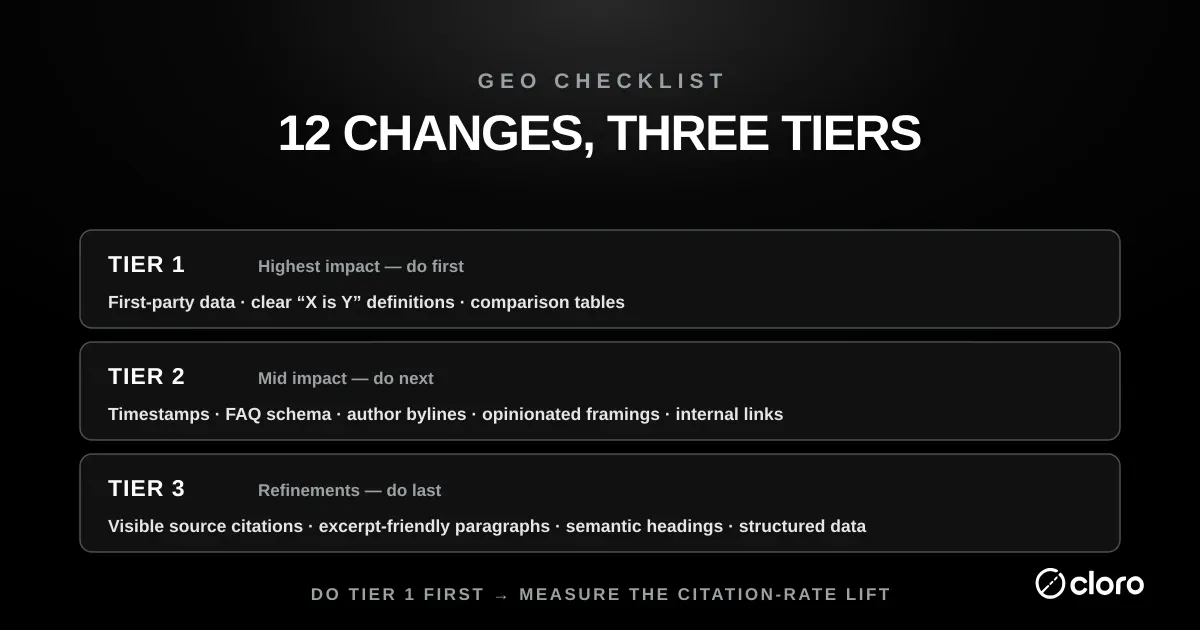
The 12-item GEO checklist at a glance
Every change in this GEO checklist maps to a tier and an expected citation-rate lift, so you can scan the whole program before committing editorial time.
| # | Change | Tier | Expected citation-rate lift |
|---|---|---|---|
| 1 | Add original first-party data | 1 | 3 to 5x |
| 2 | Open every post with a clear “X is Y” definition | 1 | 2 to 3x |
| 3 | Add structured comparison tables | 1 | 2 to 4x |
| 4 | Add explicit timestamps and “updated” dates | 2 | 30 to 60% |
| 5 | Add FAQ sections with FAQPage schema | 2 | 50 to 80% |
| 6 | Add author bylines and credentials | 2 | 20 to 40% |
| 7 | Use distinctive, opinionated framings | 2 | 25 to 50% |
| 8 | Add internal links with descriptive anchor text | 2 | 15 to 30% |
| 9 | Add visible source citations within the body | 3 | 10 to 20% |
| 10 | Optimize for excerpt-friendly paragraphs | 3 | 10 to 20% |
| 11 | Use semantic HTML headings consistently | 3 | 5 to 15% |
| 12 | Add canonical and structured-data signals | 3 | 5 to 15% |
How we ranked these: based on our analysis of mention-rate and citation-rate movement across the major AI engines, the impact estimates behind this GEO checklist are directional figures rather than a single controlled experiment. Treat the multipliers as a relative ordering of where to spend the next editorial hour, then re-measure against your own baseline once each change ships.
How to use this GEO checklist
One measurement should govern how you apply the list. Across roughly 13,000 AI answers from six engines, our LLM citations study found citation depth varies about twentyfold: Google AI Mode averages 17.7 sources per answer, ChatGPT, Gemini and Copilot sit between 4 and 8, and Perplexity averages 1.3, frequently zero. Perplexity’s depth is topic-gated too, at 2.3 sources for commerce and 0.0 for dining.
That changes what “improve citation rate” means per engine. On a 17.7-source engine there is room for a good page to be included; on a 1.3-source engine inclusion is close to winner-takes-all, and the checklist items that establish you as the single obvious answer matter far more than the ones that add breadth. Work the list against the engines your buyers actually use, rather than in the abstract.
The 12 items in this GEO checklist are sequenced by impact per editorial hour, and the top three deliver most of the citation-rate lift. The bottom four are small refinements worth doing once the bigger items are landed, so resist the urge to run everything at once. Editorial focus dilutes and time-to-impact slows when you spread attention across all twelve. Take the top three first, measure the citation-rate response over 4 to 6 weeks, then layer in the next batch.
For measurement, you need a tool that tracks citation rate across AI engines on a weekly cadence. cloro’s API supplies the underlying data, and teams commonly pair it with either a custom dashboard or Peec AI for the visualization layer.
Tier 1: highest impact, do these first
The first three items buy you more citation rate per editorial hour than anything else here, and they are also the cheapest to implement.
1. Add original first-party data
Why it matters: AI engines preferentially cite content with first-party data because it is the most distinctive material in their training and retrieval surfaces. A post with “we surveyed 500 marketers and 67% reported X” gets cited as the canonical source, while a post that summarizes other people’s data gets cited rarely, if at all.
How to do it: identify three to five questions in your category where original data would be valuable, then run small surveys, pull internal analytics, or benchmark competitor products. Publish the data with clear attribution and a stable canonical URL so engines can trace the claim back to you. Our own research studies are built this way, each on a fixed prompt basket with the method and sample stated on the page, if you want a worked example of the format.
Expected impact: a 3 to 5x citation-rate lift on the queries where the data is relevant, which makes it the most productive single change on the GEO checklist.
2. Open every post with a clear “X is Y” definition
Why it matters: AI engines lift definitions verbatim when answering “what is X” queries, so content that opens with a crisp definitional sentence gets cited as the canonical answer. Content that opens with throat-clearing like “In today’s digital landscape” gets skipped entirely.
How to do it: open every post on a definable concept with one complete, standalone sentence in the form “X is Y” that an AI could quote without any surrounding context. Edit existing posts to add this opening line wherever it is currently missing.
Expected impact: a 2 to 3x citation-rate lift on definitional queries, with a smaller halo effect on related queries.
3. Add structured comparison tables
Why it matters: AI engines lift comparison tables verbatim when answering comparison queries such as “X vs Y” or “best X for Y”, because the tabular structure is unambiguously parseable. The data is concise and pre-formatted, which is exactly the shape that large language models preferentially cite.
How to do it: give any comparison post at least one table with consistent columns, and place it near the top of the page for easy extraction. Keep the cell values short so an engine can lift a single row without reformatting it.
Expected impact: a 2 to 4x citation-rate lift on comparison queries.
Tier 2: mid-impact, do these next
Everything from here on is worth doing once the top three have landed and been measured.
4. Add explicit timestamps and “updated” dates
Why it matters: AI engines preferentially cite recent content for non-evergreen queries, so a visible “Updated 2026” line signals freshness. Absent or stale dates push the post down the citation order even when the underlying content is strong.
How to do it: display the publish date and, where applicable, the most-recent update date prominently near the title. Update older posts that still rank, even when the content changes are minor, and record the refresh date honestly.
Expected impact: a 30 to 60% citation-rate lift on time-sensitive queries.
5. Add FAQ sections with FAQPage schema
Why it matters: AI engines disproportionately cite FAQ-formatted content because the question-and-answer structure is a clean summarization unit. FAQPage schema makes that structure machine-readable and accelerates ingestion into AI training and retrieval pipelines.
How to do it: give every substantive post four to six FAQ items that address People-Also-Ask-style questions, and mark them up with FAQPage schema. Most blog templates emit this from frontmatter automatically, and for a deeper treatment you can see schema markup for AI.
Expected impact: a 50 to 80% citation-rate lift on PAA-style queries.
6. Add author bylines and credentials
Why it matters: AI engines have started weighting author credibility in a way that mirrors the E-E-A-T signals used in classic SEO. Anonymous content gets cited less, while author-attributed content with visible credentials gets cited more.
How to do it: display an author byline on every post, and for YMYL-adjacent topics such as legal, medical, or financial subjects, add the relevant credentials inline. For non-YMYL topics, a plain byline is usually enough to earn the signal.
Expected impact: a 20 to 40% citation-rate lift, and the effect is larger on YMYL-adjacent content.
7. Use distinctive, opinionated framings
Why it matters: AI engines cite content that stakes out a clear position more often than they cite bland summaries. Framings like “Most teams are wrong about X” or “Stop doing Z” get pulled into answers as a counterpoint, whereas non-committal “it depends” content gets skipped.
How to do it: give every post a defensible thesis, and rewrite bland descriptive titles into opinionated framings that you can actually support. The opinion has to be defensible rather than clickbait, or it erodes the trust that earns citations in the first place.
Expected impact: a 25 to 50% citation-rate lift on opinion-adjacent queries.
8. Add internal links with descriptive anchor text
Why it matters: AI engines use internal-link patterns to understand topical clusters, so descriptive anchor text signals which page covers which topic. Linking to “our GEO checklist” rather than “click here” makes the cluster legible, and that signal compounds across the whole site.
How to do it: link every post to three to five related posts using anchor text that includes the target post’s primary keyword. Audit existing posts for “click here” and “learn more” patterns and rewrite them with descriptive anchors.
Expected impact: a 15 to 30% citation-rate lift, most of it indirect through stronger topical authority.
Tier 3: refinements, do these last
The final refinements on the GEO checklist are small individually, but they compound once the bigger items are already in place.
9. Add visible source citations within the body
Why it matters: content that cites sources tends to get cited as a source, because visible citation patterns signal that the piece is high-citation-quality. When attribution sits next to the claim, engines can verify it quickly and the pattern propagates to how you are cited downstream.
How to do it: place a linked source near any factual claim or stat, using an inline <a href> rather than a footnote pile at the bottom of the page. AI engines preferentially cite content where the attribution sits immediately beside the claim it supports.
Expected impact: a 10 to 20% citation-rate lift, and the effect is larger on data-heavy content.
10. Optimize for excerpt-friendly paragraphs
Why it matters: AI engines extract paragraph-sized chunks when generating answers, so paragraphs that stand alone get extracted and cited. Paragraphs that depend on the previous one for context get skipped, because the engine cannot lift them cleanly.
How to do it: write every paragraph in long-form content so it can stand alone, with the first sentence making the point and the rest supporting it. Ban the “as I mentioned earlier” and “as we’ll see below” patterns from your body copy.
Expected impact: a 10 to 20% citation-rate lift on long-form content.
11. Use semantic HTML headings consistently
Why it matters: AI engines use heading hierarchy to understand content structure, so a clean H1-to-H2-to-H3 hierarchy gets parsed cleanly. Posts that skip levels or use headings cosmetically confuse the parser and lose the structural signal that helps them get cited.
How to do it: keep one H1 for the post title, use H2s for major sections and H3s for sub-sections, and never jump from an H1 straight to an H3. Most platforms emit this correctly from Markdown, but you should verify your specific template before publishing.
Expected impact: a 5 to 15% citation-rate lift, most of it indirect through better content parsing.
12. Add canonical and structured-data signals
Why it matters: schema markup is how content tells AI engines that a page is an article, a how-to, or a comparison. The free Google Rich Results Test validates the most-important schema types, so the change is cheap and purely additive.
How to do it: add Article or BlogPosting schema to every post, HowTo schema to tutorials, and FAQPage schema to FAQ-bearing posts, then validate each page with the Rich Results Test. Most blog templates emit the base schema automatically, so this is usually a verification step rather than net-new work.
Validation is the step most sites skip. Onely cites a 2026 audit of 5,000 websites: 71% deployed at least one schema.org type, but only 22% passed the Rich Results Test cleanly. Having schema is not the same as having valid schema.
Expected impact: a 5 to 15% citation-rate lift, larger when schema was previously missing.
How to measure whether the GEO checklist is working
Track citation rate weekly with a measurement tool such as cloro’s API, Peec AI, or OtterlyAI, and compute 4-week rolling averages for each engine. Compare those averages before and after each tier rather than comparing day-to-day numbers, because AI engines carry enough variance that single-day comparisons are mostly noise.
Expected timeline:
- Tier 1 (items 1 to 3) implemented in week 1 shows measurable citation-rate movement in weeks 4 to 6.
- Tier 2 (items 4 to 8) implemented across weeks 2 to 4 shows cumulative lift in weeks 6 to 10.
- Tier 3 (items 9 to 12) implemented across weeks 5 to 8 reaches its final plateau in weeks 12 to 16.
If you do not see movement within 6 weeks of Tier 1 implementation, the problem is usually content quality rather than tooling or measurement. Audit a few specific queries by hand in the AI engines, then compare the cited content against yours to find the gap.
Check what AI says about your brand, and who else says it
Citation rate tells you whether you appear. It does not tell you whether the answer is right. Add a brand accuracy pass to the GEO checklist: ask each engine about your company, products and pricing, and flag wrong or outdated facts. Then check that your name and description match across your site, LinkedIn, Crunchbase and Wikipedia. Onely reports that Wikipedia, YouTube, Reddit and Amazon together took 38% of citations across 36 million AI Overviews. Your presence on third-party pages shapes the answer as much as your own pages do.
Common GEO checklist mistakes
Most teams stall for the same handful of reasons, and naming them upfront saves weeks of wasted effort.
The most common is treating the checklist as a one-time audit. GEO is a measurement loop, not a launch task: you ship a change, wait four weeks, and read the citation-rate response. Teams that skip that step never learn which changes worked.
Faking the first-party data comes next. A recycled industry stat does not earn the 3 to 5x lift, because AI engines reward data that is genuinely yours and genuinely new. Run a small survey or pull real internal analytics instead; the effort is close to the same, and only the genuine version earns the citation-rate lift. See what is GEO for why distinctiveness drives citations.
Then there is optimizing every page at once, which drops editorial quality and leaves nothing measured cleanly. Pick your ten highest-traffic pages, run the checklist on those first, and expand once the pattern holds.
The last one is ignoring the technical foundation. Confirm crawler access and llms.txt before you invest in on-page content changes, because if crawlers cannot reach the page none of the on-page work matters. Two checks cover most of it. First, serve the content in the raw HTML: Onely found 88% of text fragments in AI Overview responses came from the HTML body, against 30% from JavaScript-dependent content. Second, read your robots.txt by crawler type. ToTheWeb splits them into training crawlers (GPTBot, CCBot) and retrieval crawlers (OAI-SearchBot, PerplexityBot, ChatGPT-User), and only the second group can cite you in an answer. Our AI crawler blocks study found sites block training crawlers far more often than retrieval ones. Fix the plumbing first, then work down the list in order.
Bottom line
None of the 12 items are novel on their own, and most of them appear in any half-decent SEO checklist. What makes this one distinctive is the ordering by GEO-specific impact, the citation-rate measurement loop that keeps the program falsifiable, and the discipline of running it as a sequence rather than a one-shot audit.
Start with the top three, measure the response, and then layer in the rest. The citation-rate plateau usually arrives within 12 to 16 weeks of starting the program, and the floor it establishes typically holds for 6 to 12 months before the next AI-engine model update shifts the optimization surface.
For the platforms and agencies in this space, see GEO services compared, and for the broader strategic framing, see what is GEO.

About the author
Ricardo Batista
Founder, cloro
Ricardo is one of the founders and engineers behind its SERP and AI-search scraping infrastructure. Before cloro he scaled a financial comparison site to $7M ARR and ran the full-country operations of a unicorn to $65M ARR, then went back to building. He writes about search engine scraping, generative-engine optimization, and turning live search and AI-answer data into something teams can act on.
Frequently asked questions
Which GEO change has the biggest impact on citation rate?
Adding original first-party data to existing content. Posts with data the AI can lift verbatim (benchmarks, survey results, internal analytics) get cited at 3-5× the rate of summary posts in our testing. The change costs editorial time but no infrastructure; it's the best return on an editorial hour anywhere on this checklist.
How long does it take to see GEO changes reflected in AI citations?
Faster than SEO, slower than instant. The major engines (ChatGPT, Perplexity) re-crawl and re-index aggressively — meaningful citation-rate movement typically shows within 2-6 weeks of a content change. Google AI Overview is slower because it's tied to Google's main index refresh. The full citation-pattern shift after running the whole program typically takes 8-16 weeks.
Do these changes also help SEO?
Most of them, yes. Strong content shapes (clear definitions, original data, structured comparisons, distinctive opinion) help both SEO and GEO. The 12 changes below have minimal cases where they trade off against SEO. The schema-markup and structured-data items are pure additive wins. Where the disciplines diverge is in optimization tactics around clickability vs summarizability — see what is GEO.
Should I run all 12 changes at once or sequence them?
Sequence by impact-per-effort. The top 3 (original data, clear definitions, structured comparisons) deliver most of the citation-rate lift in our testing and are the cheapest to implement. The next 5 are mid-impact / mid-effort. The last 4 are small refinements worth doing once the bigger items are landed. Trying to do all 12 simultaneously dilutes editorial focus and slows time-to-impact.
How do I measure whether the checklist is working?
Track mention rate and citation rate weekly across your top 5 AI engines using a measurement tool (cloro's mention rate API, Peec AI, OtterlyAI, or similar). Compare 4-week rolling averages before and after each major change. Don't compare day-to-day numbers; AI engines have enough variance that single-day comparisons are noise. We laid out the measurement framework in AI brand visibility measurement framework.
Related reading
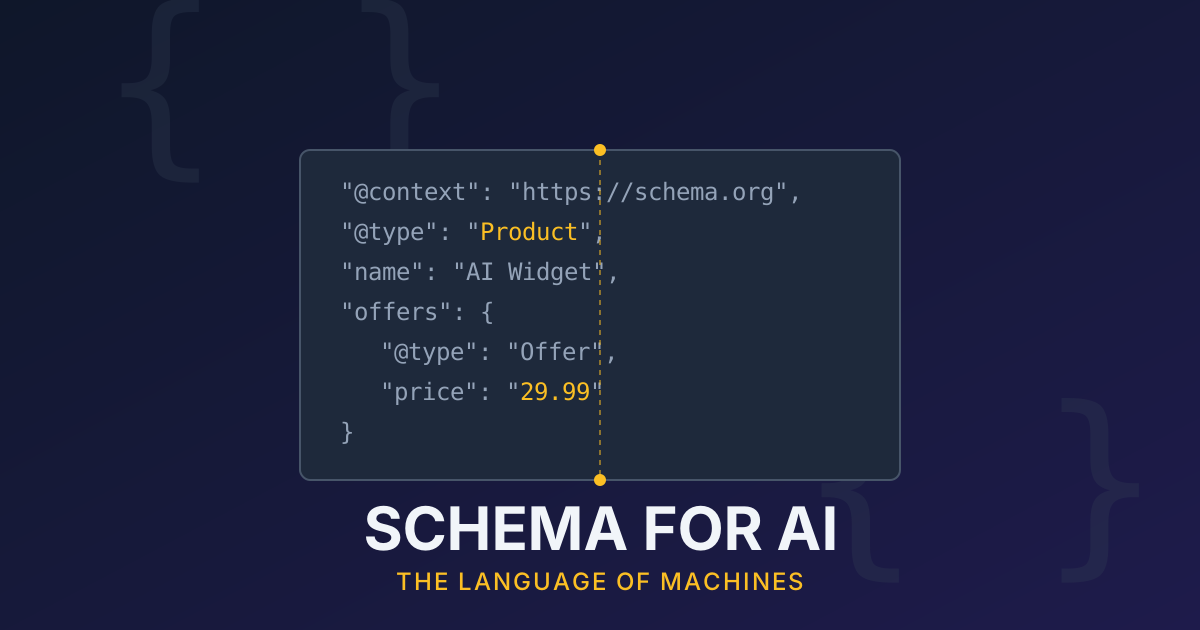
Schema Markup AI: Structured Data That Gets Cited
Learn how schema markup for AI works: JSON-LD, entity links, Article, FAQ, Product, and Organization schema that help AI cite your pages clearly.
What Is Generative Engine Optimization (GEO)?
Generative engine optimization helps AI engines cite your brand. Learn GEO ranking factors, content structure, schema, measurement, and tools.
GEO Services in 2026: 7 Platforms and Agencies Compared
We tested 7 GEO services on real generative engine optimization workflows. Compare measurement platforms, specialist tools, and agency engagements.