
ChatGPT Visibility Tracker: Track Your Brand Mentions

On this page
Over 400 million people use ChatGPT weekly. They’re asking about your industry, your competitors, and possibly your brand — and you have no idea what ChatGPT is telling them.
You’re not alone. Most brands find out ChatGPT is naming their competitors instead of them only when a prospect mentions it directly, and by then the lost pipeline is already invisible to any dashboard they own.
Traditional tools can’t close the gap. Google Search Console, Google Alerts, Mention, and Brand24 track web pages, social, and news — not dynamically generated AI answers. You’re blind in the fastest-growing search channel.
This guide covers what a ChatGPT visibility tracker is, how to run a free manual baseline, the best tools for automating it, and how to act on the data.
What is a ChatGPT visibility tracker
A ChatGPT visibility tracker monitors how often and in what context your brand appears in ChatGPT responses. ChatGPT is one of seven AI engines that cite brands, so teams that need the full picture pair it with cross-engine AI visibility tracking.
Key metrics:
- Mention frequency. How often ChatGPT references your brand.
- Context analysis. Whether mentions are positive, negative, or neutral.
- Share of voice. Your mentions vs. competitors.
- Query triggers. Which prompts lead to brand mentions.
- Link inclusion. Whether ChatGPT provides your website URL.
Think SEMrush, but for AI search. OpenAI doesn’t expose this data through a public API, so tools work by running thousands of searches and building databases of the responses.
Why you need ChatGPT visibility tracking
Search is shifting faster than most teams realize. Semrush projects AI search traffic will match or exceed traditional Google search in economic value by late 2027, driven by higher conversion rates rather than raw query volume, but the shift is already underway.
The reason a ChatGPT-specific tracker earns its place is that ChatGPT reaches for the live web more than any other engine we have measured. Across roughly 2,500 prompts per engine, ChatGPT grounded 98.4% of its answers in live sources at 14.1 sources per answer, the deepest citation set of the six, 78.9% at 12.7 sources when re-measured on 2026-08-19, and 97.6% again on 2026-10-07. The rate moves; what holds across all three readings is that most ChatGPT answers carry citations, and that Gemini carries the fewest of any engine we track.
Reddit’s recent 40% decline in ChatGPT citations shows how quickly AI search sources can change.
| Platform | Weekly Users | Daily Queries | Growth Rate |
|---|---|---|---|
| ChatGPT | 400M+ | 1B+ | +25% monthly |
| Perplexity | 100M | 500M+ | +30% monthly |
| Google Bard | 200M+ | 750M+ | +20% monthly |
The takeaway: all three platforms are growing 20%+ a month, so a one-time visibility check goes stale within weeks.
The measurable impact:
- Companies with AI visibility tracking see 3x higher conversion rates from AI-referred traffic (cloro internal data)
The takeaway: teams that measure their AI visibility convert it at a meaningfully higher rate than the ones that don’t.
Without visibility tracking, you can’t see:
- Which competitors dominate AI search results
- What questions trigger mentions of your industry
- How your brand is being described (or ignored)
- Where you could improve AI search presence
How ChatGPT visibility trackers work
OpenAI doesn’t expose mention data directly, so trackers automate around it.
Step 1: query generation. Tools build thousands of relevant search queries from:
- Your industry keywords
- Competitor brand names
- Common customer questions
- Product category searches
Step 2: automated searching. Bots run those queries against ChatGPT and collect the responses.
Step 3: data processing. Responses are parsed for:
- Brand name variations and misspellings
- Context and sentiment
- Competitor mentions in the same response
- Link inclusion and accuracy
Step 4: trend analysis. Historical data surfaces patterns:
- Mention frequency over time
- Seasonal variation
- Impact of content updates
- Shifts in which competitors get mentioned
Manual monitoring before you buy a tool
Before investing in tooling, run a manual baseline. It takes an afternoon and tells you whether you have a visibility problem worth automating. If your category is one of the twelve on the AI Visibility Leaderboard, a baseline has already been run for you — check there first before spending the afternoon.
Build a test query list across four categories:
- Direct brand queries. “What is [your brand]?”, “[Your brand] review”, “Is [your brand] worth it?”
- Category queries. “Best [product category] tools”, “Recommended [service type] providers”
- Problem-solution queries. “How to solve [customer pain point]”, “Tools for [specific use case]”
- Competitor queries. “Alternatives to [competitor]”, “[Competitor] vs [other competitor]”
Track responses in a spreadsheet with these columns:
Date | Query | Brand Mentioned? | Context | Sentiment | Competitors Mentioned | Links IncludedTesting best practices:
- Test each query 3 times — responses vary between runs.
- Use different browsers and accounts to avoid personalization skew.
- Test at different times of day.
- Document exact responses, not summaries.
After 50+ queries, patterns emerge: which query types trigger your mentions, which competitors appear most often, and where you should appear but don’t. Manual monitoring is a good start but biased — ChatGPT personalizes answers based on history and location, so what you see might not match what your customers see. That’s the signal to automate.
If you want the raw data instead of a dashboard
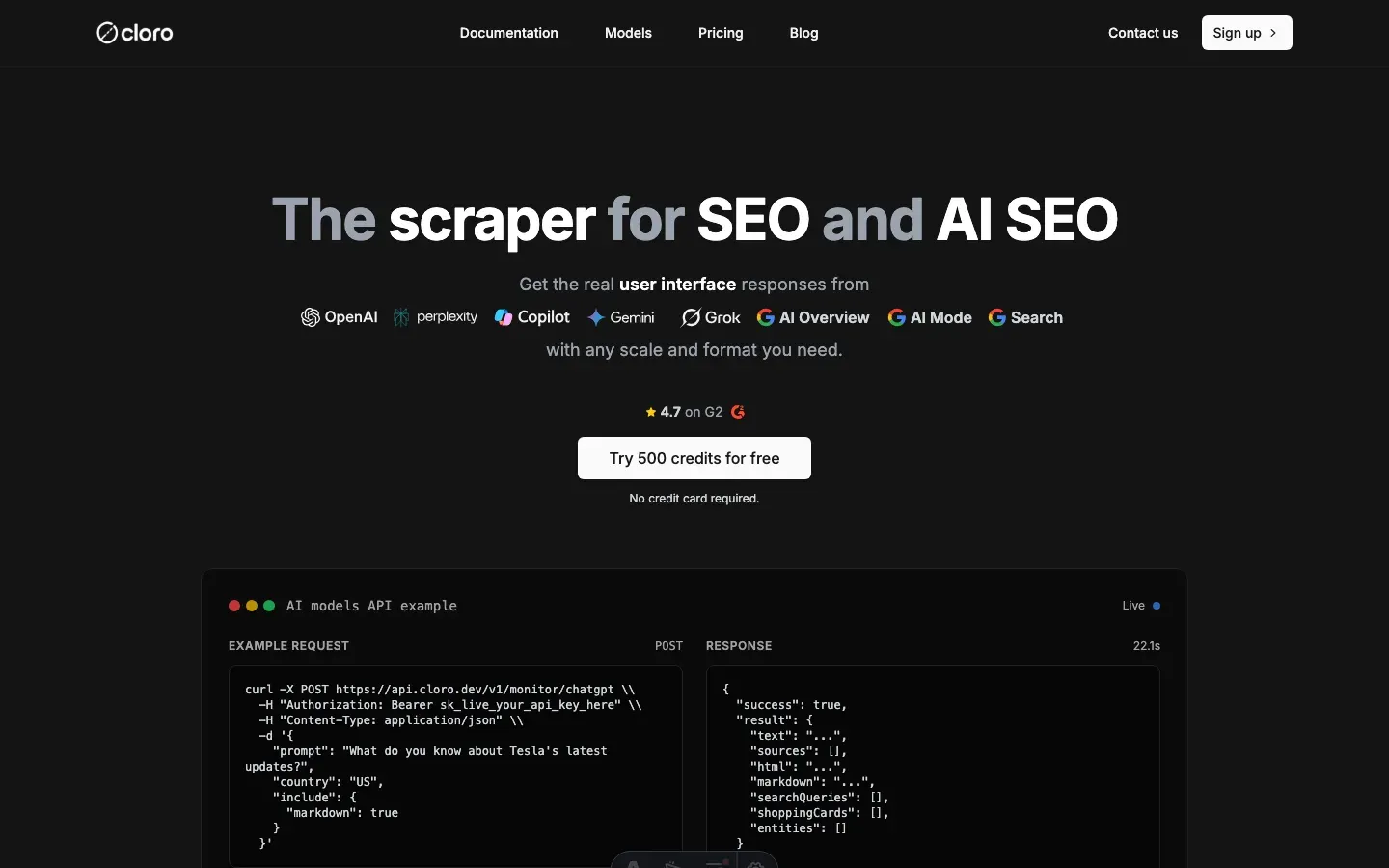
Best for teams that want programmable tracking integrated with their own stack.
The cloro ChatGPT scraper API is the API-first path. You call one endpoint per tracked query, get back the parsed ChatGPT response, and store the data in whatever pipeline you already run.
Each query comes back with the full ChatGPT answer text and the source URLs in the order ChatGPT cited them, ranked. On top of that you get the brand entities the answer named, each tagged with its position in the answer, whether it landed as a primary recommendation or just an entry in a comparison list, and a sentiment classification. Position is the field people underrate: the brand named first captures most of the click intent.
You also get the query fan-out, meaning the variant queries ChatGPT considered, which is the useful input for content-planning loops. The same API key and response shape cover Perplexity, Gemini, Copilot, AI Overview, and AI Mode, so one integration tracks every engine your buyers actually use, not just ChatGPT.
Typical setup: nightly scheduler → cloro /chatgpt API → Postgres → Metabase / Looker / Hex panel → Slack alerts on position drops or competitor first-mentions. Most teams stand the stack up in a week of engineering time on the free 500-credit tier. Used by SEOs at companies like Ahrefs, Surfer SEO, and AthenaHQ.
If you would rather log in to a finished report than build one, the trackers below are the better fit.
Best ChatGPT visibility tracking tools
Which platforms handle tracking ChatGPT brand mentions and citations?
A platform tracking ChatGPT visibility has two jobs: counting how often ChatGPT mentions your brand, and recording what it cites when it answers. The two are independent; ChatGPT can name you without citing you, and cite your page while recommending a competitor. Every tool below is scored on whether it captures both.
We tested these across 50+ brands over six months of data collection. That is an operational observation from running the product rather than a controlled study, so read it as the basis for the recommendations below and not as a published benchmark: there is no fixed query set, window, or per-brand breakdown behind it.
We compare 20+ LLM tracking tools across price points in our guide to LLM visibility tracking tools.
Gauge — AI visibility and GEO platform
Best for B2B software and SaaS companies focused on Generative Engine Optimization.
Gauge helps brands track and improve presence across ChatGPT, Perplexity, Gemini, and Google AI Overviews.
Key features:
- Brand rankings and position tracking across AI platforms
- Prompt intelligence showing which queries trigger brand mentions
- Competitive analysis and mention monitoring
- Citation opportunity identification
- Action Center with specific optimization recommendations
- Daily monitoring and mention trend tracking
Gauge was built for Generative Engine Optimization rather than adapted to it, checks AI responses daily, and hands back recommendations instead of raw metrics. The tuning is aimed squarely at B2B software and SaaS.
Ahrefs Brand Radar
Best for existing Ahrefs users.
- Recently added ChatGPT tracking
- Two months of historical data
- Pricing: an add-on at $199/month per AI index or $699 for all six platforms, on top of a subscription from $129/month
- Limitation: limited query coverage, monthly updates
AthenaHQ
Best for growing SaaS companies and digital agencies.
AthenaHQ provides AI search monitoring at a more accessible price point.
Key features:
- AI search monitoring across major platforms
- Share of voice tracking and competitive analysis
- Clear dashboard with the core metrics
- Weekly reporting with trend analysis
- Pricing aimed at growing teams
Pricing: $199-$499/month.
A solid mid-market option for companies scaling AI presence without enterprise budgets.
Setting up your first visibility tracker
How you configure a tracker decides whether it answers real questions or just produces noise.
Step 1: choose your tracking scope.
Start with four query categories:
- Brand queries. “[Your brand] review”, “What is [your brand]”
- Category queries. “Best [product type]”, “Top [industry] tools”
- Problem queries. “How to solve [customer pain point]”
- Comparison queries. “[Your brand] vs [competitor]”
Step 2: configure tracking parameters.
Essential settings:
- Update frequency. Daily in competitive industries, weekly in stable ones.
- Geographic targeting. Start with your primary markets.
- Competitor list. Include 5-10 main competitors.
- Alert thresholds. Set notifications for material changes.
Step 3: set up the monitoring dashboard.
Metrics worth tracking, with working targets:
| Metric | What It Shows | Target |
|---|---|---|
| Mention Rate | % of relevant queries mentioning your brand | >15% |
| Share of Voice | Your mentions vs. total industry mentions | Top 3 |
| Sentiment Score | Positive vs. negative mention contexts | >80% positive |
| Link Inclusion | % of mentions including your website | >30% |
The takeaway: these are diagnostic thresholds, not vanity metrics. Falling short on any one points to a content gap, not just a tracking gap.
Step 4: create a baseline report.
Document your starting point:
- Current mention frequency
- Common contexts where you appear
- Competitor mention comparison
- Top-performing queries
Analyzing and acting on tracking data
A tracker only pays off if someone reviews it on a schedule. Here’s a routine that turns the data into decisions.
Track the sources ChatGPT cites, not only your own site
Most of your ChatGPT visibility runs through other people’s pages. In a sample of 930,267 ChatGPT answers collected from September 2025 to May 2026, Wellows found that two in three brand references came through a third-party source rather than a link to the brand’s own site. A tracker that only counts citations of your domain misses most of that. Log every cited domain per prompt, group them by type (review sites, forums, publishers, competitor blogs), and rank them by how often they appear. That list is your outreach and PR target list: the pages ChatGPT already trusts for your category.
The same dataset gives a benchmark for the sentiment row above: 65.2% of brand mentions read positive, 31.1% neutral and 3.7% negative. A score above 80% positive puts you well ahead of that average.
Weekly analysis routine
Monday — mention volume review.
- Compare total mentions to the previous week
- Flag unusual spikes or drops
- Note seasonal patterns
Wednesday — competitor analysis.
- Compare share of voice to competitors
- Identify competitors gaining mention share
- Look for new players entering the conversation
Friday — content opportunities.
- Find queries where competitors appear but you don’t
- Identify questions with high search volume and low brand coverage
- Plan content to target those gaps
Monthly deep dive.
- Sentiment. Are mentions becoming more positive?
- Query expansion. Test new query categories.
- Content impact. Did recent content move mention rates?
- Competitors. Any major shifts in who’s getting mentioned?
What affects how often ChatGPT mentions your brand
AIclicks names three drivers: how clearly your content answers the questions buyers ask, how often trusted sites in your category mention you, and how strong your competitors are on both. Read your mention rate against competitors on the same prompts, not as an absolute grade; AIclicks puts category leaders above 60%. Give any change about four weeks of weekly tracking before you judge it, since single answers vary from run to run.
Optimization strategies, by failure mode.
If mention volume is low:
- Create authoritative content targeting the query gaps you identified
- Improve existing content structure and formatting
- Build more industry citations and references
- Optimize your website for ChatGPT inclusion
- Companies that publish 2-3 in-depth guides per month see 180% better mention rates (cloro data)
If context is negative:
- Address specific concerns surfaced in AI responses
- Publish content that tackles common objections head on
- Build more positive third-party references
If competitors dominate:
- Use tools like the Wayback Machine to see what content competitors published before gaining AI visibility
- Look for gaps in competitor coverage you can own
- Create differentiated content that highlights your advantages
Advanced techniques from the top performers:
- The semantic-triples approach. Rewrite key facts as bulleted subject-predicate-object statements instead of prose paragraphs. HubSpot reported a 642% increase in AI citations and a 58% increase in AI-generated mentions after making this change.
- The data authority play. Publish original research with hard data instead of summarizing someone else’s; AI engines cite the primary source, not the aggregator.
- The problem-solution framework. Structure content around the specific problems your audience searches for, not around your product.
ChatGPT visibility tracking is about understanding how search now works and positioning for it. Once you understand your visibility metrics, optimize your website for better inclusion.
Looking for tools beyond ChatGPT? Our LLM visibility tracking tools guide covers 20+ platforms for ChatGPT, Claude, Perplexity, and more.
Teams that start tracking and optimizing now get first claim on the AI search results in their industry. Leave it, and your competitors are the ones defining how AI describes your market.

About the author
Ricardo Batista
Founder, cloro
Ricardo is one of the founders and engineers behind its SERP and AI-search scraping infrastructure. Before cloro he scaled a financial comparison site to $7M ARR and ran the full-country operations of a unicorn to $65M ARR, then went back to building. He writes about search engine scraping, generative-engine optimization, and turning live search and AI-answer data into something teams can act on.
Frequently asked questions
What is a ChatGPT visibility tracker?
A tool that monitors how often and in what context your brand is mentioned in ChatGPT conversations for relevant keywords.
Why do I need to track AI mentions?
AI is becoming a primary search interface. If you aren't visible there, you are losing market share to competitors who are.
Can Google Search Console track ChatGPT?
No. GSC only tracks Google Search traffic. You need specialized tools like cloro to track AI ecosystem visibility.
How do ChatGPT visibility trackers work?
They use automated bots to run thousands of queries on ChatGPT, collect responses, and analyze them for brand mentions, context, and competitor activity.
What are the key metrics tracked by these tools?
Key metrics include mention frequency, context analysis (positive/negative), Share of Voice (vs. competitors), query triggers, and link inclusion rate.
Can I use Google Alerts to monitor ChatGPT mentions?
No. Google Alerts only tracks web pages indexed by Google. ChatGPT responses are generated dynamically and not indexed publicly, so they're invisible to traditional mention-monitoring tools like Mention or Brand24.
How can I improve my ChatGPT mention rate?
Optimize your content for AI by using clear headings, structured data, unique research, and detailed comparison pages. Ensure your website is easily crawlable by AI bots. Original research gets cited roughly 3x more often in AI responses than aggregated content.
What affects how often my brand is mentioned in ChatGPT answers?
Three things: how clearly your content answers the questions buyers ask, how often trusted third-party sites in your category mention you, and how strong your competitors are on both. Judge your mention rate against competitors on the same prompts.
Which sources does ChatGPT rely on when it mentions a brand?
Mostly third-party pages. In Wellows' sample of 930,267 ChatGPT answers, two in three brand references came through a third-party source rather than the brand's own site, so a tracker should log every cited domain, not only yours.
Related reading
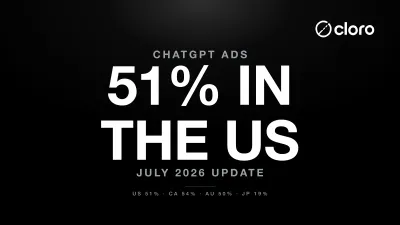
ChatGPT Ads Penetration Study: 51% in the US
ChatGPT ads over the last 7 days measure 51.0% of US responses, 53.6% CA, 49.8% AU, and, new since May, 18.8% JP. Everywhere else remains near zero. The surface reverted then re-spiked in June and now looks structural, not transient.
Best LLM & AI Visibility Tools 2026: 12 Tested
We tested 12 LLM visibility tools (also sold as AI visibility trackers and checkers) on real brand-monitoring workflows across ChatGPT, Perplexity, and Gemini. What works, what doesn't.
ChatGPT Grounding Study: 86% Commercial, 1% Informational
ChatGPT grounds almost every commercial prompt and almost no informational one. We re-ran our study without forcing web search, across 865 queries and 10 countries, and the split is 86.5% versus 0.9%.