
What Is a SERP? Search Engine Results Pages in 2026

On this page
A SERP — search engine results page — is the page a search engine returns after you submit a query.
For decades, that meant 10 blue links, and ranking #1 guaranteed a flood of traffic. In 2026, the SERP is a dynamic canvas that blends organic results, paid ads, images, videos, maps, shopping carousels, and AI-generated answers that resolve queries before anyone clicks through to a website.
If you’re still optimizing for 2010’s Google, you’re missing most of the conversation happening on the page today.
This guide answers the question of what is a SERP from the ground up, breaks down every component of the modern results page, explains how AI changed it, and shows how to win each piece.
What is a SERP? A precise definition
A SERP (search engine results page) is the page a search engine such as Google or Bing returns in response to a query a user types or speaks. It is a constructed, editorially-assembled page designed to surface the most relevant information in the most efficient format possible — not merely a ranked list of ten links. The cleanest way to understand what is a SERP is to think of it as the search engine’s structured answer to your question, delivered through many distinct content blocks rather than one uniform column.
Every SERP is generated in real time. When a query arrives, the engine evaluates the intent behind it, decides which formats will satisfy that intent, and then assembles the appropriate mix of blocks — organic links, an AI summary, a map, a set of images, or a shopping carousel. Two people searching the same words can therefore see two different pages, because what a SERP contains is a live judgement about what that specific searcher most likely wants.
Why no two SERPs look the same
Understanding what is a SERP means accepting that the page is personalized and dynamic rather than fixed. Google tailors the result set using several signals at once, and each one can change which features appear and in what order:
- Query intent. An informational query (“what is photosynthesis”) triggers a featured snippet or AI Overview, while a commercial query (“running shoes”) triggers shopping ads and product carousels.
- Location. A search for “coffee” in one city surfaces a local pack of nearby cafés, while the same word elsewhere returns a completely different set of businesses.
- Device. Mobile SERPs stack features vertically and often hide the desktop-only knowledge panel, so the same query can look very different on a phone.
- Search history and language. Personalization and localization nudge both the ranking and the feature mix toward what the engine expects that user to find useful.
Because of this variability, there is no single canonical page to optimize for. That is why measuring what your customers actually see requires ongoing SERP tracking rather than a one-time check.
What does SERP stand for?
SERP stands for Search Engine Results Page, and the acronym is pronounced “surp.” The term predates the modern feature-rich layout: it originally described the plain list of results returned in the 1990s, and it has stretched to cover today’s far more complex canvas. When SEOs talk about “the SERP” they usually mean the first page of Google results, since the overwhelming majority of clicks and impressions happen there and few searchers ever reach page two.
In finance and HR, the same acronym means something unrelated: a supplemental executive retirement plan, which Investopedia defines as a non-qualified retirement plan offered to select executives. This guide covers the search meaning only.
The evolution of the SERP
To fully grasp what is a SERP today, it helps to trace how the page evolved. The SERP has changed shape several times:
- 1990s. Plain, unformatted text links.
- Early 2000s. Paid ads (AdWords) and basic formatting arrive.
- 2010s. Rich snippets, local packs, image and video carousels, and Featured Snippets drive “zero-click” searches.
- 2020s. AI Search Engines and generative features like Google AI Overviews dominate.
Today a single query can return dozens of distinct elements, often pushing organic results far down the page.
Key components of a modern SERP
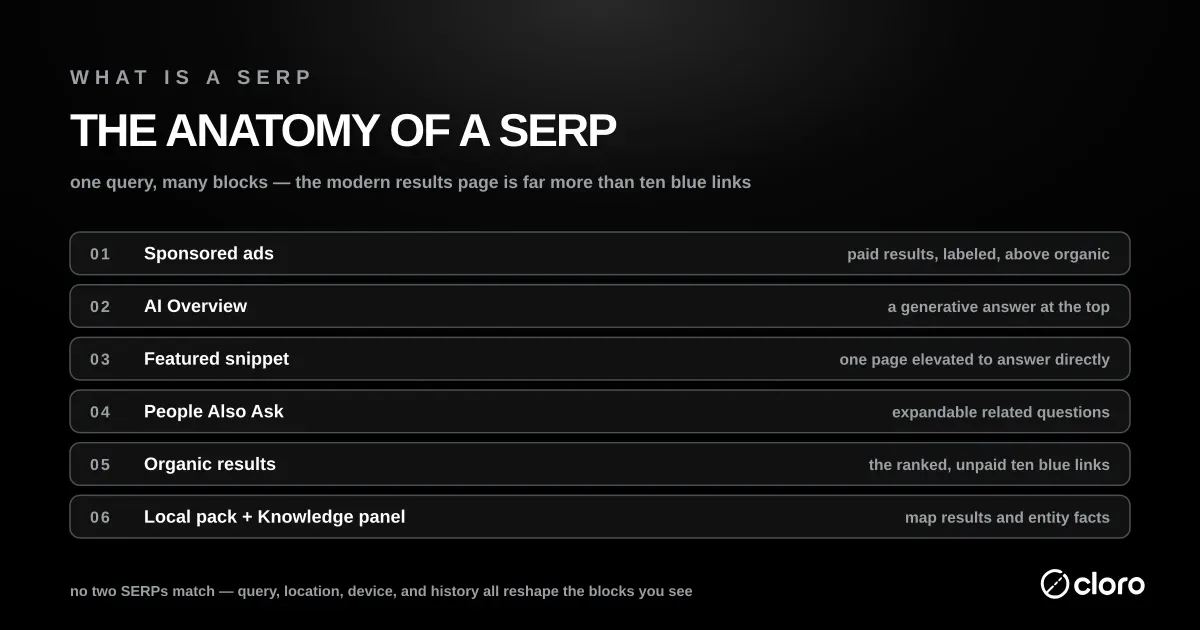
Modern SERPs mix several result types. The most common ones:
1. Organic results
The classic “blue links,” ranked by Google’s traditional algorithms on relevance, authority, and content quality. Still important, but they share space with other features.
2. Paid results (ads)
Paid placements shown at the top and sometimes the bottom of the page. Marked with a “Sponsored” or “Ad” label.
3. Featured snippets (“position zero”)
A concise answer extracted from a webpage and displayed at the top of the SERP, designed to answer the query instantly.
- Formats. Paragraphs, lists, tables.
- Why it matters. High visibility, especially for Answer Engine Optimization (AEO).
4. People also ask (PAA)
An expandable box of related questions. Clicking one reveals a snippet answer, usually linking to a source page.
- Why it matters. Useful for understanding user intent and finding long-tail keyword opportunities. The optimization play — exact-match question H2s, 40-60 word answers, FAQPage schema — is covered in People Also Ask SEO. Don’t confuse PAA with People Also Search For, which is a separate post-click refinement surface.
5. Local pack / map pack
For location-based queries (“pizza near me”), Google shows a map with 3 to 5 local business listings.
- Why it matters. Dominates local search. Google Business Profile (GBP) optimization is the lever.
6. Image and video carousels
Visual results appear for queries where a picture or a clip answers the intent better than text (“how to tie a knot,” “best dog breeds”). Google pulls video results heavily from YouTube, so a well-optimized video title and description can win a slot that no blog post could take.
7. Shopping results
Product carousels display prices, star ratings, and merchant names for commercial queries (“buy running shoes”). These listings blend paid Google Shopping ads with free product listings, and they push traditional organic results well down the page on transactional searches.
8. Knowledge panel
A box on the right side of the desktop SERP presents quick facts about an entity (a person, place, company, or thing) pulled from Google’s Knowledge Graph. It is fed by structured, authoritative sources, so earning or correcting a panel depends on strong entity signals like Wikipedia, Wikidata, and schema markup. A knowledge graph API returns the panel’s fields as structured JSON, so you can pull those facts programmatically instead of reading them off the page by hand.
9. Top stories and news
For queries with fresh news value (“election results,” a breaking product launch), Google inserts a Top Stories carousel of recent articles above the organic results. Timeliness and publisher authority decide placement, so this feature rewards fast, well-structured news coverage rather than evergreen content.
10. Sitelinks and related searches
When a searcher clearly wants a specific brand, Google expands the top result with sitelinks — a grid of deep links into the site’s key pages. Near the bottom, a “related searches” block and refinement chips suggest adjacent queries, giving you a map of how the topic branches into other intents.
SERP Feature Comparison Table:
| Feature | Description | Example Query | Optimization Focus |
|---|---|---|---|
| Organic | Traditional links | “best coffee” | Keyword research, authority |
| Featured Snippet | Direct answer at top | “what is photosynthesis” | Concise answers, structure |
| PAA | Related questions | “how to fix a leaky faucet” | FAQ content, long-tail |
| Local Pack | Map + local businesses | “plumbers in nyc” | GBP, local citations |
What is a SERP feature?
A SERP feature is any result on the page that is not a standard organic blue link. Featured snippets, the local pack, image carousels, the knowledge panel, Top Stories, and AI Overviews are all SERP features, and each one occupies premium space that would otherwise belong to the ten organic listings. So when someone asks what is a SERP feature, the short answer is that it is a specialized result block Google builds to answer a particular kind of intent more directly than a link can.
Features matter because they change the economics of ranking. A page ranked second organically can still sit below a featured snippet, an AI Overview, a video carousel, and a set of ads — meaning “position two” may actually be the sixth thing a user sees. Tracking which features appear for your keywords, and who wins them, is therefore as important as tracking the organic order itself. Our guide to SERP features tracking covers how to monitor that feature layer keyword by keyword.
Paid vs. organic results
Every SERP separates into two commercial categories that behave very differently. Paid results are ads bought through Google Ads and labelled “Sponsored”; they can appear the instant a campaign goes live and disappear the moment the budget runs out. Organic results are earned placements ranked by relevance and authority, and they cannot be bought — but they also compound over time as content and links accumulate.
For a competitive commercial query, paid and organic results often stack on top of each other, with up to four text ads and a shopping carousel before the first organic link. Reading a SERP well means understanding this split: if the page is dominated by ads and shopping units, ranking organically may deliver less traffic than the raw position suggests, and a paid strategy may be the faster route to visibility.
SERP features in the AI era
The biggest recent shift is the integration of generative AI into the SERP, and it is now the common case rather than an experiment. In our SERP feature census we score every Google result cloro collects, 69,817 of them across 41 markets. An AI Overview rendered on 85.4% of US results and People Also Ask on 93.8%, against 98.2% for the organic list itself. The corpus leans toward conversational and commercial-research intent, so read those as the rates on question-shaped queries rather than across all of Google. How much that framing matters is itself measured: on a fixed basket run across six markets, AI Overview presence ran from 9.2% on navigational queries to 97.2% on definitional ones. Which SERP features you see is decided far more by the kind of question you ask than by the country you ask it from.
Two blocks now appear more reliably than anything except the blue links themselves, which is the practical answer to what a SERP is in 2026: a stack of answer surfaces with an organic list somewhere inside it.
1. Google AI overviews
AI-generated summaries shown at the top of the SERP that synthesize information from multiple sources into a direct answer. They are dynamic and carry citations.
- Key parameter. Sometimes triggered by
udm=50, or it appears automatically. Learn how to scrape Google AI Overview to understand its structure. - Why it matters. AI Overviews push organic results further down, which makes Generative Engine Optimization (GEO) more important.
2. Conversational search
As Google integrates more AI, the SERP becomes a conversation. Users ask follow-up questions and the results adapt.
- Impact. Focus shifts from static keywords to dynamic intent and dialogue.
Zero-click searches and the SERP
The most consequential trend in modern search is the rise of the zero-click search — a query the user resolves without clicking any result at all. One 2026 analysis of US clickstream data found that 68% of Google searches ended without a click to the open web. When a featured snippet states the answer, a knowledge panel shows the fact, or an AI Overview synthesizes a full response, the searcher’s need is met on the page itself. The SERP has quietly shifted from a set of doorways into other websites toward a destination that answers the question in place.
Zero-click search reframes what a SERP is for. It is no longer just a list of links competing for a click; it is increasingly the surface where the answer lives, and where your brand is either represented or absent. For publishers, that means visibility is now measured by presence inside these answer blocks — being the cited source in an AI Overview or the page quoted in a snippet — not only by the raw click. Winning a zero-click surface still builds authority, awareness, and downstream demand even when the immediate visit does not happen.
Why SERP analysis is critical
Knowing what is a SERP is only half the picture — the value comes from analyzing the specific page your keywords return. Analyzing the SERP for your target keywords reveals:
- User intent. Does Google prioritize informational, commercial, or local content?
- Competitors. Who actually owns top-of-funnel visibility?
- Content gaps. Which SERP features are competitors winning that you aren’t?
- Optimization opportunities. Where can you tailor content to capture specific features?
If a keyword’s SERP is dominated by AI Overviews and video carousels, a long-form blog post with no video is probably wasted effort.
How to analyze a SERP for any keyword
SERP analysis sounds abstract, but it follows a repeatable sequence you can run before writing a single word of content:
- Search the keyword and read the page top to bottom. Note every feature present — ads, AI Overview, snippet, PAA, local pack, images, video — and the order they appear in. That layout tells you what Google believes the query means.
- Classify the dominant intent. Decide whether the page rewards informational, commercial, navigational, or local content, because that determines the format you need to produce.
- Identify who owns each feature. See which competitors hold the snippet, the top organic slots, and the video carousel, then judge whether those positions are realistically winnable.
- Map the content gap. Compare what the ranking pages cover against what the query implies but nobody answers well, and build your angle around that gap.
- Match the format to the SERP. If the page is full of video and images, ship those assets; if it is snippet-heavy, structure concise, extractable answers with clear headings and schema markup.
Running this analysis at scale by hand is impractical, which is exactly why teams pull the same data programmatically through a SERP API and track it over time.
What SERP data costs to collect
Reading one SERP in a browser is free. Reading a few thousand a day is not, because at that point you are buying the page as structured data from a vendor. Published rates from the providers a reader is most likely to meet:
- DataForSEO lists $0.002 per SERP on its Live endpoint, which is $2 per thousand.
- Bright Data’s SERP API is $1.50 per 1,000 requests pay as you go, so $0.0015 a call.
- SerpApi charges $150 for 15,000 searches on its Production plan, roughly $0.01 a search.
- cloro’s Hobby plan is $100 a month for 250,000 credits, and one Google Search call costs 3 credits.
Two things move the real number more than the headline rate does. The first is depth. One DataForSEO SERP is 10 results, so tracking the top 100 costs about ten times the shallow rate, and most vendors price the same way.
The second is which blocks come back parsed. DataForSEO bills AI Overview enrichment as an add-on, Serper returns that block only partially, and the proxy-led endpoints at Oxylabs return no structured AI Overview at all. The takeaway: a cheap call that arrives without the AI block is not the same product as one that includes it, so compare cost per fully-parsed SERP at the depth and feature set you actually need, not the sticker price alone. Our SERP API comparison has the per-provider detail.
Optimizing for different SERP features
Winning on today’s SERP needs more than one tactic:
- For organic results. Standard SEO: high-quality content, strong backlinks, sound technical SEO.
- For featured snippets. Write concise, direct answers. Use clear headings (
H2,H3) and structured data (Schema Markup). - For PAA. Answer the common questions around your main topic directly. A dedicated FAQ section helps.
- For local pack. Optimize your Google Business Profile (GBP) with accurate information, photos, and customer reviews, and build local citations.
- For Google AI overviews. Focus on authoritative, fact-dense content. Implement llms.txt so AI can read and synthesize your content. The goal is to be cited as a primary source.
Desktop vs. mobile SERPs
The same query can produce a meaningfully different SERP depending on the device, and mobile now accounts for the majority of searches. On a phone the page is a single vertical column, so features stack one after another and ads plus the AI Overview can fill the entire first screen before any organic link appears. The desktop-only knowledge panel usually collapses into an inline card, and horizontal carousels become swipeable strips. Because Google indexes mobile-first, the mobile SERP is the layout most of your audience actually sees — and the one your optimization should assume by default.
Tracking your SERP performance
Traditional SEO tools track organic rankings and many SERP features. SEMrush and Ahrefs do this well.
AI-driven SERP features are harder. Standard tools usually can’t tell you:
- How your brand is described inside an AI Overview.
- Whether your content is cited by Google’s Gemini model.
- The sentiment of AI-generated summaries about your products.
For modern tracking strategies, see our guide on how to track ranks on SERP beyond organic positions.
Traditional tools help you scrape Google Search results for organic data. cloro pairs that with LLM visibility tracking, so one brand is measured across the traditional SERP features, the AI ones, and the AI search engines outside Google.
Ultimately, understanding what is a SERP is the foundation, but measuring your presence across every block on it is what moves the needle. Make sure your brand is visible wherever users are looking, whether that’s a blue link or a synthesized answer from an AI.

About the author
Ricardo Batista
Founder, cloro
Ricardo is one of the founders and engineers behind its SERP and AI-search scraping infrastructure. Before cloro he scaled a financial comparison site to $7M ARR and ran the full-country operations of a unicorn to $65M ARR, then went back to building. He writes about search engine scraping, generative-engine optimization, and turning live search and AI-answer data into something teams can act on.
Frequently asked questions
How has the SERP changed recently?
The biggest change is the addition of AI Overviews, which push organic results further down the page, often below the fold.
What is a 'Zero-Click' search?
A search where the user gets their answer directly from the SERP features (like a Featured Snippet or AI summary) without clicking any link.
What is the 'Local Pack'?
The block of 3 local business listings + map that appears for location-intent queries. It is the block local businesses compete for.
How has the SERP evolved over time?
The SERP evolved from simple blue links to a complex canvas including paid ads, rich snippets, local packs, images, videos, and most recently, AI-generated answers and overviews.
Why is SERP analysis critical for SEO?
SERP analysis helps understand user intent, identify who you are competing with, uncover content gaps, and discover optimization opportunities for specific features, so your content stays visible in the modern search environment.
Related reading
How to Track SERP Features in 2026 (Free + API Methods)
How to track SERP features in 2026 — the seven that move traffic, the free ways to start monitoring today, and the API method that scales to millions of keywords.
People Also Search For: How to Mine PASF for SEO in 2026
PASF reveals what users wanted but didn't get from the page they just clicked. Here's how to mine it for SEO.
How to Track SERP Rankings Beyond Blue Links
Learn how to track SERP rankings across organic results, maps, AI Overviews, PAA, snippets, ads, and zero-click features without false confidence.