
What is AI SEO? 2026 Definition + Platforms

On this page
What is AI SEO? AI SEO is the practice of structuring your content so AI engines pick it as a source. Those engines include Google’s AI Overviews, ChatGPT, Perplexity, Copilot, and Gemini.
It’s classic SEO with two new jobs:
- Getting your pages cited inside AI-generated answers.
- Making sure the brand those answers describe is the one you actually want users to see.
Here’s why it matters. Users who see an AI summary click a traditional link only 8% of the time, versus 15% on results without one (per Pew Research). The clicks that do come through are worth more: AI-referred visitors converted 31% better than classic organic traffic by Holiday 2025, per Adobe Analytics. Ranking number one is no longer the finish line. Being inside the answer is.
What is AI SEO?
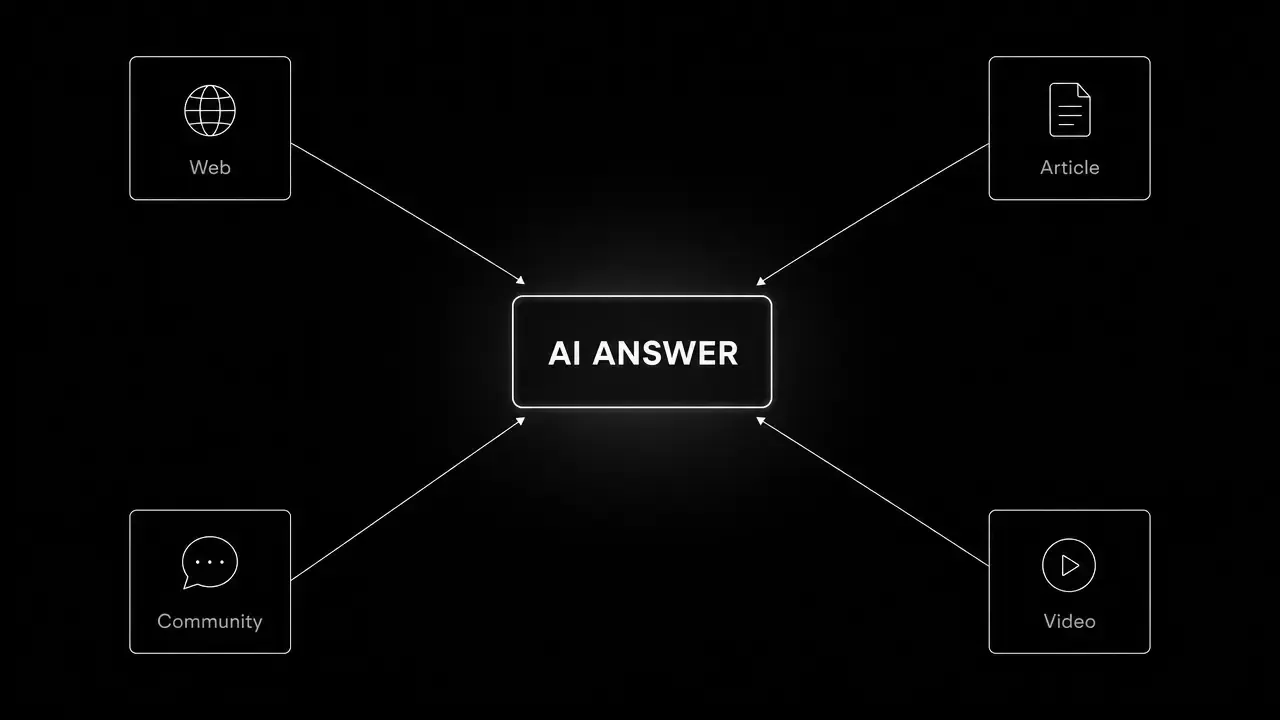
AI SEO is the process of structuring, writing, and maintaining your pages so AI-powered search surfaces (Google AI Overviews, AI Mode, ChatGPT search, Perplexity, Copilot and Gemini) pick your content as a citation when they synthesize answers. The classic definition still applies underneath: you want Google to rank your pages. The new layer is that ranking is no longer the finish line. A page can sit at position one and stay invisible inside the AI Overview that occupies the top half of the screen, because the model that built that Overview drew from a different pool than the blue links beneath it.
There are two faces to AI SEO. The first is inbound: optimizing your content so AI engines find, parse, and cite it: clear answer-first paragraphs, consistent entity language, schema, crawler access for GPTBot, and content quotable in 40 to 80 words. The second is operational: using AI tools to do SEO faster, from clustering queries to drafting briefs.
So what is AI SEO optimizing for, exactly? Classic SEO optimizes for the SERP. AI SEO optimizes for whatever surface holds the user’s attention before they click, and increasingly for the surfaces where they never click at all.
How AI SEO relates to GEO, AEO, and LLM optimization
What is AI SEO called now? You will see it as GEO, AEO, or LLMO (large language model optimization); Logical Position uses AI-SEO, GEO, and LLMO for the same shift. The three names are not strict synonyms, and holding them apart matters because the tactics differ.
GEO, or generative engine optimization, targets generative answer surfaces specifically: getting content selected, extracted, and synthesized into AI answers across AI Overviews, ChatGPT search, Perplexity, and Copilot.
AEO, or answer engine optimization, predates GEO. It started with featured snippets and voice assistants and now covers any surface that lifts a direct answer from a page. AEO emphasizes question-aligned structure, FAQ schema, and definitional clarity.
LLM optimization is the broadest framing: making your content discoverable inside the models themselves, not just the search products built on them. ChatGPT answers roughly 60% of queries from training data without searching the web, per ConvertMate’s analysis of 10,000 domains, so being well-represented in Wikipedia, review platforms, and a strong referring-domain profile matters as much as ranking on a given query.
AI SEO is the umbrella; GEO, AEO, and LLM optimization are the angles you work from.
Which platforms and search experiences does AI SEO apply to?
AI SEO applies to every surface where a model, not a ranking algorithm, decides what the user sees. In 2026 that means at least nine distinct surfaces, each with its own retrieval pipeline, citation behavior, and traffic value.
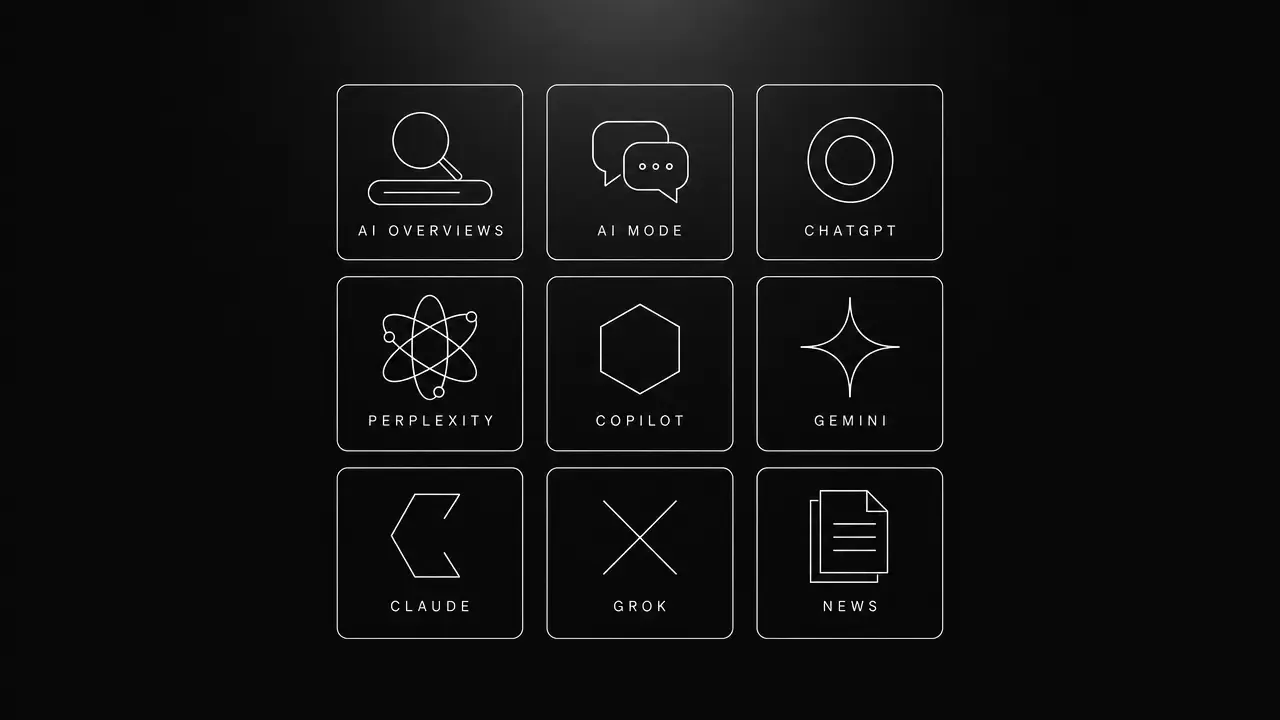
| Surface | Main index/source | Best optimization lever |
|---|---|---|
| Google AI Overviews | Google index + Gemini | Answer-first structure, FAQ schema, organic ranking strength |
| Google AI Mode | Google index + conversational fan-out | Deep entity content, structured comparison data |
| ChatGPT search | OpenAI’s own crawl (OAI-SearchBot) + training data | OAI-SearchBot access, referring-domain authority, third-party mentions |
| Perplexity | Live web + Reddit-heavy citations | Freshness, direct answers, explicit source attribution |
| Copilot | Bing index | Bing indexing, structured content |
| Gemini app | Google index + Gemini | Entity strength in Google’s index, third-party citations |
| Claude (web mode) | Brave Search | Technical depth, authority signals |
| Grok | Web + X (Twitter) | Social presence, entity signal on X |
| Google News / Discover | Google News index | Freshness, schema, publisher reputation |
Google AI Overviews
Gemini-powered summaries (AIO) that sit on top of Google Search. They trigger most aggressively on health, education, and B2B technology queries, and rarely on transactional or navigational ones. Citation overlap with the organic top 10 has weakened since the Gemini 3 rollout, so ranking number one no longer guarantees inclusion: the candidate pool is wider than the ranking pool, and that’s where the opportunity sits.
Google AI Mode
AI Mode is the conversational opt-in mode inside Google Search, separate from Overviews. It crossed 75 million daily active users by late 2025 per Google’s own disclosures. Most sessions resolve without a click, and cited URLs frequently sit outside the organic top ten, so traditional rank tracking misses most of the action. For the engineering side (selectors, async streaming, citation extraction) see our walkthrough on how to scrape Google AI Mode.
ChatGPT search
ChatGPT search is the highest-traffic AI surface for outbound clicks, driving the majority of all AI referral traffic to websites per Conductor’s 2026 enterprise benchmarks. Citation behavior is asymmetric: ChatGPT mentions brands far more often than it links them, so a brand can dominate a category and see almost no referral traffic. The path runs through training-data presence and OpenAI’s retrieval crawl (OAI-SearchBot), not Google’s index.
Perplexity
Perplexity treats source attribution as a product feature, not a footnote. Clickable links sit prominently next to each claim. It leans heavily on Reddit and other community sources, and rewards content with explicit attribution, fresh dates, and direct-answer leads.
Copilot, Gemini app, Claude, Grok
Microsoft Copilot pulls from the Bing index and behaves like ChatGPT search at lower volume. The standalone Gemini app reached 750 million monthly users by Q4 2025 per Alphabet’s earnings but sends little referral traffic. Claude has limited public volume but matters for B2B because its user base skews technical and high-intent. Grok’s citation accuracy lags badly. Columbia’s Tow Center found Grok-3 correctly attributed only 6% of test queries, which makes it useful for brand visibility but unreliable for referrals.
Google News and the SERP itself
Don’t drop classic SEO. Organic still drives the majority of clicks on AIO-absent queries, and Google News and Discover remain meaningful for publishers even as Discover referrals decline year over year per Press Gazette.
The practical implication is that “AI SEO” is really nine optimization problems in a trench coat. At Cloro we use AI web scraping to pull live UI responses from each surface: the rendered answer, with citations, sources, and shopping cards parsed out, because the only way to manage nine retrieval pipelines is to instrument them separately.
What are the main AI SEO ranking and retrieval factors?
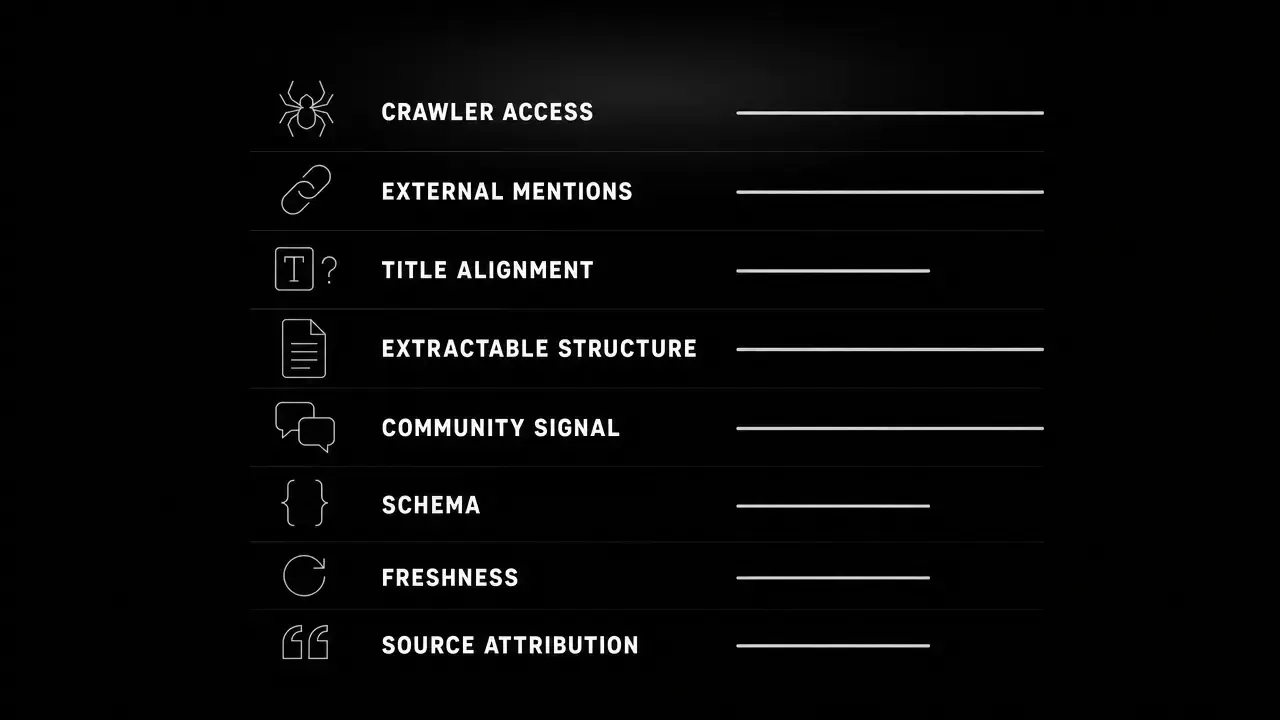
At the tactical level, what is AI SEO built on? The factors that determine whether AI engines cite your page differ from classic ranking factors and vary by platform. There’s no single ranked list, just recurring signals across studies that a serious program applies per-surface. Here are the eight with the strongest evidence in 2026.
1. Crawler access for AI bots
If GPTBot, ClaudeBot, PerplexityBot, OAI-SearchBot, and Google-Extended can’t reach your pages, your odds of being retrieved and cited drop sharply. Otterly’s analysis of more than a million citations found 73% of sites carry technical barriers (robots.txt blocks, CDN security rules, JavaScript-only content) that stop AI crawlers cold. The fix is mechanical: add explicit Allow rules per bot, whitelist their user agents at the CDN, and serve the content in server-rendered HTML.
2. Referring domains and brand entity strength
External presence (backlinks, brand mentions, third-party citations) predicts AI citation likelihood across the major studies. Per Ahrefs’ analysis of 75,000 brands, branded web mentions and YouTube mentions show the highest correlation with AI visibility, outperforming raw backlink metrics. Wikipedia, Crunchbase, G2, Capterra, and trade press all feed the entity strength a model needs before prompt-time retrieval can help.
3. Title and URL semantic alignment
Cited pages have titles that match the question shape of the user prompt and the fan-out sub-questions the model generates internally. Write your title to answer the exact question your reader would type, and put the entity in the URL. Generic titles like “The Ultimate Guide to X” lose to “What is X and how does it work in 2026?”, because the second matches the prompt shape the model decomposes the query into.
4. Extractable, answer-first content structure
Each section should lead with a self-contained answer of 40 to 80 words. Numbered lists, definition blocks, and short factual paragraphs are the shapes generative engines lift cleanly. The test: can a model quote any single section without the surrounding context? If not, rewrite it.
5. Community signal: Reddit, Quora, YouTube
Across every major AI surface, community platforms dominate the citation mix. Reddit holds roughly 21% of citations inside Google AI Overviews and 46.7% inside Perplexity per Profound. Optimizing owned content is half the job; being a real participant in the communities that train the models is the other half.
6. Schema and structured data
FAQPage schema shows the strongest measured impact on AIO citation, with Frase finding FAQPage-marked pages 3.2x more likely to appear in Google AI Overviews. Article, HowTo, and Product schema give the parser an unambiguous map of each block. Nesting FAQ inside Article schema is the strongest combination for informational queries.
7. Content freshness, with caveats
AirOps reports that 95% of ChatGPT citations come from content updated within ten months. Perplexity heavily prefers freshness, and AI Overviews favor recently updated content for time-sensitive queries. Stale pages lose citation eligibility before they lose rank.
8. Source attribution inside the page
Pages that cite their own sources clearly get cited more. Perplexity’s algorithm explicitly weights verifiability, and ChatGPT’s pipeline favors pages where claims are anchored to named studies, named companies, and named experts. The pattern is recursive: well-cited content gets cited.
A short note on what does not matter much. llms.txt files have shown no measurable impact on citations across the major studies, outbound links to authority sites have a minimal effect, and government and education TLDs perform slightly worse than commercial sites in some categories. Spending three weeks on an llms.txt file is the 2026 equivalent of stuffing a meta keywords tag.
How do you actually implement AI SEO step by step?
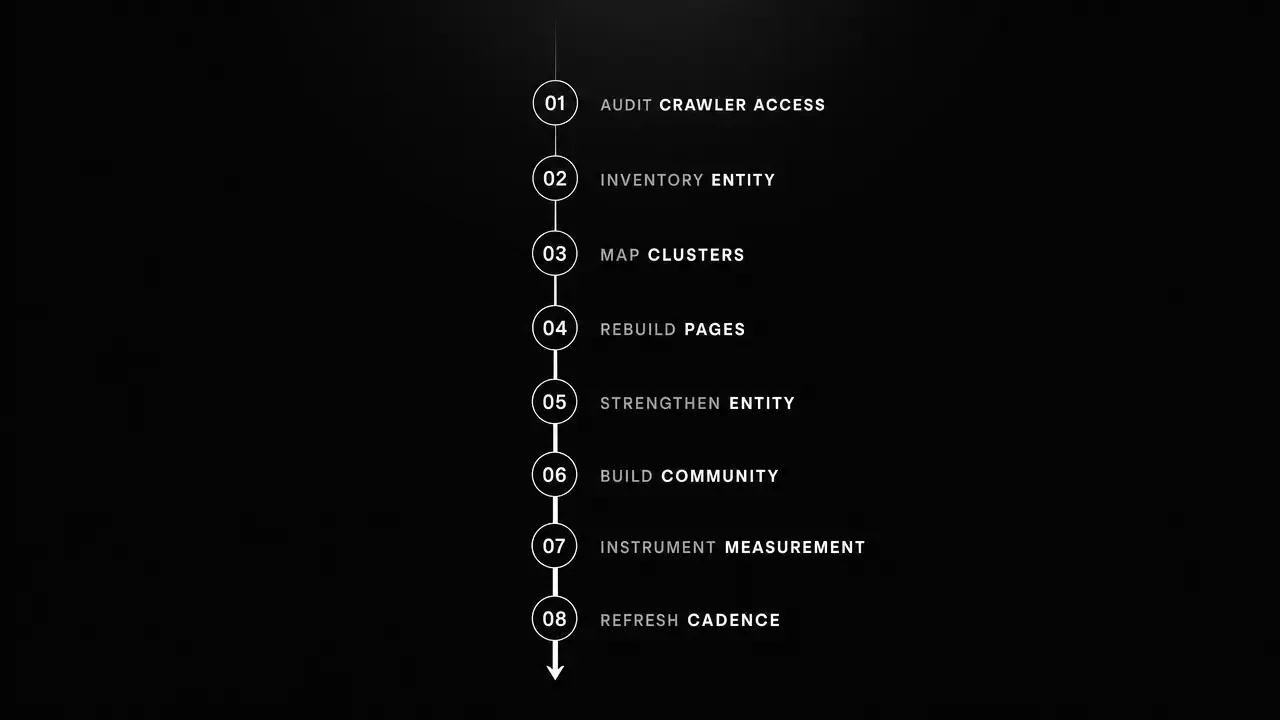
Knowing what is AI SEO in theory is the easy part; implementing it is a sequence, not a parallel checklist. Crawler access comes before content; entity strength comes before optimizing individual pages. Skip a step and the later ones return diminishing results. Here’s the order that works.
Step 1: Audit AI crawler access
Start with yoursite.com/robots.txt and confirm GPTBot, OAI-SearchBot, ChatGPT-User, ClaudeBot, PerplexityBot, and Google-Extended aren’t blocked. Run curl -A "GPTBot" https://yoursite.com/article to confirm your CDN doesn’t block non-browser agents, then pull the page with JavaScript disabled to confirm the content renders without a JS step.
Step 2: Inventory your entity footprint
Run your brand name plus your category through ChatGPT, Perplexity, and Google AI Overviews. Note which sources the answers cite, whether your brand is mentioned, and how it’s described. Three failure modes recur: the brand is absent, described inaccurately, or a competitor sits in the citation slot, and each has a different fix.
Step 3: Map topic clusters to query types
Group your existing traffic by what people are actually asking, so you know which topics need a retrieval-first rebuild and which are fine as they are. Pull twelve months of Google Search Console queries and use an LLM to cluster them by intent and entity. Flag the clusters where AI Overviews already appear and tag intent: informational, commercial, comparison, transactional. Comparison queries (X vs Y) trigger AIOs at very high rates, while transactional queries rarely do. The split tells you which clusters need answer-first content and which still respond to classic SEO.
Step 4: Rebuild target pages for extractability
For each priority page, add a 40-to-80-word answer-first paragraph under each H2, definition blocks for key terms, lists of five to ten items, comparison tables, and FAQ schema. The goal: a model could quote any single section and it would stand alone. Internal links between cluster pages reinforce depth: one deep page beats five shallow ones.
Step 5: Strengthen brand entity in third-party sources
Update Crunchbase, G2, Capterra, LinkedIn, and any trade directories, and fix the Wikipedia article if you qualify for one. Make the company description, founding date, founder names, category, and use cases identical across every external surface, because inconsistency is why AI engines sometimes describe a B2B SaaS as a consumer app.
Step 6: Build community signal
Identify the three to five subreddits, Quora topics, and YouTube channels your audience actually reads, and participate as a real contributor. Answer questions with substance, not promotion. The multiplier is real but the threshold is high. This is a year-long investment, not a quarter.
Step 7: Instrument measurement before publishing more
Don’t write the next fifty pages until you can see what’s working. Track AI Overview presence per priority query, citation share inside ChatGPT and Perplexity for your money topics, server-log access from each crawler, and brand-mention frequency across surfaces. This is where Cloro fits: pulling the live UI response from each surface so you can see whether your content is the cited source, a name-only mention, or absent.
Step 8: Refresh on a real cadence
Pages not substantively updated in twelve months lose citation eligibility before they lose rank. Set a quarterly refresh cycle for your top 20% of pages (new data, new examples, removed dead links, updated sections) rather than a date-stamp rotation.
Does AI search replace traditional SEO?
No. AI search redistributes traffic and changes the unit of visibility, but it doesn’t replace the traditional SEO foundations underneath. The sharper question is where AI SEO is additive rather than substitutive.
The data is unambiguous. Per Conductor’s 2026 AEO/GEO Benchmarks Report, covering 13,770 enterprise domains and 3.3 billion sessions, AI referral traffic accounts for roughly 1.08% of total website traffic, and 87.4% of that comes from ChatGPT. Even with rapid growth, the absolute base remains a small fraction of organic search.
| Dimension | Traditional SEO | AI SEO |
|---|---|---|
| Primary goal | Rank in the SERP | Get cited inside the AI-generated answer |
| Success metric | Position, impressions, clicks | Citation share, mention frequency, description accuracy |
| Dominant signal | Backlinks + on-page relevance | Entity strength + extractable structure + community presence |
| Content shape | Comprehensive page tuned for a keyword | Answer-first sections quotable in 40–80 words |
| Click economics | Known CTR per rank | Lower volume, materially higher conversion rate |
| Tracking tooling | Ahrefs, Semrush, Google Search Console | AI-citation tools (Profound, AthenaHQ, Cloro) + GA4 AI channel |
| Failure mode | Algorithm update pushes you down the page | Cited in one AI surface, invisible in another |
Classic SEO still drives the volume. AI Overviews trigger on roughly 48% of tracked queries per BrightEdge; the rest still resolve to a ten-blue-links page where ranking is the whole game.
AI surfaces redistribute who wins. A page ranking number one on a query that now triggers an Overview loses a meaningful share of clicks, with Ahrefs measuring up to 58% click loss on top-ranked pages. But brands cited inside that Overview gain direct traffic and brand search, so visibility shifts from raw clicks to brand recognition, and established brands with strong entity signals win disproportionately.
Conversion economics tilt toward AI traffic. AI-referred visitors converted 31% better than non-AI traffic by Holiday 2025 per Adobe Analytics. Smaller volume, much higher intent. That changes how you justify the spend, not whether you keep the classic SEO machine running.
AI SEO is about winning the answer, not just the link. For 2026 that means traditional SEO still carries the volume and AI SEO is what you add on top of it. You still rank to capture queries that don’t trigger AI experiences; you add AI SEO to win the ones that do. The one place classic SEO does erode is pure-information, low-intent queries (“how does X work,” “what is the symptom of Y”) where Overviews and ChatGPT resolve the question in place and thin informational traffic has already collapsed for many publishers.
How do you measure AI SEO performance and citations?
Measuring AI SEO means tracking visibility on surfaces where the user often never clicks, so the classic stack (rank, impressions, clicks, conversions) captures only a slice of what matters. The metrics below sit in three layers.
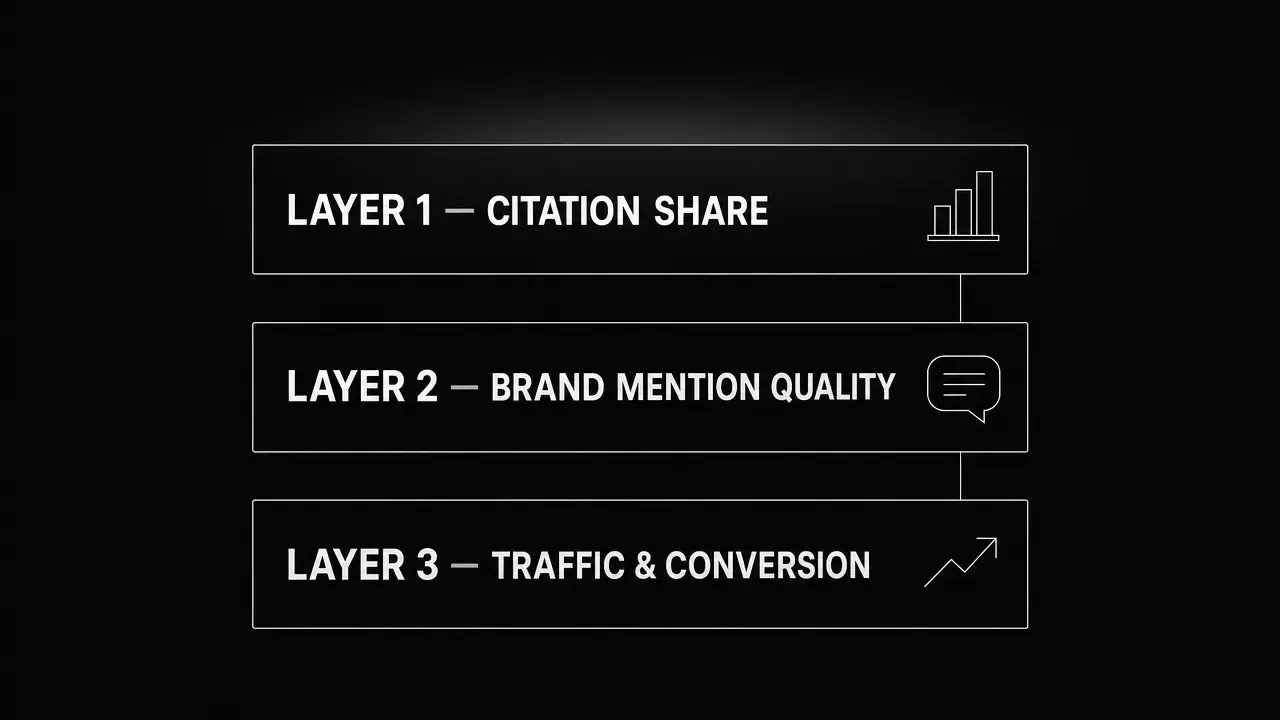
Layer 1: Citation share and presence
This is the new rank tracking. For each priority query, know whether your page is cited, whether the brand is mentioned without a link, or whether neither appears, tracked per surface, because the patterns diverge. The metric you want is citation share over a defined query set: of N priority queries, in how many does your domain appear as a source? Run it weekly and watch the trend.
Layer 2: Brand mention quality
Citation is binary; mention is qualitative. Three sub-metrics matter: mention frequency (how often the brand appears in category answers, even without a link), description accuracy (is the category and feature set correct?), and position relative to competitors (first, last, or missing when the answer lists options). Misdescription is a brand-safety problem that surfaces in AI answers before it shows up anywhere else.
Layer 3: Traffic and conversion attribution
Track AI referral traffic as its own GA4 channel (chatgpt.com, perplexity.ai, copilot.microsoft.com, gemini.google.com) and measure its conversion rate separately from organic. The rates are typically higher, and combining them masks the signal. Instrument crawler access in server logs too: if GPTBot stops hitting your site for two weeks, you want to know before citation share moves.
No single tool covers all three layers: Google Search Console shows impressions, not citations, and Ahrefs and Semrush show ranking, not AI inclusion. Pulling citation data as a raw feed you own, rather than logging into a hosted dashboard, is the job of dedicated AI visibility software; for a side-by-side of the platforms, see our best AI SEO tools 2026 comparison. The pragmatic 2026 answer is a stack: classic tooling for the SERP, an AI-citation tool for the answer layer, GA4 for traffic, and server logs for access.
Why AI SEO matters for SEO teams in 2026
The business case in 2026 is that the surface where your customer first meets your category is increasingly an AI-generated answer, and the rules for being inside that answer differ from the rules for ranking beneath it. Two forces make this operational rather than thought-leadership.
The publisher data should make every team nervous
Google search referral traffic to publishers fell roughly 33% globally in the year to November 2025 per Press Gazette’s analysis, and the same report forecasts further decline. The same compression is coming to any site that depends on top-of-funnel informational traffic. Teams that wait for the decline to show up in their own dashboards will be 18 to 24 months late.
Part of your search demand is already a machine, and it never clicks
The clearest evidence we have for this is our own Search Console. In our machine search traffic study we classified every query row on cloro.dev from February to July 2026 and found that 18.9% of July query impressions were machine-issued, up from 3.1% in March. That is 140,616 machine impressions since February, across 13,844 distinct query rows in July alone. They returned zero clicks, in every month measured.
These are not ordinary searches. They are prompts an agent typed into Google on someone’s behalf, and they look the part: instruction verbs aimed at a model, injected location phrases, and query strings that begin with a numeric job identifier like 21271:.
Two consequences follow, and they point in opposite directions for the same team. Your impression count is increasingly a machine-readership number rather than an audience number, so a page can look healthy in Search Console while reaching almost no people. And a rising share of your category’s questions is being answered to a machine that will never send a click, which is the whole argument for optimizing to be quoted rather than merely ranked.
One caution on the figure: 18.9% is the share of query-dimension impressions, which is not the same as the site-wide share (12.6% in the same month). The distinction matters if you try to reproduce this on your own property.
AI traffic converts, which changes the budget conversation
AI-referred visitors are widely reported to convert at higher rates than classic organic visitors, on a profile of lower volume and higher intent. We have not measured this ourselves, so treat it as the working assumption it is rather than a settled number. What it would justify, if it holds for your site, is a different investment: fewer, deeper pages with first-party data and entity strength rather than a thin volume play.
Common AI SEO mistakes to avoid
The most expensive mistakes in 2026 are conceptual rather than tactical. Teams losing ground repeat the same errors, and each one compounds across surfaces.
Treating AI SEO as a separate channel
Spinning up an “AI SEO” workstream isolated from the team that owns Google rankings is the most common organizational error. The same content, crawl signals, and entity strength feed both surfaces, and a page rebuilt for AI extractability usually ranks better in classic search too.
Publishing AI-generated content without an editorial layer
Per Google’s spam policies, scaled content abuse, meaning automation producing many low-value pages, is an explicit violation, and core updates removed huge volumes of thin AI content over 2024 and 2025. The fix is a real editorial pass on every page: a subject-matter expert who replaces generic claims with specific data and removes anything unverifiable. The edit is the moat.
Trying to write for the model
Prompt-engineering tricks aimed at specific models age in months. Content built around extractable structure, clear entities, and verifiable facts works across every model and survives the next architecture change.
Skipping the refresh cycle
A page that hasn’t been substantively updated in a year loses citation eligibility before it loses rank. AirOps’s data on ChatGPT, with 95% of citations coming from content updated within 10 months, is the single clearest argument for a real editorial cadence.
What to prepare for next
Four shifts are already underway, each with a concrete action you can run this quarter rather than wait for the trend to arrive in full.
Build for AI Mode now, not just AI Overviews. It is the fastest-growing search surface inside Google, and its cited URLs frequently sit outside the classic top ten. Action: pick the 10 comparison queries that drive your funnel and ship one deep page per query with explicit “X vs Y” structure, a comparison table, and entity-rich H3s.
Replace rank tracking with citation-share sampling. Personalized answers mean two users typing the same query see different responses, which breaks the assumption rank trackers were built on. Action: define a fixed query set (50 to 100 queries) per priority topic and sample it weekly across ChatGPT, Perplexity, AI Overviews, and AI Mode.
Decide your AI crawler policy explicitly. Cloudflare’s data shows ChatGPT crawls roughly 1,091 pages for every visitor it sends back, compared to Google at around 5, a mismatch driving content-licensing deals, publisher blockades, and lawsuits like Penske Media’s against Google in 2025. Action: audit robots.txt and CDN rules per crawler this quarter, and decide which bots get full access, rate limits, or blocks.
Pair every priority page with a video asset. AI Overviews and AI Mode increasingly return answers built from images, videos, and product cards, and YouTube is now one of the largest citation sources inside AI Overviews. Action: for your top 20 pages, ship a paired short YouTube video with the same primary keyword and answer-first structure, matching the video chapters to the article’s H2s.
If you can only run one of these in the next 90 days, run citation-share sampling. The data it produces tells you which of the other three to prioritize next.

About the author
Ricardo Batista
Founder, cloro
Ricardo is one of the founders and engineers behind its SERP and AI-search scraping infrastructure. Before cloro he scaled a financial comparison site to $7M ARR and ran the full-country operations of a unicorn to $65M ARR, then went back to building. He writes about search engine scraping, generative-engine optimization, and turning live search and AI-answer data into something teams can act on.
Frequently asked questions
What is AI SEO in simple terms?
AI SEO is the practice of structuring content so AI engines (Google AI Overviews, ChatGPT, Perplexity, Copilot, and Gemini) cite it as a source when they synthesize an answer. It extends classic SEO: you still want to rank, but ranking is no longer the finish line, because being inside the AI-generated answer is where visibility now lives.
Does AI SEO replace traditional SEO?
No. AI SEO extends traditional SEO rather than replacing it. Classic ranking still drives the majority of clicks on queries that don't trigger AI experiences, and the technical foundations (crawlability, schema, internal linking, content quality) feed both surfaces.
How do I optimize specifically for Google AI Overviews?
Focus on extractable answer-first paragraphs of 40 to 80 words under each H2, FAQ and Article schema together, strong entity descriptions consistent across your homepage and third-party sources, and comparison (X vs Y) content, which triggers Overviews at the highest rates.
What's the difference between AI SEO, GEO, and AEO?
AI SEO is the umbrella discipline. GEO (generative engine optimization) targets generative answer surfaces specifically. AEO (answer engine optimization) is older and broader, covering legacy SERP features and modern AI answer panels. The tactics overlap heavily: clear answers, entity strength, schema, and authoritative sources.
What is AI SEO called now?
The same practice goes by several names: GEO (generative engine optimization), AEO (answer engine optimization), LLMO (large language model optimization), and AI search optimization. AI SEO is the umbrella. GEO targets generative answers, AEO covers any surface that lifts a direct answer from a page, and LLMO focuses on how the models themselves represent your brand.
Do I need a separate llms.txt file?
Probably not. Major studies have found llms.txt files have no measurable impact on AI citations. The technical work that matters in 2026 is making sure GPTBot, ClaudeBot, PerplexityBot, and similar crawlers can actually access your existing pages via robots.txt, CDN rules, and server-side rendering.
How do I measure whether AI SEO is working?
Track three layers: citation share across a fixed query set per AI surface (weekly), brand mention frequency and description accuracy, and AI referral traffic and conversion rate as a separate channel in GA4.
Will AI replace SEO professionals?
No, but the role is shifting. Repetitive tasks (keyword clustering, brief drafting, meta description writing) are increasingly automated. Judgment-heavy work (entity strategy, editorial standards, measurement design, and the human edit that turns AI drafts into citable content) is more valuable, not less.
Related reading
What Is Generative Engine Optimization (GEO)?
Generative engine optimization helps AI engines cite your brand. Learn GEO ranking factors, content structure, schema, measurement, and tools.
What is AEO? Answer Engine Optimization Explained (2026)
Master Answer Engine Optimization (AEO) in 2026. Learn how to optimize for ChatGPT, Perplexity, and Google AI Overviews, and how AEO differs from SEO.
AI Search Engines: 10 Tools Compared for 2026
Compare the best AI search engines for research and developers: ChatGPT, Perplexity, Gemini, Copilot, Brave, You.com, Exa, Tavily, and more.