
Tavily vs Google Search: How Much SERP Do You See?

On this page
A large share of “agentic web search” runs on one API most people have never heard of. When a LangChain agent looks something up, when a LangGraph deep-research workflow gathers sources, when a RAG pipeline grounds an answer on the live web, the search call underneath is far more often Tavily than Google, because Tavily is the web-search tool those frameworks ship as the default.
That’s a quiet but consequential fact. If the agent you’re building searches with Tavily, it reasons about whatever web Tavily returns. Your users, when they check the same question, will see Google. So the question worth measuring is: how far apart are those two webs? Is Tavily a genuinely different index, or basically Google with an agent-shaped wrapper?
We measured it. We ran the same 500 queries (stratified across informational, commercial, transactional, navigational, and local intent) through the Tavily Search API and through cloro’s live Google SERP, the same day, and scored how much they actually agree. Of every search API we’ve put through this harness, Tavily came back the closest to Google. But “closest” hides a twist worth the whole article.
The search engine behind your AI agent
Tavily’s Search API is, in its own words, a search engine built specifically for AI agents (LLMs), not for a human scanning a results page. That design choice is why it spread through the agent ecosystem so fast. It ships an official LangChain integration (langchain-tavily), it’s the web-search tool wired into LangChain and LangGraph’s own agent tutorials, and it turns up as the default TavilySearch call in a large share of open-source agents, deep-research workflows, and RAG stacks.
Mechanically, an agent formats a query, sends it to Tavily, and gets back a clean JSON list: each result has a url, title, and a content snippet scored for relevance, plus an optional generated answer that summarizes the sources. There’s no page to parse, no ads, no cookie banners. That’s the pitch: Tavily hands an LLM exactly what it needs to ground a response, and nothing it doesn’t.
Which is exactly why the comparison matters. Your users search on Google. If Tavily’s aggregated, reranked results diverge from Google’s, your agent is reasoning about a web your users don’t see. The size of that divergence is the entire argument, so we quantified it.
What the Tavily Search API is (and how to get a key)
Tavily is a commercial API on top of its own aggregation-and-reranking layer over the open web. It isn’t scraping Google’s results page and it isn’t reselling a single third-party index. It retrieves candidate results and reorders them with a relevance model tuned for LLM consumption.
Getting a tavily api key is the part developers actually move through quickly:
- Sign up at
tavily.comand grab your API key from the dashboard. - Per Tavily’s published pricing, the free Researcher plan includes 1,000 API credits every month, no credit card. Beyond that, Pay As You Go is $0.008 per credit. A basic search is 1 credit, so roughly $8 per 1,000 searches (an advanced search costs 2).
- Call the search endpoint with a bearer token:
curl -s "https://api.tavily.com/search" \
  -H "Authorization: Bearer $TAVILY_API_KEY" \
  -H "Content-Type: application/json" \
  -d '{"query": "best crm software", "max_results": 10, "include_answer": true}'
Results come back under results[], each with a url, title, content, and a relevance score; set include_answer and you also get a generated answer string. That’s the same shape your LangChain agent is working from when it searches. Two things stand out once you look at 500 responses of it, and we’ll come back to both: the answer is nearly always populated, and the results carry no dates.
Tavily vs Google: same sources, a different order
A side-by-side run confirms it. We compared the top 10 results from the Tavily Search API against cloro’s live Google SERP for all 500 queries, on both URLs and domains. (One methodology note that matters: Google returns URLs with trailing slashes and Tavily without, so we normalize URLs before matching, otherwise identical pages look like misses.)
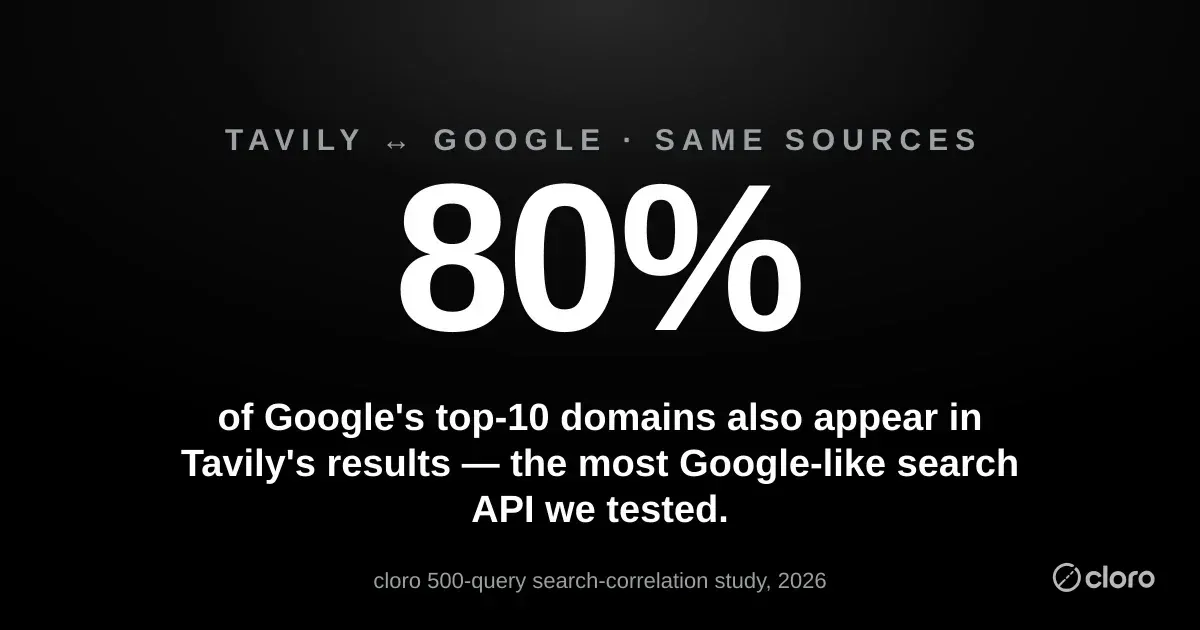
They search the same web, more tightly than any other API we’ve tested. Across the 500 queries, 80% of Google’s top-10 domains also appeared somewhere in Tavily’s results. Google’s own #1 domain showed up in Tavily’s top 10 on 92% of queries; Tavily’s #1 result was a domain Google also ranked on 78%. The two shared at least one domain on 99% of queries, essentially always, for a domain-level Jaccard of 0.66. On raw source agreement, Tavily is the most Google-like search API we’ve put through this harness: its normalized top-10 URL overlap was 55.5%, ahead of Brave’s ~47% and well ahead of the neural-search APIs that hover around 30%.
And the overlap barely moves with intent. Unlike some indexes that converge on commercial queries and wander on exploratory ones, Tavily was remarkably flat: normalized URL overlap ran 58% on informational, 56% on commercial, 55% on navigational and transactional, and 51% on local queries. Whatever your agent’s workload looks like, expect Tavily to land on roughly the same slice of Google’s sources.
But here’s the twist: same set, different order. Push past “which domains” to “in what order,” and Tavily and Google diverge sharply. The top-3 domain overlap was just 0.25, and the rank correlation between the two orderings was near zero. Read those two facts together: Tavily surfaces essentially the same authoritative domains Google does, then reranks them into an order of its own. Google’s sources come back resequenced by Tavily’s relevance model rather than Google’s. It isn’t returning a different internet; it returns Google’s internet, reshuffled.
That’s the headline. For an agent that reads all ten results before reasoning, the reshuffle is mostly harmless, since the model sees the same sources regardless of order. But the moment order is the thing you care about, Tavily and Google are not interchangeable.
Where Tavily is genuinely different
Two structural differences show up the instant you look at raw Tavily responses, and both trace back to “built for agents, not humans.”
It always hands you an answer. With include_answer on, Tavily returned a generated answer on 99.6% of our queries: a one-paragraph synthesis of the sources, ready to drop into a RAG chain. Google’s organic block gives you links; Tavily gives you links plus a pre-written summary. For grounding, that’s a real convenience.
It gives you no dates. Not one of the 4,401 Tavily results we collected carried a machine-readable date. If your app wants to filter or rank by recency at the API layer, Tavily’s default response won’t help, and you’d have to fetch and parse each page yourself. That’s the flip side of the clean, stripped-down payload: less metadata to work with.
Developers notice the missing dates when a recency filter does not hold (Mindless-Context-165 on r/Rag, September 2025):
The issue i see with Tavily is that it doesn’t respect the time range filter that i apply,
Neither is a flaw, exactly. Both are the consequence of a search product optimized to feed a model rather than to reproduce a page. But they shape what you can build on top of it.
The one real gap: Google’s result-page layer
There is a genuine difference between Tavily and Google, and, just like with Brave, it isn’t in the sources. The difference is everything Google wraps around them.
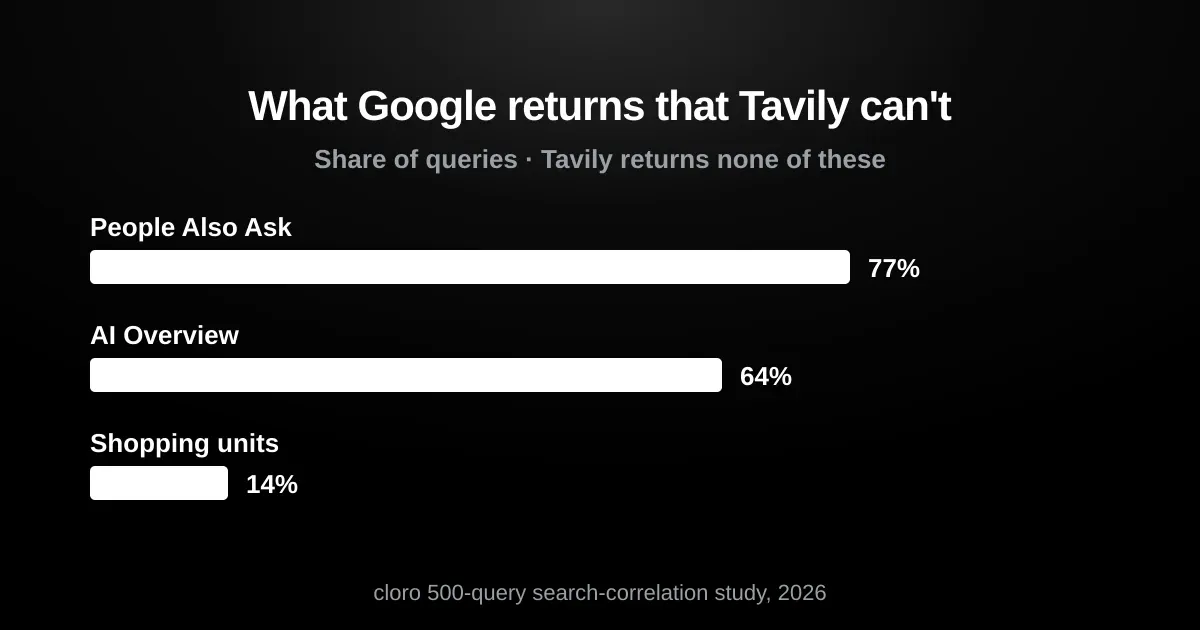
Because Tavily aggregates the open web rather than scraping Google, it structurally can’t return the Google-specific features that increasingly are the page. Google, on those same 500 queries, showed a People Also Ask block on 77% of them, an AI Overview on 64%, and shopping units on 14%. Tavily returns none of these. You get organic-style results plus its generated answer, but not Google’s answer layer, not the questions people also ask, and not the products in the shopping carousel.
This is the line that matters. Tavily can tell your agent which pages Google would surface, better than any other search API we’ve measured. What it can’t tell you is what Google actually shows: the AI Overview that now answers many queries before any link, the PAA questions, the shopping results, and the exact ranking order. If that layer is what you care about, an aggregation API is the wrong tool, however close its sources are.
What this means for your stack
The Tavily-vs-Google result splits cleanly by use case.
Grounding an LLM or agent. Tavily, at $8/1,000 searches or free up to 1,000/month, gives your model essentially Google’s sources in an agent-ready shape, with a generated answer attached and a first-class LangChain integration. For retrieval, RAG, and citation grounding, that’s not a compromise; it’s a sensible default, and it’s what a large slice of production AI search already runs on. The reshuffled order doesn’t hurt you when the model reads everything anyway.
Reproducing or measuring the Google page. The moment you need what a human sees on Google (the AI Overview answer, People Also Ask, shopping units, and the exact ranking order), you need a real Google SERP API, because no aggregation layer is scraping Google. cloro hands back the live results page, feature blocks included, as structured JSON. cloro’s pricing starts at $30/mo (Lite), or $100/mo for 250,000 credits on Hobby; a Google Search request is 3 credits, which works out to roughly $0.93 to $1.20 per 1,000 queries, actually cheaper per query than Tavily, with the full feature layer attached.
| Backend | What you get | Price |
|---|---|---|
| Tavily Search API | Agent-ready sources — essentially Google’s domains, reranked, plus a generated answer; no SERP features | $8 / 1,000 (1,000/mo free) |
| cloro (Google SERP) | The real Google page + AI Overview, PAA, shopping, exact order | ~$0.93–$1.20 / 1,000 |
At volume the gap widens, and it flips in the direction people don’t expect. The SERP API is the cheaper one per query:
| Monthly queries | Tavily | cloro (Google SERP) |
|---|---|---|
| 10,000 | ~$80 | within the $100 base plan |
| 100,000 | ~$800 | ~$93–$120 in credits |
| 1,000,000 | ~$8,000 | ~$930–$1,200 in credits |
Neither price wins outright. The two buy different things. Tavily buys clean, reranked sources with an answer stapled on; cloro buys the actual Google page. Pay for the one whose output you need.
When to use which
- Tavily Search API: you’re grounding an agent, RAG pipeline, or deep-research workflow and you want clean, LLM-ready snippets from essentially Google’s sources, a generated answer, and a drop-in LangChain integration. You don’t need Google’s exact order or its result-page features. This is the default for a reason.
- A real Google SERP API (cloro): you need the page users actually see: rank tracking, SEO, or SERP scraping, AI-Overview and PAA visibility monitoring, or anything where order is the signal. Similar sources, yes. Not the page, though, and not the layers Google stacks on top of it.
Migrating from Tavily to a Google SERP API
If you started on Tavily (most agent stacks do) and hit the “I actually need the Google page” wall, the swap is small. Both are a single HTTPS call:
Tavily  →  POST https://api.tavily.com/search
           Header: Authorization: Bearer <key>
           Body:   { "query": "<query>", "max_results": 10, "include_answer": true }
           Results: results[] → { url, title, content, score }
           Plus:    answer (generated summary)

cloro   →  POST https://api.cloro.dev/v1/monitor/google
           Header: Authorization: Bearer <key>
           Body:   { "query": "<query>", "country": "US",
                     "include": { "aioverview": { "markdown": true } } }
           Results: result.organicResults[] → { link, title, snippet, position }
           Plus:    result.aioverview, result.peopleAlsoAsk, result.shoppingCards
Map results[].url to result.organicResults[].link and the organic list ports directly. You’re mostly getting back the same domains, now in Google’s order and with position attached. Everything under result.aioverview, result.peopleAlsoAsk, and result.shoppingCards is surface area Tavily never had. If you leaned on Tavily’s generated answer, note that cloro’s AI Overview is Google’s own generated answer for the query, often the exact thing you actually wanted to measure.
The headline most teams miss is that “AI search” often is Tavily search, and Tavily is closer to Google than any other search API we’ve measured. On 500 queries the two agreed on four of every five top domains. Where they part ways isn’t the web they see. It comes down to the order Tavily puts it in, and the page Google builds on top of it. Work out which of those your product depends on.
This is one leg of a four-part study; the same 500-query harness ran against every major search API. See how Brave, Exa, and Perplexity compare to the real Google SERP.
Need Google’s actual order and features? See how cloro’s web search API returns it, or weigh the alternatives in our rundown of the best SERP APIs.

About the author
Ricardo Batista
Founder, cloro
Ricardo is one of the founders and engineers behind its SERP and AI-search scraping infrastructure. Before cloro he scaled a financial comparison site to $7M ARR and ran the full-country operations of a unicorn to $65M ARR, then went back to building. He writes about search engine scraping, generative-engine optimization, and turning live search and AI-answer data into something teams can act on.
Frequently asked questions
What is the Tavily Search API?
Tavily is a search API built specifically for AI agents and LLMs, rather than for humans reading a results page. It returns a clean list of results (url, title, and a content snippet scored for relevance) plus an optional generated answer, which is why it's the default web-search tool in so many LangChain and LangGraph agent examples. It runs on an aggregation layer over the open web, not Google's own results page, so you get sources without Google's SERP features. The free Researcher plan includes 1,000 API credits per month; Pay As You Go is $0.008 per credit ($8 per 1,000 basic searches).
Does Tavily use Google search results?
Not directly. Tavily aggregates and reranks the open web rather than scraping Google's results page. But in practice the sources land very close to Google's. In a 500-query test, 80% of Google's top-10 domains also appeared in Tavily's results, Google's #1 domain showed up in Tavily's top 10 on 92% of queries, and the two shared at least one domain on 99% of queries. Tavily returns essentially Google's sources; it just orders them by its own relevance model, not Google's ranking.
How similar are Tavily and Google search results?
On sources, the most similar of any search API we've measured; on order, not similar at all. Across 500 queries, Tavily's normalized top-10 URL overlap with Google was 55.5%, higher than Brave (about 47%), Exa, or Perplexity, and its domain-level Jaccard was 0.66. But the top-3 domain overlap was only 0.25 and rank correlation was near zero, because Tavily reranks the same result set into its own order. The takeaway: Tavily searches the same web Google does, then sorts it differently.
How much does the Tavily API cost?
Tavily's free Researcher plan includes 1,000 API credits every month with no credit card. Beyond that, Pay As You Go is $0.008 per credit, and a basic search costs 1 credit, so roughly $8 per 1,000 searches (advanced search is 2 credits). For comparison, a real Google SERP API like cloro returns the live Google page with its feature blocks for about $0.93–$1.20 per 1,000 queries: cheaper per query, with the SERP layer Tavily doesn't carry.
Should I use Tavily or a Google SERP API for my agent?
Use Tavily when you're grounding an LLM or RAG pipeline and you want clean, agent-ready snippets from essentially Google's sources; its LangChain integration and generated-answer field make it a reasonable default for retrieval. Use a Google SERP API like cloro when you need what a human actually sees on Google: the exact ranking order, the AI Overview, People Also Ask, and shopping units, none of which Tavily returns, because it isn't scraping Google's page.
Why does Tavily's ranking differ so much from Google's if the sources are the same?
Because Tavily isn't trying to reproduce Google's page; it reranks the web by its own relevance score, optimized for feeding an LLM rather than for a human scanning ten blue links. In our data the two agreed on which domains belong (domain Jaccard 0.66) but not on the order (top-3 Jaccard 0.25, rank correlation near zero). For grounding that's fine, since the model reads all the results anyway. For rank tracking, SEO, or citation monitoring, order is the whole point, and only a real SERP API gives you Google's.
Related reading
Brave Search API vs SERP API: Claude's Search Engine
Anthropic's Claude searches the web with the Brave Search API, not Google. So how close is Brave to Google? We ran 500 identical queries through both indexes. The answer is "closer than the headline number suggests," with one real exception.
Perplexity Search API vs Google: A Three-Way Study
There are three different "Perplexity webs": the Search API, the answer users see, and Google. Most people conflate them. We ran 500 identical queries through the Perplexity Search API and cloro's live Google SERP to measure exactly how far apart they sit.
Exa Search vs Google: Neural Search vs the Real SERP
Exa searches the web by meaning, not keywords. So how different is it from Google, really? We ran 500 identical queries through Exa and cloro's live Google SERP. The overlap is the lowest of any search API we've measured, and that's exactly the point.