
AI Grounding: Every AI Engine Grounds Live, Except Gemini

On this page
Do all AI engines ground their answers in live search?
In our measurement across roughly 2,500 prompts per engine, five of six AI engines grounded their answers in live search 91–98% of the time. Gemini grounded just 41.1%.
AI grounding is what those numbers describe: the engine ran a live search, read real web results, and wrote its answer from them instead of from memory. Ask ChatGPT, Perplexity, or Google’s AI Mode a question today and the answer almost always comes back with citations, the little numbered links to pages the model read while answering.
It has quietly become the default. But not for everyone, and the engine that breaks the pattern is the one most people would not guess.
What AI grounding actually means
AI grounding is the step where a model connects its answer to live web content retrieved at query time. Instead of generating a response purely from the statistical patterns it learned in training, a grounded engine issues a search, pulls back real pages, and composes its answer from them, and attaches citations so you can check the sources. Google calls its version Grounding with Google Search and describes it this way: it “connects the Gemini model to real-time web content” and shows “the sources for the model’s claims.”
Grounding is how engines perform real-time extraction on AI-generated search citations: they search, read, and cite live pages at query time.
It helps to place AI grounding next to the three things people confuse it with:
- Fine-tuning bakes knowledge into the model’s weights before it ships. It’s expensive, slow to update, and frozen the moment training ends. That makes it useless for anything that changed yesterday.
- Long context lets you paste a lot of text into a single prompt. Useful, but you have to supply the text, and it doesn’t reach anything the model wasn’t handed.
- RAG (retrieval-augmented generation) retrieves passages from a corpus you control (your docs, your knowledge base) and feeds them to the model at answer time.
Grounding is retrieval where the corpus is the live web. Mechanically it’s RAG whose retriever is a search engine instead of a private vector store: the freshest, broadest source available, with citations built in. That’s why grounding specifically means live search data. Freshness, breadth, and verifiability are the whole point. When an AI answer cites a news article from this morning, that’s grounding; fine-tuning could never have known.
What are the main grounding techniques in AI?
Live web search is one grounding technique among several. Decagon’s glossary lists the common ones:
- RAG over a private corpus: retrieve passages from your own documents before the model answers.
- Tool calls: the model calls a search engine, database, or API mid-answer.
- Structured data lookups: pull exact values such as prices or order status from a system of record.
- Citation enforcement: require every claim to point at a retrieved source.
- Fine-tuning on a curated corpus: the slowest to update, as covered above.
Google adds a cost control on top: with dynamic retrieval, Gemini predicts whether a query needs fresh information and searches only above a threshold you set. That per-query decision is also why AI grounding by engine differs so much in the measurements below.
The natural question is how consistently AI grounding actually happens across the engines people use. So we measured it.
We measured grounding across six AI engines
cloro monitors how AI engines answer real prompts. It’s what the AI visibility product is built on. That gave us a direct way to quantify grounding: for each answer an engine returned, does it carry at least one live source, and how many?
We pulled a slice of cloro’s monitoring corpus (roughly 2,500 prompts per engine over a 7-day window) and scored every answer. “Grounded” means the response carried ≥1 live source (a cited web page). The prompts are real customer AI-visibility queries: conversational, commercial, and multilingual. They are the kind of questions people actually put to these tools rather than a synthetic benchmark set.
Here’s what five of the six look like.
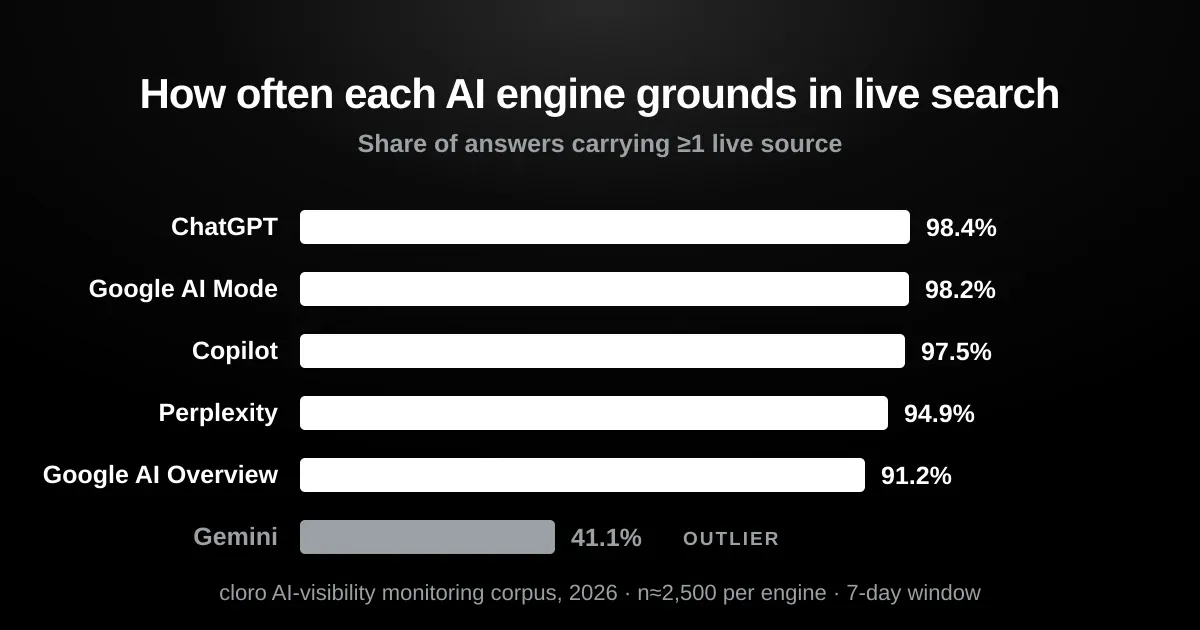
Measured 2026-07-05. See the August re-measurement below before acting on these numbers.
| Engine | Grounded (≥1 live source) | Avg sources per answer |
|---|---|---|
| ChatGPT | 98.4% | 14.1 |
| Google AI Mode | 98.2% | 9.9 |
| Copilot | 97.5% | 4.6 |
| Perplexity | 94.9% | 9.5 |
| Google AI Overview | 91.2% | 9.1 |
| Gemini | 41.1% | 3.2 |
Five engines cluster tightly between 91% and 98%. For ChatGPT, AI Mode, Copilot, and Perplexity, AI grounding is how they answer almost every time rather than a feature that occasionally fires. This lines up with our earlier finding that ChatGPT uses web search in 80%+ of prompts under clean testing conditions; measured on this corpus, with citation parsing across the full answer, the grounded share is higher still. Google’s AI Overview sits slightly lower at 91.2% (some queries render an Overview that leans more on Google’s own knowledge layer than on cited pages), but it’s still grounded nine times in ten.
Then there’s Gemini.
Why Gemini grounds least of the six
Gemini grounded 41.1% of its answers. On the other roughly 59%, it answered from training memory, with no live search and no citations. That’s not a rounding difference from the pack; it’s a different behavior.
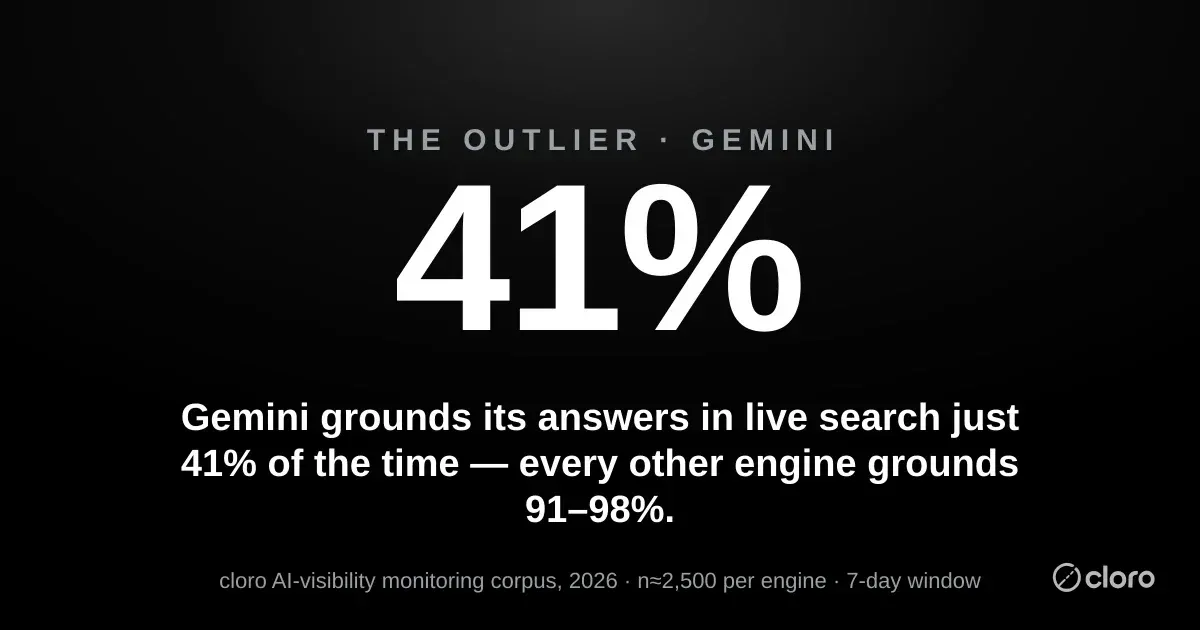
The reason is architectural. For the Gemini API, grounding is an opt-in tool a developer turns on. Google’s documentation describes enabling the google_search tool, after which “the model handles the entire workflow of searching, processing, and citing information automatically.” When that tool isn’t invoked, Gemini does what a language model does by default: it answers from its parameters. The consumer surface reflects the same tendency: Gemini reaches for live search selectively rather than reflexively. (If you want to see the grounded-vs-ungrounded split up close, we pulled it apart in scraping Gemini, and /gemini/ shows how cloro parses its citations.)
This matters more than a trivia stat. It means that when Gemini answers, there’s a better-than-even chance it’s telling you what it remembered, not what the web currently says. For a factual or fast-moving query, that’s the difference between a citation you can verify and an assertion you can’t. And for anyone doing AI-visibility work, it means live-source strategies, the ones that get you cited, reach Gemini least often of any major engine. In a later window where Gemini carried a live source on 55.8% of answers, it still cited a LinkedIn URL once in 56,423 answers, so a rising grounding rate does not mean an engine will cite any given domain.
How much does Gemini grounding cost?
For developers, Google publishes the current rates for Grounding with Google Search, including any free allowance, on its Gemini API pricing page. The lever you control is how often it fires. Google’s Vertex AI post describes dynamic retrieval as giving “lower costs, because Gemini will only tap Google Search when needed.” Set a higher threshold and you pay for fewer grounded calls, at the price of more answers from memory, which is the trade the consumer Gemini numbers above reflect.
Source depth is a visibility lever too
AI grounding isn’t binary. An engine that cites one source is grounded; so is one that cites twenty. Depth tells you how much of the live web an answer is actually built on.
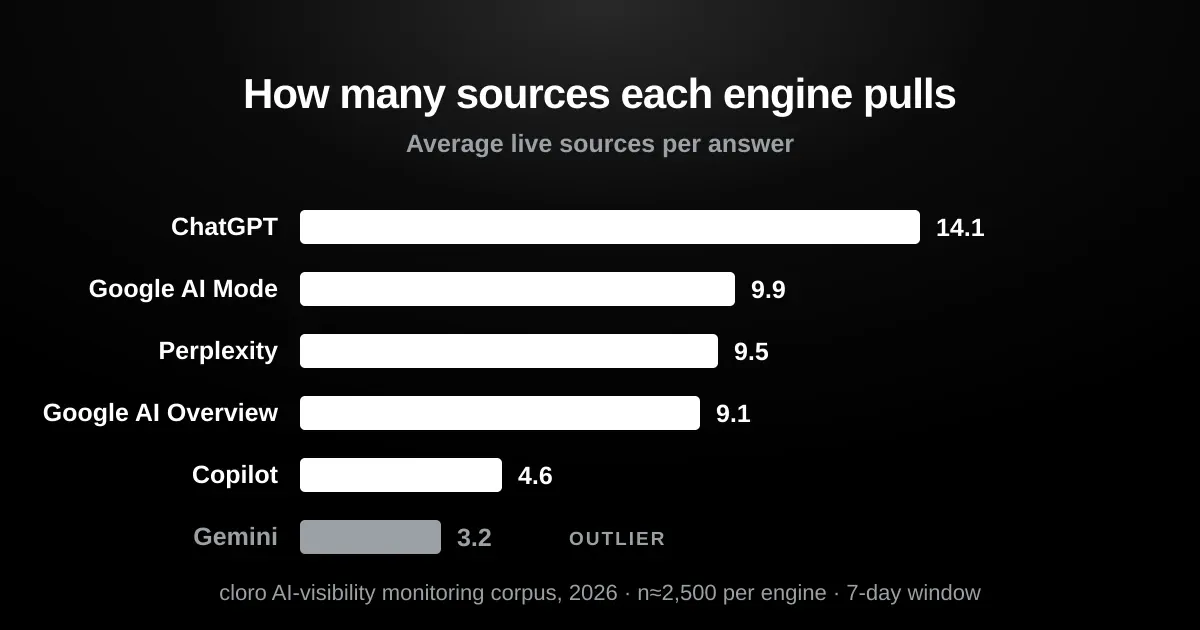
ChatGPT is the heaviest reader in the set, pulling 14 sources per answer on average. It fans a query out across many pages before writing. AI Mode, Perplexity, and AI Overview land in a middle band of 9 to 10 sources. Copilot grounds nearly every time but reads shallower, around 4.6. And Gemini, on the minority of answers where it does ground, cites just 3.2: the least likely to ground and the thinnest when it does.
Depth is its own lever for visibility: a 14-source answer has far more citation slots than a 3-source one. We took the citation anatomy apart engine by engine in how each AI engine cites sources. It’s worth reading alongside this if you care about which pages get pulled rather than how many.
Re-measured, August 2026: these rates move a lot
We re-ran the panel of six engines on 2026-08-19 over a 30-day window at 3,000 prompts per engine. Almost every figure had moved, and one had moved enough to change the story.
| Engine | Grounded, Jul 05 | Grounded, Aug 19 | Sources, Jul 05 | Sources, Aug 19 |
|---|---|---|---|---|
| Perplexity | 94.9% | 99.2% | 9.5 | 13.0 |
| Google AI Overview | 91.2% | 94.3% | 9.1 | 8.2 |
| Copilot | 97.5% | 91.8% | 4.6 | 4.5 |
| Google AI Mode | 98.2% | 91.0% | 9.9 | 13.0 |
| ChatGPT | 98.4% | 78.9% | 14.1 | 12.7 |
| Gemini | 41.1% | 70.7% | 3.2 | 10.1 |
Gemini nearly doubled its grounding rate and tripled its source count. ChatGPT, which led the July panel, was second from the bottom on this reading. The tight 91-98% cluster that made the original finding so clean has spread out.
The 41.1% was a trough, not a property
Pulling Gemini month by month explains it, and the lesson generalises:
| Month | Grounded | Avg sources |
|---|---|---|
| 2026-01 | 57.4% | 4.2 |
| 2026-02 | 61.2% | 4.2 |
| 2026-03 | 60.6% | 4.5 |
| 2026-04 | 69.6% | 4.9 |
| 2026-05 | 27.3% | 1.9 |
| 2026-06 | 37.2% | 2.7 |
| 2026-07 | 55.0% | 6.0 |
| 2026-08 | 60.8% | 6.6 |
Gemini has ranged between 27% and 70% in eight months. The July measurement caught it climbing out of a May-June trough, so 41.1% was an accurate reading of a moment and a poor description of the engine. We published it as the latter, and this section is the correction.
What actually survived
Two claims held across both measurements and the monthly series:
- Gemini grounds least of the six. True in July at 41.1% and true in August at 70.7%, when the next-lowest was ChatGPT at 78.9%. The gap narrowed; the ordering did not change.
- Copilot runs the thinnest citation set. 4.6 sources in July, 4.5 in August, against 8.2 to 13.0 for everything else. It was the most stable number on the page until the October reading below.
What did not survive is any precise grounding percentage as a durable fact about an engine. If you are building on these numbers, treat the ordering as the finding, re-measure before you quote a rate, and date whatever you publish. We now re-measure every figure we cite on a schedule, for exactly this reason.
A third reading: 7 October 2026
The schedule came round, and the panel moved again. Same 30-day window and 3,000 answers per engine, now drawn in a fixed order so a re-run returns the same sample.
| Engine | Grounded, Aug 19 | Grounded, Oct 07 | Sources per grounded answer, Oct 07 |
|---|---|---|---|
| Perplexity | 99.2% | 99.9% | 11.5 |
| ChatGPT | 78.9% | 97.6% | 36.5 |
| Copilot | 91.8% | 92.8% | 5.2 |
| Google AI Overview | 94.3% | 91.9% | 7.2 |
| Google AI Mode | 91.0% | 84.5% | 4.9 |
| Gemini | 70.7% | 68.2% | 10.2 |
ChatGPT’s August dip did not last. It is back at 97.6%, and a grounded ChatGPT answer now lists about 36 sources, close to three times the August count. Google AI Mode went the other way, down to 84.5% with fewer than five sources per grounded answer.
That leaves one of the two surviving claims standing. Gemini grounds least of the six on all three readings. Copilot no longer runs the thinnest citation set: AI Mode’s 4.9 sits under Copilot’s 5.2. If you kept only the ordering from the August section, half of it is already out of date, which is the argument for re-measuring made a second time.
Why AI grounding is the whole game for AI visibility
Across the six engines, most AI answers are now grounded in live web content. Five of the six engines people use every day run a search before they answer, and they cite between 3 and 14 pages when they do.
AI visibility means being one of the sources an engine cites. That’s precisely why it is a real, winnable channel rather than a black box:
- If an engine grounds, its citations are contestable. ChatGPT reading 14 live pages per answer means 14 slots your content could occupy. Grounding is what turns “getting mentioned by AI” from luck into an addressable surface.
- The engine’s grounding behavior is your strategy input. For ChatGPT, AI Mode, Copilot, and Perplexity, live-source optimization pays off on nearly every query. For Gemini, being cited helps only on the ~41% of answers it grounds. Reaching it more often means winning where it does search, and accepting that memory covers the rest.
- You can’t optimize what you don’t measure. Which engines ground on your queries, and whose pages they cite, is an empirical question with a different answer for every brand and topic.
That last point is the job cloro does. It runs your prompts across these engines and reports, per query, which grounded and who they cited. That’s the same measurement behind this study, pointed at your footprint. If you’re doing brand or AI search tracking, knowing which engines answer from the live web (and can therefore cite you) versus which answer from memory is the difference between a plan and a guess.
How to ground your own LLM or agent
If you’re building on models rather than monitoring them, grounding is a pattern you implement in four steps:
- Take the user’s question and use it as the search query, rewriting it first if the question is conversational.
- Call a search API for that query and take the top results.
- Format those results as context (title, URL, snippet) and pass them to the model.
- Have the model answer from that context, citing the results it used.
In pipeline form:
user question
   → call a search API for the query
   → format the top results as context (title, url, snippet)
   → pass that context to the model
   → model answers, citing those results
Either inject the results into the prompt as context, or expose search as a tool the model calls itself (which is exactly what Gemini’s google_search tool and ChatGPT’s web search do under the hood). The quality of the grounding is only as good as the search layer feeding it, so the retriever choice matters.
A Google SERP API like cloro returns the live results page as structured JSON (organic links plus the AI Overview, People Also Ask, and shopping units), so you can ground a model on what Google actually surfaces, features included. If you’d rather the search happen inside the model’s own tool loop, Copilot and Bing-based grounding and Anthropic’s Claude both wire a web index in directly; we measured how close one of those indexes sits to Google in Brave Search API vs Google. Pick the retriever whose output your product needs, then feed it in. That’s grounding.
Which API do you use to observe grounding in practice?
Watching grounding from outside means scraping the consumer answer, not calling the developer API. cloro returns the grounded answer with sources (ChatGPT 5 credits, Gemini, AI Mode, and Perplexity 4), putting a 1,000-prompt daily ChatGPT panel at about $60 a month at Hobby rates. Tavily and Exa sit on the other side of the pipeline: they supply retrieval to your model rather than observing a consumer engine’s.
Methodology and honest caveats
A few things to hold this data honestly:
- It’s cloro’s own corpus, presented with methodology. These are first-party measurements from cloro’s AI-visibility monitoring on real customer prompts rather than a public benchmark. Numbers are within-engine and directional: they describe how each engine behaved on this prompt mix rather than serving as a universal census of all AI answers.
- The prompt mix has a shape. The corpus skews conversational and commercial, and spans multiple languages. A different query set (pure factual lookups, or code questions) would move the absolute grounding rates. The ordering (five engines high, Gemini low) is the robust finding.
- AI Overview is measured where it rendered. The 91.2% figure is computed only on captures where an AI Overview actually appeared, with sources read from the Overview’s own block (
result.aioverview), not the surrounding organic SERP. Queries that render no Overview aren’t counted for that row. - “Grounded” is a floor, not a grade. It means ≥1 live source was present. It doesn’t judge whether the source was good, whether the model used it faithfully, or whether the citation was relevant. It says only that the engine reached for the live web at all.
Within those bounds, the headline is stable and striking: grounding is now the norm across the AI engines people use. Gemini is the one that most often answers from memory instead. If you’re deciding where to invest in being seen by AI, that map of who searches and who remembers is where to start.
Want to know which engines ground on your queries, and whose pages they cite? See how cloro’s web search and AI visibility monitoring works.

About the author
Ricardo Batista
Founder, cloro
Ricardo is one of the founders and engineers behind its SERP and AI-search scraping infrastructure. Before cloro he scaled a financial comparison site to $7M ARR and ran the full-country operations of a unicorn to $65M ARR, then went back to building. He writes about search engine scraping, generative-engine optimization, and turning live search and AI-answer data into something teams can act on.
Frequently asked questions
What is AI grounding?
AI grounding is when a model answers from live web content retrieved at query time (a search step) instead of relying only on what it memorized during training. A grounded answer carries citations to the pages it read, so its claims are traceable and current. Google describes its own version, Grounding with Google Search, as connecting the model to real-time web content and showing the sources for the model's claims. Grounding is the mechanism behind almost every AI answer that includes links.
What are grounding techniques in AI?
The common techniques are RAG over a private corpus, tool calls to a search engine or API, structured data lookups from a system of record, citation enforcement that ties every claim to a retrieved source, and fine-tuning on a curated corpus. Consumer AI engines mostly ground through live web search called as a tool.
How much does Gemini grounding cost?
Google publishes the current rates for Grounding with Google Search, including any free allowance, on its Gemini API pricing page. To control spend, use dynamic retrieval: Gemini predicts whether a query needs fresh information and only searches above the threshold you set.
How is grounding different from RAG and fine-tuning?
They act at different points. Fine-tuning bakes knowledge into the model's weights before deployment; it's slow and quickly goes stale. RAG (retrieval-augmented generation) retrieves passages from a fixed corpus you control, like your own docs. Grounding is retrieval where the corpus is the live web via a search engine: the freshest, broadest source, with citations attached. In practice, grounding is RAG whose retriever is a web search API. Most consumer AI engines ground; enterprise apps often combine grounding for public facts with RAG over private data.
Do all AI engines ground their answers in live search?
Almost all do, but not equally. In our measurement across roughly 2,500 prompts per engine, ChatGPT grounded 98.4% of answers, Google AI Mode 98.2%, Copilot 97.5%, Perplexity 94.9%, and Google's AI Overview 91.2%. Gemini was the exception at 41.1%: it answered from training memory, with no live source, most of the time. So 'AI search' is real for five of six engines; Gemini leans hardest on memory.
Why does Gemini ground less than ChatGPT or Perplexity?
For the Gemini API, grounding is an opt-in tool a developer enables, not default behavior. Google's docs describe enabling the google_search tool so the model searches, processes, and cites automatically. When it isn't triggered, Gemini answers from its trained parameters. Our corpus reflects that: Gemini carried at least one live source on 41.1% of answers, versus 91–98% for the others. It's not that Gemini can't ground; it grounds selectively, which means live-source strategies reach it least often.
Why does grounding matter for AI visibility and SEO?
Because if an engine grounds, the sources it cites are winnable, and being one of the pages it pulls is how a brand shows up in AI answers. When five of six engines ground 91–98% of the time and cite 3–14 sources each, the citation surface is large and contestable. Grounding is exactly what cloro monitors: which engines pull live sources on your queries, and whose pages they cite. See how it works on the AI visibility tracker.
How do I ground my own LLM or agent in live search?
Call a search API for the query, then inject the top results into the model's context (or expose search as a tool the model can call). The pattern is: user question → search API → format the results as context → model answers with citations to those results. A Google SERP API like cloro returns the live results page (organic links plus AI Overview, People Also Ask, and shopping) as structured JSON, which is the ground-truth layer to feed a model. See the web search API use case for the setup.
Related reading

ChatGPT Grounding Study: 86% Commercial, 1% Informational
ChatGPT grounds almost every commercial prompt and almost no informational one. We re-ran our study without forcing web search, across 865 queries and 10 countries, and the split is 86.5% versus 0.9%.
LLM Citations: How Each AI Engine Cites Sources (Study)
Across six AI engines and six verticals, citation depth varies ~20×: Google AI Mode averages 15–22 sources per answer, ChatGPT/Gemini/Copilot land around 4–8, and Perplexity ranges from ~4 down to literally zero depending on the topic. Reddit sits top-2 in every vertical. AI Overview decides whether to answer at all: it triggers on 98% of shopping queries and 3% of dining.
Brave Search API vs SERP API: Claude's Search Engine
Anthropic's Claude searches the web with the Brave Search API, not Google. So how close is Brave to Google? We ran 500 identical queries through both indexes. The answer is "closer than the headline number suggests," with one real exception.