
Third Party Risk Monitoring: The News Layer TPRM Misses

On this page
Third-party risk management (TPRM) is the practice of finding and reducing the risks that come from working with outside vendors and service providers, per IBM’s TPRM overview. It covers due diligence, risk assessment, remediation and ongoing monitoring, and it goes by other names too: vendor risk management or supply chain risk management.
Your TPRM program almost certainly does two things well: it screens vendors at onboarding, and it re-assesses the important ones on a schedule. Both are point-in-time exercises. The problem is that a vendor’s risk does not hold still between them.
A supplier can pass its annual review in January, get breached in April, lay off half its staff in July, and land in a regulator’s enforcement notice in September, and your questionnaire will not ask again until the following January. Everything that mattered happened in the gap. Third party risk monitoring is how you close that gap without hiring an analyst to read the news for every vendor on your list.
This is the procurement and risk flavor of a pattern cloro writes about across the adverse media and due diligence vertical. The mechanics of screening a name against negative news are the same; here the subject is your vendor and counterparty list, and the goal is early warning rather than one-time clearance.
What is counterparty risk?
Counterparty risk is the risk that the other party to an agreement fails to hold up its end: it defaults, goes insolvent, or otherwise cannot deliver what it promised. The term comes from finance, where the counterparty is whoever sits on the other side of a trade or a loan. But the idea generalizes to any dependency: a cloud provider, a payroll processor, a logistics partner, a data sub-processor.
The important thing about counterparty risk is that it is assessed statically and behaves dynamically. You underwrite a counterparty once, assign it a rating, and file it. But the counterparty keeps trading, hiring, borrowing, and getting sued after you file. The rating ages the moment you write it down.
That is the bridge from assessment to monitoring. A rating tells you what a vendor’s risk looked like on the day you scored it. Monitoring tells you what it looks like today. You need both, and most programs only have the first.
The gap: your TPRM stack reviews vendors annually; risk moves daily
Modern third-party risk management is built around a questionnaire cadence. A vendor is onboarded with a security assessment, tiered by criticality, and then re-reviewed, annually for critical vendors and less often for the rest. It is a sound system of record. It is also blind between reviews.
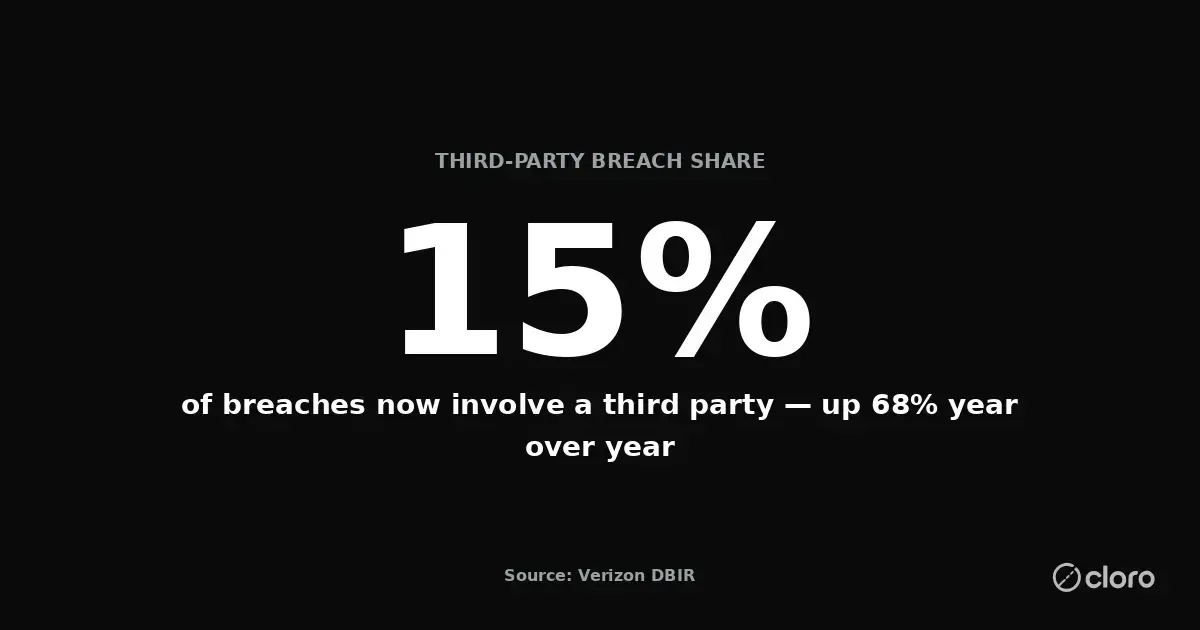
The blind spot is not hypothetical. Verizon’s Data Breach Investigations Report found that 15% of breaches involved a third party, a 68% increase year over year and one of the report’s fastest-growing categories. Third party risk is not a tail scenario anymore; it is a leading cause.
And exposure is effectively universal. SecurityScorecard found that 98% of organizations have a vendor relationship with at least one third party breached in the last two years. If nearly every company is connected to a breached vendor, the question changes. The question is no longer whether your vendors will have incidents. It is whether you hear about them before they reach you.
Risk leaders know this. In the World Economic Forum’s Global Cybersecurity Outlook, 54% of large organizations named supply chain challenges as the biggest barrier to their own cyber resilience. The dependency is understood; the visibility is missing. SecurityScorecard’s research puts a number on it: less than half of organizations monitor even 50% of their extended supply chain for cyber threats, and only 26% build incident response into their TPRM programs.
Here is why the calendar loses. A questionnaire is a scheduled pull: you ask the vendor for its status on a date you chose. An incident is an unscheduled push that lands when it lands, and the vendor’s incentive is to control the story, not to call you first. External signals close that timing mismatch, because news, court records, and breach disclosures are published on the incident’s schedule, not yours.
Vendor risk lead time: how much warning monitoring buys you
The value of monitoring is lead time: how much warning you get before a vendor problem becomes your problem. Two published numbers frame the size of the prize, and one of our own shows how much exposure sits in plain sight before any breach occurs.
We generated 400 typosquat permutations across large, mid-sized and small brands, then checked each one. 66% resolved to a live site, and of those, 53% were indexed by Google, meaning a customer or an employee who searches can actually land on them. Roughly a third of the permutations we generated were therefore both live and findable, without anyone needing to be breached first. The full typosquatting study has the per-brand breakdown.
That is the shape of third-party exposure the annual questionnaire never asks about: infrastructure registered against your name or a vendor’s, reachable today, and discoverable by the same search box your customers use.
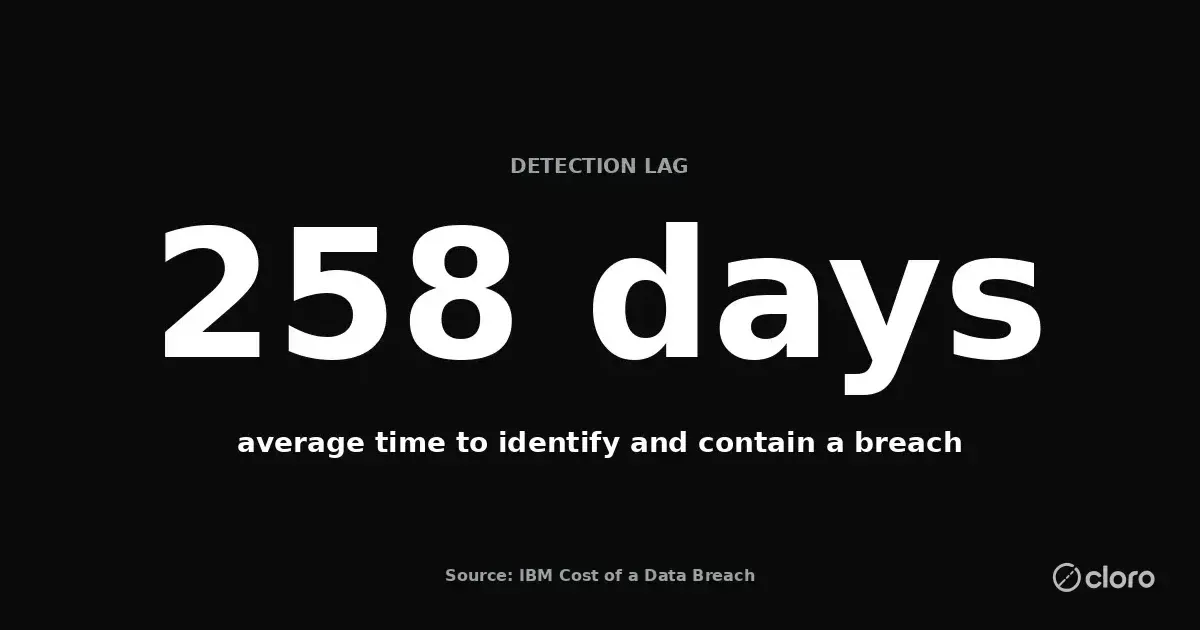
The first is duration. Even after a breach begins, it still takes 258 days on average to identify and contain, according to IBM’s Cost of a Data Breach report. That is a long window. Fragments of the story (a leak-site listing, a regional news item, a quietly filed lawsuit) surface on the open web while the official disclosure is still months away.
The second is cost. IBM puts the global average cost of a data breach at $4.88 million, and 70% of breached organizations reported significant or very significant disruption. When one of your vendors is the breached party, a share of that disruption flows downstream to you, through outages, data exposure, and remediation you did not budget for.
Monitoring does not prevent a vendor’s incident. It buys you the days or weeks between the first public signal and the moment the incident lands on your desk. That is time to pull the vendor from a critical workflow, rotate credentials, or start a contingency. The table below maps the signal families worth watching and where each tends to surface first.
| Risk category | External signal that moves first | Where it surfaces | Typical lead over an annual review |
|---|---|---|---|
| Financial distress | Layoffs, missed filings, funding trouble, credit downgrades | Business news, regulatory feeds | Weeks to months |
| Legal / regulatory | Lawsuits, enforcement actions, consent orders | Court records, news wires | Weeks |
| Security | Breach disclosures, ransomware leak-site posts, CVE advisories | News, security blogs, leak-site monitors | Days to weeks |
| Leadership / operational | C-suite exits, plant closures, mergers and acquisitions | News, press releases | Days |
| ESG / reputational | Sanctions, labor or environmental violations, adverse media | News, NGO reports, sanctions lists | Days to weeks |
This is a framework, not a proprietary dataset. The point is the shape of the advantage. Read it as a monitoring specification: these are the query types to run against a live news and search index. The columns tell you which vendors need daily coverage versus weekly. The next section turns it into a working feed.
Build a third party risk monitoring feed
You do not need a new governance, risk, and compliance (GRC) platform to add monitoring. You need a live index of news and search results, a way to query it for your vendor list, and a classifier that turns raw hits into routed alerts. cloro provides the data layer; the rest is a short pipeline that funnels into your adverse media and due diligence workflow.
Step 1: turn your vendor list into a query set
Start with the vendor register you already maintain. It is the foundation of any third party risk monitoring feed. For each vendor, build a small set of queries: the legal entity name, common trading names, and the risk terms that matter, such as “breach”, “lawsuit”, “layoffs”, “sanctions”, and “insolvency”. Tier the list so critical vendors get the full term set and daily cadence, and low-tier vendors get a lighter watch.
Step 2: pull news and search signals with cloro
Turn the query set into a live watch: cloro searches Google News and the web for each query on the schedule you set, then hands back structured hits instead of a page you would have to parse yourself. Run each query against cloro’s Google News and SERP endpoints on a schedule. News catches the freshest coverage; the SERP catches the durable pages a headline links to: regulator notices, court dockets, and company statements.
import os
import requests

VENDORS = ["Acme Payroll Inc", "Northwind Logistics", "Contoso Cloud"]
RISK_TERMS = ["breach", "lawsuit", "layoffs", "sanctions", "insolvency"]

def scan(vendor):
    query = f'"{vendor}" ({" OR ".join(RISK_TERMS)})'
    r = requests.post(
        "https://api.cloro.dev/v1/monitor/google/news",
        json={"query": query, "country": "US"},
        headers={"Authorization": f"Bearer {os.getenv('CLORO_API_KEY')}"},
        timeout=60,
    )
    return r.json()["result"]["newsResults"]

for v in VENDORS:
    for article in scan(v):
        print(v, article["title"], article["link"])
For synthesized risk narratives (“summarize what changed for this vendor this week”), send the same query to cloro’s AI-answer endpoints and store the response alongside the raw hits. It gives analysts a readable brief instead of a wall of links.
Step 3: classify each signal by risk type
Map every hit to one of the five categories in the table above: financial, legal, security, operational, or ESG (environmental, social, and governance). A short keyword-and-model classifier is enough to start. The goal is routing, not perfect taxonomy. Attach a severity based on the vendor’s tier and the signal type, so a critical vendor’s breach disclosure outranks a low-tier vendor’s leadership change.
Step 4: route to your GRC or Slack
Send classified, de-duplicated alerts where the owner will see them. A security signal on a critical vendor should open a ticket and trigger an off-cycle review in your TPRM platform. A minor ESG mention on a low-tier vendor can sit in a weekly digest. The same alerting pattern behind a reliable news alert pipeline applies here: de-duplicate first, then route by severity so the feed stays signal rather than noise.
Monitoring feeds your TPRM stack rather than replacing it
Monitoring does not replace your GRC platform. It is the sensor that makes the platform timely. OneTrust, Prevalent, and Aravo own the workflow: the questionnaires, the scoring, the audit trail. What they do not do well is watch the open web for you between reviews. Third party risk monitoring is the layer cloro fills.
Think of it as three tiers. Your TPRM platform is the system of record. Adverse media and news monitoring is the external signal layer that feeds it, and threat intelligence sits alongside for the security-specific feeds.
The monitoring layer’s only job is to notice, early, when a vendor’s story changes, then to hand that off to the system that manages the response.
The build is deliberately small because it should be. You already have the vendor list and the review process; what was missing was the daily read of the outside world. Wire the news and search signal into the stack you already run, and the annual questionnaire stops being the first time you hear that a vendor is in trouble.
Ready to instrument your vendor list? Start with cloro’s adverse media and due diligence tools and point them at the counterparties you cannot afford to lose.

About the author
Ricardo Batista
Founder, cloro
Ricardo is one of the founders and engineers behind its SERP and AI-search scraping infrastructure. Before cloro he scaled a financial comparison site to $7M ARR and ran the full-country operations of a unicorn to $65M ARR, then went back to building. He writes about search engine scraping, generative-engine optimization, and turning live search and AI-answer data into something teams can act on.
Frequently asked questions
What is third party risk monitoring?
Third party risk monitoring is the continuous tracking of external signals (news, legal filings, breach disclosures, sanctions, leadership changes) about the vendors and counterparties you depend on. Unlike a TPRM assessment, which is a point-in-time questionnaire, monitoring runs between reviews and flags when a vendor's risk profile changes.
What is third-party risk management (TPRM)?
TPRM is the practice of identifying and reducing the risks an organization takes on from outside vendors and service providers. It covers due diligence at onboarding, risk assessments, remediation and ongoing monitoring, and is also called vendor risk management or supply chain risk management.
What is the difference between counterparty risk and third party risk?
Counterparty risk is the chance that the other side of a contract or transaction fails to meet its obligations. The term comes from finance. Third party risk is broader: it covers any external vendor, supplier, or partner whose failure, breach, or misconduct could disrupt your operations, expose your data, or damage your reputation. Both are assessed at onboarding and both keep changing afterwards.
How is third party risk monitoring different from a TPRM platform?
A TPRM or GRC platform such as OneTrust, Prevalent, or Aravo manages the workflow: questionnaires, assessments, scoring, and reviews. It is the system of record. Third party risk monitoring is the external signal layer that feeds it: the live news and search intelligence that tells the platform when a vendor's status has changed so a review can be triggered early instead of on the annual calendar.
What signals should vendor risk monitoring track?
Track five signal families: financial distress (layoffs, missed filings, credit downgrades), legal and regulatory actions (lawsuits, enforcement, consent orders), security events (breach disclosures, ransomware leak-site posts, CVE advisories), leadership and operational changes (C-suite exits, plant closures, M&A), and ESG or reputational issues (sanctions, adverse media, labor or environmental violations).
How often should you monitor third party risk?
Continuously. Most TPRM programs re-assess critical vendors annually and lower-tier vendors even less often, which leaves a gap of many months where a vendor can fail without anyone noticing. Automated monitoring closes that gap by watching the open web every day and only surfacing the vendors whose risk profile actually moved.
Related reading

Brand Monitoring in 2026: News, Search, Social, AI
Brand monitoring in 2026 spans news, search, social, and reviews, plus AI answers no legacy tool tracks. The full surface map, the tools, and a DIY setup.

Google Alerts API: It Doesn't Exist, So Build This Instead
There is no Google Alerts API and never has been. Here's why free alerting lags breaking news, plus a full build-your-own alerts pipeline in Python.

Google News API: What Exists in 2026 and What to Use Instead
There is no official Google News API. Google retired it in 2011 and never replaced it. This guide maps what you can actually pull in 2026 (RSS, unofficial libraries, Custom Search, a scraping API), with an original freshness study and a Python tutorial.