
Voice Search SEO in 2026: Voice Answers Are Now AI Answers

On this page
Open any guide to voice search SEO and you will find the same advice written in 2018: target long-tail conversational keywords, win the featured snippet, add FAQ schema, and aim for a 9th-grade reading level so a robotic voice can read it cleanly. That advice optimizes for a pipeline that no longer exists.
Here is what actually happened. The assistants people speak to became large language models. Google is upgrading Assistant to Gemini across its mobile devices. Apple’s Siri now taps ChatGPT for general-knowledge questions through Apple Intelligence. Amazon’s Alexa+ is generative: it composes an answer with an LLM instead of reading back a single result. When you ask a question out loud in 2026, an AI model answers it.
Which means voice search SEO is now AI-answer optimization, the discipline usually called generative engine optimization, or GEO. This post explains the shift, backs it with a fresh test of what the AI engines actually do with spoken-style questions, and lays out the voice search SEO playbook that replaces the 2018 one.
Voice search SEO is now GEO
The old model of voice search SEO had three separable stages: a speech-to-text layer transcribed the question, a search engine ranked pages, and a text-to-speech layer read the top result aloud.
Optimizing for voice meant optimizing for that middle search engine and hoping your result got read back. The new model collapses the middle. A single language model receives the transcribed question and generates the spoken answer directly, drawing on whatever sources it retrieves.
There is no “top blue link” being read back. There is a synthesized answer, and the only question that matters for a brand is whether you are in it. That is exactly the question AI SEO is built to answer, which is why voice search SEO and AI SEO have merged into one discipline.
How voice search changed SEO: the 2018 playbook vs 2026
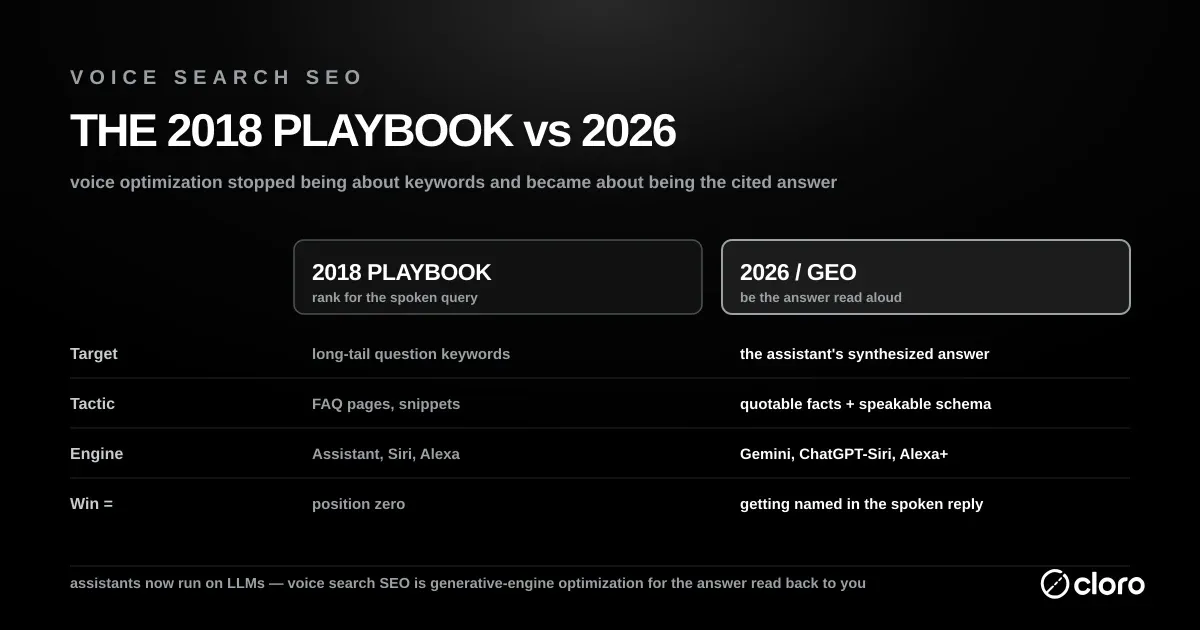
It helps to put the two eras side by side, because almost every legacy voice search SEO tactic maps onto a different 2026 equivalent. The intent behind each old tactic still holds; the mechanism it targeted has moved.
The 2018 voice search SEO pipeline
The classic playbook assumed a deterministic chain. You wrote a concise, ~40-word answer, marked it up with schema, and tried to win the featured snippet, because the snippet was the single result an assistant read aloud. The data backed it at the time: Brian Dean’s 2018 Backlinko study, as cited by Improvado, found 40.7% of voice search answers came from featured snippets.
Reading level mattered because a text-to-speech engine literally voiced your sentence. Conversational long-tail keywords mattered because spoken queries are longer and more natural than typed ones. Every tactic pointed at one deterministic ranking layer.
What replaced it
In 2026 that chain is gone. The assistant hands the spoken question to a language model, and the model composes an answer from many retrieved pages rather than reading one. So how voice search changed SEO comes down to a single shift: the target moved from a rank in an index to a citation in a generated answer.
You still write clean, quotable answers, but now to be lifted into a synthesis rather than read verbatim. You still care about question phrasing, though as a retrieval signal rather than a keyword match. The work rhymes with the old playbook; the surface it lands on is entirely new.
What search engine does Siri use?
Short answer, because people ask it as a voice query: in 2026 Siri answers in layers. Apple handles device actions and simple facts itself. For general knowledge, Apple Intelligence routes the question to ChatGPT with the user’s permission. Traditional web results have historically come from Google.
For voice search SEO, the layer that matters is the middle one. Being “the answer Siri gives” increasingly means being the brand or source ChatGPT names, not holding a classic search position. If your product is invisible in ChatGPT’s answers, it is invisible to a growing share of Siri users. Where you rank in a conventional index no longer decides it.
What search engine does Alexa use?
Amazon’s Alexa+, its generative revamp, composes answers with a large language model rather than reading a single search hit. For open-web fallback, Alexa has historically leaned on Bing.
The direction is the same as Siri’s. The spoken answer is generated, not retrieved verbatim. So what determines whether your brand is mentioned is your presence in the model’s sources, not a single ranking position.
The upshot across every assistant: there is no “voice search engine” left to rank in. There are language models composing answers, and there are the sources those models cite. Voice search SEO optimizes for the sources.
From the answer box to the AI answer
The clearest way to see the shift is to trace one feature. For a decade, the prize in voice search was Google’s answer box (the featured snippet), the single result Assistant would read aloud. Winning it was a well-understood game: structured content, a direct answer in ~40–50 words, the right schema.
That box has been absorbed into the AI Overview and its conversational sibling, AI Mode. Where a spoken query once returned one snippet from one page, it now returns a synthesized answer built from many pages. In our own SERP feature measurements, AI Overviews now appear on the majority of the commercial and conversational queries that voice assistants field. The “one snippet, read aloud” model is being replaced by “one synthesized answer, assembled from several sources”, which is a fundamentally different optimization target.
Voice, conversational, and AI search have converged
It is worth naming the convergence directly, because it dissolves three marketing categories into one. Voice search, conversational search, and AI search are now the same surface approached from different input methods. A spoken question, a typed conversational question, and a prompt to ChatGPT all hit a language model and all return a synthesized, cited answer. The optimization work is identical across all three; only the microphone is different.
This is why the smart move is not to build a separate “voice strategy.” It is to do the AI-answer work once (get named, get cited, keep your facts current across the engines) and let it pay off across voice, chat, and search simultaneously. The convergence is also why voice commerce now runs on the same recommendation layer as text: when an assistant is asked to recommend a product, it draws on the same AI shopping surface we measured separately.
What the AI engines actually do with spoken questions
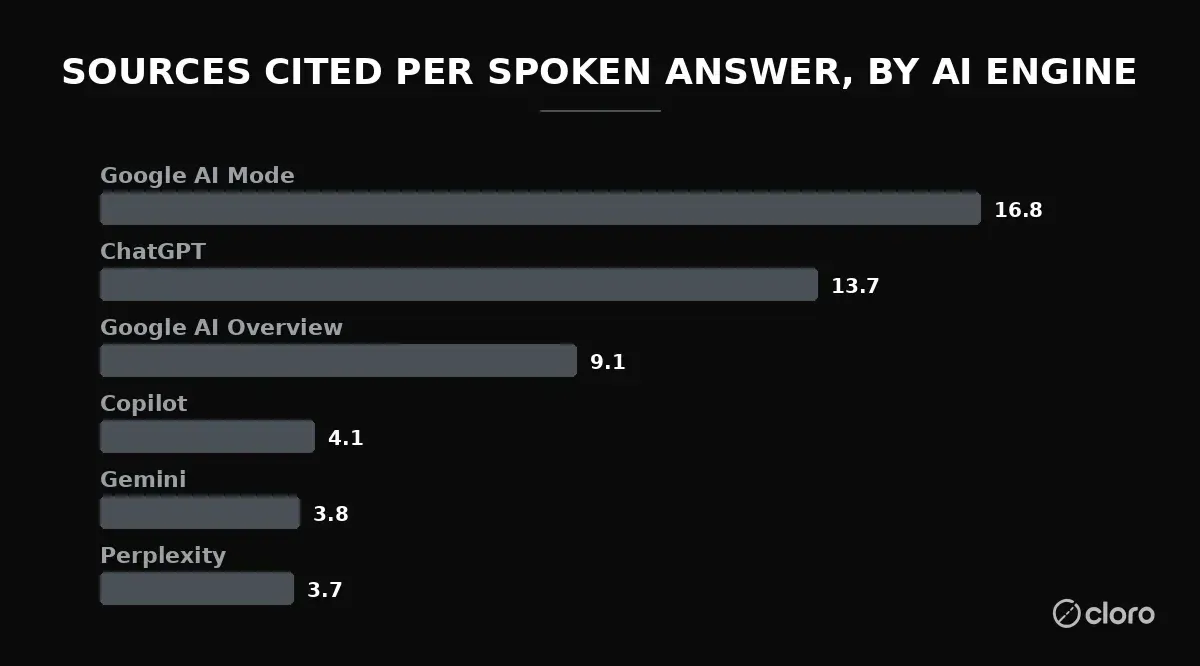
To ground the thesis, we ran the test. We put ~1,900 spoken-style questions through the six AI engines that back today’s assistants, via cloro’s monitoring, and measured what came back. These were the full-sentence, conversational phrasings people actually speak: “what’s a good beginner running watch”, “how do I clean a front-load washer”.
Every engine answered essentially every question. Not “50% of searches by 2020”, but 100% of spoken-style questions, answered right now:
| Engine | Answered | Avg. sources behind the answer |
|---|---|---|
| Google AI Mode | 100% | 16.8 |
| ChatGPT | 100% | 13.7 |
| Google AI Overview | 98% | 9.1 |
| Microsoft Copilot | 100% | 4.1 |
| Gemini | 100% | 3.8 |
| Perplexity | 100% | 3.7 |
Two findings matter for optimization.
First, the “is voice search dead?” question is settled by the answer rate. The zombie statistic (“50% of all searches will be voice by 2020”) was wrong on timing and, more importantly, on framing. The interesting number is not how many people speak their queries; it is that the AI engines now answer effectively 100% of conversational questions with a synthesized response. The answer surface is universal. What is contested is whose sources fill it.
Second, the spoken answer is built from surprisingly few sources, which raises the stakes of each citation. A voice assistant reads back one answer. On the leaner engines that back major assistants, Gemini (3.8 sources on average) and Perplexity (3.7), that spoken answer is assembled from roughly four cited pages. Being one of four is a very different, and much higher-stakes, target than being one of the ten blue links. On the deeper engines (AI Mode at 16.8, ChatGPT at 13.7) there is more room, but also more competition for a mention. Either way, the unit of victory is a citation in the answer, not a rank. Our LLM citations study maps how deep each engine’s citation list runs, and which sources fill it.
The 2026 voice search SEO playbook
The tactics follow directly from the data. Voice search SEO in 2026 means optimizing to be one of the sources an AI answer is built from. Here are the five moves that matter, in priority order.
Write answers to spoken questions
Use the full, conversational question as a heading and put a tight, quotable answer directly beneath it. LLMs lift clean, self-contained answer passages. Buried answers don’t get cited.
To find the questions, look for the three traits Neil Patel’s guide lists for voice queries: long-tail (more than three words), conversational (“where’s the nearest coffee shop” rather than “coffee shops near me”), and phrased as a question. A keyword tool’s question filter gives you the typed versions; your support inbox and sales calls give you the spoken ones.
This is the same question-phrase discipline that powers modern keyword research. The difference is that the phrase is now a retrieval signal, not a ranking key. A good rule of thumb: if a sentence can’t stand alone when quoted out of context, it won’t survive being lifted into a synthesized answer.
Add speakable schema
Mark your best answer passages with speakable schema so assistants can identify the read-ready sentence. speakable is a schema.org property on WebPage that flags, via CSS selectors or XPath, the sentences best suited to be read aloud. It is a signal, not a guarantee. But it is cheap, and it aligns with how LLM-backed assistants hunt for quotable text.
Earn presence in the sources AI cites
The answer is assembled from independent reviews, community discussion, and authoritative reference pages far more than from brand marketing. Being discussed and reviewed off your own site is what gets you into the answer. This is the part of voice search SEO that most resembles digital PR: the goal is third-party corroboration, because a model trusts a claim it sees echoed across several independent sources more than one it reads only on your homepage.
Win local voice search SEO
Treat “near me” spoken questions as their own surface. Local voice search SEO resolves through localized AI answers and the map pack, not the open-web index. Keep your business profile, hours, and reviews current, because those structured local signals are what an assistant reads back when someone asks for a recommendation nearby. The intent is strong: per Siteimprove, 58% of US consumers have used voice search to find information about a local business, and a Google/Ipsos study cited by Improvado found 76% of people who run a local search on a smartphone visit a related business within a day. If you serve a local market, treat local rank tracking as part of the same voice search SEO program.
Measure your voice search SEO
You cannot optimize what you cannot see. Track whether your brand is actually named and cited in the AI answers across engines, for the questions your customers ask. That measurement loop is what turns voice search SEO from guesswork into a program, and it is exactly what cloro is built to do.
What are the limitations of voice search?
The main limitation is that a voice assistant speaks one answer. A typed search shows a page of results the user can compare; a spoken answer gives the listener no list to scan and usually no source to click. For the user, that means trusting the synthesis. For a brand, it means there is no position two: you are in the answer or you are not.
The data above sharpens this. On Gemini and Perplexity, that one answer comes from about four cited pages, so the sources behind it are few. And because each assistant routes to a different model, the same spoken question can get different answers on different devices. Neither limit goes away with better content, which is why measuring presence per engine matters more for voice than for typed search.
Voice search SEO metrics that actually matter
If the unit of victory is a citation, the metrics you track have to change too. The old voice search SEO scorecard (keyword rankings, snippet ownership, “position zero”) measures a layer that no longer reads answers aloud. The 2026 scorecard measures presence inside the generated answer.
Three metrics carry the most weight. Mention rate is the share of relevant spoken-style questions where your brand appears in the answer at all, the baseline signal that you’re part of the conversation before competitors are. Citation share is how often your pages are among the sources the answer cites, versus competitors. It matters most on the lean engines, where the engine table above puts Gemini (3.8 sources) and Perplexity (3.7) build each answer from roughly four cited pages. Answer accuracy is whether the model describes you correctly when it does mention you, because a confident wrong claim is its own problem.
These three move independently. You can hold a high mention rate while a competitor quietly owns citation share, or be cited accurately on one engine and misdescribed on another. That is why single-engine spot-checks mislead: a spoken answer routes through whichever model backs the assistant a given user holds, so voice search SEO has to be measured per engine, not in aggregate. Tracking all three across the six engines, for the exact questions your customers speak, is what turns the playbook above into something you can actually manage.
How to monitor your voice-answer visibility
Because voice answers are assembled from the AI engines rather than from a rankable index, the way to measure “voice search visibility” is to measure your presence on those engines directly. cloro monitors ChatGPT, Gemini, Google AI Overview and AI Mode, Copilot, and Perplexity, and for any question you care about returns whether your brand was mentioned, which sources the answer cited, and how that shifts by engine, country, and over time. That is the AI visibility tracking workflow, applied to the questions people speak. That is the report to run if you want to see which sources are winning the spoken answer in your category, and whether you’re one of them.
What does it cost to track voice-era answers?
Semrush and Ahrefs track featured snippets (the surface voice assistants read from) at per-seat prices; observing answers directly prices per call. cloro’s Free tier ($0, 500 credits a month) covers a weekly snippet-and-AI-answer check on a small query set at 3 to 5 credits per call.
Methodology
The measurement draws on cloro’s monitoring corpus: 1,908 responses (≈318 per engine across Google AI Mode, ChatGPT, Google AI Overview, Copilot, Gemini, and Perplexity) to a set of spoken-style, conversational questions spanning everyday how-to, product-research, and general-knowledge intents. “Answered” is the share of prompts that returned a substantive response; “sources behind the answer” is the mean number of cited sources per response.
The corpus skews toward US-market, English, commercial-adjacent questions, so treat the point estimates as cloro-corpus signals. The directional findings (universal answer rates, and lean sourcing on Gemini/Perplexity vs deep sourcing on AI Mode/ChatGPT) hold up across prompt mixes. The assistant-integration details (Assistant→Gemini, Siri→ChatGPT, Alexa+ generative, Alexa’s Bing fallback) reflect each platform’s publicly stated direction as of mid-2026; verify the current state against each vendor before making product claims.
For a broader view of which engines mediate AI answers, see our guide to the AI search engines.

About the author
Ricardo Batista
Founder, cloro
Ricardo is one of the founders and engineers behind its SERP and AI-search scraping infrastructure. Before cloro he scaled a financial comparison site to $7M ARR and ran the full-country operations of a unicorn to $65M ARR, then went back to building. He writes about search engine scraping, generative-engine optimization, and turning live search and AI-answer data into something teams can act on.
Frequently asked questions
Is voice search still relevant in 2026?
More than ever, but not in the way the old statistics claimed. The '50% of searches will be voice by 2020' prediction never happened. What did happen is that the assistants people speak to became large language models. Google Assistant is being replaced by Gemini, Siri routes questions to ChatGPT, and Amazon's Alexa+ is generative. So voice queries now resolve to AI answers. In cloro's testing, six AI engines answered 100% of ~1,900 spoken-style questions. Voice search optimization is now the same discipline as AI-answer optimization (GEO).
What search engine does Siri use?
As of 2026, Siri answers in layers. Simple factual and device queries are handled by Apple's own systems; general knowledge questions are increasingly routed to ChatGPT via Apple Intelligence, with the user's permission; and web results have historically been served by Google. The practical takeaway for optimization: to be the answer Siri speaks, you increasingly need to be cited by ChatGPT, not just ranked #1 in a traditional index.
What search engine does Alexa use?
Amazon's newer Alexa+ is generative. It composes answers with a large language model rather than reading a single search result. Alexa has historically used Bing as its web-search fallback for open-web queries. So 'ranking for Alexa' in 2026 means being present in the sources its language model draws on, not just holding a Bing position.
How do you optimize for voice search in 2026?
Treat it as AI-answer optimization. (1) Write content that directly answers spoken-style questions (full-sentence questions as headings, concise answers right beneath them). (2) Add speakable schema where appropriate so assistants can identify the readable answer. (3) Earn presence across the sources AI engines cite (independent reviews, community discussion, authoritative reference pages), because the spoken answer is assembled from those. (4) Monitor whether you're actually named and cited in AI answers, which is the only way to know if the work is landing.
What are the limitations of voice search?
A voice assistant speaks one answer instead of showing a list of results, so the listener cannot compare sources and a brand is either in the answer or absent. On lean engines like Gemini and Perplexity, that answer is built from about four cited pages, and different assistants route to different models, so the same spoken question can get different answers on different devices.
What is speakable schema?
`speakable` is a schema.org property (on `WebPage`) that marks the specific sentences on a page best suited to be read aloud by a voice assistant, via CSS selectors or XPath. It was introduced for news but applies to any concise, answer-shaped content. It doesn't guarantee selection, but it signals to assistants which passage is the spoken-ready answer, which is useful now that those assistants are LLM-backed and looking for clean, quotable text.
How can I track my voice and AI-answer visibility?
cloro monitors the AI surfaces voice assistants read from (ChatGPT, Gemini, Google AI Overview and AI Mode, Copilot, and Perplexity) and reports whether your brand is mentioned, which sources the answer cited, and how that changes over time and by location. Because voice answers are assembled from those surfaces, tracking them is how you measure voice-search visibility in 2026. See the AI visibility tracking use case.
Related reading
LLM Citations: How Each AI Engine Cites Sources (Study)
Across six AI engines and six verticals, citation depth varies ~20×: Google AI Mode averages 15–22 sources per answer, ChatGPT/Gemini/Copilot land around 4–8, and Perplexity ranges from ~4 down to literally zero depending on the topic. Reddit sits top-2 in every vertical. AI Overview decides whether to answer at all: it triggers on 98% of shopping queries and 3% of dining.
What is AI SEO? 2026 Definition + Platforms
AI SEO is the practice of structuring content so AI engines like ChatGPT, AI Overviews, and Perplexity cite it as a source. Learn the retrieval factors that drive citations and the step-by-step implementation.
What Is Generative Engine Optimization (GEO)?
Generative engine optimization helps AI engines cite your brand. Learn GEO ranking factors, content structure, schema, measurement, and tools.