
LLM Citations: How Each AI Engine Cites Sources (Study)

On this page
Every conversation about “getting cited by AI” skips the first question. What does an LLM citation even look like, and how many does each engine attach? The answer varies by an order of magnitude between engines. It also shifts dramatically depending on what you ask about.
LLM citations are the source links an AI answer engine attaches to its response. They are the receipts: the evidence trail a model shows for what it just told you.
For any brand, they are also the scoreboard. If your domain is in the LLM citations, the engine used you to build the answer. If it isn’t, you are invisible to that engine on that prompt.
cloro parses LLM citations for a living, so we ran the numbers. This study covers ~13,000 AI answers across six engines (ChatGPT, Google AI Overview, Google AI Mode, Microsoft Copilot, Gemini, and Perplexity), spanning six topic verticals: commerce, brand-intent, travel, voice-assistant queries, restaurants, and a cross-category product panel. For every answer we parsed the full citation list. Here is the anatomy of how large language models actually cite.
Citation anatomy: what counts, and why the format decides if it’s trackable
What counts as an LLM citation
An LLM citation is any source the engine attaches to a specific answer. It is not the same as a link buried in a training set. It is a live, per-answer reference the model surfaces to justify what it said. In practice that takes four shapes: a clickable pill, a numbered footnote, a source card, or a span of grounded metadata.
The distinction matters for measurement. A brand mention inside the answer text is not an LLM citation. A citation points at a URL you can attribute to a domain. That domain-level attribution is what makes LLM citations countable, and what makes absence from them measurable.
Two engines can cite the same fact and disclose it differently. One shows a clickable source card. Another hides the reference in grounded metadata a human never sees. Both count here as LLM citations, because both name a retrievable, domain-attributable source.
The six citation formats, engine by engine, and why parsing them is the hard part
Each engine exposes its sources differently, and the format decides whether the LLM citations are machine-readable at all:
| Engine | Citation format | Placement | Machine-readable? |
|---|---|---|---|
| ChatGPT | Citation pills backed by a sources array | Inline + end-of-answer | Yes — structured array |
| Perplexity | Inline numbered footnotes [1][2] | Inline, tied to a source list | Yes — when present |
| Gemini | Grounded-source metadata | Attached to grounded spans | Yes — grounding metadata |
| Google AI Overview | Source cards | Right-side / inline cards | Yes — card links |
| Google AI Mode | Inline citation markers | Throughout the answer | Yes — dense inline links |
| Copilot | Numbered superscripts + source list | Inline + footer | Yes — source list |
Each of cloro’s engine product pages (ChatGPT, Gemini, AI Mode, AI Overview, Perplexity, Copilot) documents the exact response fields. What matters for this study is that all six expose something parseable. That is what lets us count and categorize LLM citations at scale, whether you’re building your own parser or auditing how much of a vendor’s tracker actually reaches the source list.
The format gap matters more than it looks. A pill or a numbered footnote is easy to read off. Grounded-source metadata sits deeper in the API response. So the same LLM citations a reader skims in a second can take real engineering to extract programmatically, which is why most rank trackers never attempt it, and why cloro’s pipeline normalizes all six formats into one parsed structure instead of stopping at the visible pills.
Citation depth varies ~20× by engine
The single biggest finding: engines disagree wildly on how many sources an answer needs. Averaged across all six verticals:
Google AI Mode is the citation maximalist. It attaches roughly 15–22 sources per answer depending on the vertical, about 3× what ChatGPT, Gemini, or Copilot return. AI Mode’s design casts a wide net: many sources, each carrying proportionally less weight. If your domain is in the retrievable set at all, AI Mode is the engine most likely to surface it. But being one of 20 LLM citations is very different from being one of 4.
ChatGPT, Gemini, and Copilot are selective. All three cluster around 4–8 sources per answer. These engines make sharper choices about what to cite, which means each citation carries more weight. Being included is harder.
Perplexity is the citation minimalist, sometimes down to zero. Its ~1.3 average hides enormous topic variance (below). Perplexity often produces a confident, named answer with no LLM citations at all. That is the hardest situation for anyone trying to monitor or influence AI presence: there is nothing to appear in.
The same engine cites differently by topic
Averages lie here, because LLM citations are strongly topic-dependent. The same engine that cites 20 sources for one query cites 4 for another. Here’s the full matrix of average citations per answer, engine × vertical:
| Engine | Commerce | Brand | Travel | Voice | Restaurants | Product panel |
|---|---|---|---|---|---|---|
| AI Mode | 14.9 | 7.7 | 19.6 | 20.4 | 21.6 | 21.6 |
| AI Overview | 8.0 | 6.3 | 11.5 | 14.3 | 9.7 | 13.6 |
| ChatGPT | 4.9 | 3.0 | 6.5 | 6.9 | 7.7 | 6.2 |
| Copilot | 7.7 | 4.9 | 4.9 | 7.1 | 8.0 | 6.9 |
| Gemini | 6.4 | 4.0 | 7.5 | 3.6 | 7.7 | 4.5 |
| Perplexity | 2.3 | 0.6 | 0.9 | 3.8 | 0.0 | 0.01 |
Two patterns jump out. First, brand-intent queries suppress citations across every engine. When someone asks “is [brand] legit,” models cite fewer sources (ChatGPT 3.0, AI Mode 7.7) than for any other topic, and they pull from a narrower, complaint-weighted source set. Second, Perplexity’s zero. For dining (0.0) and cross-category product recommendations (0.01), Perplexity answers with essentially no citations, while for voice-assistant and finance queries (3.8) it does attach sources. Whatever gates Perplexity’s citation surface, it’s topic-driven, not a global setting.
The takeaway: on brand-intent queries, expect a narrower, complaint-weighted citation set rather than your own site, so watch review and complaint sources directly instead of waiting for a citation to show up there. On Perplexity’s zero-citation topics, there’s no citation surface to monitor at all, so track your presence in the answer text itself, not just the citation list.
AI Overview decides whether to answer at all
There’s a second axis the citation counts hide: AI Overview frequently declines to generate an answer. Its trigger rate (the share of queries where it produced an AI Overview at all) swings from near-total to almost nothing:
For shopping and voice-assistant queries, AI Overview answers almost always (98%). For local dining, it answers 3% of the time. Google defers to the local pack instead. So “does my domain get cited in AI Overview” has a prerequisite question: does AI Overview even trigger for my query class? For some verticals, the answer is mostly no. (Every non-Google engine in the study answered 100% of prompts regardless of topic; only AI Overview gates.) The AI Overview Trigger Index breaks this down by intent, and AI Overviews Around the World shows how both trigger rate and citation depth shift across 15 markets.
Who actually gets cited: the source anatomy
Count aside, which domains do engines cite? Aggregating every citation across the corpus, two sources form a universal backbone. Each vertical then has its own authority layer. cloro now runs this count weekly for software categories on What AI cites, where the same long-tail shape holds: a modest head, and a majority of cited domains appearing exactly once.
The universal backbone: Reddit and YouTube. Reddit is a top-2 cited domain in every single vertical we measured: 22% of restaurant answers, 19% of commerce, 18% of travel, 16–19% elsewhere. YouTube is #1 in commerce (19%) and voice (19%). User forums and video, the two source types classic SEO underweights most, are the connective tissue of AI citations. We’ve covered Reddit’s citation dominance in depth separately; this study confirms it holds across every topic, not just a few. LinkedIn never joins that backbone: its citation share fell 65% in six months while YouTube’s rose.
Why these two? Both are engines of first-hand, recent, high-volume text: Reddit threads read as unvarnished user experience, and YouTube captions give models spoken, demo-style detail.
AI systems lean on that kind of content when they assemble LLM citations. It answers the did-someone-actually-use-it question a marketing page never can. The lesson for GEO is blunt: earn presence where real users talk, or watch the LLM citations route around you.
Each vertical has a distinct authority layer. Below the backbone, the cited domains are topic-specific and reveal what each engine treats as authoritative:
| Vertical | Signature cited sources (beyond Reddit/YouTube) |
|---|---|
| Commerce | RTINGS (16%), PCMag, CNET, Tom’s Guide, TechRadar, Wired — the review-tech press |
| Travel | Expedia (14%), TripAdvisor (13%), Hotels.com, Condé Nast Traveler, Booking.com |
| Voice / finance | NerdWallet, Healthline, Mayo Clinic, Experian, Bankrate — YMYL finance + health |
| Restaurants | OpenTable (13%), TimeOut, The Infatuation, Michelin, Eater city editions |
| Brand intent | Trustpilot, BBB, ConsumerAffairs — review + complaint boards |
| Local (all) | google.com / Maps — heavy in travel (16%) and dining (19%) as a grounding source |
The practical read: there is no single “get cited by AI” playbook. Landing in commerce answers means being reviewed by RTINGS and covered on tech YouTube. Landing in travel answers means presence on Expedia and TripAdvisor. Landing in dining answers means the local Eater and TimeOut “best-of” lists. The engines are drawing from different authority sets per topic, and your GEO strategy has to match the vertical you compete in.
Each engine cites a different web
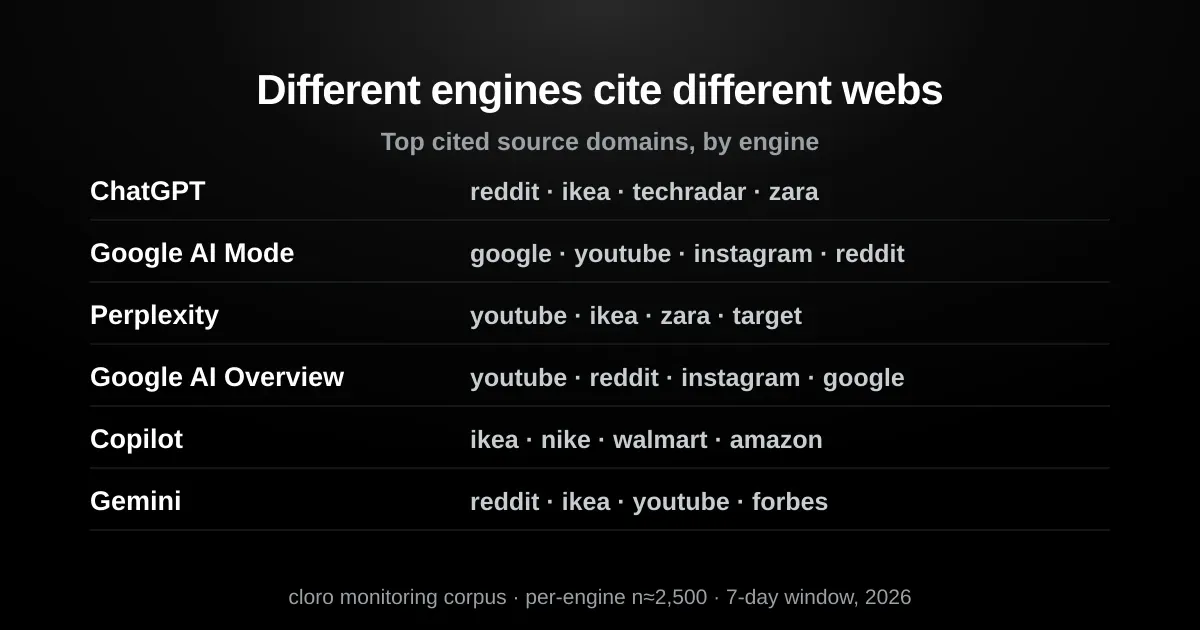
The vertical view above holds across engines. Cut the same corpus the other way, by engine rather than by topic, and a second pattern appears: the engines don’t just cite different amounts, they reach for different domains. Aggregating the most-cited source domains per engine over a complementary parse of the live monitoring corpus (roughly 2,500 answers per engine over a 7-day window), the top lists barely rhyme:
| Engine | Most-cited source domains |
|---|---|
| ChatGPT | reddit.com, ikea.com, techradar.com, whowhatwear.com, zara.com, apple.com, nike.com |
| Google AI Mode | google.com, youtube.com, instagram.com, reddit.com, facebook.com, linkedin.com, ikea.com |
| Perplexity | youtube.com, ikea.com, zara.com, target.com, shopify.com, hm.com, nike.com |
| Google AI Overview | youtube.com, reddit.com, instagram.com, facebook.com, google.com, ikea.com, quora.com |
| Copilot | ikea.com, nike.com, walmart.com, amazon.com, apple.com, zara.com, alibaba.com |
| Gemini | reddit.com, ikea.com, youtube.com, apple.com, forbes.com, pcmag.com |
- ChatGPT is a Reddit-and-brands engine: community opinion (reddit.com is its #1 source) stacked with retail and category-media pages.
- Perplexity is video-first, with youtube.com leading by a wide margin before it reaches for retail.
- Copilot is retail-only, the outlier: its top domains are almost purely commerce, with no Reddit and no social platforms in the list at all. Where every other engine surfaces community content, Copilot goes straight to the store.
- Gemini leans Reddit plus tech media, first reddit.com, then an Apple/Forbes/PCMag editorial tilt.
And Google’s AI engines cite Google’s own properties. Google AI Mode’s two most-cited domains are google.com and youtube.com (YouTube being Google-owned), and AI Overview cites youtube.com most with google.com prominent, while google.com appears in the top domains of no non-Google engine (ChatGPT, Perplexity, Copilot, Gemini). We can only report the pattern, not the intent, but the effect is real and it’s a per-engine GEO consideration: on Google’s surfaces, Google’s own properties are part of the citation mix in a way they aren’t anywhere else. The one universal thread is Reddit and YouTube near the top of most lists; past that shared backbone, each engine adds its own layer, so a domain that’s a top source in one engine can be absent from another’s entirely.
Why citations diverge from rankings
The reason all this matters for SEO teams: LLM citations are not a re-skin of the Google top 10. The most-cited AI sources (Reddit, YouTube, RTINGS, NerdWallet, OpenTable) are frequently not the pages ranking #1 for the same query in classic organic search. AI engines retrieve and synthesize from a source set weighted toward forums, video, review aggregators, and category authorities. They then attach LLM citations drawn from that set.
That divergence is the whole case for generative engine optimization as a discipline distinct from SEO. A page can rank first on Google and never enter an AI answer; a Reddit thread that ranks nowhere can be cited by four engines at once.
Optimizing for LLM citations means optimizing for a different retrieval system with different favorite sources. That is why measuring AI share of voice requires watching the citation surface directly, not inferring it from rankings. (And none of it works if AI crawlers can’t reach your pages in the first place: the supply side of citations.)
What it actually takes to monitor your LLM citations
The operational takeaway falls out of the data. LLM citations differ by engine and by topic, in depth, format, trigger behavior, and favored sources. So you can’t infer your AI presence from any single engine, and a general rank tracker won’t capture it either. You have to:
- Run your priority prompts across all six engines. The citation-heavy ones (AI Mode) and the citation-shy ones (Perplexity) tell you different things.
- Parse each answer’s full citation list: pills, footnotes, source cards, and grounding metadata normalized into one structure.
- Track whether your domain appears, per engine and per prompt, over time, along with which third-party sources are cited in your place.
- Match the vertical’s authority layer. Being absent from RTINGS (commerce) or Eater (dining) shows up as citation absence long before it shows up in traffic.
That normalization across engines is exactly what cloro’s AI visibility tracking does, running the same pipeline that produced this study against your domain. For the tooling around it, the LLM visibility tracking tools comparison covers the options.
How to track LLM mentions without building a parser
If you want a dashboard rather than raw data, off-the-shelf trackers do steps 1 to 3 for you. One 2026 roundup lists their entry prices: Otterly AI from $29/month, Peec AI from $95/month, Profound and Semrush AI Toolkit from $99/month, and Ahrefs Brand Radar from $129/month. Before you pick one, check two things against this study: does it cover all six engines, and does it record position in the citation list, not only presence? A tracker that reads only the visible pills will undercount AI Mode, where the list runs to ~20 sources.
How to track your LLM citations over time
Tracking LLM citations is a monitoring problem, not a one-time audit. Engines rewrite answers constantly. A domain cited in ChatGPT this morning can drop out by tomorrow. The only reliable signal is a time series, never a single snapshot.
The workflow itself is simple: pick the prompts your buyers actually type. Run them across every engine on a fixed schedule. Capture the full LLM citations list from each answer. Then diff the results over time: appearances, position in the list, and which rival domains showed up in your place.
The parsing is where most tools stop. Normalizing LLM citations across six formats (pills, footnotes, source cards, grounded metadata) is the hard engineering. That is the exact step cloro’s pipeline is built to handle, at the scale this study required.
One more practical note: measure position, not just presence. Being the 18th of 20 LLM citations in AI Mode is not the same win as being one of ChatGPT’s four. A good tracker records where in the list you land, per engine and per prompt. That is what turns a raw LLM citations feed into a GEO roadmap instead of a vanity metric.
How do you run an accuracy comparison of tools extracting structured citations from AI search responses?
Tools for pulling structured citations from AI search responses fail in different places, which matters most if you’re the one evaluating or building that pipeline rather than just reading the citation counts above. Run the same 20 prompts through each candidate (cloro, a SERP vendor’s AI Overview endpoint from SerpApi or DataForSEO, or your own parser) and score four checks:
- Recall against a manual count. Tools that read only the visible pills miss footnotes and source cards, worst on AI Mode.
- Deduplication.
wwwand bare domain, tracking parameters, and scroll-to-text fragments are one article, not four sources. - Position fidelity. Membership without list position loses whether you led the answer.
- Field-churn survival. Gemini’s grounding response dropped the
groundingChunks/groundingSupportsnames pre-2026 integrations still parse; a DIY parser fails silently as empty citation lists, which looks like a visibility crash.
Accuracy claims without this protocol are marketing; any vendor, cloro included, should show the raw answer next to its parsed output.
Methodology
The study parses citations from ~13,000 successful AI answers captured in cloro’s monitoring corpus between 2026-07-03 and 2026-07-04, across six engines (ChatGPT, Google AI Overview, Google AI Mode, Microsoft Copilot, Gemini, Perplexity) and six topic verticals (commerce, brand-intent, travel, voice-assistant queries, restaurants, and a cross-category product panel), US, English-language. “Average citations per answer” counts parsed LLM citations per triggered response, per engine, within each vertical; the headline per-engine averages are means across the six verticals. Trigger rate is the share of prompts for which an engine produced an answer (only AI Overview varied materially; every other engine answered ~100%). Cited-domain shares are the share of triggered answers in a vertical in which a domain appeared at least once. The per-engine “different web” cut is a complementary parse of the same monitoring corpus (roughly 2,500 answers per engine over a 7-day window), ranking each engine’s most-cited source domains regardless of vertical; it reports domain rank order, not the per-answer citation counts above, so the two views don’t share a scale.
Caveats, stated plainly. This is one measurement from one corpus with a US, English prompt mix skewed toward commercial, brand, and recommendation intents; treat the point estimates as cloro-corpus signals, not universal constants. Citation count is not citation quality. A 2026 benchmark of 14 models running as deep research agents found that even the strongest kept cited links working above 94% of the time and content relevant above 80%, yet reached only 39% to 77% factual accuracy; for GPT-5.4 accuracy fell from 79% to 17% as search depth grew while link quality held above 92%. A 20-source AI Mode answer isn’t necessarily better-grounded than a 4-source ChatGPT one, and being one of 20 LLM citations confers less influence than being one of 4.
The findings hold across verticals and any reasonable prompt weighting: AI Mode’s citation-maximalism, Perplexity’s topic-gated citation surface (down to zero for dining and cross-category product queries), AI Overview’s variable trigger rate, and the Reddit/YouTube backbone beneath vertical-specific authority layers. Citation formats are current as of mid-2026 and change as engines ship UI updates.
If you want this measured continuously for your domain (which engines cite you, how deep in the LLM citations list, for which prompts, and which sources are cited in your place), that’s what cloro’s AI visibility tracking is built for.

About the author
Ricardo Batista
Founder, cloro
Ricardo is one of the founders and engineers behind its SERP and AI-search scraping infrastructure. Before cloro he scaled a financial comparison site to $7M ARR and ran the full-country operations of a unicorn to $65M ARR, then went back to building. He writes about search engine scraping, generative-engine optimization, and turning live search and AI-answer data into something teams can act on.
Frequently asked questions
What are LLM citations?
LLM citations are the source references an AI answer engine attaches to its response: the links, source cards, or numbered footnotes that tell you (and any tool parsing the answer) which pages the model drew on. Different engines expose them differently: ChatGPT renders citation pills backed by a sources array, Perplexity uses inline numbered footnotes, Gemini attaches grounded-source metadata, and Google's AI Overview and AI Mode render source cards and inline citation markers. From a monitoring perspective, the citation list is the single most important part of an AI answer: it's where you find out whether your domain was used to generate the response.
How many sources does each AI engine cite?
It varies enormously. In cloro's study across ~13,000 answers, Google AI Mode averaged 15–22 cited sources per answer. That is the most citation-heavy engine by far. ChatGPT, Gemini, and Copilot clustered around 4–8. Google's AI Overview landed in the middle (6–14) but only when it chose to answer. Perplexity was the most variable: it cited 2–4 sources for shopping and finance queries but effectively zero for dining and cross-category product queries. So 'how many sources' depends on both the engine and the topic.
Which AI engine cites the most sources?
Google AI Mode, consistently. Across all six verticals we tested it averaged the highest citation count, at 15 to 22 sources per answer, roughly 3× what ChatGPT or Gemini attach. AI Mode casts the widest net, which means more chances for any given domain to be included, but each individual citation carries proportionally less weight. Perplexity sits at the opposite extreme, frequently returning answers with no citations at all.
Do AI citations match Google's top 10 search results?
Only partially. AI answers lean heavily on sources that classic search rankings underweight: user forums (Reddit is top-2 in every vertical we measured), video (YouTube), and category-specific authority sites (RTINGS for electronics, NerdWallet for finance, OpenTable and Eater for dining). A page can rank #1 in Google and never appear in an AI citation, and vice versa. That divergence is the core reason GEO (generative engine optimization) is a distinct discipline from SEO: you're optimizing for a different retrieval system with different favorite sources.
Why does Perplexity sometimes cite zero sources?
In cloro's data, Perplexity's citation behavior is strongly topic-dependent. For commerce (2.3 avg citations) and voice-assistant/finance queries (3.8) it does attach sources, but for dining (0.0) and cross-category product recommendations (0.01) it frequently returns a fully-formed answer with no citation trail at all. The model still produces named recommendations. It just doesn't surface where they came from. For anyone trying to influence or monitor their presence, that makes Perplexity the hardest engine to work with on those topics: there's no citation surface to appear in.
How do I track which AI engines cite my website?
You run your priority prompts across every engine on a schedule, capture each answer's full citation list, and track whether your domain appears, per engine and per prompt, over time. Because citation formats differ (pills, footnotes, source cards, grounded metadata), the parsing is the hard part. cloro's AI visibility API normalizes citations across ChatGPT, Google AI Overview, AI Mode, Perplexity, Copilot, and Gemini into one parsed structure, so you get a single citation list per answer regardless of engine. That is exactly the pipeline that produced this study.
How do you track LLM mentions?
Run the prompts your buyers type across every AI engine on a fixed schedule, parse the full citation list from each answer, and record whether your domain appears, where in the list it lands, and which rivals appear instead. You can build that on an API or buy a dashboard: one 2026 roundup lists Otterly AI from $29/month, Peec AI from $95/month, Profound and Semrush AI Toolkit from $99/month, and Ahrefs Brand Radar from $129/month.
Related reading
Brand Protection in 2026: Search and the AI Layer
Across 40 major brands and 6 AI engines (2,400 answers), 31%–72% of triggered answers cited only third-party domains, never the brand's own site. On Perplexity, the brand's own domain is cited in ~0% of answers. Trustpilot, BBB, ConsumerAffairs, and Reddit narrate your brand when you're absent.
Restaurant SEO in the AI Era: Where AI Gets Its Picks
Across 200 dining prompts × 6 AI engines, Google's AI Overview triggered on just 3% of 'best restaurants' queries; it defers to the local pack. Perplexity answered 100% of them but returned zero citations. The picks come from Reddit (22%), Google/Maps (19%), OpenTable (13%), and local 'best-of' lists (TimeOut, The Infatuation, Eater), almost never the restaurant's own site.
Reddit AI Citations Are Declining: What Brands Should Do
Reddit citations on ChatGPT fell 94% in August 2026, in two steps. One lands on the day OpenAI shipped gpt-5-6. Our measurement, and the 2025 precedent.