
What Is Generative Engine Optimization (GEO)?

On this page
Generative Engine Optimization (GEO) is the practice of structuring your content, entities, and technical signals so AI engines can retrieve, understand, cite, and recommend your brand in generated answers.
Traditional SEO tries to earn a position on a results page, while generative engine optimization tries to make your brand part of the answer itself. That means optimizing for retrieval, citation, and synthesis across ChatGPT, Perplexity, Gemini, Copilot, Google AI Overviews, and AI Mode. The discipline is young, but its mechanics are already clear enough to act on: make your pages crawlable, make your claims extractable, define your entities with schema, earn third-party validation, and measure AI visibility directly. Use this guide as the conceptual hub, then apply the tactical GEO checklist page by page.
Where the term generative engine optimization came from
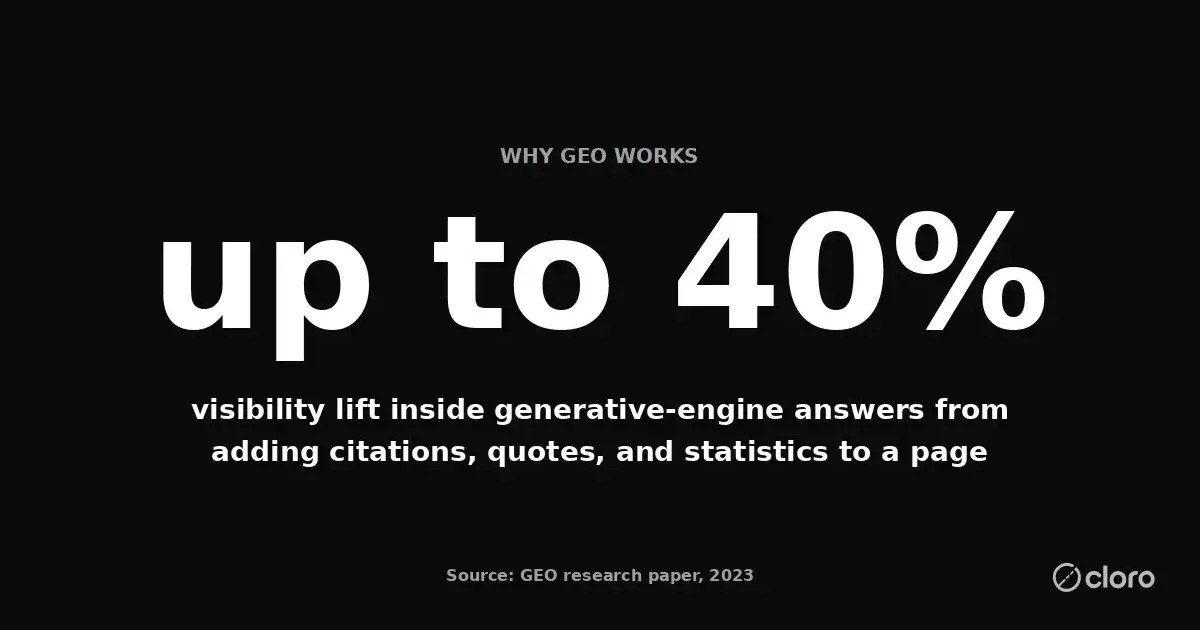
The phrase generative engine optimization was coined in a 2023 research paper by a team from Princeton, Georgia Tech, the Allen Institute for AI, and IIT Delhi, who paired it with a public benchmark called GEO-bench to measure the idea research paper. Their controlled experiments found that content-side changes such as adding citations, quotations, and statistics to a source could raise that source’s visibility inside generative engine answers by up to 40% research paper. That empirical result is the reason generative engine optimization centers on evidence density rather than keyword frequency.
The same research reframed what optimization is even for. Where classic SEO asks how to rank a URL, generative engine optimization asks how to get a passage quoted. The difference matters because an AI engine can surface your facts, paraphrase your definition, or recommend your product without ever sending a click, so the unit of success shifts from the ranked page to the extracted sentence.
GEO vs SEO vs AEO
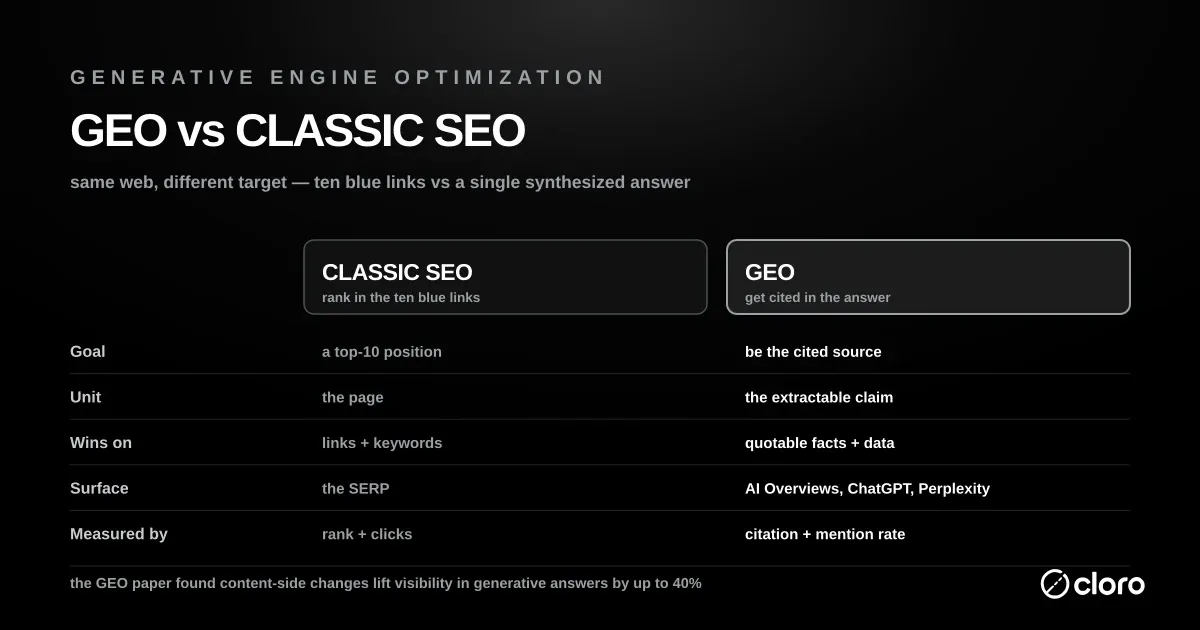
GEO, SEO, and AEO (answer engine optimization) overlap, but they do not optimize for the same surface.
| Discipline | Primary surface | Main goal | Main metric |
|---|---|---|---|
| SEO | Search result pages | Rank and win clicks | Rankings, impressions, clicks |
| AEO | Answer boxes and direct-answer surfaces | Answer a specific question | Featured snippets, People Also Ask, answer inclusion |
| GEO | AI-generated answers | Be cited, synthesized, and recommended | Mention rate, citation rate, AI share of voice |
SEO still matters. AI engines often retrieve from pages that already perform well in traditional search. But ranking is not enough. A page can rank well and still be ignored by a generative answer if it lacks extractable facts, clear entity definitions, or third-party validation.
AEO is closer to GEO because both reward direct answers. The difference is scope. AEO is usually question-and-answer optimization for known surfaces like featured snippets and People Also Ask. GEO is broader: it covers how AI systems retrieve documents, break prompts into sub-queries, select citations, and synthesize final responses.
Is GEO replacing SEO?
No, and Google says so directly. Its guide to optimizing for generative AI features states that “optimizing for generative AI search is optimizing for the search experience, and thus still SEO,” and tells site owners to keep applying foundational SEO practices. Semrush makes the same point from the practitioner side: AI assistants pull from the same web your SEO content lives on, so crawlability, content quality, and backlinks carry over. The “SEO is dead” framing, which Wikipedia’s GEO entry traces to a 2025 New York Magazine headline, gets the relationship backwards. GEO adds a second goal and a second scorecard on top of SEO; it does not remove the first.
What decides whether an engine cites you: question shape, not topic
How often they choose any source at all depends more on the shape of the question than on its subject, which is the single most useful thing we have measured for planning GEO work. Running a frozen basket of queries through five engines, our AI Search Index found engines cited a source on 91.2% of best-in-class answers and 89.8% of buying-guidance answers, against 80.7% of definitions and 83.0% of how-to answers. Across eight verticals citation presence stayed in a tight 82-88% band, so the query archetype moves the citation rate about twice as much as the topic does.
The planning consequence is direct: map your pages onto ranked lists, comparisons and buying guides before worrying about which vertical you are in. A definitional page has to earn its citation with specifics an engine can attribute, because the format starts from behind.
Each stage below is a point where GEO work can tip an engine toward citing you instead of a competitor. Most AI search products run on some form of retrieval-augmented generation (RAG), a technique introduced in a 2020 paper from Meta AI researchers that pairs a language model with a searchable document index research paper. For which domains actually come out of that process, What AI cites publishes every source the engines linked across twelve software categories each week. The exact implementation varies by engine, but the underlying pattern is consistent:
- Query interpretation. The engine interprets the user’s prompt and often expands it into related sub-queries. This is query fan-out.
- Retrieval. It searches indexes, crawled web data, partner data, or live sources for relevant passages.
- Reranking. It filters sources by relevance, authority, freshness, and source diversity.
- Synthesis. It writes a response using the selected passages.
- Citation or mention. Depending on the product, it may cite a URL, mention a brand without a link, or recommend a product directly.
GEO work improves your odds at each step. Clear headings and concise answer blocks help retrieval and passage extraction, while schema and entity consistency help the engine disambiguate who you are. Original data and third-party mentions build the authority that reranking rewards, and fresh updates signal the recency these systems favor.
Core GEO ranking factors
There is no single public generative engine optimization algorithm. But across AI Overviews, Perplexity, ChatGPT search, Gemini, and Copilot, the same factors repeatedly decide who gets cited.
1. Crawl access
If AI crawlers cannot reach your content, they cannot cite it, so crawl access is the foundation of generative engine optimization. Check robots rules for GPTBot, OAI-SearchBot, ClaudeBot, PerplexityBot, Googlebot, and Google-Extended. OpenAI documents that sites which opt out of its OAI-SearchBot crawler will not be shown in ChatGPT’s search answers OpenAI crawler docs, so a single robots.txt line can quietly remove you from an entire engine. Use the AI crawlers guide to decide which agents to allow.
Do not blindly allow every bot. Paywalled content, private docs, and proprietary datasets may need stricter rules. But for public marketing pages, blocking answer-engine crawlers usually trades away future visibility for very little in return.
2. Entity clarity
AI engines need to know what your brand, product, author, and page actually are. Use consistent names, descriptions, sameAs links, author profiles, and Organization schema so the same entity is never described two different ways.
This is where schema markup for AI matters. Google confirms that it uses structured data found on the web to understand the content of a page Google structured data docs, so schema does not magically force citations, but it does give machines a clean map of your entities and their relationships.
3. Extractable answer structure
Engines reward passages they can lift cleanly and quote without edits. Use:
- Question-based H2s and H3s.
- Direct answers in the first 40 to 80 words of a section.
- Short paragraphs.
- Tables for comparisons.
- Bullets for steps, requirements, and checklists.
- Clear definitions for core entities.
If a paragraph only makes sense after reading the entire article, it is weak GEO content. If a paragraph can stand alone as a quoted answer, it is strong GEO content.
4. Topical depth
Thin pages rarely become trusted sources, so generative engine optimization rewards genuine topical depth. You need enough coverage to answer the main question and the adjacent sub-questions a reader is likely to ask next. This matters even more as engines use query fan-out, where one user prompt may trigger five or ten related retrieval queries behind the scenes.
Build clusters. A GEO hub should link to tactical pages like llms.txt, schema markup, AI share of voice, and AI search tracking.
5. Off-site validation
AI engines do not only trust what you say about yourself. They look for supporting evidence: reviews, directories, comparison pages, analyst mentions, customer stories, press coverage, GitHub repos, and citations from trusted publications.
This is the backlink and digital-PR side of GEO. Internal changes can make your content readable, but external mentions are what make it believable. Getting quoted in a respected roundup, listed in a category directory, or referenced in a well-linked comparison often does more for AI visibility than another on-page tweak.
6. Freshness
AI search changes quickly. Engines prefer sources that look current, especially for tools, pricing, product comparisons, legal guidance, and fast-moving technical topics. Keep updatedDate current when the page receives a meaningful refresh.
Freshness is more than a date stamp, though. Refresh the substance too: update statistics, swap outdated tool names, and revise guidance whenever an engine changes how it retrieves or cites. Pages that visibly keep pace with a fast-moving field earn more trust from both readers and models than pages that only edit their timestamp.
How generative engine optimization differs across engines
No two AI engines read the web the same way, so generative engine optimization is really a portfolio of engine-specific bets rather than one universal checklist. Google states there are no special files, AI text files, or schema you need to appear in AI Overviews or AI Mode, and that the same SEO fundamentals of crawlability, quality content, and good page experience still apply Google AI features docs. Strong classic SEO is therefore table stakes for Google’s generative surfaces, even though it is rarely sufficient on its own.
ChatGPT’s search works from a different starting point. It relies on OpenAI’s own OAI-SearchBot crawler, and OpenAI notes that opted-out sites can still appear as navigational links but not as cited search answers OpenAI crawler docs. Perplexity leans on live retrieval with visible inline citations, while Gemini blends Google’s index with its own models. Because each engine weights freshness, authority, and structure differently, a page that dominates one generative engine can be nearly invisible in another, which is exactly why measurement has to span engines instead of trusting a single one.
A practical GEO workflow
Use this generative engine optimization workflow for any page you want AI engines to cite.
Step 1: Pick the prompt set
Start with 20 to 50 prompts:
- Brand prompts: “what does [brand] do?”
- Category prompts: “best [category] tools”
- Use-case prompts: “how to [job your product solves]”
- Comparison prompts: “[brand] vs [competitor]”
- Problem prompts: “how do I solve [pain point]?”
These prompts become your measurement set. Without them, GEO becomes vibes.
Step 2: Audit crawl and extraction
Check whether the page is accessible to AI crawlers, renders core content server-side, has a clean canonical URL, and avoids hiding important facts in images, tabs, modals, or JavaScript-only components.
Add an llms.txt entry for the page if it is part of your canonical AI-readable corpus.
Step 3: Rewrite for answer-first sections
Each major H2 should answer a question. Put the direct answer first, then expand. This helps both AI systems and classic SERP features like featured snippets and People Also Ask.
Step 4: Add structured data
For most content pages, start with Article or BlogPosting schema, Organization schema, author data, and FAQPage schema when the FAQ content is visible. Use Product, SoftwareApplication, HowTo, or LocalBusiness only when the visible page actually supports that type.
Step 5: Strengthen internal links
Link from ranking pages into GEO targets. Use descriptive anchors, not generic “read more” links. The goal is to make the topic cluster obvious to crawlers and readers.
Step 6: Build external validation
Promote the page into the places AI engines already cite: comparison posts, partner directories, GitHub examples, review platforms, community discussions, and industry explainers. This is the backlink work that cannot happen inside the repo but decides whether GEO work compounds.
How to measure GEO performance
Google Search Console (GSC) cannot tell you whether ChatGPT cited your page, and GA4 only captures the visitors who actually click through. Generative engine optimization needs its own metrics, built around answers rather than sessions.
Track these:
- Mention rate: percentage of prompts where the brand appears.
- Citation rate: percentage of prompts where your URL appears as a cited source.
- AI share of voice: your mentions divided by competitor mentions across the same prompt set.
- Sentiment: whether the model describes the brand positively, neutrally, or negatively.
- Source overlap: which third-party pages AI engines cite instead of you.
- Engine variance: how results differ across ChatGPT, Perplexity, Gemini, Copilot, and AI Overviews.
Start with a weekly cadence. Daily checks are useful during launches or crises, but weekly is enough for most programs. If you need a quick prototype, use the AI visibility tracking setup guide. If you need a dashboard, compare LLM visibility tracking tools.
Whatever cadence you pick, hold the prompt set steady between measurements. Changing prompts and pages at the same time makes it impossible to tell whether a shift in citation rate came from your generative engine optimization work or from the engine quietly changing its behavior. Treat the prompt set like a benchmark and only revise it deliberately.
Tools and services for GEO
GEO tools and services fall into three categories:
- Measurement platforms. These track prompts, mentions, citations, sentiment, and competitors. Examples include dedicated AI visibility tools and broader SEO suites with AI features, built for growth and marketing teams that want a dashboard without building one.
- Infrastructure APIs. These return raw AI answer and SERP data so teams can build custom dashboards. This is where cloro fits. Product and data teams use it to build their own visibility tools instead of buying one.
- Optimization services. Agencies and GEO consultants audit content, schema, internal links, and off-site authority, a fit for teams that want GEO work done without hiring in-house.
If you are choosing a vendor, start with GEO services. If you are improving pages yourself, use the GEO checklist.
What does a GEO measurement loop cost?
Two shapes. GEO platforms (Profound, Peec AI, Otterly, AthenaHQ) bundle tracking and dashboards at per-seat prices; the raw loop prices per answer. At cloro’s 5 credits per ChatGPT response and 3 to 4 for the other engines, a weekly 100-prompt sweep across four engines is about 7,000 credits a month, inside Lite ($30/month for 37,500). The takeaway: start with the loop, and buy the platform once the dashboard, not the data, is what you’re missing.
Common GEO mistakes
Most failed generative engine optimization programs share the same handful of mistakes, and each one is avoidable once you recognize the pattern.
Mistake 1: Treating GEO as keyword stuffing
Repeating the same phrase 15 times does nothing here. AI engines need clear entities, direct answers, and supporting evidence, since that combination is what earns a citation, not repetition.
Mistake 2: Shipping schema that does not match visible content
Schema should describe what users can actually see on the page. Google explicitly warns against adding structured data about information that is not visible to the user, even when that information is accurate Google structured data docs. Fake FAQPage, Product, or review markup can create trust problems with both Google and AI systems.
Mistake 3: Measuring only one engine
ChatGPT, Perplexity, Gemini, Copilot, and AI Overviews cite different sources. A brand can win in one engine and disappear in another, so judging your GEO work by a single engine can hide real progress happening elsewhere.
Mistake 4: Ignoring backlinks and mentions
On-page structure makes a page extractable, but external validation is what makes it trustworthy. GEO without digital PR is usually incomplete.
Mistake 5: Expecting instant results
Technical fixes can improve crawlability quickly, but citation patterns move over weeks. Measure before and after, then iterate.
What to do next
Start with one important page. Make it crawlable, answer-first, schema-backed, internally linked, and externally supported. Then track the prompt set weekly.
For a tactical page-by-page process, use the GEO checklist. For measurement, start with AI share of voice and AI search tracking. For vendor selection, compare GEO services.
Generative engine optimization is not a replacement for SEO. It is the next visibility layer built on top of it, and the teams that win will be the ones that make their best content easy for both people and machines to trust.

About the author
Ricardo Batista
Founder, cloro
Ricardo is one of the founders and engineers behind its SERP and AI-search scraping infrastructure. Before cloro he scaled a financial comparison site to $7M ARR and ran the full-country operations of a unicorn to $65M ARR, then went back to building. He writes about search engine scraping, generative-engine optimization, and turning live search and AI-answer data into something teams can act on.
Frequently asked questions
What is GEO?
Generative Engine Optimization (GEO) is the practice of optimizing content to be cited and synthesized by AI search engines like Perplexity and ChatGPT.
Is GEO replacing SEO?
No. Google's own guide to generative AI features says optimizing for generative AI search is still SEO, and AI engines retrieve from the same web that SEO work makes crawlable and authoritative. GEO adds a second goal, being cited inside the answer, and its own metrics such as mention rate and citation rate.
Is SEO dead now with AI?
No. Rankings still drive clicks on queries without an AI answer, and AI engines often retrieve from pages that already perform in traditional search. What changed is that ranking is no longer the only goal: a page can rank and still be left out of the generated answer, which is the gap GEO covers.
What are the ranking factors for GEO?
Citations, authority, structured data, directness, and statistical density.
How do I measure GEO success?
By tracking citation frequency and 'Share of Model' rather than traditional traffic metrics.
What is RAG in the context of GEO?
RAG (Retrieval-Augmented Generation) is the core mechanism of AI search. GEO focuses on making your content easy for RAG systems to retrieve, read, and synthesize into answers.
How does GEO impact content velocity?
By focusing on concise, fact-dense, and structured content, GEO can make content production simpler. It prioritizes clarity and machine-readability over long-form keyword stuffing, which can speed up publishing.
Related reading
What is AEO? Answer Engine Optimization Explained (2026)
Master Answer Engine Optimization (AEO) in 2026. Learn how to optimize for ChatGPT, Perplexity, and Google AI Overviews, and how AEO differs from SEO.
AI Search Engines: 10 Tools Compared for 2026
Compare the best AI search engines for research and developers: ChatGPT, Perplexity, Gemini, Copilot, Brave, You.com, Exa, Tavily, and more.
Schema Markup AI: Structured Data That Gets Cited
Learn how schema markup for AI works: JSON-LD, entity links, Article, FAQ, Product, and Organization schema that help AI cite your pages clearly.