
Is Web Scraping Legal? 7-Country 2026 Compliance Guide

On this page
Short answer: yes — scraping public web data is legal in the US and EU, provided you respect the CFAA, GDPR, a site’s robots.txt, and reasonable rate limits. Scraping publicly available data is generally permissible, much like reading a book in a public library. What matters is how you do it. The whole website scraping legal question turns on what data you collect, how you access it, and the jurisdiction you operate in.
This June 2026 update adds a seven-jurisdiction matrix (US, EU, UK, Canada, Australia, Japan, Brazil) and the four cases that anchor the framework: hiQ Labs v. LinkedIn, Meta v. Bright Data, Van Buren v. United States, and Clearview AI.
Is website scraping legal? Start with the core principles
The distinction is about risk, not just legality. Think of it as walking through an open front door versus picking the lock.
What determines scraping risk
The legal risk of a scraping project sits on a spectrum, and three factors decide where you land:
- The type of data. Public business data like prices and SEO keywords, or personal data like names, emails, and photos?
- The access method. Data openly visible to any visitor, or data behind a login, paywall, or CAPTCHA?
- The impact on the site. A considerate visitor, or a scraper overwhelming the server with rapid-fire requests?
The most critical distinction in the “is website scraping legal” debate is whether the data is public or private. Courts have consistently ruled that accessing information available to any internet user without a password is not a crime.
Legal risk factors at a glance
The table below breaks down the factors that set your project’s risk level.
| Risk Factor | Low Risk (Generally Permissible) | High Risk (Potential Legal Issues) |
|---|---|---|
| Data Type | Publicly available business data (e.g., SERP results, product prices) | Personal data (names, emails), copyrighted content, data behind a login |
| Access Method | Accessing open, public-facing pages without logging in | Bypassing CAPTCHAs, using stolen credentials, or circumventing IP blocks |
| Website Rules | Respecting robots.txt directives and rate limits | Ignoring robots.txt, aggressively hammering servers, causing downtime |
| Data Usage | Internal analysis, competitive intelligence, SEO monitoring | Republishing copyrighted material, creating a competing commercial product |
The takeaway: most SEO and competitive-intelligence scraping (prices, SERPs, listings) sits in the low-risk column by default. Risk creeps in only when a project adds a login, personal data, or a copy-paste of someone else’s writing.
How the CFAA shapes website scraping legality
In the United States, one law dominates the conversation: the Computer Fraud and Abuse Act (CFAA). Passed in 1986 to fight computer hacking, its dated language became the central battleground for scraping. The whole debate hangs on two phrases in the statute: accessing a computer “without authorization” or in a way that “exceeds authorized access”, per the text codified at 18 U.S.C. § 1030.
For years, companies argued that if their Terms of Service said “no scraping,” then any scraping was automatically unauthorized. That view would have made collecting public information a potential federal crime — like a public park putting up a “no photography” sign and calling every photo a trespass.
hiQ Labs v. LinkedIn: publicly accessible data isn’t CFAA hacking
The tension came to a head in hiQ Labs v. LinkedIn. HiQ, a small analytics firm, scraped public LinkedIn profiles to give employers workforce insights. LinkedIn sent a cease-and-desist letter, claiming this broke the CFAA. HiQ argued the data was public and that LinkedIn was crushing a competitor.
The case reached the Ninth Circuit, which sided with hiQ. As the Electronic Frontier Foundation summarizes the ruling, using automated scripts to access publicly available data is not “hacking,” and neither is violating a site’s terms of use. If data is publicly accessible and no technical barrier stands in the way, accessing it isn’t “unauthorized” under the CFAA.
The Ninth Circuit’s ruling effectively stated that the CFAA does not let website owners unilaterally forbid the scraping of data that is otherwise accessible to the public.
The Supreme Court sharpened the point in Van Buren v. United States (2021). The Court held that a person “exceeds authorized access” only by obtaining information from areas of a computer that are off-limits to them — not by using authorized access for a disapproved purpose.
For scrapers, that forecloses the theory that a mere terms-of-service breach is a computer crime; the CFAA now requires an actual bypass of an access control. The Ninth Circuit reaffirmed hiQ in 2022 on that narrower reading.
What “unauthorized access” means today
After hiQ and Van Buren, the line for SEO and data teams is a technical gate, not a site’s fine print. In practice:
- Public data is fair game. Scraping data visible to any anonymous user — search results, product prices, news articles — generally does not violate the CFAA.
- Authentication is the barrier. The moment you log in or use credentials to reach data, scraping it moves into unauthorized-access territory.
- Bypassing technical blocks is a no-go. Defeating CAPTCHAs, IP blocks, or bot detection can be read as gaining unauthorized access.
That distinction is what keeps most SERP and pricing scraping on solid legal ground. The CFAA is an anti-hacking law, not an anti-scraping one.
Meta v. Bright Data: logged-off scraping doesn’t breach Meta’s terms
The most important scraping ruling since hiQ came down on January 23, 2024. Judge Edward M. Chen of the Northern District of California granted summary judgment to Bright Data in Meta Platforms v. Bright Data, per Farella Braun + Martel’s analysis.
The court held that Meta’s terms govern “your use” of its products — and that Bright Data did not “use” Facebook when it scraped public logged-off pages after terminating its accounts.
The broader logic, per Quinn Emanuel’s client alert: giving platforms free rein over who can collect public data risks creating information monopolies that disserve the public interest. Meta dropped the suit in February 2024 and waived its appeal, per TechCrunch’s coverage. The takeaway that shapes website scraping legal strategy today: terms of service do not bind a scraper that operates without logging in.
Landmark scraping cases at a glance
| Year | Case | Jurisdiction | What it established |
|---|---|---|---|
| 2016 | Power Ventures v. Facebook | 9th Cir. (US) | Cease-and-desist letter + continued scraping = unauthorized access. Pre-hiQ, the stricter view. |
| 2017–2022 | hiQ Labs v. LinkedIn | 9th Cir. (US) | Scraping publicly accessible data is not “unauthorized access” under the CFAA. |
| 2021 | Van Buren v. United States | SCOTUS (US) | “Exceeds authorized access” means entering off-limits areas, not misusing authorized access. |
| 2024 | Meta v. Bright Data | N.D. Cal. (US) | Terms of service prohibit logged-in scraping only; logged-off public scraping after account termination is not a breach. |
| 2024–2025 | Clearview AI (EU/UK regulators) | EU, UK | Public photos are not free-use under GDPR; multiple regulators fined the company for facial-image scraping. |
The trend is consistent: public data is legally scrapeable, contract terms bind logged-in use only, and the harder boundaries are PII (GDPR), creative expression (copyright), and explicit technical access controls (CFAA).
Personal data is the real minefield: privacy, GDPR, and PII

The real minefield is personally identifiable information (PII). Grabbing public prices is like taking notes in a public market. Scraping personal data is like hiding a camera to record everyone’s face.
The Clearview AI cautionary tale
No case illustrates the danger better than Clearview AI. The company built a facial-recognition database by scraping billions of photos from public social media profiles, then sold access to law enforcement and private firms. That shattered people’s expectation of privacy and triggered a global crackdown under GDPR.
Clearview’s defense — that the photos were “publicly available” and it had a “legitimate interest” basis — failed with regulators. That basis is GDPR Article 6(1)(f), which permits processing “necessary for the purposes of the legitimate interests pursued by the controller” unless overridden by the individual’s rights. For facial-recognition data, EU and UK authorities consistently rejected that balancing test. The teeth are real: GDPR allows fines up to €20 million or 4% of total global turnover, whichever is higher, and regulators across the EU and UK imposed multimillion-euro penalties on Clearview and ordered deletion.
Clearview AI cemented a core principle: just because data is publicly visible doesn’t mean it’s free for any and all use. Without consent or a defensible legal basis, collecting personal data is a high-stakes gamble.
Lessons for SEO and data teams
These are the website scraping legal considerations worth carving into your compliance strategy:
- Avoid PII. Without explicit consent and a clear legal basis, don’t scrape names, emails, phone numbers, or photos. Even usernames are risky if they link to a real person.
- “Public” doesn’t equal “permissible.” A photo on a public profile doesn’t grant a free pass to scrape, store, and build a commercial product with it.
- Global privacy laws have long arms. GDPR (Europe), CCPA/CPRA (California), and LGPD (Brazil) apply based on whose data you scrape, not where your office sits.
Focus on non-personal signals like SERP features, product specs, or business listings. The reward from scraping PII rarely justifies the legal and financial risk.
The EU AI Act now requires disclosing what you scraped for AI training
The biggest 2026 development is a regulation, not a court case. The EU AI Act, with general-purpose AI (GPAI) provisions taking effect in 2026, introduces the first transparency regime for AI training data. Per Scalevise’s analysis, every GPAI model provider must now:
- Publish a summary of training data sources, including the top 10% of domain names used (top 5% or top 1,000 for SMEs)
- Respect copyright opt-outs under the EU Copyright Directive’s text and data mining exception (Article 4)
- Describe how their crawlers behaved, covering which bots ran, how they operated, and when data was collected
- Label AI-generated content at the output layer
Per WilmerHale’s coverage, the European Commission has released the mandatory disclosure template, so the obligation is concrete. Per IAPP’s analysis of the Digital Omnibus, the GDPR amendments meant to ease AI training have been described as missing the mark — so existing GDPR constraints on personal-data scraping remain in force.
The Act also bans specific behaviors outright. Per the Future of Privacy Forum’s analysis, Article 5 prohibits untargeted scraping of facial images from the internet or CCTV for recognition databases — the Clearview pattern, written into law.
For data teams, this is what keeps website scraping legal in Europe:
- AI training pipelines that touch EU citizens are subject to GPAI transparency obligations, wherever the model is trained.
- Respecting
robots.txt,ai.txt, and TDM opt-out signals is the legal basis for the lawful-use exception, not a courtesy. - Documenting where your data came from, meaning which domains, which crawler, and which date range, is now required.
Per IAPP’s broader 2026 web-scraping analysis, DSA enforcement is accelerating the move away from the unregulated “wild west” era. Compliance posture and lawful-basis analysis are now operational requirements for scraping at scale in the EU.
Jurisdiction-by-jurisdiction: where the rules differ
Scraping law is fragmented globally. A project that’s clearly legal in the US can be a GDPR violation in the EU. The matrix below summarizes seven jurisdictions across four data classes — the most material commercial markets for scraping in 2026.
| Use case | US (CFAA + state) | EU (GDPR + AI Act) | UK (DPA 2018 + CMA) | Canada (PIPEDA) | Australia (Privacy Act) | Japan (APPI) | Brazil (LGPD) |
|---|---|---|---|---|---|---|---|
| Public business data (prices, specs, SERP) | ✅ Generally legal | ✅ Legal if no PII | ✅ Legal if no PII | ✅ Legal if no PII | ✅ Legal if no PII | ✅ Legal if no PII | ✅ Legal if no PII |
| Public PII (names, emails, photos) | ⚠️ CCPA/CPRA apply | 🔴 GDPR — needs lawful basis | 🔴 DPA 2018 — needs lawful basis | ⚠️ PIPEDA if commercial | ⚠️ APPs if commercial | ⚠️ APPI; opt-out for sensitive data | ⚠️ LGPD — needs lawful basis |
| Behind login or paywall | 🔴 CFAA unauthorized-access | 🔴 GDPR + breach of contract | 🔴 Computer Misuse Act 1990 | 🔴 Criminal Code s.342.1 | 🔴 Unauthorized access | 🔴 Unauthorized Computer Access Law | 🔴 Criminal Code Art. 154-A |
| Copyrighted creative expression | 🔴 Copyright infringement | 🔴 Copyright Directive + TDM | 🔴 CDPA 1988 | 🔴 Copyright Act | 🔴 Copyright Act 1968 | 🔴 Copyright Act (narrow TDM) | 🔴 LDA + LGPD overlay |
Headline takeaways:
- The US has the most scraper-friendly framework for public business data, anchored by hiQ and Meta v. Bright Data.
- The EU is the most restrictive, especially after 2026 AI Act enforcement. Its jurisdiction reaches anyone scraping EU citizens’ data, wherever the scraper is based.
- The UK substantially mirrors EU rules post-Brexit through DPA 2018 and CMA enforcement.
- Japan’s APPI treats most public business data permissively but requires opt-out handling for sensitive personal data even when it’s public.
- Authentication bypass is criminal everywhere. The CFAA, the UK Computer Misuse Act 1990, Canada’s Criminal Code s.342.1, and Brazil’s Article 154-A all criminalize bypassing access controls.
- Copyright applies universally: fact extraction is generally fine, and reproducing creative work is not. The EU’s TDM exception is the main carveout, subject to a machine-readable opt-out.
If you scrape across jurisdictions, treat the EU framework as your operational floor. Treating EU-citizen data as opt-in, respecting TDM opt-out signals everywhere, and avoiding PII without a legal basis are the three behaviors that keep multi-jurisdiction scraping clean.
Terms of service and copyright
Two civil areas — a site’s Terms of Service (ToS) and copyright law — can land you in court even where no CFAA issue exists.
Are terms of service legally binding?
Ignoring a site’s ToS isn’t a federal crime, but it can get you sued for breach of contract. Whether the site can win comes down to how the terms were presented:
- Clickwrap agreements are the strongest. You tick a box or click “I Agree” to proceed, and that action forms a binding contract. Scraping after clicking “I Agree” to a ToS that forbids it is playing with fire.
- Browsewrap agreements are far weaker. The ToS is just a footer link, and courts are often skeptical that using the site implies agreement.
For a browsewrap agreement to bind you, the site must show you had “actual or constructive knowledge” of the terms. If the link is buried and you never saw it, it’s tough to argue a contract formed.
Many sites with public data use browsewrap terms, which makes a breach-of-contract suit hard to win — especially when a scraper hits the site anonymously and never touches the ToS link.
Copyright protects the words, not the facts you scrape
Copyright protects creative expression, not raw facts. Think of a cookbook: the ingredient list (2 cups flour, 1 cup sugar) is factual and free to use. The written instructions, the story, and the food photography are creative expression, and copying them word-for-word is infringement.
That fact-versus-expression split drives most website scraping legal issues in SEO work:
- Scraping SERP data. When you scrape a Google results page, you’re mostly collecting facts — titles, URLs, and meta descriptions. Low risk.
- Scraping a competitor’s blog. Copying every article and republishing it crosses a bright red line. That content is protected expression, and reproducing it is textbook infringement.
Your purpose matters too. Using factual data for internal analysis or a competitive-intelligence dashboard is different from republishing copyrighted content publicly. Rule of thumb: pull the raw facts, not the creative container they’re packaged in.
Is AI scraping illegal?
Not in itself; the copyright line above decides it. In Bartz v. Anthropic (2025), a US court treated training on copyrighted books as transformative fair use but held that copies taken from pirated libraries such as LibGen were a separate violation. Per Apify’s summary, that led to a $1.5 billion settlement covering roughly 500,000 authors. Where the copy came from matters as much as what you do with it.
What are the terms-of-service risks of scraping AI chat interfaces?
The risk is contractual, not criminal, and it turns on the same two questions as every ToS dispute above: did a contract form, and does its text reach what you are doing? AI chat platforms are the newest version of an old pattern, with one twist: their terms are written more explicitly against automation than most websites’ ever were.
What the platforms’ own documents say, read per engine:
- Anthropic (Claude). The consumer terms prohibit crawling or scraping the services except as permitted, and prohibit accessing them “through automated or non-human means” unless you come through an API key or Anthropic explicitly permits it. This is clickwrap territory: a logged-in account agreed to those terms.
- OpenAI (ChatGPT). OpenAI’s usage policies restrict automated collection from its services. Read the current text directly rather than relying on summaries, including this one: the policy pages resist automated retrieval, and the terms have changed more than once.
- Google (Gemini, AI Overview, AI Mode). Google’s terms of service frame the obligation as not abusing or harming the services, with specifics living in per-service policies. AI Overview and AI Mode answers render inside the public results page, which puts them closer to SERP scraping than to chat scraping.
- The logged-in versus logged-out line still does the heavy lifting. The precedents earlier on this page (hiQ, Meta v. Bright Data) hold that terms bind logged-in use, and a clickwrap contract needs an account that clicked. An anonymous, logged-out session that never accepted terms is a materially different posture from scraping through an account you registered, and several AI surfaces serve answers to exactly such sessions.
Three practical consequences for monitoring work:
- Account-based scraping carries the contract risk. Registering an account, agreeing to terms that ban automation, then automating is the fact pattern that loses breach-of-contract cases. It is also the pattern platform enforcement (bans, blocks) targets first.
- The remedy is usually the account, not a courtroom. For logged-out collection of publicly served answers, the realistic consequence is technical: rate limits, blocks, regional login walls. Platforms enforce with infrastructure far more often than with lawsuits.
- Republishing is a separate question from collecting. Monitoring what an engine answers, internally, sits at the low-risk end, like price monitoring above. Republishing generated answers wholesale as your own content raises the copyright and ToS questions in their sharpest form.
None of this is legal advice, and the documents change; link them into your compliance review rather than quoting a blog’s paraphrase, this page included.
Ethical scraping: robots.txt and rate limits
Is it unethical to scrape websites? Not when you collect public facts at a considerate pace. It becomes unethical when you overload a site, take personal data people would object to, or republish original work for profit. Ethical scraping means being a good internet neighbor — and it’s practical, because aggressive scraping attracts legal threats and technical blocks even when the data is public.
Respecting robots.txt directives
Your first stop is the robots.txt file, a plain-text file in the site root that instructs crawlers. Think of it less as a legal wall and more like a “Please Keep Off the Grass” sign.
The
robots.txtfile is your guide to what the owner considers acceptable for bots. It’s not legally binding, but ignoring it is the fastest way to get your IP blocked and labeled a “bad bot.”
What publishers actually put in that file has shifted, and it is worth knowing the norm before you decide what respecting it means. We fetched the robots.txt of the 1,058 most-prominent domains in cloro’s citation and organic corpus, of which 88% resolved, and recorded which crawlers each disallows at the site root:
| Crawler | Purpose | Share of top domains blocking it |
|---|---|---|
| CCBot (Common Crawl) | Training corpus | 17.8% |
| ClaudeBot | Training | 15.4% |
| GPTBot | Training | 13.9% |
| Google-Extended | Training | 13.2% |
| PerplexityBot | Retrieval | 8.6% |
| ChatGPT-User | Retrieval | 6.2% |
| OAI-SearchBot | Retrieval and search | 3.4% |
Publishers are drawing a line rather than closing the door. Training crawlers are blocked two to five times more often than the bots that fetch a page to answer a live question, which reads as “do not train on me” alongside “do cite me”. The figures are aggregate and directional, drawn from one corpus rather than the whole web; the full study has the per-engine breakdown. For a scraper, the practical reading is that a blanket Disallow is rarer than the debate suggests, and the operator’s intent is usually legible from which agents they named.
A typical file uses User-agent: * to target all bots, Disallow: /private/ to block a directory, and Allow: /public/ to permit one. Check and honor these directives as a simple sign of good faith.
Rate limiting: scrape like a person, not a flash mob
The second pillar is rate limiting: making requests at a reasonable, human-like pace. One person browsing a store is normal; a flash mob storming the entrance is a shutdown. Hammering a server with thousands of requests per second devours bandwidth and can crash the site, which causes real financial damage that the business will act to stop.
To scrape responsibly, build in delays:
- Introduce random delays. Vary the timing instead of a fixed two-second gap, to mimic real browsing.
- Scrape during off-peak hours. Run jobs late at night when there are fewer real visitors.
- Identify yourself. Use a clear User-Agent string (e.g., “MyCoolSEOToolBot/1.0”) so owners can reach you if there’s a problem.
Can web scraping be detected?
Yes. Per Browserless, sites combine CAPTCHAs, request-rate tracking, user-agent checks and JavaScript fingerprinting (canvas rendering, WebRTC behavior), and some link sessions across IPs and proxies. Detection leads to blocks, not charges. Working around a block after you are detected is what moves a project toward the bypass line in the table above.
Respecting a site’s rules and technical limits is what keeps website scraping legal and sustainable for everyone.
A practical compliance checklist
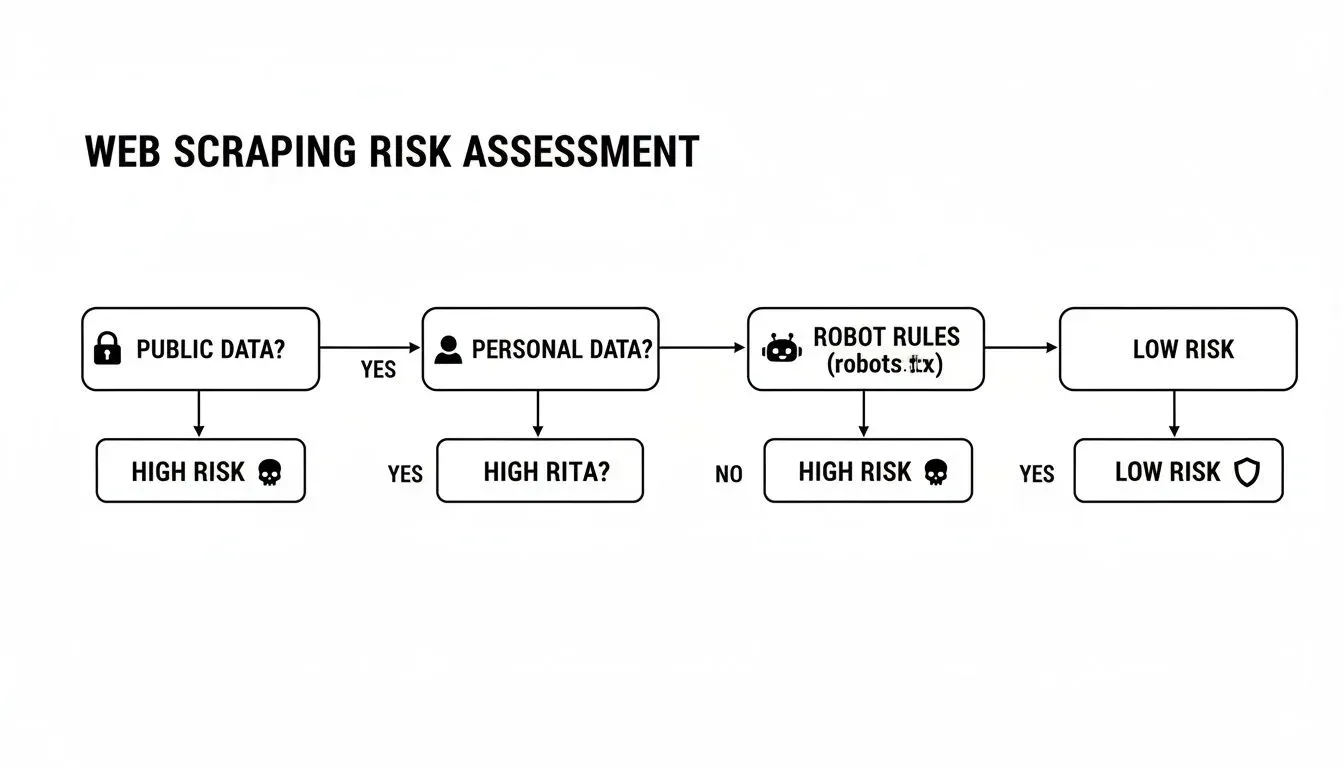
This isn’t legal advice — think of it as a pre-flight checklist that gut-checks your website scraping legal risk before a line of code gets written.
A responsible scraper acts more like a polite guest than a disruptive intruder. Respecting a site’s rules and technical limits minimizes conflict and keeps your access from being cut off.
Before kicking off any project, run through this checklist with your team. For rate-limiting patterns at scale, our guide to large-scale web scraping covers the best practices in depth.
The checklist assumes you have already decided how the data gets collected. If that decision is still open, Olostep’s API vs web scraping guide works the problem from the other end: it maps five access paths, from an official API through undocumented endpoints and managed scraping to your own browser fleet, and its legal section reaches the same place this one does, that public visibility is not the same as legal safety, citing the SerpApi case discussed above.
| Checklist Item | Assessment Question | Action/Mitigation |
|---|---|---|
| Authentication Gate | Does the data sit behind a login, paywall, or other access control? | If Yes, stop. This is a clear CFAA risk. |
| Personally Identifiable Information | Does the data include names, emails, phone numbers, or user photos? | If Yes, avoid scraping or consult a privacy expert. High GDPR/CCPA risk. |
| Copyrighted Content | Are you scraping creative works or factual data (prices, specs)? | Focus on facts. Republishing creative works is high copyright risk. |
| Terms of Service | Have you reviewed the ToS for explicit bans on scraping? | If Yes, weigh business need vs. breach-of-contract risk. |
robots.txt Directives | Does robots.txt Disallow the target URLs? | Honor all Disallow rules. Ignoring them signals bad faith. |
| Scraping Rate | What is the planned request rate? Is it aggressive? | Implement rate limits and randomized delays. |
| Data Usage | Internal analysis, republication, or commercial product? | Internal analysis is lowest risk; republication is highest. |
The real trouble in any scraping analysis comes from accessing private data or breaking clear technical rules — not from gathering public information.
None of this removes your obligation to make these calls yourself, and no vendor can make them for you. What a managed API changes is how much of the stack you have to defend: with cloro’s search and AI scraping API, the browser fleet, rendering, captcha handling, retries and parsing sit with us rather than in a script your team maintains, and the traffic only ever reaches the search and AI engines our endpoints support. Where that capacity is sourced is a question we answer in writing: we don’t recruit peers or run a residential network of our own, we ask the providers behind our IPs for certification and published sourcing documents rather than assurances, and we’ll send the full statement to your security or procurement review on request. The free tier is 500 credits a month if you want to run the checklist above against real output first.

About the author
Ricardo Batista
Founder, cloro
Ricardo is one of the founders and engineers behind its SERP and AI-search scraping infrastructure. Before cloro he scaled a financial comparison site to $7M ARR and ran the full-country operations of a unicorn to $65M ARR, then went back to building. He writes about search engine scraping, generative-engine optimization, and turning live search and AI-answer data into something teams can act on.
Frequently asked questions
Is web scraping legal in 2026?
Yes — scraping publicly accessible web data is legal in the US and EU when done properly. The Ninth Circuit's 2019 hiQ Labs v. LinkedIn ruling and the January 2024 Meta v. Bright Data summary judgment both established that scraping public data without bypassing technical access controls is not a CFAA violation. The legal lines run through four boundaries: (1) authentication (do not bypass logins), (2) personal data (GDPR and CCPA apply when you scrape PII), (3) copyright (extract facts, not creative expression), and (4) rate limiting (do not cause server harm). Stay within those and you are on solid legal ground.
Is scraping a competitor's prices illegal?
Generally, no. Scraping publicly available prices is a common, low-risk part of competitive intelligence. Prices are facts, not creative works protected by copyright. As long as prices are visible to any visitor without logging in and you are not hammering their servers, you are on solid ground. The risk creeps in if you have to click 'I Agree' on a Terms of Service that bans scraping before you can see the prices.
What did Meta v. Bright Data decide about web scraping?
On January 23, 2024, Judge Edward M. Chen of the Northern District of California granted Bright Data's motion for summary judgment in Meta v. Bright Data. The ruling held that Meta's Facebook and Instagram terms of service only prohibit logged-in scraping, not logged-off scraping of publicly accessible content. The court applied traditional contract interpretation to the phrase 'your use' and concluded that Bright Data did not 'use' Facebook when it engaged in public logged-off scraping. The ruling reinforced the hiQ v. LinkedIn precedent and Meta dropped the lawsuit in February 2024.
Does the EU AI Act affect web scraping in 2026?
Yes — starting in 2026, the EU AI Act requires every general-purpose AI model provider to publish a summary of training data sources, including the top 10% of domain names used (or top 5% or 1,000 domains for SMEs), respect copyright opt-outs under the EU Copyright Directive's text and data mining exception (Article 4), and describe how their web crawlers operated. The AI Act also explicitly bans untargeted scraping of facial images for facial recognition databases. Scraping for AI training is no longer a gray area in Europe.
Is GDPR compliance required when scraping personal data?
Yes — if you scrape data belonging to EU citizens, GDPR applies regardless of where your servers or company are located. The most common lawful basis for AI training data scraping is 'legitimate interest' under GDPR Article 6(1)(f), but data protection authorities have adopted increasingly restrictive positions. The Clearview AI case set the precedent: scraping public photos for facial recognition drew multimillion-euro fines from regulators across the EU and UK. Avoid scraping PII without explicit consent and a clear legal basis.
What if a website's robots.txt says 'Disallow'?
The robots.txt file is not a legally binding contract. Ignoring it will not result in CFAA hacking charges. However, ignoring it signals bad faith, looks bad if a dispute escalates, and is the fastest way to get your IP blocked. Respect robots.txt as a matter of professional conduct and good engineering hygiene. Cloudflare's 2024 announcement allowing one-click AI-bot blocking has made robots.txt enforcement increasingly common at the CDN layer.
Can I get sued for breaching terms of service?
Yes, you can be sued for breach of contract, but whether the website owner can win depends on how you agreed to the terms. Clickwrap agreements (where you checked a box or clicked 'I Agree' to terms) are strongly enforceable; courts have consistently upheld them. Browsewrap agreements (where the terms are just a link in the footer) are far weaker and rarely enforced unless the site can prove you had actual or constructive knowledge of them. Meta v. Bright Data clarified that even logged-in clickwrap terms do not bind users to logged-off scraping after account termination.
Is scraping AI-generated content like ChatGPT or AI Overviews legal?
Scraping AI-generated content sits in newer legal territory but follows the same principles. Publicly visible AI responses (rendered SERPs with AI Overviews, public ChatGPT shares) are generally treated like other public web data — accessing them does not violate the CFAA when no authentication is bypassed. Each platform's Terms of Service adds a contract layer, and OpenAI's terms specifically prohibit certain scraping behaviors. The conservative path: scrape your own observed sessions for monitoring (which OpenAI's terms allow), avoid commercial republishing of generated content, and use managed scraping services that operate within platform terms.
What are the terms-of-service risks of scraping AI chat interfaces?
The risk is contractual, not criminal. Anthropic's consumer terms prohibit automated access outside its API, OpenAI's policies restrict automated collection, and Google's terms bar abusing its services. The exposure concentrates on account-based scraping: registering, clicking agree, then automating is the pattern that loses breach-of-contract cases and triggers bans. Logged-out collection of publicly served answers is a materially different posture under the hiQ and Meta v. Bright Data line of cases, and enforcement there is technical (blocks, rate limits) rather than legal.
Is AI scraping illegal?
Not in itself. Copyright decides it. In Bartz v. Anthropic (2025), a US court treated training on copyrighted books as transformative fair use but held that copies taken from pirated libraries such as LibGen were a separate violation, which led to a $1.5 billion settlement covering roughly 500,000 authors. In the EU, the AI Act adds training-data disclosure and respect for text and data mining opt-outs.
Can web scraping be detected?
Yes. Sites combine CAPTCHAs, request-rate tracking, user-agent checks and JavaScript browser fingerprinting, and some link sessions across IPs and proxies. Detection usually ends in a block rather than a lawsuit, but working around a block after detection moves a project toward the technical-bypass line the CFAA cases draw.
Is it unethical to scrape websites?
Not when you collect public facts at a considerate pace. Scraping becomes unethical when it overloads a site, takes personal data people would object to, or republishes someone's original work for profit. Respect robots.txt, rate-limit your requests, and identify your bot.
Related reading
Best Web Scraping Tools 2026: 10 Tested Options
Compare the best web scraping tools for 2026: Scrapy, Playwright, Firecrawl, Crawl4AI, no-code tools, managed APIs, and AI scrapers for teams.
ChatGPT Grounding Study: 86% Commercial, 1% Informational
ChatGPT grounds almost every commercial prompt and almost no informational one. We re-ran our study without forcing web search, across 865 queries and 10 countries, and the split is 86.5% versus 0.9%.
Best ChatGPT Scraper 2026: 8 Tools Tested (Web UI)
We tested 8 ChatGPT scrapers against Cloudflare TLS fingerprinting, SSE streaming, and weekly-changing class names to find the best ChatGPT scraper for 2026.