
Query Fan Out: How AI Search Expands One Prompt Into Many

On this page
Query fan-out is how AI search turns one prompt into many hidden searches. A user asks one complex question; ChatGPT, Perplexity, or Google AI Mode breaks it into sub-queries, retrieves sources for each angle, then fuses the answer.
The name comes from Google. When it launched AI Mode, Google explained that the feature “uses a ‘query fan-out’ technique, issuing multiple related searches concurrently across subtopics and multiple data sources and then brings those results together”. ChatGPT and Perplexity do the same thing under different names — the query fan out pattern is now the default retrieval model across every major AI engine.
That breaks the old keyword model. You are not optimizing for one phrase anymore. You are optimizing for the cluster of implied questions behind the prompt.
This guide covers how query fan-out works, why it changes AI SEO, and how to structure content so you appear across the sub-queries that feed the final answer. Use it with AI search tracking to measure whether those optimizations show up.
What is query fanout?
Query fanout is when an AI agent breaks a multi-part user request into discrete sub-tasks, runs them in parallel, and synthesizes the results.
The old way (Google classic): User: “Compare Slack vs Teams for developers” Engine: Looks for pages containing “Slack vs Teams for developers”
The new way (AI search): User: “Compare Slack vs Teams for developers” AI Agent: I need to know:
- What are the developer-specific features of Slack? (Search A)
- What are the developer-specific features of Teams? (Search B)
- What is the API rate limit for Slack? (Search C)
- How does Teams integrate with GitHub? (Search D)
- What is the pricing difference? (Search E)
The AI runs all five searches at once. It reads five pages (potentially from five different sites), extracts the facts, and writes a single answer.
Why decomposition decides whether your page gets fetched
Splitting a prompt into pieces is not an implementation detail. It decides which of your pages the model even considers before it writes an answer, and the reasoning behind it draws on two established techniques.
This is Chain of Thought (CoT) reasoning applied to search. The foundational CoT research found that “generating a chain of thought — a series of intermediate reasoning steps — significantly improves the ability of large language models to perform complex reasoning”. Query fan out is that reasoning pointed at retrieval: the intermediate steps become the sub-queries. The other half — grounding the final answer in the fetched passages instead of the model’s memory — is retrieval-augmented generation, the approach a foundational 2020 paper introduced to build “models which combine pre-trained parametric and non-parametric memory for language generation”.
When models like OpenAI’s o1 or GPT-4o receive a prompt, they first run a planning phase to identify missing information. The harder the prompt, the more shards the query fan out produces before a single fact is fetched.
The fanout workflow:
- Ingest. Receive the user prompt.
- Decompose. Identify independent variables.
- Execute. Fire off parallel AI crawlers to fetch data.
- Read. Parse the content (where llms.txt helps).
- Synthesize. Stitch the facts into a coherent narrative.
The user gets a complete answer without clicking a link. The AI has done the tab-surfing for them.
The scale is larger than most people expect. Google describes AI Mode as “doing a dozen searches for you in the time it takes to do one”, and its Deep Search mode “uses the same query fan-out technique but taken to the next level,” able to “issue hundreds of searches, reason across disparate pieces of information, and create an expert-level fully-cited report”. A single research prompt can trigger dozens of parallel fetches — and every one of those fetches is a fresh chance for your page to be the source, or to be left out.
A worked example: one prompt, eight sub-queries
Abstract diagrams undersell how granular fan-out gets. Walk through a realistic prompt end to end.
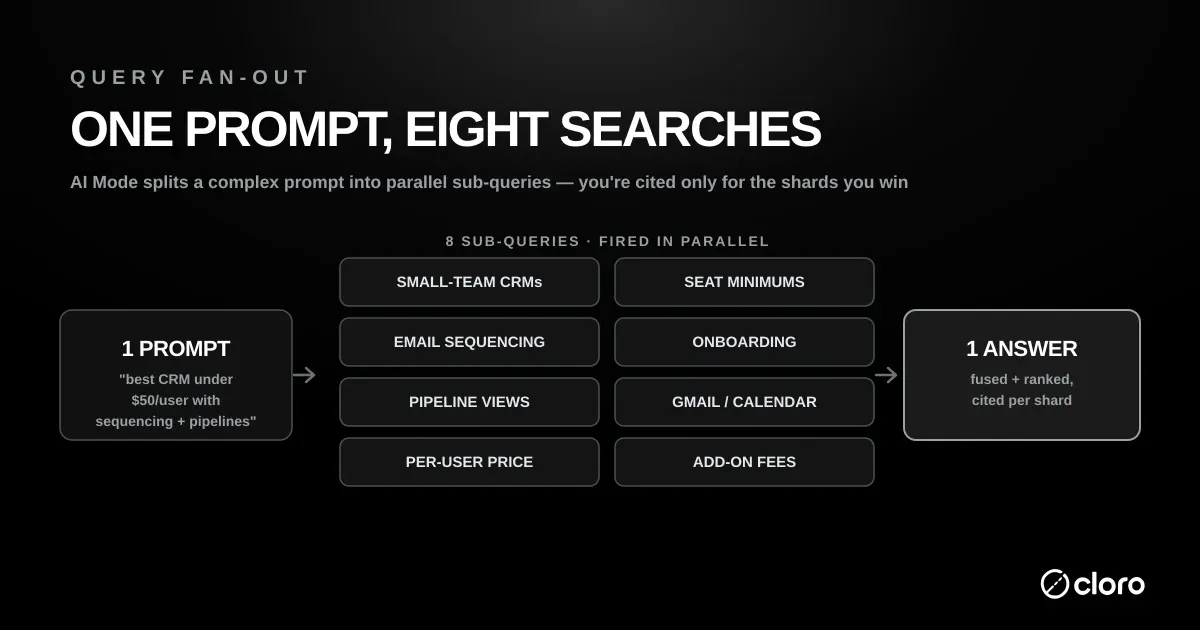
A founder types: “What’s the best CRM for a 5-person startup that needs email sequencing and HubSpot-style pipelines but costs under $50 per user?”
That is one query to the user. To the engine it is a research brief. The query fan-out step decomposes it into independent, answerable shards:
- Which CRMs are aimed at small teams (under 10 seats)? (Search A)
- Which of those include built-in email sequencing? (Search B)
- Which offer visual, HubSpot-style pipeline views? (Search C)
- What is the per-user price of each candidate? (Search D)
- Are there per-seat minimums or annual-only plans that break the $50 budget? (Search E)
- How do real users rate onboarding for a non-technical founder? (Search F)
- Which integrate with Gmail and Google Calendar? (Search G)
- Are there hidden add-on fees for sequencing or automation? (Search H)
Eight searches fire in parallel. No single page ranks for that whole sentence — but many pages answer one shard cleanly.
A pricing page answers D and E, a features comparison answers B, C, and G, a G2 or Reddit thread answers F, and a pricing FAQ answers H.
The engine reads all of them, extracts one fact from each, and writes a ranked recommendation. The reader never sees the eight searches — they see a confident paragraph with three or four citations under it. Your page is cited only for the shards it answers better than anyone else. Answer shard D with a clean, current pricing table and you are the pricing source, even if a competitor wins the features shard.
This is the mental shift the rest of the guide builds on: you are no longer competing for the prompt. You are competing, shard by shard, for the sub-queries the query fan out generates on the way to the answer.
Query fan out across Google, ChatGPT, and Perplexity
Fan-out leaves a measurable fingerprint, which is the source count on the finished answer. Across roughly 13,000 answers from six engines we counted it: Google AI Mode averages 17.7 sources per answer and ChatGPT 14.1, while Perplexity averages 1.3. An engine that lands 17 sources on one prompt has run and merged far more retrievals than one that lands one or two, so the depth spread is roughly a proxy for how aggressively each engine fans out.
For anyone optimizing against it, that means the number of chances to be included per prompt differs by an order of magnitude between engines, before anything about your page enters the picture.
Google coined the term, but query fan out is now the shared retrieval model behind every major AI engine. The names differ; the mechanic is identical. Each one decomposes the prompt, searches every shard in parallel, and fuses one answer. Optimizing for the query fan out therefore travels across engines — the same atomic, self-contained page wins shards in all of them.
Google AI Mode and Deep Search
Google is the most explicit about it. It says AI Mode “uses our query fan-out technique, breaking down your question into subtopics and issuing a multitude of queries simultaneously on your behalf”. Its Deep Search and Gemini Deep Research modes push the same query fan out further. Gemini “creates a multi-step research plan” and then “begins deeply analyzing relevant information from across the web on your behalf”, repeating the loop until it can write a cited report.
ChatGPT search
ChatGPT runs an unnamed version of the same query fan out. When a prompt needs fresh facts, it plans a set of searches, fetches the top results, and stitches the answer with inline citations. You never see the intermediate searches — only the fused paragraph and the handful of sources under it.
Perplexity
Perplexity was built around this pattern from day one. It rewrites a question into several focused searches, pulls sources for each, and answers with numbered citations. Its Pro tier widens the query fan out further: Perplexity’s own docs describe Pro Search’s “advanced multi-step tool usage”, which automatically fires web searches and page fetches before it answers. The lesson is the same on all three: you win the answer by owning the sub-queries, not the headline phrase.
Why this breaks traditional SEO
For 20 years, SEOs were taught to write “The Ultimate Guide” and stuff every sub-topic into one 5,000-word URL to maximize topical authority.
Query fanout penalizes that format. Ultimate guides tend to be:
- Hard to parse (too much fluff).
- Broad but shallow.
- Slow to load.
AI agents prefer atomic content: pages that answer one specific thing in depth.
If the AI wants “Slack API rate limits,” it picks a developer docs page that answers exactly that over a “Top 10 Chat Tools” post that mentions it in passing.
Does query fan out replace keyword research?
No — it reframes it. Keyword research still matters, but the unit of research changes. Instead of chasing one head term and its volume, you map the cluster of sub-queries the query fan out is likely to generate for that term. The head keyword tells you the topic; the shards tell you what to actually write.
Volume data cannot size those shards for you. Ahrefs’ analysis reports that over 95% of fan-out queries receive no recurring searches, and cites Seer Interactive and Nectiv research that found an average of 9 to 11 fan-out queries per prompt: 59% of prompts triggered 5 to 11 searches, 24% triggered 12 to 19, and the highest reached 28. So map the recurring patterns across many answers rather than chasing any single sub-query string.
A practical way to find those shards: take your target prompt and ask the engines to expand it, then read which sub-questions surface in the “People also ask” boxes, the AI Mode follow-ups, and the citations under a Perplexity answer. Those are the queries the fan out is already firing. Each one is a page or an H2 you can own. Treat the head term as the folder and the sub-queries as the files.
This is why a “query fan out generator” is really just structured sub-query mapping. There is no magic tool that reveals the exact hidden searches (the engines don’t publish them), but you can approximate the set by decomposing the prompt the way the model would, then checking your coverage shard by shard. cloro automates that approximation by simulating the prompt and surfacing which sub-queries fire, so you can find your coverage gaps before you publish instead of guessing from rankings alone.
Optimizing for atomic intent
To win in a query fanout world, shift your content strategy from keywords to facts.
1. Fragment your content
Instead of one giant page, build a hub-and-spoke model where specific questions get specific pages.
- Bad: One page on “All about our Pricing.”
- Good: Separate URLs (or clearly defined H2 sections) for “Enterprise Pricing,” “Startup Discounts,” and “Non-Profit Tiers.”
2. Be the fact supplier
AI engines trust data. Run a survey or publish a benchmark report and you become the primary source for that data point. When the AI fans out to find “average churn rate in SaaS,” it cites your report.
3. Structured data matters
Use Schema.org markup to label your atomic facts: wrap a pricing table in Product schema and a Q&A in FAQPage schema. This helps the bot extract the specific shard of information it needs during fanout.
The “Frankenstein” answer
The final answer the user sees is stitched together from different body parts.
- The introduction might come from Wikipedia.
- The pricing comparison might come from your pricing page.
- The pros and cons might come from a Reddit thread (or a competitor’s comparison page).
Your goal is to own as many of those body parts as possible.
You want to be the source for the pricing and the features and the security compliance. That requires a holistic GEO strategy.
How to optimize for query fan-out
The tactics above (fragment your content, be the fact supplier, add schema) are the foundation. Here is the concrete checklist for turning a page into a shard-winner — grounded in how the query fan out actually reads and ranks pages.
Map the implied question cluster first
Before writing, list every sub-query a prompt could decompose into, not just the head term. If your topic is “project management software,” the fan-out will ask about pricing, integrations, free tiers, team size limits, mobile apps, and security. Each of those is a shard you can own. Cover the cluster and you appear across more of the parallel searches feeding a single answer.
Lead with the answer, then support it
AI engines extract the sentence that answers the sub-query, so put it first. Open each section with a direct, self-contained claim (“cloro’s Starter plan is $29/month for 3 seats”), then add the caveats. A buried answer inside a 200-word paragraph is harder to lift than a leading one.
Make every key fact self-contained
A shard is extracted out of context, so it has to stand alone. Write “the Slack API allows 100 requests per minute on the free tier” rather than “it allows 100 per minute” — the pronoun breaks when the sentence is pulled into a fused answer. Self-contained sentences are what get quoted verbatim.
Use tables and lists for comparable facts
Prices, limits, tiers, and feature matrices are exactly the shards fan-out fires searches for. A clean comparison table is trivially parseable; the same data in prose is not. This is also where Product and Offer schema pays off — it labels the fact so the engine can grab it during retrieval.
Stay technically eligible
Fan-out can only fetch pages Google can already serve. Google’s own guidance is blunt: there are “no additional requirements to appear in AI Overviews or AI Mode” beyond a page being “indexed and eligible to be shown in Google Search with a snippet.” No JavaScript-only content, no blocked crawlers, fast responses — the same hygiene that wins classic snippets keeps you in the fan-out pool.
Interlink your shards
When one page answers a shard well, link it from the related shards (pricing → features → security). A tight hub-and-spoke cluster helps the engine discover every page you own for a topic, so you can win multiple shards of the same answer instead of one.
Common query fan-out mistakes
Most pages that lose the fan-out lose it for predictable reasons. Watch for these.
Answering the head term but not the cluster. A page titled “Best CRM software” that never states prices, seat limits, or integration details answers the prompt but none of the shards the query fan out actually searches for. Broad coverage without specific facts is invisible to the retrieval step.
Hiding the fact you own. If your uptime number, your price, or your rate limit lives inside a paragraph of marketing copy, the engine has to work to extract it — and often picks a competitor who stated it plainly. The fact you want cited should be a short, standalone sentence.
Blocking the crawlers. A page that answers a shard perfectly but returns JavaScript-only content, or blocks AI user agents in robots.txt, never enters the pool. Fan-out can only fuse what it can fetch. Check your AI crawlers access before anything else.
Optimizing one page for every shard. The instinct is to cram pricing, features, security, and support into a single “ultimate” URL. Query fan-out rewards depth per shard over breadth per page. Splitting into focused pages that interlink beats one sprawling document.
Treating fan-out like classic SEO reporting. Ranking position for the head keyword tells you almost nothing about whether you won the sub-queries. You can hold position one and still be absent from every fused answer because a deeper page answered the shard. Measure citations and fact retrieval, not just rank.
Avoid these and you are already ahead of most competitors, who are still writing for the prompt instead of the query fan out behind it.
How do I capture the search fan-out queries ChatGPT runs behind an answer?
Call cloro’s ChatGPT endpoint with include.searchQueries: true and read result.searchQueries: the literal web-search queries ChatGPT issued while building the answer. The engines do not show these queries in the UI, but ChatGPT’s response stream carries them, and the endpoint parses them out per request.
The working call:
import requests

response = requests.post(
    "https://api.cloro.dev/v1/monitor/chatgpt",
    headers={"Authorization": f"Bearer {API_KEY}"},
    json={
        "prompt": "best CRM for a 5-person startup under $50 per user",
        "country": "US",
        "include": {"searchQueries": True}
    }
)

result = response.json()["result"]
print(result["searchQueries"])
# ["crm small teams under 10 seats", "crm built-in email sequencing", ...]
Five things to know before you build on the field, all from the endpoint documentation:
- It costs 2 extra credits. The flag adds 2 credits to the 5-credit base for a ChatGPT web-search request.
- It is model-dependent. ChatGPT currently emits explicit fan-outs on
gpt-5-3andgpt-5-3-mini; newer models may not, and ChatGPT selects the model per request, so no parameter guarantees the field is populated. - Some responses legitimately carry none. OpenAI serves a share of logged-out traffic in a mobile-web format with no stream metadata, and on those responses
searchQueriescomes back empty. Read fan-out behavior as a rate over many answers, never from one response. - Maps queries arrive separately. The same flag also returns
result.mapSearchQueries, the queries ChatGPT fires at its maps tool. Keep them apart from the web-search fan-out when you analyze coverage. - Non-English prompts fan out partly in English. Roughly a 50/50 English-to-local split has been observed, so group captured queries by language before comparing markets.
Coverage differs by engine: Perplexity and Copilot return their issued queries in the base response at no extra cost, while Gemini, AI Overview and AI Mode expose no fan-out data at all, because Google does not include it in the HTML served to anonymous users. The per-engine support table is in the providers guide.
Captured at volume, this field is the ground truth the mapping exercise earlier in this guide approximates: instead of guessing how a prompt decomposes, you read the actual sub-queries per answer, aggregate the recurring ones, and assign each to a page that should own it.
How do I capture ChatGPT web-search results and their citations?
The same endpoint returns them without extra flags. One request gives you the full retrieval chain: what ChatGPT searched, what it fetched, and what it actually cited in the prose.
- Send the prompt to
POST /v1/monitor/chatgptas in the snippet above; web search is forced by default (senddisableWebSearch: trueto let ChatGPT decide, at the cost of fewer fan-out queries). - Read
result.sourcesfor the pages ChatGPT retrieved and referenced, with publication dates and footnote indicators per entry. - Read
result.citationPillsfor the inline citation chips exactly as they appeared in the answer body. - Join the three fields per answer.
searchQueriestells you what it searched,sourceswhat it fetched,citationPillswhat it quoted; the joins are where the diagnosis lives.
That chain is what shard-level measurement needs. A page can be fetched for a sub-query and still not be cited; the difference between those two states tells you whether your problem is discovery (never in sources) or extraction (in sources, never in the citations). The two failure modes take opposite fixes, and answer-level data is the only way to tell them apart.
Tracking your fanout performance
This is the tricky part. In Google Search Console you’ll see impressions for queries you never targeted, or a drop in clicks despite high visibility (the AI took the fact and ran).
How to measure success:
- Citation density. Check how often your brand is cited as a source in complex answers.
- Fact retrieval. Monitor whether the specific data points you publish (“our uptime is 99.99%”) show up in AI answers.
You can’t manually test every variation of a complex query. cloro simulates multi-step prompts to see how engines like ChatGPT and Perplexity decompose them, acting as a ChatGPT visibility tracker.
cloro shows you:
- Which sub-queries are being generated.
- Which of your pages are being fetched for those sub-queries.
- Whether the final synthesized answer is accurate.
That turns fan-out from a blind spot in Search Console into something you can actually watch happen.
The future of search isn’t about ranking for the question. It’s about ranking for the answer to a sub-question you didn’t know the AI was asking.

About the author
Ricardo Batista
Founder, cloro
Ricardo is one of the founders and engineers behind its SERP and AI-search scraping infrastructure. Before cloro he scaled a financial comparison site to $7M ARR and ran the full-country operations of a unicorn to $65M ARR, then went back to building. He writes about search engine scraping, generative-engine optimization, and turning live search and AI-answer data into something teams can act on.
Frequently asked questions
What is query fanout?
Query fanout is when an AI model breaks a complex user prompt into multiple sub-queries to gather information from different sources.
How does fanout affect SEO?
It means you can rank for sub-topics even if you don't rank for the main broad keyword, provided your content answers specific questions authoritatively.
Can I track fanout queries?
Yes, advanced visibility trackers like cloro can simulate prompts and show you which sub-queries the AI generates and searches for.
What is a 'Frankenstein' answer?
It refers to an AI-generated response that synthesizes information from multiple disparate sources, stitching together different 'body parts' of information into one cohesive answer.
How do I optimize for atomic content?
Instead of one giant article, create specific, in-depth pages or clearly defined sections that answer single, precise questions. This makes it easier for AI to extract exact facts.
Which AI engines use query fan-out?
Google coined the term for AI Mode, but the pattern is universal: ChatGPT, Perplexity, and Google AI Mode all decompose a complex prompt into sub-queries, retrieve sources in parallel, and fuse a single answer. Google's Deep Search extends the same technique to hundreds of searches per prompt.
Is there a query fan out generator or tool?
No engine publishes the exact hidden sub-queries, so a true 'query fan out generator' does not exist. What works is approximating the set: decompose your target prompt the way a model would, then check your content coverage shard by shard. Tools like cloro simulate the prompt and surface which sub-queries fire and which of your pages get fetched.
How many sub-queries does one prompt trigger?
It depends on the complexity of the prompt. A simple lookup may fan out to two or three searches; a multi-constraint research question can trigger a dozen or more. Google describes AI Mode as doing roughly a dozen searches in the time a classic search does one. Seer Interactive and Nectiv research, cited by Ahrefs, found an average of 9 to 11 fan-out queries per prompt, with 24% of prompts triggering 12 to 19 and a maximum of 28.
How do I capture ChatGPT's fan-out queries through an API?
Call cloro's ChatGPT endpoint with include.searchQueries set to true and read result.searchQueries: the literal web-search queries ChatGPT ran behind the answer. The flag adds 2 credits to the 5-credit base cost. Perplexity and Copilot return their queries in the base response; Gemini, AI Overview and AI Mode expose none.
Why are fan-out queries missing from some ChatGPT responses?
Two documented reasons. ChatGPT picks the serving model per request, and only some models emit explicit fan-out queries. And OpenAI serves a share of logged-out traffic in a mobile-web format that carries no stream metadata, so searchQueries comes back empty on those responses. Treat the field as possibly empty and read rates over many answers.
Related reading

ChatGPT Grounding Study: 86% Commercial, 1% Informational
ChatGPT grounds almost every commercial prompt and almost no informational one. We re-ran our study without forcing web search, across 865 queries and 10 countries, and the split is 86.5% versus 0.9%.
ChatGPT Visibility Tracker: Track Your Brand Mentions
Learn how a ChatGPT visibility tracker works, run a free manual baseline, and compare the best tools to monitor your brand mentions in AI search.

Best ChatGPT Scraper 2026: 8 Tools Tested (Web UI)
We tested 8 ChatGPT scrapers against Cloudflare TLS fingerprinting, SSE streaming, and weekly-changing class names to find the best ChatGPT scraper for 2026.